
The TPB and Registered Tax Practitioners — study companion
Part 1.2 of Australia Taxation. Preview the study companion or download the printable PDF.


Read the handout text
Accounting Ahead | Original study resource | accountingahead.com.au
The TPB and registered tax practitioners
MODULE 1 | 1.2 | STUDENT COMPANION
Under self-assessment most taxpayers rely on a paid adviser whose work they can't judge for themselves.
The Tax Agent Services Act 2009 (TASA) therefore requires anyone who charges a fee or takes any
other reward for a tax agent service to be registered. The Tax Practitioners Board (TPB) registers and
regulates tax agents and BAS agents; providers of tax (financial) advice services have registered with
ASIC since 1 January 2022. Unregistered practice is a matter for the Federal Court.
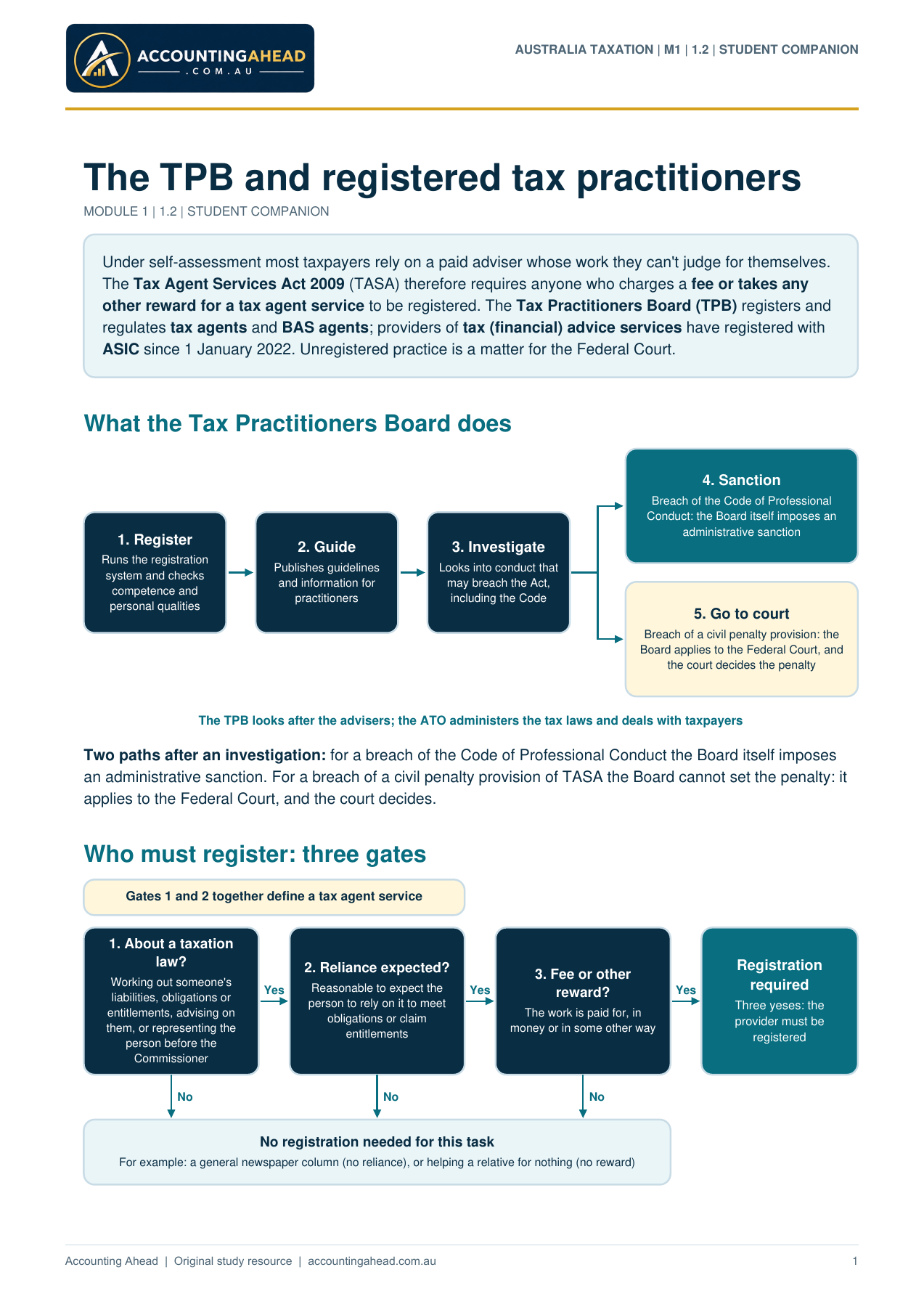
What the Tax Practitioners Board does
1. Register
Runs the registration
system and checks
competence and
personal qualities
2. Guide
Publishes guidelines
and information for
practitioners
3. Investigate
Looks into conduct that
may breach the Act,
including the Code
4. Sanction
Breach of the Code of Professional
Conduct: the Board itself imposes an
administrative sanction
5. Go to court
Breach of a civil penalty provision: the
Board applies to the Federal Court, and
the court decides the penalty
The TPB looks after the advisers; the ATO administers the tax laws and deals with taxpayers
Two paths after an investigation: for a breach of the Code of Professional Conduct the Board itself imposes
an administrative sanction. For a breach of a civil penalty provision of TASA the Board cannot set the penalty: it
applies to the Federal Court, and the court decides.
Who must register: three gates
Gates 1 and 2 together define a tax agent service
1. About a taxation
law?
Working out someone's
liabilities, obligations or
entitlements, advising on
them, or representing the
person before the
Commissioner
Yes
No
2. Reliance expected?
Reasonable to expect the
person to rely on it to meet
obligations or claim
entitlements
Yes
No
3. Fee or other
reward?
The work is paid for, in
money or in some other way
Yes
No
Registration
required
Three yeses: the
provider must be
registered
No registration needed for this task
For example: a general newspaper column (no reliance), or helping a relative for nothing (no reward)
AUSTRALIA TAXATION | M1 | 1.2 | STUDENT COMPANION
1
Accounting Ahead | Original study resource | accountingahead.com.au
The rule: an individual, partnership or company that charges a fee, or takes any other reward, for a tax agent
service must be registered. Preparing a return, drafting an objection or advising on one client's own facts passes
gates 1 and 2. A general article about how a tax rule works does not (no one can reasonably rely on it), and nor
does keying in figures or reconciling a bank account (no tax law is applied).
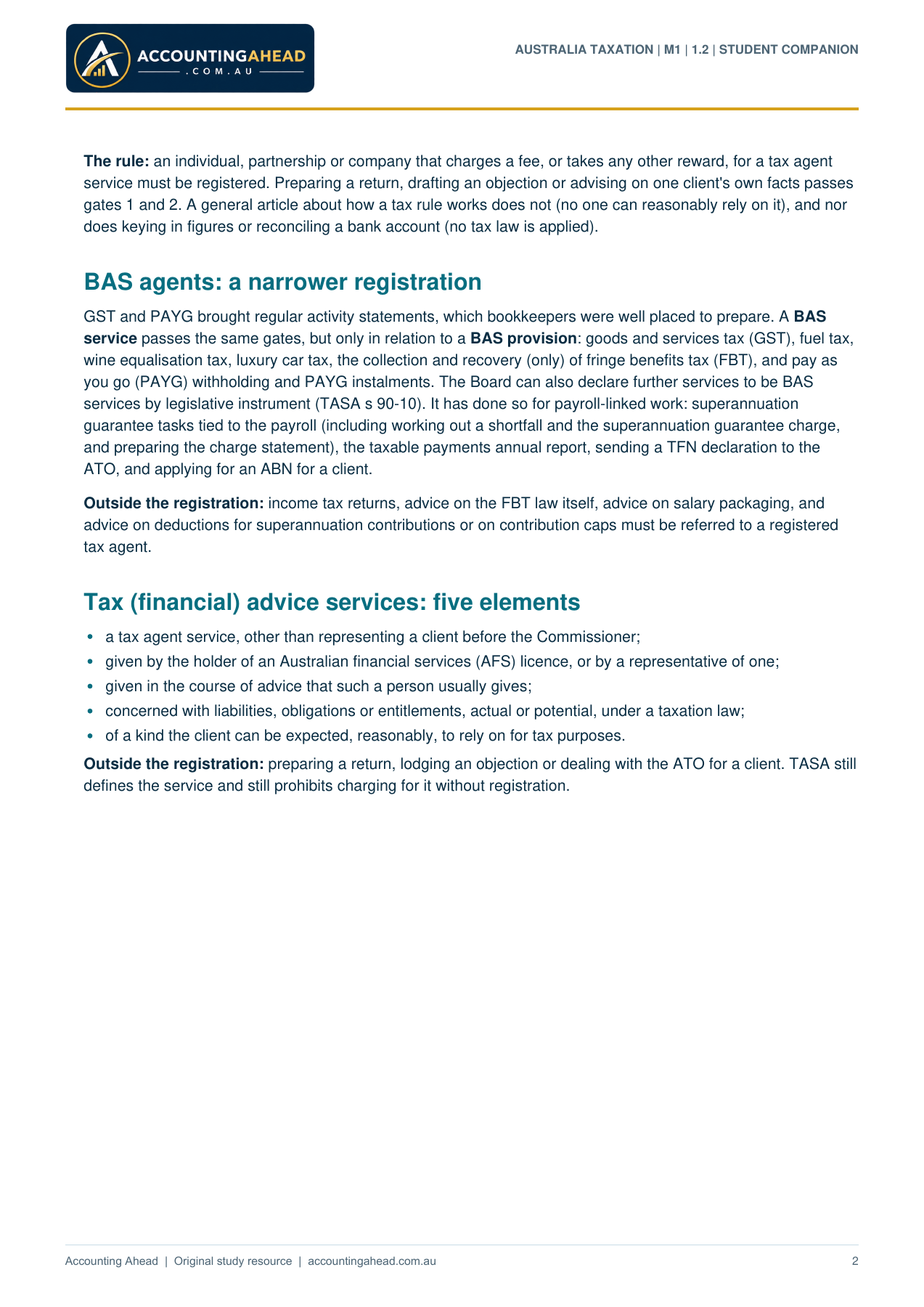
BAS agents: a narrower registration
GST and PAYG brought regular activity statements, which bookkeepers were well placed to prepare. A BAS
service passes the same gates, but only in relation to a BAS provision: goods and services tax (GST), fuel tax,
wine equalisation tax, luxury car tax, the collection and recovery (only) of fringe benefits tax (FBT), and pay as
you go (PAYG) withholding and PAYG instalments. The Board can also declare further services to be BAS
services by legislative instrument (TASA s 90-10). It has done so for payroll-linked work: superannuation
guarantee tasks tied to the payroll (including working out a shortfall and the superannuation guarantee charge,
and preparing the charge statement), the taxable payments annual report, sending a TFN declaration to the
ATO, and applying for an ABN for a client.
Outside the registration: income tax returns, advice on the FBT law itself, advice on salary packaging, and
advice on deductions for superannuation contributions or on contribution caps must be referred to a registered
tax agent.
Tax (financial) advice services: five elements
a tax agent service, other than representing a client before the Commissioner;
given by the holder of an Australian financial services (AFS) licence, or by a representative of one;
given in the course of advice that such a person usually gives;
concerned with liabilities, obligations or entitlements, actual or potential, under a taxation law;
of a kind the client can be expected, reasonably, to rely on for tax purposes.
Outside the registration: preparing a return, lodging an objection or dealing with the ATO for a client. TASA still
defines the service and still prohibits charging for it without registration.
AUSTRALIA TAXATION | M1 | 1.2 | STUDENT COMPANION
2
Accounting Ahead | Original study resource | accountingahead.com.au
The three practitioners side by side
Once registered, all three must also complete continuing professional education.
Tax agent BAS agent Provider of tax
(financial) advice
Registered by TPB TPB ASIC (since 1 January
2022)
May provide Any tax agent service BAS services only Tax advice as part of
financial advice
To get in Primary qualification in an approved field,
or voting member of a tax agent
association the Board recognises
(extensive experience can sometimes
stand in); Board-approved courses as
required (not needed where entry is by
voting membership); relevant work
experience, the amount depending on the
qualification
Primary qualification in
bookkeeping or
accounting;
Board-approved GST and
BAS course; relevant work
experience (fewer hours
for a voting member of an
association the Board
recognises)
Hold an AFS licence or
represent a licensee;
qualify as a qualified
tax relevant provider
(QTRP) through set
education and training
Working without registration
The provider breaches a civil penalty provision of TASA. The Board can investigate and apply to the Federal
Court, which can order a financial penalty and grant an injunction to stop the conduct. There is no registration
for the Board to suspend or terminate, so this is the court path.
The client misses out on protection. Under the Taxation Administration Act 1953 a taxpayer who uses a
registered agent (tax or BAS) may be sheltered from some ATO administrative penalties (the safe harbour).
An unregistered preparer's client has no such shelter.
AUSTRALIA TAXATION | M1 | 1.2 | STUDENT COMPANION
3
Accounting Ahead | Original study resource | accountingahead.com.au
Practice questions
MODULE 1 | 1.2 | TRY THESE BEFORE THE WORKED ANSWERS
Question 1 - Sort the tasks
Decide whether each task is a tax agent service only, a BAS service as well, or neither.
Task (each is done for a fee) Tax agent service only, BAS service as well, or
neither?
(a) Preparing and lodging a company's income tax return
(b) Completing a cafe's quarterly activity statement
(c) Reconciling a client's bank account to the ledger each
month
(d) Advising an employer how much to withhold from a casual
worker's pay
(e) Writing a blog post that explains, in general terms, how
GST registration works
(f) Drafting an objection against an income tax assessment
(g) Advising a new business whether it must register for GST
(h) Advising a business owner whether salary packaging a car
would reduce her tax
AUSTRALIA TAXATION | M1 | 1.2 | STUDENT COMPANION
4
Accounting Ahead | Original study resource | accountingahead.com.au
Question 2 - One job too many
For each person, say what they may do and what must be referred on, and to whom.
(a) Imran Qadri, a registered BAS agent, prepares a florist's monthly activity statements and registers the
business for PAYG withholding. The owner now asks him to work out the deductions she can claim in her own
income tax return.
(b) Oksana Petrenko, a financial planner registered with ASIC as a qualified tax relevant provider, explains the
tax effect of a client's extra superannuation contributions as part of a financial plan. The client now asks her to
lodge his overdue tax return and to ring the ATO about a payment arrangement.
(c) Gareth Kellaway, an unregistered bookkeeper, enters a builder's invoices and reconciles the bank account.
The builder now offers him an extra fee to work out the figures for the activity statement.
Question 3 - Unregistered and paid
A person with no registration prepares income tax returns for neighbours at a set fee per return. Explain the
consequences (a) for that person and (b) for the neighbours who use the service.
AUSTRALIA TAXATION | M1 | 1.2 | STUDENT COMPANION
5
Accounting Ahead | Original study resource | accountingahead.com.au
Worked answers
MODULE 1 | 1.2 | WORKED ANSWERS - ATTEMPT THE QUESTIONS FIRST
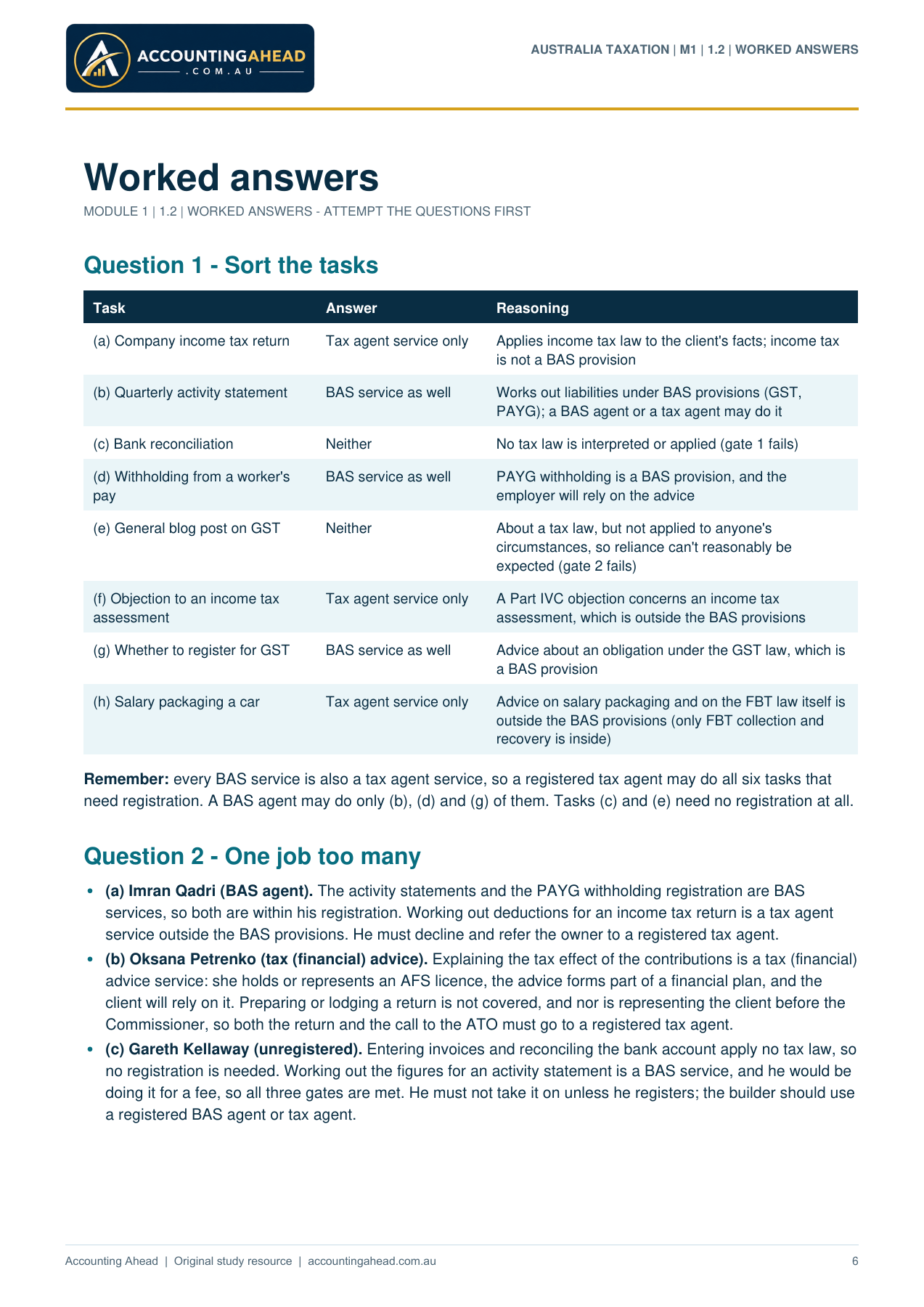
Question 1 - Sort the tasks
Task Answer Reasoning
(a) Company income tax return Tax agent service only Applies income tax law to the client's facts; income tax
is not a BAS provision
(b) Quarterly activity statement BAS service as well Works out liabilities under BAS provisions (GST,
PAYG); a BAS agent or a tax agent may do it
(c) Bank reconciliation Neither No tax law is interpreted or applied (gate 1 fails)
(d) Withholding from a worker's
pay
BAS service as well PAYG withholding is a BAS provision, and the
employer will rely on the advice
(e) General blog post on GST Neither About a tax law, but not applied to anyone's
circumstances, so reliance can't reasonably be
expected (gate 2 fails)
(f) Objection to an income tax
assessment
Tax agent service only A Part IVC objection concerns an income tax
assessment, which is outside the BAS provisions
(g) Whether to register for GST BAS service as well Advice about an obligation under the GST law, which is
a BAS provision
(h) Salary packaging a car Tax agent service only Advice on salary packaging and on the FBT law itself is
outside the BAS provisions (only FBT collection and
recovery is inside)
Remember: every BAS service is also a tax agent service, so a registered tax agent may do all six tasks that
need registration. A BAS agent may do only (b), (d) and (g) of them. Tasks (c) and (e) need no registration at all.
Question 2 - One job too many
(a) Imran Qadri (BAS agent). The activity statements and the PAYG withholding registration are BAS
services, so both are within his registration. Working out deductions for an income tax return is a tax agent
service outside the BAS provisions. He must decline and refer the owner to a registered tax agent.
(b) Oksana Petrenko (tax (financial) advice). Explaining the tax effect of the contributions is a tax (financial)
advice service: she holds or represents an AFS licence, the advice forms part of a financial plan, and the
client will rely on it. Preparing or lodging a return is not covered, and nor is representing the client before the
Commissioner, so both the return and the call to the ATO must go to a registered tax agent.
(c) Gareth Kellaway (unregistered). Entering invoices and reconciling the bank account apply no tax law, so
no registration is needed. Working out the figures for an activity statement is a BAS service, and he would be
doing it for a fee, so all three gates are met. He must not take it on unless he registers; the builder should use
a registered BAS agent or tax agent.
AUSTRALIA TAXATION | M1 | 1.2 | WORKED ANSWERS
6
Accounting Ahead | Original study resource | accountingahead.com.au
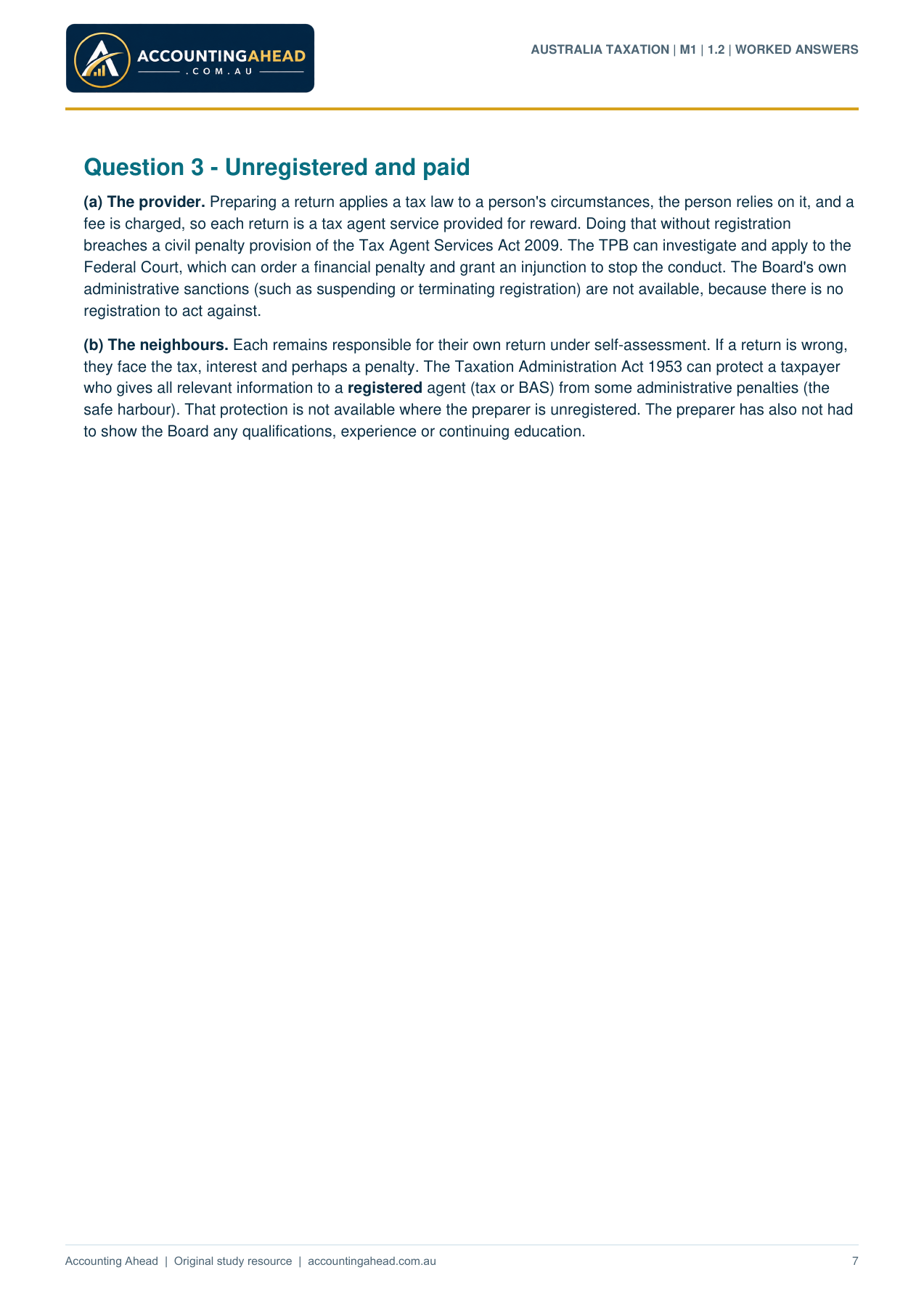
Question 3 - Unregistered and paid
(a) The provider. Preparing a return applies a tax law to a person's circumstances, the person relies on it, and a
fee is charged, so each return is a tax agent service provided for reward. Doing that without registration
breaches a civil penalty provision of the Tax Agent Services Act 2009. The TPB can investigate and apply to the
Federal Court, which can order a financial penalty and grant an injunction to stop the conduct. The Board's own
administrative sanctions (such as suspending or terminating registration) are not available, because there is no
registration to act against.
(b) The neighbours. Each remains responsible for their own return under self-assessment. If a return is wrong,
they face the tax, interest and perhaps a penalty. The Taxation Administration Act 1953 can protect a taxpayer
who gives all relevant information to a registered agent (tax or BAS) from some administrative penalties (the
safe harbour). That protection is not available where the preparer is unregistered. The preparer has also not had
to show the Board any qualifications, experience or continuing education.
AUSTRALIA TAXATION | M1 | 1.2 | WORKED ANSWERS
7