
Ethics in Tax Practice — study companion
Part 1.3 of Australia Taxation. Preview the study companion or download the printable PDF.




Read the handout text
Accounting Ahead | Original study resource | accountingahead.com.au
Ethics in tax practice
MODULE 1 | 1.3 | STUDENT COMPANION
Professional ethics are your profession's values and rules; where a professional duty conflicts with the
law, the law prevails. The APESB's Code (APES 110) puts the public interest first and rests on five
fundamental principles, which five kinds of threat can undermine. APES 220 applies the Code to tax
work. The conceptual framework and an eight-step routine turn principles into decisions.
Where a tax adviser's ethics come from
Morals and professional ethics. Personal morals grow out of your own beliefs; professional ethics are the
values and rules of your professional body. They can differ: you may disapprove of a client's lawful business
and still owe that client careful, honest work.
If they collide, you can protest or resign, at a professional cost, although the law gives some protection to an
ethical protest. Where a professional duty conflicts with the law, the law overrides it.
The APESB (Accounting Professional and Ethical Standards Board) was established in 2006 by CPA
Australia, CA ANZ and the IPA. Its standards bind every member of those three bodies.
APES 110 is the Code of Ethics for Professional Accountants (including Independence Standards), based on
the international code of the IESBA. APES 220 Taxation Services (revised July 2019) applies it to tax work
and is mandatory for members who provide taxation services. The TPB's own code sets out very similar
principles (lesson 1.4).
Principles, not a rulebook, but with teeth: on a complaint, a failure to follow the fundamental principles
counts in deciding whether there is a case of professional misconduct to answer.
The Code's building blocks
Act in the public interest
The overarching responsibility of every professional accountant
Five fundamental principles Upholding them serves the public interest
Integrity
Straightforward and
honest
Objectivity
No bias, conflicts of
interest or undue
influence, including
undue reliance on people
or technology
Professional
competence and due
care
Knowledge and skill kept
at the level the work
demands; diligent work
Confidentiality
Respect the information
gained through your work
Professional
behaviour
Comply with laws and
regulations; avoid
conduct that discredits
the profession
Five kinds of threat Each can put the principles at risk
Self-interest
A financial or other
interest could sway your
judgement
Self-review
You evaluate your own
earlier work
Advocacy
You push a client's
position until your
objectivity goes
Familiarity
A long or close
relationship makes you
too accepting
Intimidation
Pressure, real or
perceived
The threats in a tax practice (APES 110, para 120.6 A3). Self-interest: one client pays a third of the practice's
fees. Self-review: checking a restructure you designed yourself. Advocacy: overstating a client's case in a
AUSTRALIA TAXATION | M1 | 1.3 | STUDENT COMPANION
1
Accounting Ahead | Original study resource | accountingahead.com.au
dispute with the ATO. Familiarity: no longer asking a friend of twenty years for receipts. Intimidation: "Sign it, or
I'll find an accountant who will."
What APES 220 adds for tax work
Scope: fundamental responsibilities; preparing and lodging returns; tax schemes and arrangements;
estimates; false or misleading information; engagement matters; client monies; fees; documentation.
Balance: safeguard the interests of the client (or employer) at all times, but only within the Code and the law,
tax law included. Returns are prepared and lodged from the client's information and instructions, and in line
with the tax law (para 4.1).
False or misleading information (paras 7.1 to 7.3): if you form the view that a tax service rests on
information that is false or misleading, or omits something material, discuss it with the client and explain the
consequences of doing nothing. If the client will not correct it, you must not provide that service.
NOCLAR (non-compliance with laws and regulations, such as tax evasion; part of APES 110 since 2017, in
effect in Australia from 1 January 2018). The reporting conditions: the non-compliance has a direct and
material effect on the financial statements of the client or employer or, where it cannot be measured in
money, is fundamental to the business and its operations; and there is credible evidence of serious negative
consequences for employees, creditors, investors or the public. When they are met and disclosure is in the
public interest, the accountant has a responsibility to consider disclosing the matter to a public authority.
The conceptual framework in action
1. Identify
Do any facts or circumstances
threaten a fundamental
principle?
2. Evaluate
Is the threat at an acceptable level?
Ask what a reasonable and informed
third party is likely to conclude
3. Address
Remove the circumstances that create the
threat, or apply safeguards, to bring it down to
an acceptable level
Yes No
Carry on with the work
and stay alert, because new facts can create new threats
Decline or end the
work
No Yes Now acceptable Not possible
The imagined case: Ingrid Farrant, Hamish Dunleavy and the missing income
Identify
Intimidation (his ultimatum),
self-interest (the fees) and
familiarity (twelve friendly years)
Evaluate
Not acceptable: lodging a return she
knows to be false fails the third-party test
Address
Explain the consequences and ask Hamish to
include the income. If the threat can't be brought
down, decline or end the work
Acceptable level is judged from outside: is a reasonable and informed third party, weighing what you knew or
ought to have known, likely to conclude that you were complying with the principles? To address a threat (para
R120.10), remove its cause or apply safeguards; if neither is enough, decline or end the work.
AUSTRALIA TAXATION | M1 | 1.3 | STUDENT COMPANION
2
Accounting Ahead | Original study resource | accountingahead.com.au
Where conflicts come from
Four sets of values can pull against each other: societal (the law and the community's attitudes), personal,
corporate (your organisation's own codes) and professional (your professional body's standards).
A conflict of interest is a threat to objectivity: you act for two parties whose interests clash, or your own
interests clash with a client's. It is not wrong in itself; it becomes a problem when you know of it, don't declare it,
and carry on. Take reasonable steps to identify conflicts, and stay alert as interests and relationships change.
Common roots in tax work: a request to act against the tax law or your standards; loyalty to colleagues; work
beyond your expertise or experience; personal relationships with clients or staff; gifts and hospitality.
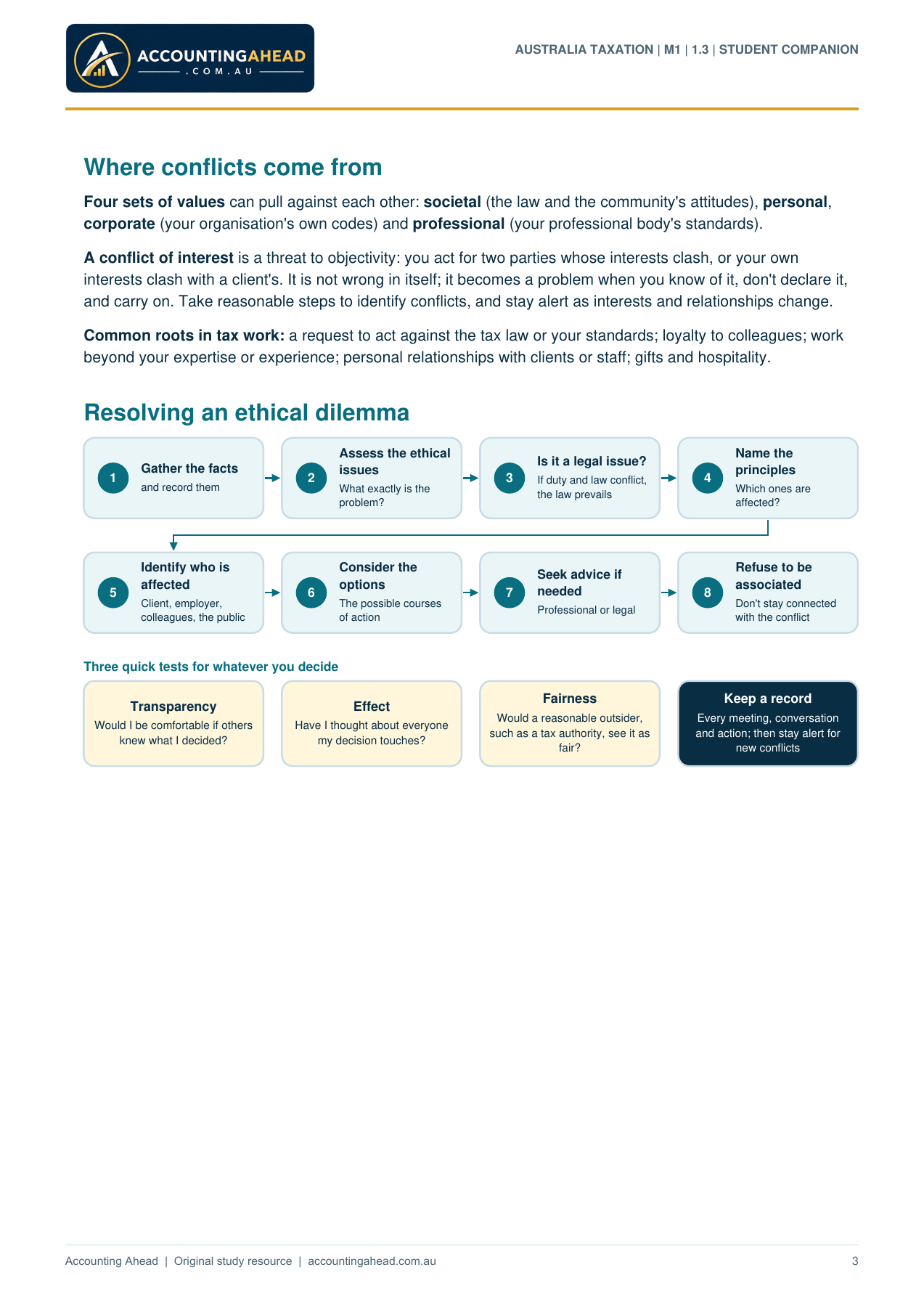
Resolving an ethical dilemma
1 Gather the facts
and record them 2
Assess the ethical
issues
What exactly is the
problem?
3
Is it a legal issue?
If duty and law conflict,
the law prevails
4
Name the
principles
Which ones are
affected?
5
Identify who is
affected
Client, employer,
colleagues, the public
6
Consider the
options
The possible courses
of action
7
Seek advice if
needed
Professional or legal
8
Refuse to be
associated
Don't stay connected
with the conflict
Three quick tests for whatever you decide
Transparency
Would I be comfortable if others
knew what I decided?
Effect
Have I thought about everyone
my decision touches?
Fairness
Would a reasonable outsider,
such as a tax authority, see it as
fair?
Keep a record
Every meeting, conversation
and action; then stay alert for
new conflicts
AUSTRALIA TAXATION | M1 | 1.3 | STUDENT COMPANION
3
Accounting Ahead | Original study resource | accountingahead.com.au
Practice questions
MODULE 1 | 1.3 | TRY THESE BEFORE THE WORKED ANSWERS
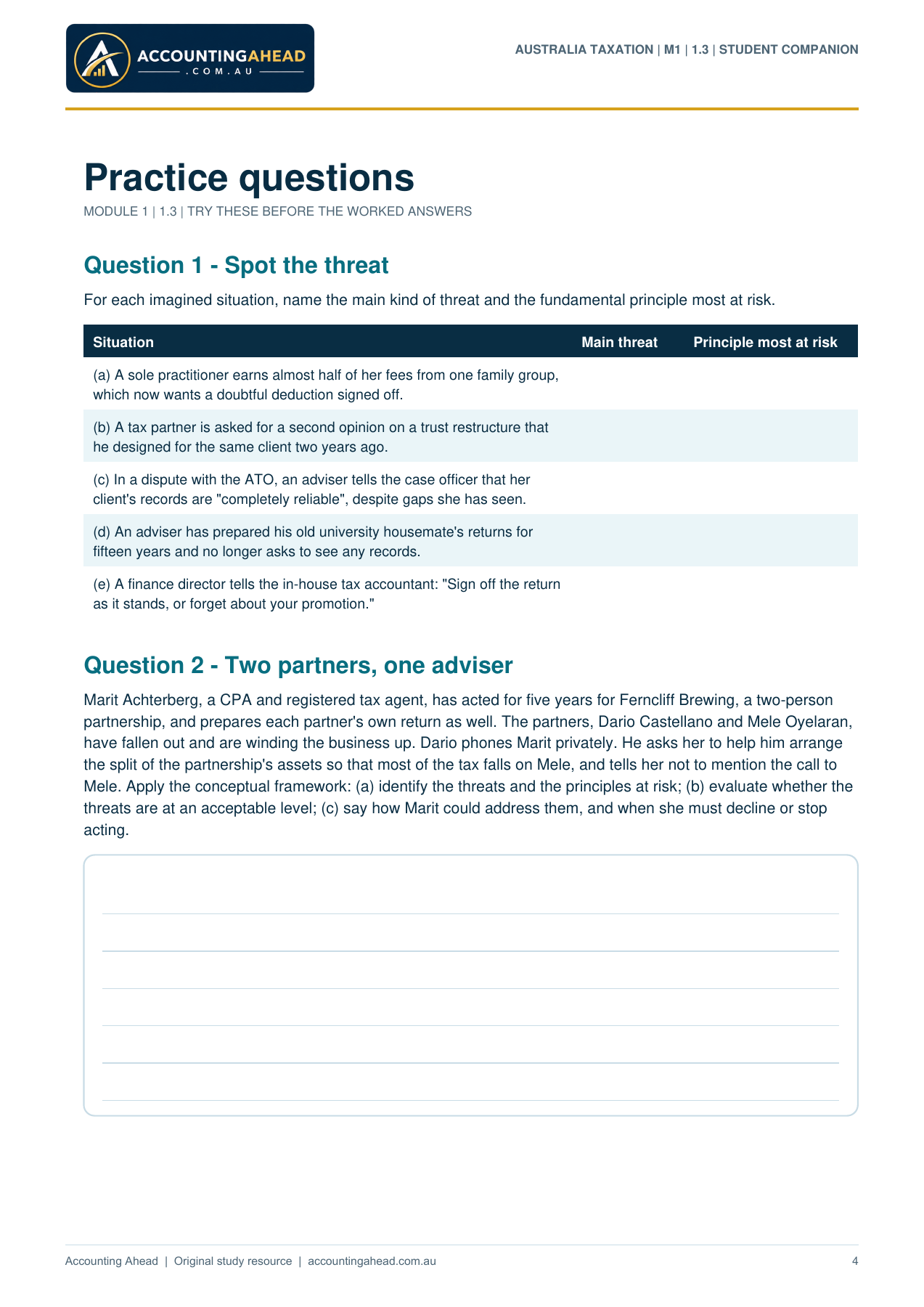
Question 1 - Spot the threat
For each imagined situation, name the main kind of threat and the fundamental principle most at risk.
Situation Main threat Principle most at risk
(a) A sole practitioner earns almost half of her fees from one family group,
which now wants a doubtful deduction signed off.
(b) A tax partner is asked for a second opinion on a trust restructure that
he designed for the same client two years ago.
(c) In a dispute with the ATO, an adviser tells the case officer that her
client's records are "completely reliable", despite gaps she has seen.
(d) An adviser has prepared his old university housemate's returns for
fifteen years and no longer asks to see any records.
(e) A finance director tells the in-house tax accountant: "Sign off the return
as it stands, or forget about your promotion."
Question 2 - Two partners, one adviser
Marit Achterberg, a CPA and registered tax agent, has acted for five years for Ferncliff Brewing, a two-person
partnership, and prepares each partner's own return as well. The partners, Dario Castellano and Mele Oyelaran,
have fallen out and are winding the business up. Dario phones Marit privately. He asks her to help him arrange
the split of the partnership's assets so that most of the tax falls on Mele, and tells her not to mention the call to
Mele. Apply the conceptual framework: (a) identify the threats and the principles at risk; (b) evaluate whether the
threats are at an acceptable level; (c) say how Marit could address them, and when she must decline or stop
acting.
AUSTRALIA TAXATION | M1 | 1.3 | STUDENT COMPANION
4
Accounting Ahead | Original study resource | accountingahead.com.au
Question 3 - A claim that doesn't match the facts
Callum Trevethan, a CPA and registered tax agent, is preparing the 2024-25 return of Freya Larkin, a wedding
photographer who trades on her own. Her logbook claims that the family's only car was used 95% for her
business. From their conversations, Callum knows that she drives her children to school in it every day and
takes it on family holidays. When he raises it, she says: "Just put it through. Nobody checks." Resolve the
dilemma using the eight steps, and say what Callum must do if Freya refuses to change the claim.
AUSTRALIA TAXATION | M1 | 1.3 | STUDENT COMPANION
5
Accounting Ahead | Original study resource | accountingahead.com.au
Worked answers
MODULE 1 | 1.3 | WORKED ANSWERS - ATTEMPT THE QUESTIONS FIRST
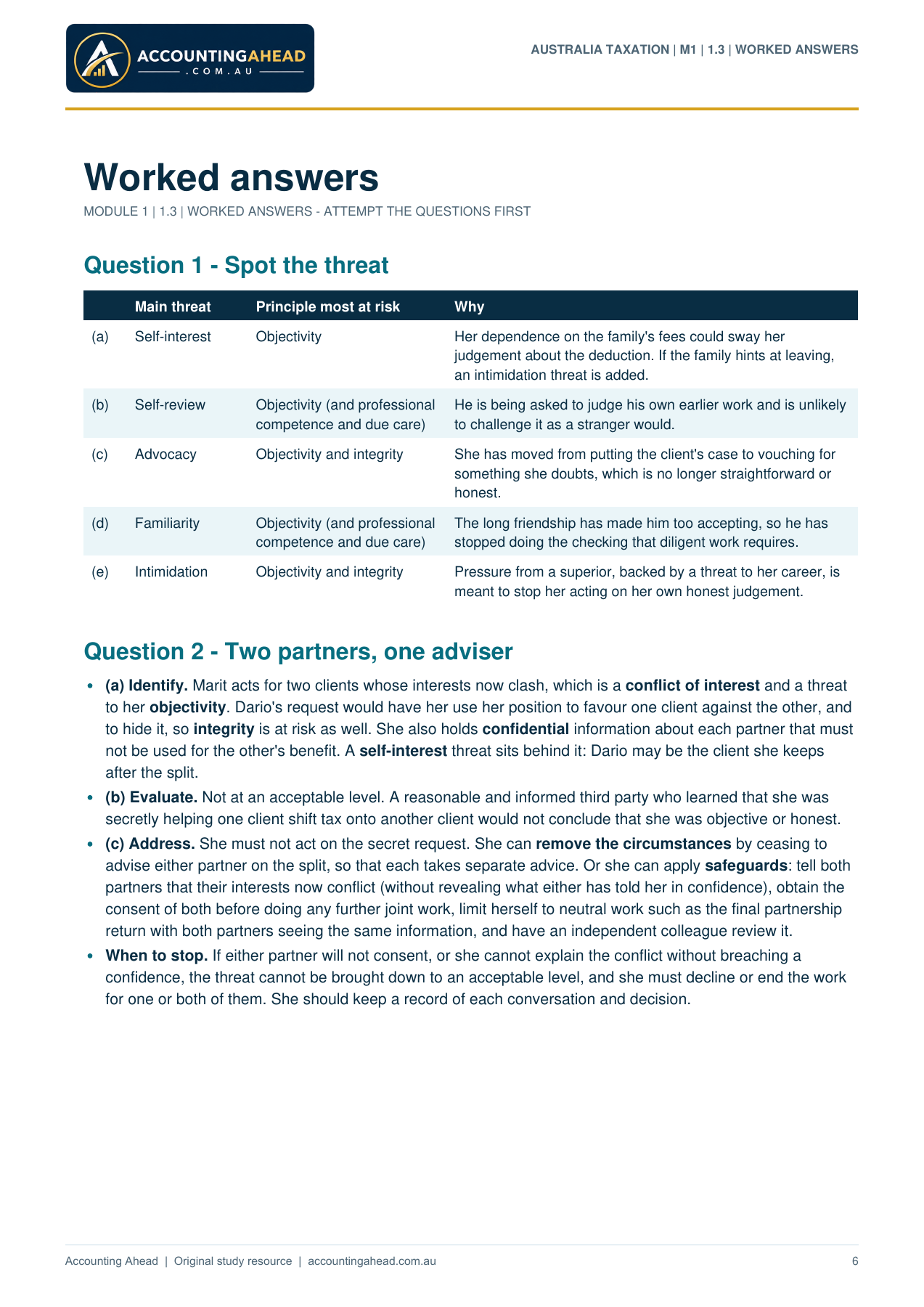
Question 1 - Spot the threat
Main threat Principle most at risk Why
(a) Self-interest Objectivity Her dependence on the family's fees could sway her
judgement about the deduction. If the family hints at leaving,
an intimidation threat is added.
(b) Self-review Objectivity (and professional
competence and due care)
He is being asked to judge his own earlier work and is unlikely
to challenge it as a stranger would.
(c) Advocacy Objectivity and integrity She has moved from putting the client's case to vouching for
something she doubts, which is no longer straightforward or
honest.
(d) Familiarity Objectivity (and professional
competence and due care)
The long friendship has made him too accepting, so he has
stopped doing the checking that diligent work requires.
(e) Intimidation Objectivity and integrity Pressure from a superior, backed by a threat to her career, is
meant to stop her acting on her own honest judgement.
Question 2 - Two partners, one adviser
(a) Identify. Marit acts for two clients whose interests now clash, which is a conflict of interest and a threat
to her objectivity. Dario's request would have her use her position to favour one client against the other, and
to hide it, so integrity is at risk as well. She also holds confidential information about each partner that must
not be used for the other's benefit. A self-interest threat sits behind it: Dario may be the client she keeps
after the split.
(b) Evaluate. Not at an acceptable level. A reasonable and informed third party who learned that she was
secretly helping one client shift tax onto another client would not conclude that she was objective or honest.
(c) Address. She must not act on the secret request. She can remove the circumstances by ceasing to
advise either partner on the split, so that each takes separate advice. Or she can apply safeguards: tell both
partners that their interests now conflict (without revealing what either has told her in confidence), obtain the
consent of both before doing any further joint work, limit herself to neutral work such as the final partnership
return with both partners seeing the same information, and have an independent colleague review it.
When to stop. If either partner will not consent, or she cannot explain the conflict without breaching a
confidence, the threat cannot be brought down to an acceptable level, and she must decline or end the work
for one or both of them. She should keep a record of each conversation and decision.
AUSTRALIA TAXATION | M1 | 1.3 | WORKED ANSWERS
6
Accounting Ahead | Original study resource | accountingahead.com.au
Question 3 - The eight steps applied
Step Callum and Freya
1. Facts Compare the logbook with what he knows: one family car, daily school runs, holidays. Ask
Freya how the 95% was worked out, and record the answers.
2. Ethical issues He is being asked to prepare a return that includes a claim he believes to be false or
misleading.
3. A legal issue? Yes. An overstated claim breaches the tax law and exposes Freya to an amended
assessment, penalties and interest. The law overrides her instruction.
4. Principles Integrity, objectivity, professional competence and due care, and professional behaviour.
The pressure to keep a client happy is a self-interest threat.
5. Who is affected Freya, Callum and his practice, and the wider community that relies on returns being
honest (the public interest).
6. Options Lodge as instructed (not acceptable); discuss it, explain the consequences and ask her to
claim only the business use she can support; or decline to act.
7. Advice If he is unsure, his professional body's ethics guidance, a senior colleague or a lawyer.
8. Refuse to be
associated
If she will not change the claim, he steps away from it.
If Freya refuses. APES 220 leaves no room: Callum has formed the view that the return would rest on false or
misleading information, he has discussed it with her and explained the consequences, and she is not prepared
to correct it, so he must not provide the service. He does not prepare or lodge the return on that basis, and he
documents what he found, what he said and what he decided. The three quick tests point the same way: he
would not be comfortable with the ATO or his professional body reading the file, lodging the claim would expose
Freya and his own practice to harm, and no reasonable outsider would call it fair.
AUSTRALIA TAXATION | M1 | 1.3 | WORKED ANSWERS
7