
The TPB Code of Professional Conduct — study companion
Part 1.4 of Australia Taxation. Preview the study companion or download the printable PDF.



Read the handout text
Accounting Ahead | Original study resource | accountingahead.com.au
The TPB Code of Professional Conduct
MODULE 1 | 1.4 | STUDENT COMPANION
Registration tests a practitioner at the door; the Code of Professional Conduct governs how they behave
afterwards. The Code is law (Tax Agent Services Act 2009, s 30-10), it is enforced by the Tax
Practitioners Board (TPB), and it binds registered tax agents and BAS agents. Its 14 principles sit under
five categories. For a breach the Board can caution, make an order, suspend or terminate registration;
financial penalties are a matter for the Federal Court.
Fourteen principles in five categories
Honesty and integrity 3
1 Act honestly and with integrity
2 Comply with the tax laws in your own
affairs
3 Account for client money or property held
on trust
Independence 2
4 Act lawfully in the client's best
interests
5 Have adequate arrangements to
manage conflicts of interest
Confidentiality 1
6 Keep client affairs confidential:
no disclosure to third parties
without permission, unless a
legal duty applies
Competence 4
7 Competent service, including work done on your behalf
8 Maintain relevant knowledge and skills
9 Reasonable care in ascertaining the client's state of affairs
10 Reasonable care to apply the tax laws correctly
Other responsibilities 4
11 Do not knowingly obstruct the administration of the tax laws
12 Advise clients of their rights and obligations
13 Maintain the required professional indemnity insurance
14 Respond to the Board in a timely, responsible, reasonable way
Count them: 3 + 2 + 1 + 4 + 4 = 14. Further obligations have been added to the Code in recent years; these 14
principles remain its core.
What each category asks of you in practice
Category In practice
Honesty and integrity (1-3) Be truthful with clients, the ATO and the Board. Keep your own lodgments and
payments up to date. Keep client money separate and account for all of it.
Independence (4-5) "Lawfully" comes first: best interests never stretch to a claim the law does not allow.
Identify conflicts, then disclose, obtain informed consent or step aside.
Confidentiality (6) Get the client's permission before passing on their information. A legal duty to disclose,
such as a formal notice from the ATO, is the exception.
Competence (7-10) You answer for work done on your behalf. Keep your knowledge current. Ask questions
when a client's information does not add up. Reasonable care, not perfection.
Other responsibilities
(11-14)
Do not hinder the administration of the tax laws. Tell clients their rights and obligations.
Keep the required insurance. Answer the Board promptly.
AUSTRALIA TAXATION | M1 | 1.4 | STUDENT COMPANION
1
Accounting Ahead | Original study resource | accountingahead.com.au
What the Board can do about a breach
Administrative sanctions for a breach of the Code
The Board may impose one or more; they rise in severity
Investigation
The Board is satisfied
that the Code was
breached
1. Written caution
A formal warning on the
record
2. Order
Complete a course,
work under supervision,
or provide only certain
services
3. Suspension
Registration is
suspended for a set
period
4. Termination
Registration ends; a
ban on reapplying of up
to 5 years can be
added
A separate path: the Federal Court
A Code breach alone brings no fine. Financial penalties belong to the civil penalty provisions (such as charging for tax agent services while
unregistered): the Board applies to the court, which sets the penalty
How it works: the Board must first investigate. If it is then satisfied that the Code has been breached, it may
impose one or more of the four administrative sanctions. An order can require a course of education,
supervision by another registered agent, or a limit on the services provided. On termination the Board can also
set a period, five years at most, in which the person may not reapply.
The Code and its neighbours
The TPB Code
BINDS
Registered tax agents and BAS agents
SOURCE
Statute: section 30-10 of the Tax Agent
Services Act 2009
ENFORCED BY
Tax Practitioners Board
APES 110 Code of Ethics
BINDS
Members of the professional accounting
bodies, such as CPA Australia
SOURCE
The profession's own standard, built on
five fundamental principles
ENFORCED BY
The member's professional body
Rules for tax (financial) advisers
BINDS
Providers of tax (financial) advice
services, outside the TPB Code since 1
January 2022
SOURCE
Corporations Act duties and the financial
advisers' Code of Ethics
OVERSEEN BY
ASIC
Duties all three share
Honesty and integrity | the client's best interests | managing conflicts of interest | confidentiality | care and competence | keeping skills current
AUSTRALIA TAXATION | M1 | 1.4 | STUDENT COMPANION
2
Accounting Ahead | Original study resource | accountingahead.com.au
How the Code lines up with APES 110
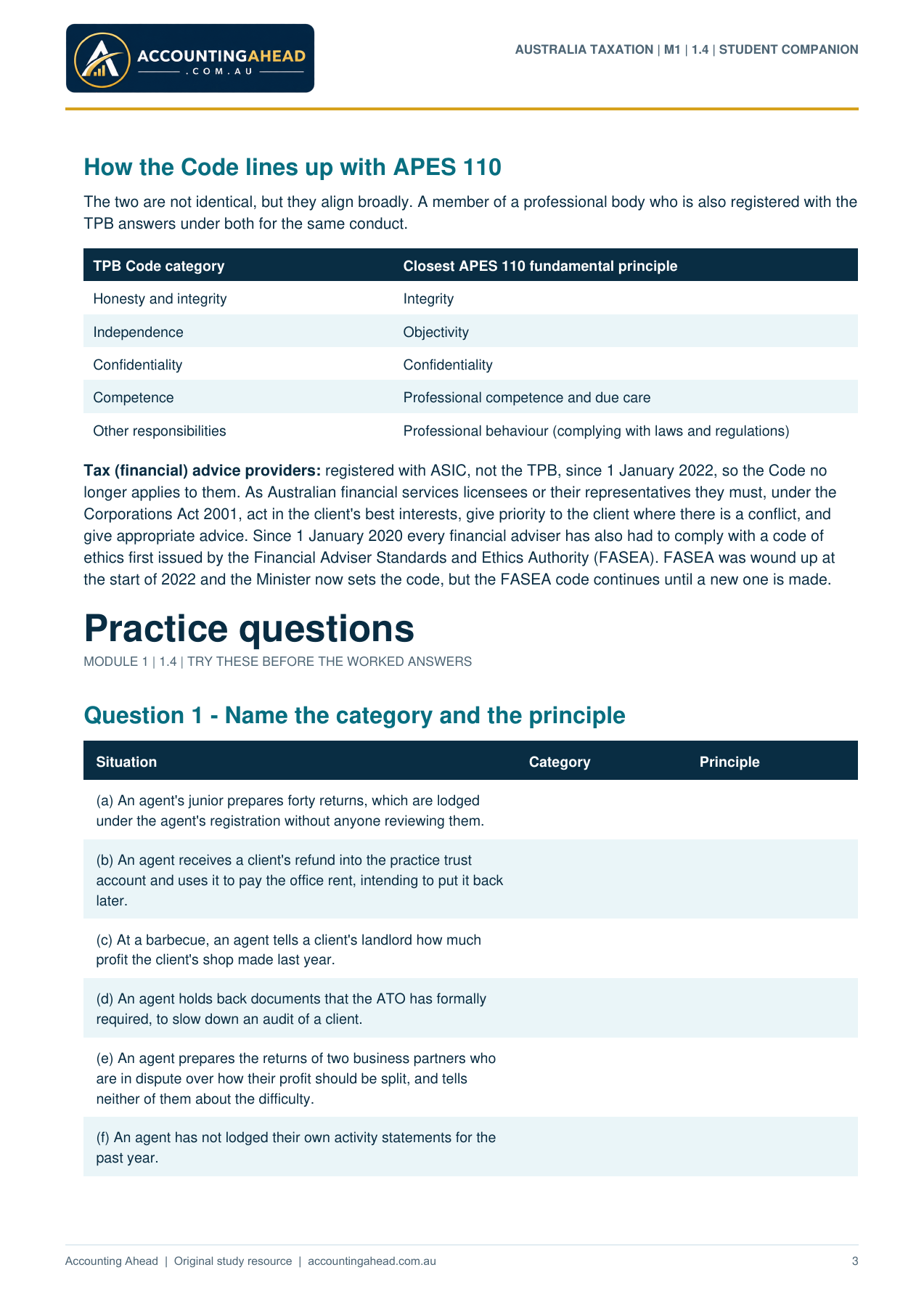
The two are not identical, but they align broadly. A member of a professional body who is also registered with the
TPB answers under both for the same conduct.
TPB Code category Closest APES 110 fundamental principle
Honesty and integrity Integrity
Independence Objectivity
Confidentiality Confidentiality
Competence Professional competence and due care
Other responsibilities Professional behaviour (complying with laws and regulations)
Tax (financial) advice providers: registered with ASIC, not the TPB, since 1 January 2022, so the Code no
longer applies to them. As Australian financial services licensees or their representatives they must, under the
Corporations Act 2001, act in the client's best interests, give priority to the client where there is a conflict, and
give appropriate advice. Since 1 January 2020 every financial adviser has also had to comply with a code of
ethics first issued by the Financial Adviser Standards and Ethics Authority (FASEA). FASEA was wound up at
the start of 2022 and the Minister now sets the code, but the FASEA code continues until a new one is made.
Practice questions
MODULE 1 | 1.4 | TRY THESE BEFORE THE WORKED ANSWERS
Question 1 - Name the category and the principle
Situation Category Principle
(a) An agent's junior prepares forty returns, which are lodged
under the agent's registration without anyone reviewing them.
(b) An agent receives a client's refund into the practice trust
account and uses it to pay the office rent, intending to put it back
later.
(c) At a barbecue, an agent tells a client's landlord how much
profit the client's shop made last year.
(d) An agent holds back documents that the ATO has formally
required, to slow down an audit of a client.
(e) An agent prepares the returns of two business partners who
are in dispute over how their profit should be split, and tells
neither of them about the difficulty.
(f) An agent has not lodged their own activity statements for the
past year.
AUSTRALIA TAXATION | M1 | 1.4 | STUDENT COMPANION
3
Accounting Ahead | Original study resource | accountingahead.com.au
Question 2 - Facing the Board
Tevita Faleafa is a registered BAS agent. A client complains to the TPB that he applied out-of-date PAYG
withholding rates to the client's payroll for a full year. The Board investigates and also finds that he has done no
continuing education for three years, that his professional indemnity insurance lapsed last year, and that he
ignored two written requests from the Board for information.
(a) Which sanctions could the Board impose?
(b) Which outcome could the Board not order itself?
Question 3 - The Code and its neighbours
Explain (a) how the Code overlaps with APES 110, and (b) why a financial planner who gives tax advice is not
bound by the Code yet owes similar duties.
AUSTRALIA TAXATION | M1 | 1.4 | STUDENT COMPANION
4
Accounting Ahead | Original study resource | accountingahead.com.au
Worked answers
MODULE 1 | 1.4 | WORKED ANSWERS - ATTEMPT THE QUESTIONS FIRST
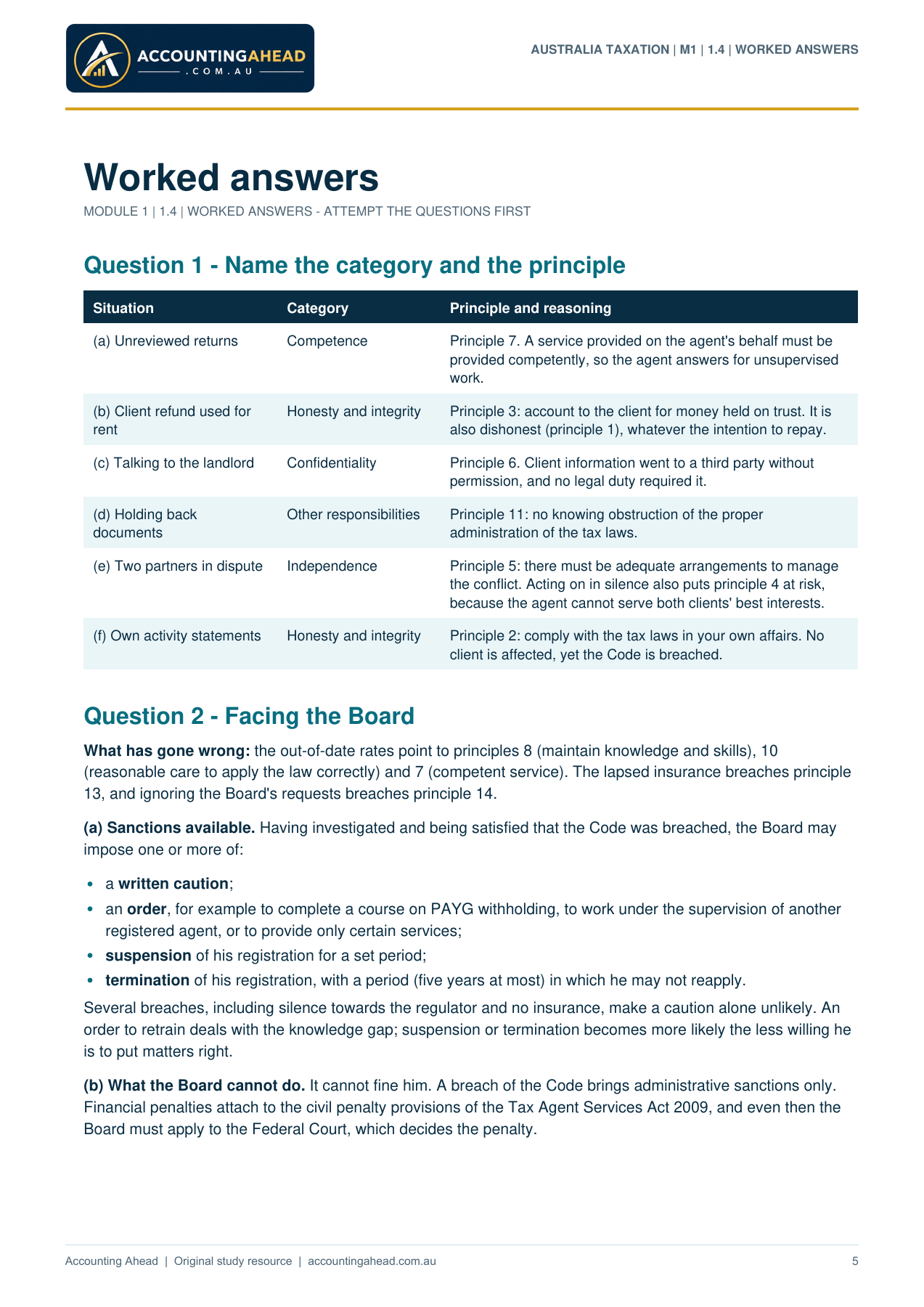
Question 1 - Name the category and the principle
Situation Category Principle and reasoning
(a) Unreviewed returns Competence Principle 7. A service provided on the agent's behalf must be
provided competently, so the agent answers for unsupervised
work.
(b) Client refund used for
rent
Honesty and integrity Principle 3: account to the client for money held on trust. It is
also dishonest (principle 1), whatever the intention to repay.
(c) Talking to the landlord Confidentiality Principle 6. Client information went to a third party without
permission, and no legal duty required it.
(d) Holding back
documents
Other responsibilities Principle 11: no knowing obstruction of the proper
administration of the tax laws.
(e) Two partners in dispute Independence Principle 5: there must be adequate arrangements to manage
the conflict. Acting on in silence also puts principle 4 at risk,
because the agent cannot serve both clients' best interests.
(f) Own activity statements Honesty and integrity Principle 2: comply with the tax laws in your own affairs. No
client is affected, yet the Code is breached.
Question 2 - Facing the Board
What has gone wrong: the out-of-date rates point to principles 8 (maintain knowledge and skills), 10
(reasonable care to apply the law correctly) and 7 (competent service). The lapsed insurance breaches principle
13, and ignoring the Board's requests breaches principle 14.
(a) Sanctions available. Having investigated and being satisfied that the Code was breached, the Board may
impose one or more of:
a written caution;
an order, for example to complete a course on PAYG withholding, to work under the supervision of another
registered agent, or to provide only certain services;
suspension of his registration for a set period;
termination of his registration, with a period (five years at most) in which he may not reapply.
Several breaches, including silence towards the regulator and no insurance, make a caution alone unlikely. An
order to retrain deals with the knowledge gap; suspension or termination becomes more likely the less willing he
is to put matters right.
(b) What the Board cannot do. It cannot fine him. A breach of the Code brings administrative sanctions only.
Financial penalties attach to the civil penalty provisions of the Tax Agent Services Act 2009, and even then the
Board must apply to the Federal Court, which decides the penalty.
AUSTRALIA TAXATION | M1 | 1.4 | WORKED ANSWERS
5
Accounting Ahead | Original study resource | accountingahead.com.au
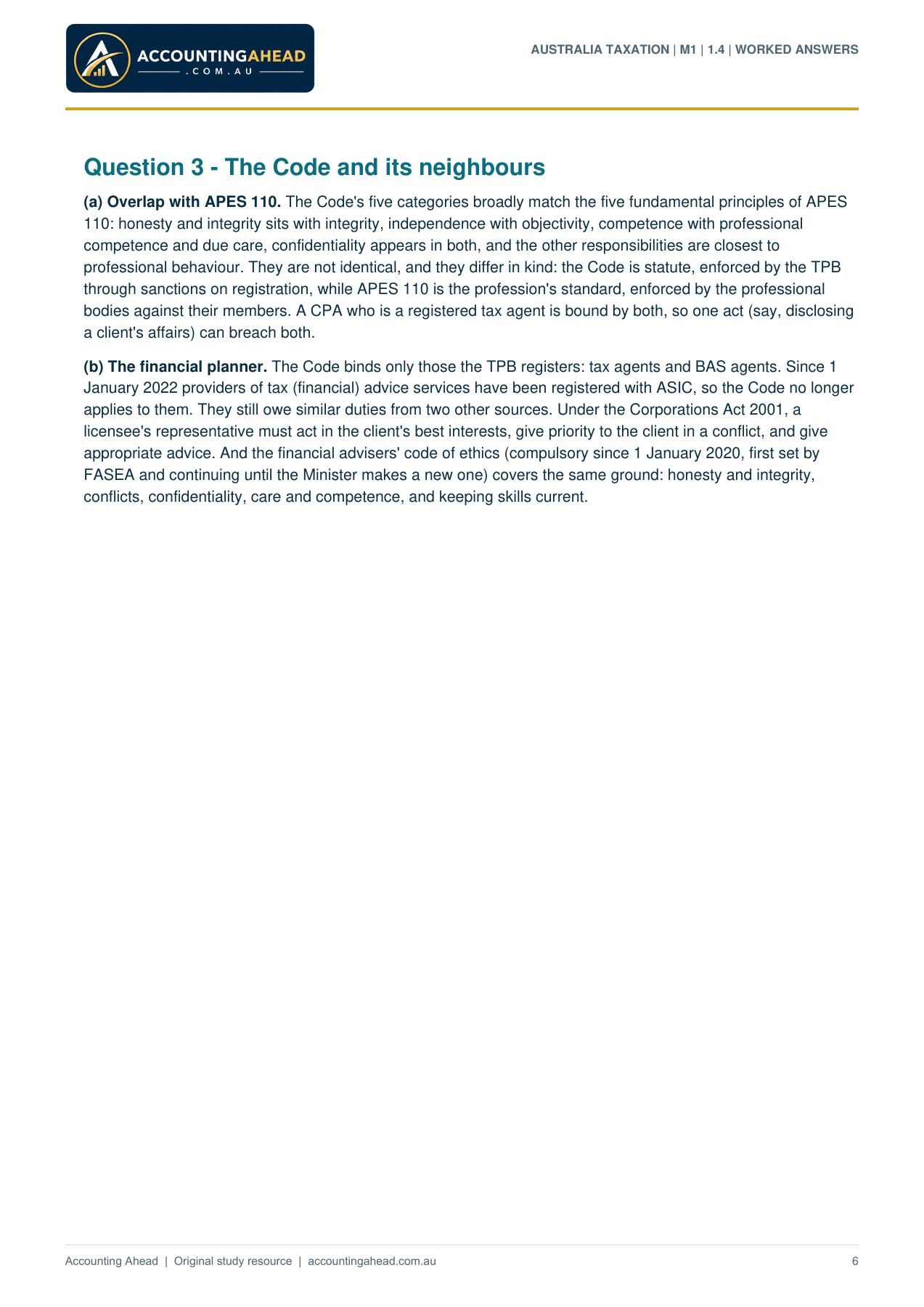
Question 3 - The Code and its neighbours
(a) Overlap with APES 110. The Code's five categories broadly match the five fundamental principles of APES
110: honesty and integrity sits with integrity, independence with objectivity, competence with professional
competence and due care, confidentiality appears in both, and the other responsibilities are closest to
professional behaviour. They are not identical, and they differ in kind: the Code is statute, enforced by the TPB
through sanctions on registration, while APES 110 is the profession's standard, enforced by the professional
bodies against their members. A CPA who is a registered tax agent is bound by both, so one act (say, disclosing
a client's affairs) can breach both.
(b) The financial planner. The Code binds only those the TPB registers: tax agents and BAS agents. Since 1
January 2022 providers of tax (financial) advice services have been registered with ASIC, so the Code no longer
applies to them. They still owe similar duties from two other sources. Under the Corporations Act 2001, a
licensee's representative must act in the client's best interests, give priority to the client in a conflict, and give
appropriate advice. And the financial advisers' code of ethics (compulsory since 1 January 2020, first set by
FASEA and continuing until the Minister makes a new one) covers the same ground: honesty and integrity,
conflicts, confidentiality, care and competence, and keeping skills current.
AUSTRALIA TAXATION | M1 | 1.4 | WORKED ANSWERS
6