
Self-Assessment, Lodgment and Assessments — study companion
Part 1.5 of Australia Taxation. Preview the study companion or download the printable PDF.


Read the handout text
Accounting Ahead | Original study resource | accountingahead.com.au
Self-assessment, lodgment and
assessments
MODULE 1 | 1.5 | STUDENT COMPANION
Under self-assessment the taxpayer works out and reports everything, and the ATO checks afterwards.
The legal liability to pay arises on assessment: most taxpayers receive a notice of assessment based on
their return, while companies and superannuation funds are deemed to be assessed when they lodge. An
assessment can be amended within two years (most individuals, small and medium businesses) or four
years (others), and at any time for fraud or evasion.
What self-assessment asks of the taxpayer
The taxpayer's job: complete the return and report all assessable income and every deduction claimed. You
are expected to understand how the law applies to you, or to get advice.
An agent doesn't shift it: even when represented, the taxpayer stays responsible for the information being
correct and for lodging on time.
Checked later, not first: the ATO, headed by the Commissioner of Taxation, generally accepts the return as
lodged and tests it afterwards through reviews and audits (lesson 1.7). An error found later can mean an
amended assessment, penalties and interest (lessons 1.10.1 to 1.10.3).
From return to assessment
1. Work it out
The taxpayer reports all
assessable income and
every deduction claimed
2. Lodge the
return
Approved form, with a
signed declaration that it
is true and correct
Partial self-assessment
Most taxpayers, including individuals. The ATO
takes the return largely at face value and
issues a notice of assessment
Full self-assessment
Companies and superannuation funds. Lodging
the return triggers a deemed assessment
based on its figures
3. Checked
afterwards
Reviews and audits, and
amendments within the
time limits
Income tax becomes legally payable only on assessment
Assessment (section 6, 1936 Act): the ascertainment of the amount of taxable income and of the tax payable on it, completed by serving a notice
A notice of assessment is not approval. Under partial self-assessment it simply reflects the taxpayer's own
figures; nobody has examined the claims behind them. For a company or superannuation fund, the notice is
deemed to be served on the day the return is lodged, so that is the day the amendment period starts.
The weight of an assessment. In the objection, review and appeal process of Part IVC of the Taxation
Administration Act 1953 (lesson 1.8), an assessment is treated as correct to begin with. The taxpayer must show
both that it is excessive and what the correct amount should have been.
AUSTRALIA TAXATION | M1 | 1.5 | STUDENT COMPANION
1
Accounting Ahead | Original study resource | accountingahead.com.au
Who must lodge an income tax return
Individuals not in business
Residents generally lodge if income
exceeds the $18,200 tax-free threshold
(part-year: pro-rated). Exceptions apply
Sole traders
Must lodge even if income is below the
threshold, or the business made a loss
Partnerships
A partnership return shows the net income;
each partner reports their share in their own
return
Trusts
The trustee lodges a trust return; each
beneficiary generally declares trust income
in their own return
Superannuation funds
Every fund lodges, self-managed funds
included
Companies
A company return; certain large companies
add a reportable tax position schedule
How and when
The form
Approved form, with a signed
declaration that it is true and
correct
The due date
31 October after the income
year, for most individuals who
prepare their own return
More time
The Commissioner can extend it;
lodgment programs give tax
agents' clients longer
No return lodged?
The Commissioner can issue a
default assessment (section 167)
Lodging: the rules to know
Rule Detail
Who must lodge Set out for each income year in a legislative instrument.
Form and declaration Approved form with the prescribed information, signed by the taxpayer (and by the
registered tax agent who prepared it), declaring it true and correct.
More time (s 161) The Commissioner can extend the time to lodge, and uses that power to create
lodgment programs for registered tax agents.
Further return (s 162) Can be required if the return lodged is unsatisfactory, or none was lodged.
Special return (s 163) When the normal time would not work: the taxpayer is about to leave Australia, say.
Default assessment (s 167) With no return lodged, the Commissioner can assess the tax believed to be payable.
Key figures for 2024-25
Item Figure
Tax-free threshold, resident individual $18,200 (a proportion for a part-year resident)
Due date, individuals who prepare their own return 31 October 2025 for the 2024-25 income year
Small business entity; medium business entity Turnover under $10 million; under $50 million
Amending an assessment (section 170)
Same limits both ways: they apply to an amendment the ATO makes on its own initiative and to one the
taxpayer asks for (self-amendment).
Asked in time: an amendment can be made after the limit if, before it expired, the taxpayer requested the
amendment (s 170(5)), or made a private ruling application (s 170(6)).
AUSTRALIA TAXATION | M1 | 1.5 | STUDENT COMPANION
2
Accounting Ahead | Original study resource | accountingahead.com.au
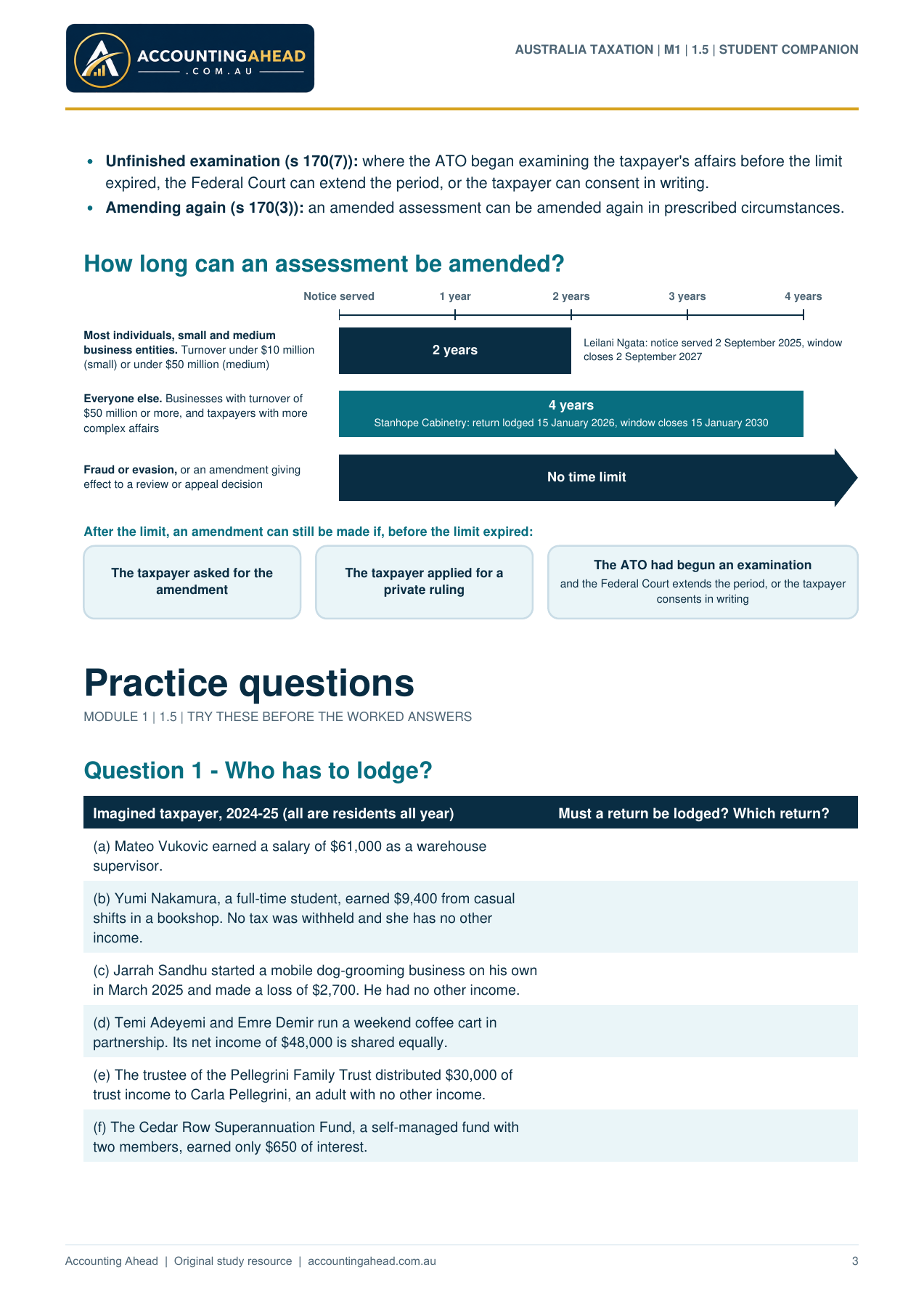
Unfinished examination (s 170(7)): where the ATO began examining the taxpayer's affairs before the limit
expired, the Federal Court can extend the period, or the taxpayer can consent in writing.
Amending again (s 170(3)): an amended assessment can be amended again in prescribed circumstances.
How long can an assessment be amended?
Notice served 1 year 2 years 3 years 4 years
Most individuals, small and medium
business entities. Turnover under $10 million
(small) or under $50 million (medium)
2 years
Everyone else. Businesses with turnover of
$50 million or more, and taxpayers with more
complex affairs
4 years
Stanhope Cabinetry: return lodged 15 January 2026, window closes 15 January 2030
Fraud or evasion, or an amendment giving
effect to a review or appeal decision No time limit
Leilani Ngata: notice served 2 September 2025, window
closes 2 September 2027
After the limit, an amendment can still be made if, before the limit expired:
The taxpayer asked for the
amendment
The taxpayer applied for a
private ruling
The ATO had begun an examination
and the Federal Court extends the period, or the taxpayer
consents in writing
Practice questions
MODULE 1 | 1.5 | TRY THESE BEFORE THE WORKED ANSWERS
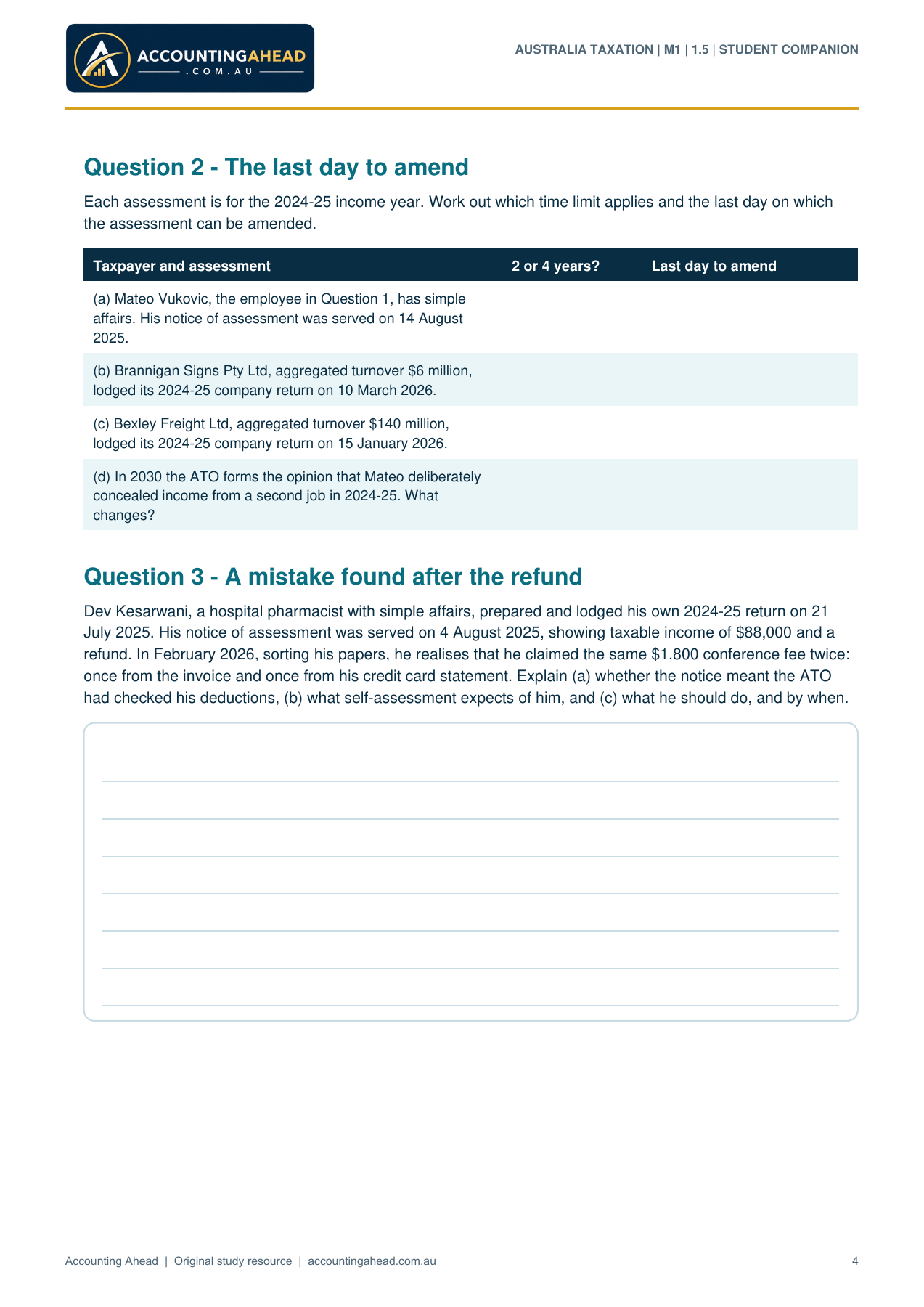
Question 1 - Who has to lodge?
Imagined taxpayer, 2024-25 (all are residents all year) Must a return be lodged? Which return?
(a) Mateo Vukovic earned a salary of $61,000 as a warehouse
supervisor.
(b) Yumi Nakamura, a full-time student, earned $9,400 from casual
shifts in a bookshop. No tax was withheld and she has no other
income.
(c) Jarrah Sandhu started a mobile dog-grooming business on his own
in March 2025 and made a loss of $2,700. He had no other income.
(d) Temi Adeyemi and Emre Demir run a weekend coffee cart in
partnership. Its net income of $48,000 is shared equally.
(e) The trustee of the Pellegrini Family Trust distributed $30,000 of
trust income to Carla Pellegrini, an adult with no other income.
(f) The Cedar Row Superannuation Fund, a self-managed fund with
two members, earned only $650 of interest.
AUSTRALIA TAXATION | M1 | 1.5 | STUDENT COMPANION
3
Accounting Ahead | Original study resource | accountingahead.com.au
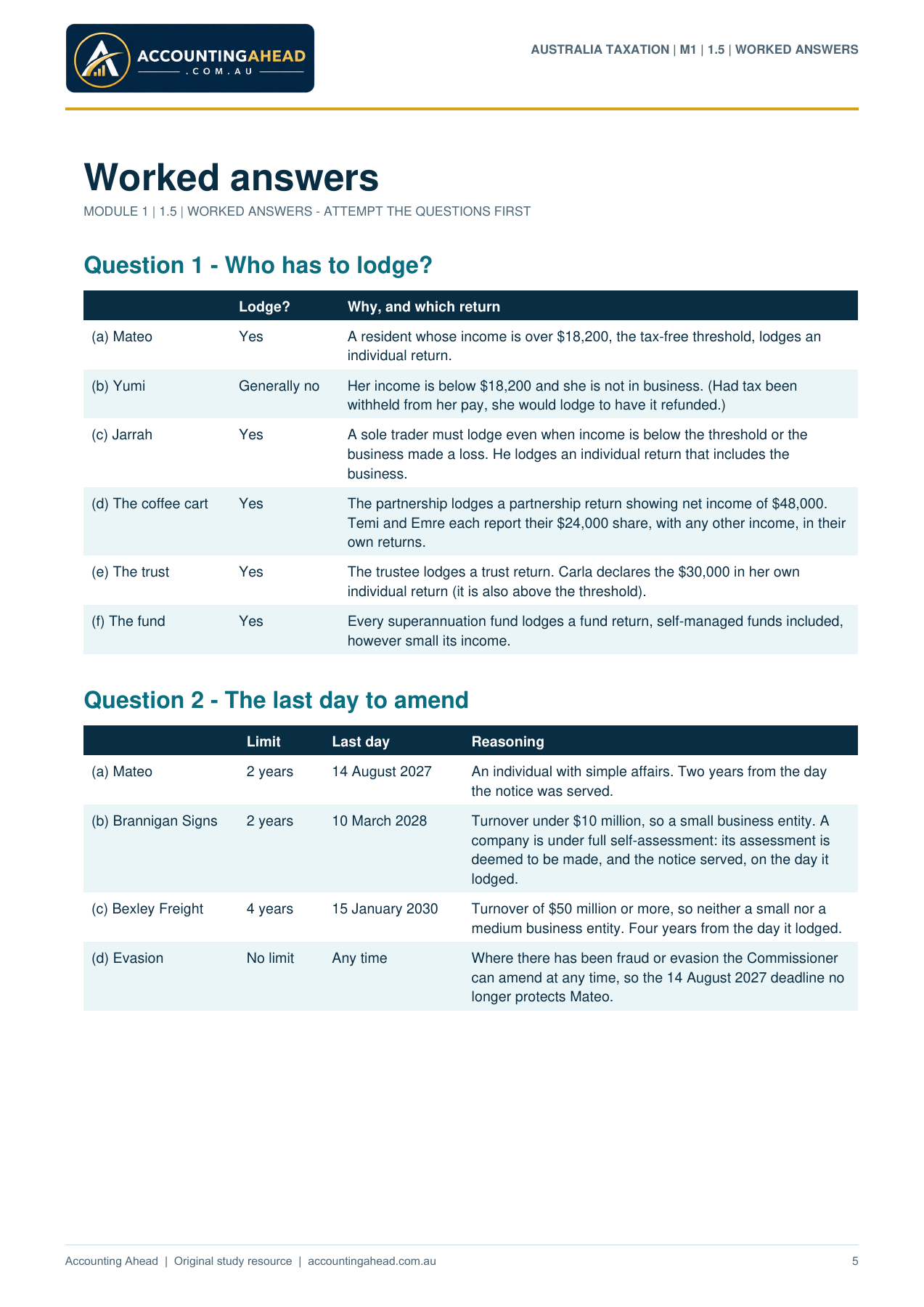
Question 2 - The last day to amend
Each assessment is for the 2024-25 income year. Work out which time limit applies and the last day on which
the assessment can be amended.
Taxpayer and assessment 2 or 4 years? Last day to amend
(a) Mateo Vukovic, the employee in Question 1, has simple
affairs. His notice of assessment was served on 14 August
2025.
(b) Brannigan Signs Pty Ltd, aggregated turnover $6 million,
lodged its 2024-25 company return on 10 March 2026.
(c) Bexley Freight Ltd, aggregated turnover $140 million,
lodged its 2024-25 company return on 15 January 2026.
(d) In 2030 the ATO forms the opinion that Mateo deliberately
concealed income from a second job in 2024-25. What
changes?
Question 3 - A mistake found after the refund
Dev Kesarwani, a hospital pharmacist with simple affairs, prepared and lodged his own 2024-25 return on 21
July 2025. His notice of assessment was served on 4 August 2025, showing taxable income of $88,000 and a
refund. In February 2026, sorting his papers, he realises that he claimed the same $1,800 conference fee twice:
once from the invoice and once from his credit card statement. Explain (a) whether the notice meant the ATO
had checked his deductions, (b) what self-assessment expects of him, and (c) what he should do, and by when.
AUSTRALIA TAXATION | M1 | 1.5 | STUDENT COMPANION
4
Accounting Ahead | Original study resource | accountingahead.com.au
Worked answers
MODULE 1 | 1.5 | WORKED ANSWERS - ATTEMPT THE QUESTIONS FIRST
Question 1 - Who has to lodge?
Lodge? Why, and which return
(a) Mateo Yes A resident whose income is over $18,200, the tax-free threshold, lodges an
individual return.
(b) Yumi Generally no Her income is below $18,200 and she is not in business. (Had tax been
withheld from her pay, she would lodge to have it refunded.)
(c) Jarrah Yes A sole trader must lodge even when income is below the threshold or the
business made a loss. He lodges an individual return that includes the
business.
(d) The coffee cart Yes The partnership lodges a partnership return showing net income of $48,000.
Temi and Emre each report their $24,000 share, with any other income, in their
own returns.
(e) The trust Yes The trustee lodges a trust return. Carla declares the $30,000 in her own
individual return (it is also above the threshold).
(f) The fund Yes Every superannuation fund lodges a fund return, self-managed funds included,
however small its income.
Question 2 - The last day to amend
Limit Last day Reasoning
(a) Mateo 2 years 14 August 2027 An individual with simple affairs. Two years from the day
the notice was served.
(b) Brannigan Signs 2 years 10 March 2028 Turnover under $10 million, so a small business entity. A
company is under full self-assessment: its assessment is
deemed to be made, and the notice served, on the day it
lodged.
(c) Bexley Freight 4 years 15 January 2030 Turnover of $50 million or more, so neither a small nor a
medium business entity. Four years from the day it lodged.
(d) Evasion No limit Any time Where there has been fraud or evasion the Commissioner
can amend at any time, so the 14 August 2027 deadline no
longer protects Mateo.
AUSTRALIA TAXATION | M1 | 1.5 | WORKED ANSWERS
5
Accounting Ahead | Original study resource | accountingahead.com.au
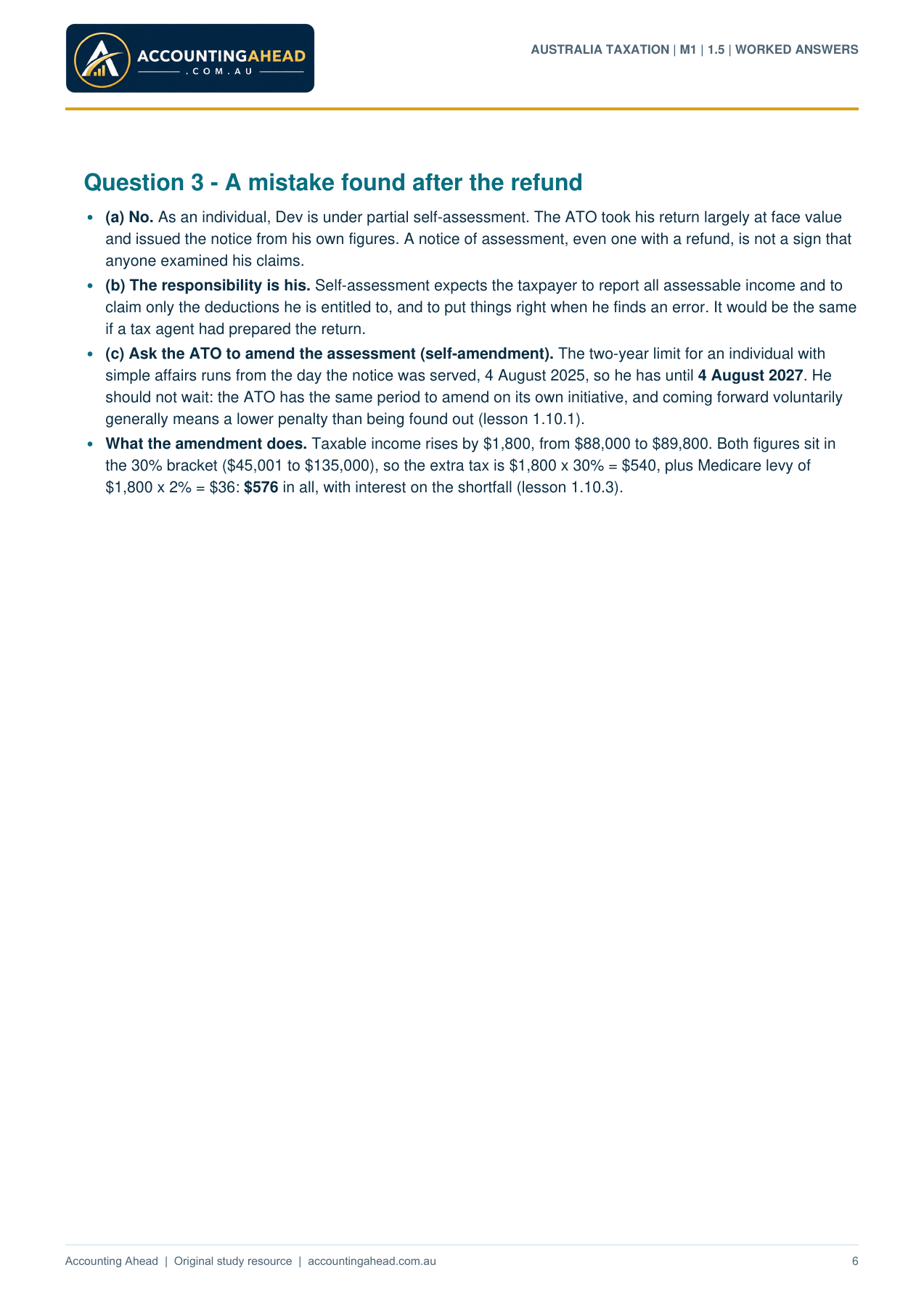
Question 3 - A mistake found after the refund
(a) No. As an individual, Dev is under partial self-assessment. The ATO took his return largely at face value
and issued the notice from his own figures. A notice of assessment, even one with a refund, is not a sign that
anyone examined his claims.
(b) The responsibility is his. Self-assessment expects the taxpayer to report all assessable income and to
claim only the deductions he is entitled to, and to put things right when he finds an error. It would be the same
if a tax agent had prepared the return.
(c) Ask the ATO to amend the assessment (self-amendment). The two-year limit for an individual with
simple affairs runs from the day the notice was served, 4 August 2025, so he has until 4 August 2027. He
should not wait: the ATO has the same period to amend on its own initiative, and coming forward voluntarily
generally means a lower penalty than being found out (lesson 1.10.1).
What the amendment does. Taxable income rises by $1,800, from $88,000 to $89,800. Both figures sit in
the 30% bracket ($45,001 to $135,000), so the extra tax is $1,800 x 30% = $540, plus Medicare levy of
$1,800 x 2% = $36: $576 in all, with interest on the shortfall (lesson 1.10.3).
AUSTRALIA TAXATION | M1 | 1.5 | WORKED ANSWERS
6