
Objections, Reviews and Appeals — study companion
Part 1.8 of Australia Taxation. Preview the study companion or download the printable PDF.


Read the handout text
Accounting Ahead | Original study resource | accountingahead.com.au
Objections, reviews and appeals
MODULE 1 | 1.8 | STUDENT COMPANION
Part IVC of the Taxation Administration Act 1953 gives a taxpayer three steps. Object to the ATO in
writing, in time and with full grounds. If the objection is disallowed, choose within 60 days between review
by the Administrative Review Tribunal and an appeal to the Federal Court. Then, if need be, appeal further
on questions of law. At every stage the burden of proof is on the taxpayer.
What can be objected to: an assessment, and certain determinations, notices and decisions, such as a private
ruling or a shortfall penalty. Form: in writing, in the approved form, with the grounds stated fully and in detail.
Those grounds matter later: before the tribunal or the court you are generally limited to them, unless it allows
otherwise.
Objecting to your own return: a taxpayer who disagrees with an ATO view can lodge in line with that view
(avoiding the risk of penalties) and then object to the assessment, arguing for their own reading of the law.
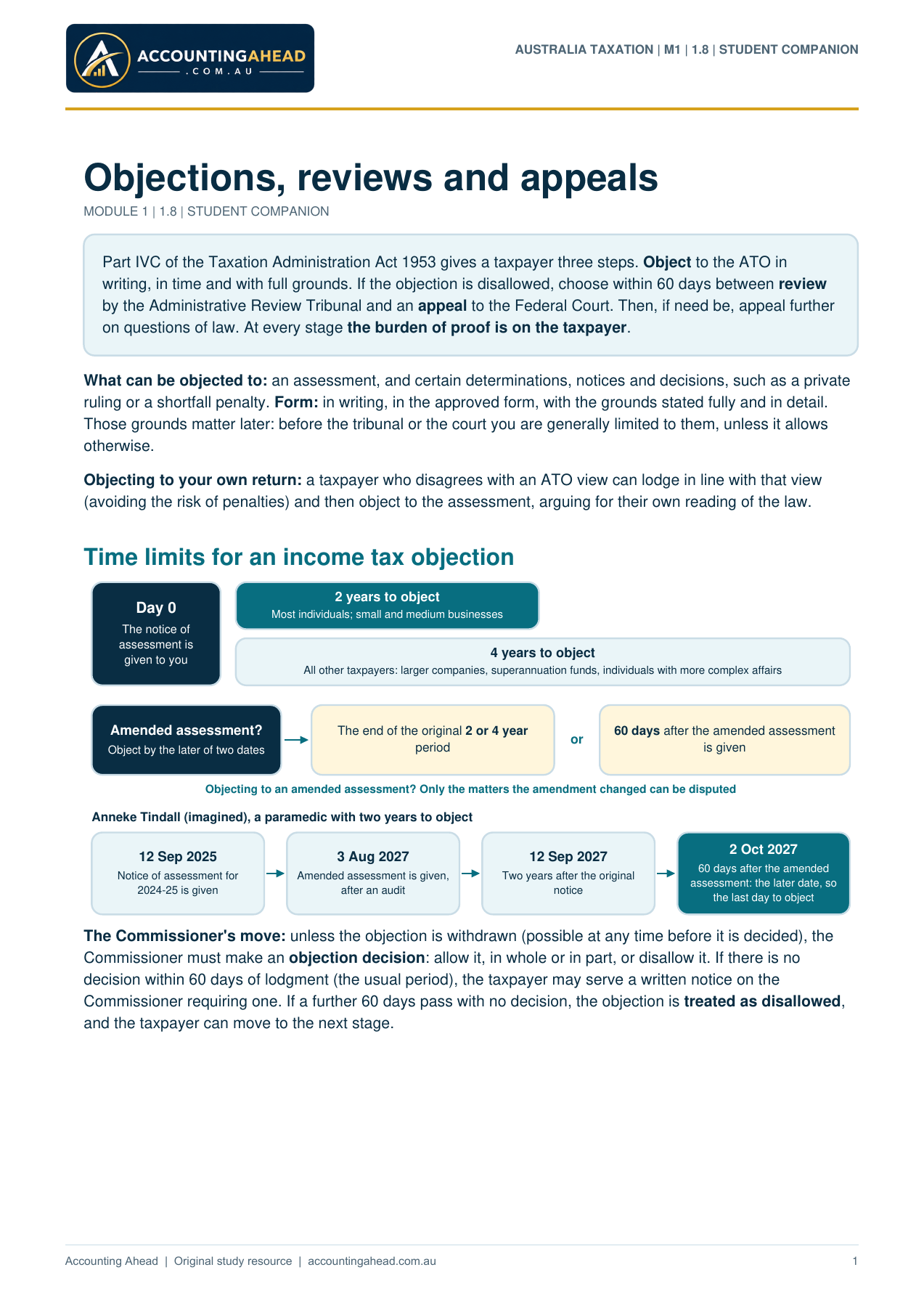
Time limits for an income tax objection
Day 0
The notice of
assessment is
given to you
2 years to object
Most individuals; small and medium businesses
4 years to object
All other taxpayers: larger companies, superannuation funds, individuals with more complex affairs
Amended assessment?
Object by the later of two dates
The end of the original 2 or 4 year
period or 60 days after the amended assessment
is given
Objecting to an amended assessment? Only the matters the amendment changed can be disputed
Anneke Tindall (imagined), a paramedic with two years to object
12 Sep 2025
Notice of assessment for
2024-25 is given
3 Aug 2027
Amended assessment is given,
after an audit
12 Sep 2027
Two years after the original
notice
2 Oct 2027
60 days after the amended
assessment: the later date, so
the last day to object
The Commissioner's move: unless the objection is withdrawn (possible at any time before it is decided), the
Commissioner must make an objection decision: allow it, in whole or in part, or disallow it. If there is no
decision within 60 days of lodgment (the usual period), the taxpayer may serve a written notice on the
Commissioner requiring one. If a further 60 days pass with no decision, the objection is treated as disallowed,
and the taxpayer can move to the next stage.
AUSTRALIA TAXATION | M1 | 1.8 | STUDENT COMPANION
1
Accounting Ahead | Original study resource | accountingahead.com.au
Key time limits
Objecting to Last day to object
Income tax assessment 2 years (most individuals; small and medium businesses) or 4 years (all other
taxpayers) after the notice of assessment is given
Amended income tax
assessment
The later of 60 days after the amended assessment is given, and the 2 or 4 years
that applied to the original. Only the amended matters can be disputed
Private ruling (income tax) The later of 60 days after the ruling is given, and 2 or 4 years after the last day for
lodging the return for that year. Once an assessment has issued for the period,
object to the assessment instead
Shortfall penalty The later of 60 days after the penalty notice is given, and the last day for objecting
to the assessment the penalty relates to
FBT assessment 4 years after the assessment is given
GST assessment 4 years and one day after the assessment is given
Many other decisions 60 days after the decision is given (for example, reviewable GST decisions)
From assessment to the High Court
Assessment
Or another
decision you can
object to
Objection
In writing, with your
grounds in full
Objection decision
The Commissioner
allows it, in whole or in
part, or disallows it
No decision? 60 days, then your written notice,
then a further 60 days: treated as disallowed
Act within 60 days of being
served with the decision
Administrative
Review Tribunal
Review
Federal Court
Appeal
Question of law
only
Full Federal
Court
High Court
Only by special leave,
which is not often
granted
A side door at any stage: alternative dispute resolution
ATO in-house facilitation for individuals, small businesses and not-for-profits. Most disputes settle, and a settlement is final
The fork (s 14ZZ): a taxpayer dissatisfied with a reviewable objection decision can ask the Administrative
Review Tribunal (ART) to review it, or appeal to the Federal Court, within 60 days of being served with notice
of the decision. The ART took over from the Administrative Appeals Tribunal on 14 October 2024.
Alternative dispute resolution: individuals, small businesses and not-for-profits have access to the ATO's
in-house facilitation service at any stage, from the audit through to litigation. Most disputes settle, and settled
issues cannot be contested again.
Further appeals: an ART decision can go to the Federal Court only where a question of law arises; from a
single judge to the Full Federal Court; then to the High Court, but only by special leave, which is not often
granted. The ATO's test case litigation program may reimburse some or all of a taxpayer's legal costs where
the case matters for the tax system as a whole.
AUSTRALIA TAXATION | M1 | 1.8 | STUDENT COMPANION
2
Accounting Ahead | Original study resource | accountingahead.com.au
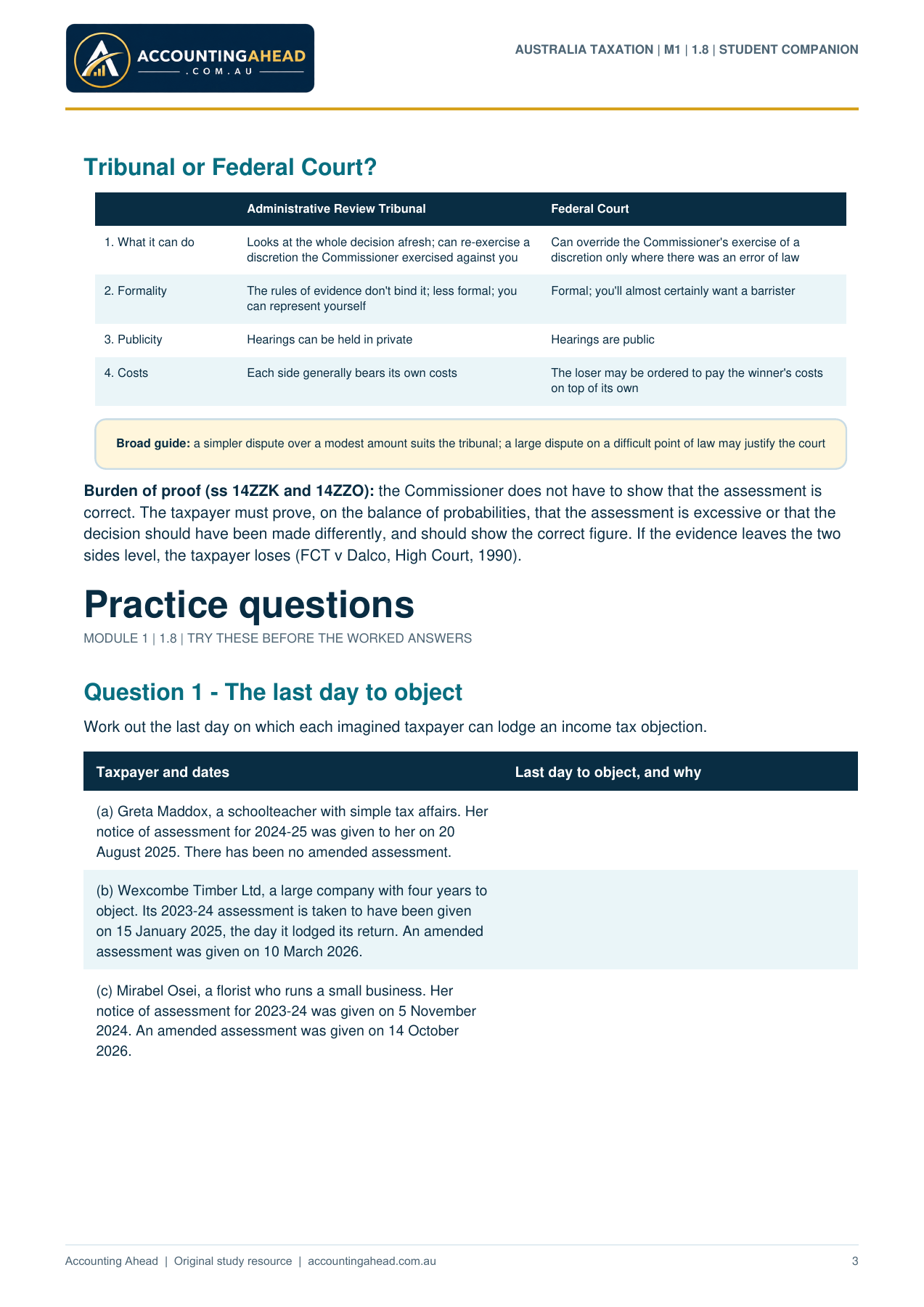
Tribunal or Federal Court?
Administrative Review Tribunal Federal Court
1. What it can do Looks at the whole decision afresh; can re-exercise a
discretion the Commissioner exercised against you
Can override the Commissioner's exercise of a
discretion only where there was an error of law
2. Formality The rules of evidence don't bind it; less formal; you
can represent yourself
Formal; you'll almost certainly want a barrister
3. Publicity Hearings can be held in private Hearings are public
4. Costs Each side generally bears its own costs The loser may be ordered to pay the winner's costs
on top of its own
Broad guide: a simpler dispute over a modest amount suits the tribunal; a large dispute on a difficult point of law may justify the court
Burden of proof (ss 14ZZK and 14ZZO): the Commissioner does not have to show that the assessment is
correct. The taxpayer must prove, on the balance of probabilities, that the assessment is excessive or that the
decision should have been made differently, and should show the correct figure. If the evidence leaves the two
sides level, the taxpayer loses (FCT v Dalco, High Court, 1990).
Practice questions
MODULE 1 | 1.8 | TRY THESE BEFORE THE WORKED ANSWERS
Question 1 - The last day to object
Work out the last day on which each imagined taxpayer can lodge an income tax objection.
Taxpayer and dates Last day to object, and why
(a) Greta Maddox, a schoolteacher with simple tax affairs. Her
notice of assessment for 2024-25 was given to her on 20
August 2025. There has been no amended assessment.
(b) Wexcombe Timber Ltd, a large company with four years to
object. Its 2023-24 assessment is taken to have been given
on 15 January 2025, the day it lodged its return. An amended
assessment was given on 10 March 2026.
(c) Mirabel Osei, a florist who runs a small business. Her
notice of assessment for 2023-24 was given on 5 November
2024. An amended assessment was given on 14 October
2026.
AUSTRALIA TAXATION | M1 | 1.8 | STUDENT COMPANION
3
Accounting Ahead | Original study resource | accountingahead.com.au
Question 2 - The objection nobody answered
Rosalind Tolliver lodged a valid objection against her income tax assessment on 3 March 2026. By 20 May 2026
she has heard nothing from the ATO. (a) What can she do? (b) If she takes that step on 25 May 2026 and the
ATO still makes no decision, on what date is her objection treated as disallowed? (c) What does that allow her to
do next?
Question 3 - Tribunal or court?
Both of these taxpayers have had their objections disallowed. Recommend the tribunal or the Federal Court for
each, with reasons, and say who carries the burden of proof. (a) Liesel Marchetti, a retired librarian, accepts the
extra tax in her amended assessment but disputes a shortfall penalty of $2,400, arguing that the Commissioner
should have used the discretion to remit it. She wants to keep costs low and her affairs private. (b) Strathmore
Dental Group Ltd disputes $3.5 million of tax. The dispute turns on the meaning of a provision that no court has
yet interpreted.
AUSTRALIA TAXATION | M1 | 1.8 | STUDENT COMPANION
4
Accounting Ahead | Original study resource | accountingahead.com.au
Worked answers
MODULE 1 | 1.8 | WORKED ANSWERS - ATTEMPT THE QUESTIONS FIRST
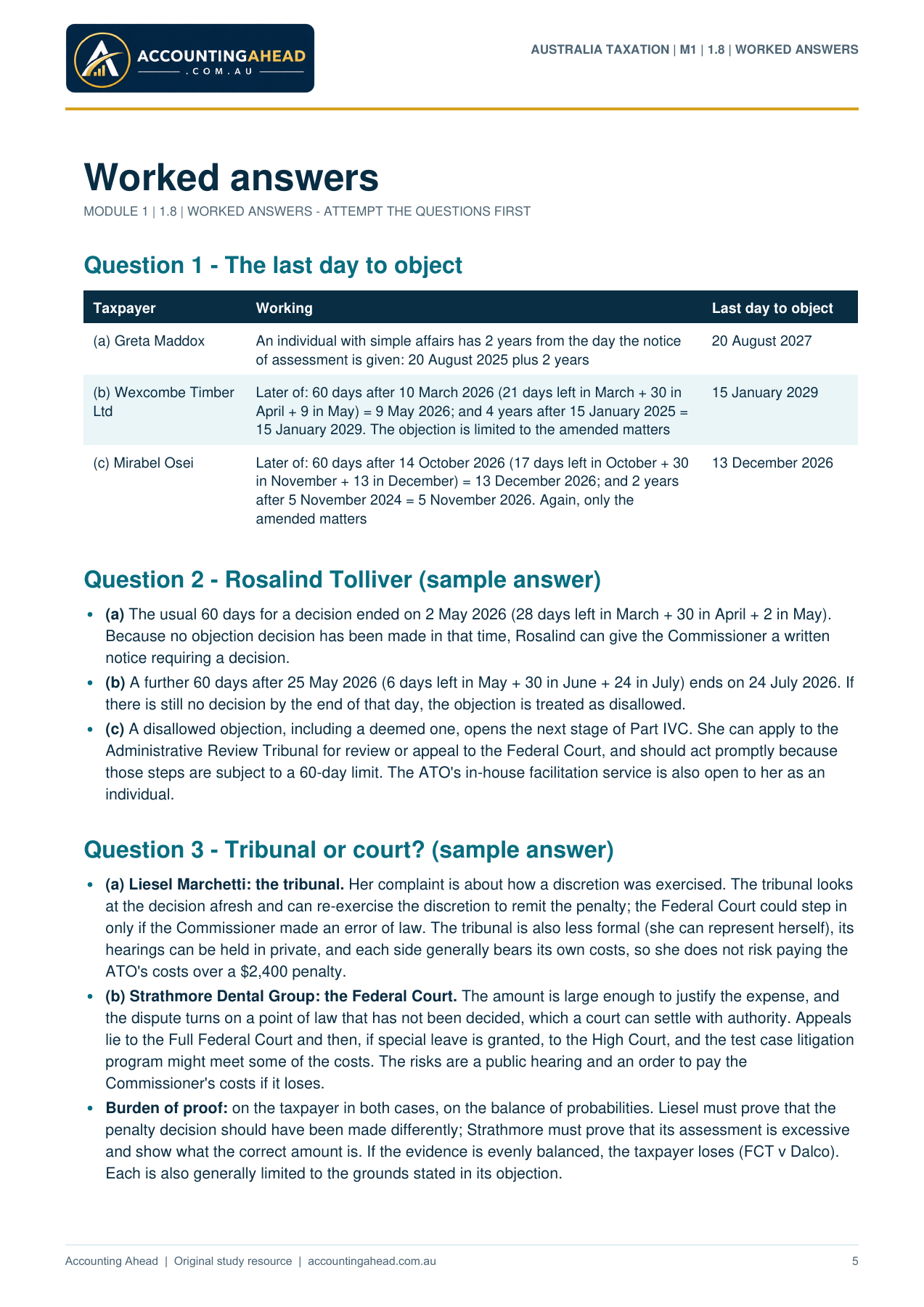
Question 1 - The last day to object
Taxpayer Working Last day to object
(a) Greta Maddox An individual with simple affairs has 2 years from the day the notice
of assessment is given: 20 August 2025 plus 2 years
20 August 2027
(b) Wexcombe Timber
Ltd
Later of: 60 days after 10 March 2026 (21 days left in March + 30 in
April + 9 in May) = 9 May 2026; and 4 years after 15 January 2025 =
15 January 2029. The objection is limited to the amended matters
15 January 2029
(c) Mirabel Osei Later of: 60 days after 14 October 2026 (17 days left in October + 30
in November + 13 in December) = 13 December 2026; and 2 years
after 5 November 2024 = 5 November 2026. Again, only the
amended matters
13 December 2026
Question 2 - Rosalind Tolliver (sample answer)
(a) The usual 60 days for a decision ended on 2 May 2026 (28 days left in March + 30 in April + 2 in May).
Because no objection decision has been made in that time, Rosalind can give the Commissioner a written
notice requiring a decision.
(b) A further 60 days after 25 May 2026 (6 days left in May + 30 in June + 24 in July) ends on 24 July 2026. If
there is still no decision by the end of that day, the objection is treated as disallowed.
(c) A disallowed objection, including a deemed one, opens the next stage of Part IVC. She can apply to the
Administrative Review Tribunal for review or appeal to the Federal Court, and should act promptly because
those steps are subject to a 60-day limit. The ATO's in-house facilitation service is also open to her as an
individual.
Question 3 - Tribunal or court? (sample answer)
(a) Liesel Marchetti: the tribunal. Her complaint is about how a discretion was exercised. The tribunal looks
at the decision afresh and can re-exercise the discretion to remit the penalty; the Federal Court could step in
only if the Commissioner made an error of law. The tribunal is also less formal (she can represent herself), its
hearings can be held in private, and each side generally bears its own costs, so she does not risk paying the
ATO's costs over a $2,400 penalty.
(b) Strathmore Dental Group: the Federal Court. The amount is large enough to justify the expense, and
the dispute turns on a point of law that has not been decided, which a court can settle with authority. Appeals
lie to the Full Federal Court and then, if special leave is granted, to the High Court, and the test case litigation
program might meet some of the costs. The risks are a public hearing and an order to pay the
Commissioner's costs if it loses.
Burden of proof: on the taxpayer in both cases, on the balance of probabilities. Liesel must prove that the
penalty decision should have been made differently; Strathmore must prove that its assessment is excessive
and show what the correct amount is. If the evidence is evenly balanced, the taxpayer loses (FCT v Dalco).
Each is also generally limited to the grounds stated in its objection.
AUSTRALIA TAXATION | M1 | 1.8 | WORKED ANSWERS
5