
The Negative Limbs and Denied Deductions — study companion
Part 2.10.1 of Australia Taxation. Preview the study companion or download the printable PDF.


Read the handout text
Accounting Ahead | Original study resource | accountingahead.com.au
The Negative Limbs and Denied
Deductions
MODULE 2 | 2.10.1 | STUDENT COMPANION
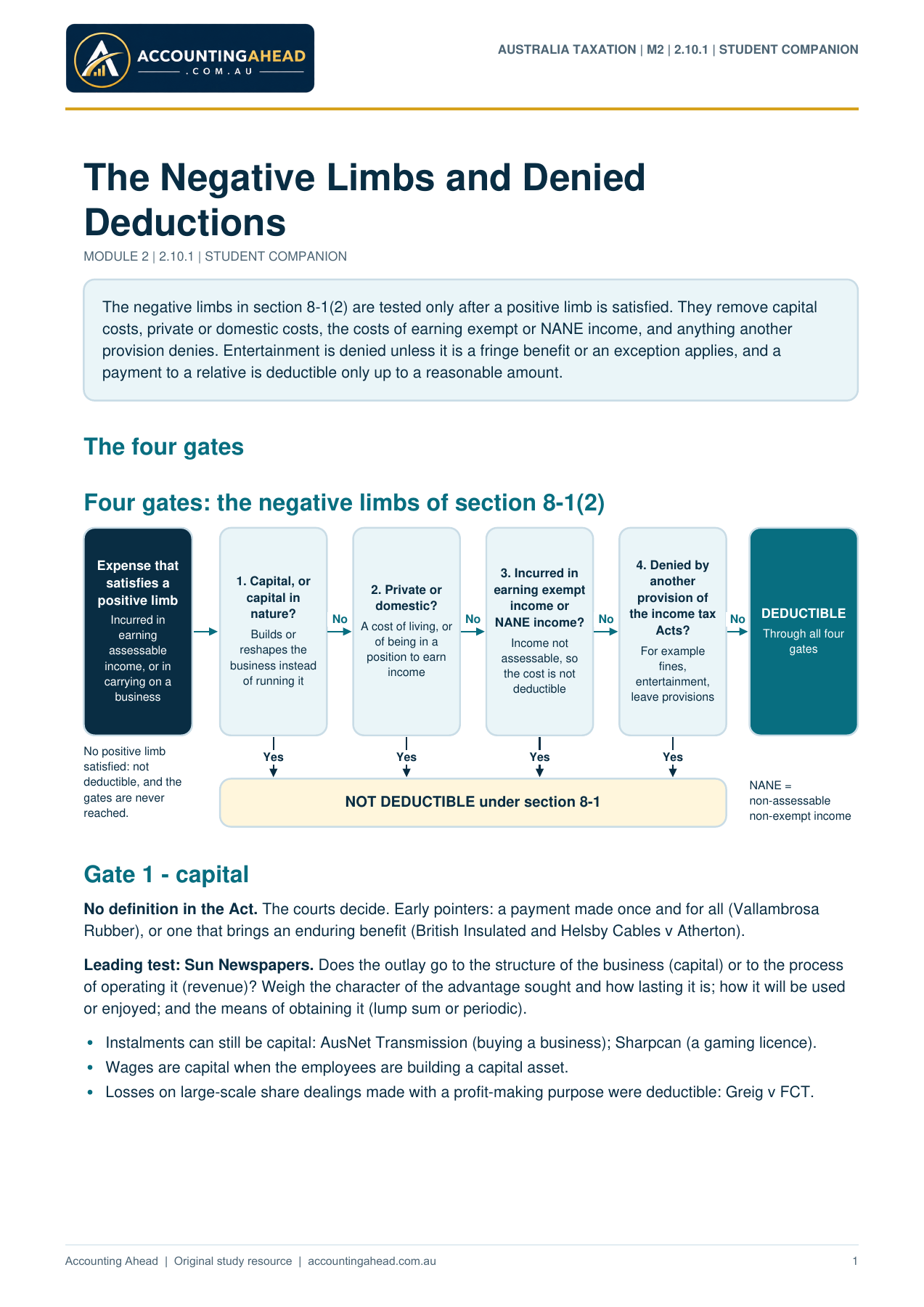
The negative limbs in section 8-1(2) are tested only after a positive limb is satisfied. They remove capital
costs, private or domestic costs, the costs of earning exempt or NANE income, and anything another
provision denies. Entertainment is denied unless it is a fringe benefit or an exception applies, and a
payment to a relative is deductible only up to a reasonable amount.
The four gates
Four gates: the negative limbs of section 8-1(2)
Expense that
satisfies a
positive limb
Incurred in
earning
assessable
income, or in
carrying on a
business
No positive limb
satisfied: not
deductible, and the
gates are never
reached.
1. Capital, or
capital in
nature?
Builds or
reshapes the
business instead
of running it
Yes
No
2. Private or
domestic?
A cost of living, or
of being in a
position to earn
income
Yes
No
3. Incurred in
earning exempt
income or
NANE income?
Income not
assessable, so
the cost is not
deductible
Yes
No
4. Denied by
another
provision of
the income tax
Acts?
For example
fines,
entertainment,
leave provisions
Yes
No DEDUCTIBLE
Through all four
gates
NOT DEDUCTIBLE under section 8-1
NANE =
non-assessable
non-exempt income
Gate 1 - capital
No definition in the Act. The courts decide. Early pointers: a payment made once and for all (Vallambrosa
Rubber), or one that brings an enduring benefit (British Insulated and Helsby Cables v Atherton).
Leading test: Sun Newspapers. Does the outlay go to the structure of the business (capital) or to the process
of operating it (revenue)? Weigh the character of the advantage sought and how lasting it is; how it will be used
or enjoyed; and the means of obtaining it (lump sum or periodic).
Instalments can still be capital: AusNet Transmission (buying a business); Sharpcan (a gaming licence).
Wages are capital when the employees are building a capital asset.
Losses on large-scale share dealings made with a profit-making purpose were deductible: Greig v FCT.
AUSTRALIA TAXATION | M2 | 2.10.1 | STUDENT COMPANION
1
Accounting Ahead | Original study resource | accountingahead.com.au
Gate 2 - private or domestic
Expense Position
Childcare Not deductible: a cost of being able to work (Lodge)
Home to work travel Not deductible. Fly-in fly-out: only travel after duties begin (John Holland)
Clothing Conventional: no. Protective, high-visibility, a specific uniform or occupation-specific: yes.
Non-compulsory uniform: only if registered with AusIndustry (s 34-10)
Home office Costs of using the room: yes. Mortgage interest and rates: no (Handley), unless that part of
the home is a separate place of business
Self-education For a new job or activity: no. To keep up to date or win promotion in the current job: yes (TR
98/9) - course and seminar fees, student union fees, materials, textbooks, and travel from
home or from work to the place of education and back. Childcare while studying stays private
(Lodge); HELP repayments are denied (s 26-20)
Gate 3 - exempt or NANE income
If the income is not assessable, the cost of earning it is not deductible.
Gate 4 - denied by another provision
Gate four: deductions denied by a specific provision
Wrongdoing
Penalties for breaching a law - s 26-5
Bribes to public officials - ss 26-52, 26-53
Spending on illegal activities, after a
conviction for an indictable offence - s 26-54
Personal
Maintaining a spouse, or a child under 16
- s 26-40
Recreational club memberships - s 26-45
(FB)
Leisure facilities - s 26-50 (FB)
Travel costs of a relative on a business trip -
s 26-30 (FB)
Gifts to political parties and candidates
- s 26-22
Protecting the system
Wages paid without the required PAYG
withholding - s 26-105
Provisions for annual and long service
leave: deduct when the leave is paid
- s 26-10
GST in a price, to the extent of an input tax
credit - s 27-5
Costs of holding vacant land (some
exceptions) - s 26-102
Travel to a residential rental property (some
exceptions) - s 26-31
(FB) = the denial gives way when the cost is provided as a fringe benefit. FBT applies instead.
Also denied. HELP debt repayments (s 26-20, unless paid by an employer subject to FBT); costs of earning a
rebatable benefit such as Youth Allowance (s 26-19); wages to seasonal workers without PAYG withholding (s
26-25A); excess superannuation contributions charge and tax (ss 26-74, 26-75).
Exceptions to remember. Section 26-5 does not catch a GST Act penalty under Subdivision 162-D. A relative's
travel is deductible if the relative has a genuine and substantial business reason to be there. Vacant land costs
stay deductible where the land is used in a business, and rental travel where letting residential property is itself a
business.
AUSTRALIA TAXATION | M2 | 2.10.1 | STUDENT COMPANION
2
Accounting Ahead | Original study resource | accountingahead.com.au
Entertainment (Division 32)
Entertainment: three questions
1. Is it entertainment?
Food, drink or recreation, plus any
accommodation or travel that goes with it.
Also property used to provide it.
2. Is it provided as a fringe benefit?
3. Does an exception apply?
Division 32 does not apply
Test under s 8-1 as usual
No
DEDUCTIBLE
FBT applies instead
Yes
Yes
No
DEDUCTIBLE
if s 8-1 is also satisfied
NOT DEDUCTIBLE
Yes
No
The main exceptions
1 Meals in an in-house dining facility
2 Entertainment an entertainment business
provides to its paying customers
3 Promotion or advertising open to the
public
4 Overtime meals under an industrial
instrument
5 Food, drink, accommodation and travel
for a seminar of at least 4 hours
6 Entertainment for sick, disabled or
disadvantaged members of the public
Example. Fernhollow Creamery: client dinner $1,200 - denied. Public tasting $800 and lunch at a six-hour staff
seminar $600 - deductible. Deductible: $1,400 of $2,600.
Payments to related entities (s 26-35)
A related entity is a relative, or a partnership in which a relative is a partner.
The payment must be deductible under another provision, normally s 8-1.
The Commissioner may cut the deduction back to what is reasonable.
Example. $60,000 paid to a daughter for work worth $15,000: deduction $15,000; the other $45,000 is not
deductible.
Key figures for 2024-25
Item Figure
Seminar exception for entertainment Seminar of at least 4 hours
Maintenance of a child denied (s 26-40) Child under 16
Indictable offence (s 26-54) Carries a prison term of one year or more
AUSTRALIA TAXATION | M2 | 2.10.1 | STUDENT COMPANION
3
Accounting Ahead | Original study resource | accountingahead.com.au
Practice questions
MODULE 2 | 2.10.1 | TRY THESE BEFORE THE WORKED ANSWERS
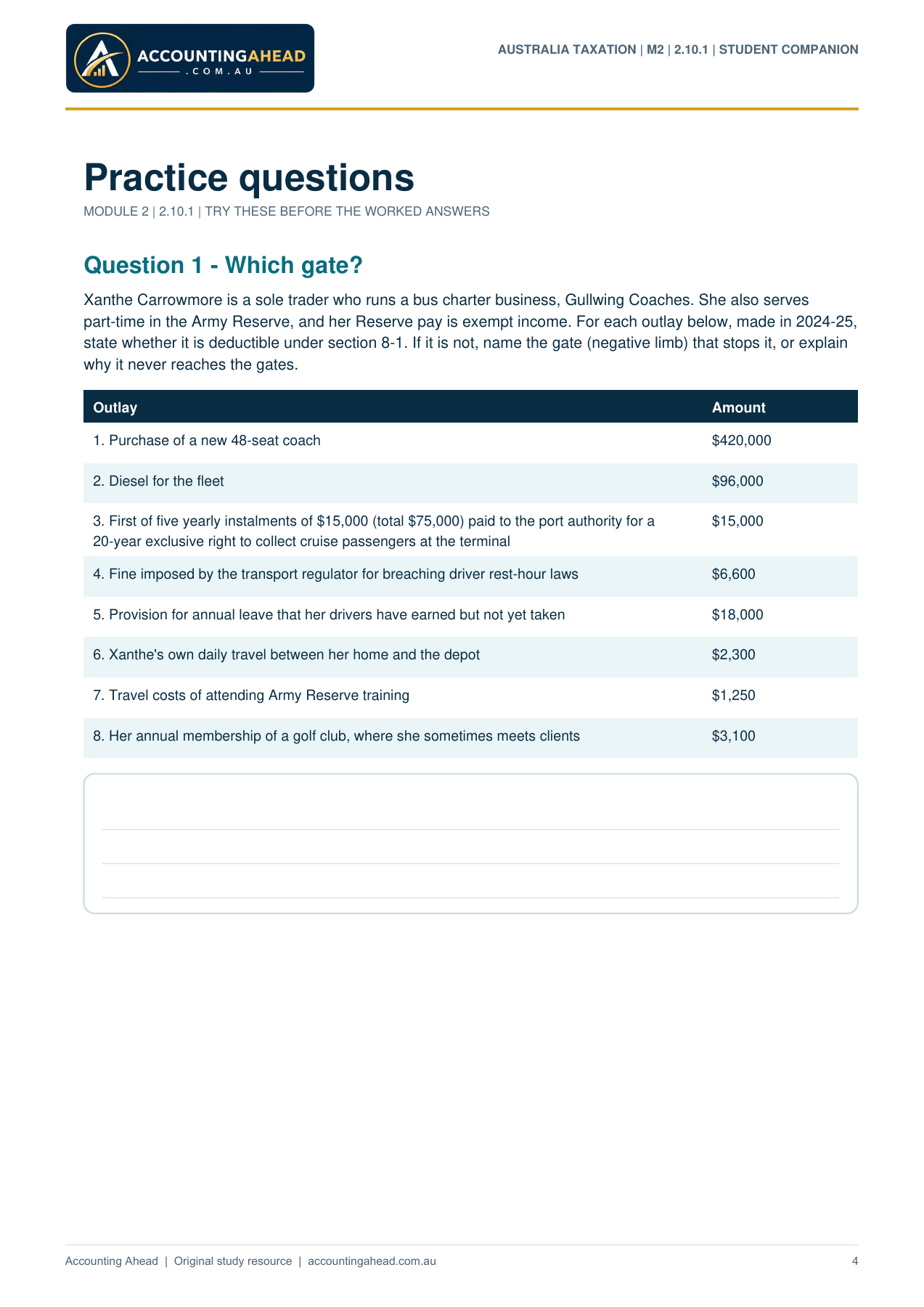
Question 1 - Which gate?
Xanthe Carrowmore is a sole trader who runs a bus charter business, Gullwing Coaches. She also serves
part-time in the Army Reserve, and her Reserve pay is exempt income. For each outlay below, made in 2024-25,
state whether it is deductible under section 8-1. If it is not, name the gate (negative limb) that stops it, or explain
why it never reaches the gates.
Outlay Amount
1. Purchase of a new 48-seat coach $420,000
2. Diesel for the fleet $96,000
3. First of five yearly instalments of $15,000 (total $75,000) paid to the port authority for a
20-year exclusive right to collect cruise passengers at the terminal
$15,000
4. Fine imposed by the transport regulator for breaching driver rest-hour laws $6,600
5. Provision for annual leave that her drivers have earned but not yet taken $18,000
6. Xanthe's own daily travel between her home and the depot $2,300
7. Travel costs of attending Army Reserve training $1,250
8. Her annual membership of a golf club, where she sometimes meets clients $3,100
AUSTRALIA TAXATION | M2 | 2.10.1 | STUDENT COMPANION
4
Accounting Ahead | Original study resource | accountingahead.com.au
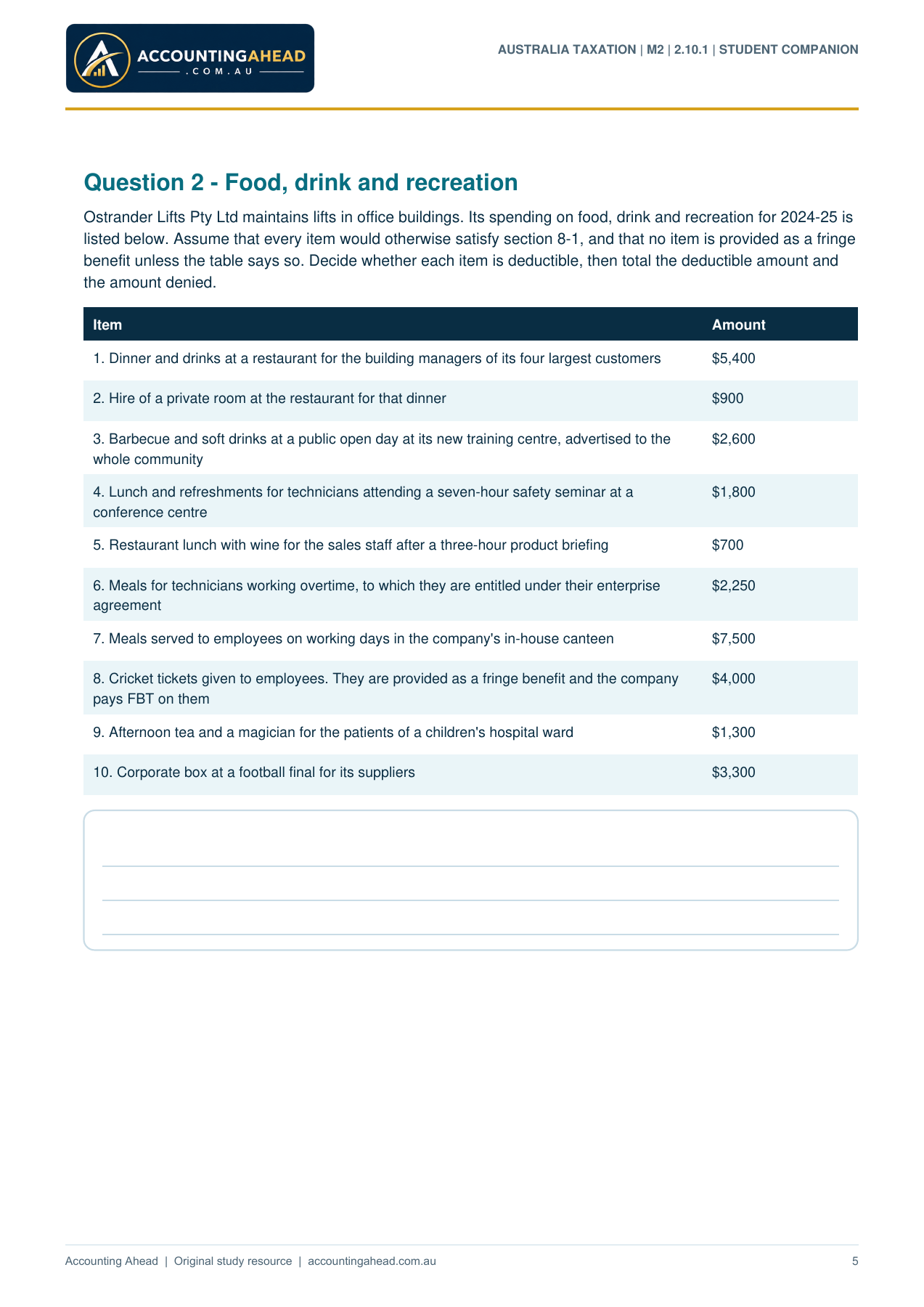
Question 2 - Food, drink and recreation
Ostrander Lifts Pty Ltd maintains lifts in office buildings. Its spending on food, drink and recreation for 2024-25 is
listed below. Assume that every item would otherwise satisfy section 8-1, and that no item is provided as a fringe
benefit unless the table says so. Decide whether each item is deductible, then total the deductible amount and
the amount denied.
Item Amount
1. Dinner and drinks at a restaurant for the building managers of its four largest customers $5,400
2. Hire of a private room at the restaurant for that dinner $900
3. Barbecue and soft drinks at a public open day at its new training centre, advertised to the
whole community
$2,600
4. Lunch and refreshments for technicians attending a seven-hour safety seminar at a
conference centre
$1,800
5. Restaurant lunch with wine for the sales staff after a three-hour product briefing $700
6. Meals for technicians working overtime, to which they are entitled under their enterprise
agreement
$2,250
7. Meals served to employees on working days in the company's in-house canteen $7,500
8. Cricket tickets given to employees. They are provided as a fringe benefit and the company
pays FBT on them
$4,000
9. Afternoon tea and a magician for the patients of a children's hospital ward $1,300
10. Corporate box at a football final for its suppliers $3,300
AUSTRALIA TAXATION | M2 | 2.10.1 | STUDENT COMPANION
5
Accounting Ahead | Original study resource | accountingahead.com.au
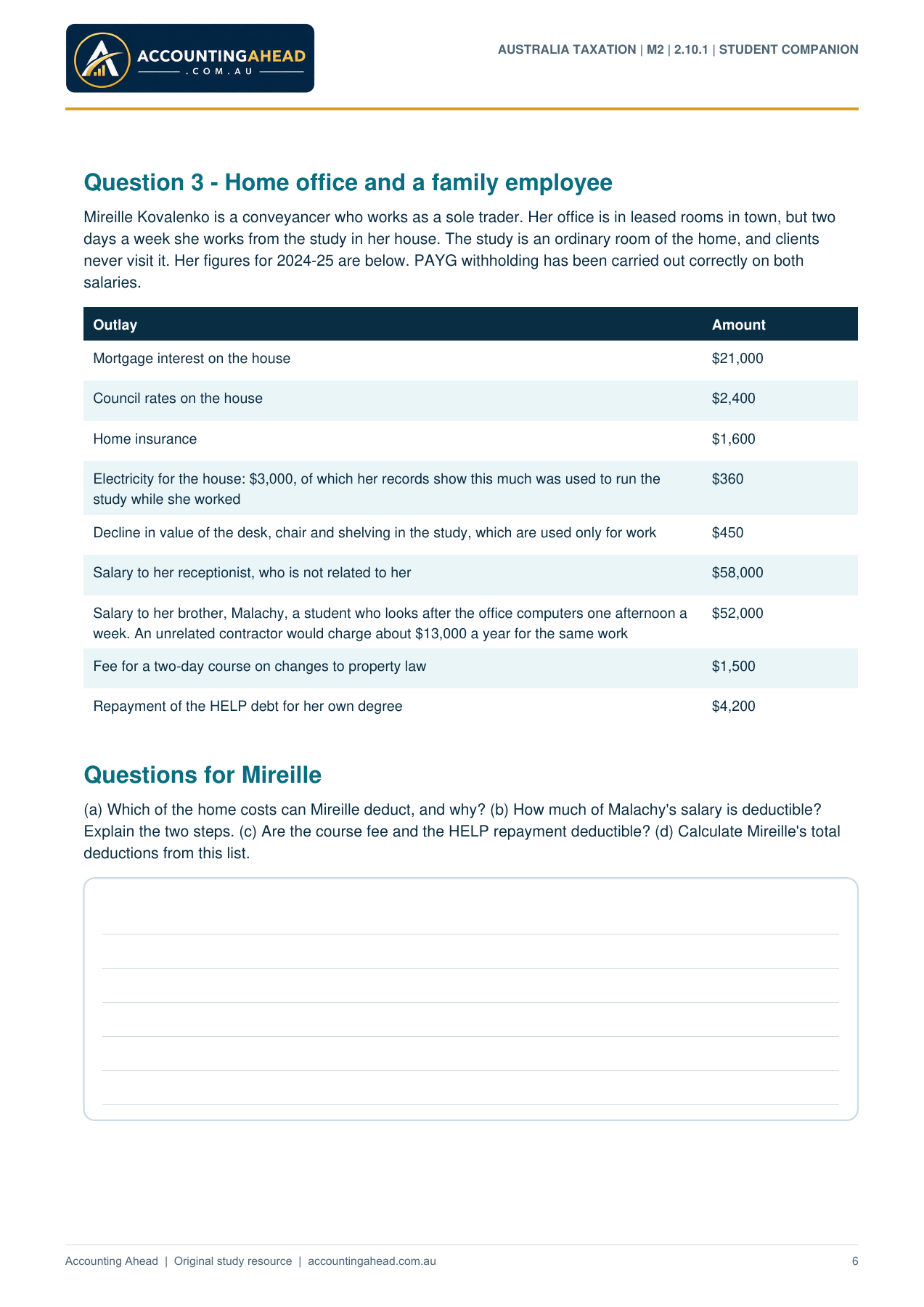
Question 3 - Home office and a family employee
Mireille Kovalenko is a conveyancer who works as a sole trader. Her office is in leased rooms in town, but two
days a week she works from the study in her house. The study is an ordinary room of the home, and clients
never visit it. Her figures for 2024-25 are below. PAYG withholding has been carried out correctly on both
salaries.
Outlay Amount
Mortgage interest on the house $21,000
Council rates on the house $2,400
Home insurance $1,600
Electricity for the house: $3,000, of which her records show this much was used to run the
study while she worked
$360
Decline in value of the desk, chair and shelving in the study, which are used only for work $450
Salary to her receptionist, who is not related to her $58,000
Salary to her brother, Malachy, a student who looks after the office computers one afternoon a
week. An unrelated contractor would charge about $13,000 a year for the same work
$52,000
Fee for a two-day course on changes to property law $1,500
Repayment of the HELP debt for her own degree $4,200
Questions for Mireille
(a) Which of the home costs can Mireille deduct, and why? (b) How much of Malachy's salary is deductible?
Explain the two steps. (c) Are the course fee and the HELP repayment deductible? (d) Calculate Mireille's total
deductions from this list.
AUSTRALIA TAXATION | M2 | 2.10.1 | STUDENT COMPANION
6
Accounting Ahead | Original study resource | accountingahead.com.au
Worked answers
MODULE 2 | 2.10.1 | WORKED ANSWERS - ATTEMPT THE QUESTIONS FIRST
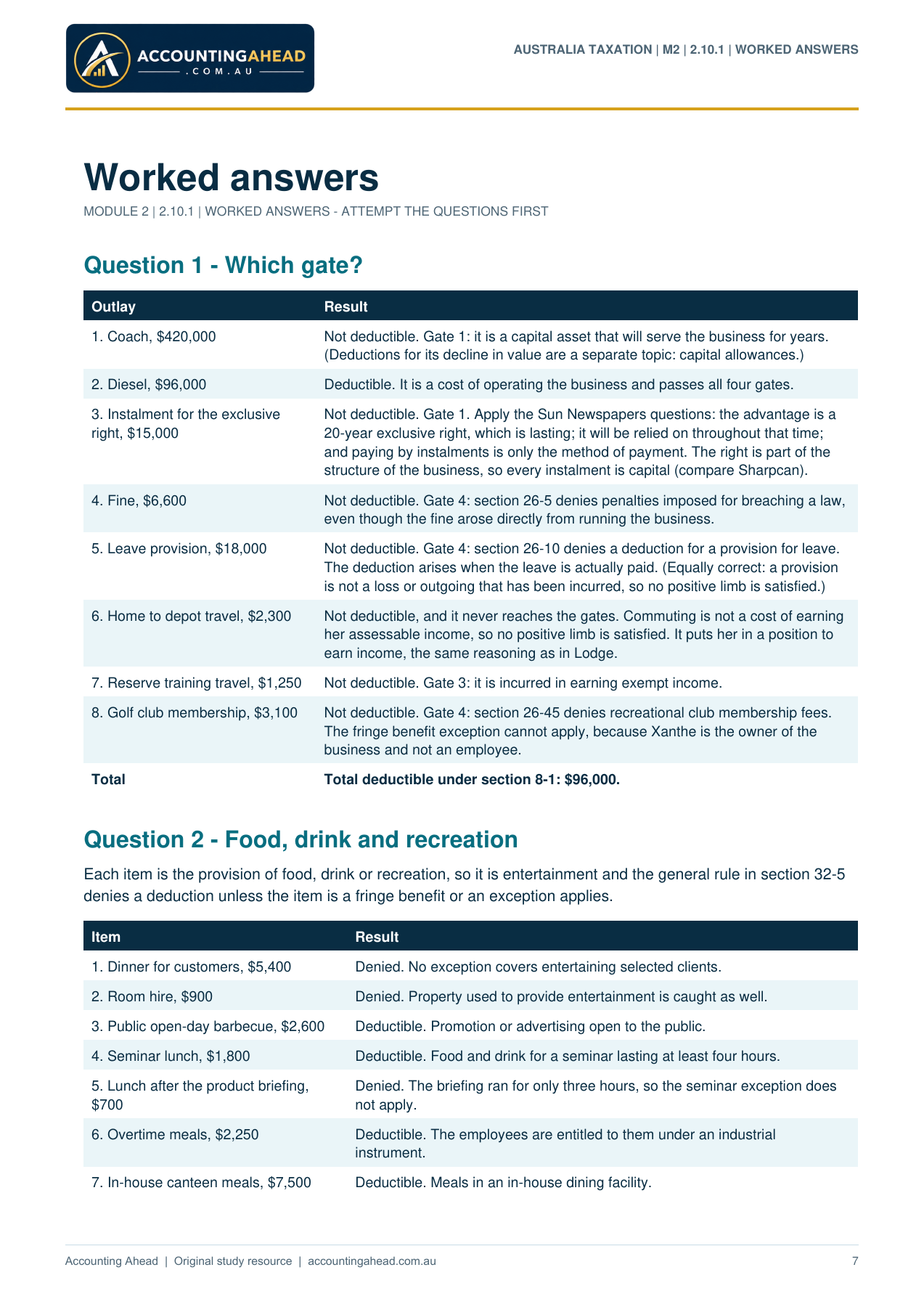
Question 1 - Which gate?
Outlay Result
1. Coach, $420,000 Not deductible. Gate 1: it is a capital asset that will serve the business for years.
(Deductions for its decline in value are a separate topic: capital allowances.)
2. Diesel, $96,000 Deductible. It is a cost of operating the business and passes all four gates.
3. Instalment for the exclusive
right, $15,000
Not deductible. Gate 1. Apply the Sun Newspapers questions: the advantage is a
20-year exclusive right, which is lasting; it will be relied on throughout that time;
and paying by instalments is only the method of payment. The right is part of the
structure of the business, so every instalment is capital (compare Sharpcan).
4. Fine, $6,600 Not deductible. Gate 4: section 26-5 denies penalties imposed for breaching a law,
even though the fine arose directly from running the business.
5. Leave provision, $18,000 Not deductible. Gate 4: section 26-10 denies a deduction for a provision for leave.
The deduction arises when the leave is actually paid. (Equally correct: a provision
is not a loss or outgoing that has been incurred, so no positive limb is satisfied.)
6. Home to depot travel, $2,300 Not deductible, and it never reaches the gates. Commuting is not a cost of earning
her assessable income, so no positive limb is satisfied. It puts her in a position to
earn income, the same reasoning as in Lodge.
7. Reserve training travel, $1,250 Not deductible. Gate 3: it is incurred in earning exempt income.
8. Golf club membership, $3,100 Not deductible. Gate 4: section 26-45 denies recreational club membership fees.
The fringe benefit exception cannot apply, because Xanthe is the owner of the
business and not an employee.
Total Total deductible under section 8-1: $96,000.
Question 2 - Food, drink and recreation
Each item is the provision of food, drink or recreation, so it is entertainment and the general rule in section 32-5
denies a deduction unless the item is a fringe benefit or an exception applies.
Item Result
1. Dinner for customers, $5,400 Denied. No exception covers entertaining selected clients.
2. Room hire, $900 Denied. Property used to provide entertainment is caught as well.
3. Public open-day barbecue, $2,600 Deductible. Promotion or advertising open to the public.
4. Seminar lunch, $1,800 Deductible. Food and drink for a seminar lasting at least four hours.
5. Lunch after the product briefing,
$700
Denied. The briefing ran for only three hours, so the seminar exception does
not apply.
6. Overtime meals, $2,250 Deductible. The employees are entitled to them under an industrial
instrument.
7. In-house canteen meals, $7,500 Deductible. Meals in an in-house dining facility.
AUSTRALIA TAXATION | M2 | 2.10.1 | WORKED ANSWERS
7
Accounting Ahead | Original study resource | accountingahead.com.au
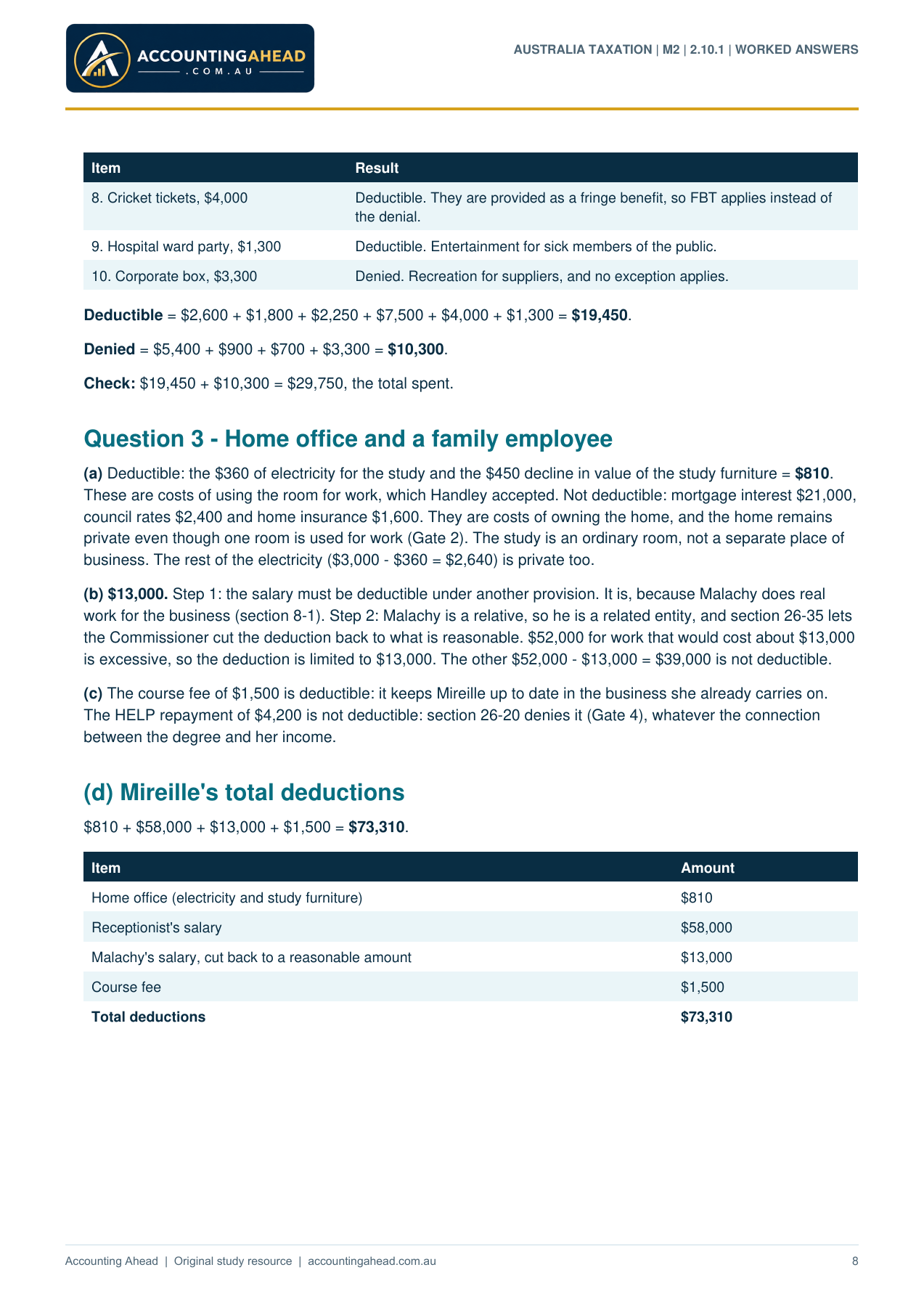
Item Result
8. Cricket tickets, $4,000 Deductible. They are provided as a fringe benefit, so FBT applies instead of
the denial.
9. Hospital ward party, $1,300 Deductible. Entertainment for sick members of the public.
10. Corporate box, $3,300 Denied. Recreation for suppliers, and no exception applies.
Deductible = $2,600 + $1,800 + $2,250 + $7,500 + $4,000 + $1,300 = $19,450.
Denied = $5,400 + $900 + $700 + $3,300 = $10,300.
Check: $19,450 + $10,300 = $29,750, the total spent.
Question 3 - Home office and a family employee
(a) Deductible: the $360 of electricity for the study and the $450 decline in value of the study furniture = $810.
These are costs of using the room for work, which Handley accepted. Not deductible: mortgage interest $21,000,
council rates $2,400 and home insurance $1,600. They are costs of owning the home, and the home remains
private even though one room is used for work (Gate 2). The study is an ordinary room, not a separate place of
business. The rest of the electricity ($3,000 - $360 = $2,640) is private too.
(b) $13,000. Step 1: the salary must be deductible under another provision. It is, because Malachy does real
work for the business (section 8-1). Step 2: Malachy is a relative, so he is a related entity, and section 26-35 lets
the Commissioner cut the deduction back to what is reasonable. $52,000 for work that would cost about $13,000
is excessive, so the deduction is limited to $13,000. The other $52,000 - $13,000 = $39,000 is not deductible.
(c) The course fee of $1,500 is deductible: it keeps Mireille up to date in the business she already carries on.
The HELP repayment of $4,200 is not deductible: section 26-20 denies it (Gate 4), whatever the connection
between the degree and her income.
(d) Mireille's total deductions
$810 + $58,000 + $13,000 + $1,500 = $73,310.
Item Amount
Home office (electricity and study furniture) $810
Receptionist's salary $58,000
Malachy's salary, cut back to a reasonable amount $13,000
Course fee $1,500
Total deductions $73,310
AUSTRALIA TAXATION | M2 | 2.10.1 | WORKED ANSWERS
8