
Decline in Value - Cost, Life and Methods — study companion
Part 2.14.1 of Australia Taxation. Preview the study companion or download the printable PDF.



Read the handout text
Accounting Ahead | Original study resource | accountingahead.com.au
Decline in value - cost, life and methods
MODULE 2 | 2.14.1 | STUDENT COMPANION
Under the general rules, a depreciating asset's cost is deducted over its effective life, using either prime
cost or diminishing value, for the days the asset is held. Cheap assets get a shortcut: an immediate
deduction or a low-value pool. The decline in value is always worked out in full, and the deduction is then
cut back for any private use.
Who uses the general rules
Two groups. Non-business individuals, such as employees and investors, and businesses: large businesses,
and small business entities that choose not to use simplified depreciation (lesson 2.17).
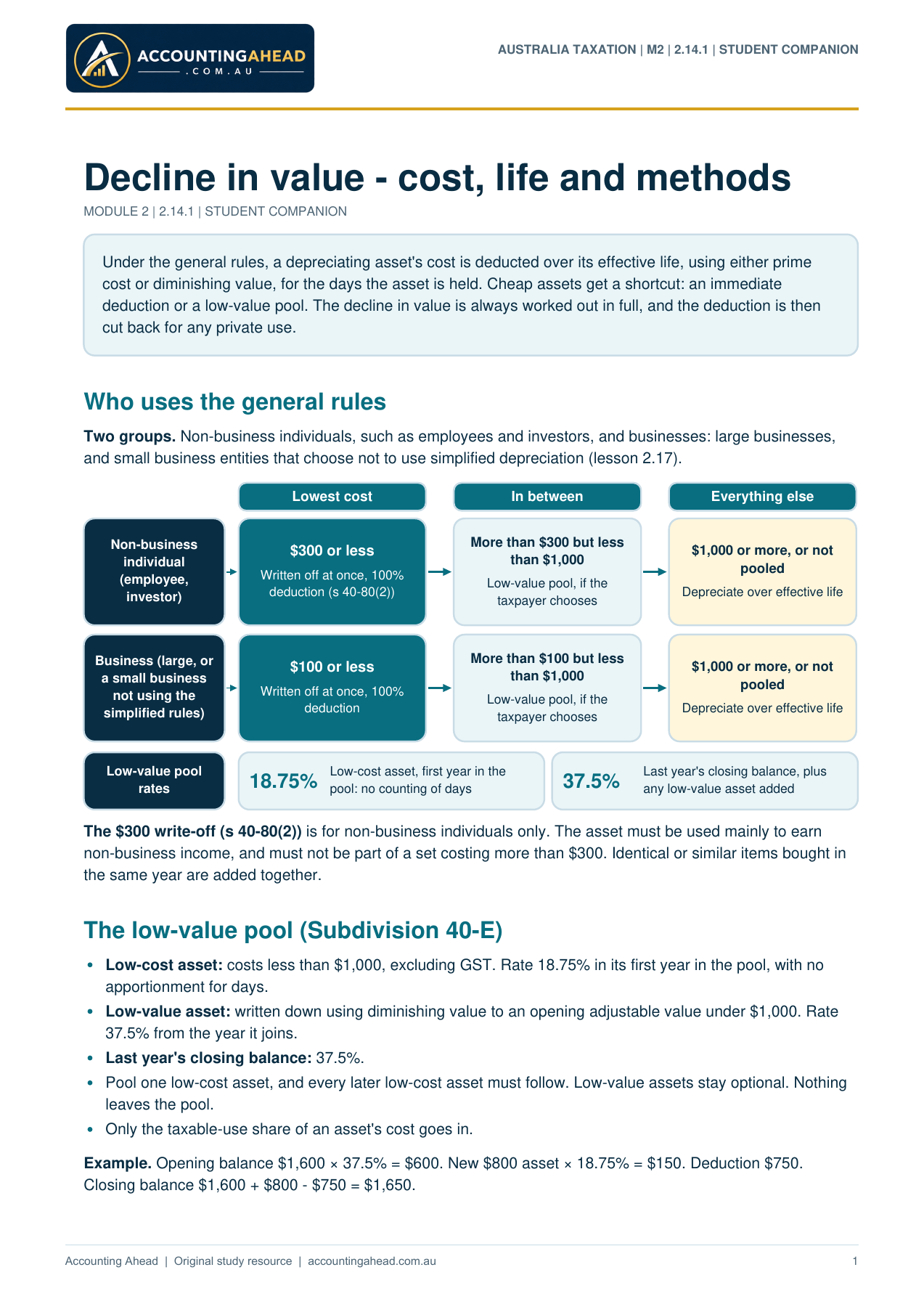
Lowest cost In between Everything else
Non-business
individual
(employee,
investor)
$300 or less
Written off at once, 100%
deduction (s 40-80(2))
More than $300 but less
than $1,000
Low-value pool, if the
taxpayer chooses
$1,000 or more, or not
pooled
Depreciate over effective life
Business (large, or
a small business
not using the
simplified rules)
$100 or less
Written off at once, 100%
deduction
More than $100 but less
than $1,000
Low-value pool, if the
taxpayer chooses
$1,000 or more, or not
pooled
Depreciate over effective life
Low-value pool
rates 18.75% Low-cost asset, first year in the
pool: no counting of days 37.5% Last year's closing balance, plus
any low-value asset added
The $300 write-off (s 40-80(2)) is for non-business individuals only. The asset must be used mainly to earn
non-business income, and must not be part of a set costing more than $300. Identical or similar items bought in
the same year are added together.
The low-value pool (Subdivision 40-E)
Low-cost asset: costs less than $1,000, excluding GST. Rate 18.75% in its first year in the pool, with no
apportionment for days.
Low-value asset: written down using diminishing value to an opening adjustable value under $1,000. Rate
37.5% from the year it joins.
Last year's closing balance: 37.5%.
Pool one low-cost asset, and every later low-cost asset must follow. Low-value assets stay optional. Nothing
leaves the pool.
Only the taxable-use share of an asset's cost goes in.
Example. Opening balance $1,600 × 37.5% = $600. New $800 asset × 18.75% = $150. Deduction $750.
Closing balance $1,600 + $800 - $750 = $1,650.
AUSTRALIA TAXATION | M2 | 2.14.1 | STUDENT COMPANION
1
Accounting Ahead | Original study resource | accountingahead.com.au
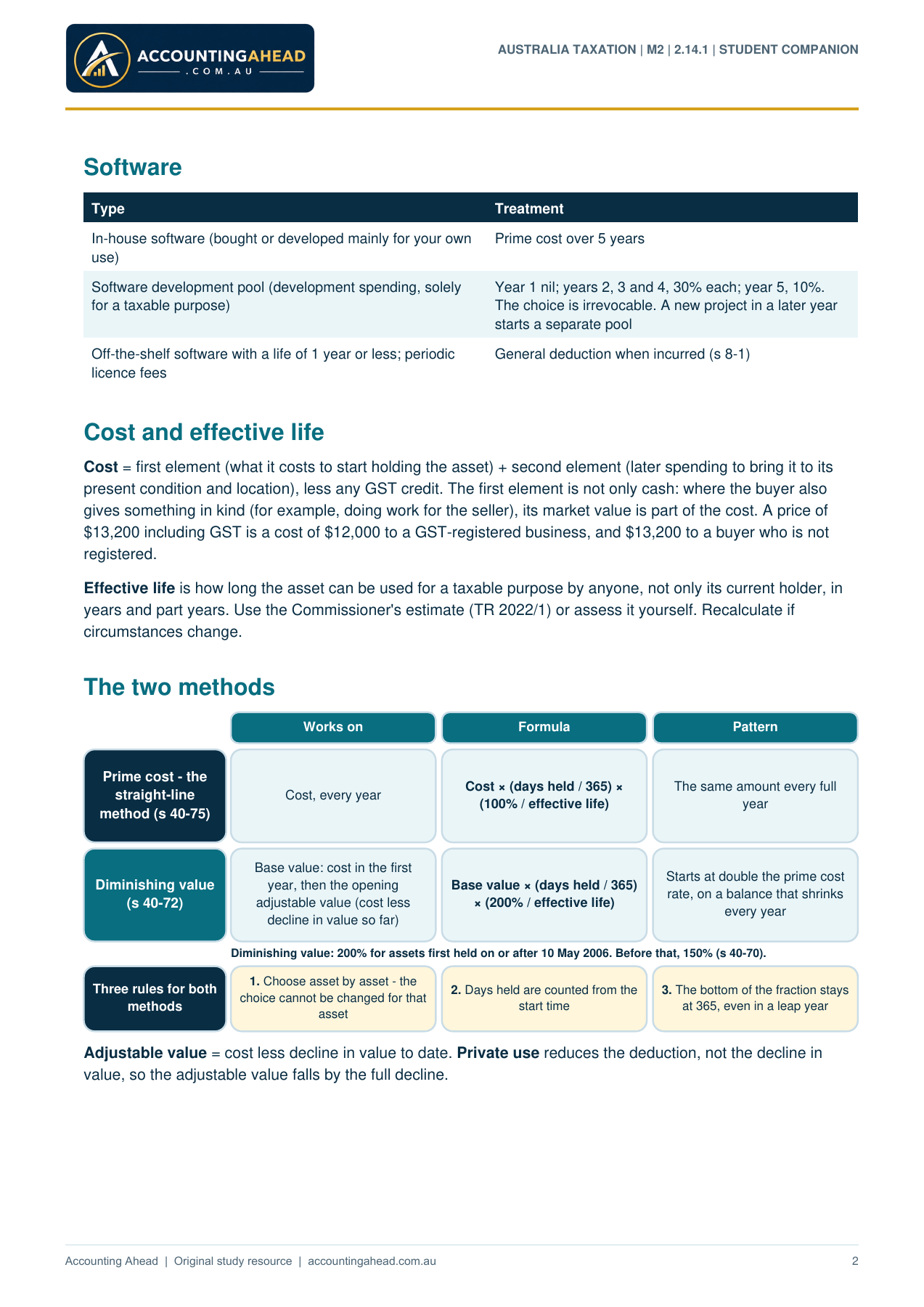
Software
Type Treatment
In-house software (bought or developed mainly for your own
use)
Prime cost over 5 years
Software development pool (development spending, solely
for a taxable purpose)
Year 1 nil; years 2, 3 and 4, 30% each; year 5, 10%.
The choice is irrevocable. A new project in a later year
starts a separate pool
Off-the-shelf software with a life of 1 year or less; periodic
licence fees
General deduction when incurred (s 8-1)
Cost and effective life
Cost = first element (what it costs to start holding the asset) + second element (later spending to bring it to its
present condition and location), less any GST credit. The first element is not only cash: where the buyer also
gives something in kind (for example, doing work for the seller), its market value is part of the cost. A price of
$13,200 including GST is a cost of $12,000 to a GST-registered business, and $13,200 to a buyer who is not
registered.
Effective life is how long the asset can be used for a taxable purpose by anyone, not only its current holder, in
years and part years. Use the Commissioner's estimate (TR 2022/1) or assess it yourself. Recalculate if
circumstances change.
The two methods
Works on Formula Pattern
Prime cost - the
straight-line
method (s 40-75)
Cost, every year Cost × (days held / 365) ×
(100% / effective life)
The same amount every full
year
Diminishing value
(s 40-72)
Base value: cost in the first
year, then the opening
adjustable value (cost less
decline in value so far)
Base value × (days held / 365)
× (200% / effective life)
Starts at double the prime cost
rate, on a balance that shrinks
every year
Diminishing value: 200% for assets first held on or after 10 May 2006. Before that, 150% (s 40-70).
Three rules for both
methods
1. Choose asset by asset - the
choice cannot be changed for that
asset
2. Days held are counted from the
start time
3. The bottom of the fraction stays
at 365, even in a leap year
Adjustable value = cost less decline in value to date. Private use reduces the deduction, not the decline in
value, so the adjustable value falls by the full decline.
AUSTRALIA TAXATION | M2 | 2.14.1 | STUDENT COMPANION
2
Accounting Ahead | Original study resource | accountingahead.com.au
1 Days held in 2024-25 5 February to 30 June 2025 = 146 days. 146 / 365 = 40% of a year.
2 Prime cost, 2024-25
Rate 100% / 4 = 25%
$8,000 × 40% × 25% = $800
3 Diminishing value, 2024-25
Rate 200% / 4 = 50%
$8,000 × 40% × 50% = $1,600
4 Private use - she chooses diminishing value
Decline in value, worked out in full: $1,600
Deduction: 75% × $1,600 = $1,200
Adjustable value: $8,000 - $1,600 = $6,400
The decline in value is always
worked out in full. It is the deduction
that is reduced.
5 2025-26, a full year Decline in value: 50% × $6,400 = $3,200 Deduction: 75% × $3,200 = $2,400
6 Prime cost in 2025-26, for comparison 25% × $8,000 = $2,000
Choosing. Diminishing value brings deductions forward. Prime cost keeps them level, which can suit a taxpayer
in a tax loss.
Adjusted prime cost (s 40-75(3)). After a recalculated effective life, or a second element of cost added in a
later year: (opening adjustable value + that cost) × (days held / 365) × (100% / remaining effective life).
Key figures for 2024-25
Item Figure
Immediate deduction - non-business individual Asset costing $300 or less
Immediate deduction - business Asset costing $100 or less
Low-cost asset / low-value asset Less than $1,000
Low-value pool rates 18.75% first year; 37.5% after that
Prime cost rate 100% / effective life
Diminishing value rate 200% / effective life (150% if first held before 10 May
2006)
Days-held fraction Days held / 365, even in a leap year
In-house software 5 years, prime cost
Software development pool 0%, 30%, 30%, 30%, 10%
Car limit $69,674
AUSTRALIA TAXATION | M2 | 2.14.1 | STUDENT COMPANION
3
Accounting Ahead | Original study resource | accountingahead.com.au
Practice questions
MODULE 2 | 2.14.1 | TRY THESE BEFORE THE WORKED ANSWERS
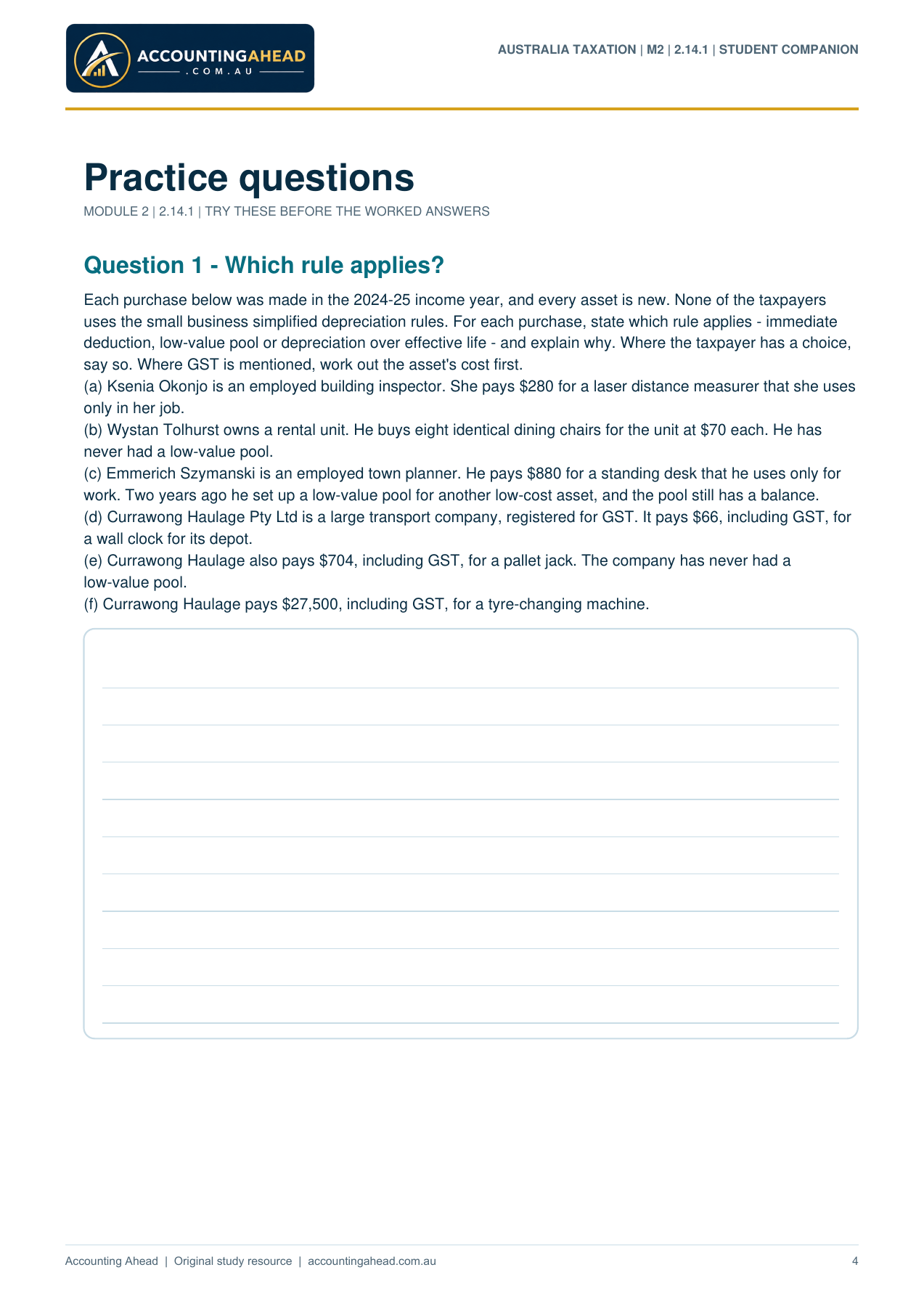
Question 1 - Which rule applies?
Each purchase below was made in the 2024-25 income year, and every asset is new. None of the taxpayers
uses the small business simplified depreciation rules. For each purchase, state which rule applies - immediate
deduction, low-value pool or depreciation over effective life - and explain why. Where the taxpayer has a choice,
say so. Where GST is mentioned, work out the asset's cost first.
(a) Ksenia Okonjo is an employed building inspector. She pays $280 for a laser distance measurer that she uses
only in her job.
(b) Wystan Tolhurst owns a rental unit. He buys eight identical dining chairs for the unit at $70 each. He has
never had a low-value pool.
(c) Emmerich Szymanski is an employed town planner. He pays $880 for a standing desk that he uses only for
work. Two years ago he set up a low-value pool for another low-cost asset, and the pool still has a balance.
(d) Currawong Haulage Pty Ltd is a large transport company, registered for GST. It pays $66, including GST, for
a wall clock for its depot.
(e) Currawong Haulage also pays $704, including GST, for a pallet jack. The company has never had a
low-value pool.
(f) Currawong Haulage pays $27,500, including GST, for a tyre-changing machine.
AUSTRALIA TAXATION | M2 | 2.14.1 | STUDENT COMPANION
4
Accounting Ahead | Original study resource | accountingahead.com.au
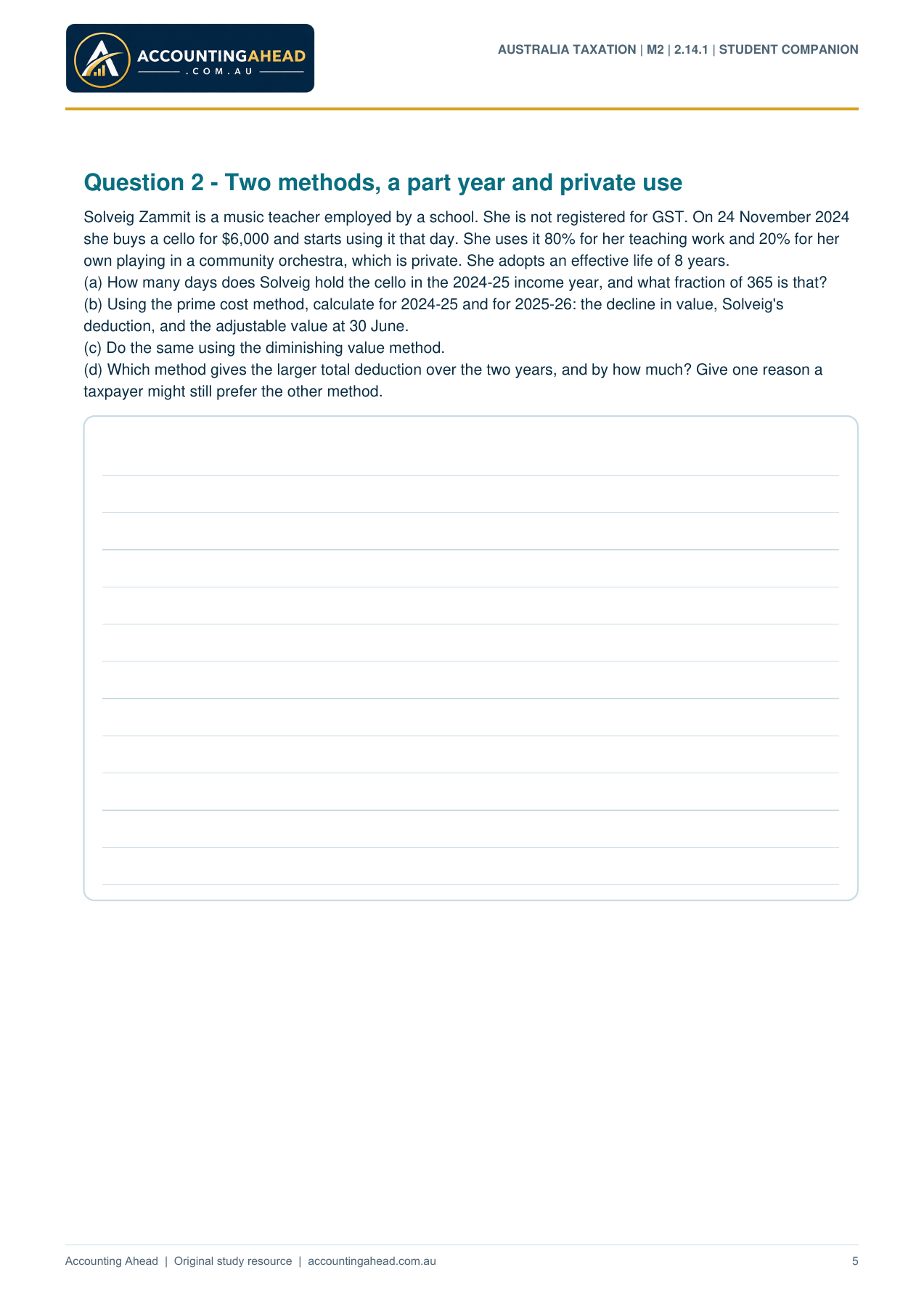
Question 2 - Two methods, a part year and private use
Solveig Zammit is a music teacher employed by a school. She is not registered for GST. On 24 November 2024
she buys a cello for $6,000 and starts using it that day. She uses it 80% for her teaching work and 20% for her
own playing in a community orchestra, which is private. She adopts an effective life of 8 years.
(a) How many days does Solveig hold the cello in the 2024-25 income year, and what fraction of 365 is that?
(b) Using the prime cost method, calculate for 2024-25 and for 2025-26: the decline in value, Solveig's
deduction, and the adjustable value at 30 June.
(c) Do the same using the diminishing value method.
(d) Which method gives the larger total deduction over the two years, and by how much? Give one reason a
taxpayer might still prefer the other method.
AUSTRALIA TAXATION | M2 | 2.14.1 | STUDENT COMPANION
5
Accounting Ahead | Original study resource | accountingahead.com.au
Question 3 - Two kinds of pool
Part A - Low-value pool. Ruairi Engstrom is an employed draftsman who is not registered for GST. He set up a
low-value pool three years ago for low-cost assets, and its closing balance at 30 June 2024 was $2,400. In
2024-25 he buys two new assets:
Asset Date bought Cost Use
Drafting table 3 March 2025 $720 100% work
Noise-cancelling headset 10 May 2025 $480 50% work, 50% private
(a) Calculate Ruairi's low-value pool deduction for 2024-25.
(b) Calculate the pool's closing balance at 30 June 2025.
(c) Both assets were bought late in the income year. Does that reduce the deduction?
(d) Ruairi also owns a camera that he has been depreciating under the prime cost method. Its opening
adjustable value at 1 July 2024 was $700. Can he allocate it to the pool?
(e) If nothing is added to the pool or sold in 2025-26, what is the pool deduction for that year?
Part B - Software development pool. Wattlebird Hire Pty Ltd is a large equipment-hire company. In the
2024-25 income year it pays a developer $80,000 (excluding GST) to build a booking system that it will use
solely in its own business, and it allocates the expenditure to a software development pool.
(f) What can Wattlebird Hire deduct in each income year from 2024-25 to 2028-29?
(g) In 2025-26 Wattlebird Hire commissions a second, separate software development project. Can that
spending go into the same pool? Can the company choose not to pool it?
AUSTRALIA TAXATION | M2 | 2.14.1 | STUDENT COMPANION
6
Accounting Ahead | Original study resource | accountingahead.com.au
Worked answers
MODULE 2 | 2.14.1 | WORKED ANSWERS - ATTEMPT THE QUESTIONS FIRST
Answer 1
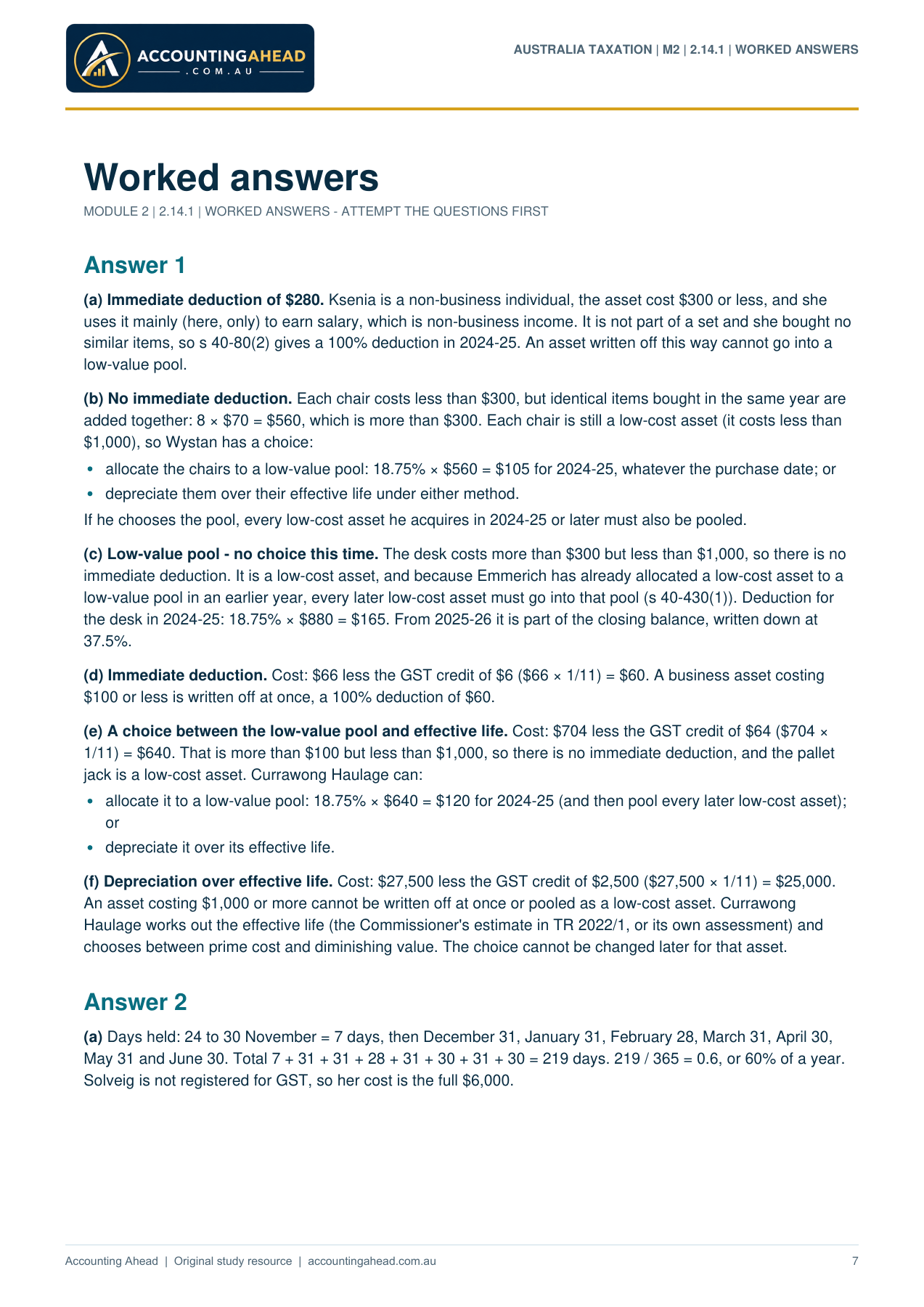
(a) Immediate deduction of $280. Ksenia is a non-business individual, the asset cost $300 or less, and she
uses it mainly (here, only) to earn salary, which is non-business income. It is not part of a set and she bought no
similar items, so s 40-80(2) gives a 100% deduction in 2024-25. An asset written off this way cannot go into a
low-value pool.
(b) No immediate deduction. Each chair costs less than $300, but identical items bought in the same year are
added together: 8 × $70 = $560, which is more than $300. Each chair is still a low-cost asset (it costs less than
$1,000), so Wystan has a choice:
allocate the chairs to a low-value pool: 18.75% × $560 = $105 for 2024-25, whatever the purchase date; or
depreciate them over their effective life under either method.
If he chooses the pool, every low-cost asset he acquires in 2024-25 or later must also be pooled.
(c) Low-value pool - no choice this time. The desk costs more than $300 but less than $1,000, so there is no
immediate deduction. It is a low-cost asset, and because Emmerich has already allocated a low-cost asset to a
low-value pool in an earlier year, every later low-cost asset must go into that pool (s 40-430(1)). Deduction for
the desk in 2024-25: 18.75% × $880 = $165. From 2025-26 it is part of the closing balance, written down at
37.5%.
(d) Immediate deduction. Cost: $66 less the GST credit of $6 ($66 × 1/11) = $60. A business asset costing
$100 or less is written off at once, a 100% deduction of $60.
(e) A choice between the low-value pool and effective life. Cost: $704 less the GST credit of $64 ($704 ×
1/11) = $640. That is more than $100 but less than $1,000, so there is no immediate deduction, and the pallet
jack is a low-cost asset. Currawong Haulage can:
allocate it to a low-value pool: 18.75% × $640 = $120 for 2024-25 (and then pool every later low-cost asset);
or
depreciate it over its effective life.
(f) Depreciation over effective life. Cost: $27,500 less the GST credit of $2,500 ($27,500 × 1/11) = $25,000.
An asset costing $1,000 or more cannot be written off at once or pooled as a low-cost asset. Currawong
Haulage works out the effective life (the Commissioner's estimate in TR 2022/1, or its own assessment) and
chooses between prime cost and diminishing value. The choice cannot be changed later for that asset.
Answer 2
(a) Days held: 24 to 30 November = 7 days, then December 31, January 31, February 28, March 31, April 30,
May 31 and June 30. Total 7 + 31 + 31 + 28 + 31 + 30 + 31 + 30 = 219 days. 219 / 365 = 0.6, or 60% of a year.
Solveig is not registered for GST, so her cost is the full $6,000.
AUSTRALIA TAXATION | M2 | 2.14.1 | WORKED ANSWERS
7
Accounting Ahead | Original study resource | accountingahead.com.au
(b) Prime cost - rate 100% / 8 = 12.5%
2024-25 2025-26
Decline in value $6,000 × 219/365 × 12.5% = $450 $6,000 × 365/365 × 12.5% = $750
Deduction (80%) 80% × $450 = $360 80% × $750 = $600
Adjustable value at 30 June $6,000 - $450 = $5,550 $5,550 - $750 = $4,800
(c) Diminishing value - rate 200% / 8 = 25%
2024-25 2025-26
Base value $6,000 (cost) $5,100 (opening adjustable value)
Decline in value $6,000 × 219/365 × 25% = $900 $5,100 × 365/365 × 25% = $1,275
Deduction (80%) 80% × $900 = $720 80% × $1,275 = $1,020
Adjustable value at 30 June $6,000 - $900 = $5,100 $5,100 - $1,275 = $3,825
Under both methods the adjustable value falls by the full decline in value, not by the deduction. The 20% private
use reduces only what Solveig can deduct.
(d) Prime cost deductions: $360 + $600 = $960. Diminishing value deductions: $720 + $1,020 = $1,740.
Diminishing value gives $780 more over the two years ($1,740 - $960). A taxpayer might still prefer prime cost if
they are in a tax loss, or expect a higher taxable income in later years: prime cost leaves more of the deduction
for those years. Both methods spread the same $6,000 of cost, so the difference is one of timing. Whichever
method Solveig chooses, she cannot change it later for the cello.
Answer 3
Part A
(a) Both new assets cost less than $1,000, so they are low-cost assets, and because Ruairi already has a pool
holding low-cost assets, both must be allocated to it. The headset's cost ($480) is more than $300, so it could
not be written off at once. Only the taxable-use share of its cost goes into the pool: 50% × $480 = $240.
Pool deduction for 2024-25
Item Calculation Deduction
Closing balance from 2023-24 37.5% × $2,400 $900
Drafting table 18.75% × $720 $135
Headset (work share $240) 18.75% × $240 $45
Total deduction for 2024-25 $1,080
(b) Closing balance at 30 June 2025: $2,400 + $720 + $240 - $1,080 = $2,280.
(c) No. A low-cost asset gets 18.75% in its first year in the pool whenever it was bought during the year. There is
no apportionment for days held.
AUSTRALIA TAXATION | M2 | 2.14.1 | WORKED ANSWERS
8
Accounting Ahead | Original study resource | accountingahead.com.au
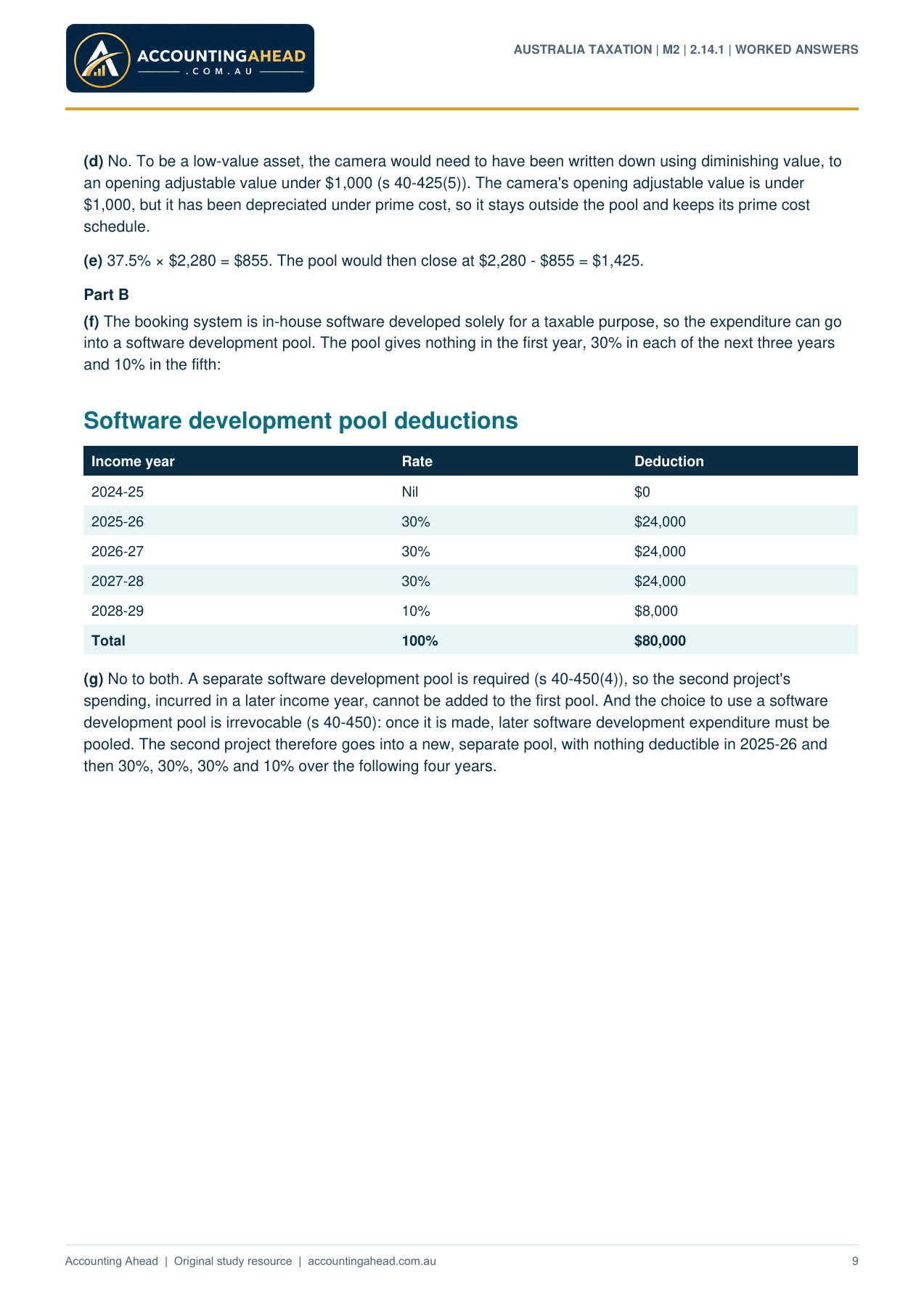
(d) No. To be a low-value asset, the camera would need to have been written down using diminishing value, to
an opening adjustable value under $1,000 (s 40-425(5)). The camera's opening adjustable value is under
$1,000, but it has been depreciated under prime cost, so it stays outside the pool and keeps its prime cost
schedule.
(e) 37.5% × $2,280 = $855. The pool would then close at $2,280 - $855 = $1,425.
Part B
(f) The booking system is in-house software developed solely for a taxable purpose, so the expenditure can go
into a software development pool. The pool gives nothing in the first year, 30% in each of the next three years
and 10% in the fifth:
Software development pool deductions
Income year Rate Deduction
2024-25 Nil $0
2025-26 30% $24,000
2026-27 30% $24,000
2027-28 30% $24,000
2028-29 10% $8,000
Total 100% $80,000
(g) No to both. A separate software development pool is required (s 40-450(4)), so the second project's
spending, incurred in a later income year, cannot be added to the first pool. And the choice to use a software
development pool is irrevocable (s 40-450): once it is made, later software development expenditure must be
pooled. The second project therefore goes into a new, separate pool, with nothing deductible in 2025-26 and
then 30%, 30%, 30% and 10% over the following four years.
AUSTRALIA TAXATION | M2 | 2.14.1 | WORKED ANSWERS
9