
Ordinary Income and the Capital Line — study companion
Part 2.4.1 of Australia Taxation. Preview the study companion or download the printable PDF.
Read the handout text
Accounting Ahead | Original study resource | accountingahead.com.au
Ordinary income and the capital line
MODULE 2 | 2.4.1 | STUDENT COMPANION
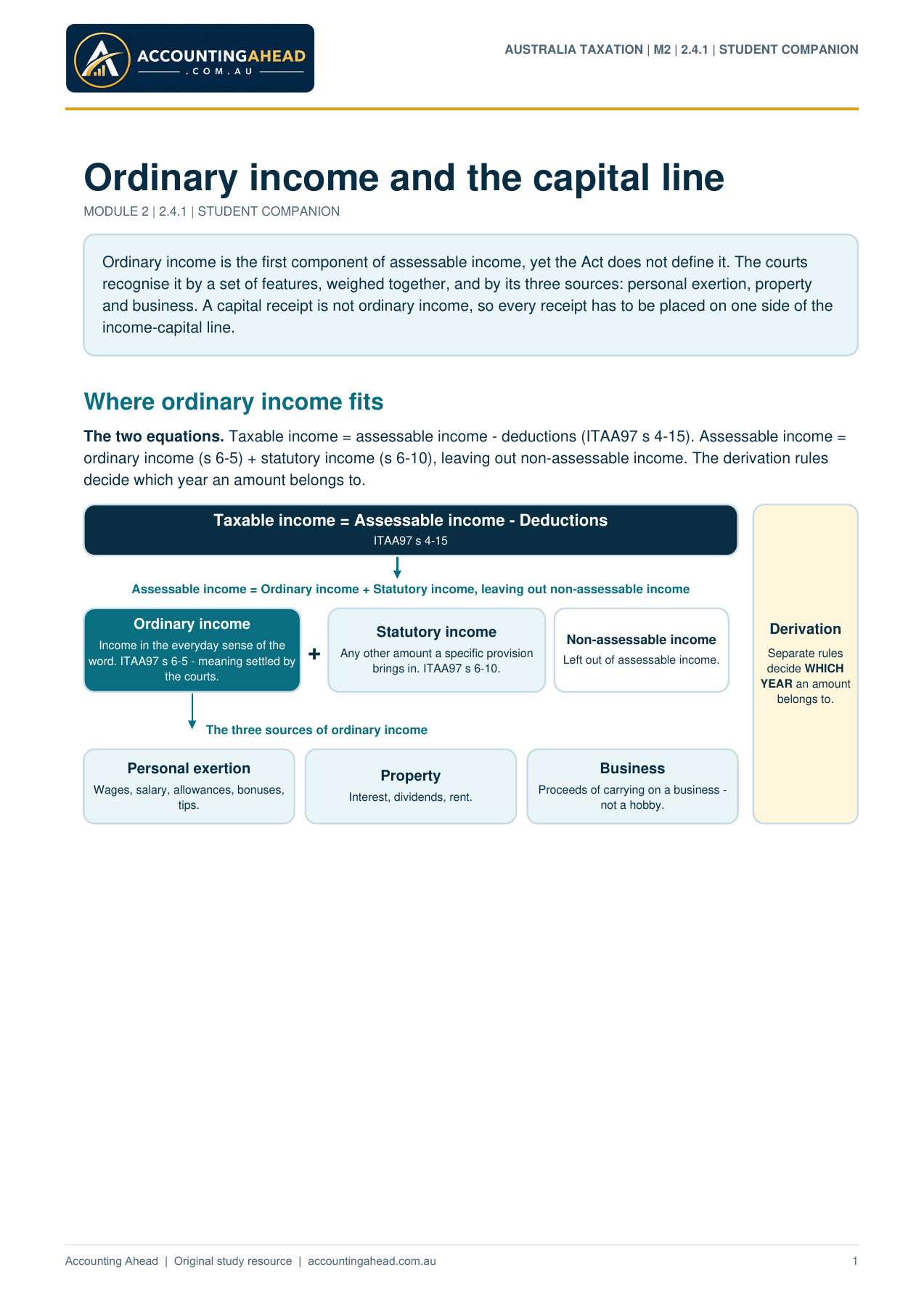
Ordinary income is the first component of assessable income, yet the Act does not define it. The courts
recognise it by a set of features, weighed together, and by its three sources: personal exertion, property
and business. A capital receipt is not ordinary income, so every receipt has to be placed on one side of the
income-capital line.
Where ordinary income fits
The two equations. Taxable income = assessable income - deductions (ITAA97 s 4-15). Assessable income =
ordinary income (s 6-5) + statutory income (s 6-10), leaving out non-assessable income. The derivation rules
decide which year an amount belongs to.
Taxable income = Assessable income - Deductions
ITAA97 s 4-15
Assessable income = Ordinary income + Statutory income, leaving out non-assessable income
Ordinary income
Income in the everyday sense of the
word. ITAA97 s 6-5 - meaning settled by
the courts.
+
Statutory income
Any other amount a specific provision
brings in. ITAA97 s 6-10.
Non-assessable income
Left out of assessable income.
The three sources of ordinary income
Personal exertion
Wages, salary, allowances, bonuses,
tips.
Property
Interest, dividends, rent.
Business
Proceeds of carrying on a business -
not a hobby.
Derivation
Separate rules
decide WHICH
YEAR an amount
belongs to.
AUSTRALIA TAXATION | M2 | 2.4.1 | STUDENT COMPANION
1
Accounting Ahead | Original study resource | accountingahead.com.au
Income according to ordinary concepts
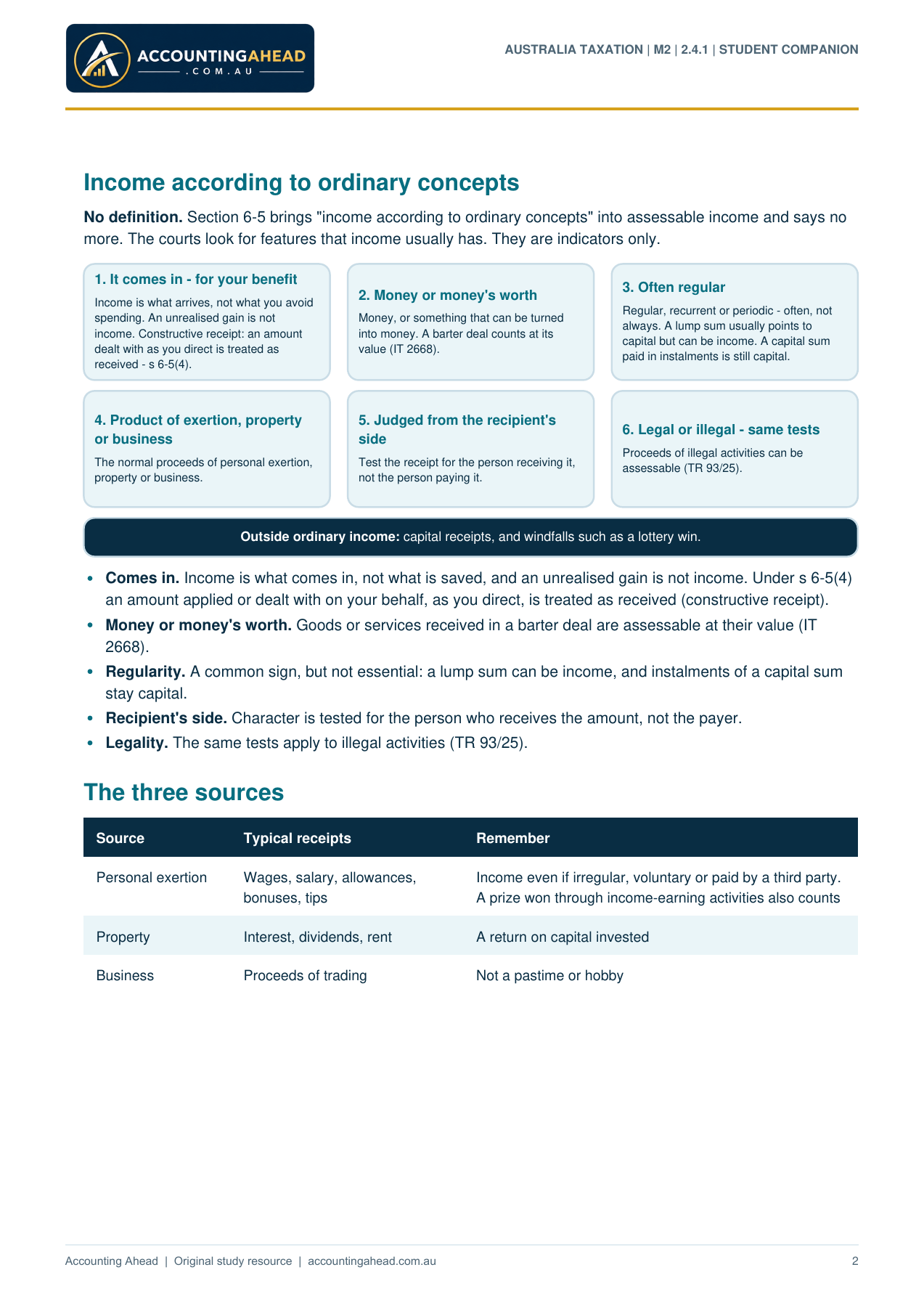
No definition. Section 6-5 brings "income according to ordinary concepts" into assessable income and says no
more. The courts look for features that income usually has. They are indicators only.
1. It comes in - for your benefit
Income is what arrives, not what you avoid
spending. An unrealised gain is not
income. Constructive receipt: an amount
dealt with as you direct is treated as
received - s 6-5(4).
2. Money or money's worth
Money, or something that can be turned
into money. A barter deal counts at its
value (IT 2668).
3. Often regular
Regular, recurrent or periodic - often, not
always. A lump sum usually points to
capital but can be income. A capital sum
paid in instalments is still capital.
4. Product of exertion, property
or business
The normal proceeds of personal exertion,
property or business.
5. Judged from the recipient's
side
Test the receipt for the person receiving it,
not the person paying it.
6. Legal or illegal - same tests
Proceeds of illegal activities can be
assessable (TR 93/25).
Outside ordinary income: capital receipts, and windfalls such as a lottery win.
Comes in. Income is what comes in, not what is saved, and an unrealised gain is not income. Under s 6-5(4)
an amount applied or dealt with on your behalf, as you direct, is treated as received (constructive receipt).
Money or money's worth. Goods or services received in a barter deal are assessable at their value (IT
2668).
Regularity. A common sign, but not essential: a lump sum can be income, and instalments of a capital sum
stay capital.
Recipient's side. Character is tested for the person who receives the amount, not the payer.
Legality. The same tests apply to illegal activities (TR 93/25).
The three sources
Source Typical receipts Remember
Personal exertion Wages, salary, allowances,
bonuses, tips
Income even if irregular, voluntary or paid by a third party.
A prize won through income-earning activities also counts
Property Interest, dividends, rent A return on capital invested
Business Proceeds of trading Not a pastime or hobby
AUSTRALIA TAXATION | M2 | 2.4.1 | STUDENT COMPANION
2
Accounting Ahead | Original study resource | accountingahead.com.au
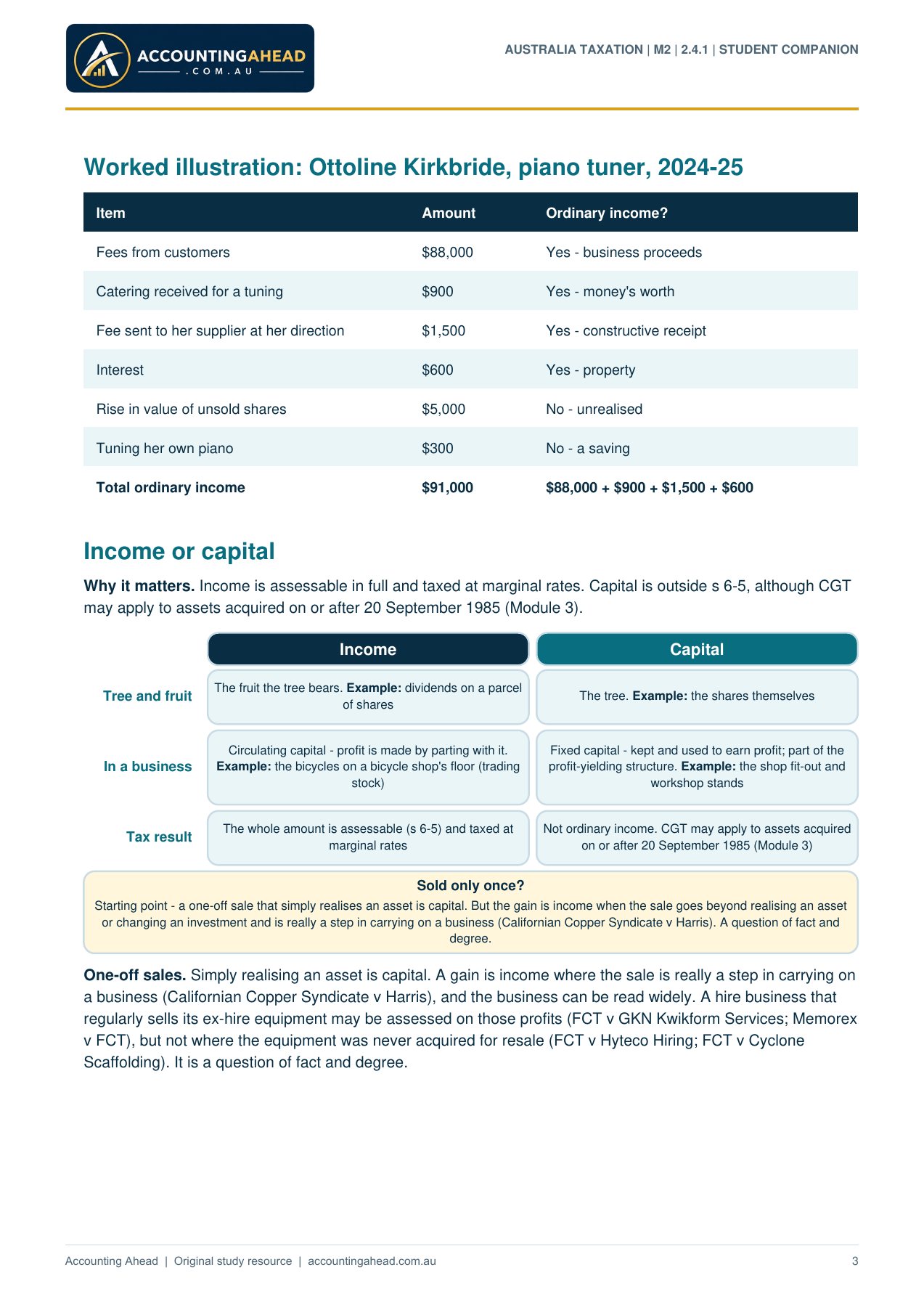
Worked illustration: Ottoline Kirkbride, piano tuner, 2024-25
Item Amount Ordinary income?
Fees from customers $88,000 Yes - business proceeds
Catering received for a tuning $900 Yes - money's worth
Fee sent to her supplier at her direction $1,500 Yes - constructive receipt
Interest $600 Yes - property
Rise in value of unsold shares $5,000 No - unrealised
Tuning her own piano $300 No - a saving
Total ordinary income $91,000 $88,000 + $900 + $1,500 + $600
Income or capital
Why it matters. Income is assessable in full and taxed at marginal rates. Capital is outside s 6-5, although CGT
may apply to assets acquired on or after 20 September 1985 (Module 3).
Income Capital
Tree and fruit The fruit the tree bears. Example: dividends on a parcel
of shares The tree. Example: the shares themselves
In a business
Circulating capital - profit is made by parting with it.
Example: the bicycles on a bicycle shop's floor (trading
stock)
Fixed capital - kept and used to earn profit; part of the
profit-yielding structure. Example: the shop fit-out and
workshop stands
Tax result The whole amount is assessable (s 6-5) and taxed at
marginal rates
Not ordinary income. CGT may apply to assets acquired
on or after 20 September 1985 (Module 3)
Sold only once?
Starting point - a one-off sale that simply realises an asset is capital. But the gain is income when the sale goes beyond realising an asset
or changing an investment and is really a step in carrying on a business (Californian Copper Syndicate v Harris). A question of fact and
degree.
One-off sales. Simply realising an asset is capital. A gain is income where the sale is really a step in carrying on
a business (Californian Copper Syndicate v Harris), and the business can be read widely. A hire business that
regularly sells its ex-hire equipment may be assessed on those profits (FCT v GKN Kwikform Services; Memorex
v FCT), but not where the equipment was never acquired for resale (FCT v Hyteco Hiring; FCT v Cyclone
Scaffolding). It is a question of fact and degree.
AUSTRALIA TAXATION | M2 | 2.4.1 | STUDENT COMPANION
3
Accounting Ahead | Original study resource | accountingahead.com.au
Practice questions
MODULE 2 | 2.4.1 | TRY THESE BEFORE THE WORKED ANSWERS
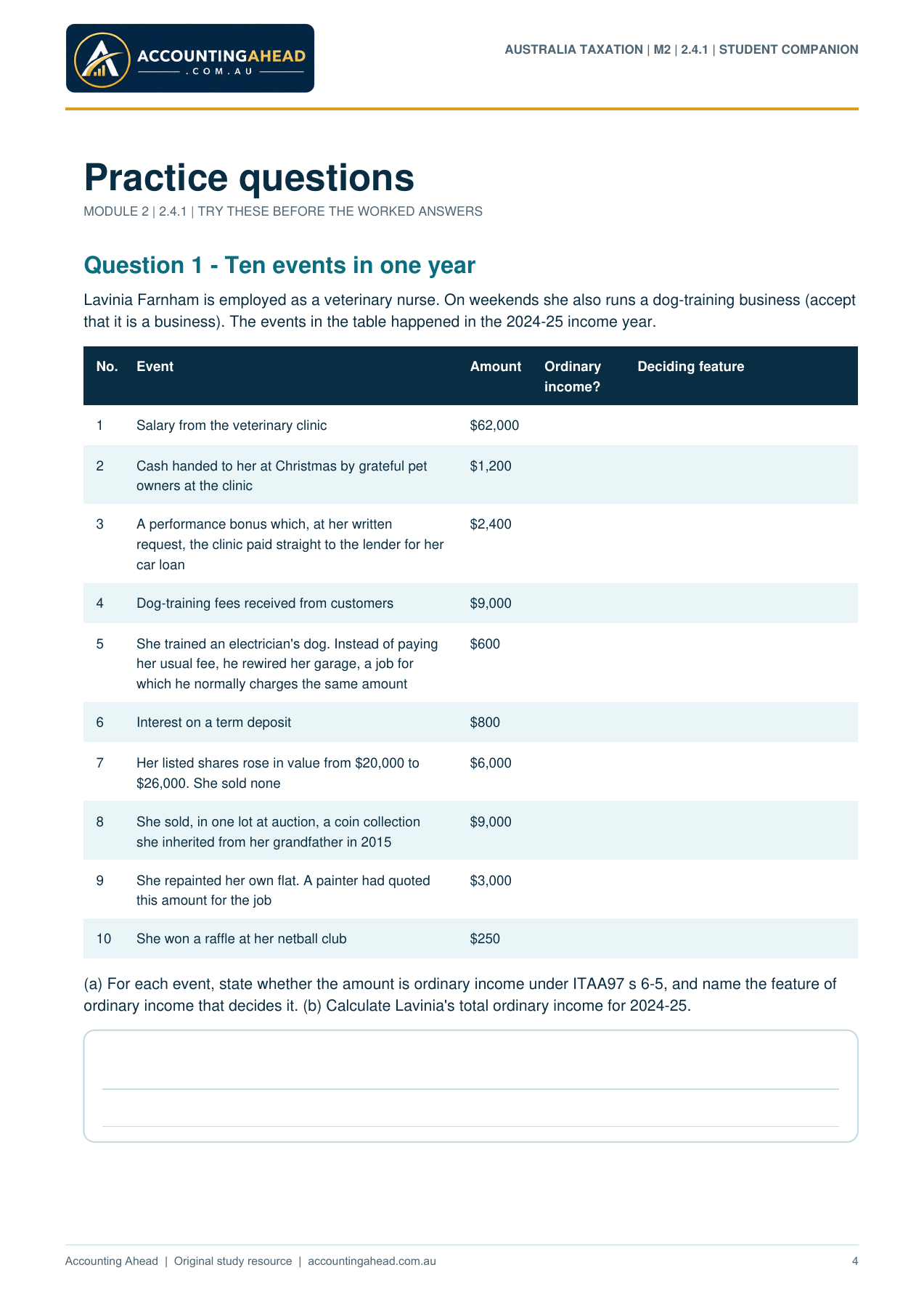
Question 1 - Ten events in one year
Lavinia Farnham is employed as a veterinary nurse. On weekends she also runs a dog-training business (accept
that it is a business). The events in the table happened in the 2024-25 income year.
No. Event Amount Ordinary
income?
Deciding feature
1 Salary from the veterinary clinic $62,000
2 Cash handed to her at Christmas by grateful pet
owners at the clinic
$1,200
3 A performance bonus which, at her written
request, the clinic paid straight to the lender for her
car loan
$2,400
4 Dog-training fees received from customers $9,000
5 She trained an electrician's dog. Instead of paying
her usual fee, he rewired her garage, a job for
which he normally charges the same amount
$600
6 Interest on a term deposit $800
7 Her listed shares rose in value from $20,000 to
$26,000. She sold none
$6,000
8 She sold, in one lot at auction, a coin collection
she inherited from her grandfather in 2015
$9,000
9 She repainted her own flat. A painter had quoted
this amount for the job
$3,000
10 She won a raffle at her netball club $250
(a) For each event, state whether the amount is ordinary income under ITAA97 s 6-5, and name the feature of
ordinary income that decides it. (b) Calculate Lavinia's total ordinary income for 2024-25.
AUSTRALIA TAXATION | M2 | 2.4.1 | STUDENT COMPANION
4
Accounting Ahead | Original study resource | accountingahead.com.au
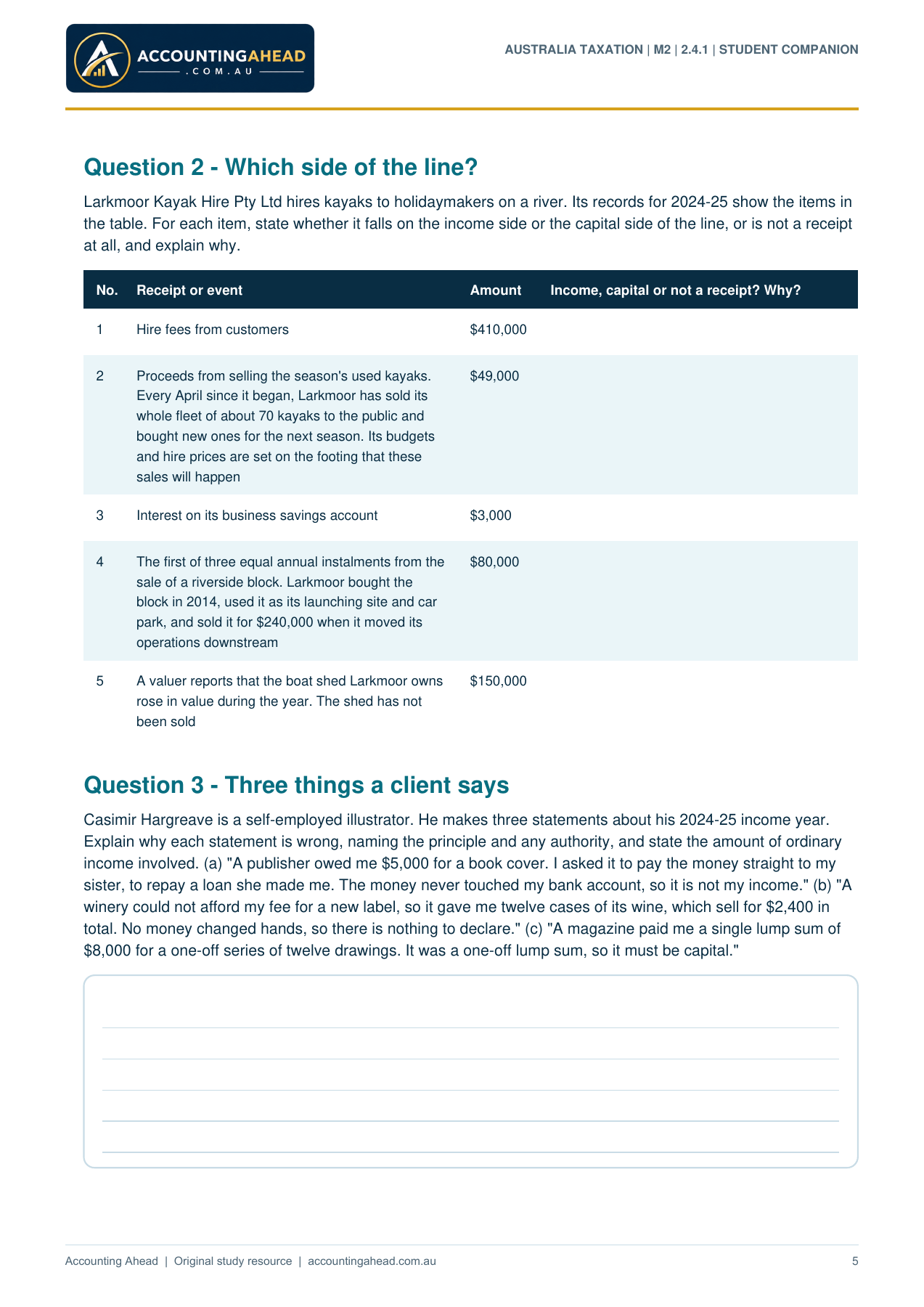
Question 2 - Which side of the line?
Larkmoor Kayak Hire Pty Ltd hires kayaks to holidaymakers on a river. Its records for 2024-25 show the items in
the table. For each item, state whether it falls on the income side or the capital side of the line, or is not a receipt
at all, and explain why.
No. Receipt or event Amount Income, capital or not a receipt? Why?
1 Hire fees from customers $410,000
2 Proceeds from selling the season's used kayaks.
Every April since it began, Larkmoor has sold its
whole fleet of about 70 kayaks to the public and
bought new ones for the next season. Its budgets
and hire prices are set on the footing that these
sales will happen
$49,000
3 Interest on its business savings account $3,000
4 The first of three equal annual instalments from the
sale of a riverside block. Larkmoor bought the
block in 2014, used it as its launching site and car
park, and sold it for $240,000 when it moved its
operations downstream
$80,000
5 A valuer reports that the boat shed Larkmoor owns
rose in value during the year. The shed has not
been sold
$150,000
Question 3 - Three things a client says
Casimir Hargreave is a self-employed illustrator. He makes three statements about his 2024-25 income year.
Explain why each statement is wrong, naming the principle and any authority, and state the amount of ordinary
income involved. (a) "A publisher owed me $5,000 for a book cover. I asked it to pay the money straight to my
sister, to repay a loan she made me. The money never touched my bank account, so it is not my income." (b) "A
winery could not afford my fee for a new label, so it gave me twelve cases of its wine, which sell for $2,400 in
total. No money changed hands, so there is nothing to declare." (c) "A magazine paid me a single lump sum of
$8,000 for a one-off series of twelve drawings. It was a one-off lump sum, so it must be capital."
AUSTRALIA TAXATION | M2 | 2.4.1 | STUDENT COMPANION
5
Accounting Ahead | Original study resource | accountingahead.com.au
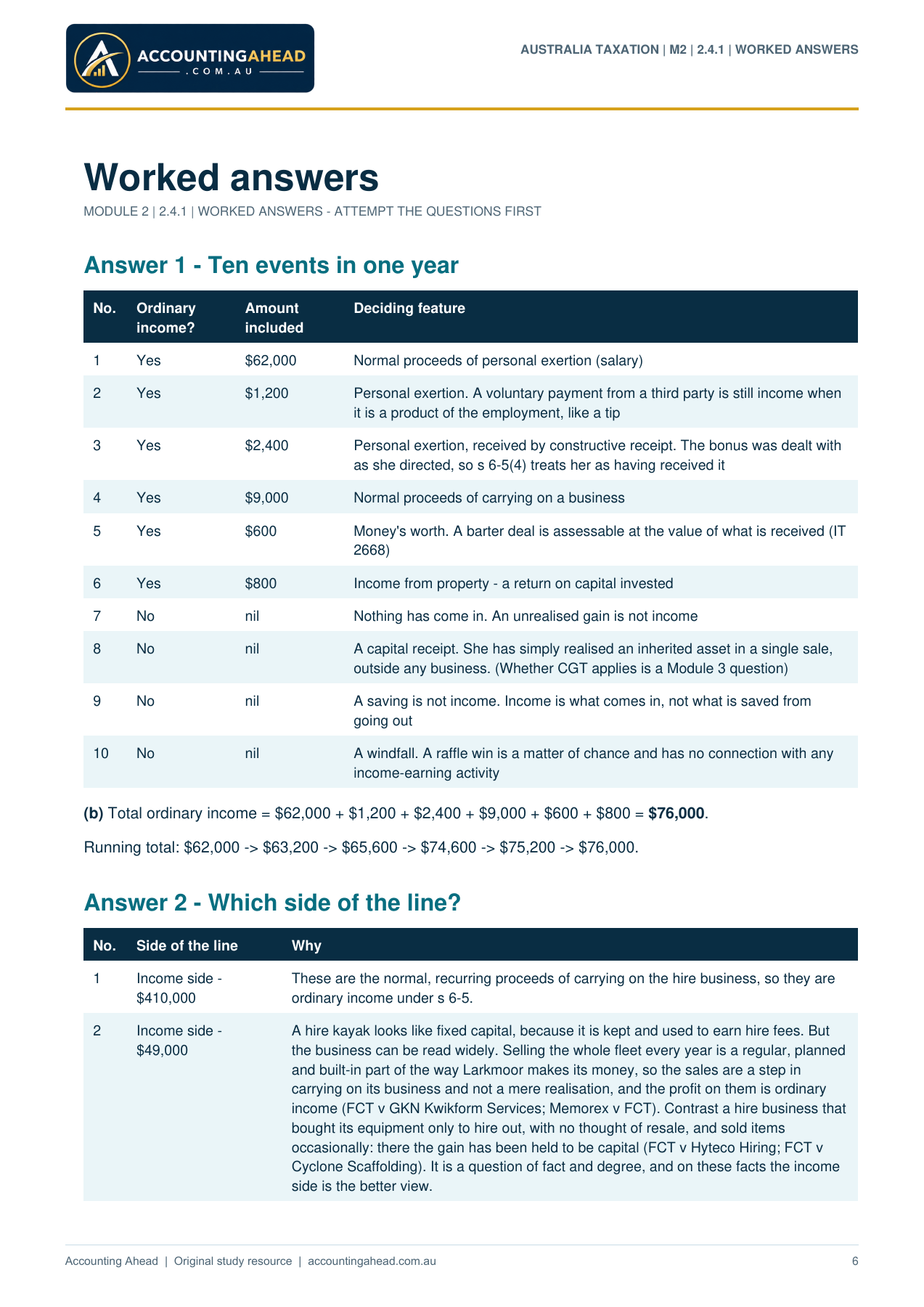
Worked answers
MODULE 2 | 2.4.1 | WORKED ANSWERS - ATTEMPT THE QUESTIONS FIRST
Answer 1 - Ten events in one year
No. Ordinary
income?
Amount
included
Deciding feature
1 Yes $62,000 Normal proceeds of personal exertion (salary)
2 Yes $1,200 Personal exertion. A voluntary payment from a third party is still income when
it is a product of the employment, like a tip
3 Yes $2,400 Personal exertion, received by constructive receipt. The bonus was dealt with
as she directed, so s 6-5(4) treats her as having received it
4 Yes $9,000 Normal proceeds of carrying on a business
5 Yes $600 Money's worth. A barter deal is assessable at the value of what is received (IT
2668)
6 Yes $800 Income from property - a return on capital invested
7 No nil Nothing has come in. An unrealised gain is not income
8 No nil A capital receipt. She has simply realised an inherited asset in a single sale,
outside any business. (Whether CGT applies is a Module 3 question)
9 No nil A saving is not income. Income is what comes in, not what is saved from
going out
10 No nil A windfall. A raffle win is a matter of chance and has no connection with any
income-earning activity
(b) Total ordinary income = $62,000 + $1,200 + $2,400 + $9,000 + $600 + $800 = $76,000.
Running total: $62,000 -> $63,200 -> $65,600 -> $74,600 -> $75,200 -> $76,000.
Answer 2 - Which side of the line?
No. Side of the line Why
1 Income side -
$410,000
These are the normal, recurring proceeds of carrying on the hire business, so they are
ordinary income under s 6-5.
2 Income side -
$49,000
A hire kayak looks like fixed capital, because it is kept and used to earn hire fees. But
the business can be read widely. Selling the whole fleet every year is a regular, planned
and built-in part of the way Larkmoor makes its money, so the sales are a step in
carrying on its business and not a mere realisation, and the profit on them is ordinary
income (FCT v GKN Kwikform Services; Memorex v FCT). Contrast a hire business that
bought its equipment only to hire out, with no thought of resale, and sold items
occasionally: there the gain has been held to be capital (FCT v Hyteco Hiring; FCT v
Cyclone Scaffolding). It is a question of fact and degree, and on these facts the income
side is the better view.
AUSTRALIA TAXATION | M2 | 2.4.1 | WORKED ANSWERS
6
Accounting Ahead | Original study resource | accountingahead.com.au
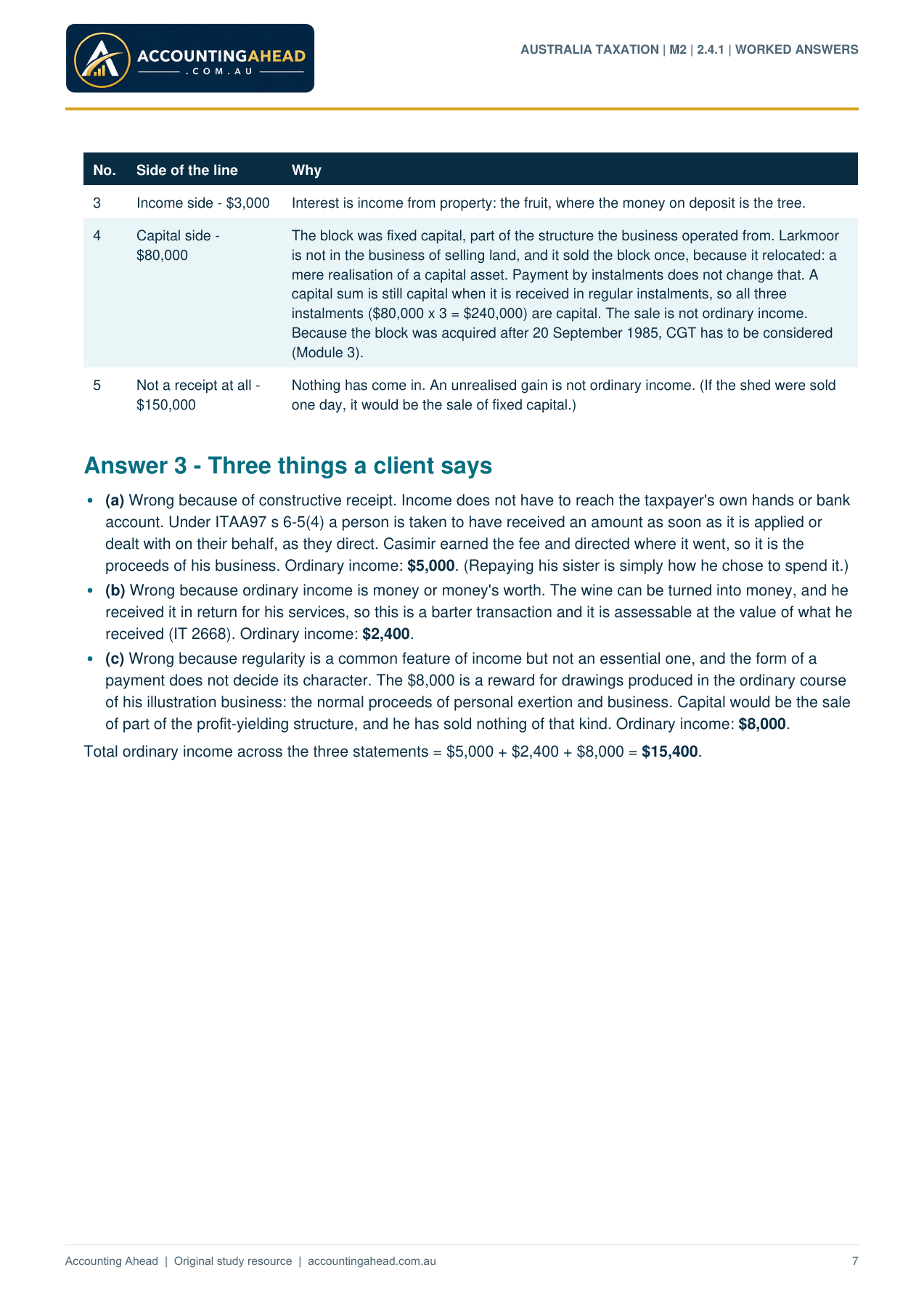
No. Side of the line Why
3 Income side - $3,000 Interest is income from property: the fruit, where the money on deposit is the tree.
4 Capital side -
$80,000
The block was fixed capital, part of the structure the business operated from. Larkmoor
is not in the business of selling land, and it sold the block once, because it relocated: a
mere realisation of a capital asset. Payment by instalments does not change that. A
capital sum is still capital when it is received in regular instalments, so all three
instalments ($80,000 x 3 = $240,000) are capital. The sale is not ordinary income.
Because the block was acquired after 20 September 1985, CGT has to be considered
(Module 3).
5 Not a receipt at all -
$150,000
Nothing has come in. An unrealised gain is not ordinary income. (If the shed were sold
one day, it would be the sale of fixed capital.)
Answer 3 - Three things a client says
(a) Wrong because of constructive receipt. Income does not have to reach the taxpayer's own hands or bank
account. Under ITAA97 s 6-5(4) a person is taken to have received an amount as soon as it is applied or
dealt with on their behalf, as they direct. Casimir earned the fee and directed where it went, so it is the
proceeds of his business. Ordinary income: $5,000. (Repaying his sister is simply how he chose to spend it.)
(b) Wrong because ordinary income is money or money's worth. The wine can be turned into money, and he
received it in return for his services, so this is a barter transaction and it is assessable at the value of what he
received (IT 2668). Ordinary income: $2,400.
(c) Wrong because regularity is a common feature of income but not an essential one, and the form of a
payment does not decide its character. The $8,000 is a reward for drawings produced in the ordinary course
of his illustration business: the normal proceeds of personal exertion and business. Capital would be the sale
of part of the profit-yielding structure, and he has sold nothing of that kind. Ordinary income: $8,000.
Total ordinary income across the three statements = $5,000 + $2,400 + $8,000 = $15,400.
AUSTRALIA TAXATION | M2 | 2.4.1 | WORKED ANSWERS
7