
Statutory, Exempt and NANE Income — study companion
Part 2.5 of Australia Taxation. Preview the study companion or download the printable PDF.



Read the handout text
Accounting Ahead | Original study resource | accountingahead.com.au
Statutory, exempt and NANE income
MODULE 2 | 2.5 | STUDENT COMPANION
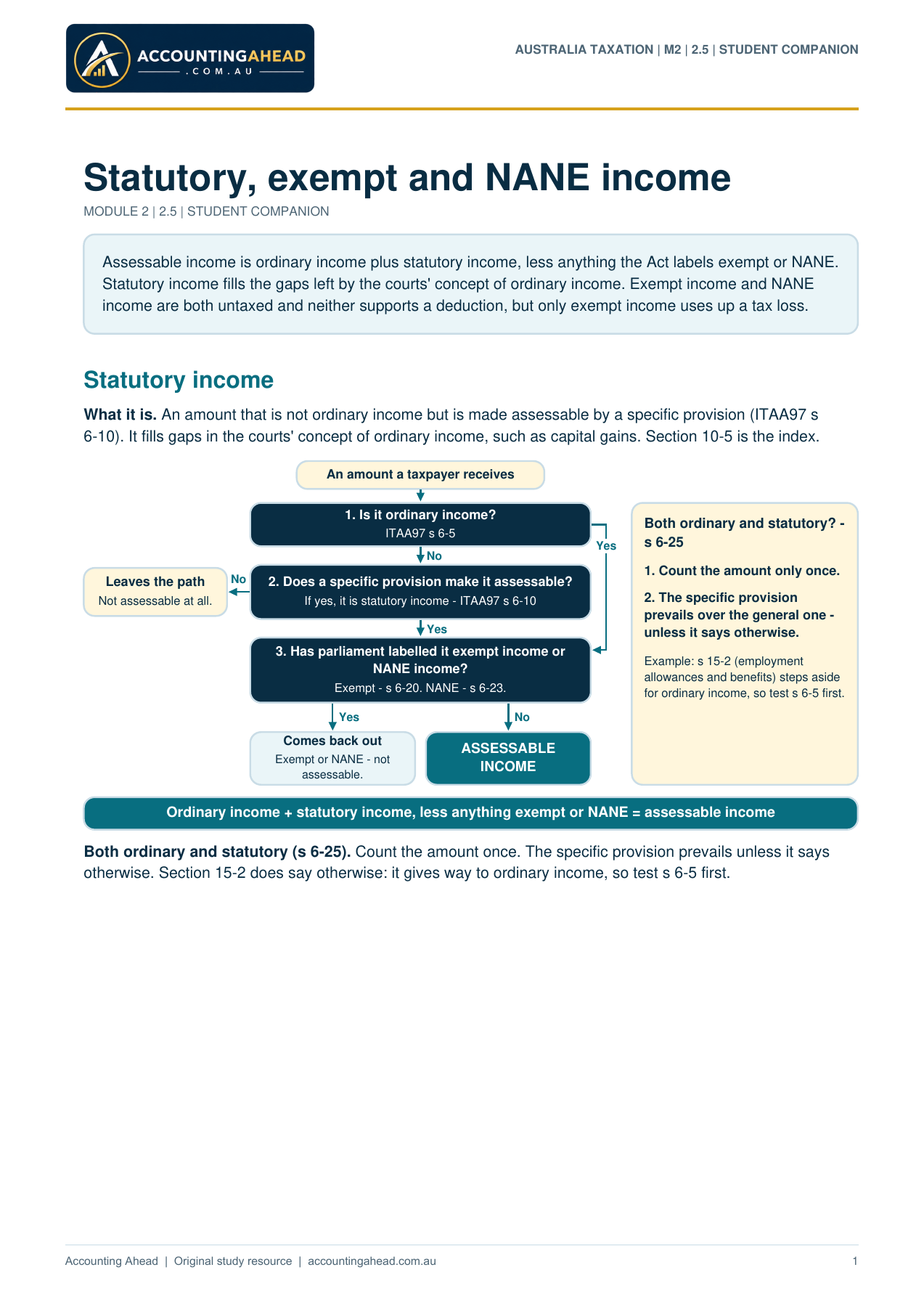
Assessable income is ordinary income plus statutory income, less anything the Act labels exempt or NANE.
Statutory income fills the gaps left by the courts' concept of ordinary income. Exempt income and NANE
income are both untaxed and neither supports a deduction, but only exempt income uses up a tax loss.
Statutory income
What it is. An amount that is not ordinary income but is made assessable by a specific provision (ITAA97 s
6-10). It fills gaps in the courts' concept of ordinary income, such as capital gains. Section 10-5 is the index.
An amount a taxpayer receives
1. Is it ordinary income?
ITAA97 s 6-5
2. Does a specific provision make it assessable?
If yes, it is statutory income - ITAA97 s 6-10
3. Has parliament labelled it exempt income or
NANE income?
Exempt - s 6-20. NANE - s 6-23.
No
Yes
Yes
Leaves the path
Not assessable at all.
No
Comes back out
Exempt or NANE - not
assessable.
ASSESSABLE
INCOME
Yes No
Both ordinary and statutory? -
s 6-25
1. Count the amount only once.
2. The specific provision
prevails over the general one -
unless it says otherwise.
Example: s 15-2 (employment
allowances and benefits) steps aside
for ordinary income, so test s 6-5 first.
Ordinary income + statutory income, less anything exempt or NANE = assessable income
Both ordinary and statutory (s 6-25). Count the amount once. The specific provision prevails unless it says
otherwise. Section 15-2 does say otherwise: it gives way to ordinary income, so test s 6-5 first.
AUSTRALIA TAXATION | M2 | 2.5 | STUDENT COMPANION
1
Accounting Ahead | Original study resource | accountingahead.com.au
Division 15, ITAA97
Employment
allowances and
benefits
s 15-2
Not if ordinary
income or a fringe
benefit
Return-to-work
payments
s 15-3
Bounty or
subsidy paid to
a business
s 15-10
Even if capital
Royalties that
are not ordinary
income
s 15-20
Insurance or
indemnity for
lost assessable
income
s 15-30
Interest from the
ATO on
overpaid tax
s 15-35
Certain car
expense
reimbursements
s 15-70
Found elsewhere
Recoupment of an
amount already
deducted
ITAA97 s 20-20
Profit on disposing
of a leased car
ITAA97 s 20-110
Trading stock
ITAA97 s 70-35
Employment
termination
payments
ITAA97 s 82-130
Capital gains (CGT)
ITAA97 Parts 3-1
and 3-3
Assets acquired after
19 September 1985
Non-cash business
benefits
ITAA36 s 21A
Arm's-length value is
assessable
Index to statutory income: ITAA97 s 10-5. Finding that an amount is not ordinary income is never the end of the analysis.
Non-cash business benefits - ITAA36 s 21A
A benefit that cannot be converted into money is not ordinary income (FCT v Cooke & Sherden). Where it arises
from a business relationship, s 21A treats it as convertible:
1. Start with the arm's-length value.
2. Subtract the part the recipient could have deducted had they paid for it - the otherwise deductible rule (s
21A(3)).
3. Subtract any cost that is non-deductible entertainment for the provider (s 21A(4)).
4. If the year's total is $300 or less, it is exempt income (s 23L(2)).
Example. Thomasina Varnham's $2,600 sailing course from a supplier: $2,600 assessable. A $2,600 trade
course she could have deducted: nil.
Benefits from employment fall under s 15-2 or FBT instead.
Exempt income
Ordinary or statutory income that a provision specifically frees from tax (ITAA97 s 6-20). Lists: ss 11-5 and
11-15.
Exempt entities (Division 50): registered charities, public hospitals, and educational, religious and scientific
institutions.
Exempt types of income (Division 51): part-time reserve forces pay; most scholarships for full-time
students, unless the student must work for the payer (s 51-35).
Social security (Division 52): listed payments only. Any other pension is ordinary income (Keily v FCT).
AUSTRALIA TAXATION | M2 | 2.5 | STUDENT COMPANION
2
Accounting Ahead | Original study resource | accountingahead.com.au
NANE income
Not assessable and not exempt (ITAA97 s 6-23). List: s 11-55.
GST payable to the ATO (s 17-5)
a fringe benefit in the employee's hands (ITAA36 s 23L(1))
certain employment termination payments (s 82-10) and superannuation benefits (Division 301)
certain small business CGT concessions (Division 152) and foreign equity distributions (Subdivision 768-A)
Why the label matters
Assessable income Exempt income (s 6-20) NANE income (s 6-23)
Is it taxed? Yes No No
Can you deduct the cost
of earning it?
Yes - if the usual tests are
met No - s 8-1(2)(c) No - s 8-1(2)(c)
Does it use up a tax
loss?
It is what a loss is meant to
reduce
Yes - a tax loss is applied
against net exempt income
first
No - the loss is untouched
One more effect of exemption: selling an asset used solely to produce exempt income gives no capital gain or loss.
Example. Osric Ashdown, 2024-25: tax loss brought forward $12,000; Army Reserve pay $5,000.
Reserve pay is exempt If it were NANE
Assessable income less the year's
deductions
$40,000 $40,000
Loss deductible after net exempt income $12,000 - $5,000 = $7,000 $12,000
Taxable income $33,000 $28,000
Key figures for 2024-25
Figure What it does
$300 or less Non-cash business benefits for the year are exempt income (ITAA36 s 23L(2))
19 September 1985 CGT applies to assets acquired after this date
AUSTRALIA TAXATION | M2 | 2.5 | STUDENT COMPANION
3
Accounting Ahead | Original study resource | accountingahead.com.au
Practice questions
MODULE 2 | 2.5 | TRY THESE BEFORE THE WORKED ANSWERS
Question 1 - Label each amount
For each amount below, state whether it is ordinary income, statutory income, exempt income or NANE income,
and name the provision that gives it that label.
Amount Label Provision
(a) Weekly wages paid to a shop assistant
(b) A capital gain an individual makes on
shares bought in 2016 and sold in May 2025
(c) A subsidy of a capital nature that a State
government pays to a dairy business towards
new milking equipment
(d) $1,500 of GST included in the June 2025
invoices of a GST-registered plumber
(e) Pay for part-time service in the Army
Reserve
(f) Private use of an employer's car that is a
fringe benefit, in the hands of the employee
(g) $2,200 recovered in 2024-25 on a debt the
business wrote off and deducted as a bad debt
in 2022-23
(h) Interest the ATO pays a taxpayer on an
overpayment of tax
AUSTRALIA TAXATION | M2 | 2.5 | STUDENT COMPANION
4
Accounting Ahead | Original study resource | accountingahead.com.au
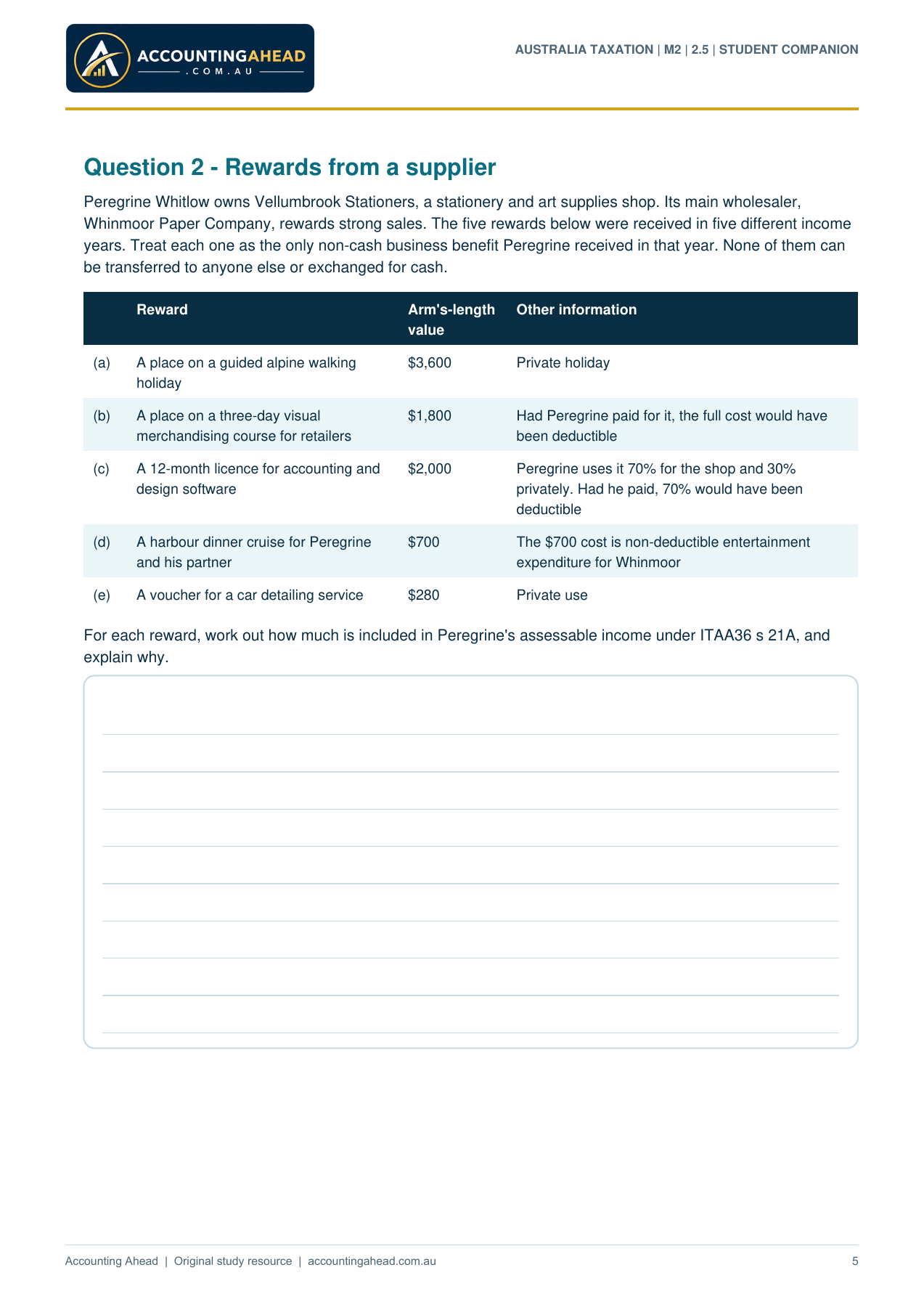
Question 2 - Rewards from a supplier
Peregrine Whitlow owns Vellumbrook Stationers, a stationery and art supplies shop. Its main wholesaler,
Whinmoor Paper Company, rewards strong sales. The five rewards below were received in five different income
years. Treat each one as the only non-cash business benefit Peregrine received in that year. None of them can
be transferred to anyone else or exchanged for cash.
Reward Arm's-length
value
Other information
(a) A place on a guided alpine walking
holiday
$3,600 Private holiday
(b) A place on a three-day visual
merchandising course for retailers
$1,800 Had Peregrine paid for it, the full cost would have
been deductible
(c) A 12-month licence for accounting and
design software
$2,000 Peregrine uses it 70% for the shop and 30%
privately. Had he paid, 70% would have been
deductible
(d) A harbour dinner cruise for Peregrine
and his partner
$700 The $700 cost is non-deductible entertainment
expenditure for Whinmoor
(e) A voucher for a car detailing service $280 Private use
For each reward, work out how much is included in Peregrine's assessable income under ITAA36 s 21A, and
explain why.
AUSTRALIA TAXATION | M2 | 2.5 | STUDENT COMPANION
5
Accounting Ahead | Original study resource | accountingahead.com.au
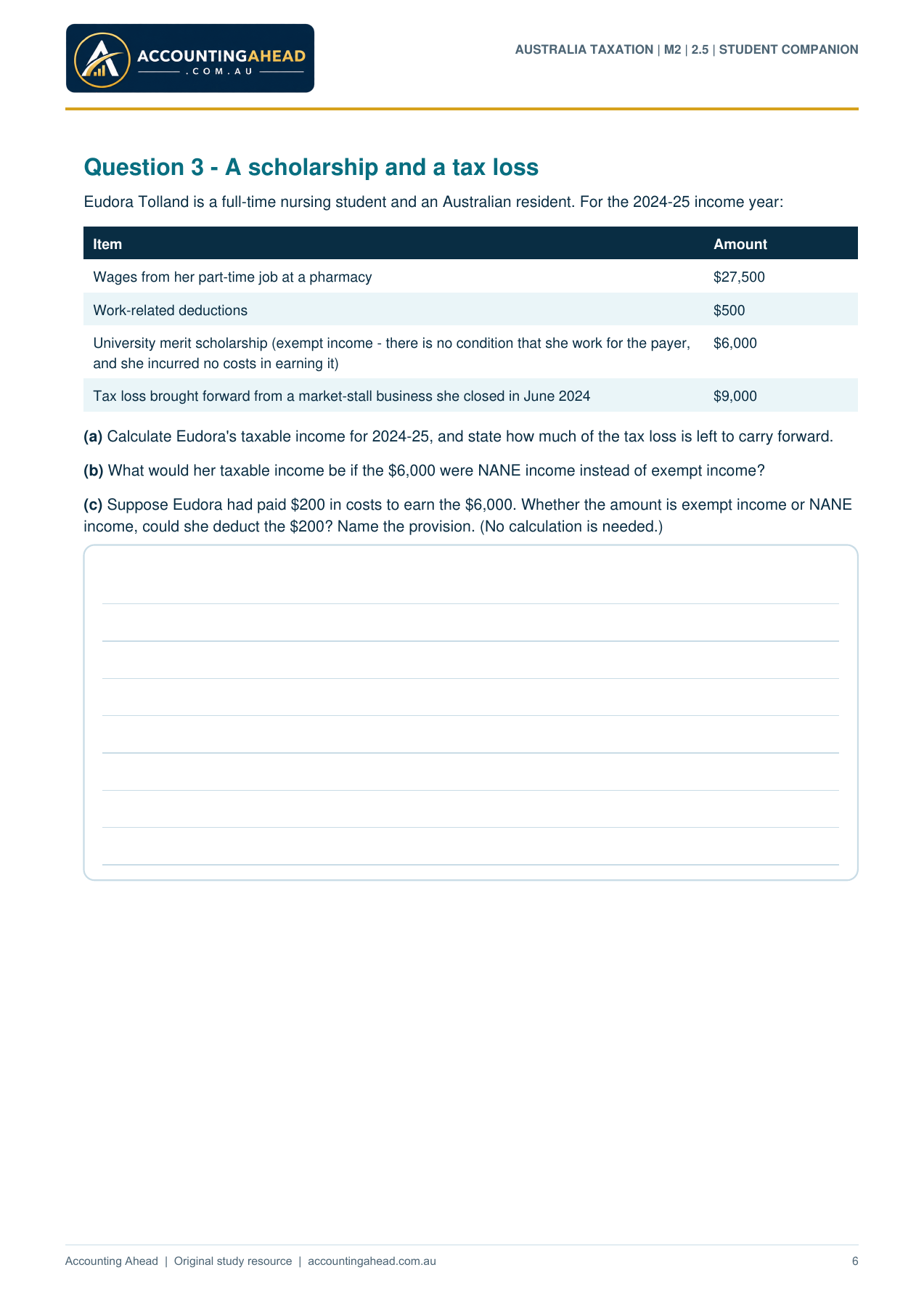
Question 3 - A scholarship and a tax loss
Eudora Tolland is a full-time nursing student and an Australian resident. For the 2024-25 income year:
Item Amount
Wages from her part-time job at a pharmacy $27,500
Work-related deductions $500
University merit scholarship (exempt income - there is no condition that she work for the payer,
and she incurred no costs in earning it)
$6,000
Tax loss brought forward from a market-stall business she closed in June 2024 $9,000
(a) Calculate Eudora's taxable income for 2024-25, and state how much of the tax loss is left to carry forward.
(b) What would her taxable income be if the $6,000 were NANE income instead of exempt income?
(c) Suppose Eudora had paid $200 in costs to earn the $6,000. Whether the amount is exempt income or NANE
income, could she deduct the $200? Name the provision. (No calculation is needed.)
AUSTRALIA TAXATION | M2 | 2.5 | STUDENT COMPANION
6
Accounting Ahead | Original study resource | accountingahead.com.au
Worked answers
MODULE 2 | 2.5 | WORKED ANSWERS - ATTEMPT THE QUESTIONS FIRST
Answer 1
Label Provision and reason
(a) Ordinary income ITAA97 s 6-5. A regular reward for personal services.
(b) Statutory income The CGT provisions, ITAA97 Parts 3-1 and 3-3. A capital gain is not ordinary income; the
shares were acquired after 19 September 1985.
(c) Statutory income ITAA97 s 15-10. A bounty or subsidy received by a business is assessable even if it is
capital and so not ordinary income.
(d) NANE income ITAA97 s 17-5. GST payable to the ATO is neither assessable nor exempt.
(e) Exempt income ITAA97 Division 51 (s 51-5). It would otherwise be ordinary income, but the Act
specifically exempts it.
(f) NANE income ITAA36 s 23L(1). A fringe benefit is not assessable to the employee; the employer pays
FBT.
(g) Statutory income ITAA97 s 20-20, an assessable recoupment. An amount deducted earlier and later
recovered is assessable.
(h) Statutory income ITAA97 s 15-35. It is not ordinary income but is specifically made assessable.
Answer 2
None of the rewards is ordinary income, because none can be converted into money (FCT v Cooke & Sherden).
Each is a non-cash benefit arising from a business relationship, so ITAA36 s 21A treats it as convertible to cash
and starts with its arm's-length value.
(a) $3,600 is assessable. Nothing would have been deductible had Peregrine paid for a private holiday, so
there is no reduction: $3,600 - $0 = $3,600.
(b) Nil. The otherwise deductible rule (s 21A(3)) reduces the value by the amount Peregrine could have
deducted had he paid: $1,800 - $1,800 = $0.
(c) $600 is assessable. The otherwise deductible rule applies only to the extent of the deduction he could
have claimed: 70% x $2,000 = $1,400. $2,000 - $1,400 = $600. As $600 is more than $300, the exemption
does not apply.
(d) Nil. The value is reduced by the cost that is non-deductible entertainment expenditure for the provider (s
21A(4)): $700 - $700 = $0.
(e) Nil assessable. Nothing would have been deductible and the cost is not entertainment, so the amount
stays at $280. Because the total for the year is $300 or less, it is exempt income under ITAA36 s 23L(2).
AUSTRALIA TAXATION | M2 | 2.5 | WORKED ANSWERS
7
Accounting Ahead | Original study resource | accountingahead.com.au
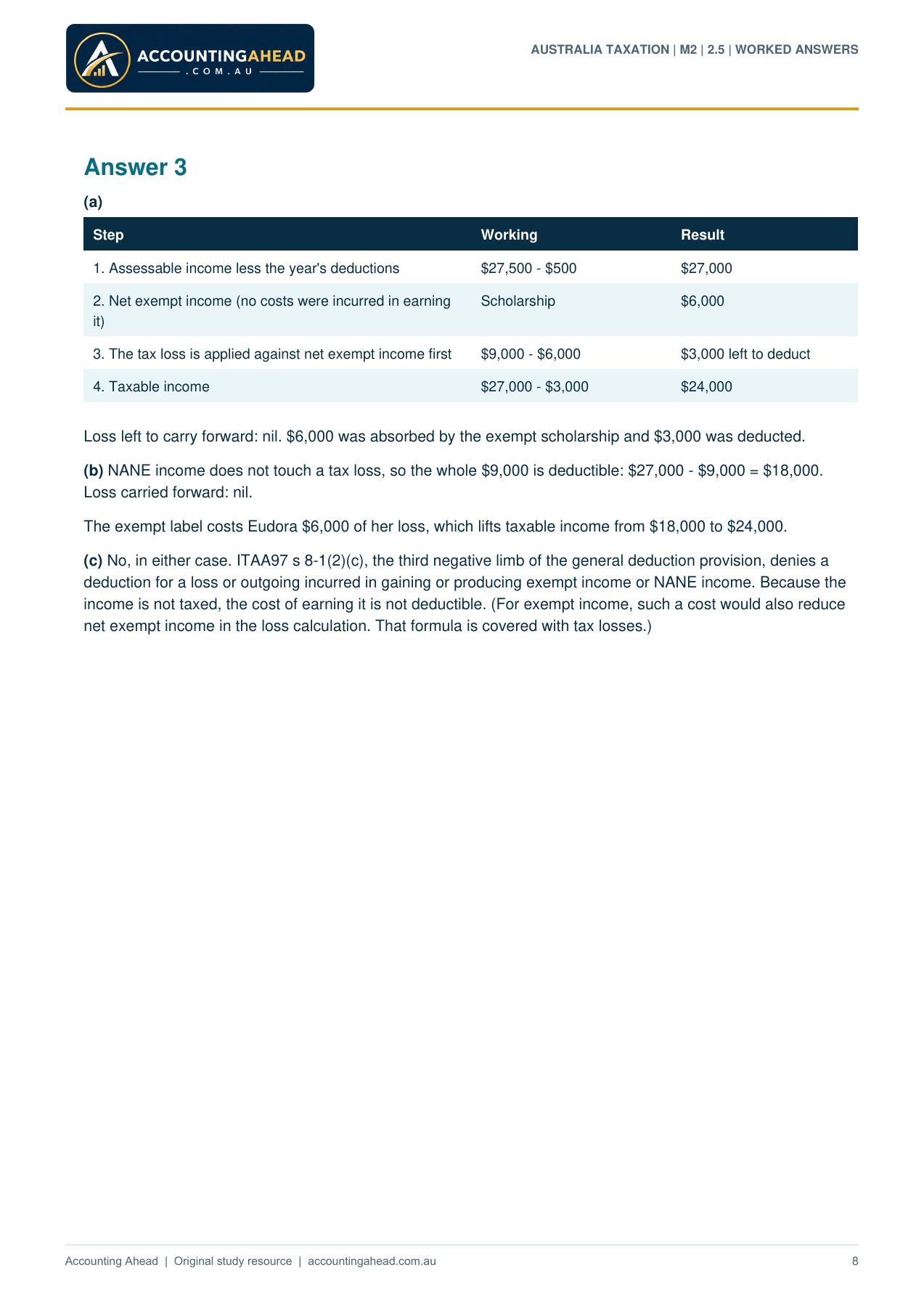
Answer 3
(a)
Step Working Result
1. Assessable income less the year's deductions $27,500 - $500 $27,000
2. Net exempt income (no costs were incurred in earning
it)
Scholarship $6,000
3. The tax loss is applied against net exempt income first $9,000 - $6,000 $3,000 left to deduct
4. Taxable income $27,000 - $3,000 $24,000
Loss left to carry forward: nil. $6,000 was absorbed by the exempt scholarship and $3,000 was deducted.
(b) NANE income does not touch a tax loss, so the whole $9,000 is deductible: $27,000 - $9,000 = $18,000.
Loss carried forward: nil.
The exempt label costs Eudora $6,000 of her loss, which lifts taxable income from $18,000 to $24,000.
(c) No, in either case. ITAA97 s 8-1(2)(c), the third negative limb of the general deduction provision, denies a
deduction for a loss or outgoing incurred in gaining or producing exempt income or NANE income. Because the
income is not taxed, the cost of earning it is not deductible. (For exempt income, such a cost would also reduce
net exempt income in the loss calculation. That formula is covered with tax losses.)
AUSTRALIA TAXATION | M2 | 2.5 | WORKED ANSWERS
8