
Derivation - Cash or Accruals — study companion
Part 2.7 of Australia Taxation. Preview the study companion or download the printable PDF.



Read the handout text
Accounting Ahead | Original study resource | accountingahead.com.au
Derivation - Cash or Accruals
MODULE 2 | 2.7 | STUDENT COMPANION
Income is taxed in the year it is derived, and "derived" does not always mean "received". The courts use
two methods, cash and accruals, and the kind of income decides which one applies. Extra rules deal with
disputed amounts, amounts dealt with on your behalf and income received in advance.
What "derived" means
The date of derivation decides which return an amount goes into. Neither Assessment Act defines "derived". In
FCT v Clarke (1927), Justice Isaacs said it means obtained, got or acquired, which is not the same as received.
Two methods
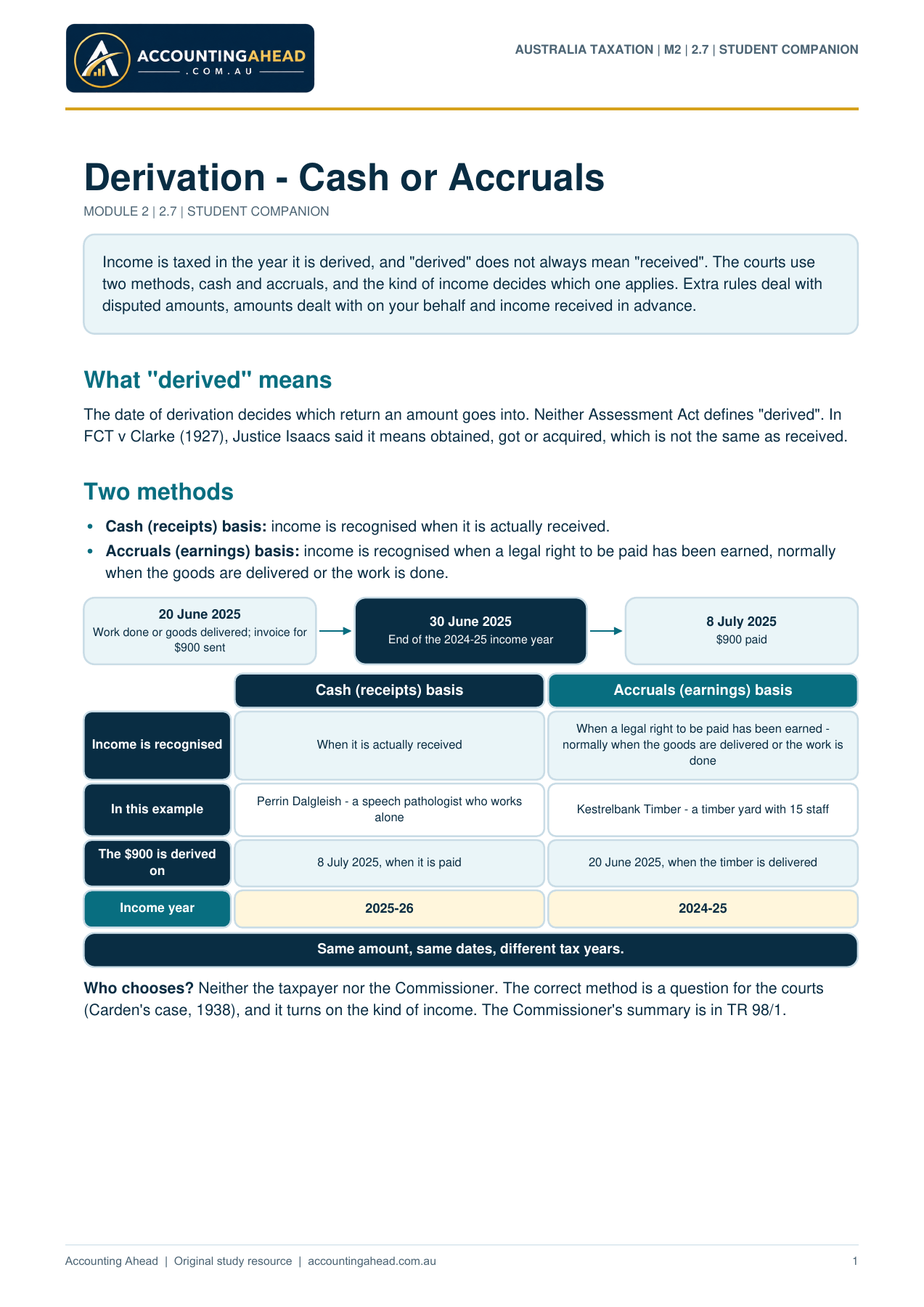
Cash (receipts) basis: income is recognised when it is actually received.
Accruals (earnings) basis: income is recognised when a legal right to be paid has been earned, normally
when the goods are delivered or the work is done.
20 June 2025
Work done or goods delivered; invoice for
$900 sent
30 June 2025
End of the 2024-25 income year
8 July 2025
$900 paid
Cash (receipts) basis Accruals (earnings) basis
Income is recognised When it is actually received
When a legal right to be paid has been earned -
normally when the goods are delivered or the work is
done
In this example Perrin Dalgleish - a speech pathologist who works
alone Kestrelbank Timber - a timber yard with 15 staff
The $900 is derived
on 8 July 2025, when it is paid 20 June 2025, when the timber is delivered
Income year 2025-26 2024-25
Same amount, same dates, different tax years.
Who chooses? Neither the taxpayer nor the Commissioner. The correct method is a question for the courts
(Carden's case, 1938), and it turns on the kind of income. The Commissioner's summary is in TR 98/1.
AUSTRALIA TAXATION | M2 | 2.7 | STUDENT COMPANION
1
Accounting Ahead | Original study resource | accountingahead.com.au
Which basis for which income
What kind of income is it?
Personal exertion
Salary, wages, fees for your
own work
Trading income
From carrying on a business
Professional practice income
Depends on the services, the size of the
practice and the billing terms
Income from property
Interest, rent, dividends
CASH
Derived when received, for
past or current work (Brent v
FCT).
Example: wages for late
June, paid 3 July - new
income year.
ACCRUALS
Recognised when earned,
not when the cash arrives
(Henderson v FCT).
Why: stock, credit sales and
debtors - the real result
shows only when sales are
counted as made.
CASH
Interest - when credited to
your account.
Rent - when received.
Dividend - when paid or
credited (ITAA36 s 44).
Exception: lending or letting
is itself the business (for
example, a bank)
ACCRUALS
Small practice
Income is the
reward for the
practitioner's own
skill
CASH
Large practice
Staff generate
much of the fee
income - a
business
ACCRUALS
No number in the legislation. The
cases suggest accruals at around 3 to 5
employees or more.
Cash basis:
salary, wages and fees for your own work, for past or current work (Brent v FCT)
a small professional practice (Carden's case; FCT v Firstenberg; FCT v Dunn)
interest (when credited), rent (when received) and dividends (when paid or credited - ITAA36 s 44)
Accruals basis:
trading income from carrying on a business (Henderson v FCT)
a large professional practice (Henderson v FCT; Barratt v FCT)
interest or rent where lending or letting is itself the business
Two refinements
Disputed amounts (accruals). An amount the customer genuinely disputes is not derived until the dispute is
resolved (BHP Billiton Petroleum (Bass Strait) Pty Ltd v FCT).
Constructive receipt (cash). You are taken to have received an amount as soon as it is applied or dealt with on
your behalf or as you direct (ITAA97 s 6-5(4)). Odalys Brennock has a publisher pay her $4,000 fee straight to
her landlord: she derives it on the day it is paid. A dividend reinvestment plan is treated the same way.
AUSTRALIA TAXATION | M2 | 2.7 | STUDENT COMPANION
2
Accounting Ahead | Original study resource | accountingahead.com.au
Income received in advance
Fees paid in advance for services still to be delivered are derived as the services are provided, not on receipt (Arthur Murray
(NSW) Pty Ltd v FCT).
1 April 2025
$2,400 received - credited to
unearned revenue.
Refundable for unused
months.
30 June 2025
Year end - 3 of the 12
months delivered.
31 March 2026
Plan ends - remaining 9
months delivered.
2024-25
3/12 × $2,400
= $600 derived
2025-26
9/12 × $2,400
= $1,800 derived
Two conditions
1. Accounts kept on an accruals
basis, with advance payments
credited to an unearned revenue
account.
2. A possibility of refunds.
Non-refundable plan? The
whole $2,400 is assessable in
the year it is received.
Fees paid in advance for services still to be delivered are derived as the services are provided (Arthur Murray
(NSW) Pty Ltd v FCT), because until then the money may have to be given back.
Not automatic. The accounts must be on an accruals basis with advances credited to unearned revenue, and
refunds must be possible. A non-refundable upfront amount is assessable in full in the year it is received.
Lay-by sales. Income is derived when the final instalment is paid and the goods are handed over (TR 95/7).
Assessable income in four questions
1. Is it ordinary income (s 6-5)?
2. If not, is it statutory income (s 6-10)?
3. Is it exempt (s 6-20) or NANE (s 6-23)?
4. In which income year is it derived?
Taxable income = assessable income - deductions (ITAA97 s 4-15).
AUSTRALIA TAXATION | M2 | 2.7 | STUDENT COMPANION
3
Accounting Ahead | Original study resource | accountingahead.com.au
Practice questions
MODULE 2 | 2.7 | TRY THESE BEFORE THE WORKED ANSWERS
Question 1 - Which basis, which year?
For each amount below, state whether the cash basis or the accruals basis applies, and whether the amount is
derived in the 2024-25 income year (ended 30 June 2025) or the 2025-26 income year. Give a brief reason.
Taxpayer Amount Basis and year
(a) Tamsyn Pemberley, a
warehouse employee
Wages of $1,800 for the fortnight ended 27 June 2025,
paid into her account on 2 July 2025
(b) Yarrowby Hardware, a
hardware retailer with 12
staff
Goods sold on 30-day credit for $6,400 and delivered
on 18 June 2025. The customer paid on 16 July 2025
(c) Cuthbert Rowbotham, a
private investor
Interest of $310 for the June quarter, credited to his
savings account on 1 July 2025
(d) Cuthbert Rowbotham A dividend of $540 paid on 27 June 2025. Under the
company's dividend reinvestment plan it was used to
buy him more shares, so he received no cash
(e) Melisande Drummond, a
landscape designer who
works alone
An invoice for $2,750 issued on 5 June 2025 for a
finished design. The client paid on 9 July 2025
(f) Hawksworth Merrin, a
surveying practice with 4
partners and 38 employees
Invoices totalling $85,000 issued in June 2025 for work
completed in June, all unpaid at 30 June 2025
(g) Bramblewick Finance, a
money-lending business
Interest of $9,200 that accrued on customer loans
during June 2025 and was received in July 2025
(h) Melisande Drummond, who
also owns one rental flat
Rent of $2,000 for June 2025, paid late and received on
4 July 2025
AUSTRALIA TAXATION | M2 | 2.7 | STUDENT COMPANION
4
Accounting Ahead | Original study resource | accountingahead.com.au
Question 2 - Money in advance
Thistlewood Climbing Centre keeps its accounts on an accruals basis and credits all amounts received in
advance to an unearned revenue account. During 2024-25 it received the following.
Item Details
1. Annual passes On 1 March 2025 it sold 50 twelve-month passes at $1,200 each, paid upfront. Each pass
runs from 1 March 2025 to 28 February 2026. A member who cancels is refunded for the
unused months.
2. Joining fees On 1 June 2025 it charged 40 new members a joining fee of $150 each. The fee is
non-refundable.
3. Holiday program On 15 June 2025 it received $4,500 for places in a school holiday program that runs entirely
in July 2025. A place that is cancelled is refunded in full.
For each item, work out how much is derived in the 2024-25 income year and how much in the 2025-26 income
year. Then total each year.
Question 3 - Accruals with a disputed invoice
Copperladle Catering Supplies sells kitchen equipment and consumables to cafes and restaurants on credit, and
has 20 staff. Its records for the 2024-25 income year show:
Item Amount
Cash received from customers during 2024-25 $480,000
Included in that cash: collections on invoices for goods delivered in June 2024 $30,000
Invoices for goods delivered during 2024-25 that were still unpaid at 30 June 2025 $42,000
Included in those unpaid invoices: an invoice that a cafe disputes, claiming it never ordered
the goods. The dispute was unresolved at 30 June 2025 and was settled in Copperladle's
favour in September 2025
$5,000
Work out the income Copperladle derives in 2024-25 on the accruals basis. Explain how you treat each figure,
including the disputed invoice.
AUSTRALIA TAXATION | M2 | 2.7 | STUDENT COMPANION
5
Accounting Ahead | Original study resource | accountingahead.com.au
Worked answers
MODULE 2 | 2.7 | WORKED ANSWERS - ATTEMPT THE QUESTIONS FIRST
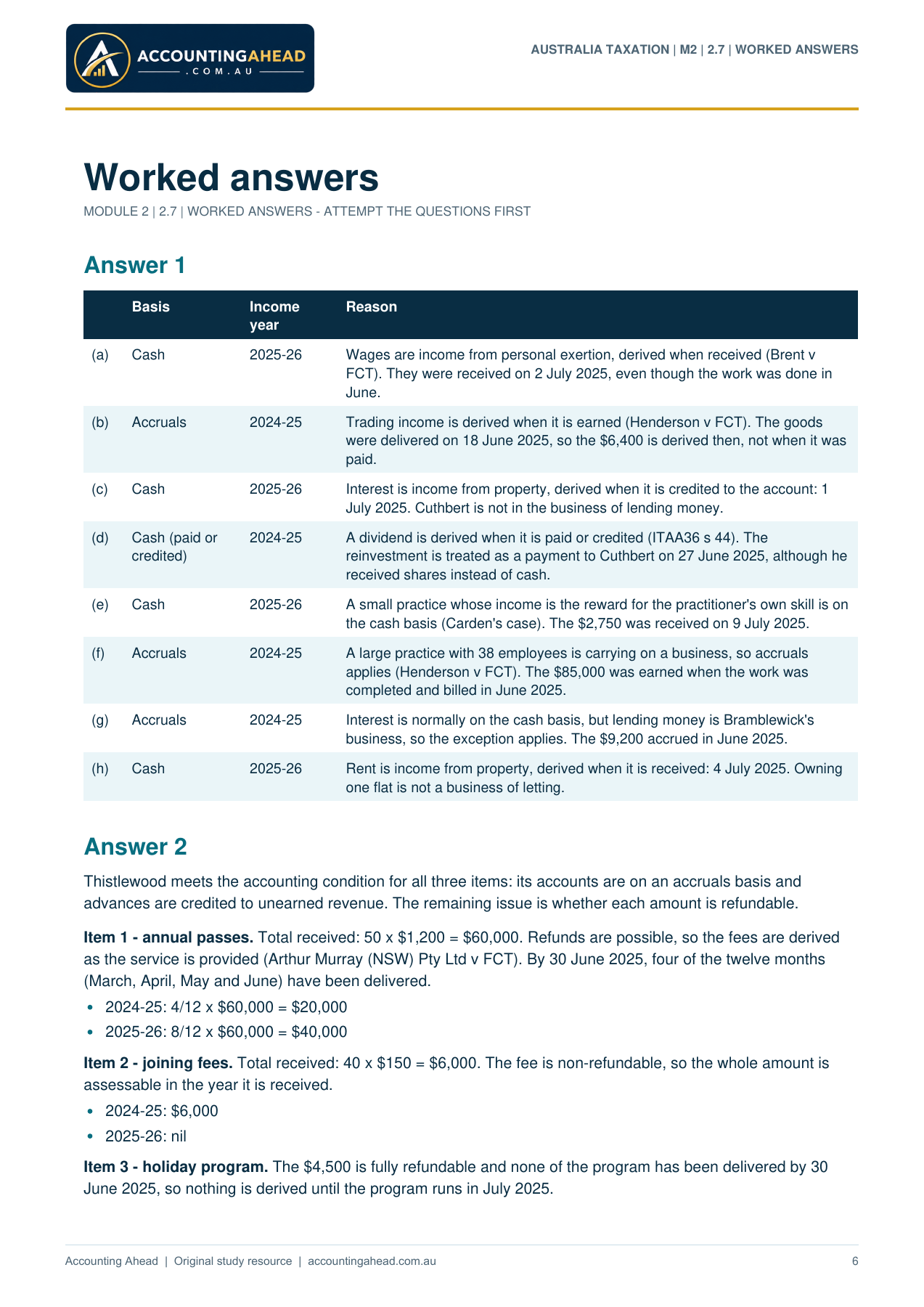
Answer 1
Basis Income
year
Reason
(a) Cash 2025-26 Wages are income from personal exertion, derived when received (Brent v
FCT). They were received on 2 July 2025, even though the work was done in
June.
(b) Accruals 2024-25 Trading income is derived when it is earned (Henderson v FCT). The goods
were delivered on 18 June 2025, so the $6,400 is derived then, not when it was
paid.
(c) Cash 2025-26 Interest is income from property, derived when it is credited to the account: 1
July 2025. Cuthbert is not in the business of lending money.
(d) Cash (paid or
credited)
2024-25 A dividend is derived when it is paid or credited (ITAA36 s 44). The
reinvestment is treated as a payment to Cuthbert on 27 June 2025, although he
received shares instead of cash.
(e) Cash 2025-26 A small practice whose income is the reward for the practitioner's own skill is on
the cash basis (Carden's case). The $2,750 was received on 9 July 2025.
(f) Accruals 2024-25 A large practice with 38 employees is carrying on a business, so accruals
applies (Henderson v FCT). The $85,000 was earned when the work was
completed and billed in June 2025.
(g) Accruals 2024-25 Interest is normally on the cash basis, but lending money is Bramblewick's
business, so the exception applies. The $9,200 accrued in June 2025.
(h) Cash 2025-26 Rent is income from property, derived when it is received: 4 July 2025. Owning
one flat is not a business of letting.
Answer 2
Thistlewood meets the accounting condition for all three items: its accounts are on an accruals basis and
advances are credited to unearned revenue. The remaining issue is whether each amount is refundable.
Item 1 - annual passes. Total received: 50 x $1,200 = $60,000. Refunds are possible, so the fees are derived
as the service is provided (Arthur Murray (NSW) Pty Ltd v FCT). By 30 June 2025, four of the twelve months
(March, April, May and June) have been delivered.
2024-25: 4/12 x $60,000 = $20,000
2025-26: 8/12 x $60,000 = $40,000
Item 2 - joining fees. Total received: 40 x $150 = $6,000. The fee is non-refundable, so the whole amount is
assessable in the year it is received.
2024-25: $6,000
2025-26: nil
Item 3 - holiday program. The $4,500 is fully refundable and none of the program has been delivered by 30
June 2025, so nothing is derived until the program runs in July 2025.
AUSTRALIA TAXATION | M2 | 2.7 | WORKED ANSWERS
6
Accounting Ahead | Original study resource | accountingahead.com.au
2024-25: nil
2025-26: $4,500
Totals
2024-25 2025-26
Annual passes $20,000 $40,000
Joining fees $6,000 nil
Holiday program nil $4,500
Total derived $26,000 $44,500
Check: $26,000 + $44,500 = $70,500, which equals the cash received ($60,000 + $6,000 + $4,500).
Note: had the annual passes been non-refundable, the whole $60,000 would have been assessable in 2024-25.
Answer 3
Copperladle is a trading business that sells on credit, so its income is derived on the accruals basis, when the
goods are delivered and the right to be paid is earned (Henderson v FCT). Cash received is not the test.
Step 1 - cash received in 2024-25: $480,000.
Step 2 - remove the $30,000 collected on June 2024 deliveries. That income was earned, and so derived,
in 2023-24: $480,000 - $30,000 = $450,000. This is the cash collected on 2024-25 deliveries.
Step 3 - add the invoices for 2024-25 deliveries that were unpaid at 30 June 2025, but leave out the
disputed invoice: $42,000 - $5,000 = $37,000. These amounts have been earned although not yet received.
Step 4 - income derived in 2024-25: $450,000 + $37,000 = $487,000.
The disputed $5,000: when a customer disputes that an amount is owed at all, it is not derived until the dispute
is resolved (BHP Billiton Petroleum (Bass Strait) Pty Ltd v FCT). The dispute was resolved in September 2025,
so the $5,000 is derived in 2025-26.
AUSTRALIA TAXATION | M2 | 2.7 | WORKED ANSWERS
7