
Repairs and Bad Debts — study companion
Part 2.9.1 of Australia Taxation. Preview the study companion or download the printable PDF.

Read the handout text
Accounting Ahead | Original study resource | accountingahead.com.au
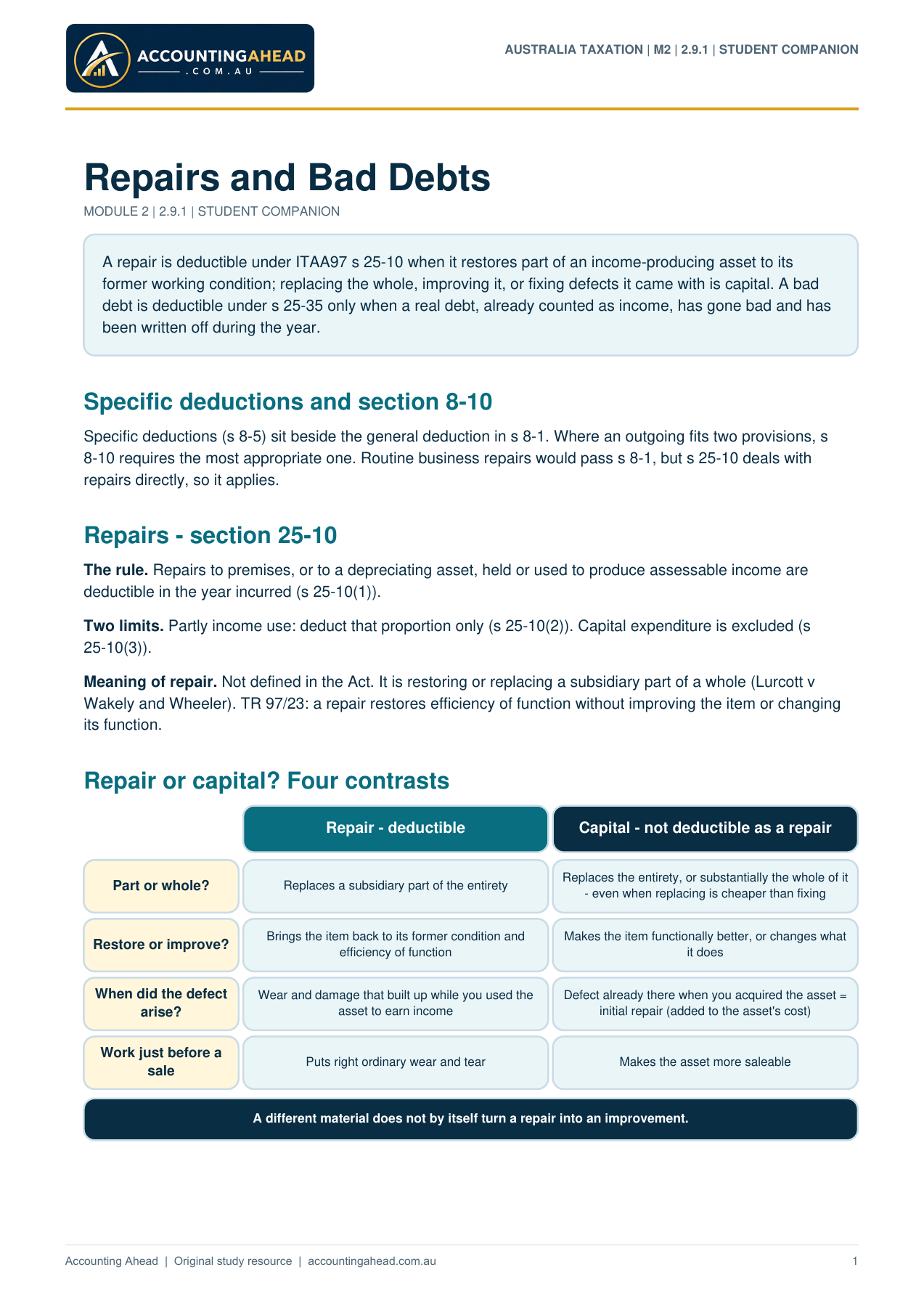
Repairs and Bad Debts
MODULE 2 | 2.9.1 | STUDENT COMPANION
A repair is deductible under ITAA97 s 25-10 when it restores part of an income-producing asset to its
former working condition; replacing the whole, improving it, or fixing defects it came with is capital. A bad
debt is deductible under s 25-35 only when a real debt, already counted as income, has gone bad and has
been written off during the year.
Specific deductions and section 8-10
Specific deductions (s 8-5) sit beside the general deduction in s 8-1. Where an outgoing fits two provisions, s
8-10 requires the most appropriate one. Routine business repairs would pass s 8-1, but s 25-10 deals with
repairs directly, so it applies.
Repairs - section 25-10
The rule. Repairs to premises, or to a depreciating asset, held or used to produce assessable income are
deductible in the year incurred (s 25-10(1)).
Two limits. Partly income use: deduct that proportion only (s 25-10(2)). Capital expenditure is excluded (s
25-10(3)).
Meaning of repair. Not defined in the Act. It is restoring or replacing a subsidiary part of a whole (Lurcott v
Wakely and Wheeler). TR 97/23: a repair restores efficiency of function without improving the item or changing
its function.
Repair or capital? Four contrasts
Repair - deductible Capital - not deductible as a repair
Part or whole? Replaces a subsidiary part of the entirety Replaces the entirety, or substantially the whole of it
- even when replacing is cheaper than fixing
Restore or improve? Brings the item back to its former condition and
efficiency of function
Makes the item functionally better, or changes what
it does
When did the defect
arise?
Wear and damage that built up while you used the
asset to earn income
Defect already there when you acquired the asset =
initial repair (added to the asset's cost)
Work just before a
sale Puts right ordinary wear and tear Makes the asset more saleable
A different material does not by itself turn a repair into an improvement.
AUSTRALIA TAXATION | M2 | 2.9.1 | STUDENT COMPANION
1
Accounting Ahead | Original study resource | accountingahead.com.au
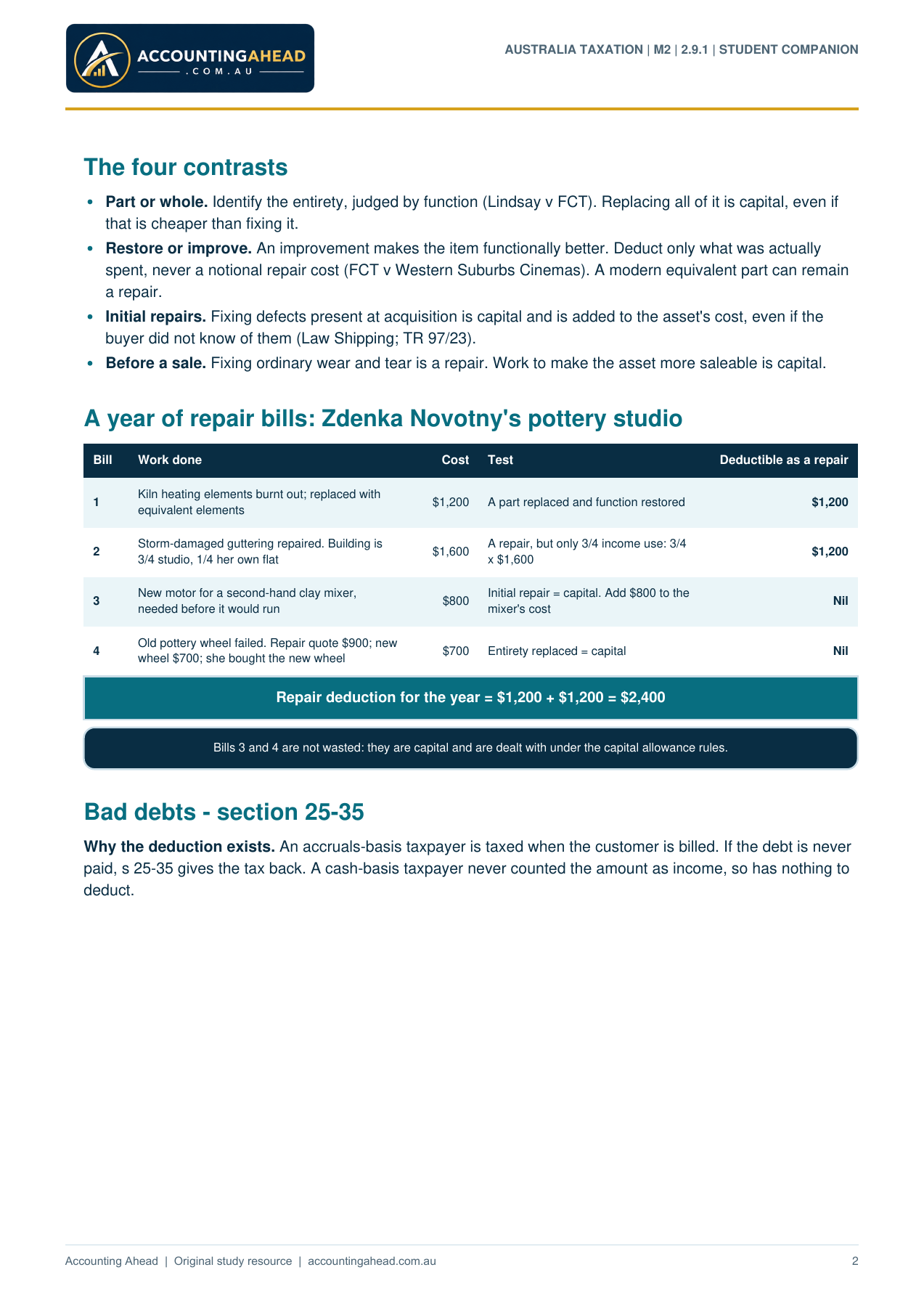
The four contrasts
Part or whole. Identify the entirety, judged by function (Lindsay v FCT). Replacing all of it is capital, even if
that is cheaper than fixing it.
Restore or improve. An improvement makes the item functionally better. Deduct only what was actually
spent, never a notional repair cost (FCT v Western Suburbs Cinemas). A modern equivalent part can remain
a repair.
Initial repairs. Fixing defects present at acquisition is capital and is added to the asset's cost, even if the
buyer did not know of them (Law Shipping; TR 97/23).
Before a sale. Fixing ordinary wear and tear is a repair. Work to make the asset more saleable is capital.
A year of repair bills: Zdenka Novotny's pottery studio
Bill Work done Cost Test Deductible as a repair
1 Kiln heating elements burnt out; replaced with
equivalent elements $1,200 A part replaced and function restored $1,200
2 Storm-damaged guttering repaired. Building is
3/4 studio, 1/4 her own flat $1,600 A repair, but only 3/4 income use: 3/4
x $1,600 $1,200
3 New motor for a second-hand clay mixer,
needed before it would run $800 Initial repair = capital. Add $800 to the
mixer's cost Nil
4 Old pottery wheel failed. Repair quote $900; new
wheel $700; she bought the new wheel $700 Entirety replaced = capital Nil
Repair deduction for the year = $1,200 + $1,200 = $2,400
Bills 3 and 4 are not wasted: they are capital and are dealt with under the capital allowance rules.
Bad debts - section 25-35
Why the deduction exists. An accruals-basis taxpayer is taxed when the customer is billed. If the debt is never
paid, s 25-35 gives the tax back. A cash-basis taxpayer never counted the amount as income, so has nothing to
deduct.
AUSTRALIA TAXATION | M2 | 2.9.1 | STUDENT COMPANION
2
Accounting Ahead | Original study resource | accountingahead.com.au
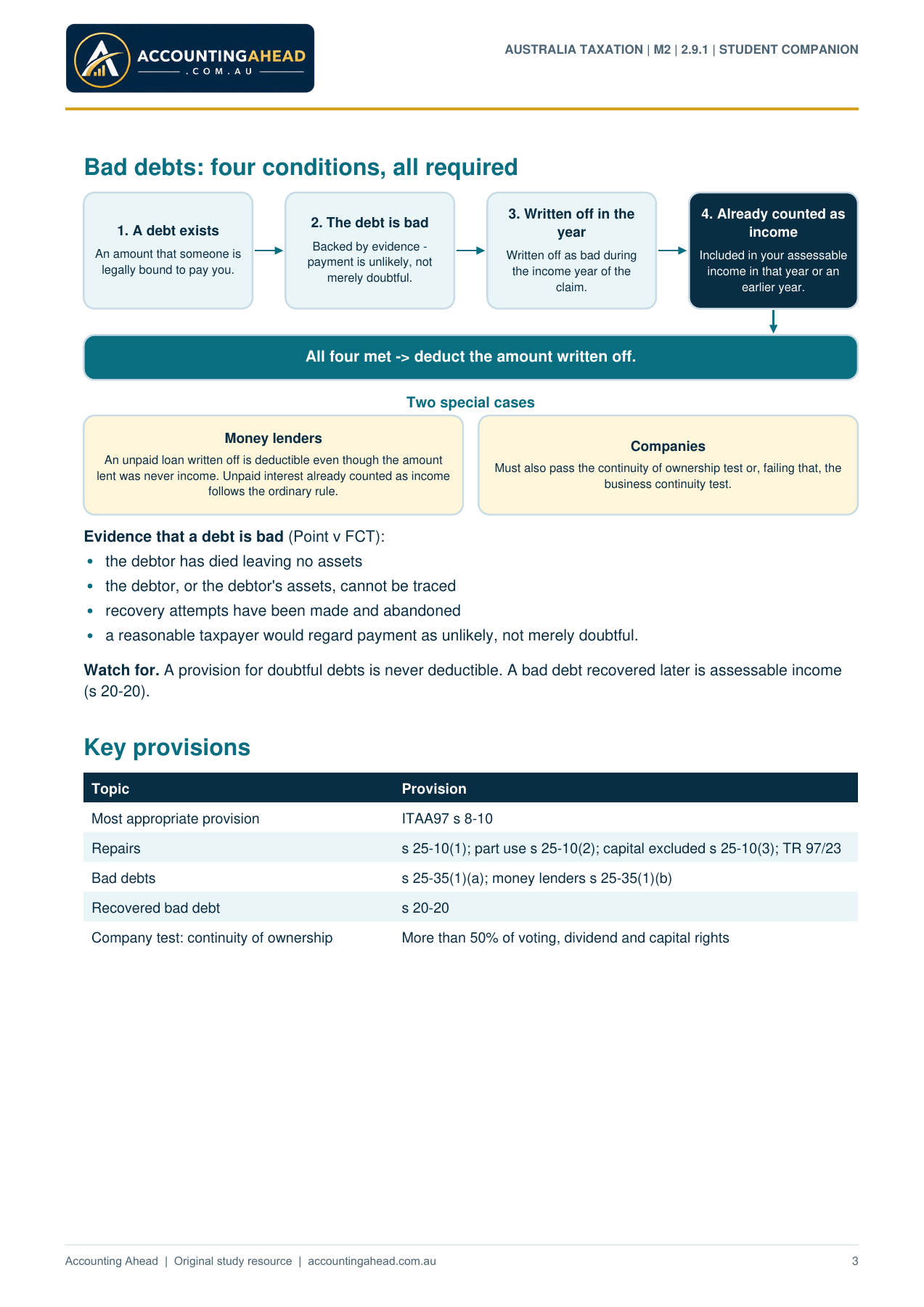
Bad debts: four conditions, all required
1. A debt exists
An amount that someone is
legally bound to pay you.
2. The debt is bad
Backed by evidence -
payment is unlikely, not
merely doubtful.
3. Written off in the
year
Written off as bad during
the income year of the
claim.
4. Already counted as
income
Included in your assessable
income in that year or an
earlier year.
All four met -> deduct the amount written off.
Two special cases
Money lenders
An unpaid loan written off is deductible even though the amount
lent was never income. Unpaid interest already counted as income
follows the ordinary rule.
Companies
Must also pass the continuity of ownership test or, failing that, the
business continuity test.
Evidence that a debt is bad (Point v FCT):
the debtor has died leaving no assets
the debtor, or the debtor's assets, cannot be traced
recovery attempts have been made and abandoned
a reasonable taxpayer would regard payment as unlikely, not merely doubtful.
Watch for. A provision for doubtful debts is never deductible. A bad debt recovered later is assessable income
(s 20-20).
Key provisions
Topic Provision
Most appropriate provision ITAA97 s 8-10
Repairs s 25-10(1); part use s 25-10(2); capital excluded s 25-10(3); TR 97/23
Bad debts s 25-35(1)(a); money lenders s 25-35(1)(b)
Recovered bad debt s 20-20
Company test: continuity of ownership More than 50% of voting, dividend and capital rights
AUSTRALIA TAXATION | M2 | 2.9.1 | STUDENT COMPANION
3
Accounting Ahead | Original study resource | accountingahead.com.au
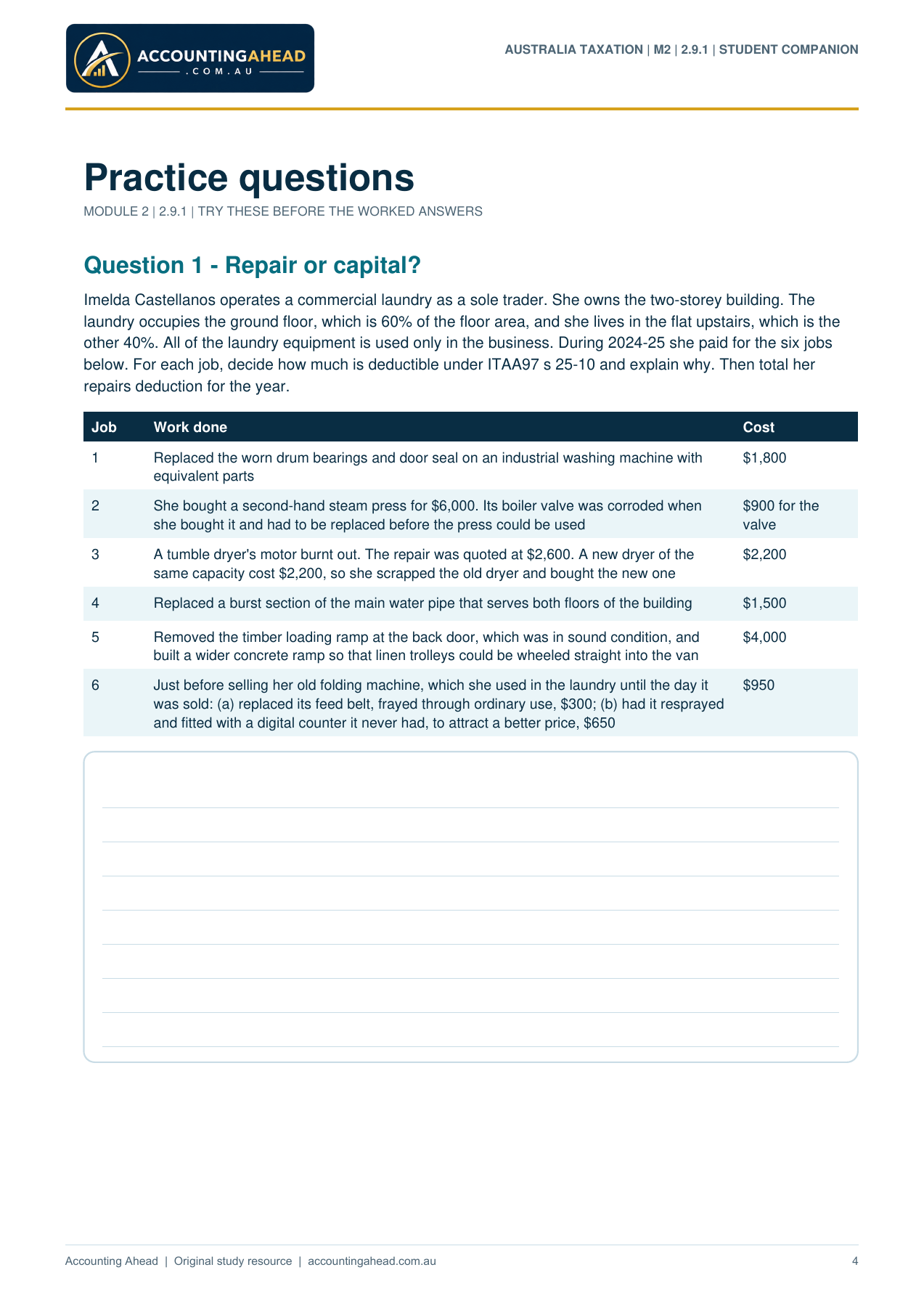
Practice questions
MODULE 2 | 2.9.1 | TRY THESE BEFORE THE WORKED ANSWERS
Question 1 - Repair or capital?
Imelda Castellanos operates a commercial laundry as a sole trader. She owns the two-storey building. The
laundry occupies the ground floor, which is 60% of the floor area, and she lives in the flat upstairs, which is the
other 40%. All of the laundry equipment is used only in the business. During 2024-25 she paid for the six jobs
below. For each job, decide how much is deductible under ITAA97 s 25-10 and explain why. Then total her
repairs deduction for the year.
Job Work done Cost
1 Replaced the worn drum bearings and door seal on an industrial washing machine with
equivalent parts
$1,800
2 She bought a second-hand steam press for $6,000. Its boiler valve was corroded when
she bought it and had to be replaced before the press could be used
$900 for the
valve
3 A tumble dryer's motor burnt out. The repair was quoted at $2,600. A new dryer of the
same capacity cost $2,200, so she scrapped the old dryer and bought the new one
$2,200
4 Replaced a burst section of the main water pipe that serves both floors of the building $1,500
5 Removed the timber loading ramp at the back door, which was in sound condition, and
built a wider concrete ramp so that linen trolleys could be wheeled straight into the van
$4,000
6 Just before selling her old folding machine, which she used in the laundry until the day it
was sold: (a) replaced its feed belt, frayed through ordinary use, $300; (b) had it resprayed
and fitted with a digital counter it never had, to attract a better price, $650
$950
AUSTRALIA TAXATION | M2 | 2.9.1 | STUDENT COMPANION
4
Accounting Ahead | Original study resource | accountingahead.com.au
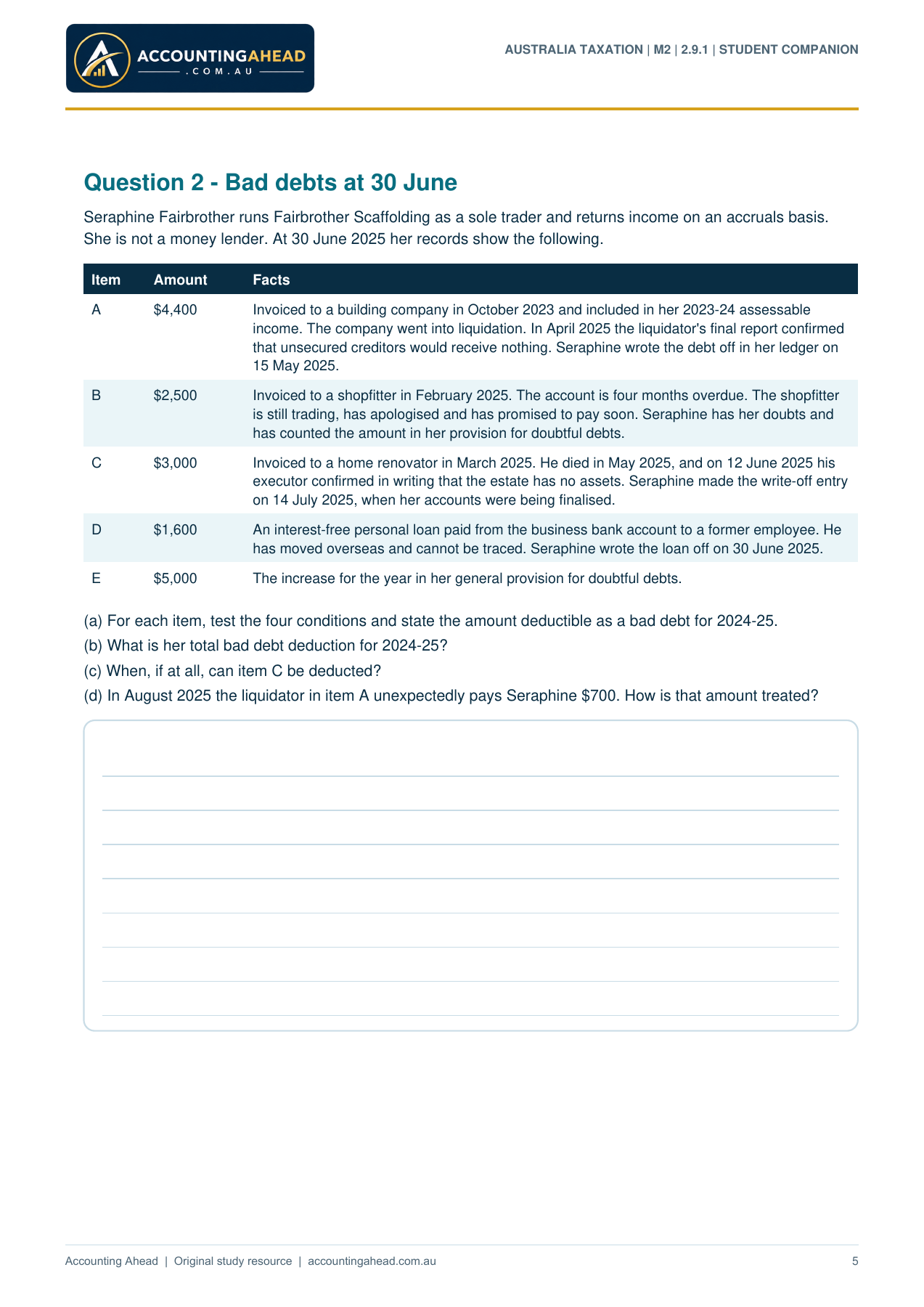
Question 2 - Bad debts at 30 June
Seraphine Fairbrother runs Fairbrother Scaffolding as a sole trader and returns income on an accruals basis.
She is not a money lender. At 30 June 2025 her records show the following.
Item Amount Facts
A $4,400 Invoiced to a building company in October 2023 and included in her 2023-24 assessable
income. The company went into liquidation. In April 2025 the liquidator's final report confirmed
that unsecured creditors would receive nothing. Seraphine wrote the debt off in her ledger on
15 May 2025.
B $2,500 Invoiced to a shopfitter in February 2025. The account is four months overdue. The shopfitter
is still trading, has apologised and has promised to pay soon. Seraphine has her doubts and
has counted the amount in her provision for doubtful debts.
C $3,000 Invoiced to a home renovator in March 2025. He died in May 2025, and on 12 June 2025 his
executor confirmed in writing that the estate has no assets. Seraphine made the write-off entry
on 14 July 2025, when her accounts were being finalised.
D $1,600 An interest-free personal loan paid from the business bank account to a former employee. He
has moved overseas and cannot be traced. Seraphine wrote the loan off on 30 June 2025.
E $5,000 The increase for the year in her general provision for doubtful debts.
(a) For each item, test the four conditions and state the amount deductible as a bad debt for 2024-25.
(b) What is her total bad debt deduction for 2024-25?
(c) When, if at all, can item C be deducted?
(d) In August 2025 the liquidator in item A unexpectedly pays Seraphine $700. How is that amount treated?
AUSTRALIA TAXATION | M2 | 2.9.1 | STUDENT COMPANION
5
Accounting Ahead | Original study resource | accountingahead.com.au
Question 3 - Three special cases
Explain what each taxpayer can deduct for 2024-25.
(a) Dr Benedikt Winterbourne is a vet in sole practice who returns income on a cash basis. At 30 June 2025
clients owe him $3,800 for treatment that he is certain will never be paid for, and he writes the amounts off.
(b) Tamarind Finance Pty Ltd lends money to small businesses in the ordinary course of its business and returns
interest income on an accruals basis. A borrower has disappeared owing $18,000 of loan principal and $2,000 of
interest, which Tamarind has already included in assessable income. On 20 June 2025 Tamarind writes off the
full $20,000 as bad. Assume Tamarind passes the company tests mentioned in (c).
(c) Delahunty Freight Pty Ltd returns income on an accruals basis. On 10 June 2025 it writes off a genuine bad
trade debt of $9,000 that was included in its assessable income in 2023-24. In January 2025, after the debt
arose and before it was written off, 70% of the company's shares were sold to an unrelated buyer. The company
carries on exactly the same freight business as before. What extra requirement applies because the taxpayer is
a company, and is it likely to be met?
AUSTRALIA TAXATION | M2 | 2.9.1 | STUDENT COMPANION
6
Accounting Ahead | Original study resource | accountingahead.com.au
Worked answers
MODULE 2 | 2.9.1 | WORKED ANSWERS - ATTEMPT THE QUESTIONS FIRST
Answer 1
Work through the four contrasts for each job: part or whole, restore or improve, when the defect arose, and work
before a sale. Then check how far the asset is used to produce income.
Job Deductible under
s 25-10
Reason
1 $1,800 The washing machine is the entirety. Bearings and a door seal are subsidiary parts,
replaced with equivalents, which restores the machine without improving it. The machine
is used wholly in the business, so the full cost is deductible.
2 Nil The valve was already defective when she bought the press. Fixing it is an initial repair,
which is capital: it is really part of the cost of acquiring a working press (Law Shipping).
The $900 is added to the cost, giving $6,000 + $900 = $6,900 for capital allowance
purposes.
3 Nil She replaced the entirety, the whole dryer. That is capital, even though replacing was
cheaper than repairing. She cannot claim the $2,600 quote, or any part of it, as a
notional repair: only what was actually spent counts, and it was spent on a new asset
(Western Suburbs Cinemas). The $2,200 is dealt with under the capital allowance rules.
4 $900 Replacing a burst section of pipe restores part of the building, so it is a repair to
premises. The building is only partly used to produce income, so only that proportion is
deductible (s 25-10(2)). On a floor-area basis: 60% x $1,500 = $900. The other $600
relates to her home.
5 Nil Nothing was broken or worn, so nothing was repaired. A wider concrete ramp in place of
a sound timber one is an improvement, which is capital (s 25-10(3)).
6 $300 (a) $300: replacing the frayed belt puts right ordinary wear and tear from using the
machine to earn income. It is a repair even though it was done just before sale. (b) $650:
respraying and adding a counter the machine never had were done to make it more
saleable and go beyond restoring it. That is capital.
Total repairs deduction for 2024-25: $1,800 + $900 + $300 = $3,000.
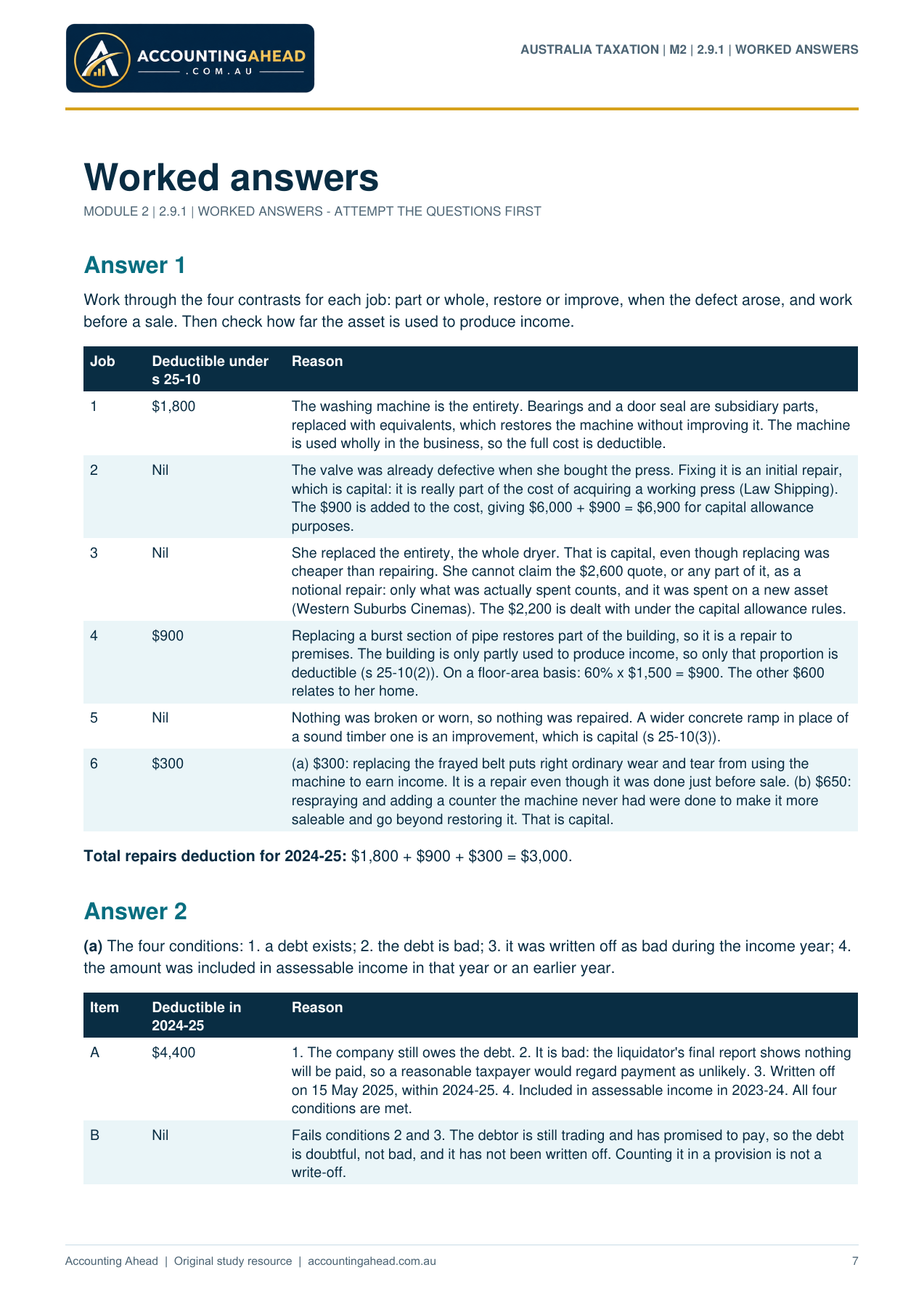
Answer 2
(a) The four conditions: 1. a debt exists; 2. the debt is bad; 3. it was written off as bad during the income year; 4.
the amount was included in assessable income in that year or an earlier year.
Item Deductible in
2024-25
Reason
A $4,400 1. The company still owes the debt. 2. It is bad: the liquidator's final report shows nothing
will be paid, so a reasonable taxpayer would regard payment as unlikely. 3. Written off
on 15 May 2025, within 2024-25. 4. Included in assessable income in 2023-24. All four
conditions are met.
B Nil Fails conditions 2 and 3. The debtor is still trading and has promised to pay, so the debt
is doubtful, not bad, and it has not been written off. Counting it in a provision is not a
write-off.
AUSTRALIA TAXATION | M2 | 2.9.1 | WORKED ANSWERS
7
Accounting Ahead | Original study resource | accountingahead.com.au
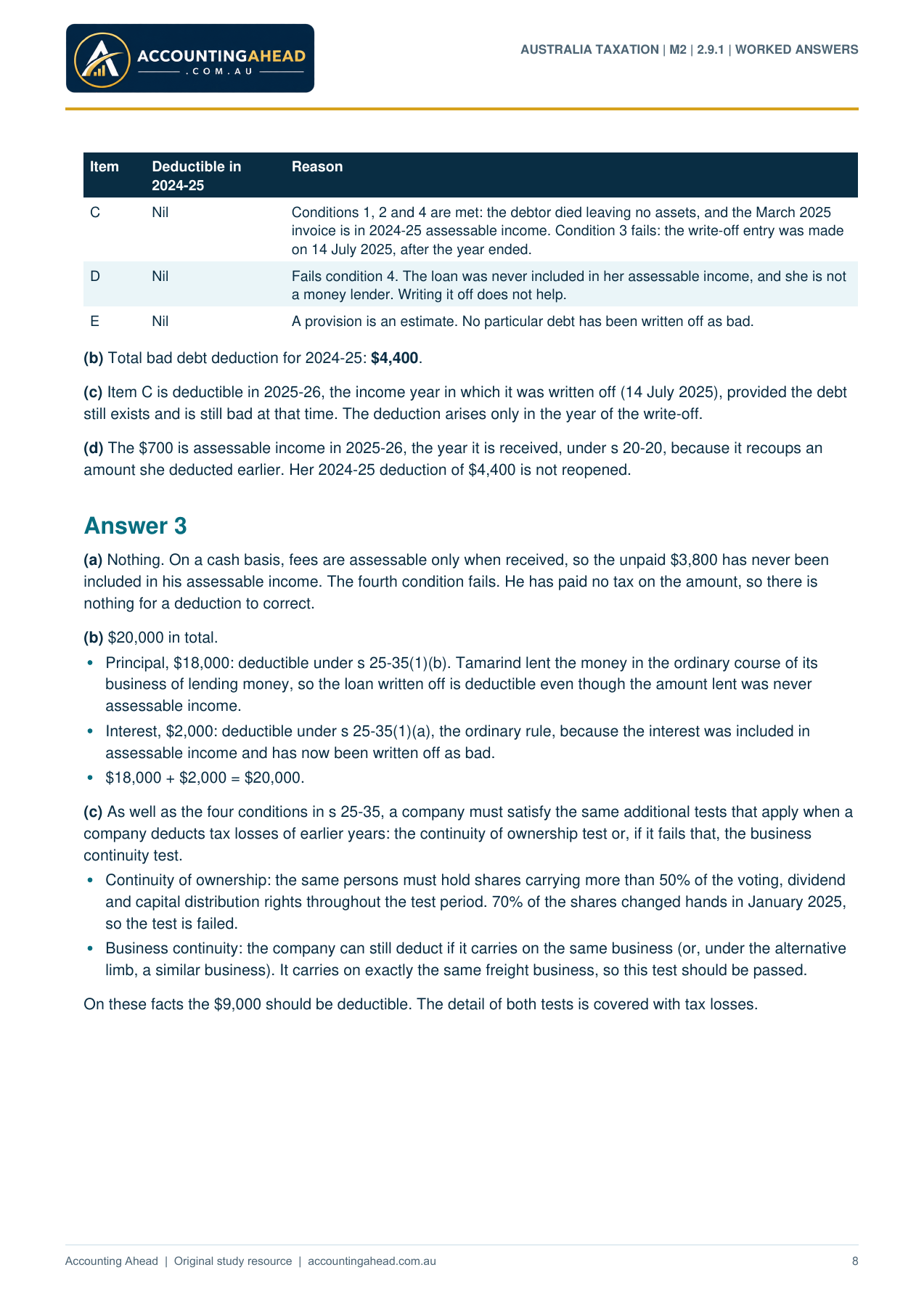
Item Deductible in
2024-25
Reason
C Nil Conditions 1, 2 and 4 are met: the debtor died leaving no assets, and the March 2025
invoice is in 2024-25 assessable income. Condition 3 fails: the write-off entry was made
on 14 July 2025, after the year ended.
D Nil Fails condition 4. The loan was never included in her assessable income, and she is not
a money lender. Writing it off does not help.
E Nil A provision is an estimate. No particular debt has been written off as bad.
(b) Total bad debt deduction for 2024-25: $4,400.
(c) Item C is deductible in 2025-26, the income year in which it was written off (14 July 2025), provided the debt
still exists and is still bad at that time. The deduction arises only in the year of the write-off.
(d) The $700 is assessable income in 2025-26, the year it is received, under s 20-20, because it recoups an
amount she deducted earlier. Her 2024-25 deduction of $4,400 is not reopened.
Answer 3
(a) Nothing. On a cash basis, fees are assessable only when received, so the unpaid $3,800 has never been
included in his assessable income. The fourth condition fails. He has paid no tax on the amount, so there is
nothing for a deduction to correct.
(b) $20,000 in total.
Principal, $18,000: deductible under s 25-35(1)(b). Tamarind lent the money in the ordinary course of its
business of lending money, so the loan written off is deductible even though the amount lent was never
assessable income.
Interest, $2,000: deductible under s 25-35(1)(a), the ordinary rule, because the interest was included in
assessable income and has now been written off as bad.
$18,000 + $2,000 = $20,000.
(c) As well as the four conditions in s 25-35, a company must satisfy the same additional tests that apply when a
company deducts tax losses of earlier years: the continuity of ownership test or, if it fails that, the business
continuity test.
Continuity of ownership: the same persons must hold shares carrying more than 50% of the voting, dividend
and capital distribution rights throughout the test period. 70% of the shares changed hands in January 2025,
so the test is failed.
Business continuity: the company can still deduct if it carries on the same business (or, under the alternative
limb, a similar business). It carries on exactly the same freight business, so this test should be passed.
On these facts the $9,000 should be deductible. The detail of both tests is covered with tax losses.
AUSTRALIA TAXATION | M2 | 2.9.1 | WORKED ANSWERS
8