
CGT Core Concepts — study companion
Part 3.1 of Australia Taxation. Preview the study companion or download the printable PDF.



Read the handout text
Accounting Ahead | Original study resource | accountingahead.com.au
CGT Core Concepts
MODULE 3 | 3.1 | STUDENT COMPANION
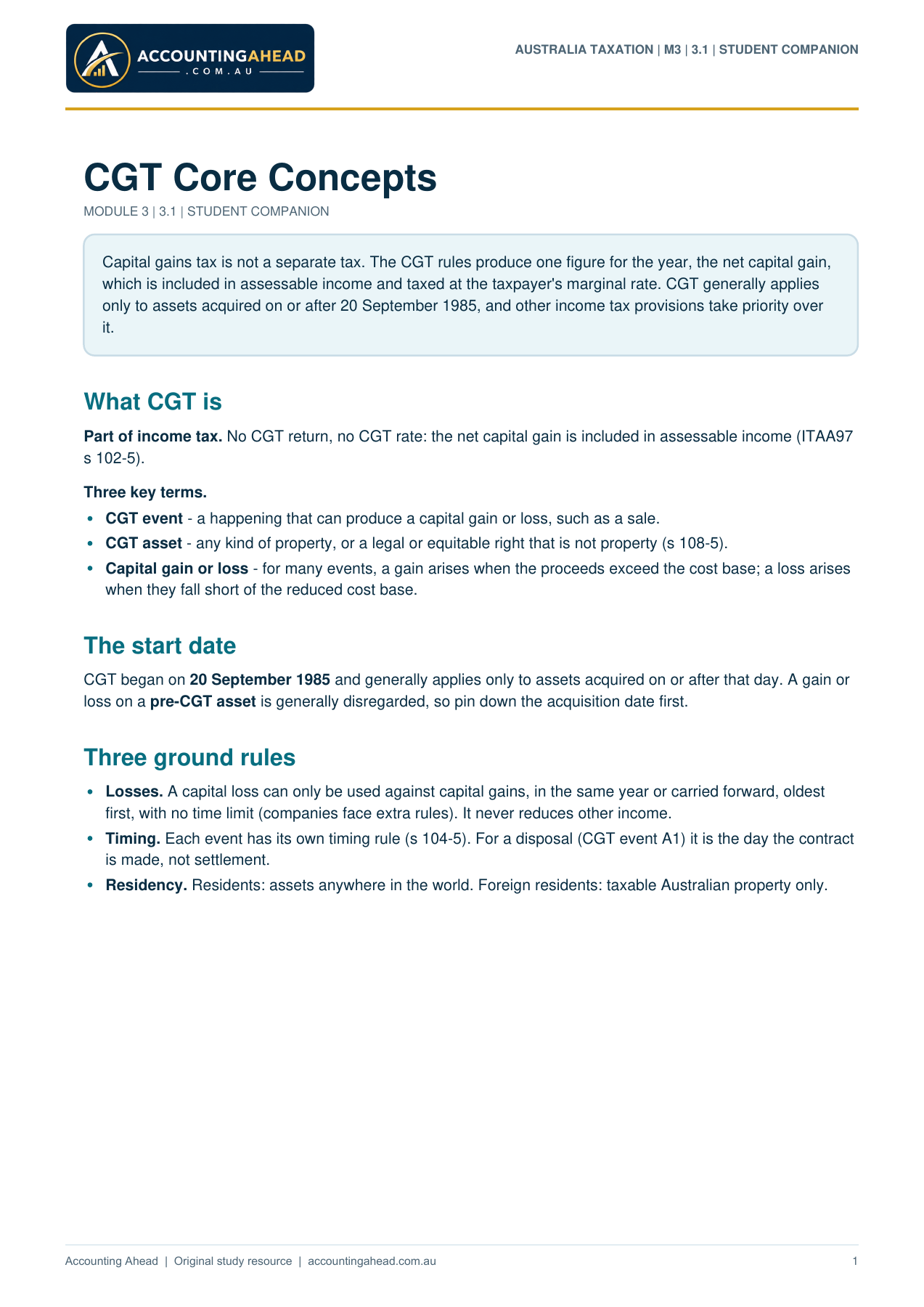
Capital gains tax is not a separate tax. The CGT rules produce one figure for the year, the net capital gain,
which is included in assessable income and taxed at the taxpayer's marginal rate. CGT generally applies
only to assets acquired on or after 20 September 1985, and other income tax provisions take priority over
it.
What CGT is
Part of income tax. No CGT return, no CGT rate: the net capital gain is included in assessable income (ITAA97
s 102-5).
Three key terms.
CGT event - a happening that can produce a capital gain or loss, such as a sale.
CGT asset - any kind of property, or a legal or equitable right that is not property (s 108-5).
Capital gain or loss - for many events, a gain arises when the proceeds exceed the cost base; a loss arises
when they fall short of the reduced cost base.
The start date
CGT began on 20 September 1985 and generally applies only to assets acquired on or after that day. A gain or
loss on a pre-CGT asset is generally disregarded, so pin down the acquisition date first.
Three ground rules
Losses. A capital loss can only be used against capital gains, in the same year or carried forward, oldest
first, with no time limit (companies face extra rules). It never reduces other income.
Timing. Each event has its own timing rule (s 104-5). For a disposal (CGT event A1) it is the day the contract
is made, not settlement.
Residency. Residents: assets anywhere in the world. Foreign residents: taxable Australian property only.
AUSTRALIA TAXATION | M3 | 3.1 | STUDENT COMPANION
1
Accounting Ahead | Original study resource | accountingahead.com.au
Interaction with the rest of the law
Other provisions go first. A sale in the ordinary course of business is ordinary income (s 6-5), with no capital
gain. A pre-CGT asset escapes CGT but may still produce ordinary income, or a profit taxed by s 15-15 under a
profit-making undertaking or plan.
The priority rule: Other income tax provisions take precedence. If an amount is already assessable under another provision, the capital
gain is reduced to match.
A CGT asset is sold
Sold in the ordinary course
of a business
Acquired on or after 20
September 1985, no other
provision applies
Pre-CGT asset (acquired before 20 September 1985)
Example - a dealer in
second-hand pianos sells a
piano from the showroom
floor.
Ordinary income under
s 6-5. No capital gain
arises.
CGT applies - subject
to exemptions and
rollover relief.
CGT disregards the gain.
Ordinary income? s 6-5
The sale is really a business
operation or a commercial deal
made for profit, not just the
realisation of an investment.
Profit-making plan? s 15-15
The asset was part of a
profit-making undertaking or plan -
the profit may be taxed.
Neither applies -> nothing assessable.
The six-step process
1 Determine the CGT event
No event, no capital gain or loss.
2 Identify the CGT asset
Most events involve one - though not all.
3 Calculate the gain or loss
Separately for each CGT event.
4 Check exceptions and exemptions
These can wipe a gain out.
5 Consider rollover relief
Defers a gain until a later CGT event. Some rollovers apply automatically; others must be chosen.
6 Find the net result
Bring everything together into a net capital gain or a net capital loss for the year.
Net capital gain
Included in assessable income (s 102-5).
Net capital loss
Carried forward against capital gains in future years.
AUSTRALIA TAXATION | M3 | 3.1 | STUDENT COMPANION
2
Accounting Ahead | Original study resource | accountingahead.com.au
The CGT equation (s 100-50)
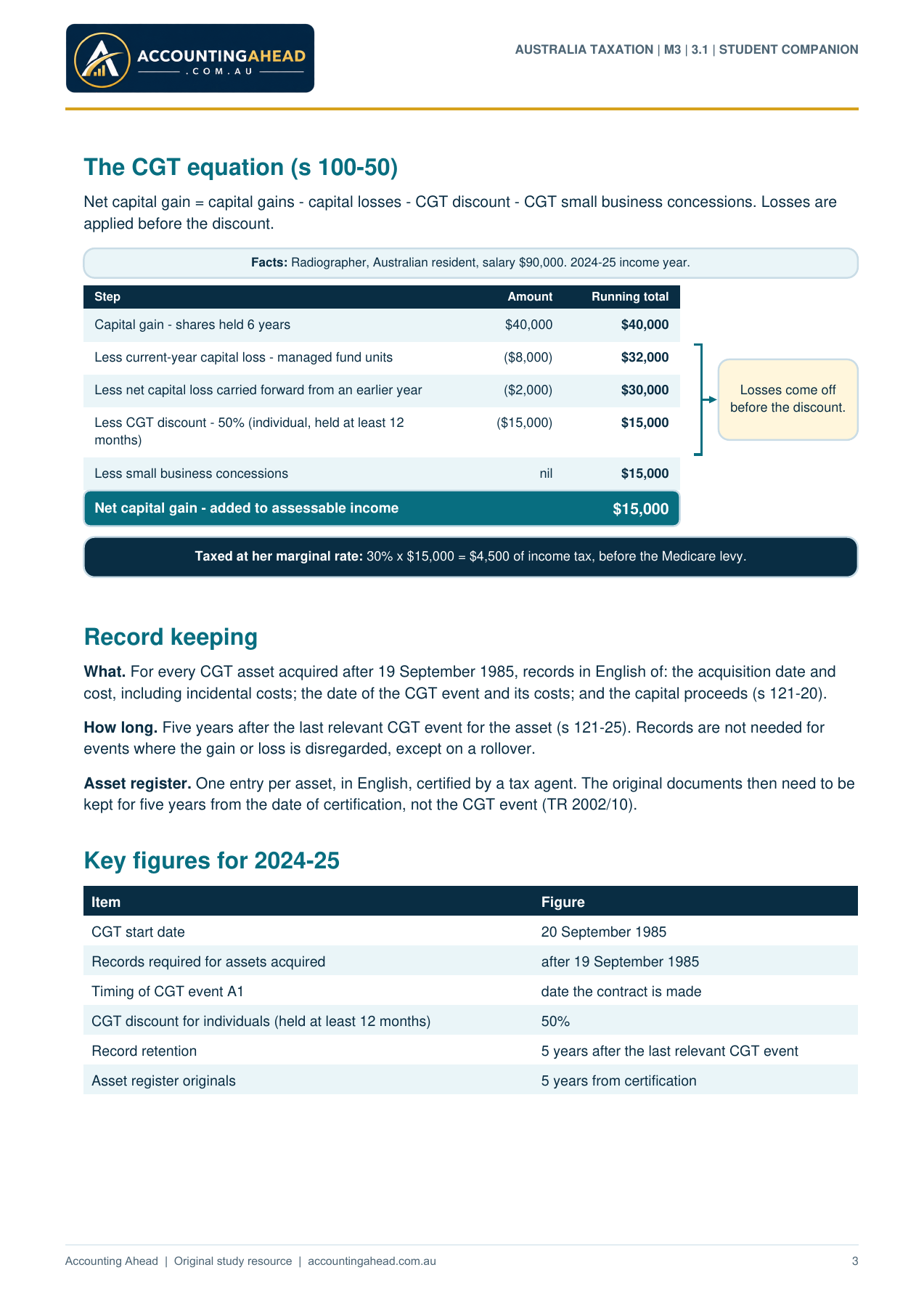
Net capital gain = capital gains - capital losses - CGT discount - CGT small business concessions. Losses are
applied before the discount.
Facts: Radiographer, Australian resident, salary $90,000. 2024-25 income year.
Step Amount Running total
Capital gain - shares held 6 years $40,000 $40,000
Less current-year capital loss - managed fund units ($8,000) $32,000
Less net capital loss carried forward from an earlier year ($2,000) $30,000
Less CGT discount - 50% (individual, held at least 12
months)
($15,000) $15,000
Less small business concessions nil $15,000
Net capital gain - added to assessable income $15,000
Losses come off
before the discount.
Taxed at her marginal rate: 30% x $15,000 = $4,500 of income tax, before the Medicare levy.
Record keeping
What. For every CGT asset acquired after 19 September 1985, records in English of: the acquisition date and
cost, including incidental costs; the date of the CGT event and its costs; and the capital proceeds (s 121-20).
How long. Five years after the last relevant CGT event for the asset (s 121-25). Records are not needed for
events where the gain or loss is disregarded, except on a rollover.
Asset register. One entry per asset, in English, certified by a tax agent. The original documents then need to be
kept for five years from the date of certification, not the CGT event (TR 2002/10).
Key figures for 2024-25
Item Figure
CGT start date 20 September 1985
Records required for assets acquired after 19 September 1985
Timing of CGT event A1 date the contract is made
CGT discount for individuals (held at least 12 months) 50%
Record retention 5 years after the last relevant CGT event
Asset register originals 5 years from certification
AUSTRALIA TAXATION | M3 | 3.1 | STUDENT COMPANION
3
Accounting Ahead | Original study resource | accountingahead.com.au
Practice questions
MODULE 3 | 3.1 | TRY THESE BEFORE THE WORKED ANSWERS
Question 1 - Which rules, which year?
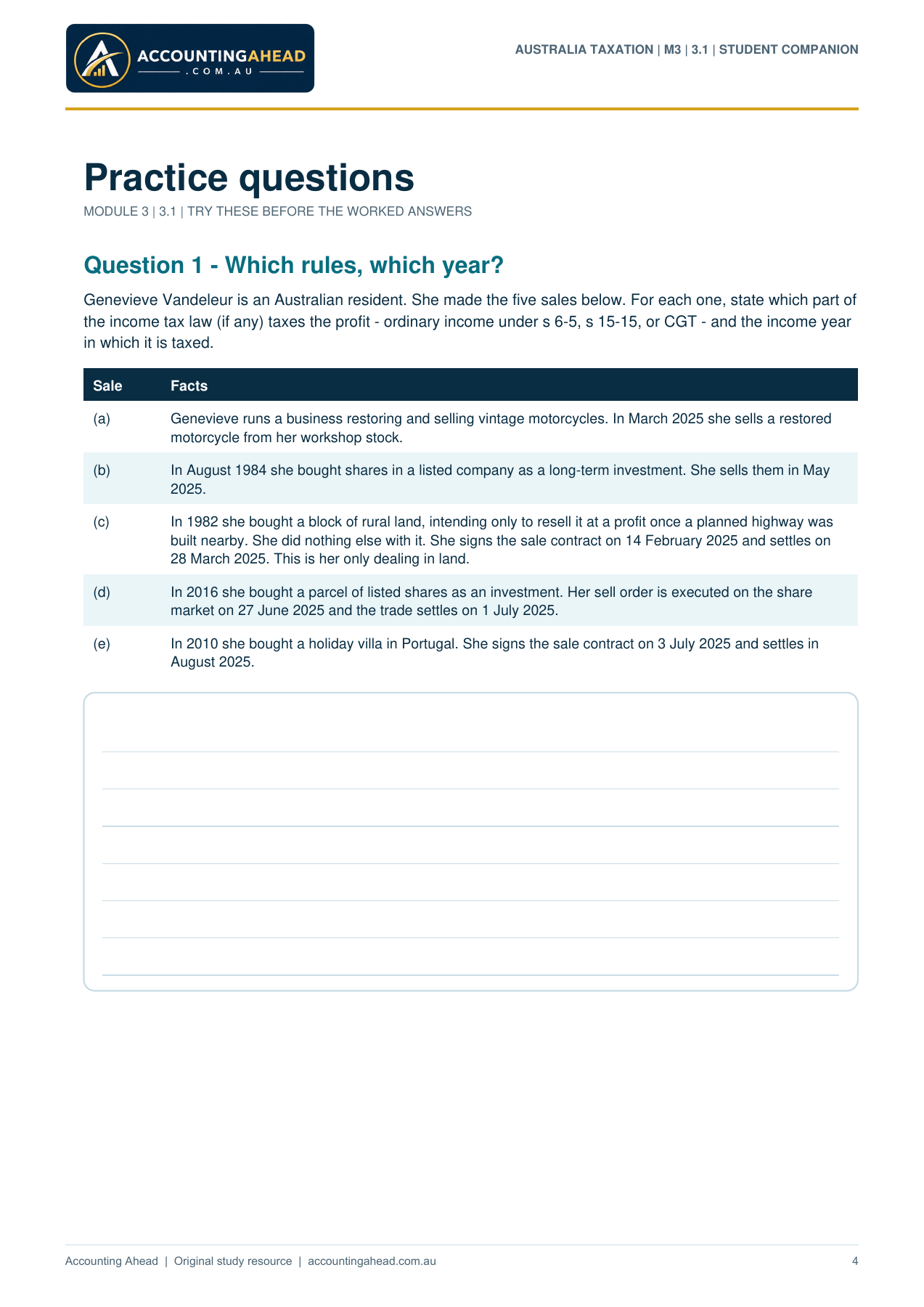
Genevieve Vandeleur is an Australian resident. She made the five sales below. For each one, state which part of
the income tax law (if any) taxes the profit - ordinary income under s 6-5, s 15-15, or CGT - and the income year
in which it is taxed.
Sale Facts
(a) Genevieve runs a business restoring and selling vintage motorcycles. In March 2025 she sells a restored
motorcycle from her workshop stock.
(b) In August 1984 she bought shares in a listed company as a long-term investment. She sells them in May
2025.
(c) In 1982 she bought a block of rural land, intending only to resell it at a profit once a planned highway was
built nearby. She did nothing else with it. She signs the sale contract on 14 February 2025 and settles on
28 March 2025. This is her only dealing in land.
(d) In 2016 she bought a parcel of listed shares as an investment. Her sell order is executed on the share
market on 27 June 2025 and the trade settles on 1 July 2025.
(e) In 2010 she bought a holiday villa in Portugal. She signs the sale contract on 3 July 2025 and settles in
August 2025.
AUSTRALIA TAXATION | M3 | 3.1 | STUDENT COMPANION
4
Accounting Ahead | Original study resource | accountingahead.com.au
Question 2 - Applying the CGT equation
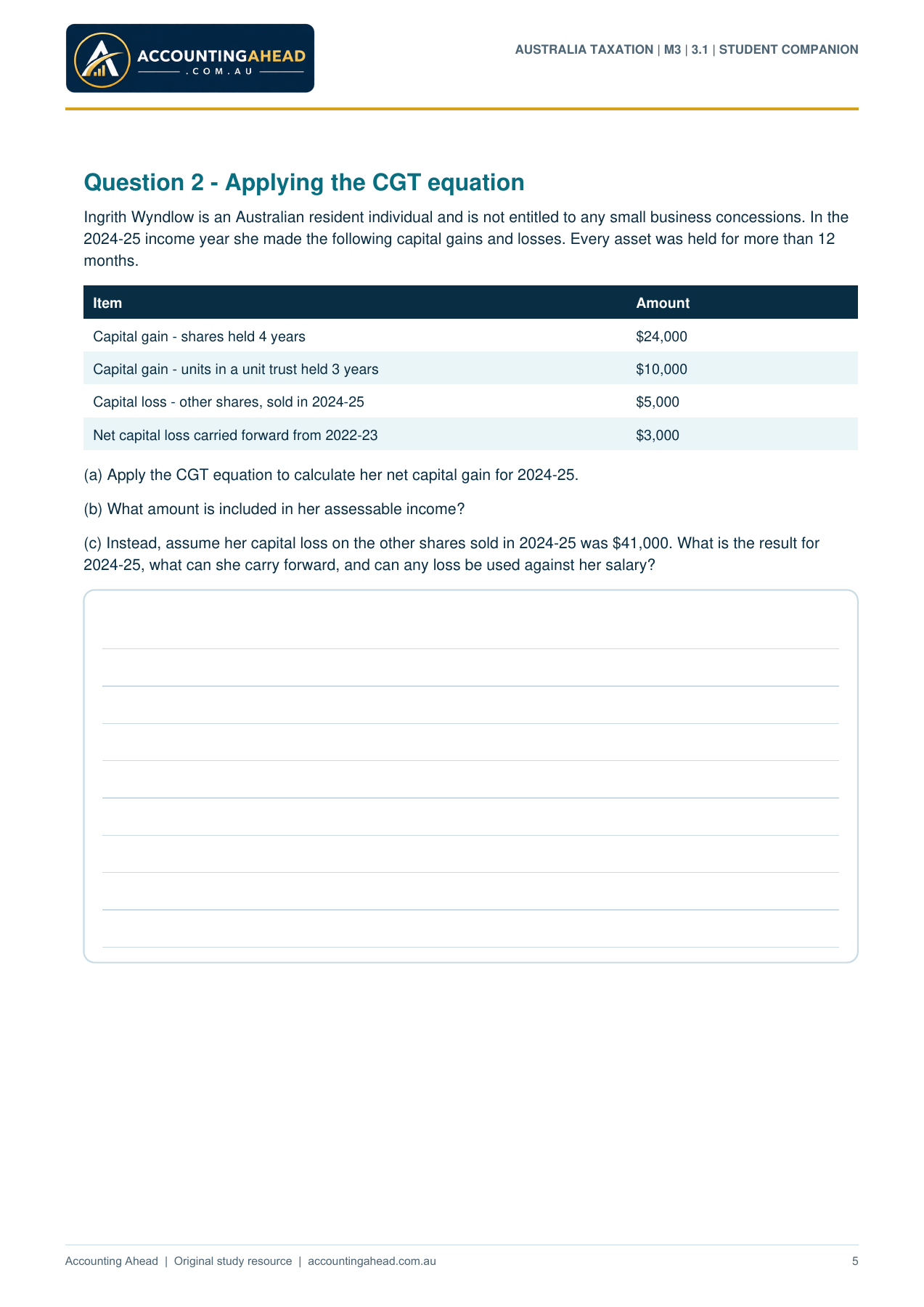
Ingrith Wyndlow is an Australian resident individual and is not entitled to any small business concessions. In the
2024-25 income year she made the following capital gains and losses. Every asset was held for more than 12
months.
Item Amount
Capital gain - shares held 4 years $24,000
Capital gain - units in a unit trust held 3 years $10,000
Capital loss - other shares, sold in 2024-25 $5,000
Net capital loss carried forward from 2022-23 $3,000
(a) Apply the CGT equation to calculate her net capital gain for 2024-25.
(b) What amount is included in her assessable income?
(c) Instead, assume her capital loss on the other shares sold in 2024-25 was $41,000. What is the result for
2024-25, what can she carry forward, and can any loss be used against her salary?
AUSTRALIA TAXATION | M3 | 3.1 | STUDENT COMPANION
5
Accounting Ahead | Original study resource | accountingahead.com.au
Question 3 - The filing cabinet
On 1 December 2024 Torquil Hollinrake clears out his filing cabinet. He has not been told otherwise by the
Commissioner. For each bundle, say whether the CGT record-keeping rules require him to keep it and, if so,
until when.
Bundle Contents
(a) Broker's contract notes for shares bought in 1983. He still owns the shares.
(b) The purchase contract, stamp duty receipt and legal fees invoice for a rental property bought in 2012. He
still owns it.
(c) Contract notes for shares bought in 2015 and sold, at a capital gain, in October 2019.
(d) The purchase papers for the car he bought in 2021 for private use.
(e) The original purchase documents for a second rental property bought in 2006. Its entry in his CGT asset
register was certified by his tax agent on 1 September 2023. He still owns the property.
AUSTRALIA TAXATION | M3 | 3.1 | STUDENT COMPANION
6
Accounting Ahead | Original study resource | accountingahead.com.au
Worked answers
MODULE 3 | 3.1 | WORKED ANSWERS - ATTEMPT THE QUESTIONS FIRST
Answer 1
Sale Rule that taxes the profit Income year
(a) Ordinary income under s 6-5. The motorcycle is stock of her business, sold in
the ordinary course of business, so the proceeds are ordinary income and no
capital gain arises (other provisions take priority over CGT).
2024-25 (sold March 2025)
(b) Nothing is assessable. The shares are a pre-CGT asset (bought before 20
September 1985), so CGT disregards the gain. Selling a long-held investment
is a mere realisation of an asset, not a business or a profit-making plan, so
neither s 6-5 nor s 15-15 applies.
Not applicable
(c) s 15-15 may tax the profit. The land is pre-CGT, so CGT disregards the gain,
but she bought it under a plan to make a profit by reselling it, which is a
profit-making undertaking or plan involving a pre-CGT asset. (If the dealing
amounted to a business or commercial venture, it would instead be ordinary
income under s 6-5.)
2024-25 (contract and
settlement both in 2024-25)
(d) CGT. The shares are a post-CGT investment and no other provision taxes the
sale. Under CGT event A1 the timing is the date of the contract - the trade
date of 27 June 2025 - not settlement.
2024-25
(e) CGT. As an Australian resident she is subject to CGT on assets anywhere in
the world. The contract was made on 3 July 2025.
2025-26
Answer 2
Step Working
Capital gains $24,000 + $10,000 = $34,000.
Less current-year capital loss $34,000 - $5,000 = $29,000.
Less net capital loss carried forward $29,000 - $3,000 = $26,000.
Less CGT discount (50%, individual, assets held at
least 12 months)
50% x $26,000 = $13,000; $26,000 - $13,000 = $13,000.
Less small business concessions Nil.
Net capital gain $13,000.
The losses are applied before the discount. Applying the discount first would wrongly halve the losses as well.
(a) Net capital gain = $13,000 (see the table).
(b) $13,000 is included in her assessable income for 2024-25 (s 102-5) and taxed at her marginal rate.
(c) Capital gains $34,000 - current-year capital loss $41,000 = -$7,000. Her losses exceed her gains, so she has
a net capital loss of $7,000 for 2024-25 and a net capital gain of nil. Nothing is added to assessable income and
no discount applies. The $3,000 loss from 2022-23 has not been used, so it also stays available. She carries
AUSTRALIA TAXATION | M3 | 3.1 | WORKED ANSWERS
7
Accounting Ahead | Original study resource | accountingahead.com.au
forward $7,000 + $3,000 = $10,000 to use against capital gains in future years, oldest loss first, with no time
limit. None of it can be used against her salary: a capital loss can only reduce capital gains.
Answer 3
Bundle Must he keep it?
(a) Not required by the CGT record-keeping rules, which cover assets acquired after 19 September 1985.
These shares are pre-CGT. Keeping evidence of the 1983 purchase date is still sensible, because it proves
the shares are pre-CGT.
(b) Yes. The rental property is a post-CGT asset and these papers show its acquisition date and cost, including
incidental costs. He must keep them until five years after the last relevant CGT event, for example five
years after he eventually sells the property.
(c) No longer required. The last relevant CGT event was the sale in October 2019. Five years after that ended
in October 2024, so by 1 December 2024 he may discard them.
(d) Not required. A car is exempt from CGT, so any gain or loss on it is disregarded, and records do not have to
be kept for events where the gain or loss is disregarded.
(e) Yes, but only until 1 September 2028. Because the asset register entry was certified by a tax agent, the
originals need to be kept for five years from the date of certification, not five years from the CGT event.
AUSTRALIA TAXATION | M3 | 3.1 | WORKED ANSWERS
8