
CGT Events - Disposals and Timing — study companion
Part 3.2.1 of Australia Taxation. Preview the study companion or download the printable PDF.

Read the handout text
Accounting Ahead | Original study resource | accountingahead.com.au
CGT events - disposals and timing
MODULE 3 | 3.2.1 | STUDENT COMPANION
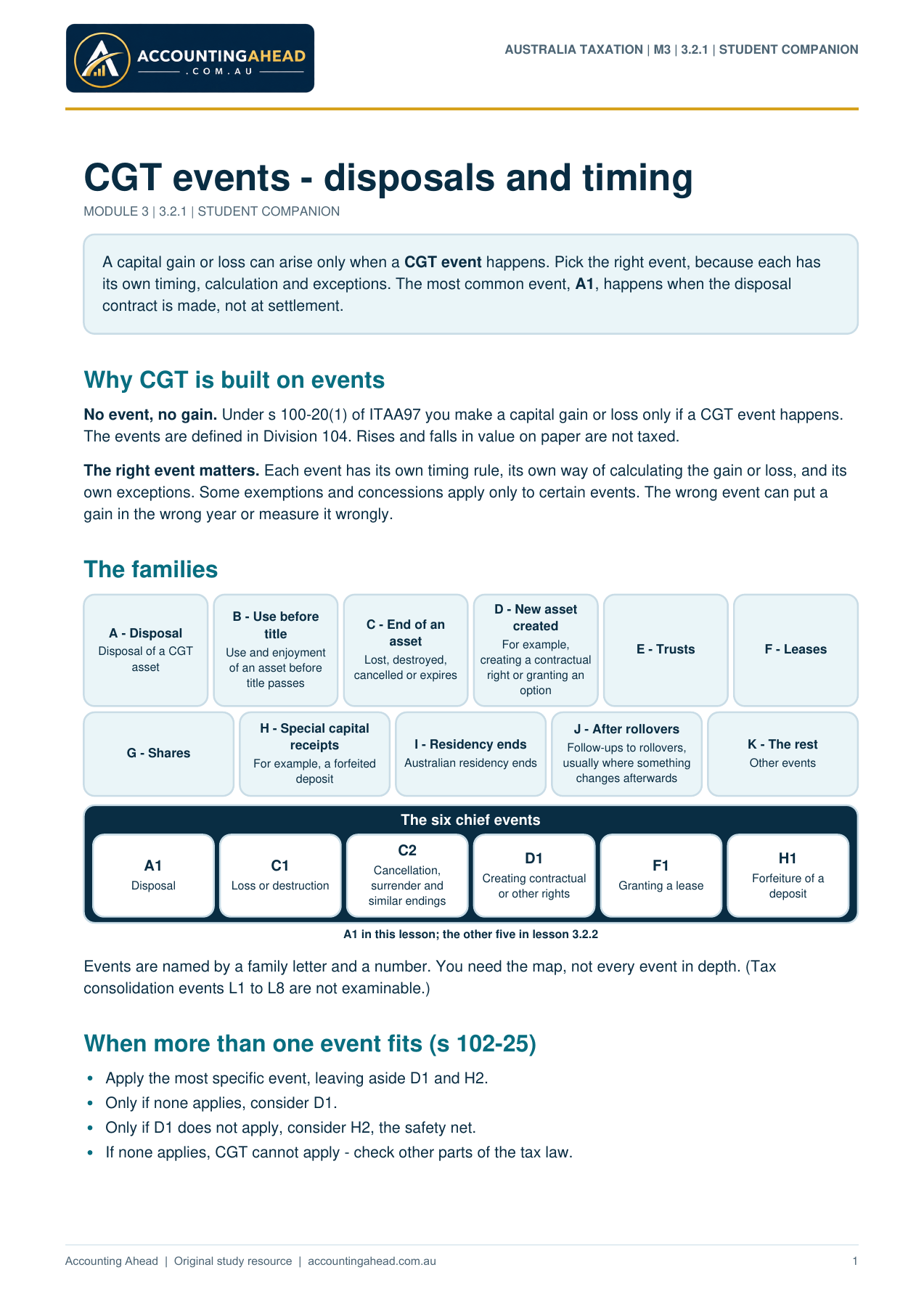
A capital gain or loss can arise only when a CGT event happens. Pick the right event, because each has
its own timing, calculation and exceptions. The most common event, A1, happens when the disposal
contract is made, not at settlement.
Why CGT is built on events
No event, no gain. Under s 100-20(1) of ITAA97 you make a capital gain or loss only if a CGT event happens.
The events are defined in Division 104. Rises and falls in value on paper are not taxed.
The right event matters. Each event has its own timing rule, its own way of calculating the gain or loss, and its
own exceptions. Some exemptions and concessions apply only to certain events. The wrong event can put a
gain in the wrong year or measure it wrongly.
The families
A - Disposal
Disposal of a CGT
asset
B - Use before
title
Use and enjoyment
of an asset before
title passes
C - End of an
asset
Lost, destroyed,
cancelled or expires
D - New asset
created
For example,
creating a contractual
right or granting an
option
E - Trusts F - Leases
G - Shares
H - Special capital
receipts
For example, a forfeited
deposit
I - Residency ends
Australian residency ends
J - After rollovers
Follow-ups to rollovers,
usually where something
changes afterwards
K - The rest
Other events
The six chief events
A1
Disposal
C1
Loss or destruction
C2
Cancellation,
surrender and
similar endings
D1
Creating contractual
or other rights
F1
Granting a lease
H1
Forfeiture of a
deposit
A1 in this lesson; the other five in lesson 3.2.2
Events are named by a family letter and a number. You need the map, not every event in depth. (Tax
consolidation events L1 to L8 are not examinable.)
When more than one event fits (s 102-25)
Apply the most specific event, leaving aside D1 and H2.
Only if none applies, consider D1.
Only if D1 does not apply, consider H2, the safety net.
If none applies, CGT cannot apply - check other parts of the tax law.
AUSTRALIA TAXATION | M3 | 3.2.1 | STUDENT COMPANION
1
Accounting Ahead | Original study resource | accountingahead.com.au
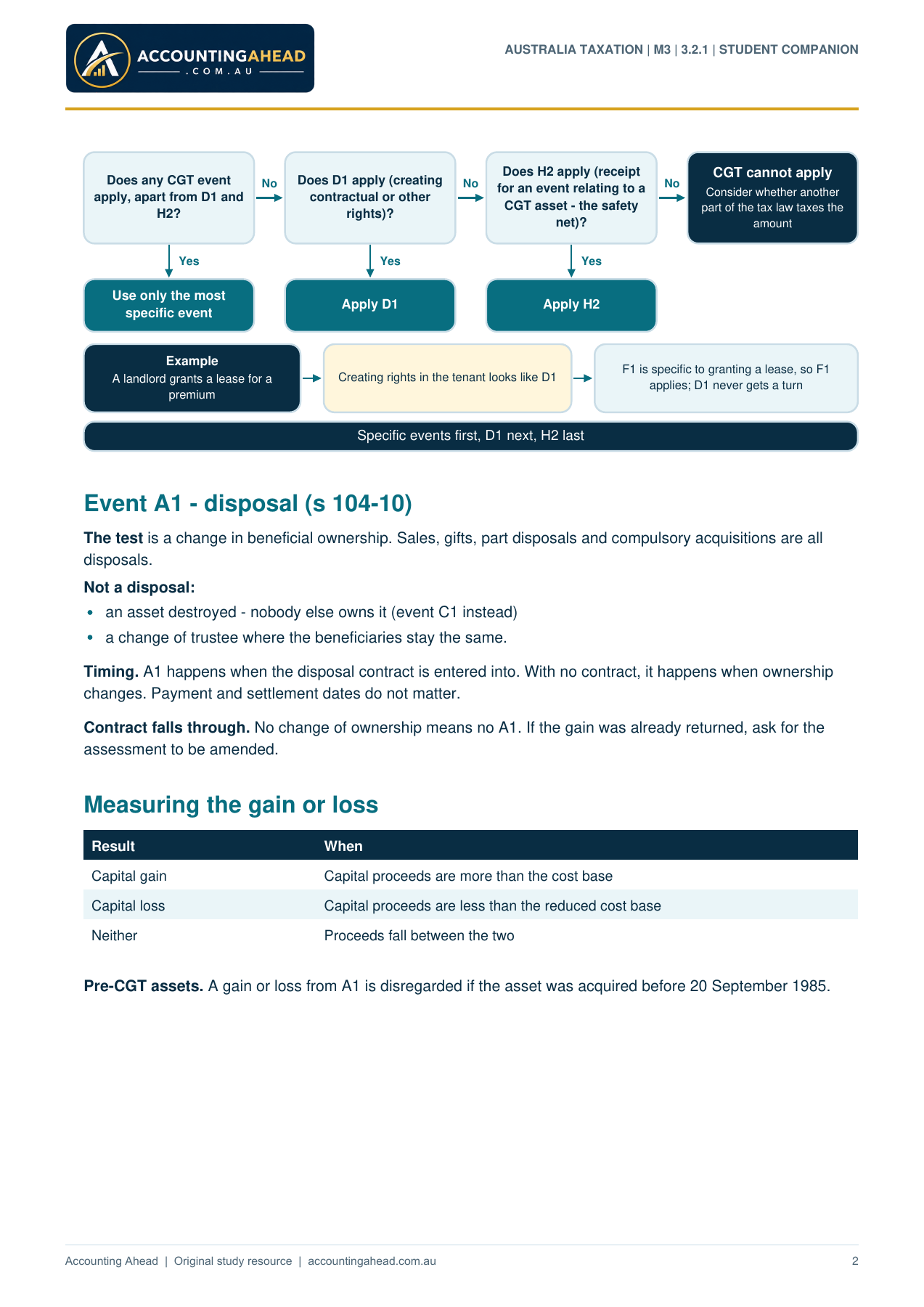
Does any CGT event
apply, apart from D1 and
H2?
Yes
Use only the most
specific event
No Does D1 apply (creating
contractual or other
rights)?
Yes
Apply D1
No
Does H2 apply (receipt
for an event relating to a
CGT asset - the safety
net)?
Yes
Apply H2
No
CGT cannot apply
Consider whether another
part of the tax law taxes the
amount
Example
A landlord grants a lease for a
premium
Creating rights in the tenant looks like D1 F1 is specific to granting a lease, so F1
applies; D1 never gets a turn
Specific events first, D1 next, H2 last
Event A1 - disposal (s 104-10)
The test is a change in beneficial ownership. Sales, gifts, part disposals and compulsory acquisitions are all
disposals.
Not a disposal:
an asset destroyed - nobody else owns it (event C1 instead)
a change of trustee where the beneficiaries stay the same.
Timing. A1 happens when the disposal contract is entered into. With no contract, it happens when ownership
changes. Payment and settlement dates do not matter.
Contract falls through. No change of ownership means no A1. If the gain was already returned, ask for the
assessment to be amended.
Measuring the gain or loss
Result When
Capital gain Capital proceeds are more than the cost base
Capital loss Capital proceeds are less than the reduced cost base
Neither Proceeds fall between the two
Pre-CGT assets. A gain or loss from A1 is disregarded if the asset was acquired before 20 September 1985.
AUSTRALIA TAXATION | M3 | 3.2.1 | STUDENT COMPANION
2
Accounting Ahead | Original study resource | accountingahead.com.au
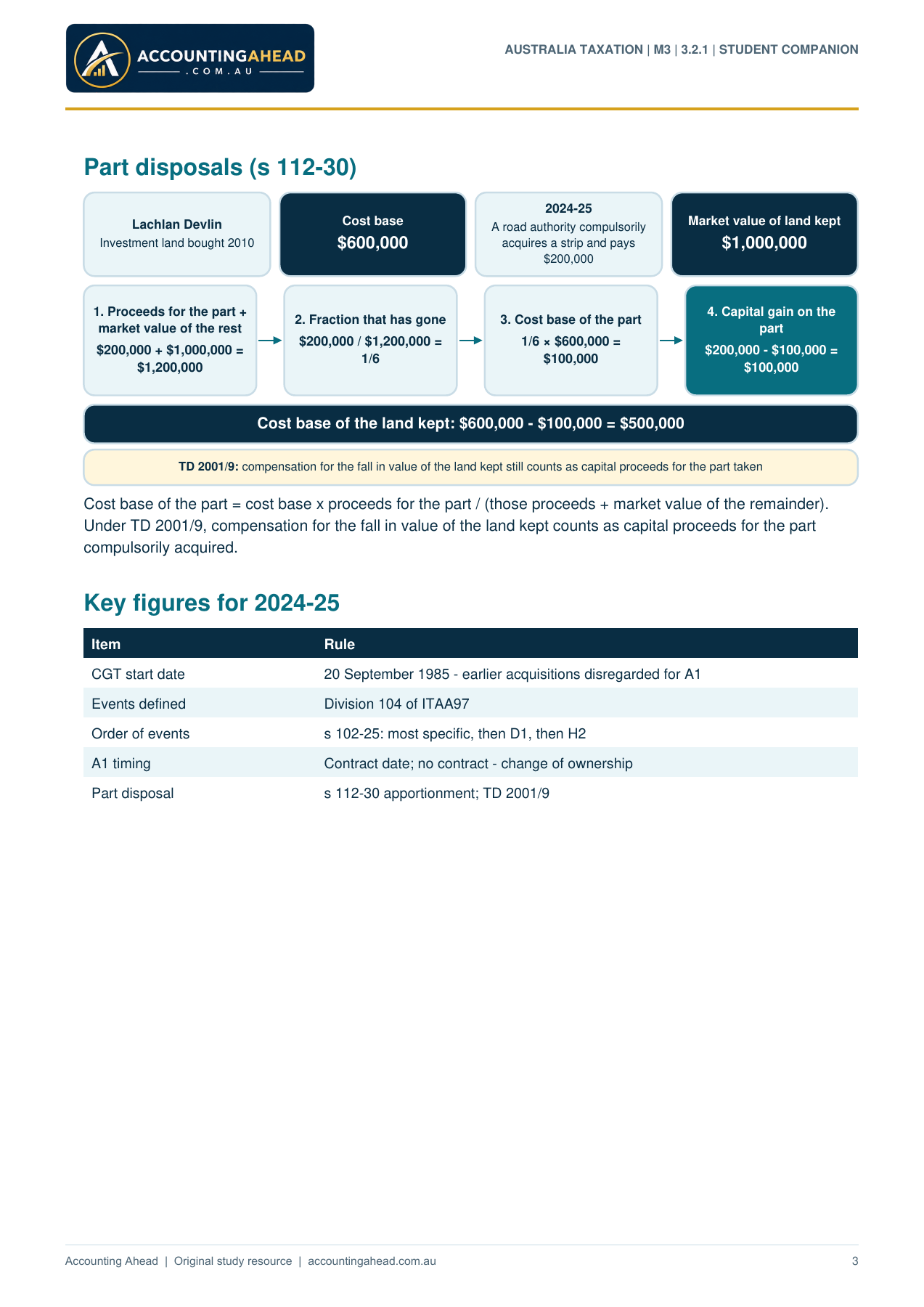
Part disposals (s 112-30)
Lachlan Devlin
Investment land bought 2010
Cost base
$600,000
2024-25
A road authority compulsorily
acquires a strip and pays
$200,000
Market value of land kept
$1,000,000
1. Proceeds for the part +
market value of the rest
$200,000 + $1,000,000 =
$1,200,000
2. Fraction that has gone
$200,000 / $1,200,000 =
1/6
3. Cost base of the part
1/6 × $600,000 =
$100,000
4. Capital gain on the
part
$200,000 - $100,000 =
$100,000
Cost base of the land kept: $600,000 - $100,000 = $500,000
TD 2001/9: compensation for the fall in value of the land kept still counts as capital proceeds for the part taken
Cost base of the part = cost base x proceeds for the part / (those proceeds + market value of the remainder).
Under TD 2001/9, compensation for the fall in value of the land kept counts as capital proceeds for the part
compulsorily acquired.
Key figures for 2024-25
Item Rule
CGT start date 20 September 1985 - earlier acquisitions disregarded for A1
Events defined Division 104 of ITAA97
Order of events s 102-25: most specific, then D1, then H2
A1 timing Contract date; no contract - change of ownership
Part disposal s 112-30 apportionment; TD 2001/9
AUSTRALIA TAXATION | M3 | 3.2.1 | STUDENT COMPANION
3
Accounting Ahead | Original study resource | accountingahead.com.au
Practice questions
MODULE 3 | 3.2.1 | TRY THESE BEFORE THE WORKED ANSWERS
Question 1 - Does event A1 happen, and when?
For each situation, state whether CGT event A1 happens. If it does, give the date of the event and the income
year it falls in. If it does not, say why.
(a) On 27 June 2025, an investor signs a contract to sell listed shares. Settlement takes place on 2 July 2025.
(b) On 15 September 2024, a father transfers a parcel of units in a unit trust to his son as a gift. There is no
contract.
(c) On 1 March 2025, a family trust replaces its individual trustee with a company as trustee. The beneficiaries
do not change.
(d) On 3 November 2024, an investment painting is destroyed in a gallery fire.
(e) On 10 May 2025, an investor signs a contract to sell vacant land. In June 2025 the buyer withdraws, and the
sale is never completed.
(f) On 1 April 2025, an investor signs a contract to sell land she acquired in 1983. Settlement is on 20 May 2025.
(g) On 30 June 2024, an investor signs a contract to sell shares in a private company. Settlement is on 20 July
2024.
AUSTRALIA TAXATION | M3 | 3.2.1 | STUDENT COMPANION
4
Accounting Ahead | Original study resource | accountingahead.com.au
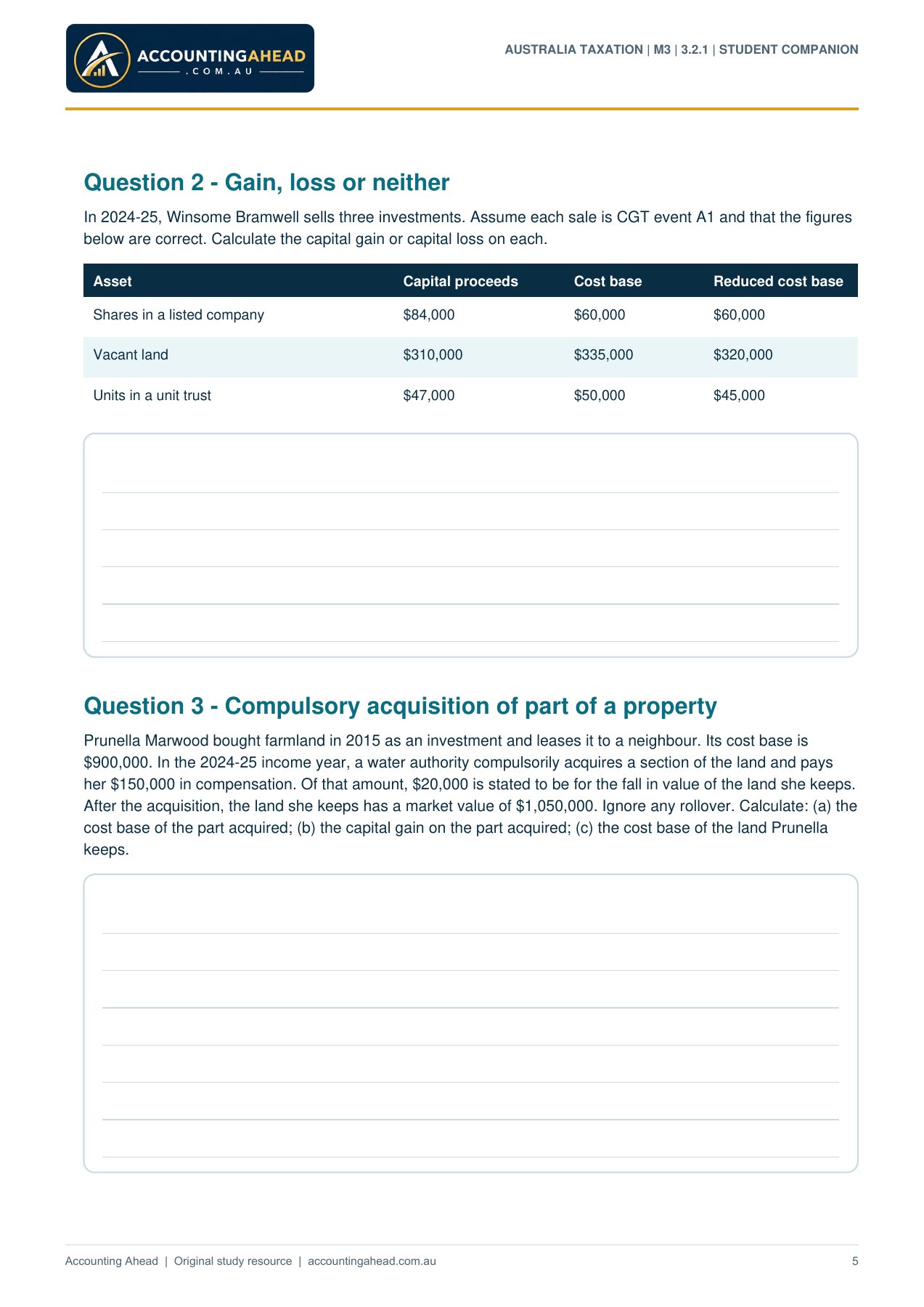
Question 2 - Gain, loss or neither
In 2024-25, Winsome Bramwell sells three investments. Assume each sale is CGT event A1 and that the figures
below are correct. Calculate the capital gain or capital loss on each.
Asset Capital proceeds Cost base Reduced cost base
Shares in a listed company $84,000 $60,000 $60,000
Vacant land $310,000 $335,000 $320,000
Units in a unit trust $47,000 $50,000 $45,000
Question 3 - Compulsory acquisition of part of a property
Prunella Marwood bought farmland in 2015 as an investment and leases it to a neighbour. Its cost base is
$900,000. In the 2024-25 income year, a water authority compulsorily acquires a section of the land and pays
her $150,000 in compensation. Of that amount, $20,000 is stated to be for the fall in value of the land she keeps.
After the acquisition, the land she keeps has a market value of $1,050,000. Ignore any rollover. Calculate: (a) the
cost base of the part acquired; (b) the capital gain on the part acquired; (c) the cost base of the land Prunella
keeps.
AUSTRALIA TAXATION | M3 | 3.2.1 | STUDENT COMPANION
5
Accounting Ahead | Original study resource | accountingahead.com.au
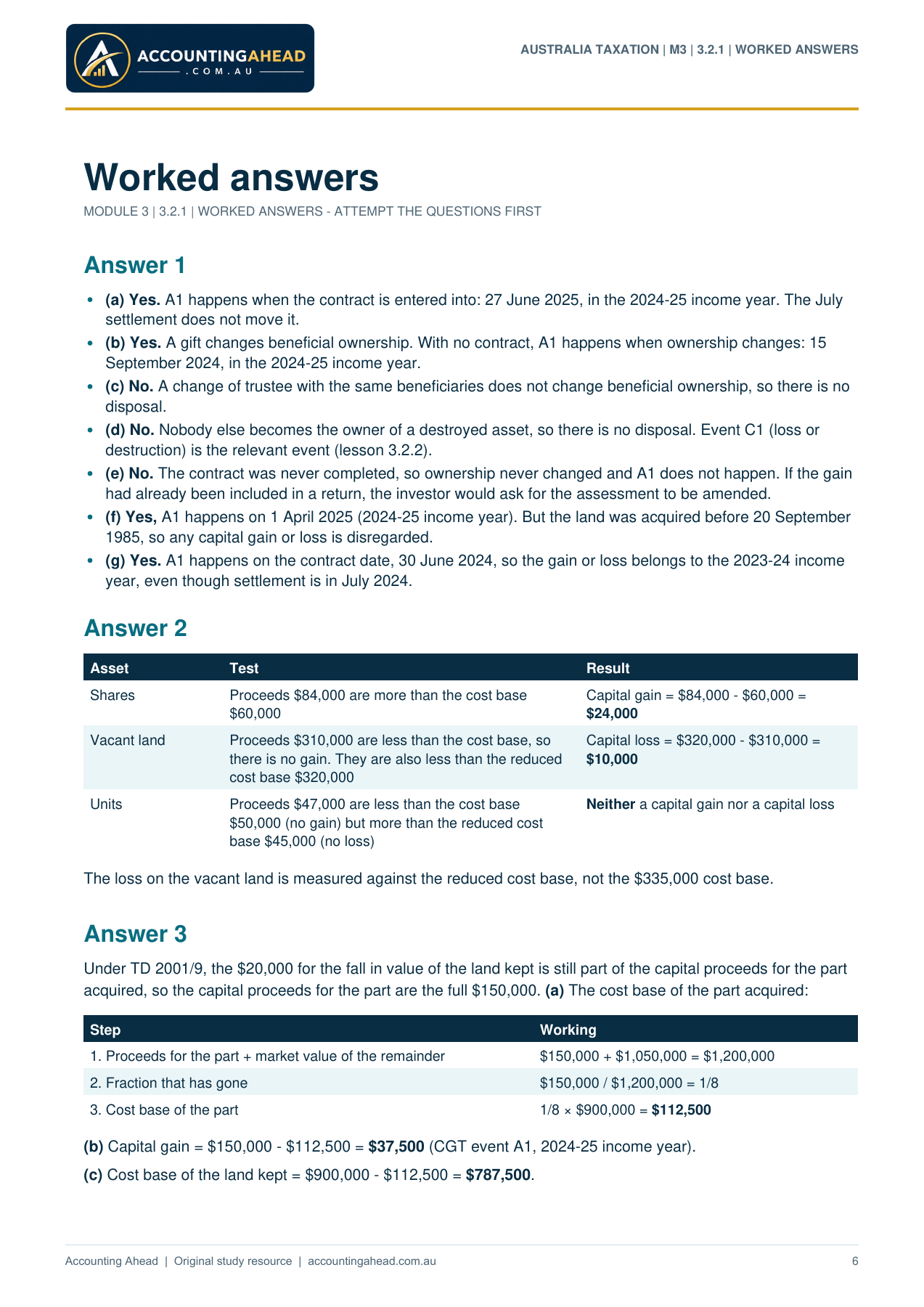
Worked answers
MODULE 3 | 3.2.1 | WORKED ANSWERS - ATTEMPT THE QUESTIONS FIRST
Answer 1
(a) Yes. A1 happens when the contract is entered into: 27 June 2025, in the 2024-25 income year. The July
settlement does not move it.
(b) Yes. A gift changes beneficial ownership. With no contract, A1 happens when ownership changes: 15
September 2024, in the 2024-25 income year.
(c) No. A change of trustee with the same beneficiaries does not change beneficial ownership, so there is no
disposal.
(d) No. Nobody else becomes the owner of a destroyed asset, so there is no disposal. Event C1 (loss or
destruction) is the relevant event (lesson 3.2.2).
(e) No. The contract was never completed, so ownership never changed and A1 does not happen. If the gain
had already been included in a return, the investor would ask for the assessment to be amended.
(f) Yes, A1 happens on 1 April 2025 (2024-25 income year). But the land was acquired before 20 September
1985, so any capital gain or loss is disregarded.
(g) Yes. A1 happens on the contract date, 30 June 2024, so the gain or loss belongs to the 2023-24 income
year, even though settlement is in July 2024.
Answer 2
Asset Test Result
Shares Proceeds $84,000 are more than the cost base
$60,000
Capital gain = $84,000 - $60,000 =
$24,000
Vacant land Proceeds $310,000 are less than the cost base, so
there is no gain. They are also less than the reduced
cost base $320,000
Capital loss = $320,000 - $310,000 =
$10,000
Units Proceeds $47,000 are less than the cost base
$50,000 (no gain) but more than the reduced cost
base $45,000 (no loss)
Neither a capital gain nor a capital loss
The loss on the vacant land is measured against the reduced cost base, not the $335,000 cost base.
Answer 3
Under TD 2001/9, the $20,000 for the fall in value of the land kept is still part of the capital proceeds for the part
acquired, so the capital proceeds for the part are the full $150,000. (a) The cost base of the part acquired:
Step Working
1. Proceeds for the part + market value of the remainder $150,000 + $1,050,000 = $1,200,000
2. Fraction that has gone $150,000 / $1,200,000 = 1/8
3. Cost base of the part 1/8 × $900,000 = $112,500
(b) Capital gain = $150,000 - $112,500 = $37,500 (CGT event A1, 2024-25 income year).
(c) Cost base of the land kept = $900,000 - $112,500 = $787,500.
AUSTRALIA TAXATION | M3 | 3.2.1 | WORKED ANSWERS
6