
CGT Assets — study companion
Part 3.3 of Australia Taxation. Preview the study companion or download the printable PDF.



Read the handout text
Accounting Ahead | Original study resource | accountingahead.com.au
CGT Assets
MODULE 3 | 3.3 | STUDENT COMPANION
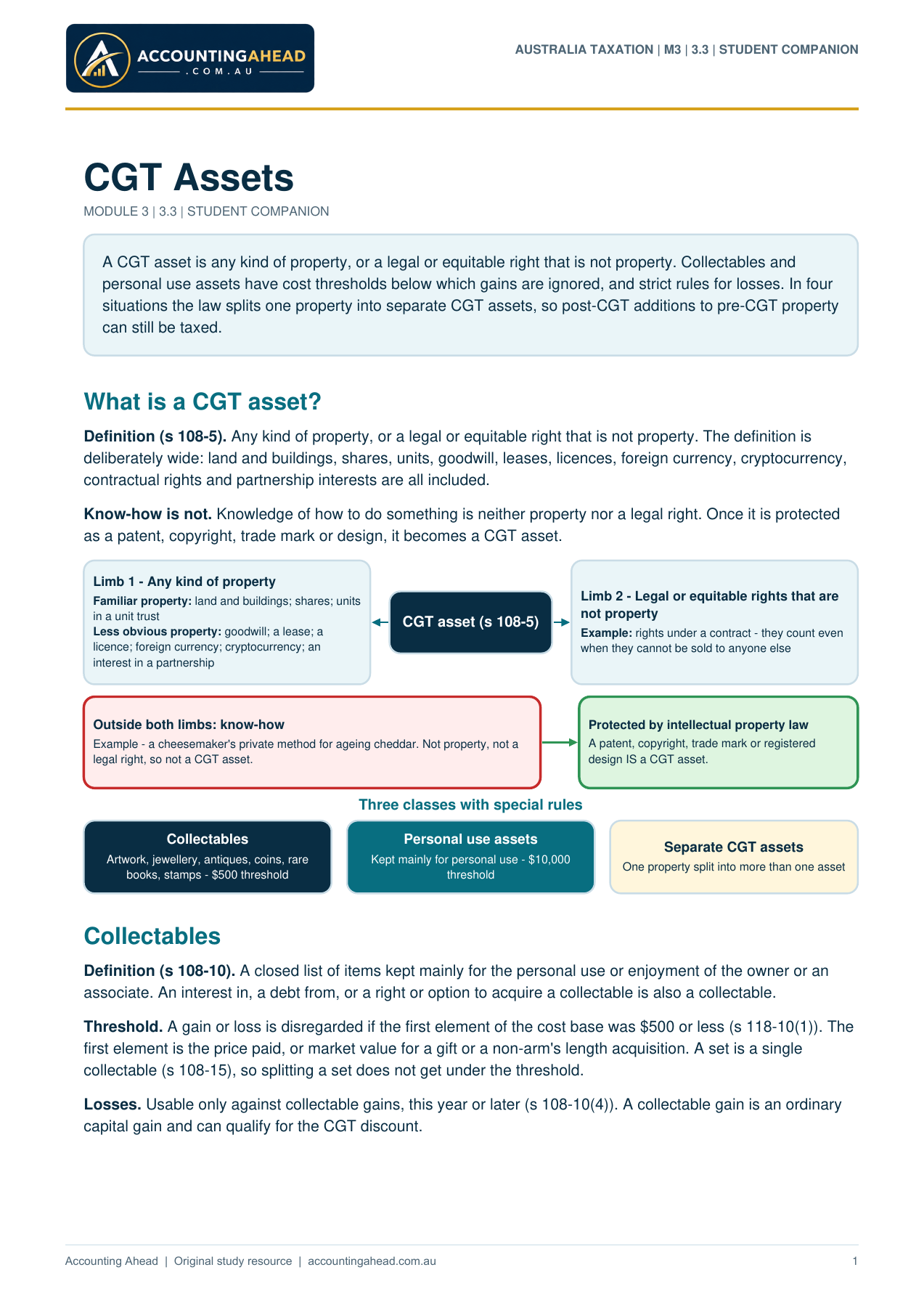
A CGT asset is any kind of property, or a legal or equitable right that is not property. Collectables and
personal use assets have cost thresholds below which gains are ignored, and strict rules for losses. In four
situations the law splits one property into separate CGT assets, so post-CGT additions to pre-CGT property
can still be taxed.
What is a CGT asset?
Definition (s 108-5). Any kind of property, or a legal or equitable right that is not property. The definition is
deliberately wide: land and buildings, shares, units, goodwill, leases, licences, foreign currency, cryptocurrency,
contractual rights and partnership interests are all included.
Know-how is not. Knowledge of how to do something is neither property nor a legal right. Once it is protected
as a patent, copyright, trade mark or design, it becomes a CGT asset.
Limb 1 - Any kind of property
Familiar property: land and buildings; shares; units
in a unit trust
Less obvious property: goodwill; a lease; a
licence; foreign currency; cryptocurrency; an
interest in a partnership
Limb 2 - Legal or equitable rights that are
not property
Example: rights under a contract - they count even
when they cannot be sold to anyone else
CGT asset (s 108-5)
Outside both limbs: know-how
Example - a cheesemaker's private method for ageing cheddar. Not property, not a
legal right, so not a CGT asset.
Protected by intellectual property law
A patent, copyright, trade mark or registered
design IS a CGT asset.
Three classes with special rules
Collectables
Artwork, jewellery, antiques, coins, rare
books, stamps - $500 threshold
Personal use assets
Kept mainly for personal use - $10,000
threshold
Separate CGT assets
One property split into more than one asset
Collectables
Definition (s 108-10). A closed list of items kept mainly for the personal use or enjoyment of the owner or an
associate. An interest in, a debt from, or a right or option to acquire a collectable is also a collectable.
Threshold. A gain or loss is disregarded if the first element of the cost base was $500 or less (s 118-10(1)). The
first element is the price paid, or market value for a gift or a non-arm's length acquisition. A set is a single
collectable (s 108-15), so splitting a set does not get under the threshold.
Losses. Usable only against collectable gains, this year or later (s 108-10(4)). A collectable gain is an ordinary
capital gain and can qualify for the CGT discount.
AUSTRALIA TAXATION | M3 | 3.3 | STUDENT COMPANION
1
Accounting Ahead | Original study resource | accountingahead.com.au
Personal use assets
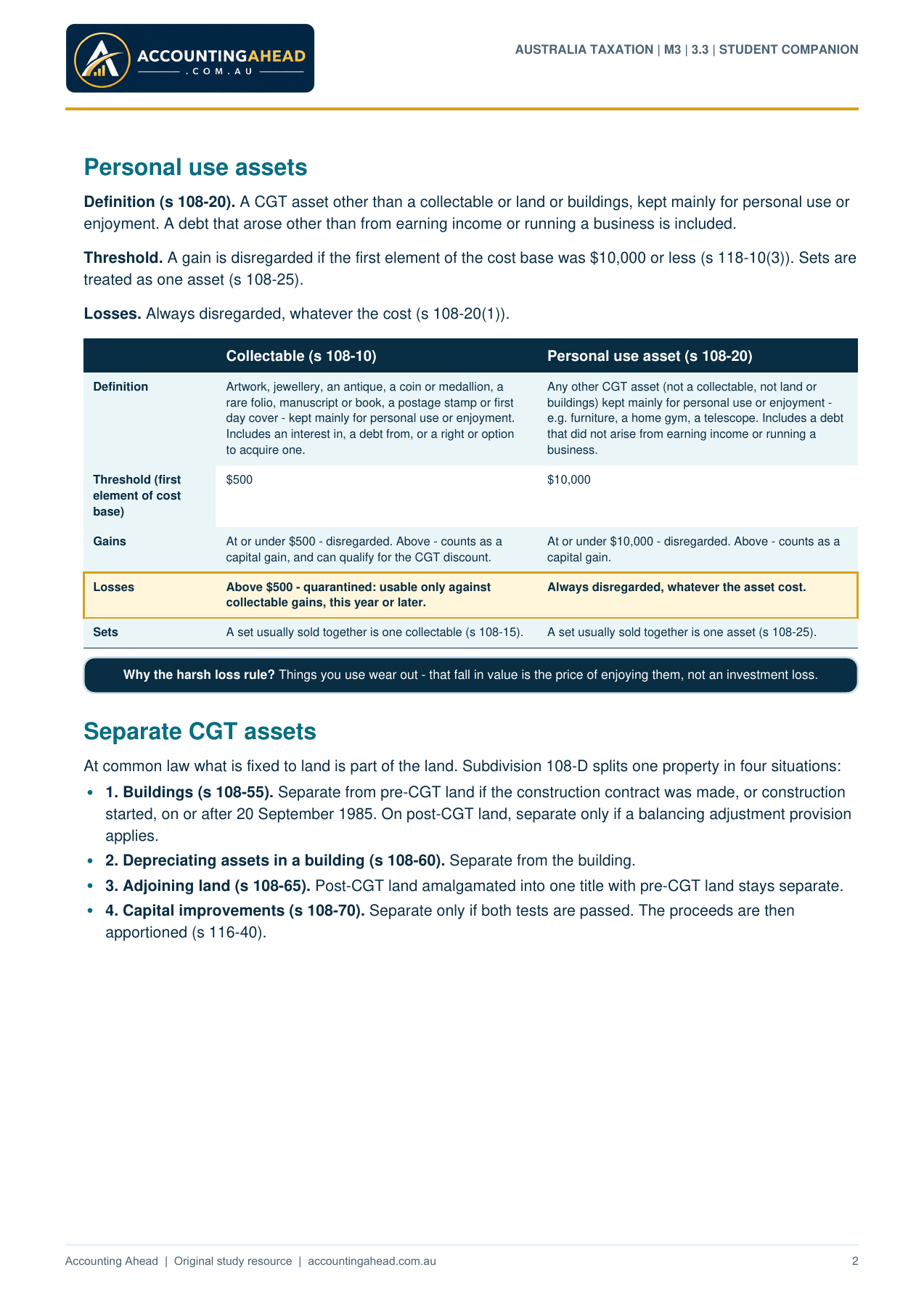
Definition (s 108-20). A CGT asset other than a collectable or land or buildings, kept mainly for personal use or
enjoyment. A debt that arose other than from earning income or running a business is included.
Threshold. A gain is disregarded if the first element of the cost base was $10,000 or less (s 118-10(3)). Sets are
treated as one asset (s 108-25).
Losses. Always disregarded, whatever the cost (s 108-20(1)).
Collectable (s 108-10) Personal use asset (s 108-20)
Definition Artwork, jewellery, an antique, a coin or medallion, a
rare folio, manuscript or book, a postage stamp or first
day cover - kept mainly for personal use or enjoyment.
Includes an interest in, a debt from, or a right or option
to acquire one.
Any other CGT asset (not a collectable, not land or
buildings) kept mainly for personal use or enjoyment -
e.g. furniture, a home gym, a telescope. Includes a debt
that did not arise from earning income or running a
business.
Threshold (first
element of cost
base)
$500 $10,000
Gains At or under $500 - disregarded. Above - counts as a
capital gain, and can qualify for the CGT discount.
At or under $10,000 - disregarded. Above - counts as a
capital gain.
Losses Above $500 - quarantined: usable only against
collectable gains, this year or later.
Always disregarded, whatever the asset cost.
Sets A set usually sold together is one collectable (s 108-15). A set usually sold together is one asset (s 108-25).
Why the harsh loss rule? Things you use wear out - that fall in value is the price of enjoying them, not an investment loss.
Separate CGT assets
At common law what is fixed to land is part of the land. Subdivision 108-D splits one property in four situations:
1. Buildings (s 108-55). Separate from pre-CGT land if the construction contract was made, or construction
started, on or after 20 September 1985. On post-CGT land, separate only if a balancing adjustment provision
applies.
2. Depreciating assets in a building (s 108-60). Separate from the building.
3. Adjoining land (s 108-65). Post-CGT land amalgamated into one title with pre-CGT land stays separate.
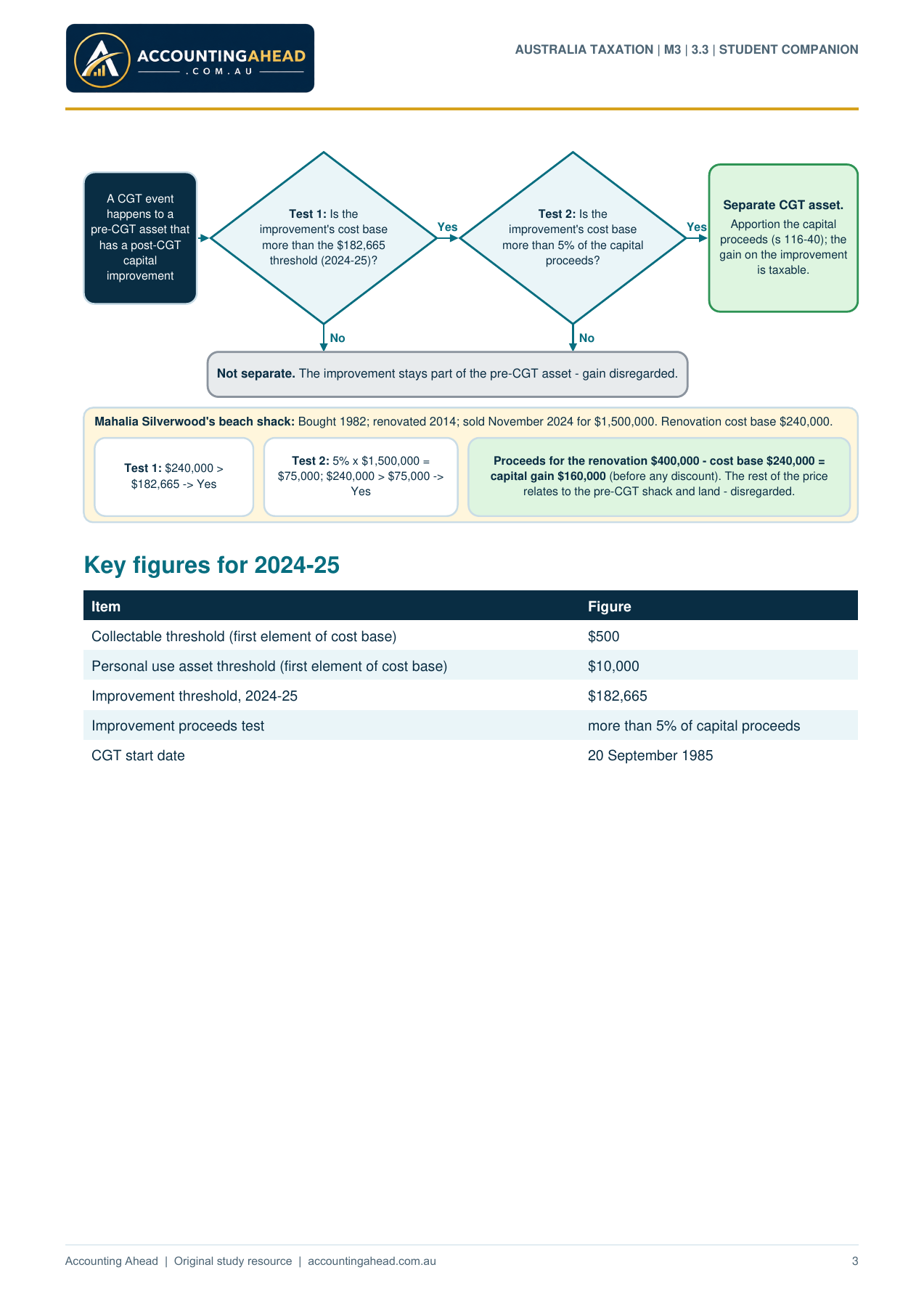
4. Capital improvements (s 108-70). Separate only if both tests are passed. The proceeds are then
apportioned (s 116-40).
AUSTRALIA TAXATION | M3 | 3.3 | STUDENT COMPANION
2
Accounting Ahead | Original study resource | accountingahead.com.au
A CGT event
happens to a
pre-CGT asset that
has a post-CGT
capital
improvement
Test 1: Is the
improvement's cost base
more than the $182,665
threshold (2024-25)?
Yes
Test 2: Is the
improvement's cost base
more than 5% of the capital
proceeds?
Yes
Separate CGT asset.
Apportion the capital
proceeds (s 116-40); the
gain on the improvement
is taxable.
No No
Not separate. The improvement stays part of the pre-CGT asset - gain disregarded.
Mahalia Silverwood's beach shack: Bought 1982; renovated 2014; sold November 2024 for $1,500,000. Renovation cost base $240,000.
Test 1: $240,000 >
$182,665 -> Yes
Test 2: 5% x $1,500,000 =
$75,000; $240,000 > $75,000 ->
Yes
Proceeds for the renovation $400,000 - cost base $240,000 =
capital gain $160,000 (before any discount). The rest of the price
relates to the pre-CGT shack and land - disregarded.
Key figures for 2024-25
Item Figure
Collectable threshold (first element of cost base) $500
Personal use asset threshold (first element of cost base) $10,000
Improvement threshold, 2024-25 $182,665
Improvement proceeds test more than 5% of capital proceeds
CGT start date 20 September 1985
AUSTRALIA TAXATION | M3 | 3.3 | STUDENT COMPANION
3
Accounting Ahead | Original study resource | accountingahead.com.au
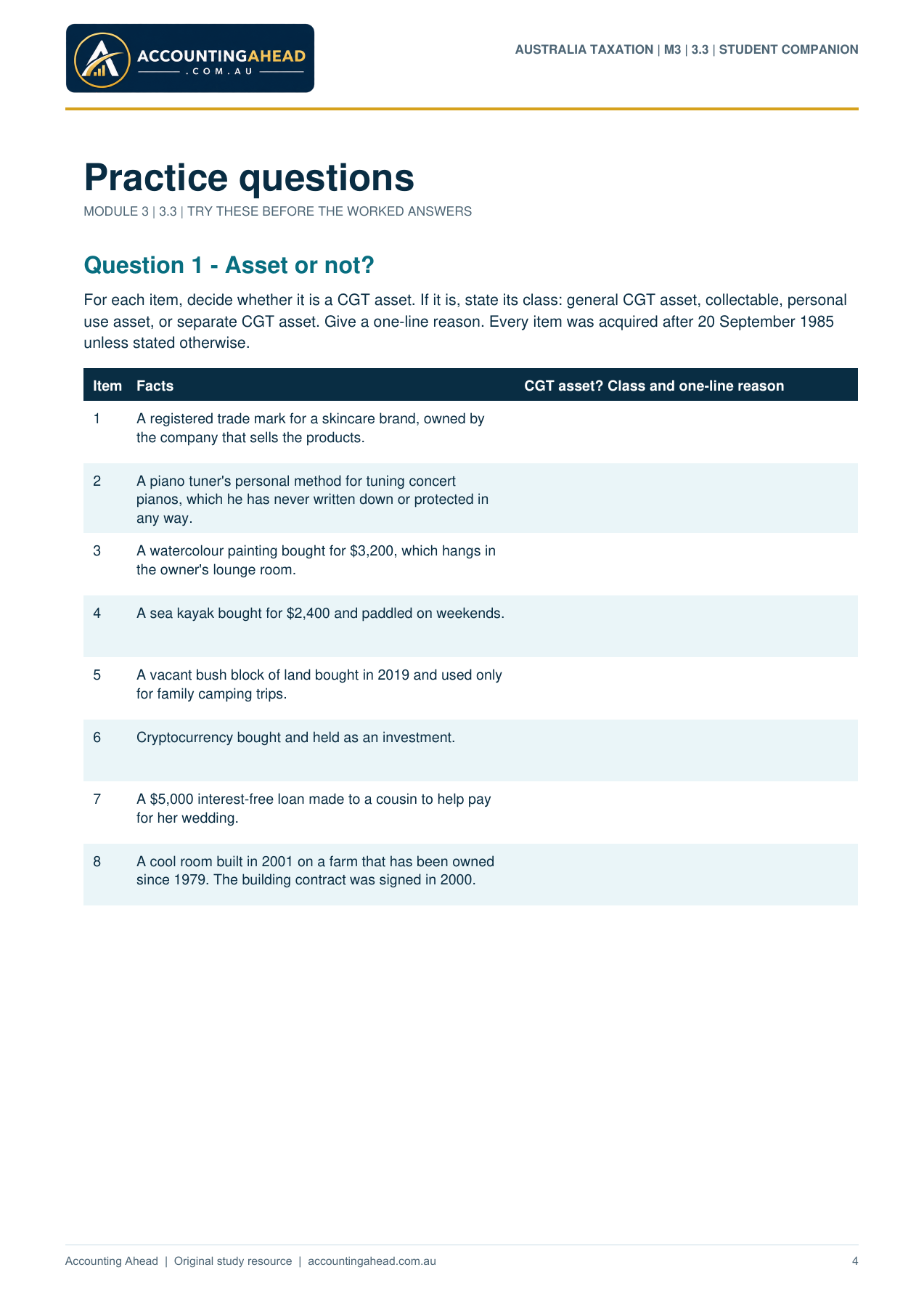
Practice questions
MODULE 3 | 3.3 | TRY THESE BEFORE THE WORKED ANSWERS
Question 1 - Asset or not?
For each item, decide whether it is a CGT asset. If it is, state its class: general CGT asset, collectable, personal
use asset, or separate CGT asset. Give a one-line reason. Every item was acquired after 20 September 1985
unless stated otherwise.
Item Facts CGT asset? Class and one-line reason
1 A registered trade mark for a skincare brand, owned by
the company that sells the products.
2 A piano tuner's personal method for tuning concert
pianos, which he has never written down or protected in
any way.
3 A watercolour painting bought for $3,200, which hangs in
the owner's lounge room.
4 A sea kayak bought for $2,400 and paddled on weekends.
5 A vacant bush block of land bought in 2019 and used only
for family camping trips.
6 Cryptocurrency bought and held as an investment.
7 A $5,000 interest-free loan made to a cousin to help pay
for her wedding.
8 A cool room built in 2001 on a farm that has been owned
since 1979. The building contract was signed in 2000.
AUSTRALIA TAXATION | M3 | 3.3 | STUDENT COMPANION
4
Accounting Ahead | Original study resource | accountingahead.com.au
Question 2 - Five sales in one year
Corisande Ardwinkle is an Australian resident. In the 2024-25 income year she sold the five assets below. All
were acquired after 20 September 1985 and held for more than 12 months. The antique, the brooch, the stamp
and the home cinema system were all kept for her personal use or enjoyment. She has no capital losses from
earlier years.
Asset Cost (first element of cost base) Sale price
Antique writing desk $4,000 $6,500
Diamond brooch $9,000 $5,000
Rare postage stamp $400 $1,200
Home cinema system $12,000 $3,000
Listed shares $12,000 $20,000
(a) For each sale, state whether the gain or loss counts for CGT, and why.
(b) What is her capital gain for 2024-25 before any discount?
(c) What, if anything, does she carry forward, and what can it be used against?
AUSTRALIA TAXATION | M3 | 3.3 | STUDENT COMPANION
5
Accounting Ahead | Original study resource | accountingahead.com.au
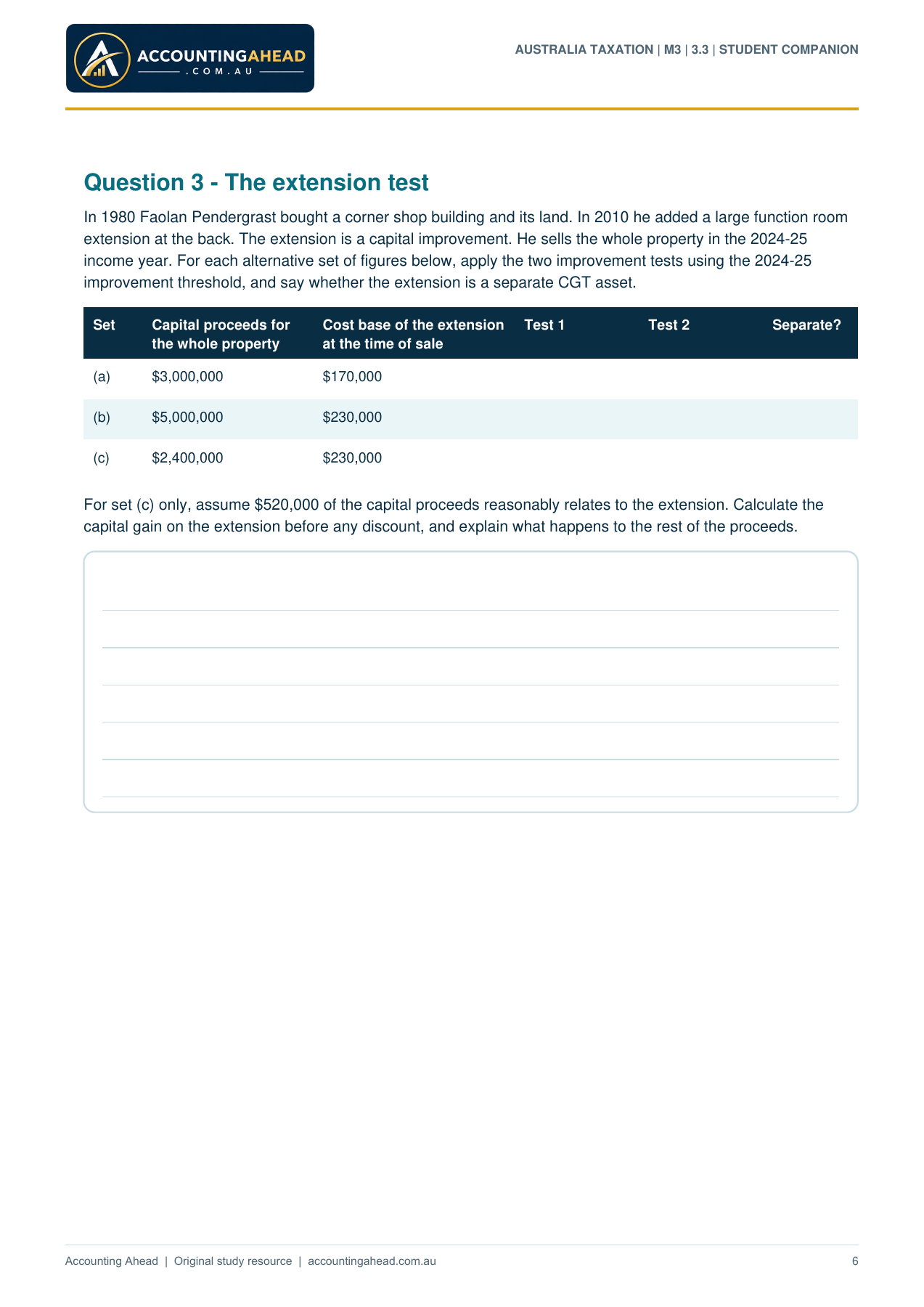
Question 3 - The extension test
In 1980 Faolan Pendergrast bought a corner shop building and its land. In 2010 he added a large function room
extension at the back. The extension is a capital improvement. He sells the whole property in the 2024-25
income year. For each alternative set of figures below, apply the two improvement tests using the 2024-25
improvement threshold, and say whether the extension is a separate CGT asset.
Set Capital proceeds for
the whole property
Cost base of the extension
at the time of sale
Test 1 Test 2 Separate?
(a) $3,000,000 $170,000
(b) $5,000,000 $230,000
(c) $2,400,000 $230,000
For set (c) only, assume $520,000 of the capital proceeds reasonably relates to the extension. Calculate the
capital gain on the extension before any discount, and explain what happens to the rest of the proceeds.
AUSTRALIA TAXATION | M3 | 3.3 | STUDENT COMPANION
6
Accounting Ahead | Original study resource | accountingahead.com.au
Worked answers
MODULE 3 | 3.3 | WORKED ANSWERS - ATTEMPT THE QUESTIONS FIRST
Answer 1
Item CGT asset? Class and reason
1 Yes General CGT asset. A trade mark is intellectual property, which is property.
2 No It is know-how: not property and not a legal or equitable right. It would become a CGT asset only
if protected as intellectual property.
3 Yes Collectable. Artwork kept mainly for personal enjoyment. It cost more than $500, so gains and
losses count, and any loss is quarantined to collectable gains.
4 Yes Personal use asset. Kept mainly for personal use, not a collectable and not land. It cost $10,000
or less, so any gain is disregarded; a loss would be disregarded anyway.
5 Yes General CGT asset. Land can never be a personal use asset, even when used only for personal
enjoyment, so the $10,000 rule does not apply.
6 Yes General CGT asset. Cryptocurrency is property and is held as an investment.
7 Yes Personal use asset. The debt did not arise from earning income or running a business.
8 Yes Separate CGT asset. The farm is pre-CGT land, but the building contract was made after 20
September 1985, so the cool room is a separate, post-CGT asset (s 108-55).
Answer 2
(a)
Asset Gain or loss Counts? Why
Antique writing
desk
Gain $6,500 - $4,000 =
$2,500
Yes Collectable (an antique) costing more than
$500.
Diamond brooch Loss $5,000 - $9,000 =
($4,000)
Yes, but
quarantined
Collectable (jewellery) costing more than $500.
The loss can be used only against collectable
gains.
Rare postage
stamp
Gain $1,200 - $400 = $800 No Collectable acquired for $500 or less: the gain is
disregarded.
Home cinema
system
Loss $3,000 - $12,000 =
($9,000)
No Personal use asset: a loss is always
disregarded, whatever it cost.
Listed shares Gain $20,000 - $12,000 =
$8,000
Yes General CGT asset.
(b) Collectable gains $2,500 less collectable loss $4,000: the loss absorbs the whole $2,500 gain, leaving
$1,500 of collectable loss unused. That $1,500 cannot reduce the gain on the shares. Capital gain for 2024-25
before any discount = $8,000 (the shares).
(c) She carries forward a $1,500 collectable loss ($4,000 - $2,500). It can be used only against capital gains on
collectables in later years. Nothing is carried forward for the home cinema system or the stamp.
AUSTRALIA TAXATION | M3 | 3.3 | WORKED ANSWERS
7
Accounting Ahead | Original study resource | accountingahead.com.au
Answer 3
The improvement threshold for 2024-25 is $182,665. The extension is a separate CGT asset only if its cost base
is more than $182,665 AND more than 5% of the capital proceeds.
Set Test 1: more than
$182,665?
Test 2: more than 5% of proceeds? Separate CGT asset?
(a) $170,000 - No 5% x $3,000,000 = $150,000; $170,000 is more -
Yes
No - fails Test 1
(b) $230,000 - Yes 5% x $5,000,000 = $250,000; $230,000 is less -
No
No - fails Test 2
(c) $230,000 - Yes 5% x $2,400,000 = $120,000; $230,000 is more -
Yes
Yes - passes both
In (a) and (b) the extension stays part of the pre-CGT property, so any gain on the whole sale is disregarded.
Set (c): the capital proceeds are apportioned between the pre-CGT property and the extension (s 116-40).
Capital gain on the extension = $520,000 - $230,000 = $290,000, before any discount. The remaining proceeds,
$2,400,000 - $520,000 = $1,880,000, relate to the pre-CGT building and land, so any gain on that part is
disregarded.
AUSTRALIA TAXATION | M3 | 3.3 | WORKED ANSWERS
8