
The Main Residence Exemption — study companion
Part 3.4.4 of Australia Taxation. Preview the study companion or download the printable PDF.



Read the handout text
Accounting Ahead | Original study resource | accountingahead.com.au
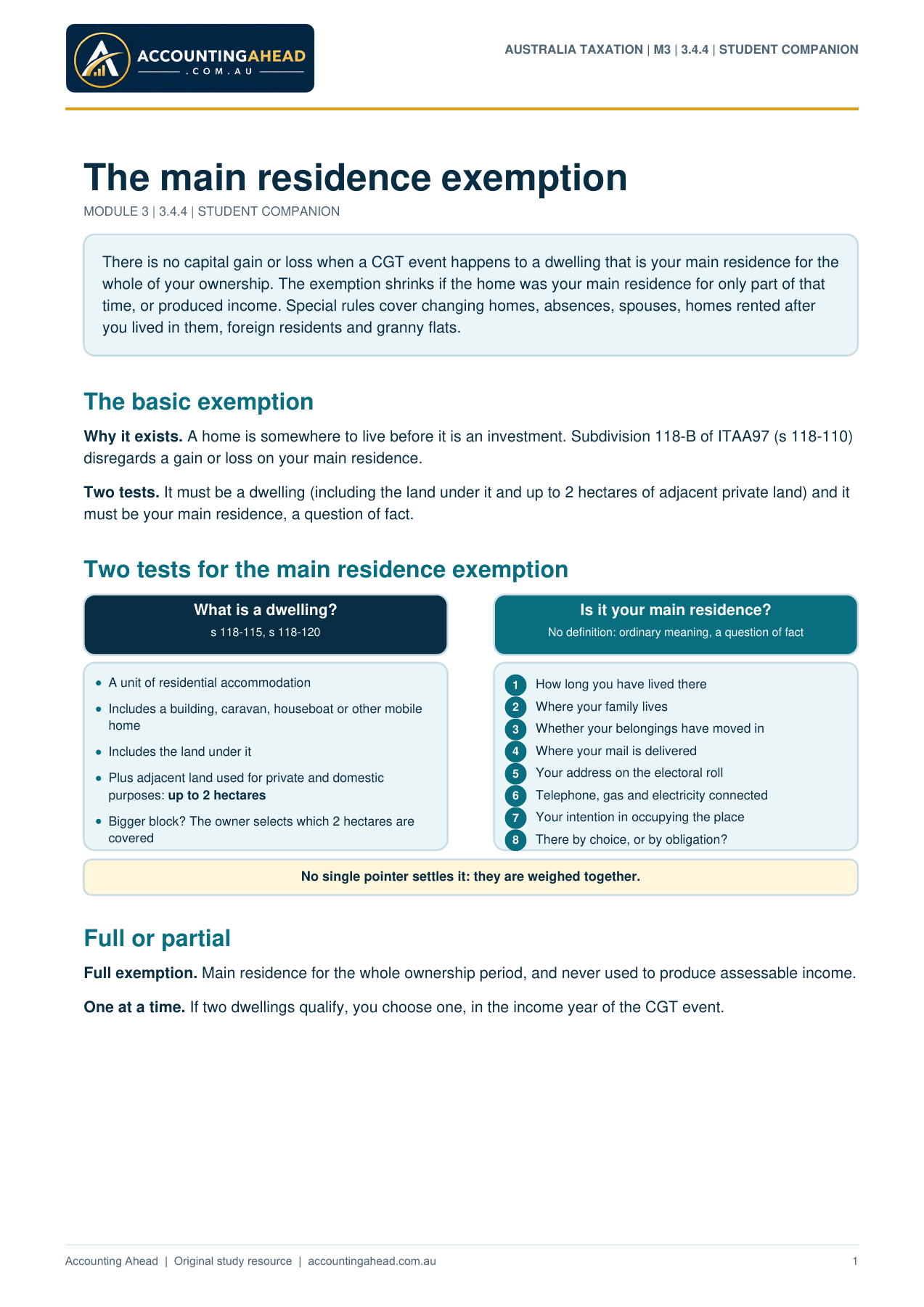
The main residence exemption
MODULE 3 | 3.4.4 | STUDENT COMPANION
There is no capital gain or loss when a CGT event happens to a dwelling that is your main residence for the
whole of your ownership. The exemption shrinks if the home was your main residence for only part of that
time, or produced income. Special rules cover changing homes, absences, spouses, homes rented after
you lived in them, foreign residents and granny flats.
The basic exemption
Why it exists. A home is somewhere to live before it is an investment. Subdivision 118-B of ITAA97 (s 118-110)
disregards a gain or loss on your main residence.
Two tests. It must be a dwelling (including the land under it and up to 2 hectares of adjacent private land) and it
must be your main residence, a question of fact.
Two tests for the main residence exemption
What is a dwelling?
s 118-115, s 118-120
Is it your main residence?
No definition: ordinary meaning, a question of fact
A unit of residential accommodation
Includes a building, caravan, houseboat or other mobile
home
Includes the land under it
Plus adjacent land used for private and domestic
purposes: up to 2 hectares
Bigger block? The owner selects which 2 hectares are
covered
1 How long you have lived there
2 Where your family lives
3 Whether your belongings have moved in
4 Where your mail is delivered
5 Your address on the electoral roll
6 Telephone, gas and electricity connected
7 Your intention in occupying the place
8 There by choice, or by obligation?
No single pointer settles it: they are weighed together.
Full or partial
Full exemption. Main residence for the whole ownership period, and never used to produce assessable income.
One at a time. If two dwellings qualify, you choose one, in the income year of the CGT event.
AUSTRALIA TAXATION | M3 | 3.4.4 | STUDENT COMPANION
1
Accounting Ahead | Original study resource | accountingahead.com.au
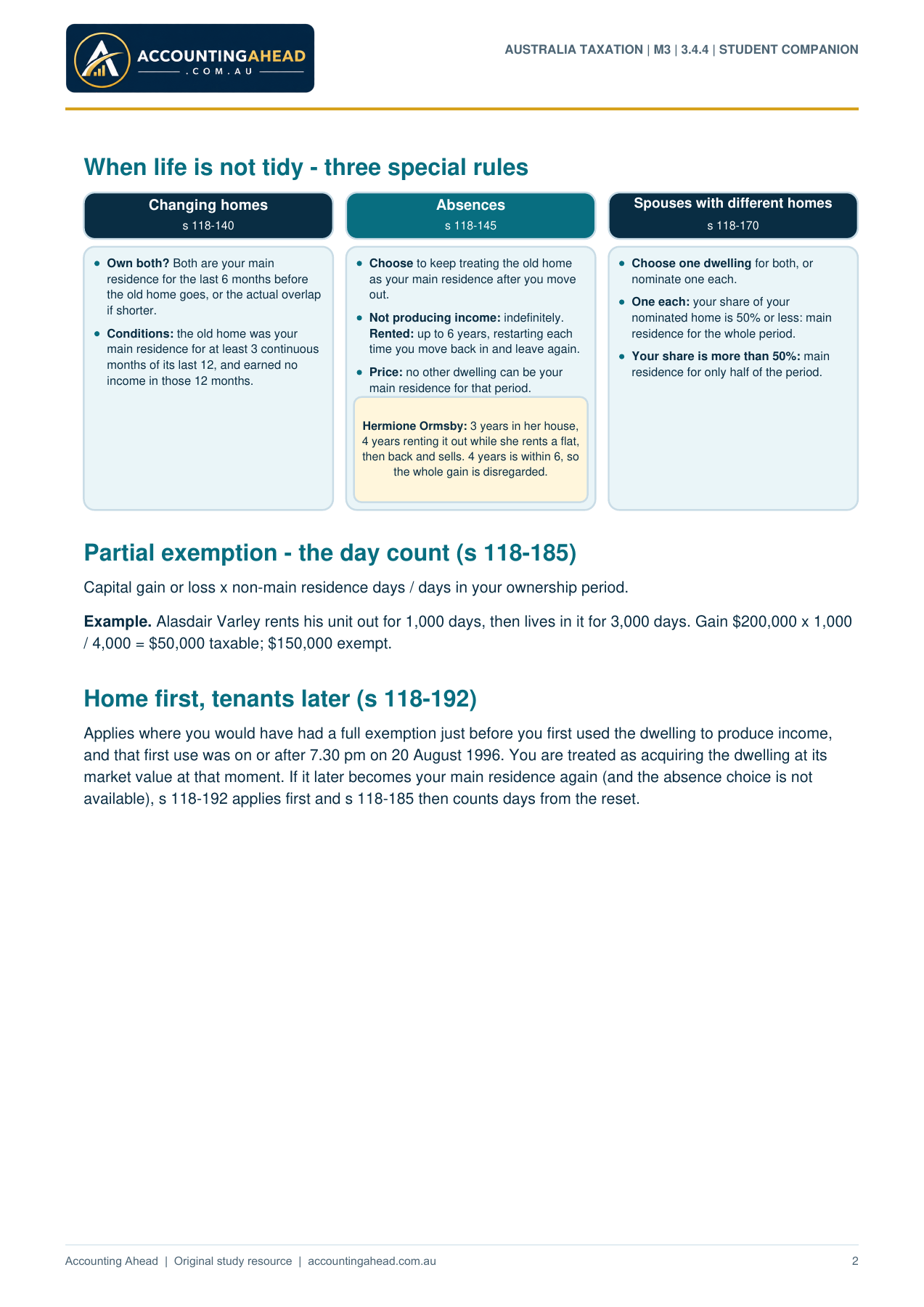
When life is not tidy - three special rules
Changing homes
s 118-140
Own both? Both are your main
residence for the last 6 months before
the old home goes, or the actual overlap
if shorter.
Conditions: the old home was your
main residence for at least 3 continuous
months of its last 12, and earned no
income in those 12 months.
Absences
s 118-145
Choose to keep treating the old home
as your main residence after you move
out.
Not producing income: indefinitely.
Rented: up to 6 years, restarting each
time you move back in and leave again.
Price: no other dwelling can be your
main residence for that period.
Spouses with different homes
s 118-170
Choose one dwelling for both, or
nominate one each.
One each: your share of your
nominated home is 50% or less: main
residence for the whole period.
Your share is more than 50%: main
residence for only half of the period.
Hermione Ormsby: 3 years in her house,
4 years renting it out while she rents a flat,
then back and sells. 4 years is within 6, so
the whole gain is disregarded.
Partial exemption - the day count (s 118-185)
Capital gain or loss x non-main residence days / days in your ownership period.
Example. Alasdair Varley rents his unit out for 1,000 days, then lives in it for 3,000 days. Gain $200,000 x 1,000
/ 4,000 = $50,000 taxable; $150,000 exempt.
Home first, tenants later (s 118-192)
Applies where you would have had a full exemption just before you first used the dwelling to produce income,
and that first use was on or after 7.30 pm on 20 August 1996. You are treated as acquiring the dwelling at its
market value at that moment. If it later becomes your main residence again (and the absence choice is not
available), s 118-192 applies first and s 118-185 then counts days from the reset.
AUSTRALIA TAXATION | M3 | 3.4.4 | STUDENT COMPANION
2
Accounting Ahead | Original study resource | accountingahead.com.au
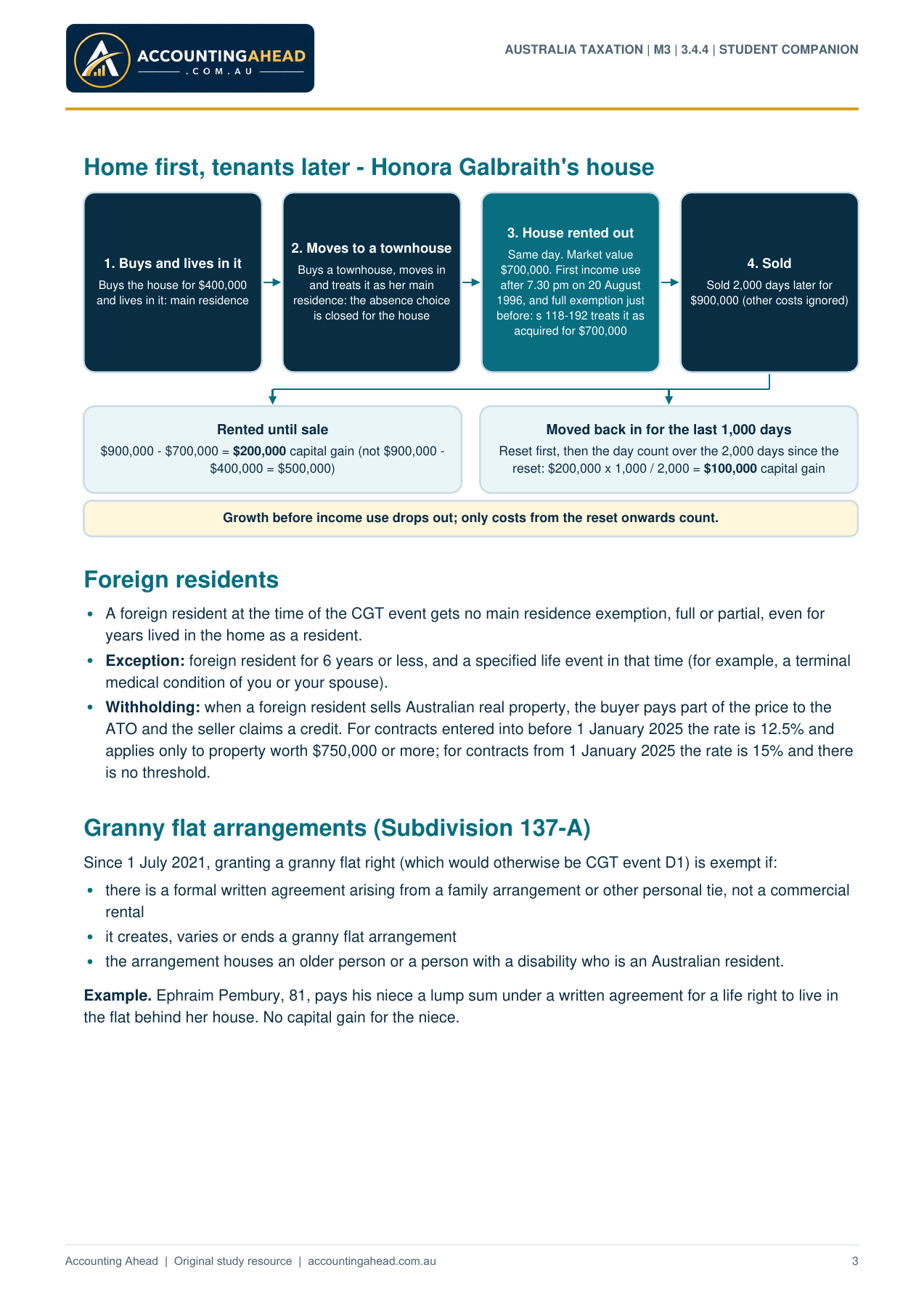
Home first, tenants later - Honora Galbraith's house
1. Buys and lives in it
Buys the house for $400,000
and lives in it: main residence
2. Moves to a townhouse
Buys a townhouse, moves in
and treats it as her main
residence: the absence choice
is closed for the house
3. House rented out
Same day. Market value
$700,000. First income use
after 7.30 pm on 20 August
1996, and full exemption just
before: s 118-192 treats it as
acquired for $700,000
4. Sold
Sold 2,000 days later for
$900,000 (other costs ignored)
Rented until sale
$900,000 - $700,000 = $200,000 capital gain (not $900,000 -
$400,000 = $500,000)
Moved back in for the last 1,000 days
Reset first, then the day count over the 2,000 days since the
reset: $200,000 x 1,000 / 2,000 = $100,000 capital gain
Growth before income use drops out; only costs from the reset onwards count.
Foreign residents
A foreign resident at the time of the CGT event gets no main residence exemption, full or partial, even for
years lived in the home as a resident.
Exception: foreign resident for 6 years or less, and a specified life event in that time (for example, a terminal
medical condition of you or your spouse).
Withholding: when a foreign resident sells Australian real property, the buyer pays part of the price to the
ATO and the seller claims a credit. For contracts entered into before 1 January 2025 the rate is 12.5% and
applies only to property worth $750,000 or more; for contracts from 1 January 2025 the rate is 15% and there
is no threshold.
Granny flat arrangements (Subdivision 137-A)
Since 1 July 2021, granting a granny flat right (which would otherwise be CGT event D1) is exempt if:
there is a formal written agreement arising from a family arrangement or other personal tie, not a commercial
rental
it creates, varies or ends a granny flat arrangement
the arrangement houses an older person or a person with a disability who is an Australian resident.
Example. Ephraim Pembury, 81, pays his niece a lump sum under a written agreement for a life right to live in
the flat behind her house. No capital gain for the niece.
AUSTRALIA TAXATION | M3 | 3.4.4 | STUDENT COMPANION
3
Accounting Ahead | Original study resource | accountingahead.com.au
Key figures for 2024-25
Item Figure
Adjacent land covered Up to 2 hectares
Changing homes overlap Up to 6 months (or the actual overlap, if shorter)
Changing homes condition Main residence 3 continuous months of the last 12; no income in those
12 months
Absence, no income Indefinite
Absence, rented Up to 6 years each absence
Market value rule start First income use on or after 7.30 pm, 20 August 1996
Foreign resident exception Foreign resident 6 years or less, plus a life event
Withholding 12.5%, property $750,000 or more (contracts before 1 January 2025);
15%, no threshold (contracts from 1 January 2025)
Granny flat exemption From 1 July 2021
Practice questions
MODULE 3 | 3.4.4 | TRY THESE BEFORE THE WORKED ANSWERS
Question 1 - Full, partial or lost?
For each situation, decide whether the main residence exemption is full, partial or lost, and name the rule that
decides it. Ignore any CGT discount.
Situation Full, partial or
lost?
Rule that
decides it
(a) Wynstan Kittredge sells the house he has lived in, and never rented out, for the
whole time he owned it. It stands on a block of 1.5 hectares that he used as a
garden and orchard.
(b) Dunstan Sedgwick buys a new home and moves in. He sells his old home 4
months later. He lived in the old home for the 12 months before he moved out and
never rented it out.
(c) Wenonah Dallimore moves out of her house to take a 3-year job in another
town, where she boards with a friend. Her house stays empty. She claims no other
home, moves back in, and later sells it.
(d) Rainsford Ferrier lived in his Perth house for many years, then moved to
Canada. Nine years later, still living in Canada and a foreign resident, he sells the
house. No life event has happened.
(e) Mortimer Linwood lives in his house, then buys an apartment, moves in and
treats the apartment as his main residence. He rents the house out for 4 years and
then sells it.
(f) Vaughn Cartwright lives on a 3-hectare property for the whole time he owns it,
never earning income from it. He sells the whole property.
AUSTRALIA TAXATION | M3 | 3.4.4 | STUDENT COMPANION
4
Accounting Ahead | Original study resource | accountingahead.com.au
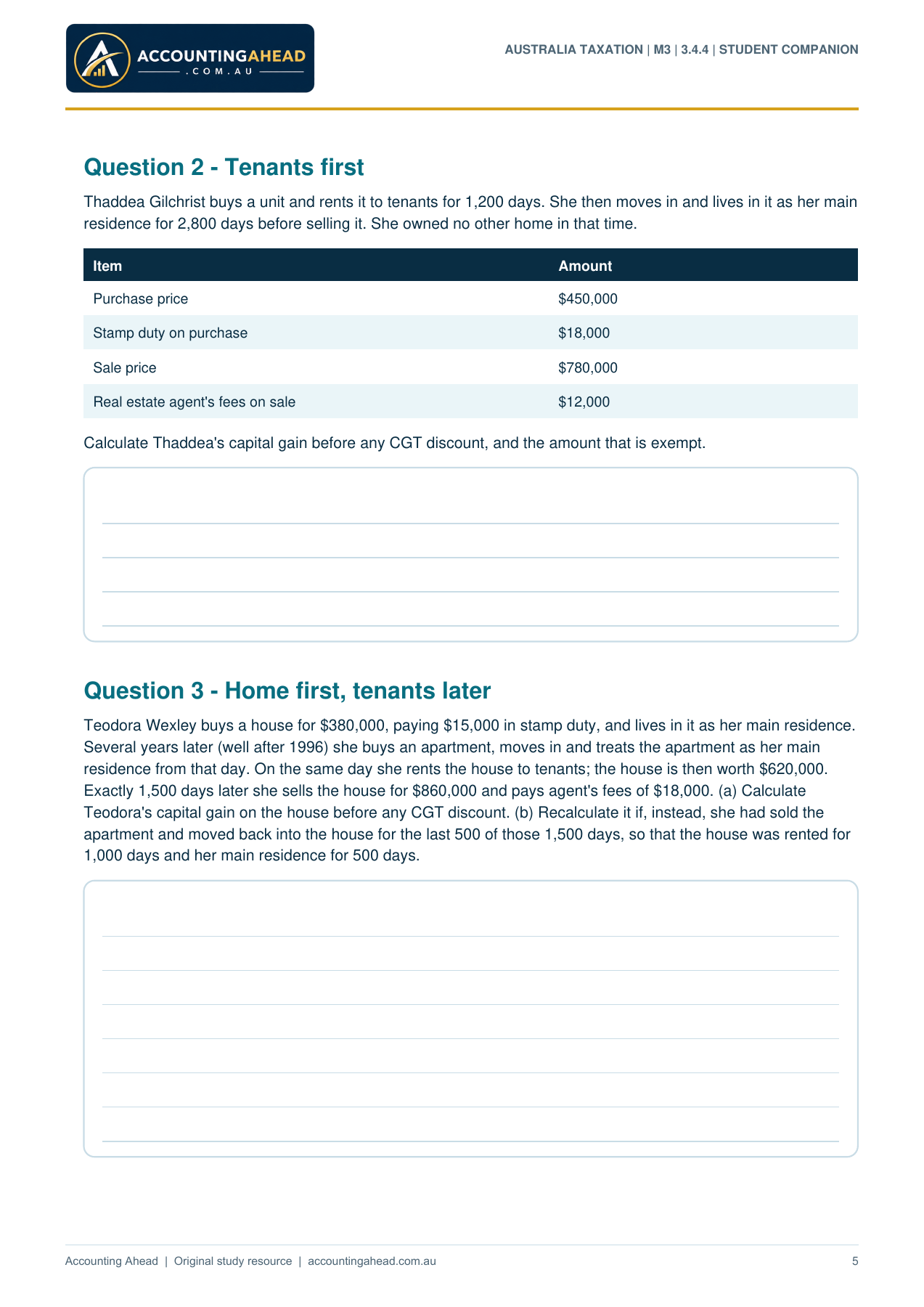
Question 2 - Tenants first
Thaddea Gilchrist buys a unit and rents it to tenants for 1,200 days. She then moves in and lives in it as her main
residence for 2,800 days before selling it. She owned no other home in that time.
Item Amount
Purchase price $450,000
Stamp duty on purchase $18,000
Sale price $780,000
Real estate agent's fees on sale $12,000
Calculate Thaddea's capital gain before any CGT discount, and the amount that is exempt.
Question 3 - Home first, tenants later
Teodora Wexley buys a house for $380,000, paying $15,000 in stamp duty, and lives in it as her main residence.
Several years later (well after 1996) she buys an apartment, moves in and treats the apartment as her main
residence from that day. On the same day she rents the house to tenants; the house is then worth $620,000.
Exactly 1,500 days later she sells the house for $860,000 and pays agent's fees of $18,000. (a) Calculate
Teodora's capital gain on the house before any CGT discount. (b) Recalculate it if, instead, she had sold the
apartment and moved back into the house for the last 500 of those 1,500 days, so that the house was rented for
1,000 days and her main residence for 500 days.
AUSTRALIA TAXATION | M3 | 3.4.4 | STUDENT COMPANION
5
Accounting Ahead | Original study resource | accountingahead.com.au
Worked answers
MODULE 3 | 3.4.4 | WORKED ANSWERS - ATTEMPT THE QUESTIONS FIRST
Question 1 - Full, partial or lost?
Situation Result Why
(a) Wynstan, 1.5 hectares Full The basic exemption (s 118-110) covers the dwelling and adjacent
land used for private and domestic purposes up to 2 hectares (s
118-120). 1.5 hectares is within the limit, and it was his main residence
for the whole ownership period with no income use.
(b) Dunstan, 4-month
overlap
Full, for both
homes
The changing homes rule (s 118-140) treats both dwellings as his
main residence for the shorter of 6 months and the actual overlap. The
overlap is 4 months, so it is covered. The conditions are met: the old
home was his main residence for at least 3 continuous months of its
last 12 and earned no income in those 12 months.
(c) Wenonah, 3-year job Full The absence rule (s 118-145) lets her choose to keep treating the
house as her main residence. It produced no income, so the choice
can last indefinitely, and the 3 years are covered. She claimed no
other home, so the choice is available.
(d) Rainsford, foreign
resident
Lost He is a foreign resident when the CGT event happens, so neither the
full nor the partial exemption is available, even for the years he lived
there as a resident. The exception does not help: he has been a
foreign resident for more than 6 years and no life event has happened.
(e) Mortimer, house rented
4 years
Partial The absence rule cannot cover the rental years because he claims the
apartment as his main residence for the same period. The house was
fully exempt just before it was first rented, so s 118-192 treats him as
acquiring it at its market value on that day. The whole gain from that
value to the sale price is taxable (all days after the reset are non-main
residence days); the growth before the rental is exempt.
(f) Vaughn, 3 hectares Partial The exemption covers the dwelling and only 2 hectares of adjacent
land (s 118-120). Vaughn selects which 2 hectares are covered; the
gain on the remaining 1 hectare is not exempt.
AUSTRALIA TAXATION | M3 | 3.4.4 | WORKED ANSWERS
6
Accounting Ahead | Original study resource | accountingahead.com.au
Question 2 - Thaddea's capital gain
Thaddea's capital gain is $90,000 (before any CGT discount).
Step Working
Which rule? Thaddea did not live in the unit before renting it, so it was not her main residence
before the income use and s 118-192 does not apply. Use the s 118-185 day
count.
Cost base $450,000 + $18,000 + $12,000 = $480,000
Capital gain before exemption $780,000 - $480,000 = $300,000
Days Ownership period = 1,200 + 2,800 = 4,000 days; non-main residence days = 1,200
Taxable capital gain $300,000 x 1,200 / 4,000 = $300,000 x 30% = $90,000
Exempt $300,000 - $90,000 = $210,000
Question 3 - Teodora's house
The absence choice is not available because Teodora treats the apartment as her main residence while the
house is rented. The changing homes rule does not help either, because the house earned income in its last 12
months. The house was fully exempt just before it was first rented, after 7.30 pm on 20 August 1996, so s
118-192 applies. The original price and stamp duty drop out.
Step (a) Rented until sale (b) Moved back in
Rule s 118-192 applies: treated as acquired for
$620,000 on the day the rental began
s 118-192 applies first, then s 118-185
Cost base $620,000 + $18,000 agent's fees = $638,000 $638,000 (unchanged)
Capital gain $860,000 - $638,000 = $222,000 $222,000
Day count All 1,500 days are non-main residence days: 1,500
/ 1,500
Non-main residence days = 1,000 of
1,500
Taxable gain $222,000 $222,000 x 1,000 / 1,500 = $148,000
Exempt Nil $222,000 - $148,000 = $74,000
Compare: without the reset, the gain would be $860,000 - $380,000 - $15,000 - $18,000 = $447,000.
AUSTRALIA TAXATION | M3 | 3.4.4 | WORKED ANSWERS
7