
Small Business CGT - Basic Conditions — study companion
Part 3.5.2 of Australia Taxation. Preview the study companion or download the printable PDF.



Read the handout text
Accounting Ahead | Original study resource | accountingahead.com.au
Small Business CGT - Basic Conditions
MODULE 3 | 3.5.2 | STUDENT COMPANION
None of the four small business CGT concessions is available until the basic conditions in ITAA97 s 152-10
are met. You need a CGT event that produces a capital gain, an entity test passed through one of four
routes, and an asset that passes the active asset test. Selling shares or trust interests brings four extra
checks.
Why the concessions exist
The business is the retirement plan. Owners often reinvest in the business instead of superannuation. Division
152 of ITAA97 offers four concessions (next lesson); s 152-10 sets the conditions all of them need.
The gate in front of the four concessions
Gate shut: no small business concession.
1. CGT event?
A CGT event happens
to an asset you own,
in the income year
No
Yes
2. Capital gain?
The event, ignoring
Division 152, produces
a capital gain
No
Yes
3. Entity test?
You pass at least one
of the four routes
below
No
Yes
4. Active asset
test?
The asset passes the
test in s 152-35
No
Gate open
The four concessions
can now be
considered
Yes
Any one route is enough
Route 1: CGT small business
entity
You carry on a business and
aggregated turnover is less than
$2 million
Route 2: Net assets, s 152-15
Net CGT assets of you,
connected entities and affiliates:
$6 million or less, just before the
event
Route 3: Partner
The partnership is a CGT small
business entity and the asset is
your interest in a partnership
asset
Route 4: Passive asset
You own it; your affiliate or
connected entity uses it in a
business and is a CGT small
business entity
Questions 1 and 2 rarely cause trouble. The work is in questions 3 and 4.
The entity test - four routes
Route 1 - CGT small business entity. You carry on a business and your aggregated turnover is under $2
million. Aggregated turnover adds the annual turnover of your connected entities and affiliates, so a large
group cannot qualify by splitting up. (The general small business entity threshold is $10 million; this one is
much lower.)
Route 2 - maximum net asset value test (s 152-15). Just before the CGT event, the net value of the CGT
assets of you, your connected entities and your affiliates is no more than $6 million. Net value = market value
less related liabilities. Leave out personal use assets and your home, except any part used to produce
income.
AUSTRALIA TAXATION | M3 | 3.5.2 | STUDENT COMPANION
1
Accounting Ahead | Original study resource | accountingahead.com.au
Route 3 - partner. The partnership is a CGT small business entity and the asset is your interest in a
partnership asset.
Route 4 - passively held asset. You own the asset; your affiliate or connected entity uses it in its business
and is a CGT small business entity.
The active asset test
Active asset (s 152-40). An asset you own that is used, or held ready for use, in a business you carry on (alone
or in partnership) or one carried on by your affiliate or connected entity; or an intangible inherently connected
with that business, such as goodwill.
Excluded. An asset whose main use is to derive rent, even if leasing is your business - unless the tenant is your
affiliate or connected entity and uses it in its own business.
Active asset test: how long is long enough?
How long have you owned
the asset?
15 years or less
More than 15 years
Active for at least HALF of the test period.
Active for at least 7.5 YEARS in total.
The test period
Starts when you acquire the asset. Ends at the CGT
event, or on the day the business stopped, if it stopped
within the 12 months before the event.
Aldous Pettifer's stonemason's yard
Bought 1 July 2012. Worked from it 7 years, then leased to an unrelated tenant
from 1 July 2019. Contract to sell 1 July 2024. Owned 12 years: needs 6 years
active. Active 7 years: PASSES.
Had he owned it for 20 years, the target would be 7.5 years, not 10: 7 years would
fall just short.
CGT event D1. A new right, such as a promise not to compete, cannot have been active for any period. Under s
152-12 the gain qualifies if the right is inherently connected with an active asset, such as the goodwill of the
business sold.
Selling shares or trust interests
The business sits one step away from the seller, so four checks apply on top of the basic conditions: the 80%
test for the share itself; the seller is a CGT concession stakeholder; the company or trust passes an entity test;
and, unless the seller relies on the maximum net asset value test, the seller was carrying on a business just
before the sale.
AUSTRALIA TAXATION | M3 | 3.5.2 | STUDENT COMPANION
2
Accounting Ahead | Original study resource | accountingahead.com.au
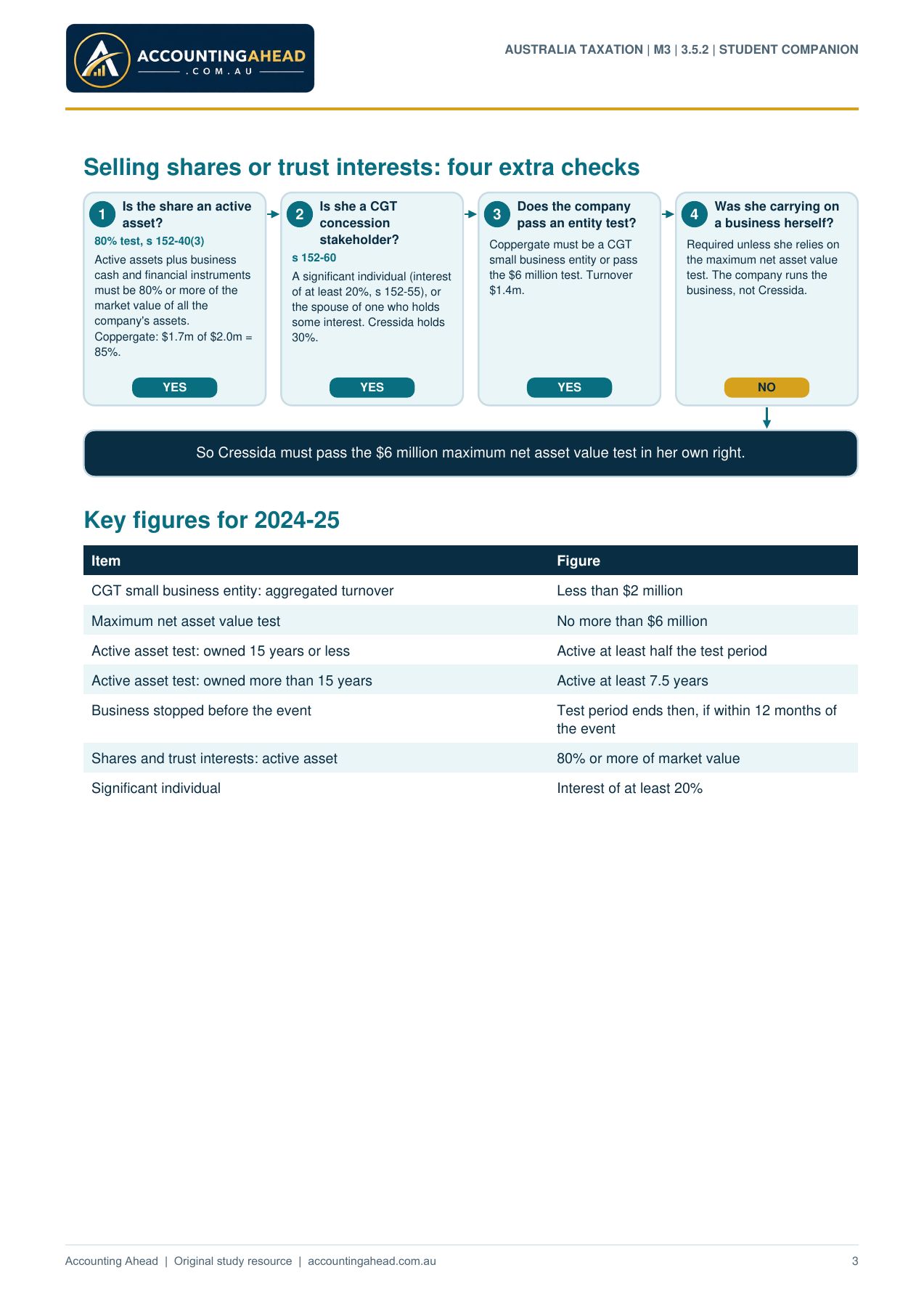
Selling shares or trust interests: four extra checks
1 Is the share an active
asset?
80% test, s 152-40(3)
Active assets plus business
cash and financial instruments
must be 80% or more of the
market value of all the
company's assets.
Coppergate: $1.7m of $2.0m =
85%.
YES
2 Is she a CGT
concession
stakeholder?
s 152-60
A significant individual (interest
of at least 20%, s 152-55), or
the spouse of one who holds
some interest. Cressida holds
30%.
YES
3 Does the company
pass an entity test?
Coppergate must be a CGT
small business entity or pass
the $6 million test. Turnover
$1.4m.
YES
4 Was she carrying on
a business herself?
Required unless she relies on
the maximum net asset value
test. The company runs the
business, not Cressida.
NO
So Cressida must pass the $6 million maximum net asset value test in her own right.
Key figures for 2024-25
Item Figure
CGT small business entity: aggregated turnover Less than $2 million
Maximum net asset value test No more than $6 million
Active asset test: owned 15 years or less Active at least half the test period
Active asset test: owned more than 15 years Active at least 7.5 years
Business stopped before the event Test period ends then, if within 12 months of
the event
Shares and trust interests: active asset 80% or more of market value
Significant individual Interest of at least 20%
AUSTRALIA TAXATION | M3 | 3.5.2 | STUDENT COMPANION
3
Accounting Ahead | Original study resource | accountingahead.com.au
Practice questions
MODULE 3 | 3.5.2 | TRY THESE BEFORE THE WORKED ANSWERS
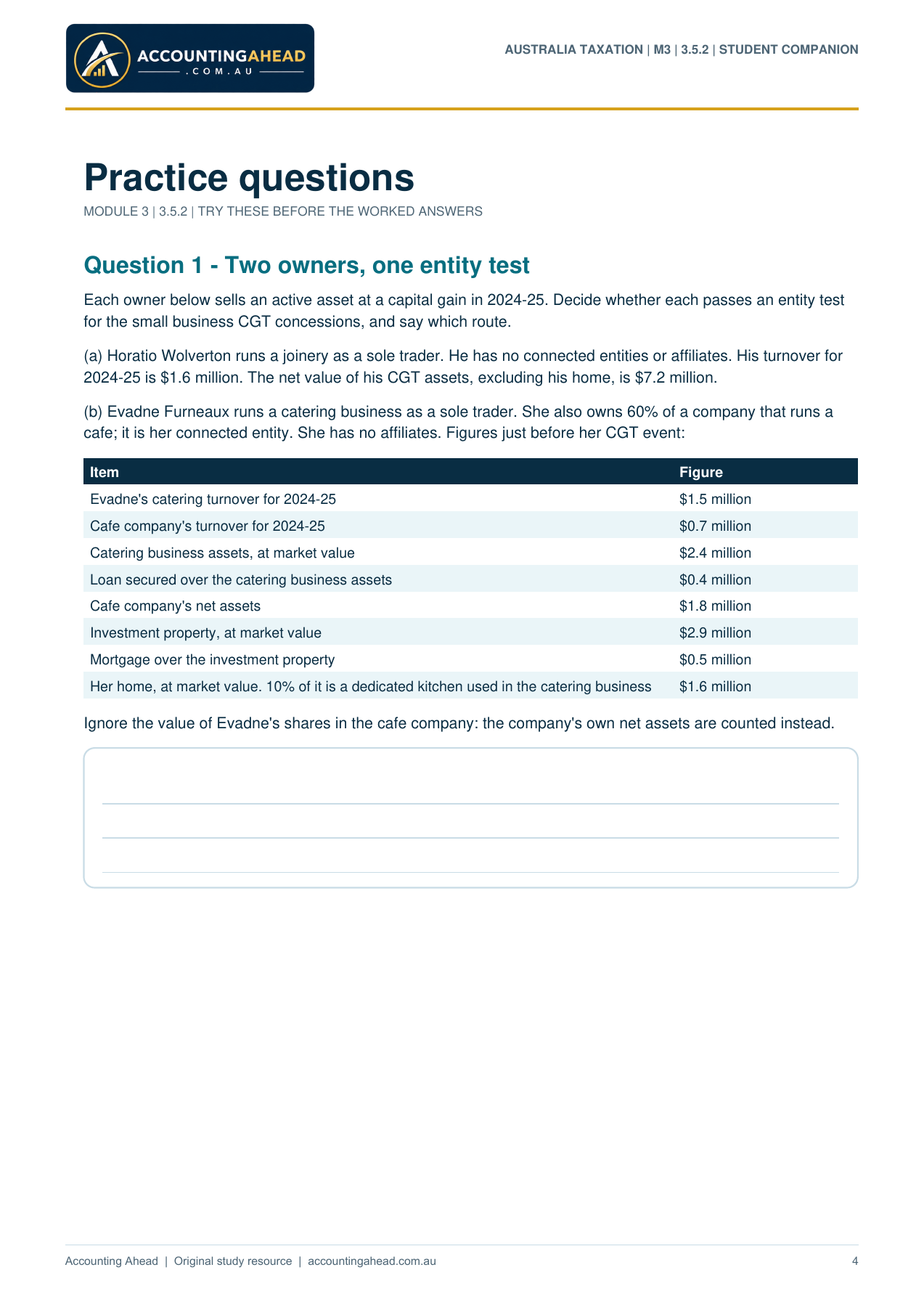
Question 1 - Two owners, one entity test
Each owner below sells an active asset at a capital gain in 2024-25. Decide whether each passes an entity test
for the small business CGT concessions, and say which route.
(a) Horatio Wolverton runs a joinery as a sole trader. He has no connected entities or affiliates. His turnover for
2024-25 is $1.6 million. The net value of his CGT assets, excluding his home, is $7.2 million.
(b) Evadne Furneaux runs a catering business as a sole trader. She also owns 60% of a company that runs a
cafe; it is her connected entity. She has no affiliates. Figures just before her CGT event:
Item Figure
Evadne's catering turnover for 2024-25 $1.5 million
Cafe company's turnover for 2024-25 $0.7 million
Catering business assets, at market value $2.4 million
Loan secured over the catering business assets $0.4 million
Cafe company's net assets $1.8 million
Investment property, at market value $2.9 million
Mortgage over the investment property $0.5 million
Her home, at market value. 10% of it is a dedicated kitchen used in the catering business $1.6 million
Ignore the value of Evadne's shares in the cafe company: the company's own net assets are counted instead.
AUSTRALIA TAXATION | M3 | 3.5.2 | STUDENT COMPANION
4
Accounting Ahead | Original study resource | accountingahead.com.au
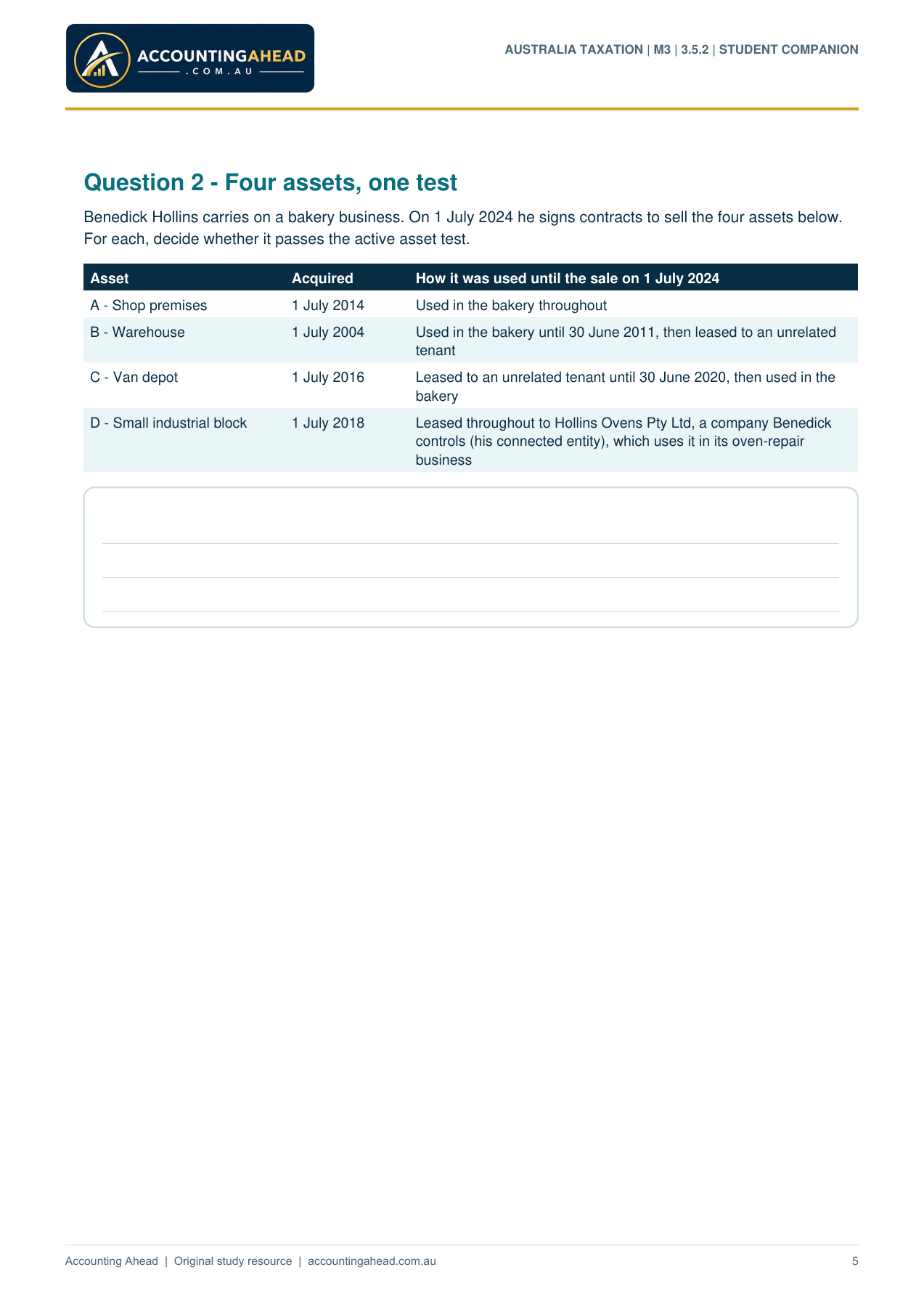
Question 2 - Four assets, one test
Benedick Hollins carries on a bakery business. On 1 July 2024 he signs contracts to sell the four assets below.
For each, decide whether it passes the active asset test.
Asset Acquired How it was used until the sale on 1 July 2024
A - Shop premises 1 July 2014 Used in the bakery throughout
B - Warehouse 1 July 2004 Used in the bakery until 30 June 2011, then leased to an unrelated
tenant
C - Van depot 1 July 2016 Leased to an unrelated tenant until 30 June 2020, then used in the
bakery
D - Small industrial block 1 July 2018 Leased throughout to Hollins Ovens Pty Ltd, a company Benedick
controls (his connected entity), which uses it in its oven-repair
business
AUSTRALIA TAXATION | M3 | 3.5.2 | STUDENT COMPANION
5
Accounting Ahead | Original study resource | accountingahead.com.au
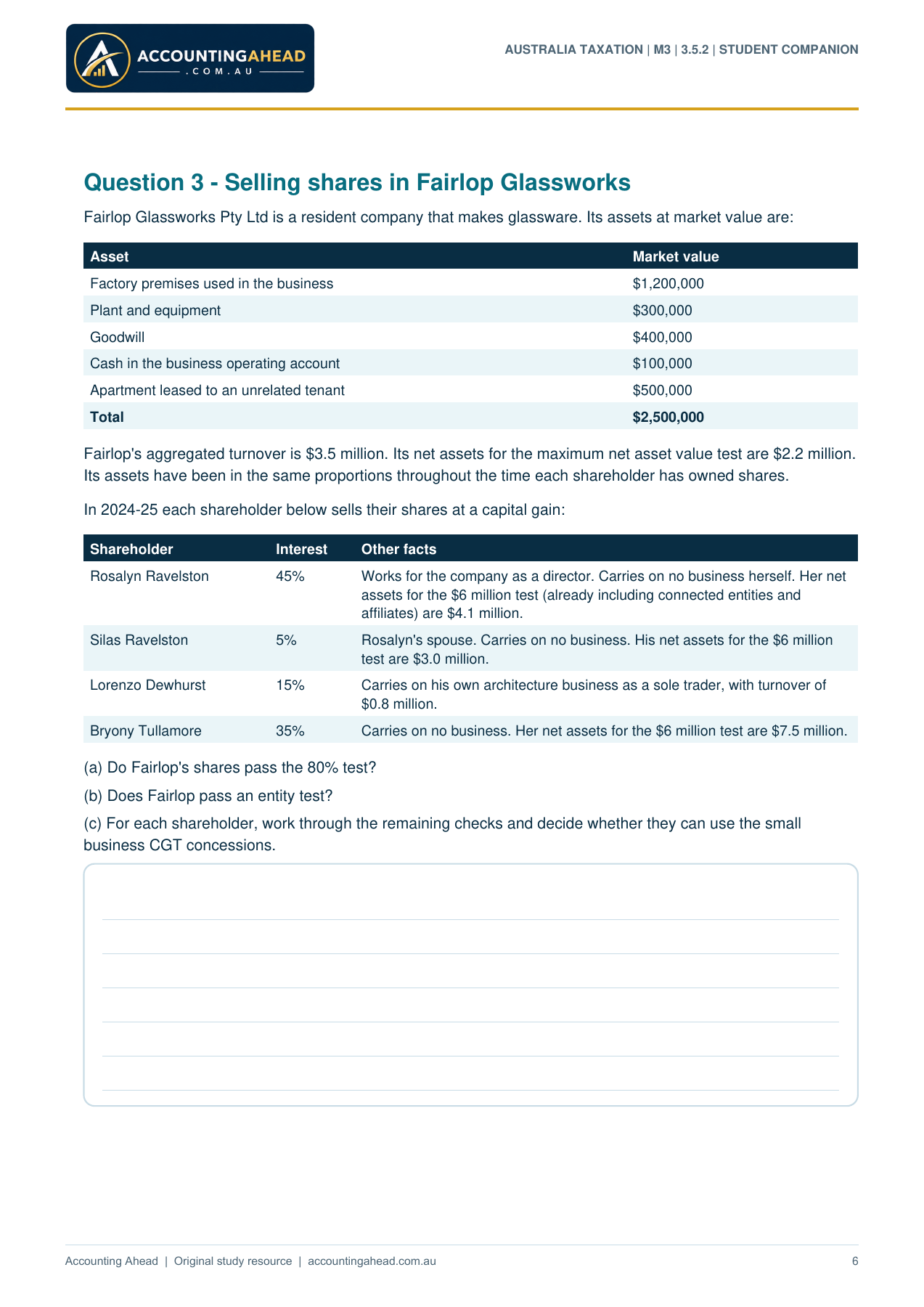
Question 3 - Selling shares in Fairlop Glassworks
Fairlop Glassworks Pty Ltd is a resident company that makes glassware. Its assets at market value are:
Asset Market value
Factory premises used in the business $1,200,000
Plant and equipment $300,000
Goodwill $400,000
Cash in the business operating account $100,000
Apartment leased to an unrelated tenant $500,000
Total $2,500,000
Fairlop's aggregated turnover is $3.5 million. Its net assets for the maximum net asset value test are $2.2 million.
Its assets have been in the same proportions throughout the time each shareholder has owned shares.
In 2024-25 each shareholder below sells their shares at a capital gain:
Shareholder Interest Other facts
Rosalyn Ravelston 45% Works for the company as a director. Carries on no business herself. Her net
assets for the $6 million test (already including connected entities and
affiliates) are $4.1 million.
Silas Ravelston 5% Rosalyn's spouse. Carries on no business. His net assets for the $6 million
test are $3.0 million.
Lorenzo Dewhurst 15% Carries on his own architecture business as a sole trader, with turnover of
$0.8 million.
Bryony Tullamore 35% Carries on no business. Her net assets for the $6 million test are $7.5 million.
(a) Do Fairlop's shares pass the 80% test?
(b) Does Fairlop pass an entity test?
(c) For each shareholder, work through the remaining checks and decide whether they can use the small
business CGT concessions.
AUSTRALIA TAXATION | M3 | 3.5.2 | STUDENT COMPANION
6
Accounting Ahead | Original study resource | accountingahead.com.au
Worked answers
MODULE 3 | 3.5.2 | WORKED ANSWERS - ATTEMPT THE QUESTIONS FIRST
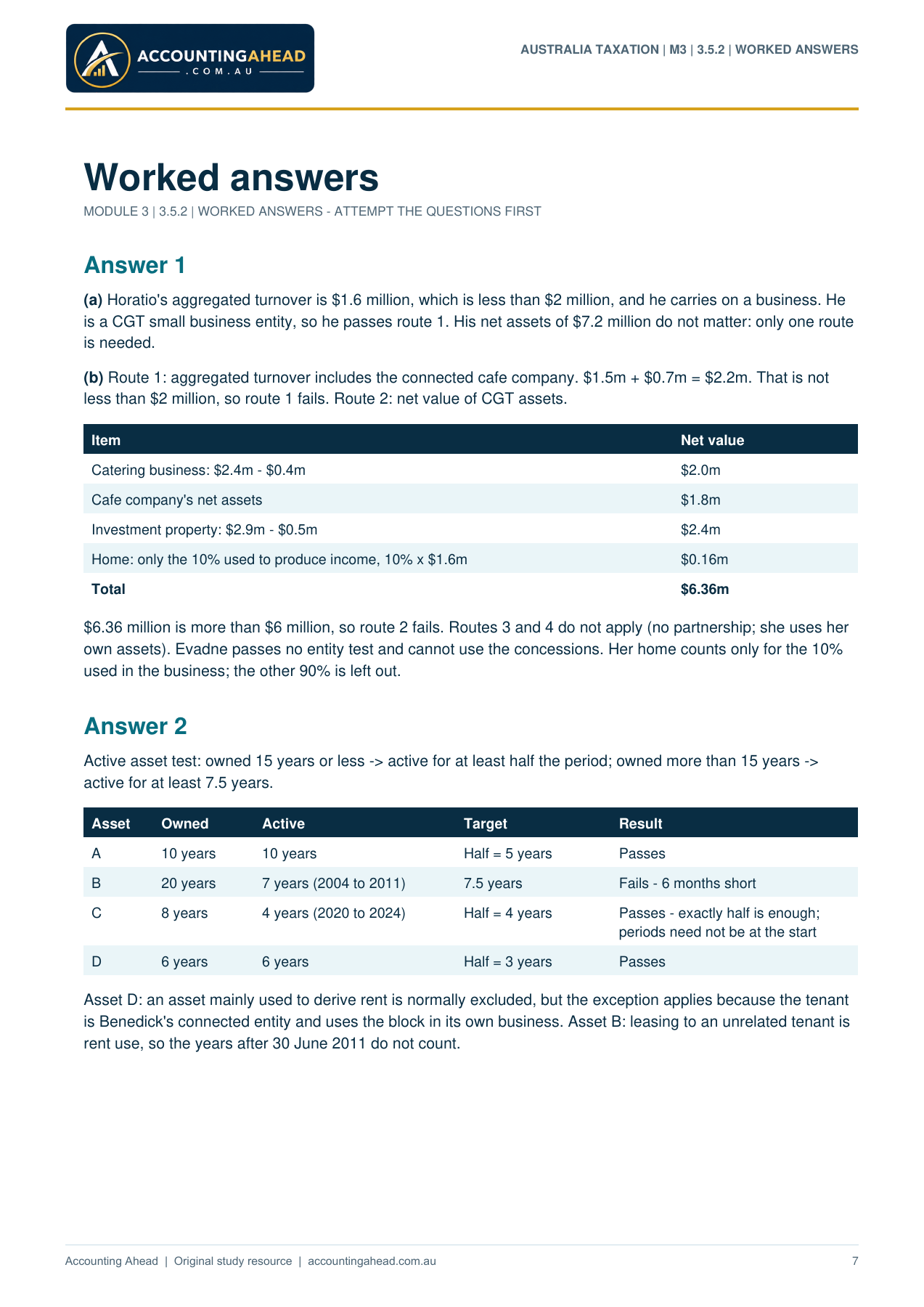
Answer 1
(a) Horatio's aggregated turnover is $1.6 million, which is less than $2 million, and he carries on a business. He
is a CGT small business entity, so he passes route 1. His net assets of $7.2 million do not matter: only one route
is needed.
(b) Route 1: aggregated turnover includes the connected cafe company. $1.5m + $0.7m = $2.2m. That is not
less than $2 million, so route 1 fails. Route 2: net value of CGT assets.
Item Net value
Catering business: $2.4m - $0.4m $2.0m
Cafe company's net assets $1.8m
Investment property: $2.9m - $0.5m $2.4m
Home: only the 10% used to produce income, 10% x $1.6m $0.16m
Total $6.36m
$6.36 million is more than $6 million, so route 2 fails. Routes 3 and 4 do not apply (no partnership; she uses her
own assets). Evadne passes no entity test and cannot use the concessions. Her home counts only for the 10%
used in the business; the other 90% is left out.
Answer 2
Active asset test: owned 15 years or less -> active for at least half the period; owned more than 15 years ->
active for at least 7.5 years.
Asset Owned Active Target Result
A 10 years 10 years Half = 5 years Passes
B 20 years 7 years (2004 to 2011) 7.5 years Fails - 6 months short
C 8 years 4 years (2020 to 2024) Half = 4 years Passes - exactly half is enough;
periods need not be at the start
D 6 years 6 years Half = 3 years Passes
Asset D: an asset mainly used to derive rent is normally excluded, but the exception applies because the tenant
is Benedick's connected entity and uses the block in its own business. Asset B: leasing to an unrelated tenant is
rent use, so the years after 30 June 2011 do not count.
AUSTRALIA TAXATION | M3 | 3.5.2 | WORKED ANSWERS
7
Accounting Ahead | Original study resource | accountingahead.com.au
Answer 3
(a) Qualifying assets: factory $1,200,000 + plant $300,000 + goodwill $400,000 + business cash $100,000 =
$2,000,000. The apartment is mainly used to derive rent from an unrelated tenant, so it is not an active asset.
$2,000,000 / $2,500,000 = 80%. The test is 80% or more, so the shares pass.
(b) Turnover of $3.5 million fails the CGT small business entity route, but net assets of $2.2 million are no more
than $6 million, so Fairlop passes the maximum net asset value test.
(c)
Shareholder Stakeholder? Business or $6m test? Result
Rosalyn Yes: significant individual, 45% is
at least 20%
Carries on no business, so she must pass
the $6m test herself: $4.1m - passes
Eligible
Silas Yes: only 5%, but he is the
spouse of a significant individual
and holds some interest himself
Carries on no business; $6m test: $3.0m -
passes
Eligible
Lorenzo No: 15% is under 20%, and he is
not the spouse of a significant
individual
Not reached Not eligible
Bryony Yes: 35% is at least 20% Carries on no business, so she must rely on
the $6m test: $7.5m - fails
Not eligible
Lorenzo's own business does not help him: the stakeholder check fails first. Bryony shows the fourth check at
work: owning a large share of a qualifying company is not enough when the seller carries on no business and
has net assets over $6 million.
AUSTRALIA TAXATION | M3 | 3.5.2 | WORKED ANSWERS
8