
Redundancy, Death Benefits and Unused Leave — study companion
Part 4.3.2 of Australia Taxation. Preview the study companion or download the printable PDF.



Read the handout text
Accounting Ahead | Original study resource | accountingahead.com.au
Redundancy, death benefits and unused
leave
MODULE 4 | 4.3.2 | STUDENT COMPANION
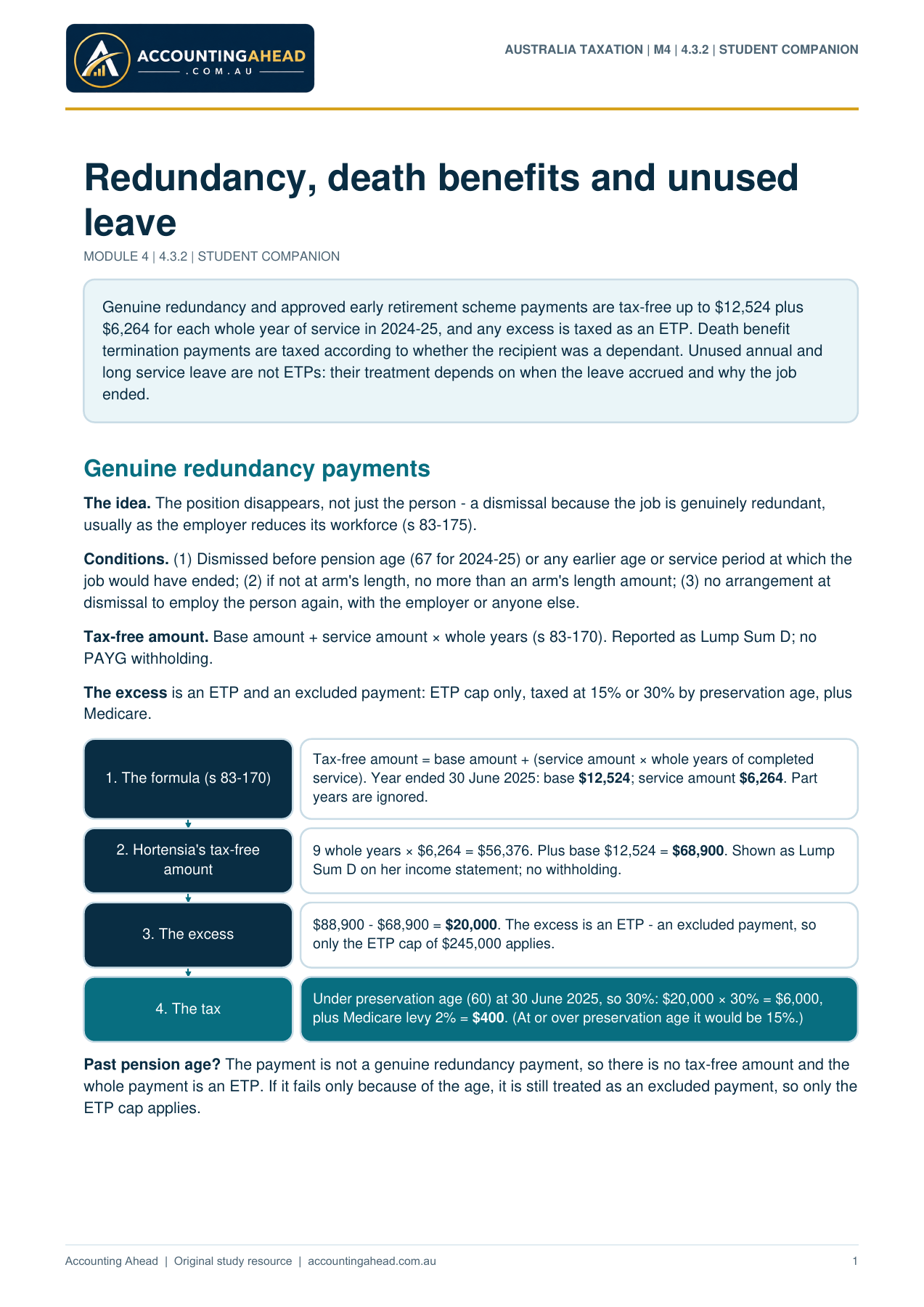
Genuine redundancy and approved early retirement scheme payments are tax-free up to $12,524 plus
$6,264 for each whole year of service in 2024-25, and any excess is taxed as an ETP. Death benefit
termination payments are taxed according to whether the recipient was a dependant. Unused annual and
long service leave are not ETPs: their treatment depends on when the leave accrued and why the job
ended.
Genuine redundancy payments
The idea. The position disappears, not just the person - a dismissal because the job is genuinely redundant,
usually as the employer reduces its workforce (s 83-175).
Conditions. (1) Dismissed before pension age (67 for 2024-25) or any earlier age or service period at which the
job would have ended; (2) if not at arm's length, no more than an arm's length amount; (3) no arrangement at
dismissal to employ the person again, with the employer or anyone else.
Tax-free amount. Base amount + service amount × whole years (s 83-170). Reported as Lump Sum D; no
PAYG withholding.
The excess is an ETP and an excluded payment: ETP cap only, taxed at 15% or 30% by preservation age, plus
Medicare.
1. The formula (s 83-170)
Tax-free amount = base amount + (service amount × whole years of completed
service). Year ended 30 June 2025: base $12,524; service amount $6,264. Part
years are ignored.
2. Hortensia's tax-free
amount
9 whole years × $6,264 = $56,376. Plus base $12,524 = $68,900. Shown as Lump
Sum D on her income statement; no withholding.
3. The excess $88,900 - $68,900 = $20,000. The excess is an ETP - an excluded payment, so
only the ETP cap of $245,000 applies.
4. The tax Under preservation age (60) at 30 June 2025, so 30%: $20,000 × 30% = $6,000,
plus Medicare levy 2% = $400. (At or over preservation age it would be 15%.)
Past pension age? The payment is not a genuine redundancy payment, so there is no tax-free amount and the
whole payment is an ETP. If it fails only because of the age, it is still treated as an excluded payment, so only the
ETP cap applies.
AUSTRALIA TAXATION | M4 | 4.3.2 | STUDENT COMPANION
1
Accounting Ahead | Original study resource | accountingahead.com.au
Early retirement scheme payments
An employer rationalising or reorganising its operations offers an incentive to retire (s 83-180). The
Commissioner must approve the scheme before it is implemented, and it must be open to all employees in a
class the Commissioner approves. Only the amount above what a voluntary resignation would have brought
qualifies. The same three conditions (with retirement in place of dismissal) and the same formula apply.
Death benefit termination payments
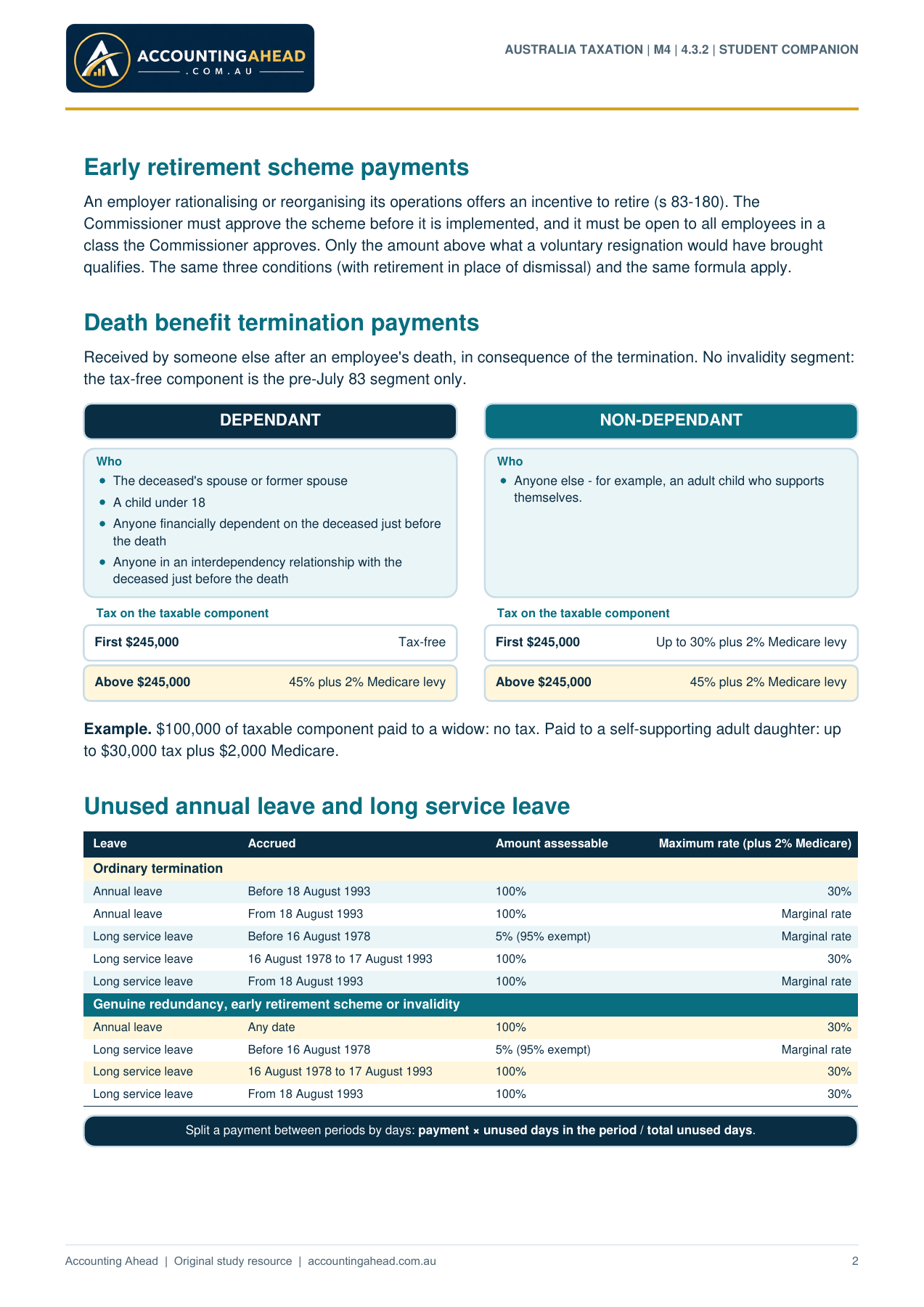
Received by someone else after an employee's death, in consequence of the termination. No invalidity segment:
the tax-free component is the pre-July 83 segment only.
DEPENDANT
Who
The deceased's spouse or former spouse
A child under 18
Anyone financially dependent on the deceased just before
the death
Anyone in an interdependency relationship with the
deceased just before the death
Tax on the taxable component
First $245,000 Tax-free
Above $245,000 45% plus 2% Medicare levy
NON-DEPENDANT
Who
Anyone else - for example, an adult child who supports
themselves.
Tax on the taxable component
First $245,000 Up to 30% plus 2% Medicare levy
Above $245,000 45% plus 2% Medicare levy
Example. $100,000 of taxable component paid to a widow: no tax. Paid to a self-supporting adult daughter: up
to $30,000 tax plus $2,000 Medicare.
Unused annual leave and long service leave
Leave Accrued Amount assessable Maximum rate (plus 2% Medicare)
Ordinary termination
Annual leave Before 18 August 1993 100% 30%
Annual leave From 18 August 1993 100% Marginal rate
Long service leave Before 16 August 1978 5% (95% exempt) Marginal rate
Long service leave 16 August 1978 to 17 August 1993 100% 30%
Long service leave From 18 August 1993 100% Marginal rate
Genuine redundancy, early retirement scheme or invalidity
Annual leave Any date 100% 30%
Long service leave Before 16 August 1978 5% (95% exempt) Marginal rate
Long service leave 16 August 1978 to 17 August 1993 100% 30%
Long service leave From 18 August 1993 100% 30%
Split a payment between periods by days: payment × unused days in the period / total unused days.
AUSTRALIA TAXATION | M4 | 4.3.2 | STUDENT COMPANION
2
Accounting Ahead | Original study resource | accountingahead.com.au
Apportion by days. A long service leave payment of $20,000 for 100 days (10 before 16 August 1978, 40 in the
middle period, 50 since): $2,000 of which 5% ($100) is assessable; $8,000 assessable with tax capped at 30%
($2,400 at most); $10,000 at marginal rates.
Key figures for 2024-25
Item Figure
Redundancy/ERS base amount $12,524
Redundancy/ERS service amount $6,264 per whole year
Pension age 67
ETP cap (redundancy/ERS excess, death benefits) $245,000
Life ETP rates up to cap 15% (preservation age reached) or 30% + 2% Medicare
Death benefit - dependant First $245,000 tax-free; above, 45% + 2% Medicare
Death benefit - non-dependant First $245,000 up to 30% + 2% Medicare; above, 45% + 2%
Medicare
Leave cut-off dates 16 August 1978 (long service leave); 18 August 1993 (both)
Pre-16 August 1978 long service leave 5% assessable
AUSTRALIA TAXATION | M4 | 4.3.2 | STUDENT COMPANION
3
Accounting Ahead | Original study resource | accountingahead.com.au
Practice questions
MODULE 4 | 4.3.2 | TRY THESE BEFORE THE WORKED ANSWERS
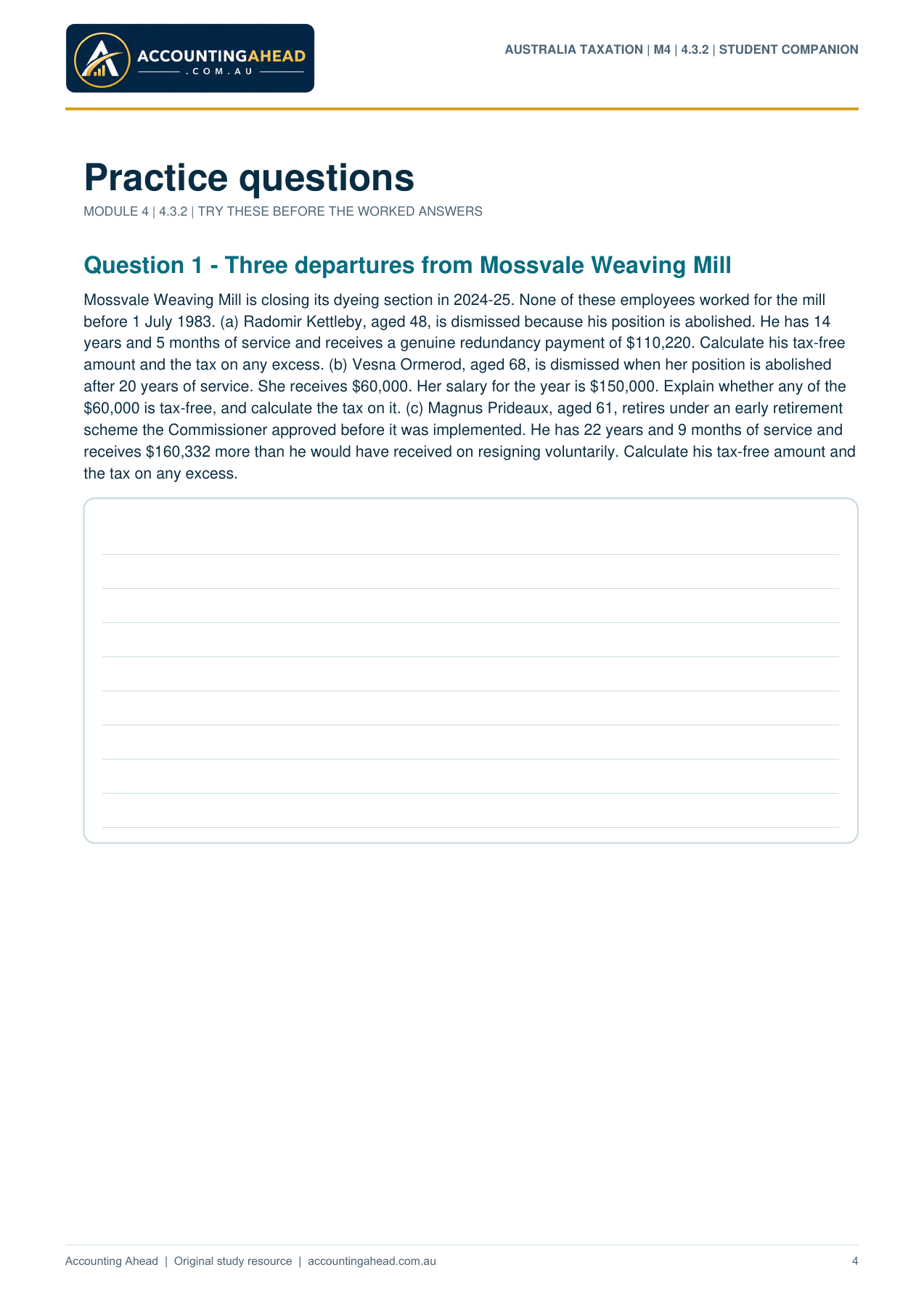
Question 1 - Three departures from Mossvale Weaving Mill
Mossvale Weaving Mill is closing its dyeing section in 2024-25. None of these employees worked for the mill
before 1 July 1983. (a) Radomir Kettleby, aged 48, is dismissed because his position is abolished. He has 14
years and 5 months of service and receives a genuine redundancy payment of $110,220. Calculate his tax-free
amount and the tax on any excess. (b) Vesna Ormerod, aged 68, is dismissed when her position is abolished
after 20 years of service. She receives $60,000. Her salary for the year is $150,000. Explain whether any of the
$60,000 is tax-free, and calculate the tax on it. (c) Magnus Prideaux, aged 61, retires under an early retirement
scheme the Commissioner approved before it was implemented. He has 22 years and 9 months of service and
receives $160,332 more than he would have received on resigning voluntarily. Calculate his tax-free amount and
the tax on any excess.
AUSTRALIA TAXATION | M4 | 4.3.2 | STUDENT COMPANION
4
Accounting Ahead | Original study resource | accountingahead.com.au
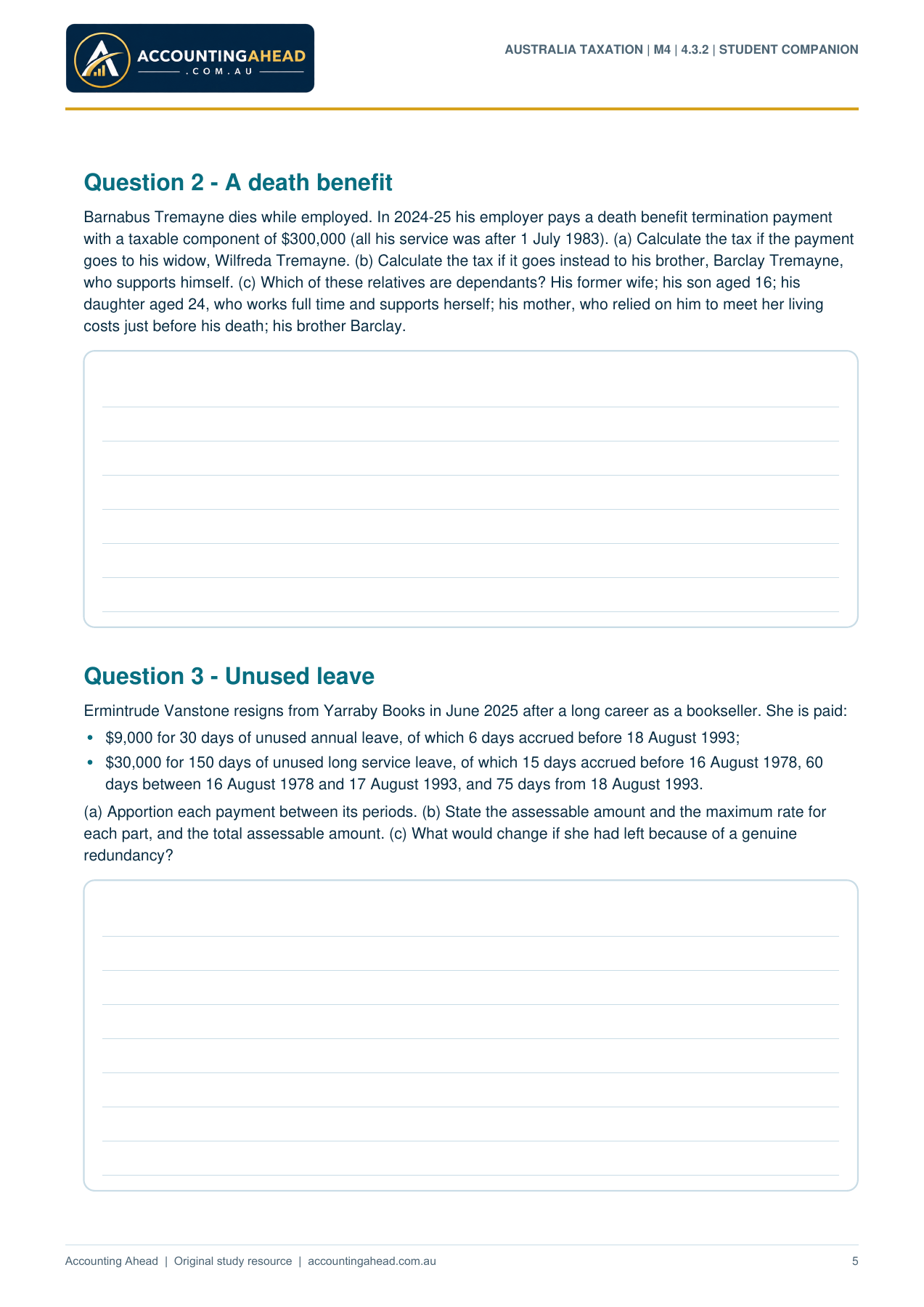
Question 2 - A death benefit
Barnabus Tremayne dies while employed. In 2024-25 his employer pays a death benefit termination payment
with a taxable component of $300,000 (all his service was after 1 July 1983). (a) Calculate the tax if the payment
goes to his widow, Wilfreda Tremayne. (b) Calculate the tax if it goes instead to his brother, Barclay Tremayne,
who supports himself. (c) Which of these relatives are dependants? His former wife; his son aged 16; his
daughter aged 24, who works full time and supports herself; his mother, who relied on him to meet her living
costs just before his death; his brother Barclay.
Question 3 - Unused leave
Ermintrude Vanstone resigns from Yarraby Books in June 2025 after a long career as a bookseller. She is paid:
$9,000 for 30 days of unused annual leave, of which 6 days accrued before 18 August 1993;
$30,000 for 150 days of unused long service leave, of which 15 days accrued before 16 August 1978, 60
days between 16 August 1978 and 17 August 1993, and 75 days from 18 August 1993.
(a) Apportion each payment between its periods. (b) State the assessable amount and the maximum rate for
each part, and the total assessable amount. (c) What would change if she had left because of a genuine
redundancy?
AUSTRALIA TAXATION | M4 | 4.3.2 | STUDENT COMPANION
5
Accounting Ahead | Original study resource | accountingahead.com.au
Worked answers
MODULE 4 | 4.3.2 | WORKED ANSWERS - ATTEMPT THE QUESTIONS FIRST
Answer 1 - Three departures from Mossvale Weaving Mill
(a) Radomir Kettleby
Step Working
Tax-free amount $12,524 + 14 whole years × $6,264 = $12,524 + $87,696 = $100,220 (the 5 months are
ignored)
Excess $110,220 - $100,220 = $10,000, an ETP and an excluded payment, so only the $245,000
ETP cap applies
Tax Radomir (48) is under preservation age: 30% × $10,000 = $3,000, plus Medicare 2% = $200
(b) Vesna was dismissed after reaching pension age (67), so the payment is not a genuine redundancy
payment: none of it is tax-free and the whole $60,000 is an ETP (taxable component, no pre-July 83 service).
Because it would have been a genuine redundancy but for her age, it is an excluded payment, so only the ETP
cap of $245,000 applies and her $150,000 salary does not reduce it. She has reached preservation age: tax =
15% × $60,000 = $9,000, plus Medicare 2% = $1,200. (Had it been non-excluded, her cap would have been only
$180,000 - $150,000 = $30,000.)
(c) Magnus Prideaux
Step Working
Tax-free amount $12,524 + 22 whole years × $6,264 = $12,524 + $137,808 = $150,332 (the 9 months are
ignored)
Excess $160,332 - $150,332 = $10,000, an excluded ETP
Tax Magnus (61) has reached preservation age: 15% × $10,000 = $1,500, plus Medicare 2% =
$200
Answer 2 - A death benefit
(a) and (b) Tax on the $300,000
Recipient Tax-free Taxed at 30% or 45% Tax Medicare Total
(a) Wilfreda, spouse (a
dependant)
First
$245,000
Excess $300,000 - $245,000 =
$55,000 × 45% = $24,750
$24,750 2% × $55,000 =
$1,100
$25,850
(b) Barclay, brother (a
non-dependant)
None $245,000 × 30% = $73,500 plus
$55,000 × 45% = $24,750
$98,250 2% × $300,000 =
$6,000
$104,250
(a) Wilfreda, as his spouse, is a dependant. First $245,000: tax-free. Excess $300,000 - $245,000 = $55,000 ×
45% = $24,750, plus Medicare 2% × $55,000 = $1,100. Total $25,850.
AUSTRALIA TAXATION | M4 | 4.3.2 | WORKED ANSWERS
6
Accounting Ahead | Original study resource | accountingahead.com.au
(b) Barclay is a non-dependant. $245,000 × 30% = $73,500 plus $55,000 × 45% = $24,750; total tax $98,250,
plus Medicare 2% × $300,000 = $6,000. Total $104,250.
(c) Dependants: his former wife (a former spouse), his son aged 16 (a child under 18) and his mother (financially
dependent on him just before his death). Not dependants: his self-supporting daughter aged 24 and his brother
Barclay.
Answer 3 - Ermintrude Vanstone's unused leave
Leave and period Apportioned payment Assessable amount Maximum rate
Annual leave, before 18 August
1993
$9,000 × 6/30 = $1,800 $1,800 (100%) 30%
Annual leave, from 18 August
1993
$9,000 × 24/30 = $7,200 $7,200 (100%) Marginal rates
Long service leave, before 16
August 1978
$30,000 × 15/150 =
$3,000
5% × $3,000 = $150 (the other
$2,850 is exempt)
Marginal rates
Long service leave, 16 August
1978 to 17 August 1993
$30,000 × 60/150 =
$12,000
$12,000 (100%) 30% (tax no more than
$3,600)
Long service leave, from 18
August 1993
$30,000 × 75/150 =
$15,000
$15,000 (100%) Marginal rates
Total assessable $1,800 + $7,200 + $150 + $12,000
+ $15,000 = $36,150
(a) Annual leave: before 18 August 1993 = $9,000 × 6/30 = $1,800; from 18 August 1993 = $9,000 × 24/30 =
$7,200. Long service leave: before 16 August 1978 = $30,000 × 15/150 = $3,000; 16 August 1978 to 17 August
1993 = $30,000 × 60/150 = $12,000; from 18 August 1993 = $30,000 × 75/150 = $15,000.
(b) Annual leave: $1,800 fully assessable, maximum 30%; $7,200 fully assessable at marginal rates. Long
service leave: 5% × $3,000 = $150 assessable at marginal rates (the other $2,850 is exempt); $12,000 fully
assessable, maximum 30% (tax no more than $3,600); $15,000 fully assessable at marginal rates. Total
assessable = $1,800 + $7,200 + $150 + $12,000 + $15,000 = $36,150. Medicare levy of 2% applies on top.
(c) With a genuine redundancy, all of the annual leave ($9,000) is capped at 30%, and the long service leave
accrued from 18 August 1993 ($15,000) is also capped at 30% instead of being taxed at marginal rates. The
pre-16 August 1978 long service leave is unchanged (5% assessable at marginal rates), and the assessable
total is still $36,150.
AUSTRALIA TAXATION | M4 | 4.3.2 | WORKED ANSWERS
7