
Personal Services Income — study companion
Part 4.3.3 of Australia Taxation. Preview the study companion or download the printable PDF.


Read the handout text
Accounting Ahead | Original study resource | accountingahead.com.au
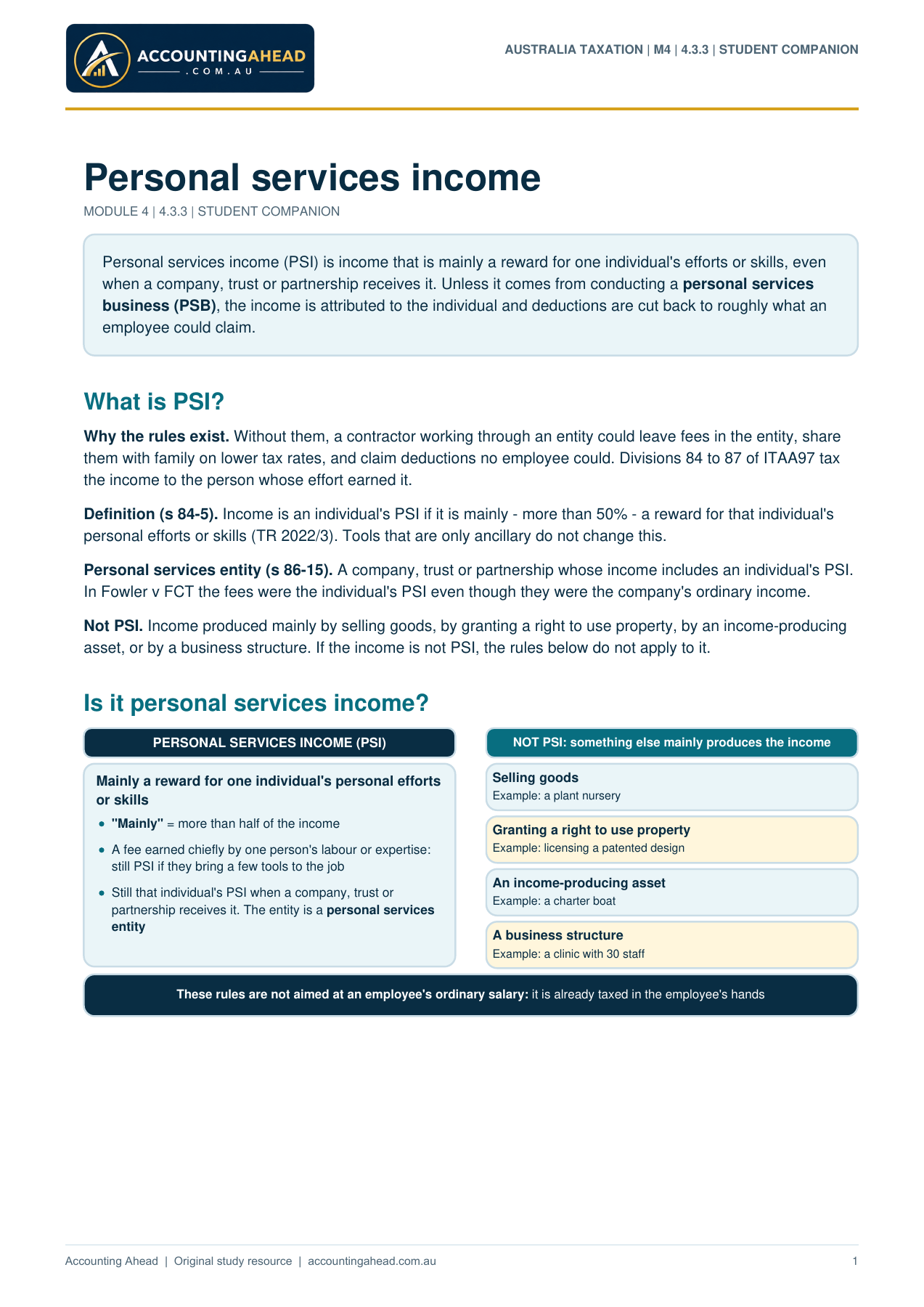
Personal services income
MODULE 4 | 4.3.3 | STUDENT COMPANION
Personal services income (PSI) is income that is mainly a reward for one individual's efforts or skills, even
when a company, trust or partnership receives it. Unless it comes from conducting a personal services
business (PSB), the income is attributed to the individual and deductions are cut back to roughly what an
employee could claim.
What is PSI?
Why the rules exist. Without them, a contractor working through an entity could leave fees in the entity, share
them with family on lower tax rates, and claim deductions no employee could. Divisions 84 to 87 of ITAA97 tax
the income to the person whose effort earned it.
Definition (s 84-5). Income is an individual's PSI if it is mainly - more than 50% - a reward for that individual's
personal efforts or skills (TR 2022/3). Tools that are only ancillary do not change this.
Personal services entity (s 86-15). A company, trust or partnership whose income includes an individual's PSI.
In Fowler v FCT the fees were the individual's PSI even though they were the company's ordinary income.
Not PSI. Income produced mainly by selling goods, by granting a right to use property, by an income-producing
asset, or by a business structure. If the income is not PSI, the rules below do not apply to it.
Is it personal services income?
PERSONAL SERVICES INCOME (PSI) NOT PSI: something else mainly produces the income
Mainly a reward for one individual's personal efforts
or skills
"Mainly" = more than half of the income
A fee earned chiefly by one person's labour or expertise:
still PSI if they bring a few tools to the job
Still that individual's PSI when a company, trust or
partnership receives it. The entity is a personal services
entity
Selling goods
Example: a plant nursery
Granting a right to use property
Example: licensing a patented design
An income-producing asset
Example: a charter boat
A business structure
Example: a clinic with 30 staff
These rules are not aimed at an employee's ordinary salary: it is already taxed in the employee's hands
AUSTRALIA TAXATION | M4 | 4.3.3 | STUDENT COMPANION
1
Accounting Ahead | Original study resource | accountingahead.com.au
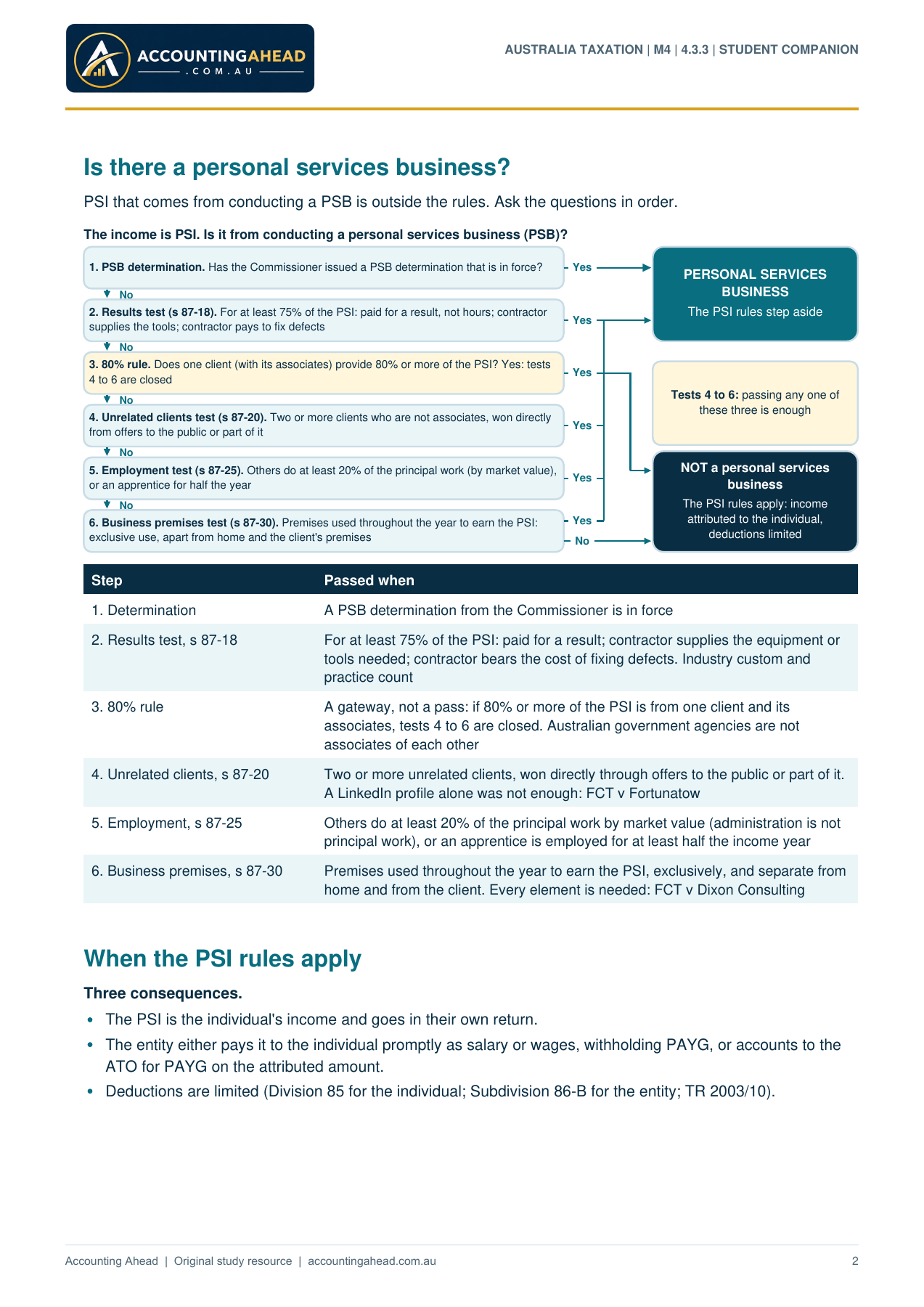
Is there a personal services business?
PSI that comes from conducting a PSB is outside the rules. Ask the questions in order.
The income is PSI. Is it from conducting a personal services business (PSB)?
1. PSB determination. Has the Commissioner issued a PSB determination that is in force?
No
2. Results test (s 87-18). For at least 75% of the PSI: paid for a result, not hours; contractor
supplies the tools; contractor pays to fix defects
No
3. 80% rule. Does one client (with its associates) provide 80% or more of the PSI? Yes: tests
4 to 6 are closed
No
4. Unrelated clients test (s 87-20). Two or more clients who are not associates, won directly
from offers to the public or part of it
No
5. Employment test (s 87-25). Others do at least 20% of the principal work (by market value),
or an apprentice for half the year
No
6. Business premises test (s 87-30). Premises used throughout the year to earn the PSI:
exclusive use, apart from home and the client's premises
PERSONAL SERVICES
BUSINESS
The PSI rules step aside
NOT a personal services
business
The PSI rules apply: income
attributed to the individual,
deductions limited
Yes
Yes
Yes
Yes
Yes
Yes
No
Tests 4 to 6: passing any one of
these three is enough
Step Passed when
1. Determination A PSB determination from the Commissioner is in force
2. Results test, s 87-18 For at least 75% of the PSI: paid for a result; contractor supplies the equipment or
tools needed; contractor bears the cost of fixing defects. Industry custom and
practice count
3. 80% rule A gateway, not a pass: if 80% or more of the PSI is from one client and its
associates, tests 4 to 6 are closed. Australian government agencies are not
associates of each other
4. Unrelated clients, s 87-20 Two or more unrelated clients, won directly through offers to the public or part of it.
A LinkedIn profile alone was not enough: FCT v Fortunatow
5. Employment, s 87-25 Others do at least 20% of the principal work by market value (administration is not
principal work), or an apprentice is employed for at least half the income year
6. Business premises, s 87-30 Premises used throughout the year to earn the PSI, exclusively, and separate from
home and from the client. Every element is needed: FCT v Dixon Consulting
When the PSI rules apply
Three consequences.
The PSI is the individual's income and goes in their own return.
The entity either pays it to the individual promptly as salary or wages, withholding PAYG, or accounts to the
ATO for PAYG on the attributed amount.
Deductions are limited (Division 85 for the individual; Subdivision 86-B for the entity; TR 2003/10).
AUSTRALIA TAXATION | M4 | 4.3.3 | STUDENT COMPANION
2
Accounting Ahead | Original study resource | accountingahead.com.au
Still deductible Not deductible
Costs of gaining work, such as advertising Rent, mortgage interest, rates or land tax on the
individual's home
Income protection and professional indemnity insurance Payments to associates (including super) for work that is
not principal work
Super contributions for the individual
Payments to others (even associates) who help with the
principal work
Workers compensation and GST obligations
How much is attributed (s 86-20). Step 1: deductions relating to the PSI. Step 2: entity maintenance
deductions. Step 3: the entity's other assessable income. Step 4: Step 2 less Step 3. If Step 4 is more than zero,
reduce the PSI by Step 1 + Step 4; otherwise by Step 1 only. An excess of deductions over PSI is deductible to
the individual (s 86-27).
How much PSI is attributed to the individual?
PSI received by the company = $200,000
Step 1: $40,000
Deductions that relate to the PSI (mostly
superannuation and insurance)
Step 2: $3,000
Entity maintenance deductions: costs of
keeping the company in existence, such as
bank fees and its annual registration fee
Step 3: $1,000
The company's other assessable income
(interest)
Step 4: $2,000
Step 2 - Step 3 = $3,000 - $1,000 =
$2,000
Is Step 4 more than zero?
YES: reduce the PSI by Step 1 + Step 4 = $40,000 +
$2,000 = $42,000. If Step 4 is zero or less: reduce the
PSI by Step 1 only
Attributed to Leontine
$200,000 - $42,000 =
$158,000
If the deductions exceed the PSI, the individual deducts the excess (s 86-27)
Two boundaries. The rules change only the income tax result: contracts stand and the individual is not treated
as an employee. Even a genuine PSB can still face the general anti-avoidance rules in Part IVA of ITAA36 if
income is split.
AUSTRALIA TAXATION | M4 | 4.3.3 | STUDENT COMPANION
3
Accounting Ahead | Original study resource | accountingahead.com.au
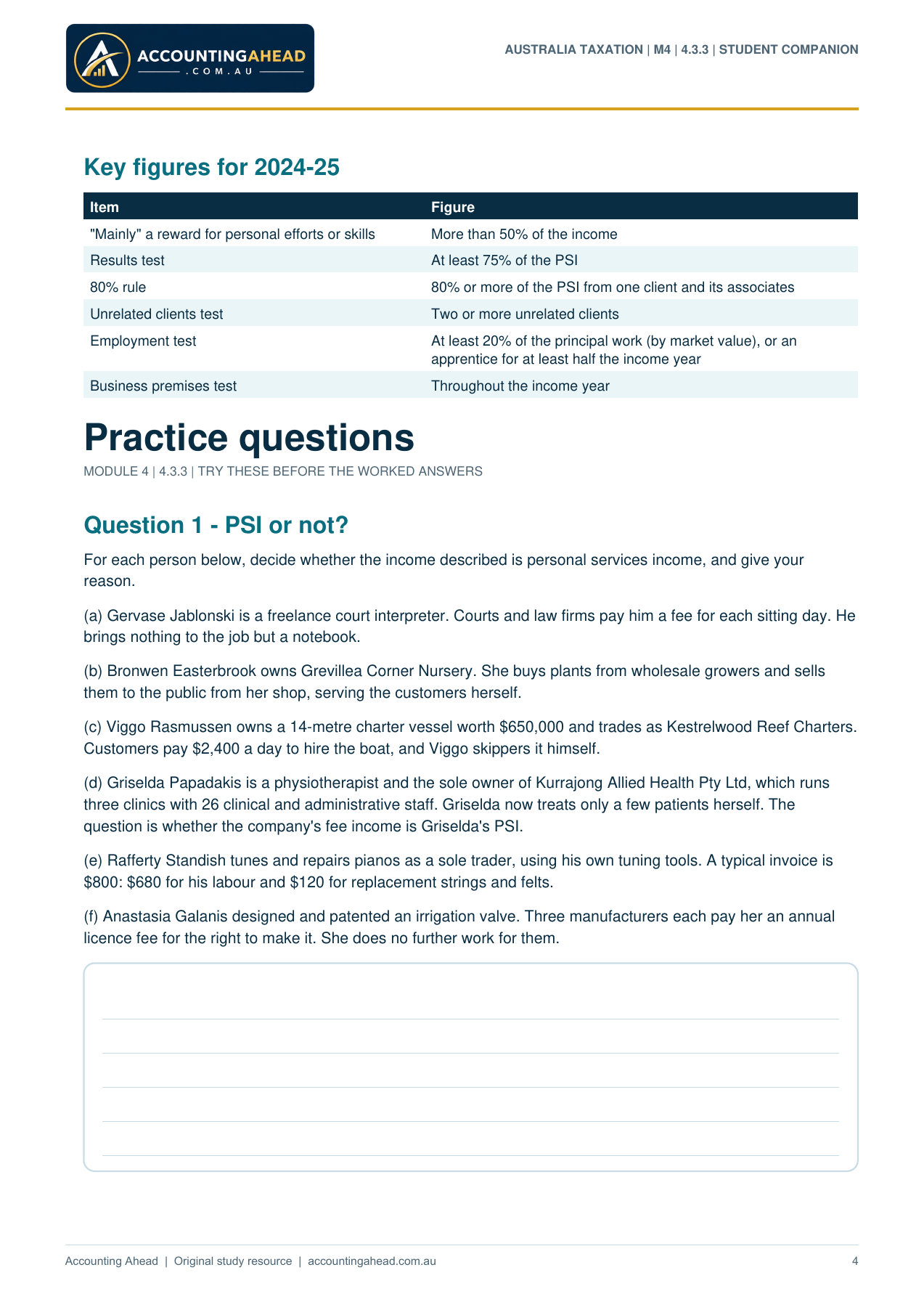
Key figures for 2024-25
Item Figure
"Mainly" a reward for personal efforts or skills More than 50% of the income
Results test At least 75% of the PSI
80% rule 80% or more of the PSI from one client and its associates
Unrelated clients test Two or more unrelated clients
Employment test At least 20% of the principal work (by market value), or an
apprentice for at least half the income year
Business premises test Throughout the income year
Practice questions
MODULE 4 | 4.3.3 | TRY THESE BEFORE THE WORKED ANSWERS
Question 1 - PSI or not?
For each person below, decide whether the income described is personal services income, and give your
reason.
(a) Gervase Jablonski is a freelance court interpreter. Courts and law firms pay him a fee for each sitting day. He
brings nothing to the job but a notebook.
(b) Bronwen Easterbrook owns Grevillea Corner Nursery. She buys plants from wholesale growers and sells
them to the public from her shop, serving the customers herself.
(c) Viggo Rasmussen owns a 14-metre charter vessel worth $650,000 and trades as Kestrelwood Reef Charters.
Customers pay $2,400 a day to hire the boat, and Viggo skippers it himself.
(d) Griselda Papadakis is a physiotherapist and the sole owner of Kurrajong Allied Health Pty Ltd, which runs
three clinics with 26 clinical and administrative staff. Griselda now treats only a few patients herself. The
question is whether the company's fee income is Griselda's PSI.
(e) Rafferty Standish tunes and repairs pianos as a sole trader, using his own tuning tools. A typical invoice is
$800: $680 for his labour and $120 for replacement strings and felts.
(f) Anastasia Galanis designed and patented an irrigation valve. Three manufacturers each pay her an annual
licence fee for the right to make it. She does no further work for them.
AUSTRALIA TAXATION | M4 | 4.3.3 | STUDENT COMPANION
4
Accounting Ahead | Original study resource | accountingahead.com.au
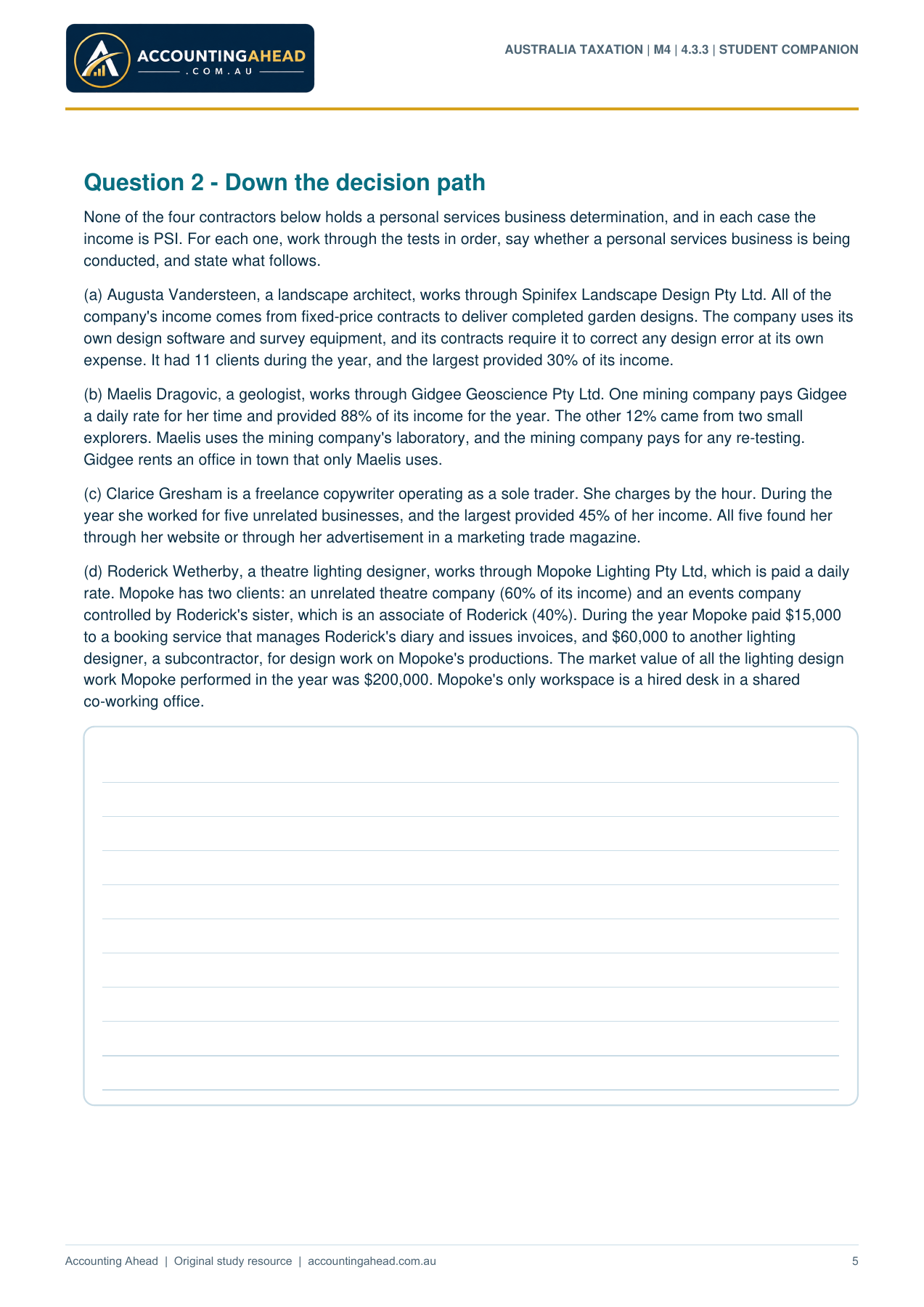
Question 2 - Down the decision path
None of the four contractors below holds a personal services business determination, and in each case the
income is PSI. For each one, work through the tests in order, say whether a personal services business is being
conducted, and state what follows.
(a) Augusta Vandersteen, a landscape architect, works through Spinifex Landscape Design Pty Ltd. All of the
company's income comes from fixed-price contracts to deliver completed garden designs. The company uses its
own design software and survey equipment, and its contracts require it to correct any design error at its own
expense. It had 11 clients during the year, and the largest provided 30% of its income.
(b) Maelis Dragovic, a geologist, works through Gidgee Geoscience Pty Ltd. One mining company pays Gidgee
a daily rate for her time and provided 88% of its income for the year. The other 12% came from two small
explorers. Maelis uses the mining company's laboratory, and the mining company pays for any re-testing.
Gidgee rents an office in town that only Maelis uses.
(c) Clarice Gresham is a freelance copywriter operating as a sole trader. She charges by the hour. During the
year she worked for five unrelated businesses, and the largest provided 45% of her income. All five found her
through her website or through her advertisement in a marketing trade magazine.
(d) Roderick Wetherby, a theatre lighting designer, works through Mopoke Lighting Pty Ltd, which is paid a daily
rate. Mopoke has two clients: an unrelated theatre company (60% of its income) and an events company
controlled by Roderick's sister, which is an associate of Roderick (40%). During the year Mopoke paid $15,000
to a booking service that manages Roderick's diary and issues invoices, and $60,000 to another lighting
designer, a subcontractor, for design work on Mopoke's productions. The market value of all the lighting design
work Mopoke performed in the year was $200,000. Mopoke's only workspace is a hired desk in a shared
co-working office.
AUSTRALIA TAXATION | M4 | 4.3.3 | STUDENT COMPANION
5
Accounting Ahead | Original study resource | accountingahead.com.au
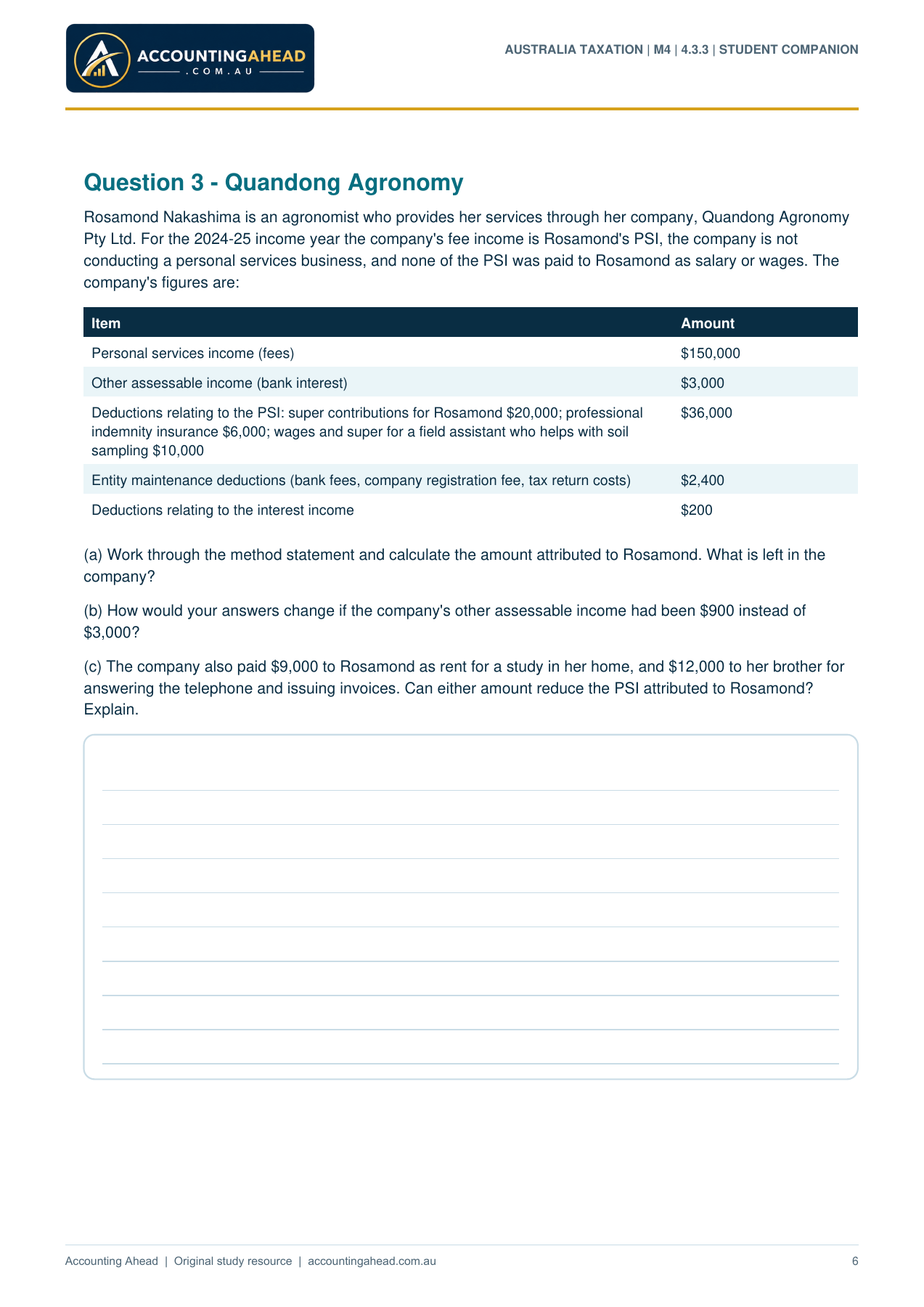
Question 3 - Quandong Agronomy
Rosamond Nakashima is an agronomist who provides her services through her company, Quandong Agronomy
Pty Ltd. For the 2024-25 income year the company's fee income is Rosamond's PSI, the company is not
conducting a personal services business, and none of the PSI was paid to Rosamond as salary or wages. The
company's figures are:
Item Amount
Personal services income (fees) $150,000
Other assessable income (bank interest) $3,000
Deductions relating to the PSI: super contributions for Rosamond $20,000; professional
indemnity insurance $6,000; wages and super for a field assistant who helps with soil
sampling $10,000
$36,000
Entity maintenance deductions (bank fees, company registration fee, tax return costs) $2,400
Deductions relating to the interest income $200
(a) Work through the method statement and calculate the amount attributed to Rosamond. What is left in the
company?
(b) How would your answers change if the company's other assessable income had been $900 instead of
$3,000?
(c) The company also paid $9,000 to Rosamond as rent for a study in her home, and $12,000 to her brother for
answering the telephone and issuing invoices. Can either amount reduce the PSI attributed to Rosamond?
Explain.
AUSTRALIA TAXATION | M4 | 4.3.3 | STUDENT COMPANION
6
Accounting Ahead | Original study resource | accountingahead.com.au
Worked answers
MODULE 4 | 4.3.3 | WORKED ANSWERS - ATTEMPT THE QUESTIONS FIRST
Answer 1 - PSI or not?
(a) PSI. The fees are a reward for Gervase's personal skill as an interpreter. Nothing else produces the income.
An individual can earn PSI directly as a sole trader; no company or trust is needed.
(b) Not PSI. The income comes mainly from selling goods (the plants). Bronwen's labour in serving customers is
incidental to the sales.
(c) Not PSI. The income is produced mainly by an income-producing asset, the $650,000 vessel, which is what
customers hire. Viggo's work as skipper is secondary.
(d) Not PSI. The company's income is generated by its business structure - three clinics and 26 staff - and not
mainly by Griselda's own efforts or skills.
(e) PSI. $680 / $800 = 85% of the income is a reward for Rafferty's labour and skill, which is more than 50%, so
the income is mainly a reward for his personal efforts. The parts and his tools are ancillary.
(f) Not PSI. The licence fees are income from granting a right to use property (the patent), and Anastasia
performs no further work to earn them.
Answer 2 - Down the decision path
(a) Personal services business - results test passed.
Determination: none.
Results test: 100% of the PSI (at least 75% is needed) is paid for producing a result (a completed design for a
fixed price); the company supplies the software and equipment needed; and it must fix errors at its own cost.
All three conditions are met.
No further test is needed. The PSI rules do not apply, so the income is not attributed to Augusta. The
Commissioner could still apply Part IVA if the company were used to split income.
(b) Not a personal services business - stopped by the 80% rule.
Determination: none.
Results test: failed. The company is paid for time (a daily rate), Maelis uses the client's laboratory, and the
client bears the cost of re-testing.
80% rule: 88% of the PSI comes from one client, which is 80% or more.
The path stops here. The unrelated clients, employment and business premises tests cannot be used, so the
office that only Maelis uses does not help. The PSI rules apply unless the Commissioner grants a determination:
the income is attributed to Maelis and deductions are limited.
(c) Personal services business - unrelated clients test passed.
Determination: none.
Results test: failed. Clarice is paid by the hour, not for a result.
80% rule: the largest client provides 45%, which is less than 80%, so the remaining tests are open.
Unrelated clients test: she has two or more clients who are not associates of each other or of her (five
unrelated businesses), and the work came directly from offers to the public (her website and her
advertisement). Passed.
AUSTRALIA TAXATION | M4 | 4.3.3 | WORKED ANSWERS
7
Accounting Ahead | Original study resource | accountingahead.com.au
One test is enough. The PSI rules do not apply. The rules cover sole traders as well as entities, which is why
Clarice has to work through the tests at all.
(d) Personal services business - employment test passed.
Determination: none.
Results test: failed (paid a daily rate).
80% rule: neither client provides 80% or more. The two clients are not associates of each other, so their
shares (60% and 40%) are not added together.
Unrelated clients test: failed. Only one client counts, because the events company is an associate of
Roderick. Two or more unrelated clients are needed.
Employment test: the subcontractor performed $60,000 of the $200,000 of principal work: $60,000 / $200,000
= 30%, which is at least 20%. Passed. The $15,000 paid to the booking service is ignored, because diary
management and invoicing are administration, not principal work.
One test is enough, so the business premises test need not be considered (it would have failed: a desk in a
shared office is not exclusive use). The PSI rules do not apply.
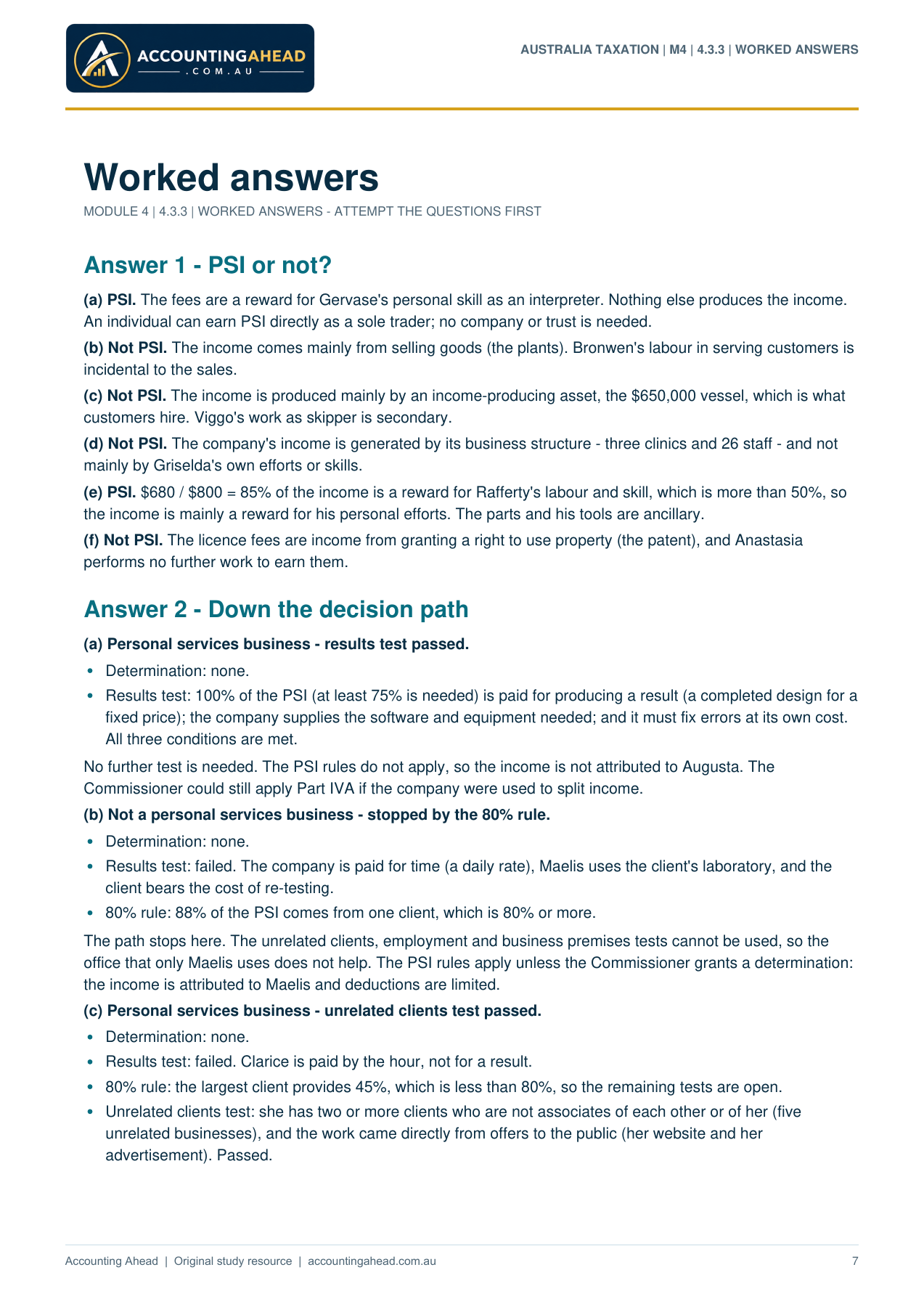
Answer 3 - Quandong Agronomy
(a) Method statement, s 86-20:
Step Working Amount
Step 1: deductions relating to the PSI $20,000 + $6,000 + $10,000 $36,000
Step 2: entity maintenance deductions $2,400
Step 3: other assessable income $3,000
Step 4: Step 2 - Step 3 $2,400 - $3,000 -$600
Attributed to Rosamond $150,000 - $36,000 $114,000
Step 4 is not more than zero, so the PSI is reduced by the Step 1 amount only. Amount attributed to Rosamond
= $150,000 - $36,000 = $114,000. It is included in her assessable income and taxed at her marginal rates.
Left in the company: other income $3,000 - entity maintenance deductions $2,400 - deductions relating to the
interest $200 = $400 of taxable income.
(b) With other assessable income of $900:
Step 4: $2,400 - $900 = $1,500, which is more than zero.
The PSI is reduced by Step 1 + Step 4 = $36,000 + $1,500 = $37,500.
Amount attributed to Rosamond = $150,000 - $37,500 = $112,500.
Left in the company: the $900 of interest is fully absorbed by entity maintenance deductions (the other $1,500
of those deductions has reduced the PSI). The $200 of deductions relating to the interest remains, so the
company has a loss of $200, which stays in the company.
(c) No, neither amount reduces the attributed PSI.
The $9,000 rent relates to Rosamond's own home. Rent, mortgage interest, rates and land tax for the
individual's residence are specifically denied.
The $12,000 is paid to an associate (her brother) for work that is not principal work: answering the telephone
and invoicing are administration. Payments to associates for non-principal work are specifically denied. (Had
he helped with the agronomy work itself, the payment would have been deductible.)
The answers in (a) and (b) are unchanged.
AUSTRALIA TAXATION | M4 | 4.3.3 | WORKED ANSWERS
8