
Employee Share Schemes — study companion
Part 4.3.4 of Australia Taxation. Preview the study companion or download the printable PDF.


Read the handout text
Accounting Ahead | Original study resource | accountingahead.com.au
Employee share schemes
MODULE 4 | 4.3.4 | STUDENT COMPANION
An employee share scheme (ESS) gives employees shares, or rights to acquire shares, usually at a
discount. Division 83A of ITAA97 taxes that discount as income: upfront by default, at a later deferred
taxing point where there is a real risk of forfeiture, or not at all for eligible start-ups. After that, CGT takes
over.
What is taxed
ESS interest. A share, or a right to acquire a share (such as an option), provided to an employee under an
employee share scheme.
The discount. Market value of the interest less the amount the employee pays for it. It is taxed because it is a
reward for work, like a cash bonus.
Route 1: taxed upfront (s 83A-25)
The discount is assessable in the income year the interest is acquired.
The $1,000 reduction (s 83A-35). The first $1,000 of the discount is not taxed if taxable income + reportable
fringe benefits + reportable superannuation contributions + net investment loss is no more than $180,000, and
the scheme conditions (ss 83A-35 and 83A-45) are met:
ordinary shares only
employee works for the company or one of its subsidiaries
offered to at least 75% of permanent employees with 3 or more years of service who are Australian residents
not at real risk of forfeiture
must be held for 3 years or until employment ends
employee does not end up with more than 10% of the shares or voting rights.
AUSTRALIA TAXATION | M4 | 4.3.4 | STUDENT COMPANION
1
Accounting Ahead | Original study resource | accountingahead.com.au
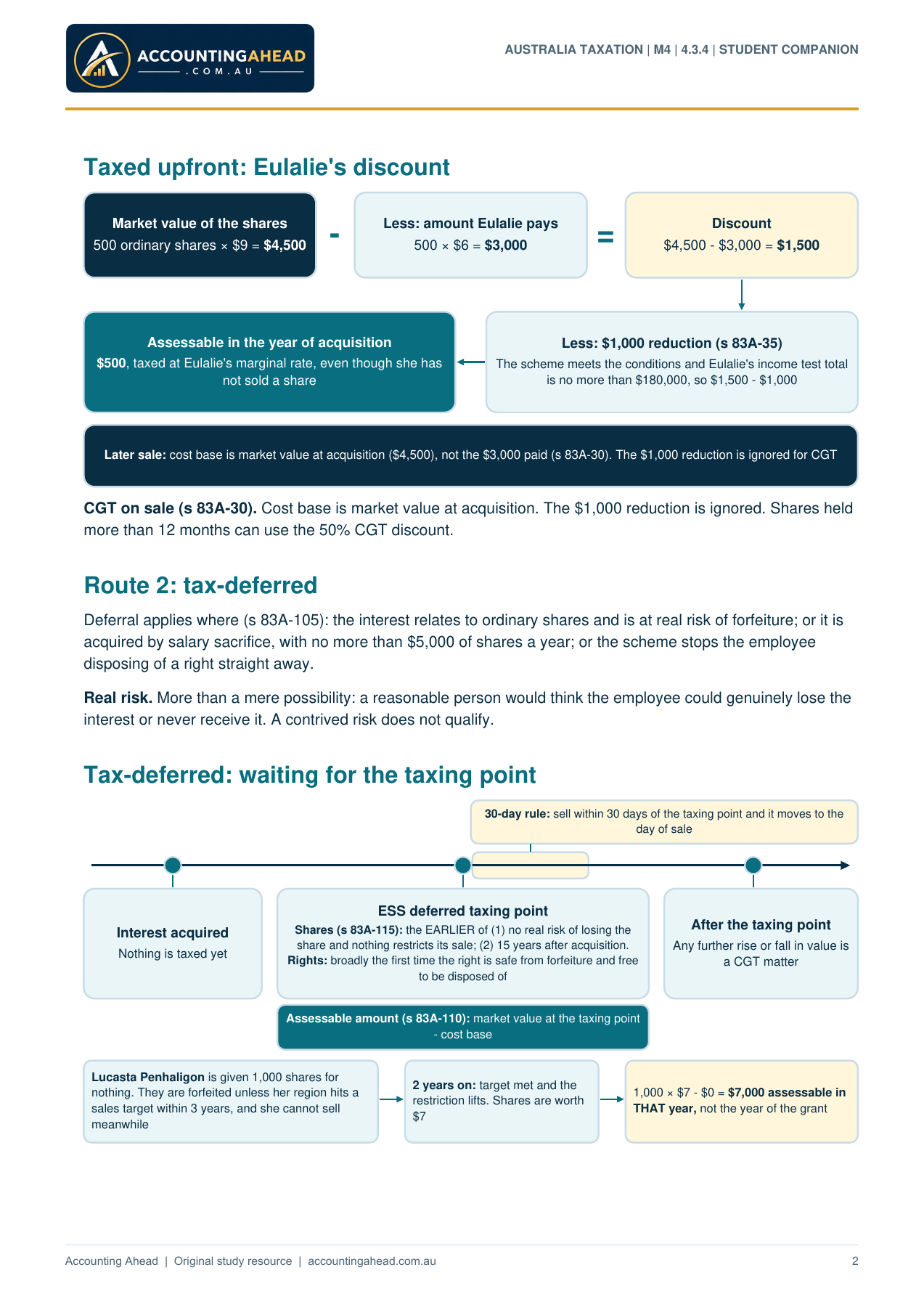
Taxed upfront: Eulalie's discount
Market value of the shares
500 ordinary shares × $9 = $4,500 -
Less: amount Eulalie pays
500 × $6 = $3,000 =
Discount
$4,500 - $3,000 = $1,500
Less: $1,000 reduction (s 83A-35)
The scheme meets the conditions and Eulalie's income test total
is no more than $180,000, so $1,500 - $1,000
Assessable in the year of acquisition
$500, taxed at Eulalie's marginal rate, even though she has
not sold a share
Later sale: cost base is market value at acquisition ($4,500), not the $3,000 paid (s 83A-30). The $1,000 reduction is ignored for CGT
CGT on sale (s 83A-30). Cost base is market value at acquisition. The $1,000 reduction is ignored. Shares held
more than 12 months can use the 50% CGT discount.
Route 2: tax-deferred
Deferral applies where (s 83A-105): the interest relates to ordinary shares and is at real risk of forfeiture; or it is
acquired by salary sacrifice, with no more than $5,000 of shares a year; or the scheme stops the employee
disposing of a right straight away.
Real risk. More than a mere possibility: a reasonable person would think the employee could genuinely lose the
interest or never receive it. A contrived risk does not qualify.
Tax-deferred: waiting for the taxing point
30-day rule: sell within 30 days of the taxing point and it moves to the
day of sale
Interest acquired
Nothing is taxed yet
ESS deferred taxing point
Shares (s 83A-115): the EARLIER of (1) no real risk of losing the
share and nothing restricts its sale; (2) 15 years after acquisition.
Rights: broadly the first time the right is safe from forfeiture and free
to be disposed of
Assessable amount (s 83A-110): market value at the taxing point
- cost base
After the taxing point
Any further rise or fall in value is
a CGT matter
Lucasta Penhaligon is given 1,000 shares for
nothing. They are forfeited unless her region hits a
sales target within 3 years, and she cannot sell
meanwhile
2 years on: target met and the
restriction lifts. Shares are worth
$7
1,000 × $7 - $0 = $7,000 assessable in
THAT year, not the year of the grant
AUSTRALIA TAXATION | M4 | 4.3.4 | STUDENT COMPANION
2
Accounting Ahead | Original study resource | accountingahead.com.au
Route 3: start-ups (s 83A-33)
For interests acquired on or after 1 July 2015, the discount is not assessable if the company is unlisted, an
Australian resident, incorporated less than 10 years, and had aggregated turnover below $50 million in the
previous income year. A share's discount must not exceed 15% of market value; a right's exercise price must be
at least the share's market value when the right is acquired. CGT applies on sale with a cost base of market
value. For shares from exercising rights, the 12 months for the CGT discount runs from acquisition of the rights
(item 9A, s 115-30).
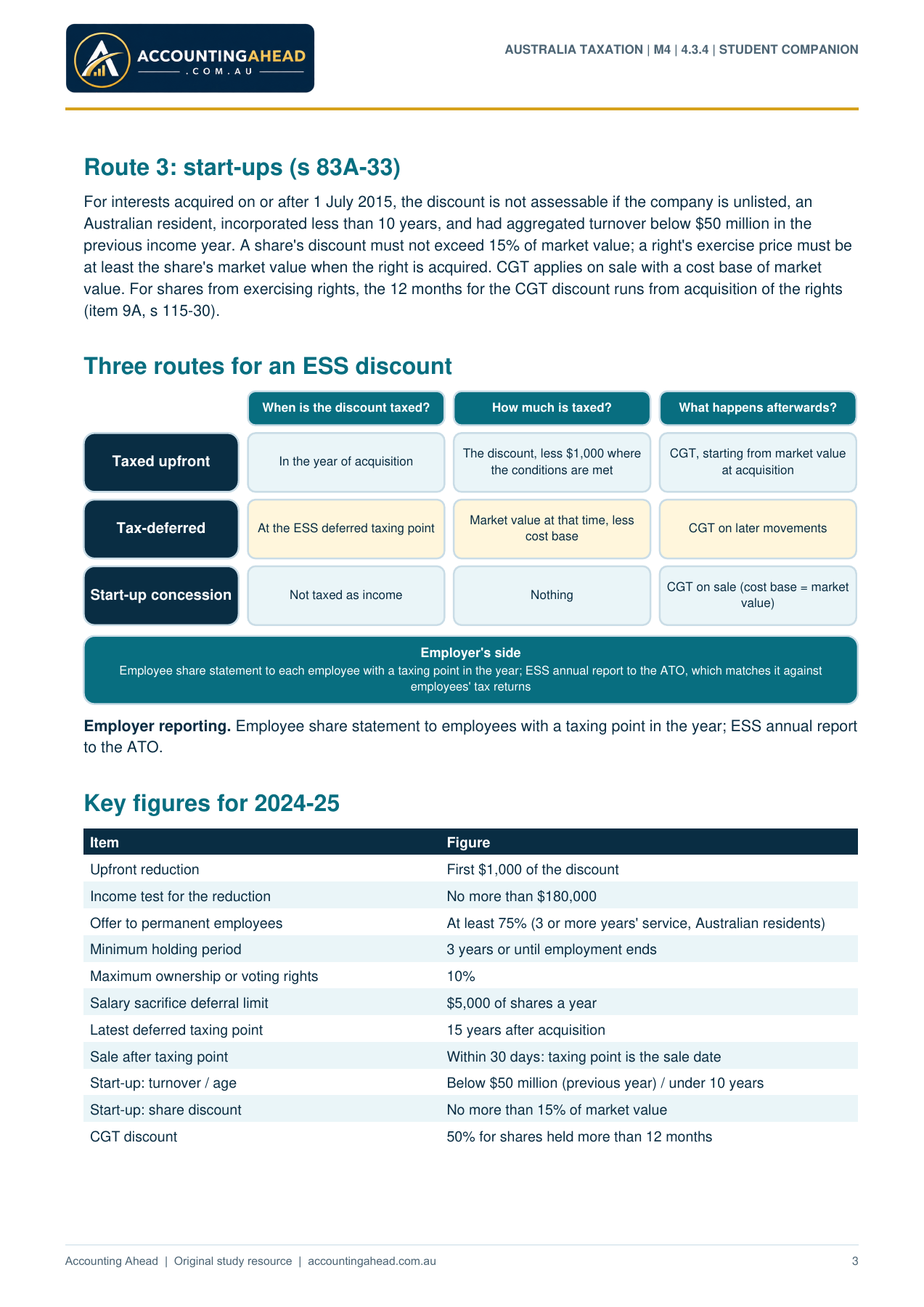
Three routes for an ESS discount
When is the discount taxed? How much is taxed? What happens afterwards?
Taxed upfront In the year of acquisition The discount, less $1,000 where
the conditions are met
CGT, starting from market value
at acquisition
Tax-deferred At the ESS deferred taxing point Market value at that time, less
cost base CGT on later movements
Start-up concession Not taxed as income Nothing CGT on sale (cost base = market
value)
Employer's side
Employee share statement to each employee with a taxing point in the year; ESS annual report to the ATO, which matches it against
employees' tax returns
Employer reporting. Employee share statement to employees with a taxing point in the year; ESS annual report
to the ATO.
Key figures for 2024-25
Item Figure
Upfront reduction First $1,000 of the discount
Income test for the reduction No more than $180,000
Offer to permanent employees At least 75% (3 or more years' service, Australian residents)
Minimum holding period 3 years or until employment ends
Maximum ownership or voting rights 10%
Salary sacrifice deferral limit $5,000 of shares a year
Latest deferred taxing point 15 years after acquisition
Sale after taxing point Within 30 days: taxing point is the sale date
Start-up: turnover / age Below $50 million (previous year) / under 10 years
Start-up: share discount No more than 15% of market value
CGT discount 50% for shares held more than 12 months
AUSTRALIA TAXATION | M4 | 4.3.4 | STUDENT COMPANION
3
Accounting Ahead | Original study resource | accountingahead.com.au
Practice questions
MODULE 4 | 4.3.4 | TRY THESE BEFORE THE WORKED ANSWERS
Question 1 - Same offer, different results
Tarrawingee Freight Ltd, a listed company, runs an employee share scheme that meets every condition in ss
83A-35 and 83A-45, and the shares are not at real risk of forfeiture. In October 2024 it lets two colleagues,
Aurelie Okonkwo and Tancredi Wardlow, each buy 800 ordinary shares for $5.00 each when the market value is
$7.50 a share. Their figures for the 2024-25 income year are:
Item Aurelie Tancredi
Taxable income $95,000 $170,000
Reportable fringe benefits $0 $8,000
Reportable superannuation contributions $4,000 $5,000
Net investment loss $2,000 $0
(a) How much does each colleague include in assessable income for 2024-25 in respect of the shares?
(b) In April 2028 Aurelie sells all 800 shares for $9,000. She has no capital losses. Calculate her net capital gain.
AUSTRALIA TAXATION | M4 | 4.3.4 | STUDENT COMPANION
4
Accounting Ahead | Original study resource | accountingahead.com.au
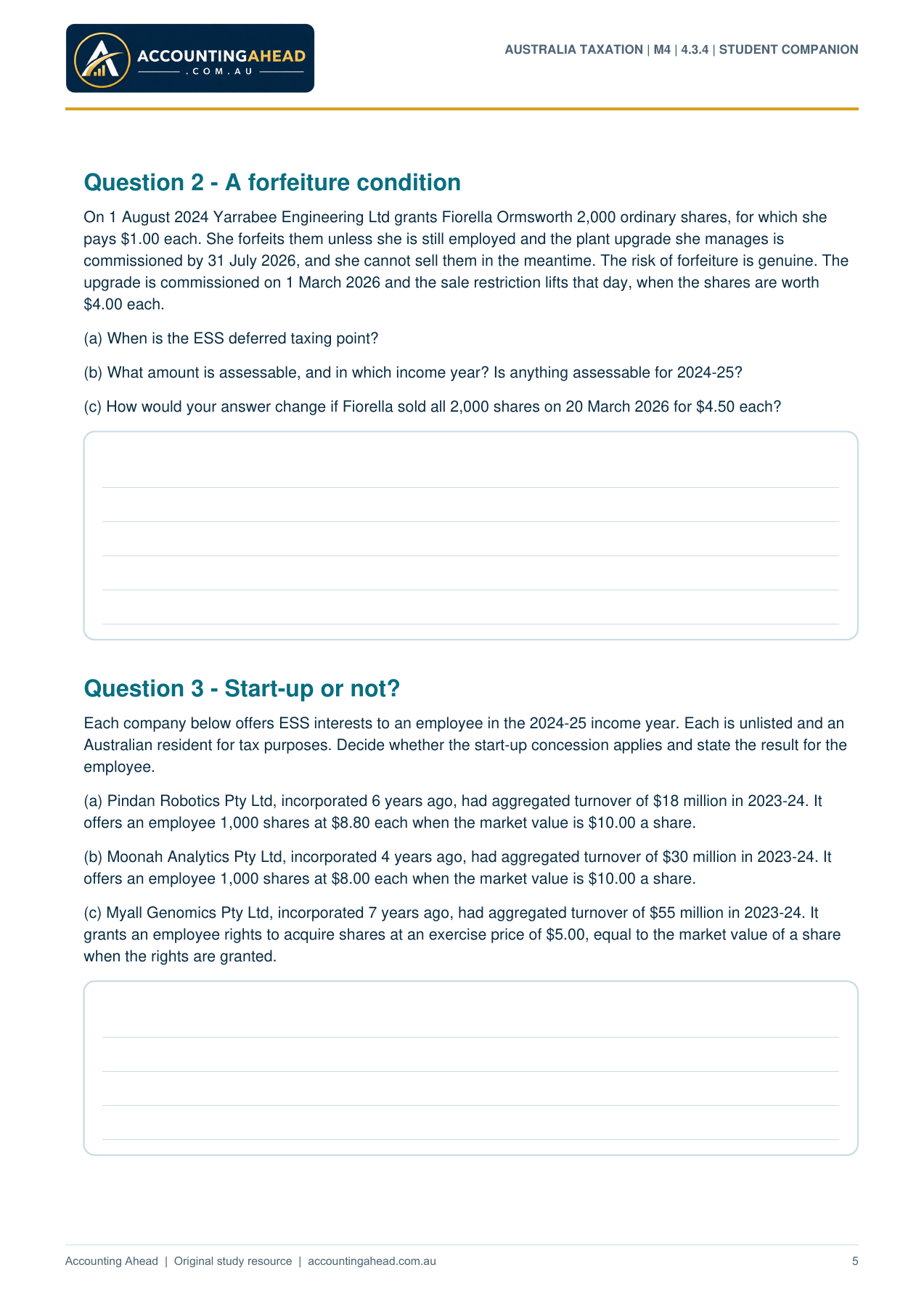
Question 2 - A forfeiture condition
On 1 August 2024 Yarrabee Engineering Ltd grants Fiorella Ormsworth 2,000 ordinary shares, for which she
pays $1.00 each. She forfeits them unless she is still employed and the plant upgrade she manages is
commissioned by 31 July 2026, and she cannot sell them in the meantime. The risk of forfeiture is genuine. The
upgrade is commissioned on 1 March 2026 and the sale restriction lifts that day, when the shares are worth
$4.00 each.
(a) When is the ESS deferred taxing point?
(b) What amount is assessable, and in which income year? Is anything assessable for 2024-25?
(c) How would your answer change if Fiorella sold all 2,000 shares on 20 March 2026 for $4.50 each?
Question 3 - Start-up or not?
Each company below offers ESS interests to an employee in the 2024-25 income year. Each is unlisted and an
Australian resident for tax purposes. Decide whether the start-up concession applies and state the result for the
employee.
(a) Pindan Robotics Pty Ltd, incorporated 6 years ago, had aggregated turnover of $18 million in 2023-24. It
offers an employee 1,000 shares at $8.80 each when the market value is $10.00 a share.
(b) Moonah Analytics Pty Ltd, incorporated 4 years ago, had aggregated turnover of $30 million in 2023-24. It
offers an employee 1,000 shares at $8.00 each when the market value is $10.00 a share.
(c) Myall Genomics Pty Ltd, incorporated 7 years ago, had aggregated turnover of $55 million in 2023-24. It
grants an employee rights to acquire shares at an exercise price of $5.00, equal to the market value of a share
when the rights are granted.
AUSTRALIA TAXATION | M4 | 4.3.4 | STUDENT COMPANION
5
Accounting Ahead | Original study resource | accountingahead.com.au
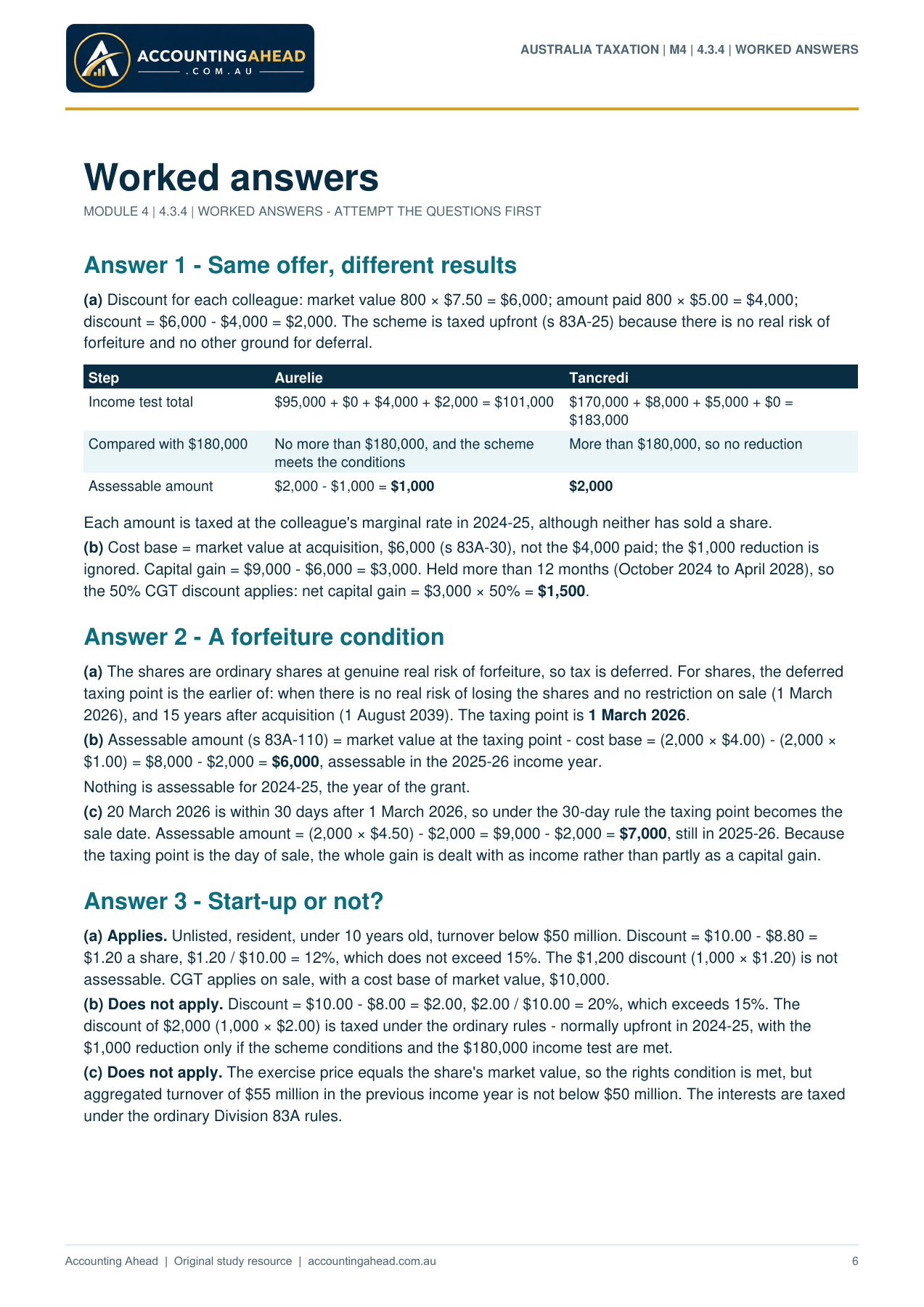
Worked answers
MODULE 4 | 4.3.4 | WORKED ANSWERS - ATTEMPT THE QUESTIONS FIRST
Answer 1 - Same offer, different results
(a) Discount for each colleague: market value 800 × $7.50 = $6,000; amount paid 800 × $5.00 = $4,000;
discount = $6,000 - $4,000 = $2,000. The scheme is taxed upfront (s 83A-25) because there is no real risk of
forfeiture and no other ground for deferral.
Step Aurelie Tancredi
Income test total $95,000 + $0 + $4,000 + $2,000 = $101,000 $170,000 + $8,000 + $5,000 + $0 =
$183,000
Compared with $180,000 No more than $180,000, and the scheme
meets the conditions
More than $180,000, so no reduction
Assessable amount $2,000 - $1,000 = $1,000 $2,000
Each amount is taxed at the colleague's marginal rate in 2024-25, although neither has sold a share.
(b) Cost base = market value at acquisition, $6,000 (s 83A-30), not the $4,000 paid; the $1,000 reduction is
ignored. Capital gain = $9,000 - $6,000 = $3,000. Held more than 12 months (October 2024 to April 2028), so
the 50% CGT discount applies: net capital gain = $3,000 × 50% = $1,500.
Answer 2 - A forfeiture condition
(a) The shares are ordinary shares at genuine real risk of forfeiture, so tax is deferred. For shares, the deferred
taxing point is the earlier of: when there is no real risk of losing the shares and no restriction on sale (1 March
2026), and 15 years after acquisition (1 August 2039). The taxing point is 1 March 2026.
(b) Assessable amount (s 83A-110) = market value at the taxing point - cost base = (2,000 × $4.00) - (2,000 ×
$1.00) = $8,000 - $2,000 = $6,000, assessable in the 2025-26 income year.
Nothing is assessable for 2024-25, the year of the grant.
(c) 20 March 2026 is within 30 days after 1 March 2026, so under the 30-day rule the taxing point becomes the
sale date. Assessable amount = (2,000 × $4.50) - $2,000 = $9,000 - $2,000 = $7,000, still in 2025-26. Because
the taxing point is the day of sale, the whole gain is dealt with as income rather than partly as a capital gain.
Answer 3 - Start-up or not?
(a) Applies. Unlisted, resident, under 10 years old, turnover below $50 million. Discount = $10.00 - $8.80 =
$1.20 a share, $1.20 / $10.00 = 12%, which does not exceed 15%. The $1,200 discount (1,000 × $1.20) is not
assessable. CGT applies on sale, with a cost base of market value, $10,000.
(b) Does not apply. Discount = $10.00 - $8.00 = $2.00, $2.00 / $10.00 = 20%, which exceeds 15%. The
discount of $2,000 (1,000 × $2.00) is taxed under the ordinary rules - normally upfront in 2024-25, with the
$1,000 reduction only if the scheme conditions and the $180,000 income test are met.
(c) Does not apply. The exercise price equals the share's market value, so the rights condition is met, but
aggregated turnover of $55 million in the previous income year is not below $50 million. The interests are taxed
under the ordinary Division 83A rules.
AUSTRALIA TAXATION | M4 | 4.3.4 | WORKED ANSWERS
6