
Super Benefits and Transition to Retirement — study companion
Part 4.5.2 of Australia Taxation. Preview the study companion or download the printable PDF.


Read the handout text
Accounting Ahead | Original study resource | accountingahead.com.au
Super benefits and transition to retirement
MODULE 4 | 4.5.2 | STUDENT COMPANION
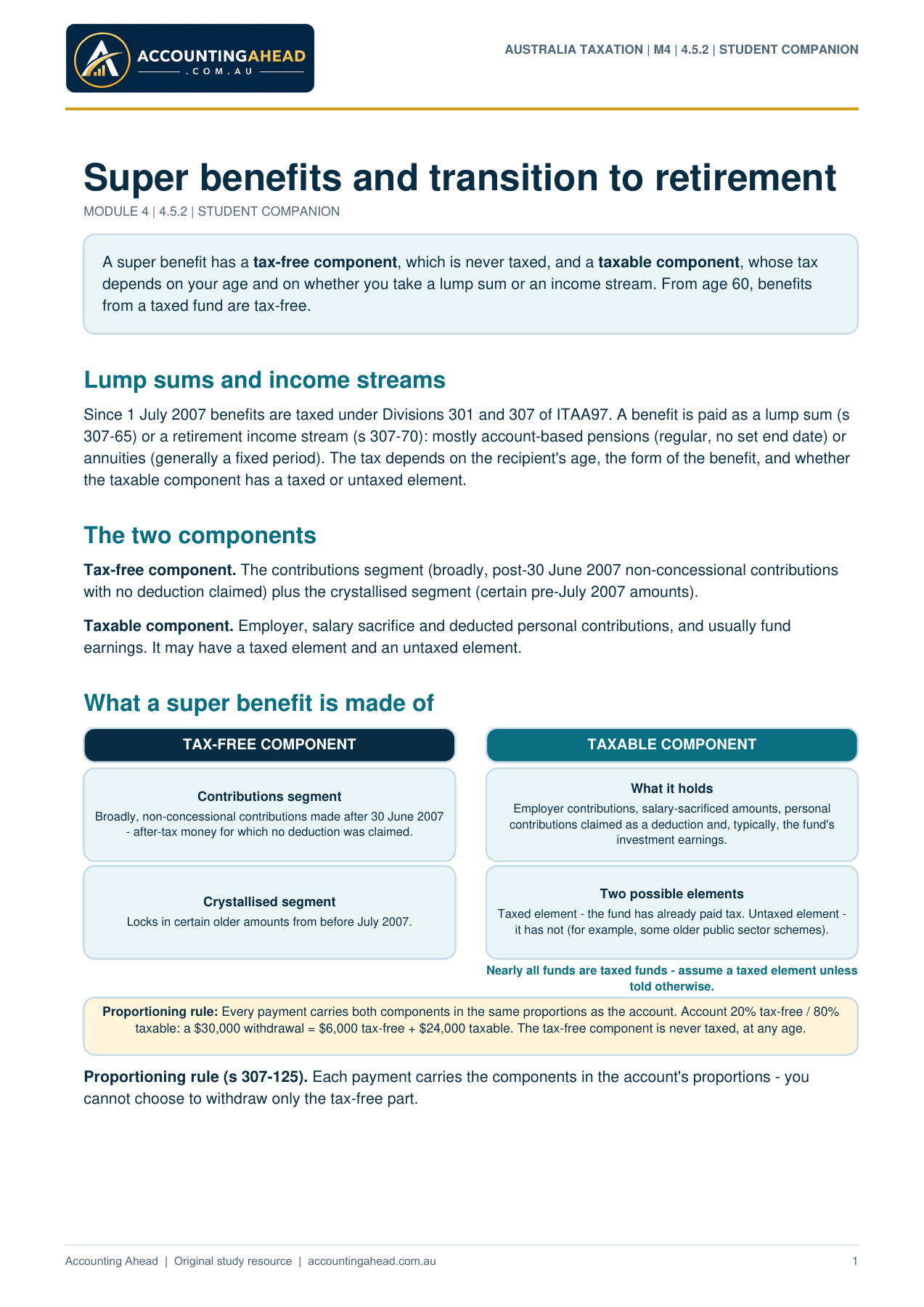
A super benefit has a tax-free component, which is never taxed, and a taxable component, whose tax
depends on your age and on whether you take a lump sum or an income stream. From age 60, benefits
from a taxed fund are tax-free.
Lump sums and income streams
Since 1 July 2007 benefits are taxed under Divisions 301 and 307 of ITAA97. A benefit is paid as a lump sum (s
307-65) or a retirement income stream (s 307-70): mostly account-based pensions (regular, no set end date) or
annuities (generally a fixed period). The tax depends on the recipient's age, the form of the benefit, and whether
the taxable component has a taxed or untaxed element.
The two components
Tax-free component. The contributions segment (broadly, post-30 June 2007 non-concessional contributions
with no deduction claimed) plus the crystallised segment (certain pre-July 2007 amounts).
Taxable component. Employer, salary sacrifice and deducted personal contributions, and usually fund
earnings. It may have a taxed element and an untaxed element.
What a super benefit is made of
TAX-FREE COMPONENT
Contributions segment
Broadly, non-concessional contributions made after 30 June 2007
- after-tax money for which no deduction was claimed.
Crystallised segment
Locks in certain older amounts from before July 2007.
TAXABLE COMPONENT
What it holds
Employer contributions, salary-sacrificed amounts, personal
contributions claimed as a deduction and, typically, the fund's
investment earnings.
Two possible elements
Taxed element - the fund has already paid tax. Untaxed element -
it has not (for example, some older public sector schemes).
Nearly all funds are taxed funds - assume a taxed element unless
told otherwise.
Proportioning rule: Every payment carries both components in the same proportions as the account. Account 20% tax-free / 80%
taxable: a $30,000 withdrawal = $6,000 tax-free + $24,000 taxable. The tax-free component is never taxed, at any age.
Proportioning rule (s 307-125). Each payment carries the components in the account's proportions - you
cannot choose to withdraw only the tax-free part.
AUSTRALIA TAXATION | M4 | 4.5.2 | STUDENT COMPANION
1
Accounting Ahead | Original study resource | accountingahead.com.au
Age: preservation age and 60
Preservation age is 55 to 60 depending on date of birth, tested at the end of the income year of payment.
Lump sums from a taxed fund: three age bands
Preservation age (by date of birth): born before 1 July 1960: 55 | rising one year at a time | born after 30 June 1964: 60. Tested at the end of the
income year in which the payment is received.
Band 1: Under preservation age
Released only in very limited
circumstances, such as permanent
incapacity or severe financial hardship.
Taxable component: assessable, taxed
at 20% plus Medicare levy, or the
marginal rate if lower.
Fabian Brisbourne, 48
$30,000 released on compassionate
grounds, $24,000 taxable. Maximum:
$24,000 x 20% = $4,800 + Medicare levy
$24,000 x 2% = $480. Total $5,280.
Band 2: Preservation age to 59
Taxable component taxed at nil up to the low rate cap of
$245,000 (2024-25) - a lifetime cap. Above it: 15% plus
Medicare levy, or the marginal rate if lower.
Calista Osgood, retired, under 60
First lump sum: $200,000 taxable - nil tax, uses $200,000 of
the cap. Second lump sum: $100,000 taxable. Cap left
$245,000 - $200,000 = $45,000. Taxed amount $100,000 -
$45,000 = $55,000. Maximum: $55,000 x 15% = $8,250 +
$55,000 x 2% = $1,100. Total $9,350.
Band 3: Aged 60 and over
From a taxed fund, lump sum
or income stream: tax-free -
non-assessable non-exempt
income (s 301-10). Exception:
an untaxed element of a lump
sum is taxed at 15% or the
marginal rate if lower, up to
the untaxed plan cap of $1.78
million.
For 2024-25 this band is closing - everyone born after 30 June 1964 has a preservation age of 60. Apply the rules to the facts you are
given.
Age when paid (taxed fund, lump sum) Taxable component
Under preservation age 20% plus Medicare levy, or marginal rate if lower
Preservation age to 59 Nil up to $245,000 lifetime low rate cap; then 15% plus Medicare
levy, or marginal rate if lower
60 and over Tax-free (non-assessable non-exempt income)
Transition to retirement
A transition to retirement income stream lets you draw on super while still working - to reduce your hours, or to
salary sacrifice more.
AUSTRALIA TAXATION | M4 | 4.5.2 | STUDENT COMPANION
2
Accounting Ahead | Original study resource | accountingahead.com.au
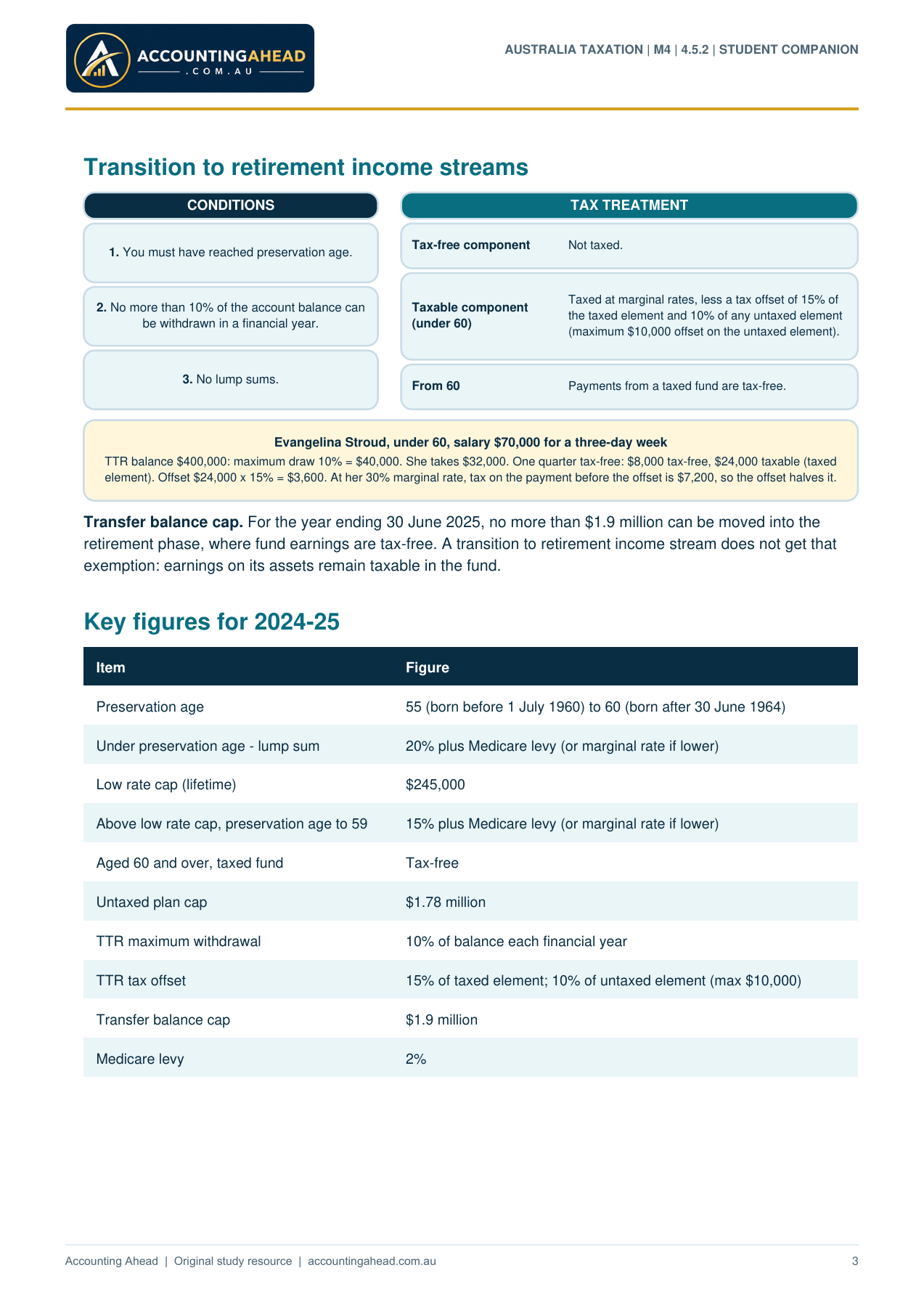
Transition to retirement income streams
CONDITIONS TAX TREATMENT
1. You must have reached preservation age.
2. No more than 10% of the account balance can
be withdrawn in a financial year.
3. No lump sums.
Tax-free component Not taxed.
Taxable component
(under 60)
Taxed at marginal rates, less a tax offset of 15% of
the taxed element and 10% of any untaxed element
(maximum $10,000 offset on the untaxed element).
From 60 Payments from a taxed fund are tax-free.
Evangelina Stroud, under 60, salary $70,000 for a three-day week
TTR balance $400,000: maximum draw 10% = $40,000. She takes $32,000. One quarter tax-free: $8,000 tax-free, $24,000 taxable (taxed
element). Offset $24,000 x 15% = $3,600. At her 30% marginal rate, tax on the payment before the offset is $7,200, so the offset halves it.
Transfer balance cap. For the year ending 30 June 2025, no more than $1.9 million can be moved into the
retirement phase, where fund earnings are tax-free. A transition to retirement income stream does not get that
exemption: earnings on its assets remain taxable in the fund.
Key figures for 2024-25
Item Figure
Preservation age 55 (born before 1 July 1960) to 60 (born after 30 June 1964)
Under preservation age - lump sum 20% plus Medicare levy (or marginal rate if lower)
Low rate cap (lifetime) $245,000
Above low rate cap, preservation age to 59 15% plus Medicare levy (or marginal rate if lower)
Aged 60 and over, taxed fund Tax-free
Untaxed plan cap $1.78 million
TTR maximum withdrawal 10% of balance each financial year
TTR tax offset 15% of taxed element; 10% of untaxed element (max $10,000)
Transfer balance cap $1.9 million
Medicare levy 2%
AUSTRALIA TAXATION | M4 | 4.5.2 | STUDENT COMPANION
3
Accounting Ahead | Original study resource | accountingahead.com.au
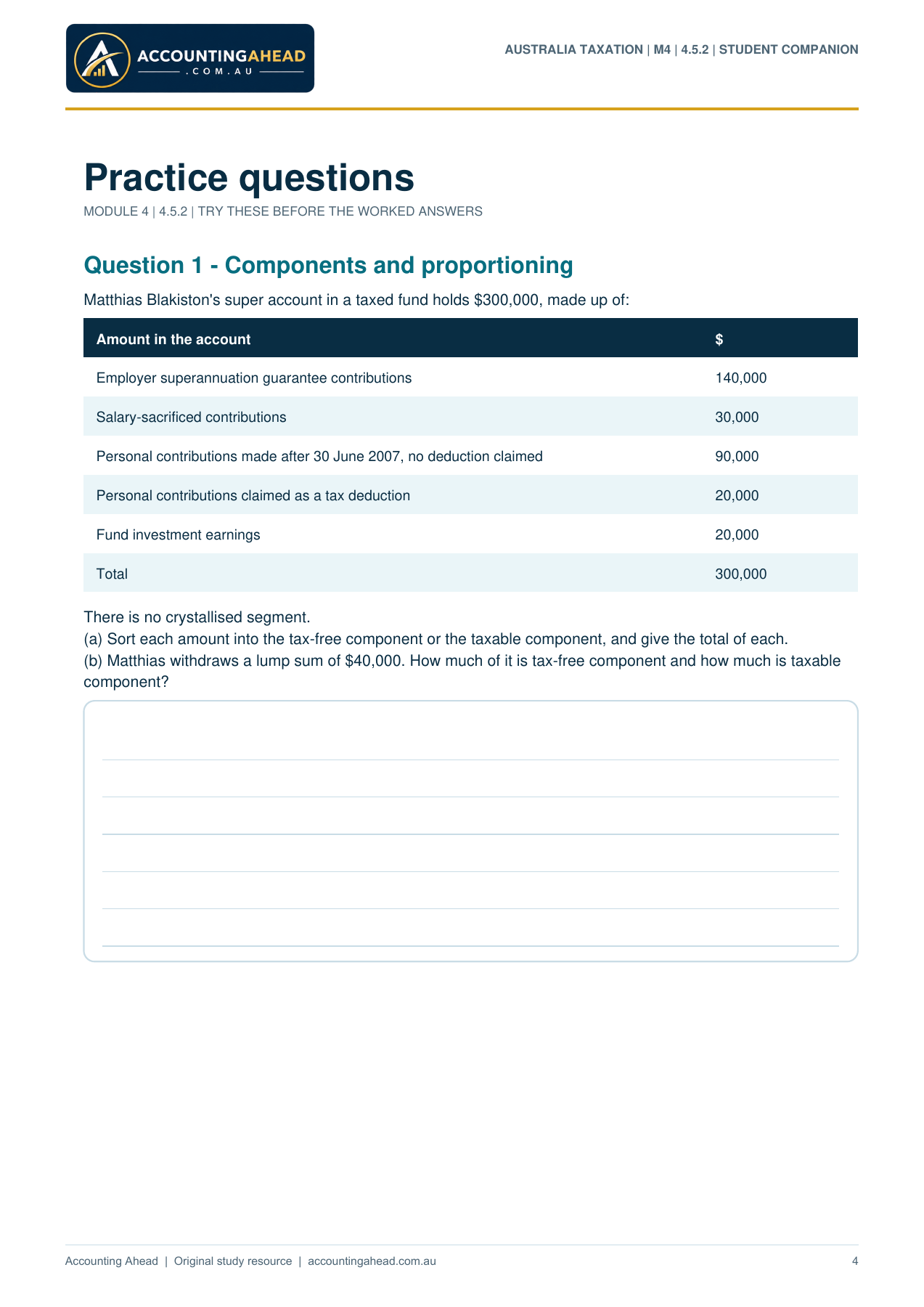
Practice questions
MODULE 4 | 4.5.2 | TRY THESE BEFORE THE WORKED ANSWERS
Question 1 - Components and proportioning
Matthias Blakiston's super account in a taxed fund holds $300,000, made up of:
Amount in the account $
Employer superannuation guarantee contributions 140,000
Salary-sacrificed contributions 30,000
Personal contributions made after 30 June 2007, no deduction claimed 90,000
Personal contributions claimed as a tax deduction 20,000
Fund investment earnings 20,000
Total 300,000
There is no crystallised segment.
(a) Sort each amount into the tax-free component or the taxable component, and give the total of each.
(b) Matthias withdraws a lump sum of $40,000. How much of it is tax-free component and how much is taxable
component?
AUSTRALIA TAXATION | M4 | 4.5.2 | STUDENT COMPANION
4
Accounting Ahead | Original study resource | accountingahead.com.au
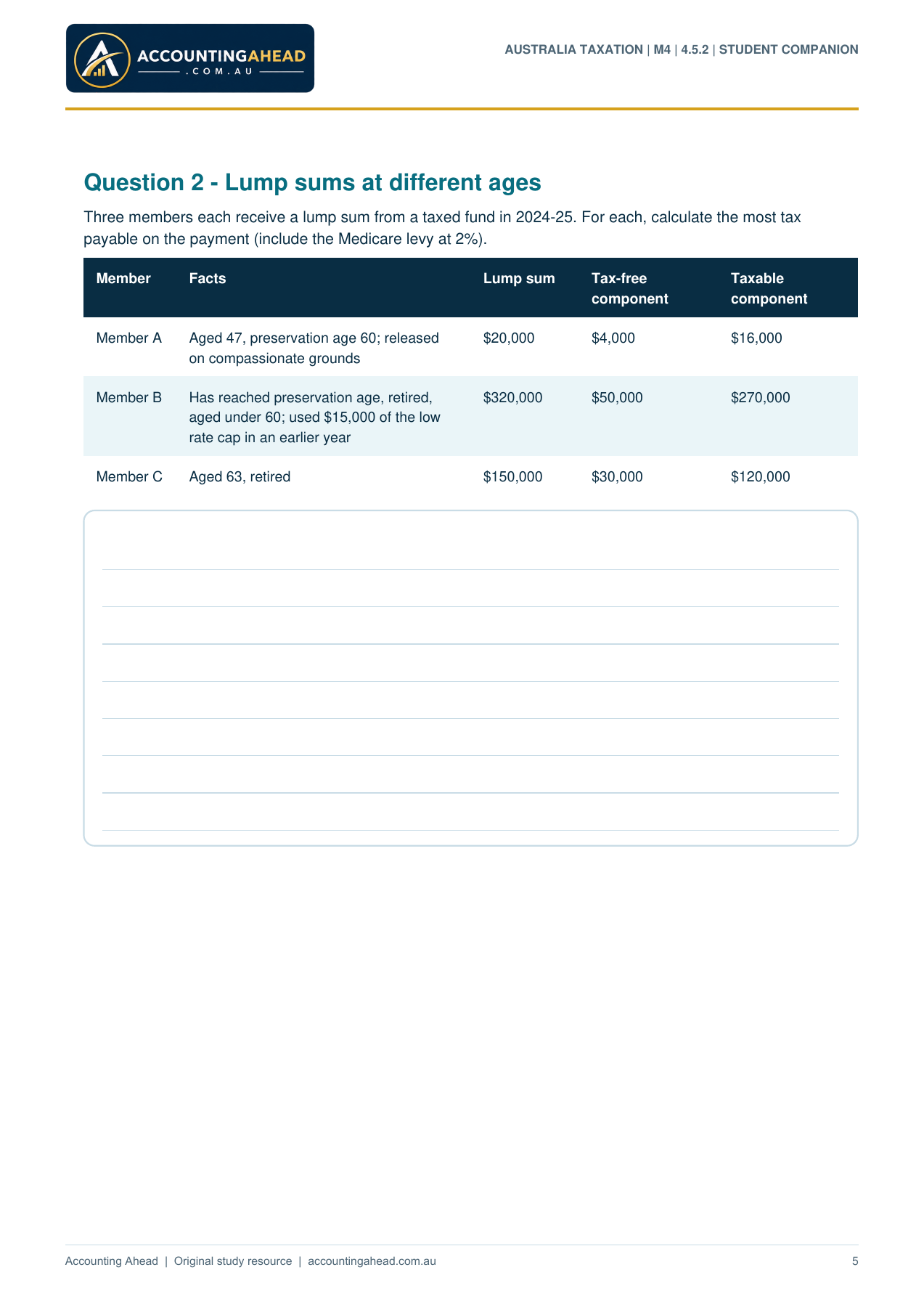
Question 2 - Lump sums at different ages
Three members each receive a lump sum from a taxed fund in 2024-25. For each, calculate the most tax
payable on the payment (include the Medicare levy at 2%).
Member Facts Lump sum Tax-free
component
Taxable
component
Member A Aged 47, preservation age 60; released
on compassionate grounds
$20,000 $4,000 $16,000
Member B Has reached preservation age, retired,
aged under 60; used $15,000 of the low
rate cap in an earlier year
$320,000 $50,000 $270,000
Member C Aged 63, retired $150,000 $30,000 $120,000
AUSTRALIA TAXATION | M4 | 4.5.2 | STUDENT COMPANION
5
Accounting Ahead | Original study resource | accountingahead.com.au
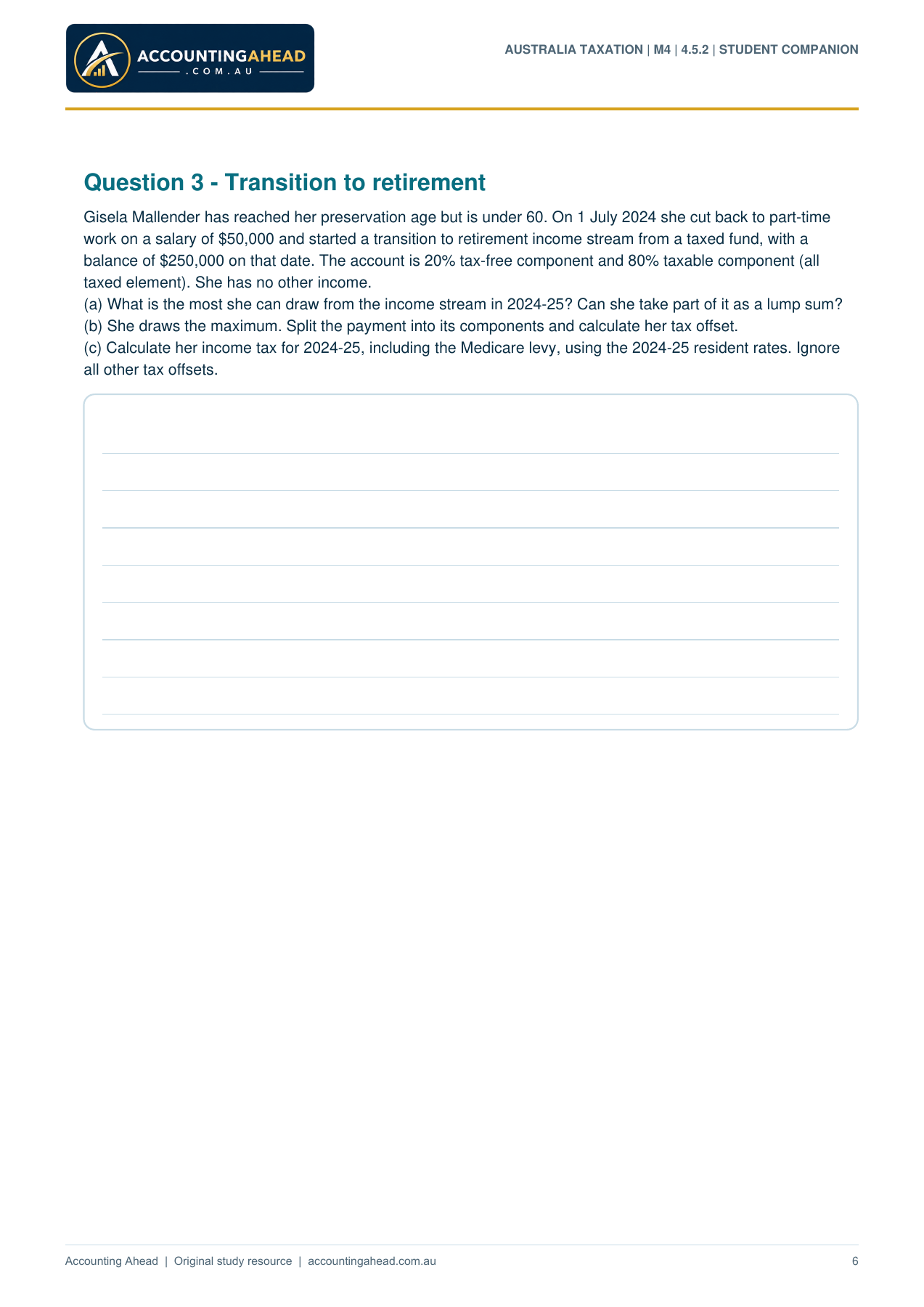
Question 3 - Transition to retirement
Gisela Mallender has reached her preservation age but is under 60. On 1 July 2024 she cut back to part-time
work on a salary of $50,000 and started a transition to retirement income stream from a taxed fund, with a
balance of $250,000 on that date. The account is 20% tax-free component and 80% taxable component (all
taxed element). She has no other income.
(a) What is the most she can draw from the income stream in 2024-25? Can she take part of it as a lump sum?
(b) She draws the maximum. Split the payment into its components and calculate her tax offset.
(c) Calculate her income tax for 2024-25, including the Medicare levy, using the 2024-25 resident rates. Ignore
all other tax offsets.
AUSTRALIA TAXATION | M4 | 4.5.2 | STUDENT COMPANION
6
Accounting Ahead | Original study resource | accountingahead.com.au
Worked answers
MODULE 4 | 4.5.2 | WORKED ANSWERS - ATTEMPT THE QUESTIONS FIRST
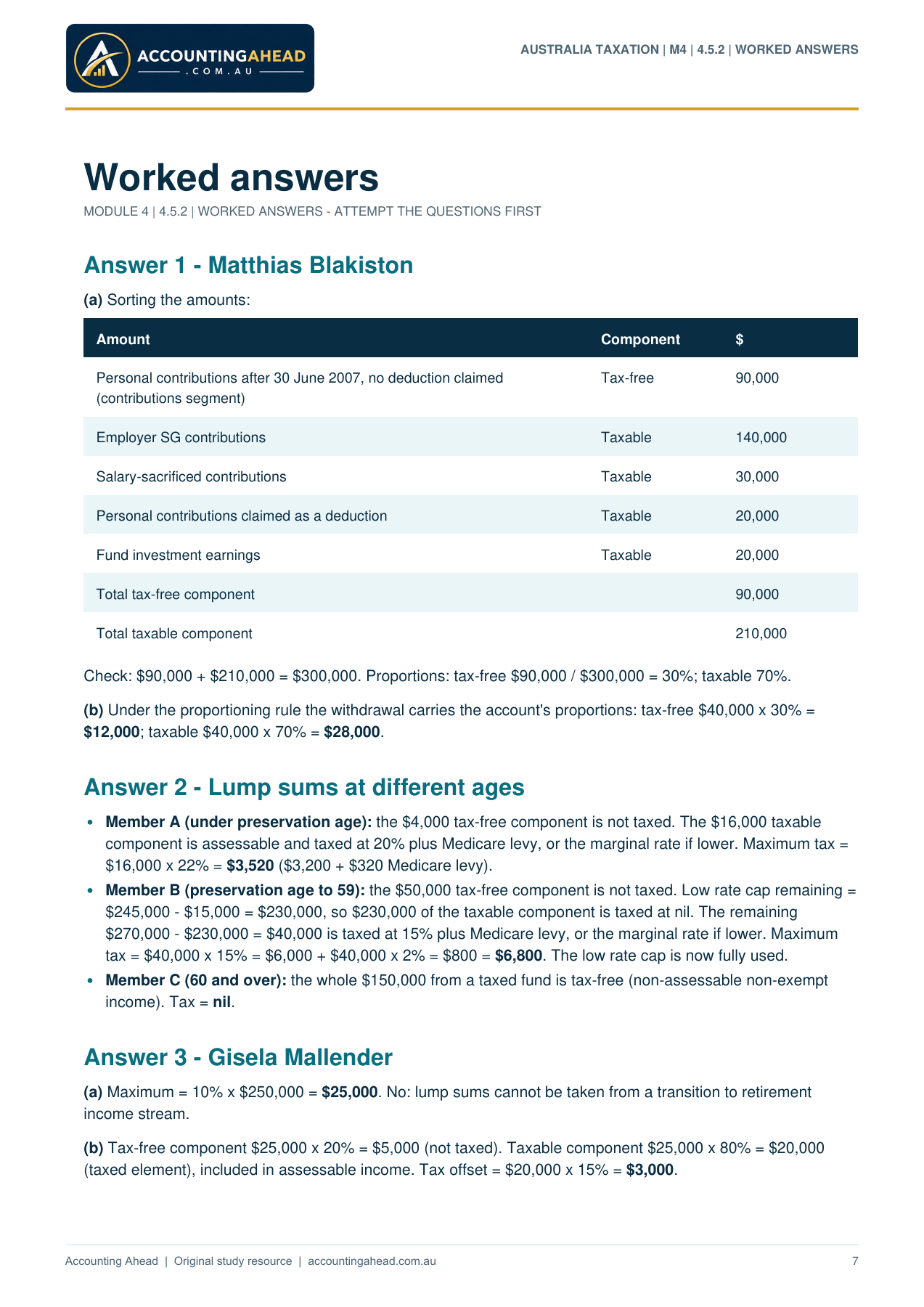
Answer 1 - Matthias Blakiston
(a) Sorting the amounts:
Amount Component $
Personal contributions after 30 June 2007, no deduction claimed
(contributions segment)
Tax-free 90,000
Employer SG contributions Taxable 140,000
Salary-sacrificed contributions Taxable 30,000
Personal contributions claimed as a deduction Taxable 20,000
Fund investment earnings Taxable 20,000
Total tax-free component 90,000
Total taxable component 210,000
Check: $90,000 + $210,000 = $300,000. Proportions: tax-free $90,000 / $300,000 = 30%; taxable 70%.
(b) Under the proportioning rule the withdrawal carries the account's proportions: tax-free $40,000 x 30% =
$12,000; taxable $40,000 x 70% = $28,000.
Answer 2 - Lump sums at different ages
Member A (under preservation age): the $4,000 tax-free component is not taxed. The $16,000 taxable
component is assessable and taxed at 20% plus Medicare levy, or the marginal rate if lower. Maximum tax =
$16,000 x 22% = $3,520 ($3,200 + $320 Medicare levy).
Member B (preservation age to 59): the $50,000 tax-free component is not taxed. Low rate cap remaining =
$245,000 - $15,000 = $230,000, so $230,000 of the taxable component is taxed at nil. The remaining
$270,000 - $230,000 = $40,000 is taxed at 15% plus Medicare levy, or the marginal rate if lower. Maximum
tax = $40,000 x 15% = $6,000 + $40,000 x 2% = $800 = $6,800. The low rate cap is now fully used.
Member C (60 and over): the whole $150,000 from a taxed fund is tax-free (non-assessable non-exempt
income). Tax = nil.
Answer 3 - Gisela Mallender
(a) Maximum = 10% x $250,000 = $25,000. No: lump sums cannot be taken from a transition to retirement
income stream.
(b) Tax-free component $25,000 x 20% = $5,000 (not taxed). Taxable component $25,000 x 80% = $20,000
(taxed element), included in assessable income. Tax offset = $20,000 x 15% = $3,000.
AUSTRALIA TAXATION | M4 | 4.5.2 | WORKED ANSWERS
7
Accounting Ahead | Original study resource | accountingahead.com.au
(c) Her income tax for 2024-25:
Step Working Amount
Taxable income $50,000 + $20,000 $70,000
Tax on $70,000 $4,288 + 30% x ($70,000 - $45,000) = $4,288 + $7,500 $11,788
Less TTR tax offset $11,788 - $3,000 $8,788
Add Medicare levy $70,000 x 2% $1,400
Total $8,788 + $1,400 $10,188
AUSTRALIA TAXATION | M4 | 4.5.2 | WORKED ANSWERS
8