
Allowable Deductions for Individuals — study companion
Part 4.6 of Australia Taxation. Preview the study companion or download the printable PDF.


Read the handout text
Accounting Ahead | Original study resource | accountingahead.com.au
Allowable deductions for individuals
MODULE 4 | 4.6 | STUDENT COMPANION
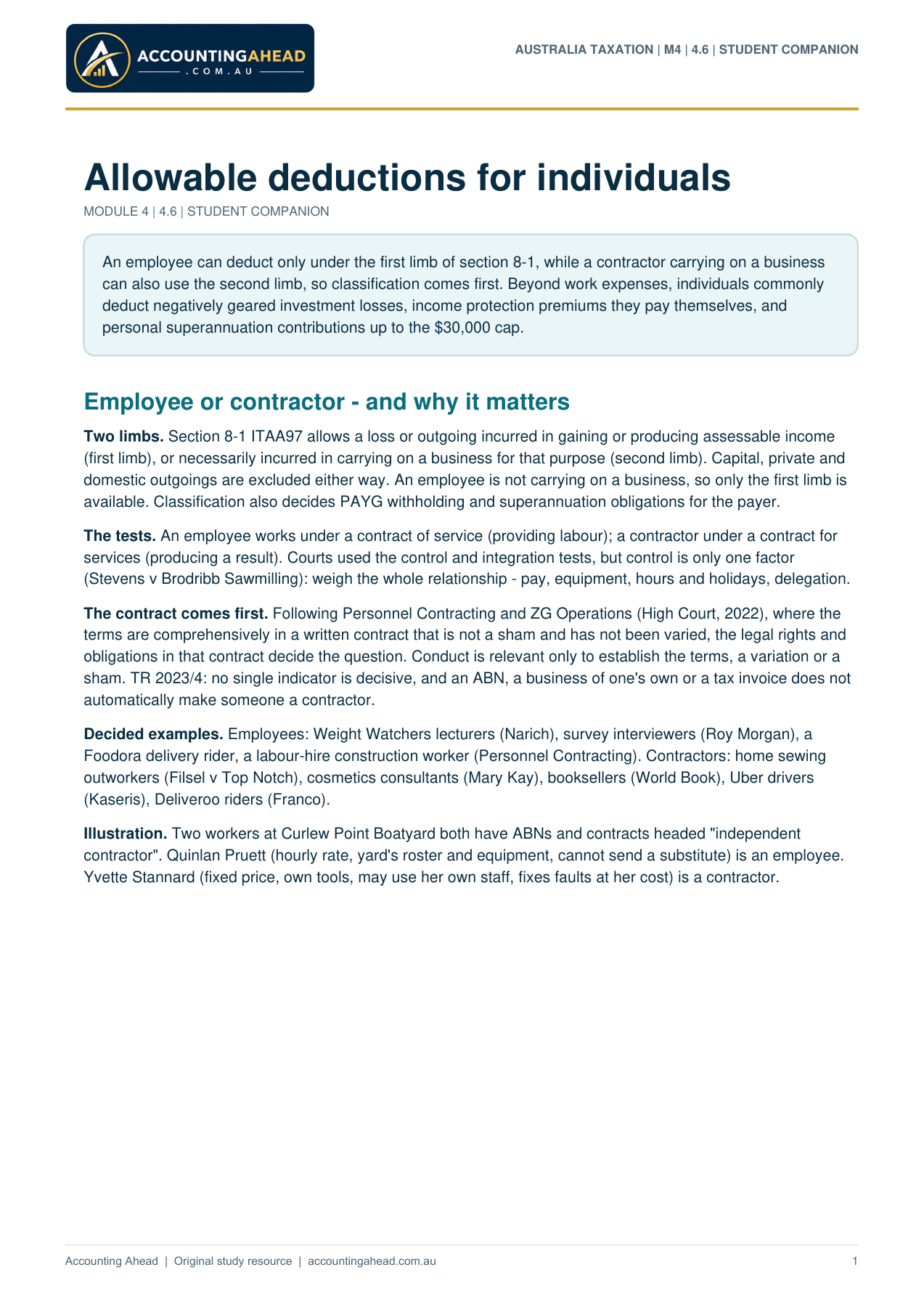
An employee can deduct only under the first limb of section 8-1, while a contractor carrying on a business
can also use the second limb, so classification comes first. Beyond work expenses, individuals commonly
deduct negatively geared investment losses, income protection premiums they pay themselves, and
personal superannuation contributions up to the $30,000 cap.
Employee or contractor - and why it matters
Two limbs. Section 8-1 ITAA97 allows a loss or outgoing incurred in gaining or producing assessable income
(first limb), or necessarily incurred in carrying on a business for that purpose (second limb). Capital, private and
domestic outgoings are excluded either way. An employee is not carrying on a business, so only the first limb is
available. Classification also decides PAYG withholding and superannuation obligations for the payer.
The tests. An employee works under a contract of service (providing labour); a contractor under a contract for
services (producing a result). Courts used the control and integration tests, but control is only one factor
(Stevens v Brodribb Sawmilling): weigh the whole relationship - pay, equipment, hours and holidays, delegation.
The contract comes first. Following Personnel Contracting and ZG Operations (High Court, 2022), where the
terms are comprehensively in a written contract that is not a sham and has not been varied, the legal rights and
obligations in that contract decide the question. Conduct is relevant only to establish the terms, a variation or a
sham. TR 2023/4: no single indicator is decisive, and an ABN, a business of one's own or a tax invoice does not
automatically make someone a contractor.
Decided examples. Employees: Weight Watchers lecturers (Narich), survey interviewers (Roy Morgan), a
Foodora delivery rider, a labour-hire construction worker (Personnel Contracting). Contractors: home sewing
outworkers (Filsel v Top Notch), cosmetics consultants (Mary Kay), booksellers (World Book), Uber drivers
(Kaseris), Deliveroo riders (Franco).
Illustration. Two workers at Curlew Point Boatyard both have ABNs and contracts headed "independent
contractor". Quinlan Pruett (hourly rate, yard's roster and equipment, cannot send a substitute) is an employee.
Yvette Stannard (fixed price, own tools, may use her own staff, fixes faults at her cost) is a contractor.
AUSTRALIA TAXATION | M4 | 4.6 | STUDENT COMPANION
1
Accounting Ahead | Original study resource | accountingahead.com.au
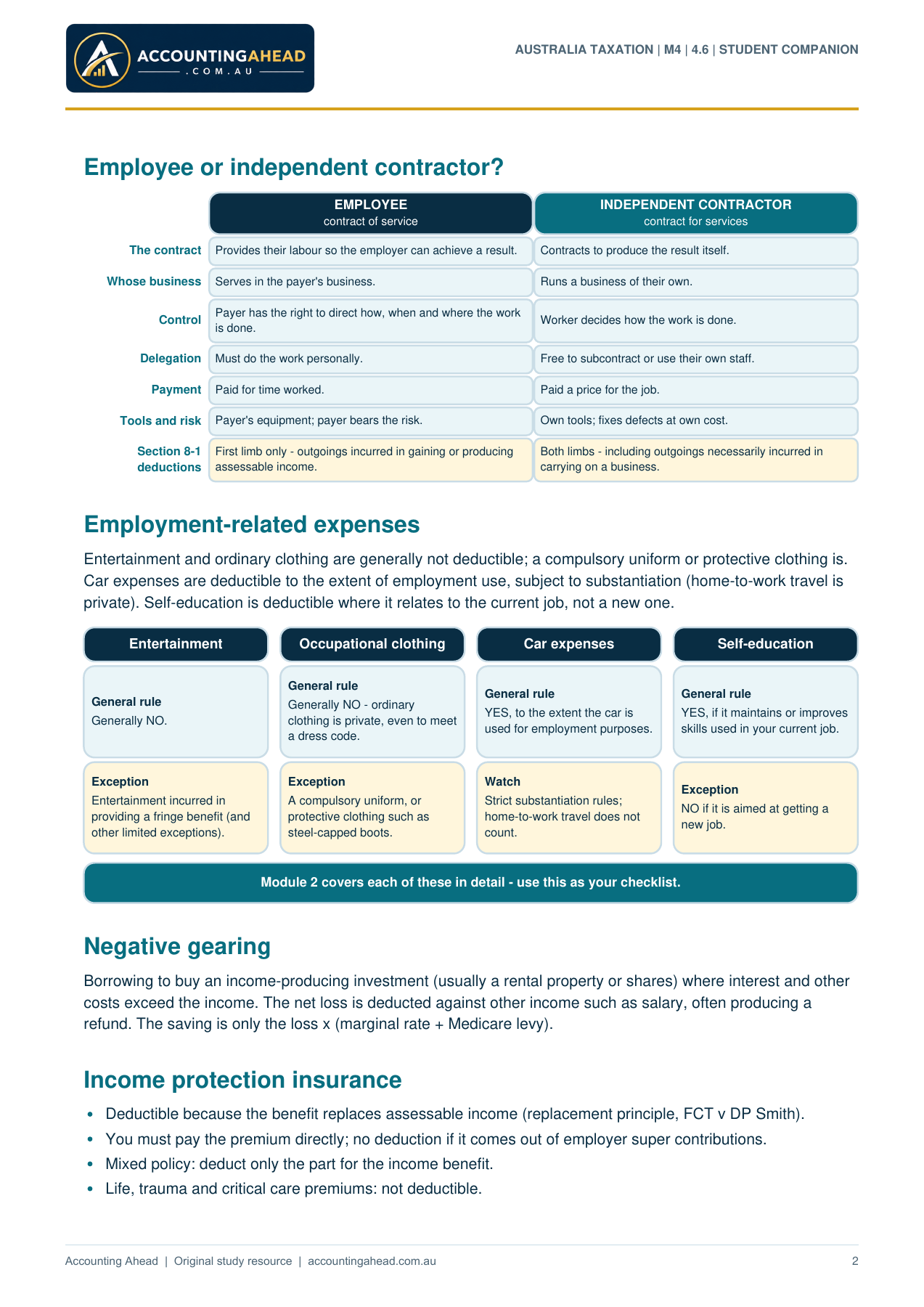
Employee or independent contractor?
EMPLOYEE
contract of service
INDEPENDENT CONTRACTOR
contract for services
The contract Provides their labour so the employer can achieve a result. Contracts to produce the result itself.
Whose business Serves in the payer's business. Runs a business of their own.
Control Payer has the right to direct how, when and where the work
is done. Worker decides how the work is done.
Delegation Must do the work personally. Free to subcontract or use their own staff.
Payment Paid for time worked. Paid a price for the job.
Tools and risk Payer's equipment; payer bears the risk. Own tools; fixes defects at own cost.
Section 8-1
deductions
First limb only - outgoings incurred in gaining or producing
assessable income.
Both limbs - including outgoings necessarily incurred in
carrying on a business.
Employment-related expenses
Entertainment and ordinary clothing are generally not deductible; a compulsory uniform or protective clothing is.
Car expenses are deductible to the extent of employment use, subject to substantiation (home-to-work travel is
private). Self-education is deductible where it relates to the current job, not a new one.
Entertainment
General rule
Generally NO.
Exception
Entertainment incurred in
providing a fringe benefit (and
other limited exceptions).
Occupational clothing
General rule
Generally NO - ordinary
clothing is private, even to meet
a dress code.
Exception
A compulsory uniform, or
protective clothing such as
steel-capped boots.
Car expenses
General rule
YES, to the extent the car is
used for employment purposes.
Watch
Strict substantiation rules;
home-to-work travel does not
count.
Self-education
General rule
YES, if it maintains or improves
skills used in your current job.
Exception
NO if it is aimed at getting a
new job.
Module 2 covers each of these in detail - use this as your checklist.
Negative gearing
Borrowing to buy an income-producing investment (usually a rental property or shares) where interest and other
costs exceed the income. The net loss is deducted against other income such as salary, often producing a
refund. The saving is only the loss x (marginal rate + Medicare levy).
Income protection insurance
Deductible because the benefit replaces assessable income (replacement principle, FCT v DP Smith).
You must pay the premium directly; no deduction if it comes out of employer super contributions.
Mixed policy: deduct only the part for the income benefit.
Life, trauma and critical care premiums: not deductible.
AUSTRALIA TAXATION | M4 | 4.6 | STUDENT COMPANION
2
Accounting Ahead | Original study resource | accountingahead.com.au
Personal superannuation contributions
Most individuals (employees and the self-employed) can deduct a direct contribution under s 290-150, if they
give the trustee a notice of intention to claim. Employer contributions count towards the $30,000 cap.
From salary to taxable income
Salary = $100,000
Rung 1
Negative gearing - rental flat
Rent $26,000 - expenses $36,000
(interest $30,000 + rates,
insurance, agent's commission and
repairs $6,000) = loss $10,000.
Saving at a 30% marginal rate
30% × $10,000 = $3,000 income tax + 2% ×
$10,000 = $200 Medicare levy = $3,200, usually
received as a refund. She still bears the other
$6,800 of the loss.
Deduct
$10,000
Rung 2
Income protection premium
Premium $2,400, paid directly to the insurer. 75% relates to the income benefit: 75% ×
$2,400 = $1,800.
Deduct
$1,800
Rung 3
Personal super contribution (s
290-150)
Concessional cap $30,000 - employer contributions $11,500 = room $18,500.
Contribution $8,200, notice of intention given to the trustee.
Deduct
$8,200
Taxable income = $100,000 - $10,000 - $1,800 - $8,200 = $80,000
Key figures for 2024-25
Item Figure
Concessional contributions cap $30,000 (employer contributions count towards it)
Superannuation guarantee rate (used in the
questions)
11.5% of ordinary time earnings
Car expenses - cents per kilometre method 88 cents per km, up to 5,000 business km
Medicare levy 2%
Marginal rate, taxable income $45,001 to $135,000 30% (tax = $4,288 + 30% of the excess over $45,000)
AUSTRALIA TAXATION | M4 | 4.6 | STUDENT COMPANION
3
Accounting Ahead | Original study resource | accountingahead.com.au
Practice questions
MODULE 4 | 4.6 | TRY THESE BEFORE THE WORKED ANSWERS
Question 1 - Pardalote Hollow
Rosalba Haverford teaches horse riding at Pardalote Hollow Equestrian Centre. She has an ABN and invoices
the centre every fortnight. Her written contract sets out all the terms of the engagement; neither party says it is a
sham, and it has not been varied. Its terms are:
Clause Term
1 The agreement is headed "Independent Contractor Agreement".
2 Rosalba is paid $48 for each hour of lessons she teaches.
3 The centre sets her weekly timetable and allocates her students.
4 The centre supplies the horses, saddlery, arena and riders' helmets.
5 Rosalba must teach every lesson personally and may not send a substitute.
6 She must follow the centre's lesson plans and safety manual, and wear the centre's branded shirt.
7 The centre refunds unhappy customers and holds the public liability insurance.
8 Either party may end the engagement on two weeks' notice.
(a) Is Rosalba an employee or an independent contractor of the centre? Give your reasons.
(b) What does your answer mean for her deductions, and for the centre?
AUSTRALIA TAXATION | M4 | 4.6 | STUDENT COMPANION
4
Accounting Ahead | Original study resource | accountingahead.com.au
Question 2 - Alaric's claims
Alaric Truscott is employed as a lift technician by Tarrawong Lifts Pty Ltd. During the 2024-25 income year he
paid for the items below. Alaric keeps all the records he needs, and his employer reimbursed none of these
amounts. For each item, state whether it is deductible and how much, then total his deductions.
Item Detail Amount Deductible? How much?
1 Steel-capped boots for working in lift shafts $260
2 Compulsory uniform shirts bearing his employer's logo $150
3 Plain black trousers from a department store, worn with the
uniform
$90
4 Driving his own car 3,000 km between lift sites during the
working day (cents per kilometre method)
3,000 km
5 Driving his own car 4,200 km between his home and the depot 4,200 km
6 Short course on a new lift control system he services in his
current job
$600
7 Evening course in real estate sales, as he plans a career
change
$400
8 Income protection premium, paid directly to the insurer
(income benefit only)
$1,500
9 Life insurance premium $900
10 His share of the team's end-of-year dinner $120
Total
AUSTRALIA TAXATION | M4 | 4.6 | STUDENT COMPANION
5
Accounting Ahead | Original study resource | accountingahead.com.au
Question 3 - Coralie's return
Coralie Dunstable is a sonographer employed on a salary of $120,000 for the 2024-25 income year. Her
employer pays superannuation guarantee contributions of 11.5% of her salary, and no other concessional
contributions are made for her. She has no unused concessional cap carried forward from earlier years. Her
other figures are:
Item Amount
Rent from her investment unit ($600 a week for 52 weeks) $31,200
Interest on the loan used to buy the unit $36,000
Council rates $2,400
Landlord insurance $1,300
Property agent's commission $2,500
Repairs $1,000
Income protection premium paid directly to the insurer. The policy also pays a lump sum for
permanent disablement; the insurer states 80% of the premium relates to the income benefit
$3,000
Personal contribution to her super fund, with a valid notice of intention to claim given to the
trustee
$15,600
(a) Calculate Coralie's net rental result.
(b) How much of the income protection premium is deductible?
(c) Is the personal superannuation contribution fully deductible? Check it against the cap.
(d) Calculate Coralie's taxable income.
(e) How much income tax and Medicare levy does the rental loss save her, and what is her after-tax cost of the
loss?
AUSTRALIA TAXATION | M4 | 4.6 | STUDENT COMPANION
6
Accounting Ahead | Original study resource | accountingahead.com.au
Worked answers
MODULE 4 | 4.6 | WORKED ANSWERS - ATTEMPT THE QUESTIONS FIRST
Answer 1 - Pardalote Hollow
(a) Rosalba is most likely an employee. Because the written contract is comprehensive and unchallenged, its
rights and obligations decide the question (Personnel Contracting; TR 2023/4):
Payment: $48 per hour taught - she is paid for her time, not for a result.
Control: the centre sets her timetable, allocates students, and imposes its lesson plans, safety manual and
shirt.
Integration: she serves in the centre's business, presenting as part of it.
Delegation: she must teach personally and cannot send a substitute.
Tools and risk: the centre supplies the horses, saddlery, arena and helmets, refunds unhappy customers
and holds the insurance.
The heading "Independent Contractor Agreement", her ABN and her fortnightly invoices are labels only and do
not make her a contractor (TR 2023/4).
(b) As an employee she can deduct only under the first limb of s 8-1 - outgoings incurred in gaining or producing
her assessable income that are not capital, private or domestic. She cannot rely on the second (business) limb.
For the centre, the classification means its employer obligations apply, including PAYG withholding from her pay
and superannuation guarantee contributions.
Answer 2 - Alaric's claims
Item Deductible? Amount
1 Steel-capped boots Yes - protective clothing $260
2 Compulsory uniform shirts Yes - compulsory uniform $150
3 Plain black trousers No - conventional clothing is private $0
4 Travel between lift sites Yes - employment use; 3,000 km × $0.88 = $2,640 (within the 5,000
km limit)
$2,640
5 Home to depot No - home-to-work travel is private $0
6 Lift control course Yes - improves skills used in his current job $600
7 Real estate course No - aimed at a new career $0
8 Income protection premium Yes - paid directly; benefit replaces income $1,500
9 Life insurance premium No - life cover premiums are not deductible $0
10 Team dinner No - entertainment is generally not deductible $0
Total $5,150
Check: $260 + $150 + $2,640 + $600 + $1,500 = $5,150.
AUSTRALIA TAXATION | M4 | 4.6 | WORKED ANSWERS
7
Accounting Ahead | Original study resource | accountingahead.com.au
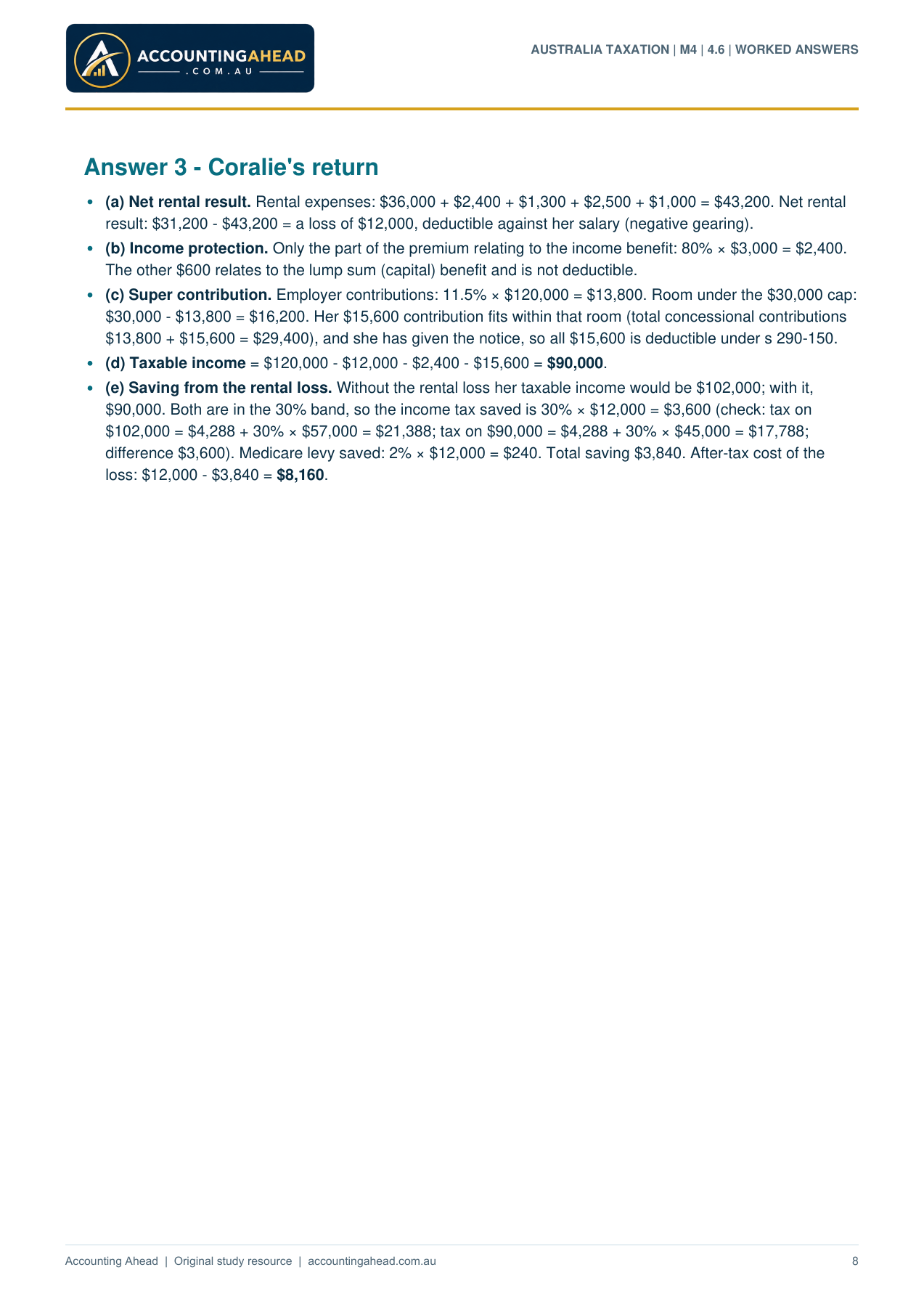
Answer 3 - Coralie's return
(a) Net rental result. Rental expenses: $36,000 + $2,400 + $1,300 + $2,500 + $1,000 = $43,200. Net rental
result: $31,200 - $43,200 = a loss of $12,000, deductible against her salary (negative gearing).
(b) Income protection. Only the part of the premium relating to the income benefit: 80% × $3,000 = $2,400.
The other $600 relates to the lump sum (capital) benefit and is not deductible.
(c) Super contribution. Employer contributions: 11.5% × $120,000 = $13,800. Room under the $30,000 cap:
$30,000 - $13,800 = $16,200. Her $15,600 contribution fits within that room (total concessional contributions
$13,800 + $15,600 = $29,400), and she has given the notice, so all $15,600 is deductible under s 290-150.
(d) Taxable income = $120,000 - $12,000 - $2,400 - $15,600 = $90,000.
(e) Saving from the rental loss. Without the rental loss her taxable income would be $102,000; with it,
$90,000. Both are in the 30% band, so the income tax saved is 30% × $12,000 = $3,600 (check: tax on
$102,000 = $4,288 + 30% × $57,000 = $21,388; tax on $90,000 = $4,288 + 30% × $45,000 = $17,788;
difference $3,600). Medicare levy saved: 2% × $12,000 = $240. Total saving $3,840. After-tax cost of the
loss: $12,000 - $3,840 = $8,160.
AUSTRALIA TAXATION | M4 | 4.6 | WORKED ANSWERS
8