
Medicare Levy and Surcharge — study companion
Part 4.8.2 of Australia Taxation. Preview the study companion or download the printable PDF.




Read the handout text
Accounting Ahead | Original study resource | accountingahead.com.au
Medicare Levy and Surcharge
MODULE 4 | 4.8.2 | STUDENT COMPANION
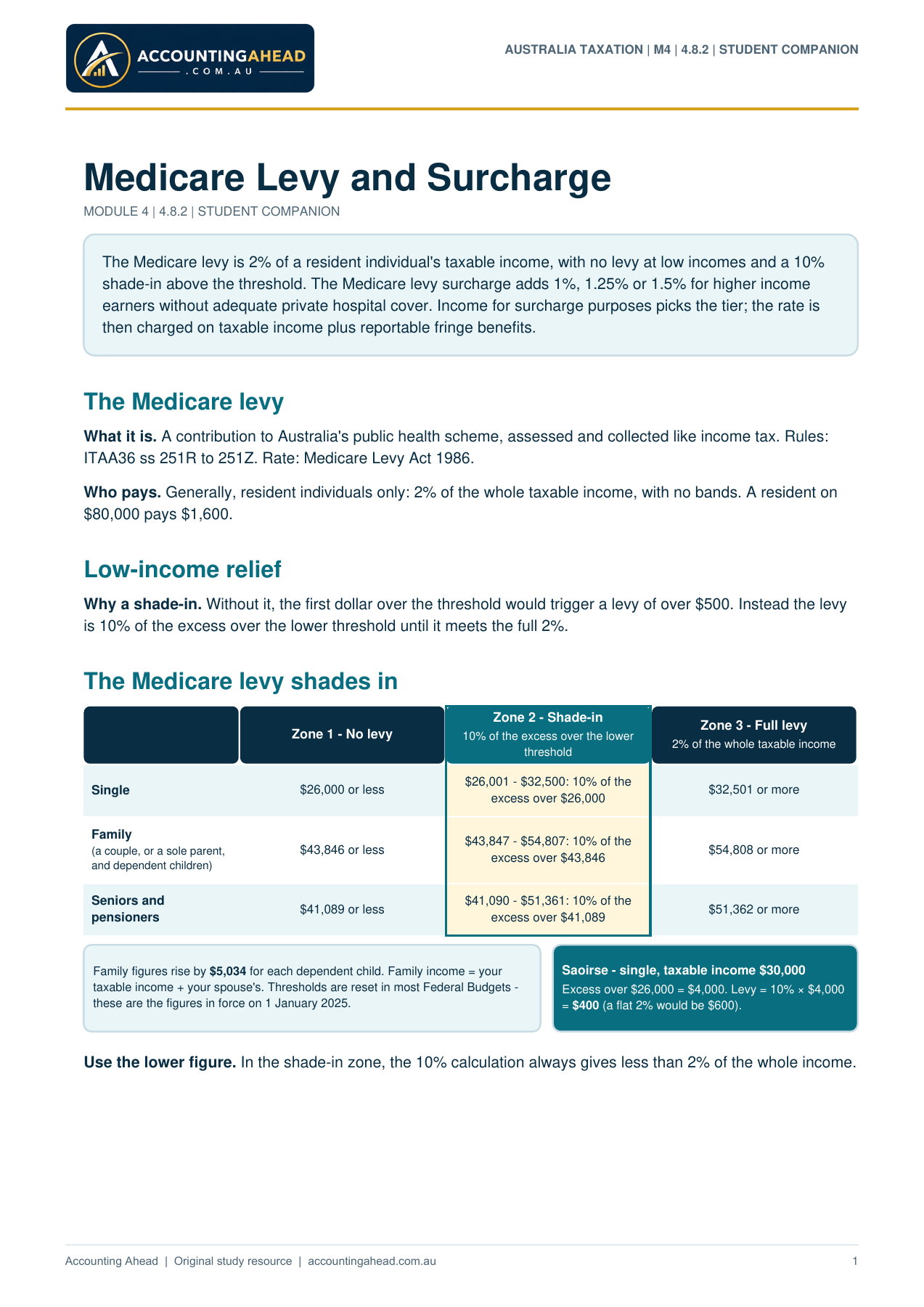
The Medicare levy is 2% of a resident individual's taxable income, with no levy at low incomes and a 10%
shade-in above the threshold. The Medicare levy surcharge adds 1%, 1.25% or 1.5% for higher income
earners without adequate private hospital cover. Income for surcharge purposes picks the tier; the rate is
then charged on taxable income plus reportable fringe benefits.
The Medicare levy
What it is. A contribution to Australia's public health scheme, assessed and collected like income tax. Rules:
ITAA36 ss 251R to 251Z. Rate: Medicare Levy Act 1986.
Who pays. Generally, resident individuals only: 2% of the whole taxable income, with no bands. A resident on
$80,000 pays $1,600.
Low-income relief
Why a shade-in. Without it, the first dollar over the threshold would trigger a levy of over $500. Instead the levy
is 10% of the excess over the lower threshold until it meets the full 2%.
The Medicare levy shades in
Zone 1 - No levy
Zone 2 - Shade-in
10% of the excess over the lower
threshold
Zone 3 - Full levy
2% of the whole taxable income
Single $26,000 or less $26,001 - $32,500: 10% of the
excess over $26,000 $32,501 or more
Family
(a couple, or a sole parent,
and dependent children)
$43,846 or less $43,847 - $54,807: 10% of the
excess over $43,846 $54,808 or more
Seniors and
pensioners $41,089 or less $41,090 - $51,361: 10% of the
excess over $41,089 $51,362 or more
Family figures rise by $5,034 for each dependent child. Family income = your
taxable income + your spouse's. Thresholds are reset in most Federal Budgets -
these are the figures in force on 1 January 2025.
Saoirse - single, taxable income $30,000
Excess over $26,000 = $4,000. Levy = 10% × $4,000
= $400 (a flat 2% would be $600).
Use the lower figure. In the shade-in zone, the 10% calculation always gives less than 2% of the whole income.
AUSTRALIA TAXATION | M4 | 4.8.2 | STUDENT COMPANION
1
Accounting Ahead | Original study resource | accountingahead.com.au
Who is exempt
Prescribed persons (ITAA36 ss 251T and 251U) include:
Defence Force members entitled to full free medical treatment
Veterans' Affairs Gold Card holders
blind pensioners receiving certain pensions
people who are not Australian residents at any time in the year
people certified as not entitled to Medicare benefits
non-citizen diplomats and consular staff who do not ordinarily live here.
The condition. The exemption applies only if they have no dependants, or all their dependants are prescribed
persons too (s 251T(2)). Claim it in the tax return; those not entitled to Medicare benefits also need a Medicare
Entitlement Statement from Services Australia. A part-year foreign resident can claim it for that period, on the
same condition.
The Medicare levy surcharge
Purpose. Imposed since 1 July 1997 (Medicare Levy Act 1986 s 8) to encourage higher earners to take out
private hospital cover.
Adequate cover. Private hospital cover for the taxpayer and all dependants, all year, with an excess of no more
than $750 (single) or $1,500 (family).
Does the surcharge apply?
Hospital cover all year?
Did the taxpayer and every dependant hold private hospital
cover for the whole income year? Excess no more than
$750 (single) or $1,500 (family).
Over the threshold?
Is income for surcharge purposes above $97,000 (single)
or $194,000 combined (couple or family, + $1,500 for each
dependent child after the first)?
Which tier?
Find the tier and its rate (Visual 3).
No
Yes
Yes
No surcharge
No
No surcharge
Income for surcharge purposes
Taxable income
+ Reportable employer super contributions (such
as salary-sacrificed super)
+ Reportable fringe benefits amount
+ Exempt foreign employment income
+ Net financial investment losses and net rental
property losses, added back
+ Amounts on which family trust distribution tax
has been paid
- Taxed super benefits that qualify for a tax
offset (ITAA97 s 301-20(2))
The wide measure decides whether the surcharge applies and which tier. The rate is charged on a narrower base: taxable income +
reportable fringe benefits.
The twist. The wide measure picks the tier. The rate is charged on taxable income + reportable fringe benefits
only.
AUSTRALIA TAXATION | M4 | 4.8.2 | STUDENT COMPANION
2
Accounting Ahead | Original study resource | accountingahead.com.au
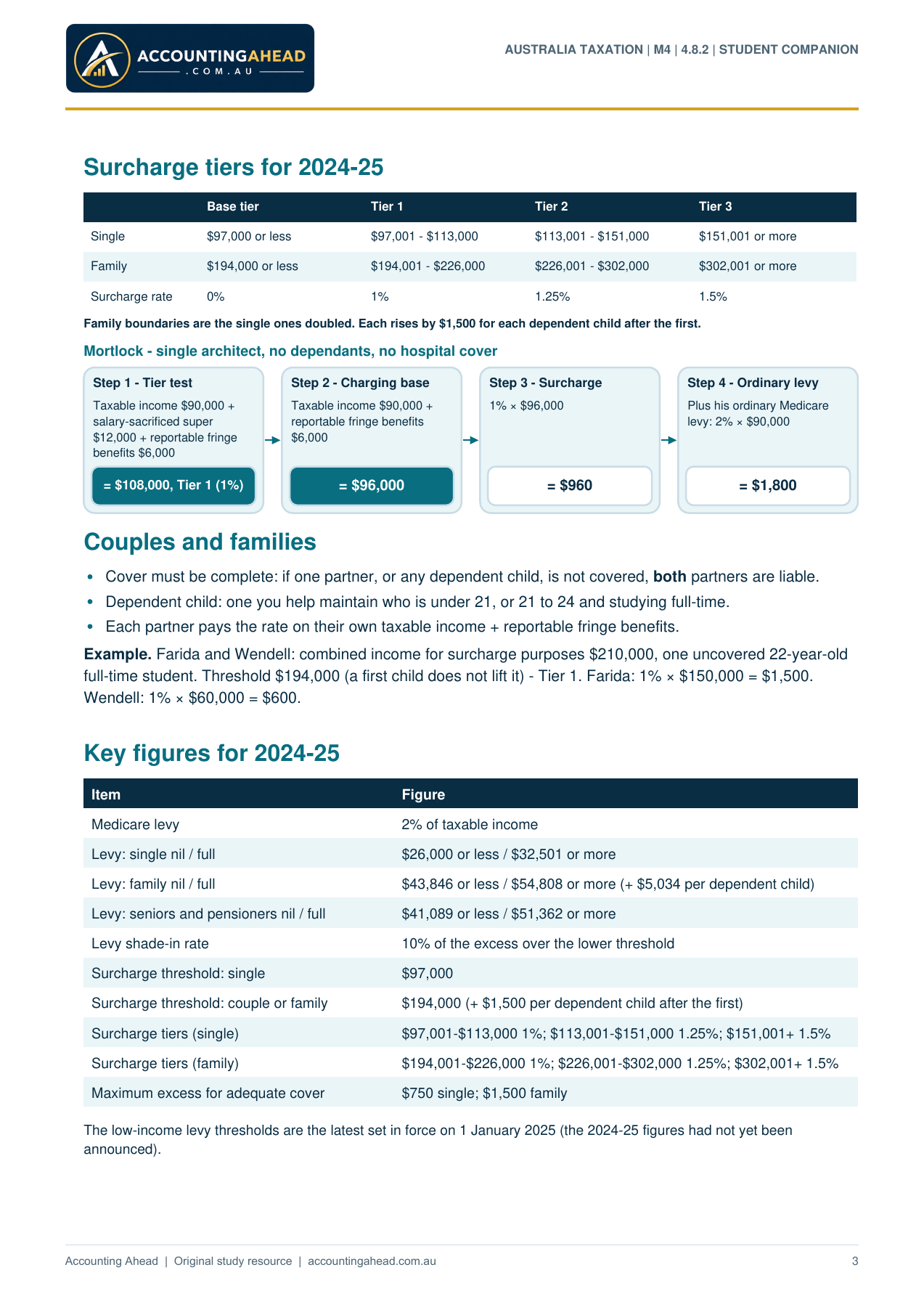
Surcharge tiers for 2024-25
Base tier Tier 1 Tier 2 Tier 3
Single $97,000 or less $97,001 - $113,000 $113,001 - $151,000 $151,001 or more
Family $194,000 or less $194,001 - $226,000 $226,001 - $302,000 $302,001 or more
Surcharge rate 0% 1% 1.25% 1.5%
Family boundaries are the single ones doubled. Each rises by $1,500 for each dependent child after the first.
Mortlock - single architect, no dependants, no hospital cover
Step 1 - Tier test
Taxable income $90,000 +
salary-sacrificed super
$12,000 + reportable fringe
benefits $6,000
= $108,000, Tier 1 (1%)
Step 2 - Charging base
Taxable income $90,000 +
reportable fringe benefits
$6,000
= $96,000
Step 3 - Surcharge
1% × $96,000
= $960
Step 4 - Ordinary levy
Plus his ordinary Medicare
levy: 2% × $90,000
= $1,800
Couples and families
Cover must be complete: if one partner, or any dependent child, is not covered, both partners are liable.
Dependent child: one you help maintain who is under 21, or 21 to 24 and studying full-time.
Each partner pays the rate on their own taxable income + reportable fringe benefits.
Example. Farida and Wendell: combined income for surcharge purposes $210,000, one uncovered 22-year-old
full-time student. Threshold $194,000 (a first child does not lift it) - Tier 1. Farida: 1% × $150,000 = $1,500.
Wendell: 1% × $60,000 = $600.
Key figures for 2024-25
Item Figure
Medicare levy 2% of taxable income
Levy: single nil / full $26,000 or less / $32,501 or more
Levy: family nil / full $43,846 or less / $54,808 or more (+ $5,034 per dependent child)
Levy: seniors and pensioners nil / full $41,089 or less / $51,362 or more
Levy shade-in rate 10% of the excess over the lower threshold
Surcharge threshold: single $97,000
Surcharge threshold: couple or family $194,000 (+ $1,500 per dependent child after the first)
Surcharge tiers (single) $97,001-$113,000 1%; $113,001-$151,000 1.25%; $151,001+ 1.5%
Surcharge tiers (family) $194,001-$226,000 1%; $226,001-$302,000 1.25%; $302,001+ 1.5%
Maximum excess for adequate cover $750 single; $1,500 family
The low-income levy thresholds are the latest set in force on 1 January 2025 (the 2024-25 figures had not yet been
announced).
AUSTRALIA TAXATION | M4 | 4.8.2 | STUDENT COMPANION
3
Accounting Ahead | Original study resource | accountingahead.com.au
Practice questions
MODULE 4 | 4.8.2 | TRY THESE BEFORE THE WORKED ANSWERS
Question 1 - Six levies
The six Australian residents below are single, with no dependants, unless stated otherwise. Calculate the
Medicare levy each one pays for the 2024-25 income year.
Taxpayer Details Taxable income Medicare levy
A Part-time student $24,000
B Junior gardener $29,000
C Café cook $32,000
D Library officer $45,000
E Retiree eligible for the seniors and pensioners
thresholds
$46,000
F Defence Force member entitled to full free medical
treatment, no dependants
$70,000
AUSTRALIA TAXATION | M4 | 4.8.2 | STUDENT COMPANION
4
Accounting Ahead | Original study resource | accountingahead.com.au
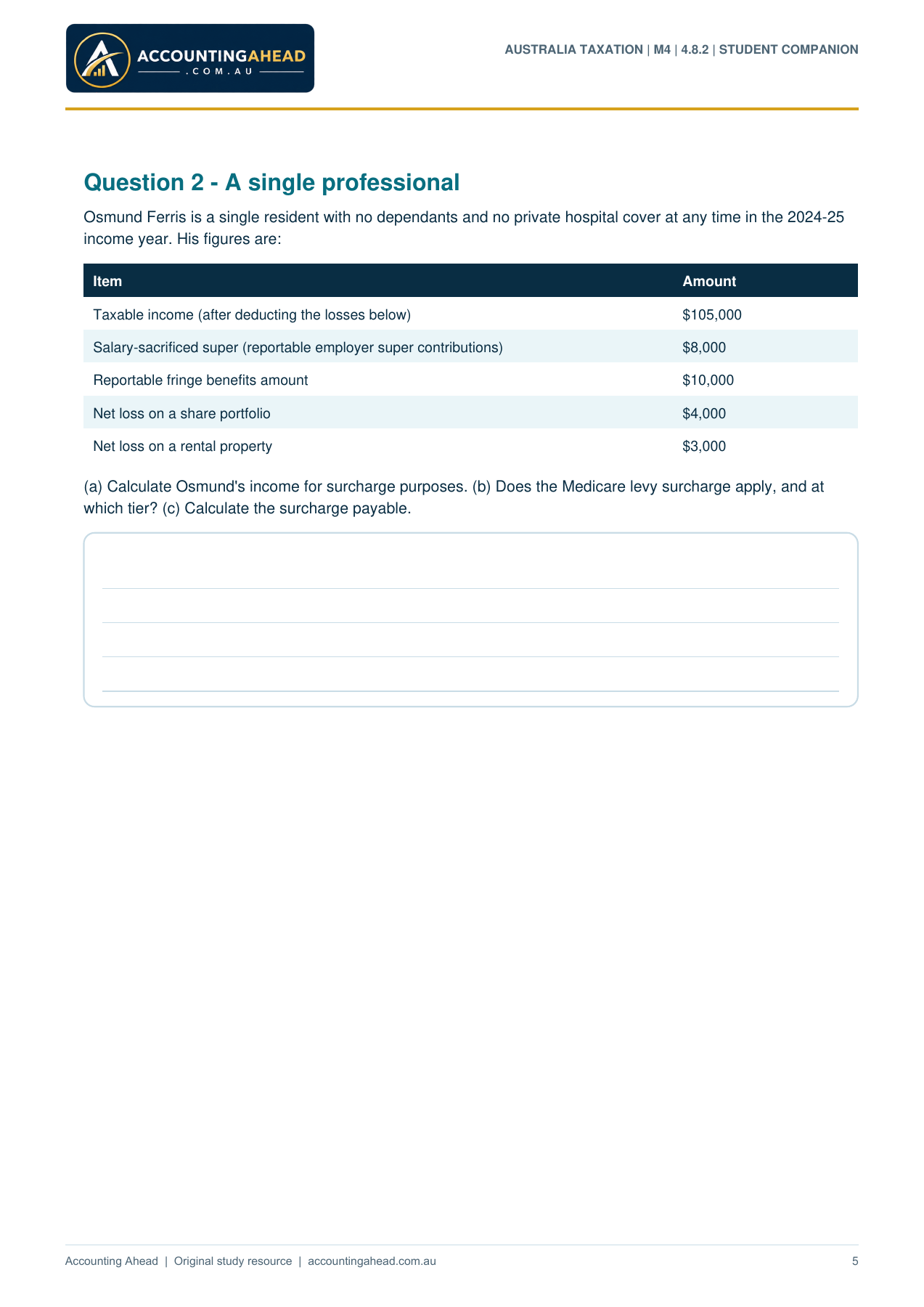
Question 2 - A single professional
Osmund Ferris is a single resident with no dependants and no private hospital cover at any time in the 2024-25
income year. His figures are:
Item Amount
Taxable income (after deducting the losses below) $105,000
Salary-sacrificed super (reportable employer super contributions) $8,000
Reportable fringe benefits amount $10,000
Net loss on a share portfolio $4,000
Net loss on a rental property $3,000
(a) Calculate Osmund's income for surcharge purposes. (b) Does the Medicare levy surcharge apply, and at
which tier? (c) Calculate the surcharge payable.
AUSTRALIA TAXATION | M4 | 4.8.2 | STUDENT COMPANION
5
Accounting Ahead | Original study resource | accountingahead.com.au
Question 3 - A gap in family cover
Gudrun and Leofric Tavistock are married residents with three dependent children aged 12, 9 and 5. Their family
hospital policy covers Gudrun, Leofric and the two younger children for the whole of the 2024-25 income year,
but the eldest child was left off the policy. Their figures are:
Gudrun Leofric
Taxable income $115,000 $90,000
Reportable fringe benefits amount $10,000 nil
They have no other components of income for surcharge purposes. (a) Calculate their family surcharge
threshold. (b) Explain whether the surcharge applies and at which tier. (c) Calculate the surcharge each partner
pays.
AUSTRALIA TAXATION | M4 | 4.8.2 | STUDENT COMPANION
6
Accounting Ahead | Original study resource | accountingahead.com.au
Worked answers
MODULE 4 | 4.8.2 | WORKED ANSWERS - ATTEMPT THE QUESTIONS FIRST
Answer 1 - Six levies
Taxpayer Working Levy
A $24,000 is not above the single threshold of $26,000. Nil
B In the shade-in zone: 10% × ($29,000 - $26,000) = 10% × $3,000 (2% would be
$580)
$300
C Still in the shade-in zone (it ends at $32,500): 10% × ($32,000 - $26,000) (2% would
be $640)
$600
D $45,000 is above $32,500, so the full levy applies: 2% × $45,000 $900
E Seniors and pensioners thresholds; $46,000 is in the shade-in zone ($41,090 -
$51,361): 10% × ($46,000 - $41,089) = 10% × $4,911 (2% would be $920)
$491.10
F A Defence Force member entitled to full free medical treatment is a prescribed
person, and has no dependants, so is exempt.
Nil
Answer 2 - A single professional
(a) Income for surcharge purposes. $105,000 + $8,000 + $10,000 + $4,000 + $3,000 = $130,000. The losses
are added back because they were deducted in arriving at taxable income.
(b) Tier. Osmund has no hospital cover and $130,000 is above the $97,000 single threshold, so the surcharge
applies. $130,000 is between $113,001 and $151,000: Tier 2, rate 1.25%. (On taxable income alone he would
have been in Tier 1 - the add-backs move him up a tier.)
(c) Surcharge. The rate is charged on taxable income + reportable fringe benefits: $105,000 + $10,000 =
$115,000. Surcharge = 1.25% × $115,000 = $1,437.50. This is on top of his ordinary Medicare levy (2% ×
$105,000 = $2,100).
Answer 3 - A gap in family cover
(a) Threshold. $194,000 + $1,500 × (3 - 1) = $197,000.
(b) Does it apply? The eldest child is a dependant (under 21) but is not covered, so the family's cover is not
complete and both partners are exposed. Combined income for surcharge purposes = ($115,000 + $10,000) +
$90,000 = $215,000, which is above $197,000, so the surcharge applies to both. With three children each family
tier boundary rises by $3,000, so Tier 1 runs from $197,001 to $229,000. $215,000 is in Tier 1: rate 1%.
(c) Each partner pays 1% of their own taxable income + reportable fringe benefits:
Partner Working Surcharge
Gudrun 1% × ($115,000 + $10,000) $1,250
Leofric 1% × $90,000 $900
Total for the family $1,250 + $900 $2,150
Covering the eldest child for the whole year would have removed the surcharge for both.
AUSTRALIA TAXATION | M4 | 4.8.2 | WORKED ANSWERS
7