Small Business Concessions and Tax Rates — study companion
Part 5.1 of Australia Taxation. Preview the study companion or download the printable PDF.



Read the handout text
Accounting Ahead | Original study resource | accountingahead.com.au
Small business concessions and tax rates
MODULE 5 | 5.1 | STUDENT COMPANION
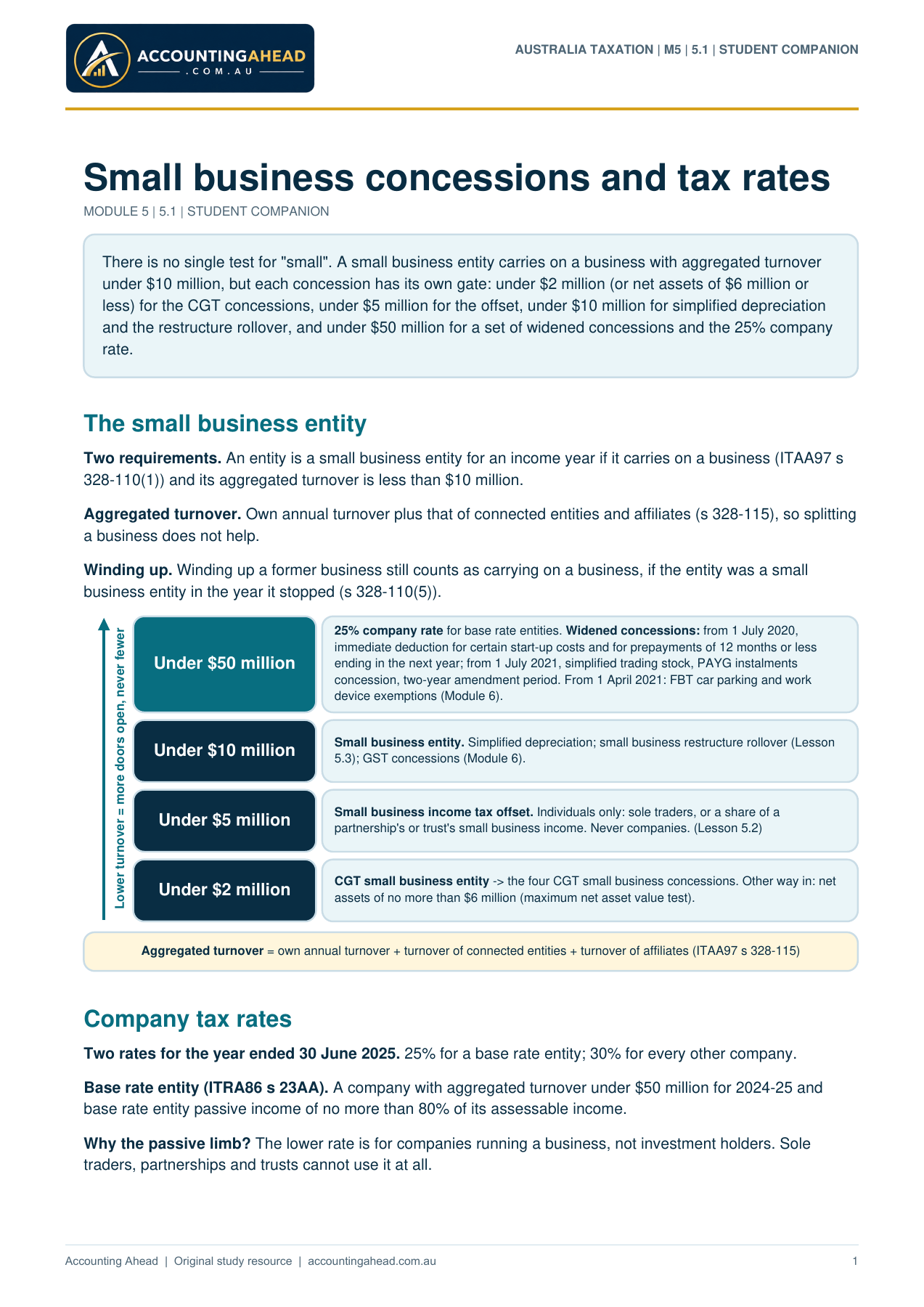
There is no single test for "small". A small business entity carries on a business with aggregated turnover
under $10 million, but each concession has its own gate: under $2 million (or net assets of $6 million or
less) for the CGT concessions, under $5 million for the offset, under $10 million for simplified depreciation
and the restructure rollover, and under $50 million for a set of widened concessions and the 25% company
rate.
The small business entity
Two requirements. An entity is a small business entity for an income year if it carries on a business (ITAA97 s
328-110(1)) and its aggregated turnover is less than $10 million.
Aggregated turnover. Own annual turnover plus that of connected entities and affiliates (s 328-115), so splitting
a business does not help.
Winding up. Winding up a former business still counts as carrying on a business, if the entity was a small
business entity in the year it stopped (s 328-110(5)).
Under $50 million
25% company rate for base rate entities. Widened concessions: from 1 July 2020,
immediate deduction for certain start-up costs and for prepayments of 12 months or less
ending in the next year; from 1 July 2021, simplified trading stock, PAYG instalments
concession, two-year amendment period. From 1 April 2021: FBT car parking and work
device exemptions (Module 6).
Under $10 million Small business entity. Simplified depreciation; small business restructure rollover (Lesson
5.3); GST concessions (Module 6).
Under $5 million Small business income tax offset. Individuals only: sole traders, or a share of a
partnership's or trust's small business income. Never companies. (Lesson 5.2)
Under $2 million CGT small business entity -> the four CGT small business concessions. Other way in: net
assets of no more than $6 million (maximum net asset value test).
Lower turnover = more doors open, never fewer
Aggregated turnover = own annual turnover + turnover of connected entities + turnover of affiliates (ITAA97 s 328-115)
Company tax rates
Two rates for the year ended 30 June 2025. 25% for a base rate entity; 30% for every other company.
Base rate entity (ITRA86 s 23AA). A company with aggregated turnover under $50 million for 2024-25 and
base rate entity passive income of no more than 80% of its assessable income.
Why the passive limb? The lower rate is for companies running a business, not investment holders. Sole
traders, partnerships and trusts cannot use it at all.
AUSTRALIA TAXATION | M5 | 5.1 | STUDENT COMPANION
1
Accounting Ahead | Original study resource | accountingahead.com.au
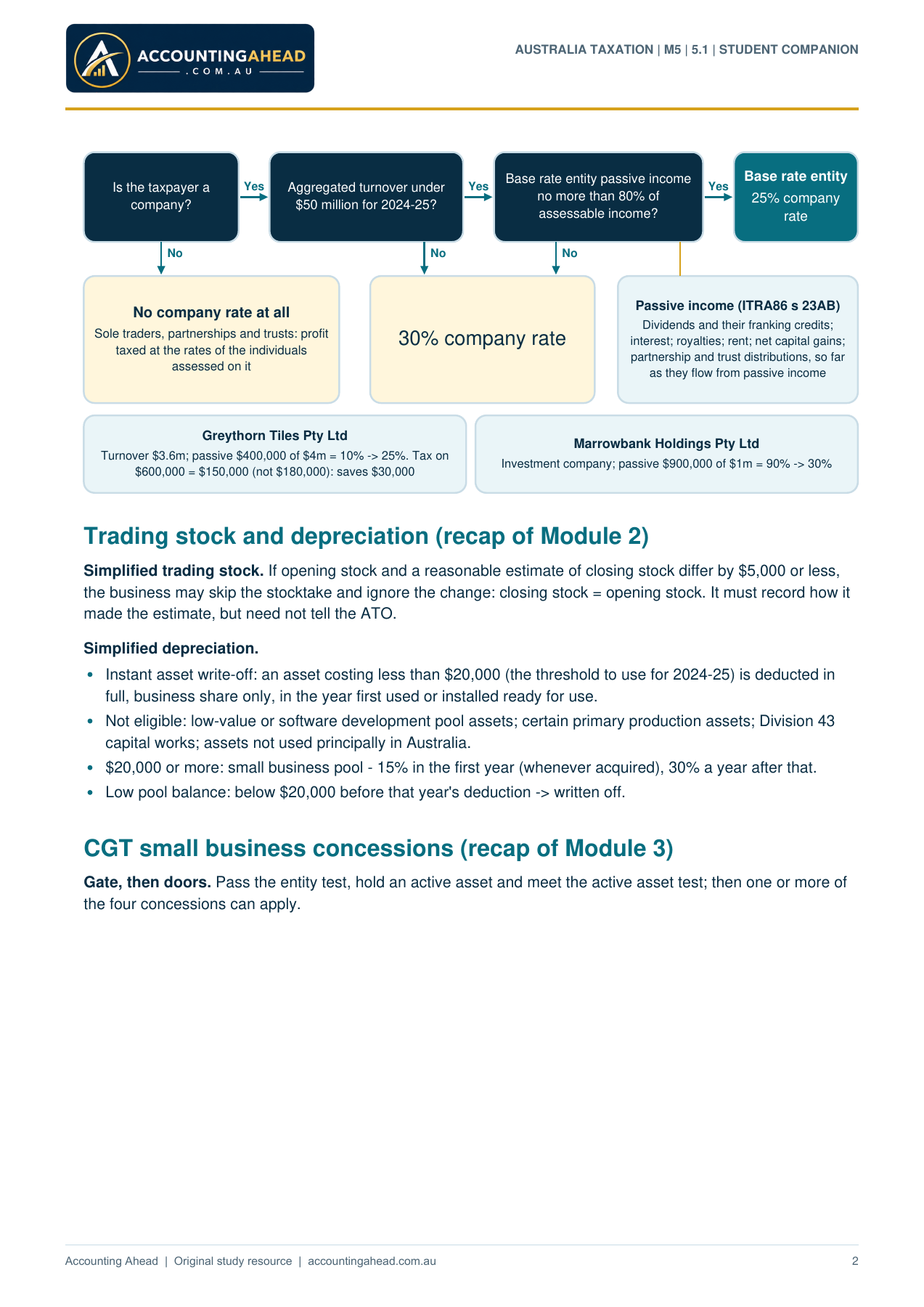
Is the taxpayer a
company?
Aggregated turnover under
$50 million for 2024-25?
Base rate entity passive income
no more than 80% of
assessable income?
Base rate entity
25% company
rate
Yes Yes Yes
No No No
No company rate at all
Sole traders, partnerships and trusts: profit
taxed at the rates of the individuals
assessed on it
30% company rate
Passive income (ITRA86 s 23AB)
Dividends and their franking credits;
interest; royalties; rent; net capital gains;
partnership and trust distributions, so far
as they flow from passive income
Greythorn Tiles Pty Ltd
Turnover $3.6m; passive $400,000 of $4m = 10% -> 25%. Tax on
$600,000 = $150,000 (not $180,000): saves $30,000
Marrowbank Holdings Pty Ltd
Investment company; passive $900,000 of $1m = 90% -> 30%
Trading stock and depreciation (recap of Module 2)
Simplified trading stock. If opening stock and a reasonable estimate of closing stock differ by $5,000 or less,
the business may skip the stocktake and ignore the change: closing stock = opening stock. It must record how it
made the estimate, but need not tell the ATO.
Simplified depreciation.
Instant asset write-off: an asset costing less than $20,000 (the threshold to use for 2024-25) is deducted in
full, business share only, in the year first used or installed ready for use.
Not eligible: low-value or software development pool assets; certain primary production assets; Division 43
capital works; assets not used principally in Australia.
$20,000 or more: small business pool - 15% in the first year (whenever acquired), 30% a year after that.
Low pool balance: below $20,000 before that year's deduction -> written off.
CGT small business concessions (recap of Module 3)
Gate, then doors. Pass the entity test, hold an active asset and meet the active asset test; then one or more of
the four concessions can apply.
AUSTRALIA TAXATION | M5 | 5.1 | STUDENT COMPANION
2
Accounting Ahead | Original study resource | accountingahead.com.au
Entity test
Aggregated turnover under $2 million (CGT
small business entity) or net assets of no
more than $6 million, including connected
entities and affiliates, excluding personal
use assets such as the home
Active asset
Owned by the taxpayer and used, or held
ready for use, in carrying on a business -
or goodwill and other intangibles tied to the
business. Not an asset used mainly to earn
rent
Active asset test (s 152-35)
Owned 15 years or less: active for at least
half the ownership period. Owned more
than 15 years: active for at least 7.5 years
Ismay Fothergill: workshop owned 12 years, active for the last 7. Half of 12 = 6; 7 >= 6 -> passes.
15-year exemption
Owned continuously 15 years,
and the owner is 55 or over
and retiring, or permanently
incapacitated: whole gain
disregarded
50% active asset
reduction
Halves the gain - on top of the
50% general discount where
that applies
Retirement exemption
Lifetime limit $500,000. Under
55: pay the exempt amount
into a complying super fund or
RSA
Rollover
Defers the gain. Replacement
active asset (or improvement)
within 2 years, or the deferral
unwinds
Key figures for 2024-25
Item Figure
Small business entity Aggregated turnover under $10 million
Small business income tax offset Aggregated turnover under $5 million
CGT small business entity Aggregated turnover under $2 million
Maximum net asset value test Net assets no more than $6 million
Base rate entity Turnover under $50 million; passive income no more than 80%
Company tax rates 25% base rate entity; 30% other companies
Simplified trading stock Difference of $5,000 or less
Instant asset write-off Cost less than $20,000
Small business pool 15% first year; 30% later years; write-off below $20,000
Retirement exemption $500,000 lifetime limit; super contribution if under 55
AUSTRALIA TAXATION | M5 | 5.1 | STUDENT COMPANION
3
Accounting Ahead | Original study resource | accountingahead.com.au
Practice questions
MODULE 5 | 5.1 | TRY THESE BEFORE THE WORKED ANSWERS
Question 1 - Which doors are open?
For each imagined business below, state which of these concessions it can use in 2024-25, and explain why: (i)
the CGT small business concessions (entity test only - assume the asset conditions are met); (ii) the small
business income tax offset; (iii) simplified depreciation and the small business restructure rollover; (iv) the
widened concessions open to businesses under $50 million (start-up costs, prepayments, simplified trading
stock, PAYG instalments concession, two-year amendment period); (v) the 25% company tax rate.
Business Structure Own annual
turnover
Turnover of connected
entities
Net assets (incl.
connected entities
and affiliates)
Passive
income
share
(a) Faramond
Strangways, electrician
Sole trader $1,100,000 $300,000 (a lighting
supply business he
controls)
$1,900,000 nil
(b) Loveday Signage Pty
Ltd
Company $3,000,000 $1,200,000 (a related
printing company)
$5,100,000 5%
(c) Craddock Family
Trust, commercial laundry
Trust $23,000,000 nil $9,000,000 2%
(i) CGT
concessions
(ii) Offset (iii) Depreciation
and rollover
(iv) Widened
concessions
(v) 25% rate
(a) Faramond
(b) Loveday
(c) Craddock
AUSTRALIA TAXATION | M5 | 5.1 | STUDENT COMPANION
4
Accounting Ahead | Original study resource | accountingahead.com.au
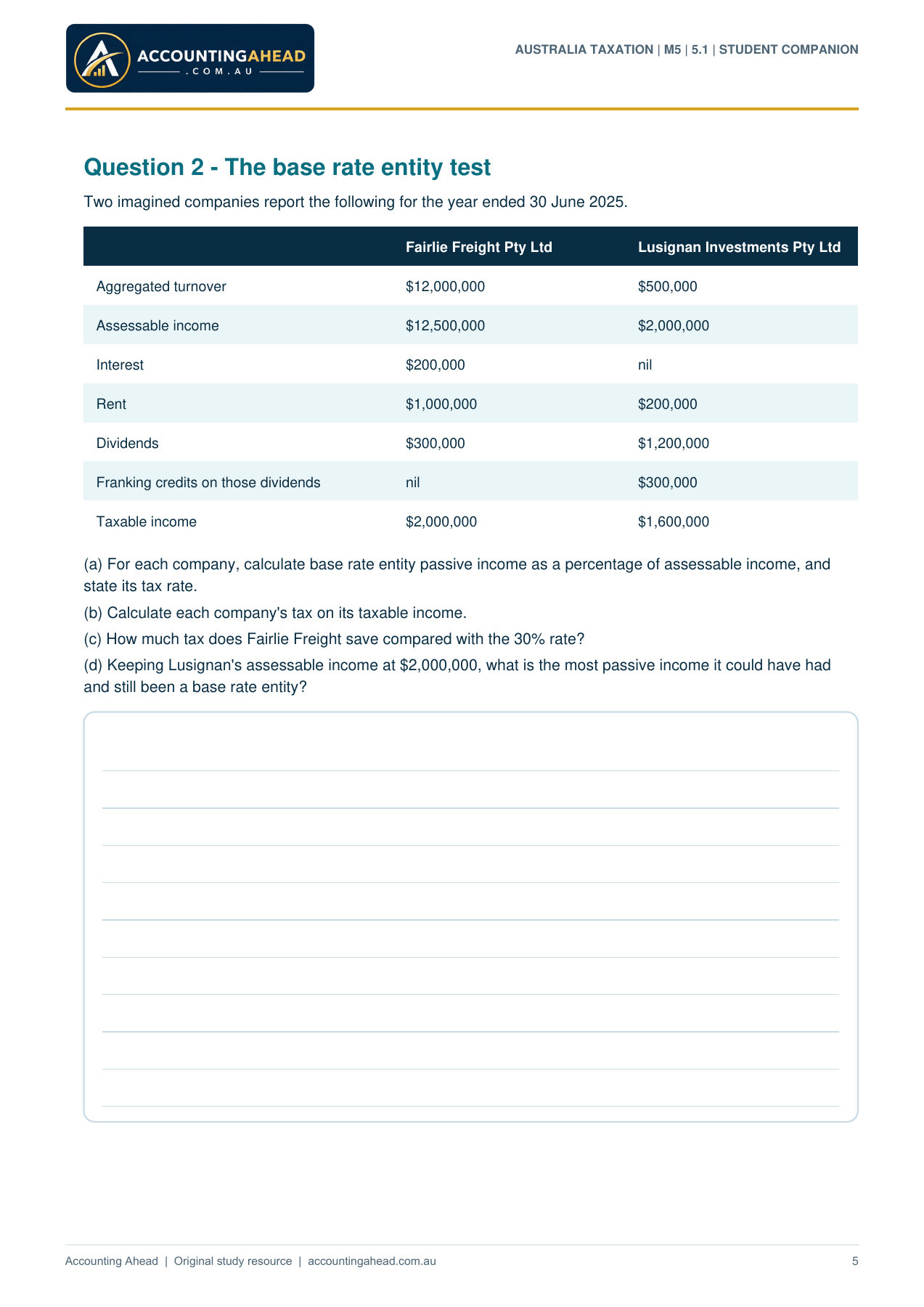
Question 2 - The base rate entity test
Two imagined companies report the following for the year ended 30 June 2025.
Fairlie Freight Pty Ltd Lusignan Investments Pty Ltd
Aggregated turnover $12,000,000 $500,000
Assessable income $12,500,000 $2,000,000
Interest $200,000 nil
Rent $1,000,000 $200,000
Dividends $300,000 $1,200,000
Franking credits on those dividends nil $300,000
Taxable income $2,000,000 $1,600,000
(a) For each company, calculate base rate entity passive income as a percentage of assessable income, and
state its tax rate.
(b) Calculate each company's tax on its taxable income.
(c) How much tax does Fairlie Freight save compared with the 30% rate?
(d) Keeping Lusignan's assessable income at $2,000,000, what is the most passive income it could have had
and still been a base rate entity?
AUSTRALIA TAXATION | M5 | 5.1 | STUDENT COMPANION
5
Accounting Ahead | Original study resource | accountingahead.com.au
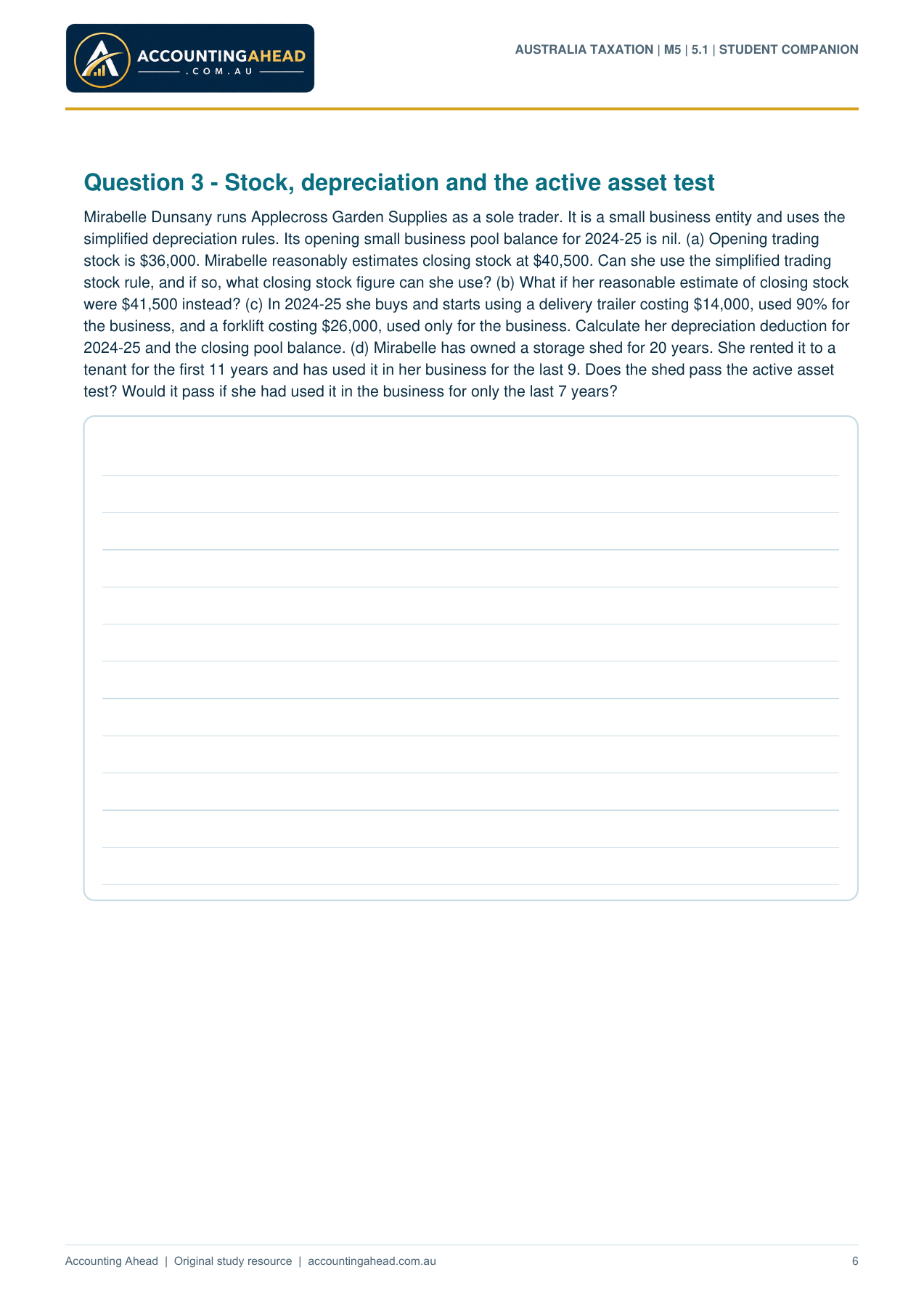
Question 3 - Stock, depreciation and the active asset test
Mirabelle Dunsany runs Applecross Garden Supplies as a sole trader. It is a small business entity and uses the
simplified depreciation rules. Its opening small business pool balance for 2024-25 is nil. (a) Opening trading
stock is $36,000. Mirabelle reasonably estimates closing stock at $40,500. Can she use the simplified trading
stock rule, and if so, what closing stock figure can she use? (b) What if her reasonable estimate of closing stock
were $41,500 instead? (c) In 2024-25 she buys and starts using a delivery trailer costing $14,000, used 90% for
the business, and a forklift costing $26,000, used only for the business. Calculate her depreciation deduction for
2024-25 and the closing pool balance. (d) Mirabelle has owned a storage shed for 20 years. She rented it to a
tenant for the first 11 years and has used it in her business for the last 9. Does the shed pass the active asset
test? Would it pass if she had used it in the business for only the last 7 years?
AUSTRALIA TAXATION | M5 | 5.1 | STUDENT COMPANION
6
Accounting Ahead | Original study resource | accountingahead.com.au
Worked answers
MODULE 5 | 5.1 | WORKED ANSWERS - ATTEMPT THE QUESTIONS FIRST
Answer 1
(a) Faramond Strangways. Aggregated turnover = $1,100,000 + $300,000 = $1,400,000 (the connected
entity's turnover counts). (i) Yes. $1.4 million is under $2 million, so he is a CGT small business entity. (His
net assets of $1.9 million would also pass the $6 million test.) (ii) Yes. He is an individual sole trader and
turnover is under $5 million. (iii) Yes. Under $10 million, so he is a small business entity. (iv) Yes. Under $50
million. (v) No. He is not a company: his business profit is taxed at his own marginal rates.
(b) Loveday Signage Pty Ltd. Aggregated turnover = $3,000,000 + $1,200,000 = $4,200,000. (i) Yes, but
only through the maximum net asset value test. $4.2 million is not under $2 million, but net assets of $5.1
million are no more than $6 million. (ii) No. The offset is never available to a company (even though turnover
is under $5 million). (iii) Yes. Under $10 million. (iv) Yes. Under $50 million. (v) Yes. It is a company, turnover
is under $50 million and passive income is 5%, no more than 80%: 25%.
(c) Craddock Family Trust. Aggregated turnover = $23,000,000. (i) No. Turnover is not under $2 million and
net assets of $9 million exceed $6 million. (ii) No. Turnover is not under $5 million. (iii) No. Turnover is not
under $10 million, so it is not a small business entity. (iv) Yes. Turnover is under $50 million, so the widened
concessions are available. (v) No. A trust is not a company; its net income is taxed under the trust rules (later
in this module).
Answer 2
Fairlie Freight Lusignan Investments
(a) Passive income Interest $200,000 + rent $1,000,000 +
dividends $300,000 = $1,500,000
Rent $200,000 + dividends $1,200,000 +
franking credits $300,000 = $1,700,000
Percentage of assessable
income
$1,500,000 / $12,500,000 = 12% $1,700,000 / $2,000,000 = 85%
Base rate entity? Turnover of $12 million is under $50 million
and 12% is no more than 80%: yes, 25%.
(It is not a small business entity, but the
base rate entity test uses the $50 million
threshold.)
Turnover is under $50 million, but 85% is
more than 80%: no, 30%.
(b) Tax $2,000,000 x 25% = $500,000 $1,600,000 x 30% = $480,000
(c) Saving at 25% v 30% At 30%: $2,000,000 x 30% = $600,000.
Saving = $600,000 - $500,000 = $100,000
(d) 80% x $2,000,000 = $1,600,000. Passive income of up to $1,600,000 (no more than 80%) would have kept
Lusignan a base rate entity, taxed at 25%: $1,600,000 x 25% = $400,000 instead of $480,000.
AUSTRALIA TAXATION | M5 | 5.1 | WORKED ANSWERS
7
Accounting Ahead | Original study resource | accountingahead.com.au
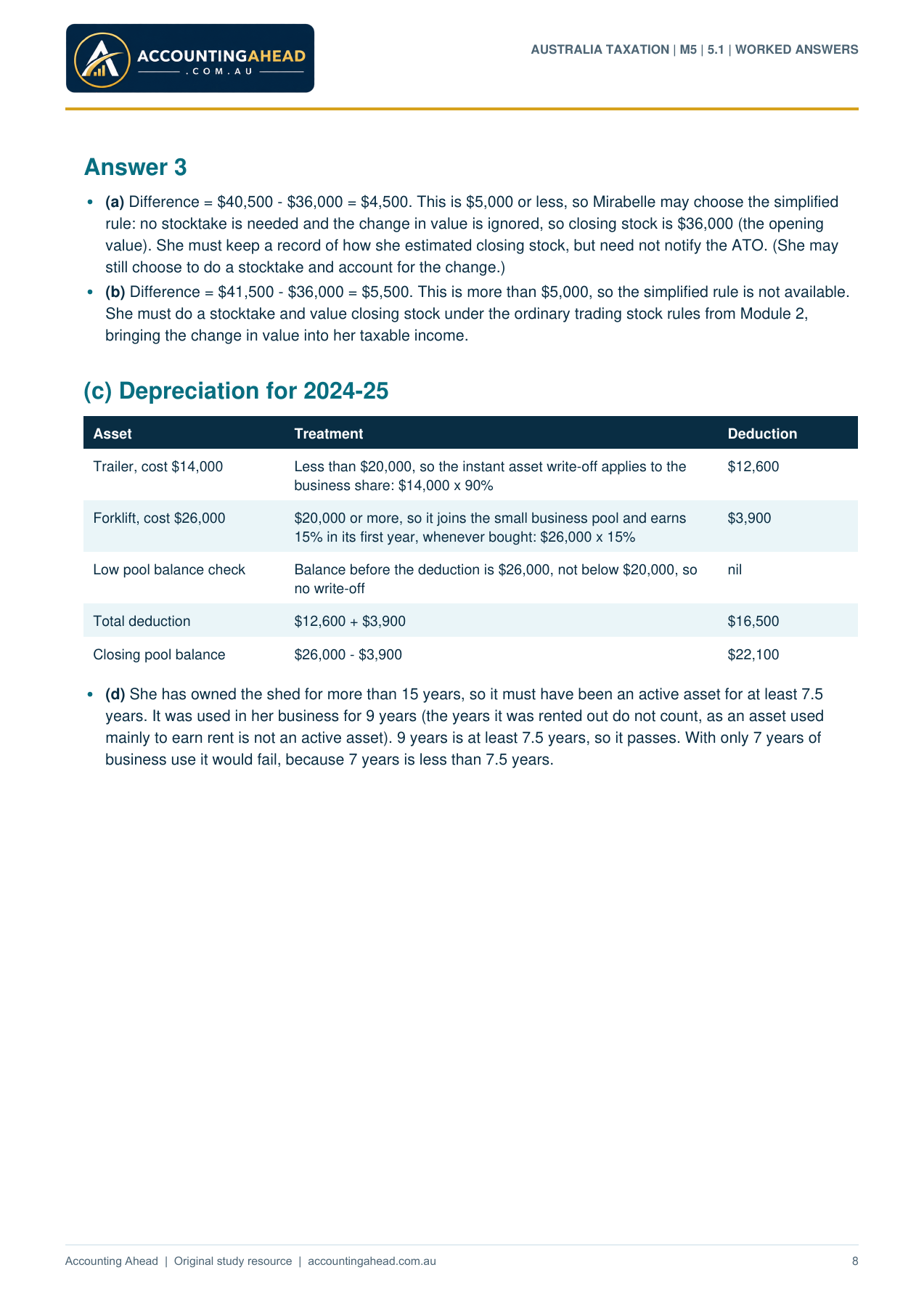
Answer 3
(a) Difference = $40,500 - $36,000 = $4,500. This is $5,000 or less, so Mirabelle may choose the simplified
rule: no stocktake is needed and the change in value is ignored, so closing stock is $36,000 (the opening
value). She must keep a record of how she estimated closing stock, but need not notify the ATO. (She may
still choose to do a stocktake and account for the change.)
(b) Difference = $41,500 - $36,000 = $5,500. This is more than $5,000, so the simplified rule is not available.
She must do a stocktake and value closing stock under the ordinary trading stock rules from Module 2,
bringing the change in value into her taxable income.
(c) Depreciation for 2024-25
Asset Treatment Deduction
Trailer, cost $14,000 Less than $20,000, so the instant asset write-off applies to the
business share: $14,000 x 90%
$12,600
Forklift, cost $26,000 $20,000 or more, so it joins the small business pool and earns
15% in its first year, whenever bought: $26,000 x 15%
$3,900
Low pool balance check Balance before the deduction is $26,000, not below $20,000, so
no write-off
nil
Total deduction $12,600 + $3,900 $16,500
Closing pool balance $26,000 - $3,900 $22,100
(d) She has owned the shed for more than 15 years, so it must have been an active asset for at least 7.5
years. It was used in her business for 9 years (the years it was rented out do not count, as an asset used
mainly to earn rent is not an active asset). 9 years is at least 7.5 years, so it passes. With only 7 years of
business use it would fail, because 7 years is less than 7.5 years.
AUSTRALIA TAXATION | M5 | 5.1 | WORKED ANSWERS
8