
Trust Discrepancies, Gains and Streaming — study companion
Part 5.10 of Australia Taxation. Preview the study companion or download the printable PDF.



Read the handout text
Accounting Ahead | Original study resource | accountingahead.com.au
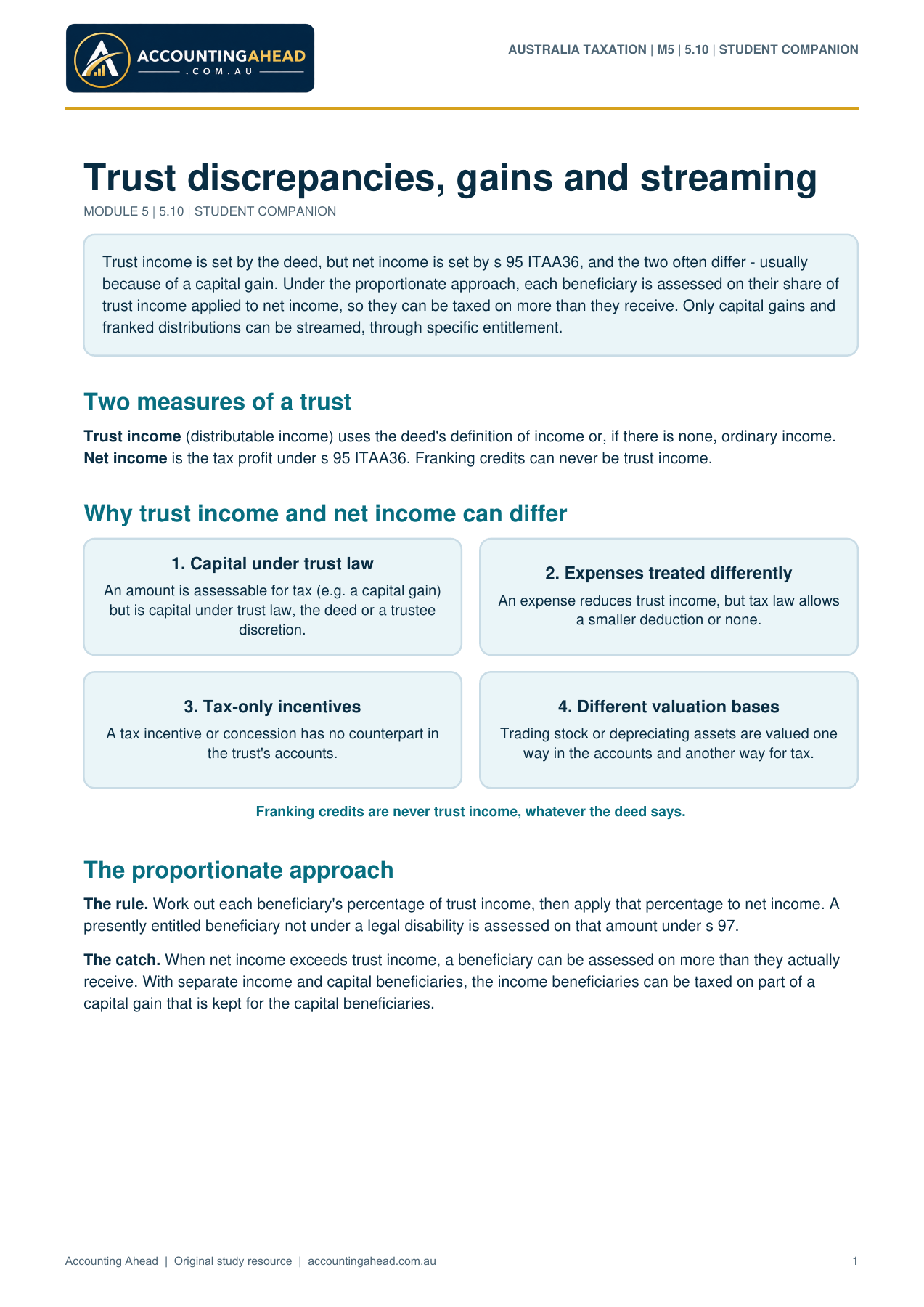
Trust discrepancies, gains and streaming
MODULE 5 | 5.10 | STUDENT COMPANION
Trust income is set by the deed, but net income is set by s 95 ITAA36, and the two often differ - usually
because of a capital gain. Under the proportionate approach, each beneficiary is assessed on their share of
trust income applied to net income, so they can be taxed on more than they receive. Only capital gains and
franked distributions can be streamed, through specific entitlement.
Two measures of a trust
Trust income (distributable income) uses the deed's definition of income or, if there is none, ordinary income.
Net income is the tax profit under s 95 ITAA36. Franking credits can never be trust income.
Why trust income and net income can differ
1. Capital under trust law
An amount is assessable for tax (e.g. a capital gain)
but is capital under trust law, the deed or a trustee
discretion.
2. Expenses treated differently
An expense reduces trust income, but tax law allows
a smaller deduction or none.
3. Tax-only incentives
A tax incentive or concession has no counterpart in
the trust's accounts.
4. Different valuation bases
Trading stock or depreciating assets are valued one
way in the accounts and another way for tax.
Franking credits are never trust income, whatever the deed says.
The proportionate approach
The rule. Work out each beneficiary's percentage of trust income, then apply that percentage to net income. A
presently entitled beneficiary not under a legal disability is assessed on that amount under s 97.
The catch. When net income exceeds trust income, a beneficiary can be assessed on more than they actually
receive. With separate income and capital beneficiaries, the income beneficiaries can be taxed on part of a
capital gain that is kept for the capital beneficiaries.
AUSTRALIA TAXATION | M5 | 5.10 | STUDENT COMPANION
1
Accounting Ahead | Original study resource | accountingahead.com.au
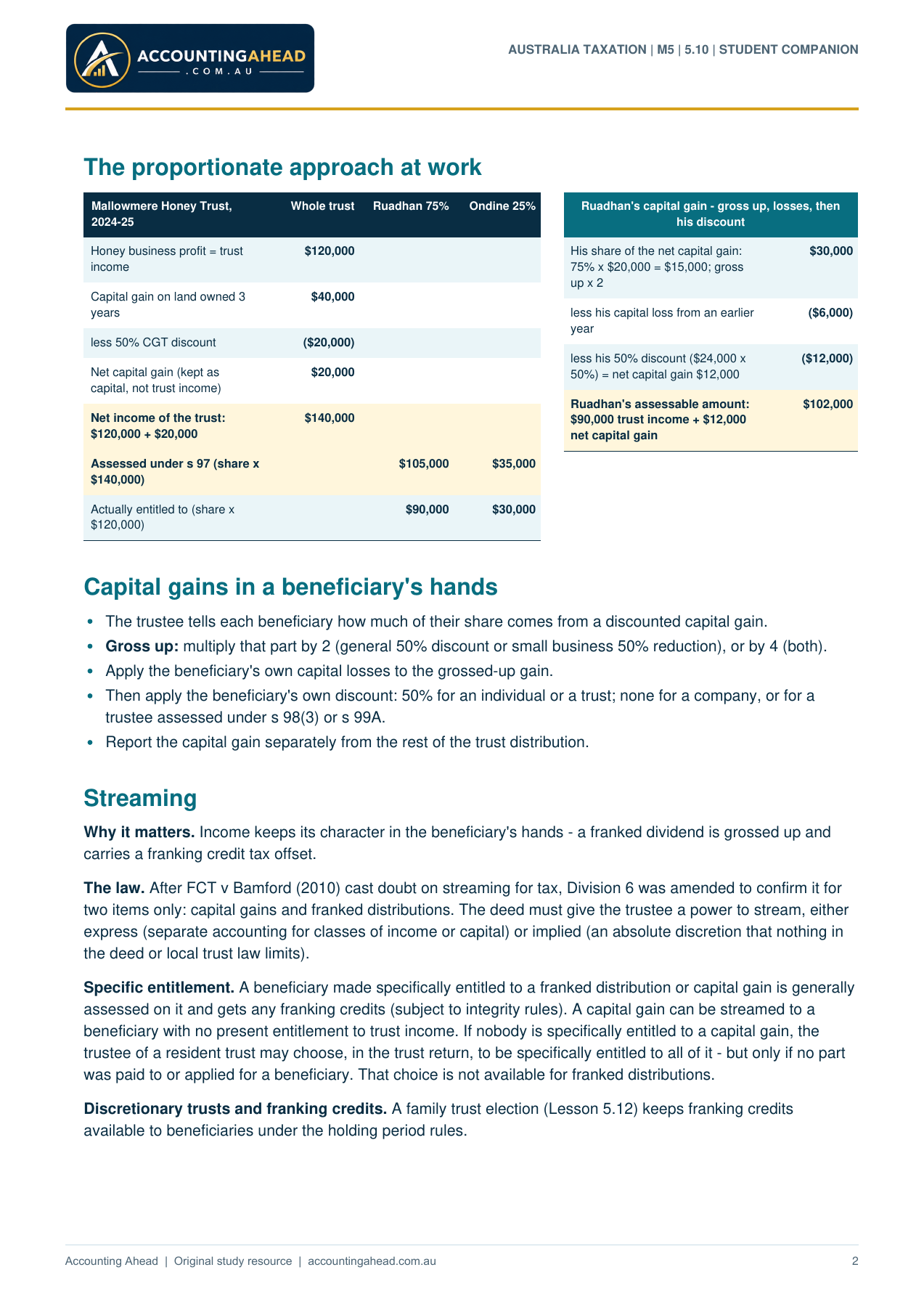
The proportionate approach at work
Mallowmere Honey Trust,
2024-25
Whole trust Ruadhan 75% Ondine 25%
Honey business profit = trust
income
$120,000
Capital gain on land owned 3
years
$40,000
less 50% CGT discount ($20,000)
Net capital gain (kept as
capital, not trust income)
$20,000
Net income of the trust:
$120,000 + $20,000
$140,000
Assessed under s 97 (share x
$140,000)
$105,000 $35,000
Actually entitled to (share x
$120,000)
$90,000 $30,000
Ruadhan's capital gain - gross up, losses, then
his discount
His share of the net capital gain:
75% x $20,000 = $15,000; gross
up x 2
$30,000
less his capital loss from an earlier
year
($6,000)
less his 50% discount ($24,000 x
50%) = net capital gain $12,000
($12,000)
Ruadhan's assessable amount:
$90,000 trust income + $12,000
net capital gain
$102,000
Capital gains in a beneficiary's hands
The trustee tells each beneficiary how much of their share comes from a discounted capital gain.
Gross up: multiply that part by 2 (general 50% discount or small business 50% reduction), or by 4 (both).
Apply the beneficiary's own capital losses to the grossed-up gain.
Then apply the beneficiary's own discount: 50% for an individual or a trust; none for a company, or for a
trustee assessed under s 98(3) or s 99A.
Report the capital gain separately from the rest of the trust distribution.
Streaming
Why it matters. Income keeps its character in the beneficiary's hands - a franked dividend is grossed up and
carries a franking credit tax offset.
The law. After FCT v Bamford (2010) cast doubt on streaming for tax, Division 6 was amended to confirm it for
two items only: capital gains and franked distributions. The deed must give the trustee a power to stream, either
express (separate accounting for classes of income or capital) or implied (an absolute discretion that nothing in
the deed or local trust law limits).
Specific entitlement. A beneficiary made specifically entitled to a franked distribution or capital gain is generally
assessed on it and gets any franking credits (subject to integrity rules). A capital gain can be streamed to a
beneficiary with no present entitlement to trust income. If nobody is specifically entitled to a capital gain, the
trustee of a resident trust may choose, in the trust return, to be specifically entitled to all of it - but only if no part
was paid to or applied for a beneficiary. That choice is not available for franked distributions.
Discretionary trusts and franking credits. A family trust election (Lesson 5.12) keeps franking credits
available to beneficiaries under the holding period rules.
AUSTRALIA TAXATION | M5 | 5.10 | STUDENT COMPANION
2
Accounting Ahead | Original study resource | accountingahead.com.au
Streaming through specific entitlement
Franked distribution
Is a beneficiary specifically entitled
to it?
Yes
That beneficiary is
taxed on it and gets
the franking credits
(subject to integrity
rules)
No
Shared in proportion to
entitlements to trust
income
The trustee cannot choose to be specifically entitled
to a franked distribution.
Capital gain
Is a beneficiary specifically
entitled to it?
Yes
That beneficiary adds it to
their own capital gains (no
present entitlement to trust
income needed)
No
Resident trust: does the
trustee choose, in the trust
return, to be specifically
entitled to the whole gain?
Yes
No
Trustee is assessed on
the whole gain
Shared under the
proportionate approach
Choice only if no part of the gain was paid
to or applied for a beneficiary
Everything else in net income -> proportionate approach (each beneficiary's share of trust income applied to net income)
Key figures for 2024-25
Item Figure
CGT discount - individuals and trusts 50%
CGT discount - companies; trustees assessed under s 98(3) or s 99A Nil
Gross-up factor - general discount or small business 50% reduction x 2
Gross-up factor - both applied x 4
Corporate tax rate used for full franking in the questions 30%
AUSTRALIA TAXATION | M5 | 5.10 | STUDENT COMPANION
3
Accounting Ahead | Original study resource | accountingahead.com.au
Practice questions
MODULE 5 | 5.10 | TRY THESE BEFORE THE WORKED ANSWERS
Question 1 - Kittiwake Sailmakers Trust
The Kittiwake Sailmakers Trust runs a sailmaking business. Its deed gives Ignacio Ostrom (an individual, not
under a legal disability) 60% of the trust income and Pentland Rigging Pty Ltd 40%. The deed treats capital
gains as capital, held for separate capital beneficiaries. For the 2024-25 income year:
Item Amount
Sailmaking business assessable income $210,000
Sailmaking business deductible expenses $140,000
Capital gain on the sale of a workshop owned for five years (before the discount) $30,000
The trustee applies the 50% CGT discount, and the gain is not eligible for any other concession. Ignacio has
$6,000 of net capital losses carried forward from earlier years and no other capital gains. Pentland Rigging Pty
Ltd has no capital losses.
(a) Calculate the trust income and the net income of the trust. (b) Using the proportionate approach, work out
each beneficiary's slice of the net income, and compare it with the trust income each actually receives. (c)
Calculate the amount each beneficiary includes in assessable income, applying the capital gain rules for
beneficiaries. (d) Explain why the result may seem unfair to the two beneficiaries.
AUSTRALIA TAXATION | M5 | 5.10 | STUDENT COMPANION
4
Accounting Ahead | Original study resource | accountingahead.com.au
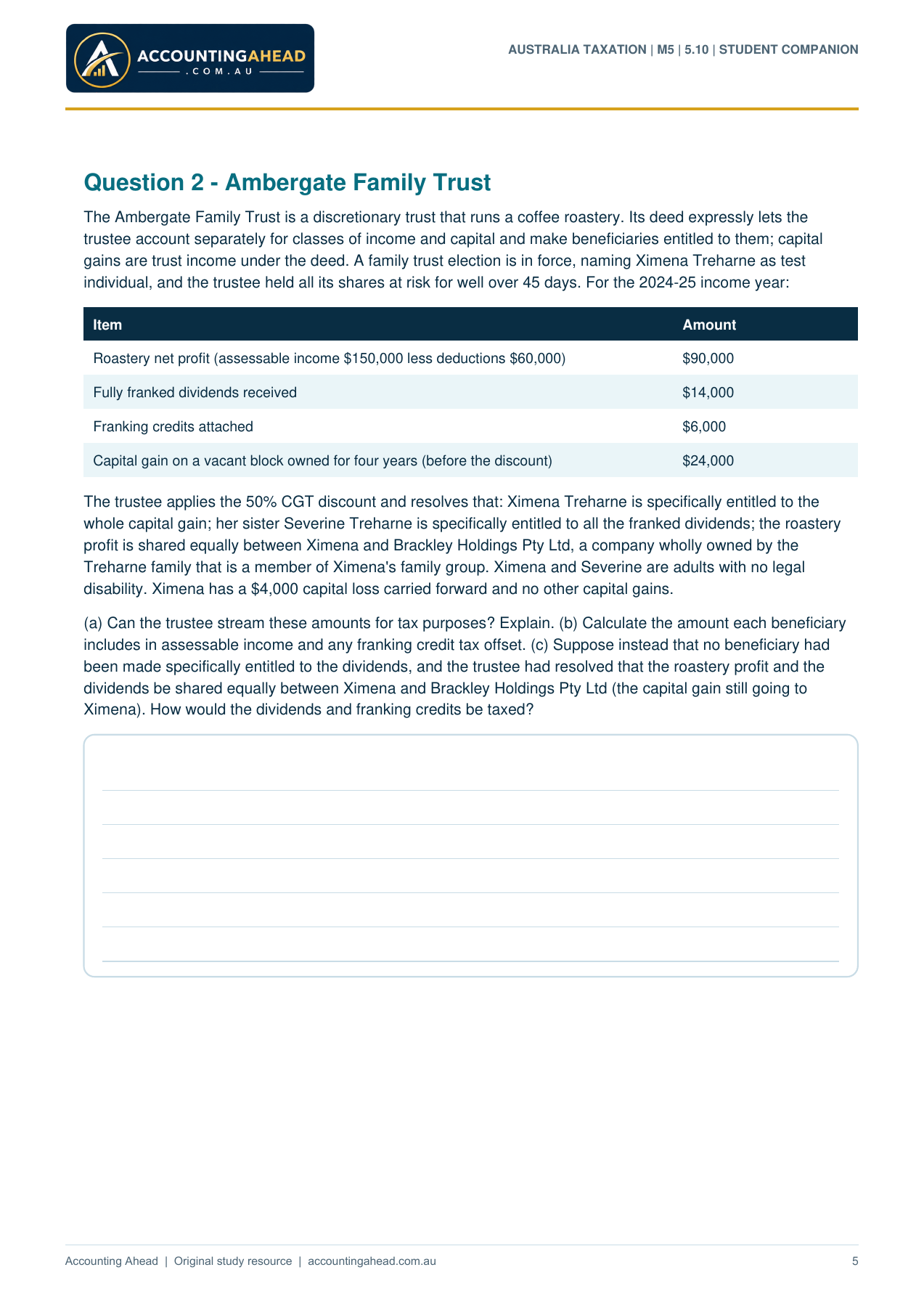
Question 2 - Ambergate Family Trust
The Ambergate Family Trust is a discretionary trust that runs a coffee roastery. Its deed expressly lets the
trustee account separately for classes of income and capital and make beneficiaries entitled to them; capital
gains are trust income under the deed. A family trust election is in force, naming Ximena Treharne as test
individual, and the trustee held all its shares at risk for well over 45 days. For the 2024-25 income year:
Item Amount
Roastery net profit (assessable income $150,000 less deductions $60,000) $90,000
Fully franked dividends received $14,000
Franking credits attached $6,000
Capital gain on a vacant block owned for four years (before the discount) $24,000
The trustee applies the 50% CGT discount and resolves that: Ximena Treharne is specifically entitled to the
whole capital gain; her sister Severine Treharne is specifically entitled to all the franked dividends; the roastery
profit is shared equally between Ximena and Brackley Holdings Pty Ltd, a company wholly owned by the
Treharne family that is a member of Ximena's family group. Ximena and Severine are adults with no legal
disability. Ximena has a $4,000 capital loss carried forward and no other capital gains.
(a) Can the trustee stream these amounts for tax purposes? Explain. (b) Calculate the amount each beneficiary
includes in assessable income and any franking credit tax offset. (c) Suppose instead that no beneficiary had
been made specifically entitled to the dividends, and the trustee had resolved that the roastery profit and the
dividends be shared equally between Ximena and Brackley Holdings Pty Ltd (the capital gain still going to
Ximena). How would the dividends and franking credits be taxed?
AUSTRALIA TAXATION | M5 | 5.10 | STUDENT COMPANION
5
Accounting Ahead | Original study resource | accountingahead.com.au
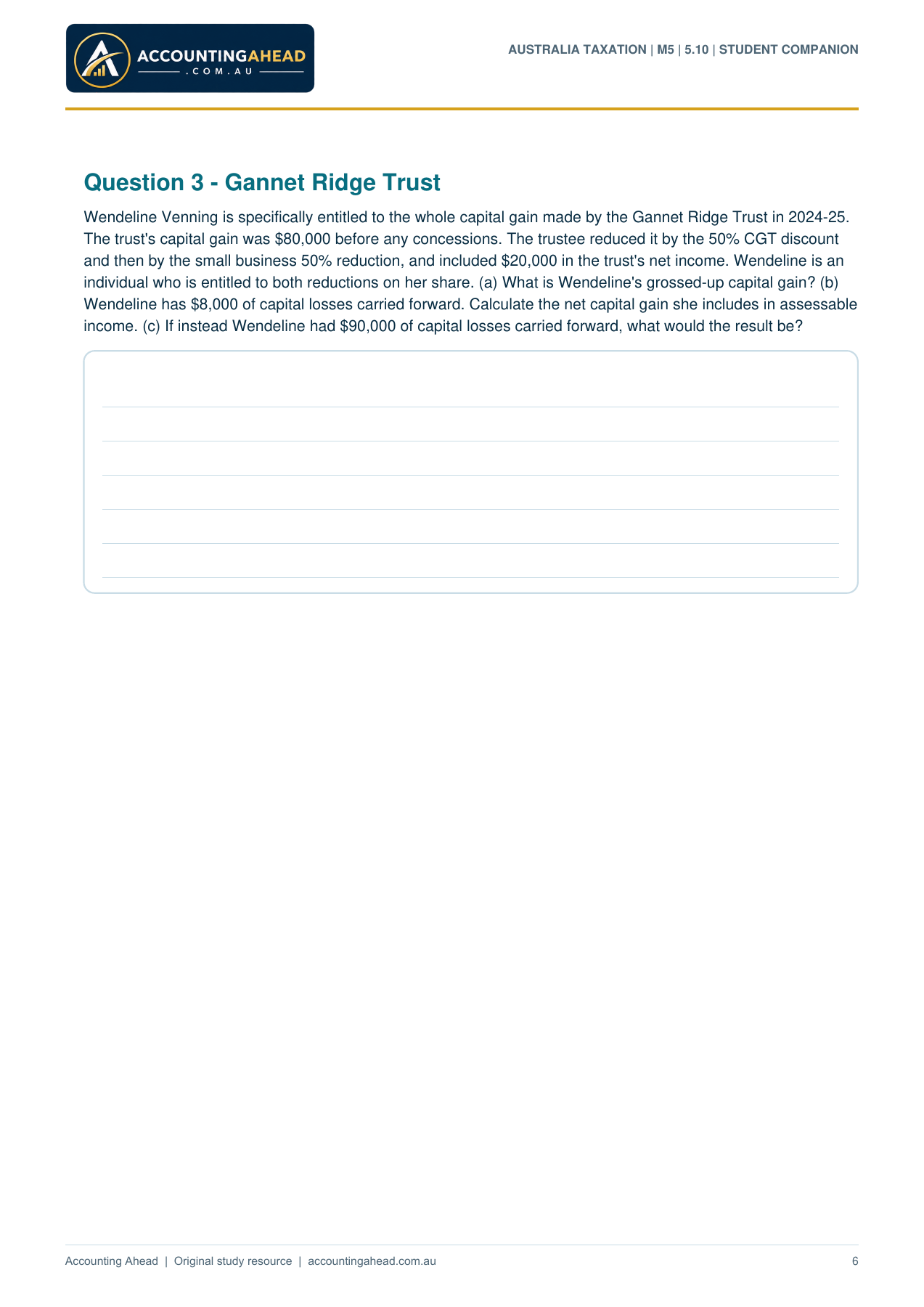
Question 3 - Gannet Ridge Trust
Wendeline Venning is specifically entitled to the whole capital gain made by the Gannet Ridge Trust in 2024-25.
The trust's capital gain was $80,000 before any concessions. The trustee reduced it by the 50% CGT discount
and then by the small business 50% reduction, and included $20,000 in the trust's net income. Wendeline is an
individual who is entitled to both reductions on her share. (a) What is Wendeline's grossed-up capital gain? (b)
Wendeline has $8,000 of capital losses carried forward. Calculate the net capital gain she includes in assessable
income. (c) If instead Wendeline had $90,000 of capital losses carried forward, what would the result be?
AUSTRALIA TAXATION | M5 | 5.10 | STUDENT COMPANION
6
Accounting Ahead | Original study resource | accountingahead.com.au
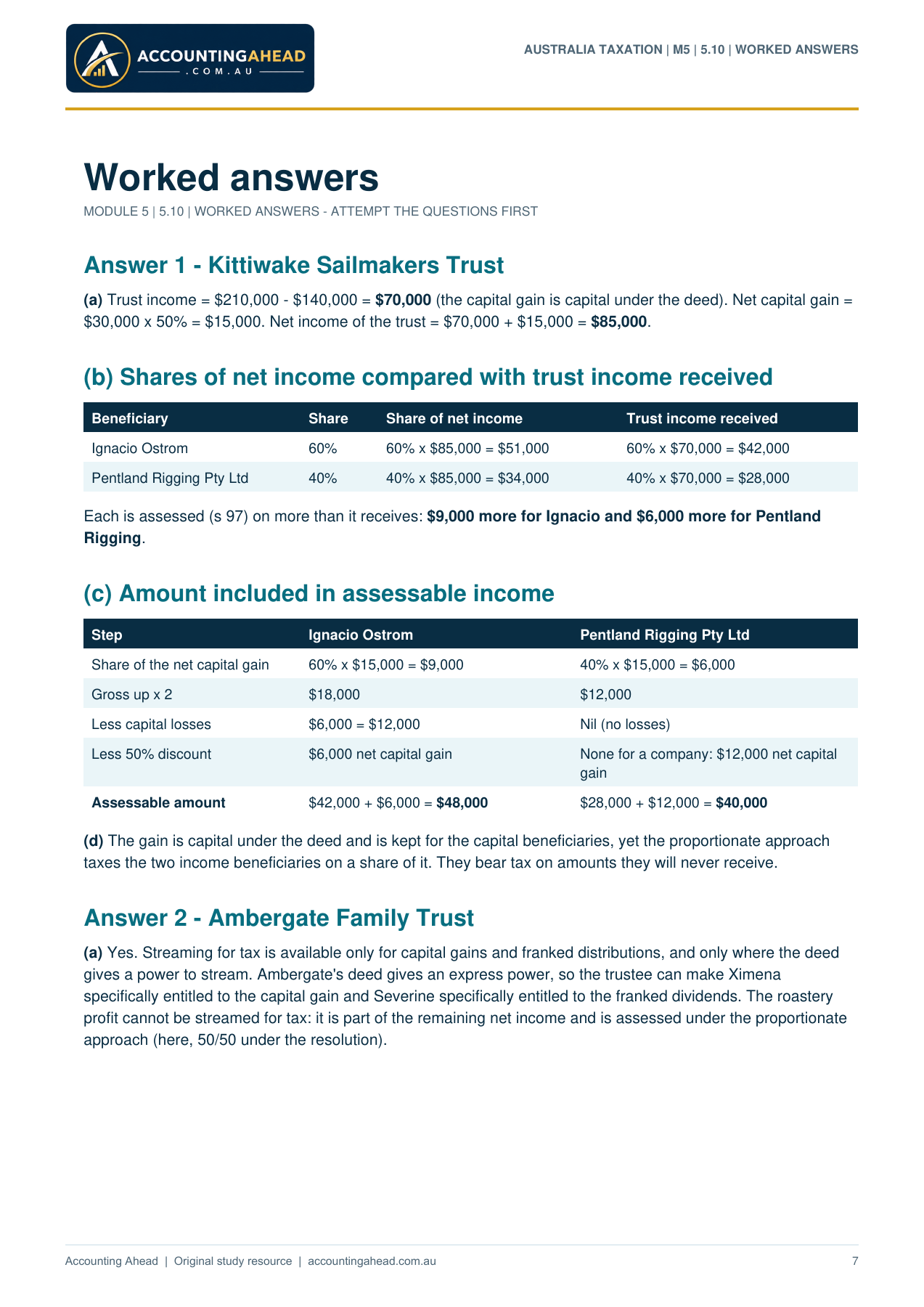
Worked answers
MODULE 5 | 5.10 | WORKED ANSWERS - ATTEMPT THE QUESTIONS FIRST
Answer 1 - Kittiwake Sailmakers Trust
(a) Trust income = $210,000 - $140,000 = $70,000 (the capital gain is capital under the deed). Net capital gain =
$30,000 x 50% = $15,000. Net income of the trust = $70,000 + $15,000 = $85,000.
(b) Shares of net income compared with trust income received
Beneficiary Share Share of net income Trust income received
Ignacio Ostrom 60% 60% x $85,000 = $51,000 60% x $70,000 = $42,000
Pentland Rigging Pty Ltd 40% 40% x $85,000 = $34,000 40% x $70,000 = $28,000
Each is assessed (s 97) on more than it receives: $9,000 more for Ignacio and $6,000 more for Pentland
Rigging.
(c) Amount included in assessable income
Step Ignacio Ostrom Pentland Rigging Pty Ltd
Share of the net capital gain 60% x $15,000 = $9,000 40% x $15,000 = $6,000
Gross up x 2 $18,000 $12,000
Less capital losses $6,000 = $12,000 Nil (no losses)
Less 50% discount $6,000 net capital gain None for a company: $12,000 net capital
gain
Assessable amount $42,000 + $6,000 = $48,000 $28,000 + $12,000 = $40,000
(d) The gain is capital under the deed and is kept for the capital beneficiaries, yet the proportionate approach
taxes the two income beneficiaries on a share of it. They bear tax on amounts they will never receive.
Answer 2 - Ambergate Family Trust
(a) Yes. Streaming for tax is available only for capital gains and franked distributions, and only where the deed
gives a power to stream. Ambergate's deed gives an express power, so the trustee can make Ximena
specifically entitled to the capital gain and Severine specifically entitled to the franked dividends. The roastery
profit cannot be streamed for tax: it is part of the remaining net income and is assessed under the proportionate
approach (here, 50/50 under the resolution).
AUSTRALIA TAXATION | M5 | 5.10 | WORKED ANSWERS
7
Accounting Ahead | Original study resource | accountingahead.com.au
(b) Assessable amounts and franking credit tax offsets
Beneficiary Working Result
Ximena Treharne Streamed net capital gain $24,000 x 50% = $12,000. Gross up x 2
= $24,000. Less capital loss $4,000 = $20,000. Less 50%
discount = $10,000 net capital gain. Plus roastery share $90,000 x
50% = $45,000. No franking credits.
Assessable amount
$55,000
Severine Treharne Franked dividends $14,000 + franking credits $6,000 = $20,000
assessable. Franking credit tax offset $6,000. Her credits are
$5,000 or more, so the small shareholder exemption would not
help her; the family trust election (with shares held at risk for over
45 days) keeps the credits available.
Assessable $20,000;
offset $6,000
Brackley Holdings Pty
Ltd
Roastery share $45,000 assessable. No franking credits. As a
family group member, the distribution does not attract family trust
distribution tax.
Assessable amount
$45,000
Check: net income of the trust = $90,000 + $14,000 + $6,000 + $12,000 = $122,000 = Ximena $57,000 (before
her gross-up) + Severine $20,000 + Brackley $45,000.
(c) With no specific entitlement, the franked dividends are taxed in proportion to each beneficiary's entitlement to
trust income, like the rest of the net income: 50% each (the streamed capital gain is left out of this sharing).
Ximena and Brackley Holdings Pty Ltd each include $7,000 of dividends + $3,000 of franking credits = $10,000,
and each gets a $3,000 franking credit tax offset. Severine includes nothing. Ximena's assessable amount
becomes $45,000 + $10,000 + $10,000 net capital gain = $65,000; Brackley's becomes $45,000 + $10,000 =
$55,000.
Answer 3 - Gannet Ridge Trust
(a) Both the 50% discount and the small business 50% reduction applied, so the gross-up factor is 4: $20,000
x 4 = $80,000.
(b) $80,000 - $8,000 capital losses = $72,000. Less 50% CGT discount = $36,000. Less small business 50%
reduction = $18,000 net capital gain included in assessable income.
(c) $80,000 - $90,000 = a $10,000 excess of losses. Wendeline has no net capital gain for the year, includes
nothing from the trust gain in assessable income, and carries forward a $10,000 net capital loss.
AUSTRALIA TAXATION | M5 | 5.10 | WORKED ANSWERS
8