
Company Taxation - Core Concepts — study companion
Part 5.13.1 of Australia Taxation. Preview the study companion or download the printable PDF.

Read the handout text
Accounting Ahead | Original study resource | accountingahead.com.au
Company Taxation - Core Concepts
MODULE 5 | 5.13.1 | STUDENT COMPANION
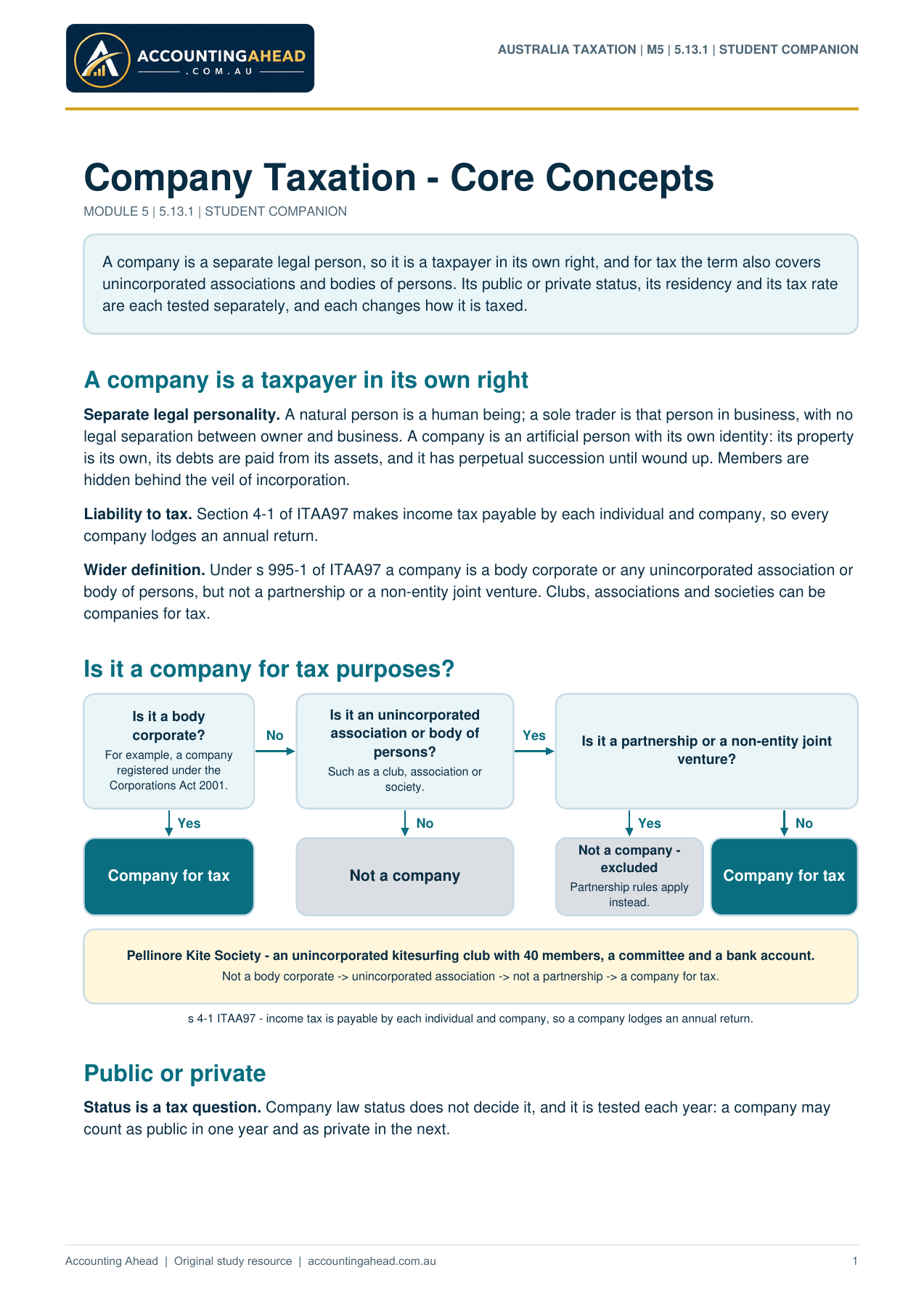
A company is a separate legal person, so it is a taxpayer in its own right, and for tax the term also covers
unincorporated associations and bodies of persons. Its public or private status, its residency and its tax rate
are each tested separately, and each changes how it is taxed.
A company is a taxpayer in its own right
Separate legal personality. A natural person is a human being; a sole trader is that person in business, with no
legal separation between owner and business. A company is an artificial person with its own identity: its property
is its own, its debts are paid from its assets, and it has perpetual succession until wound up. Members are
hidden behind the veil of incorporation.
Liability to tax. Section 4-1 of ITAA97 makes income tax payable by each individual and company, so every
company lodges an annual return.
Wider definition. Under s 995-1 of ITAA97 a company is a body corporate or any unincorporated association or
body of persons, but not a partnership or a non-entity joint venture. Clubs, associations and societies can be
companies for tax.
Is it a company for tax purposes?
Is it a body
corporate?
For example, a company
registered under the
Corporations Act 2001.
Is it an unincorporated
association or body of
persons?
Such as a club, association or
society.
Is it a partnership or a non-entity joint
venture?
No Yes
Yes No Yes No
Company for tax Not a company
Not a company -
excluded
Partnership rules apply
instead.
Company for tax
Pellinore Kite Society - an unincorporated kitesurfing club with 40 members, a committee and a bank account.
Not a body corporate -> unincorporated association -> not a partnership -> a company for tax.
s 4-1 ITAA97 - income tax is payable by each individual and company, so a company lodges an annual return.
Public or private
Status is a tax question. Company law status does not decide it, and it is tested each year: a company may
count as public in one year and as private in the next.
AUSTRALIA TAXATION | M5 | 5.13.1 | STUDENT COMPANION
1
Accounting Ahead | Original study resource | accountingahead.com.au
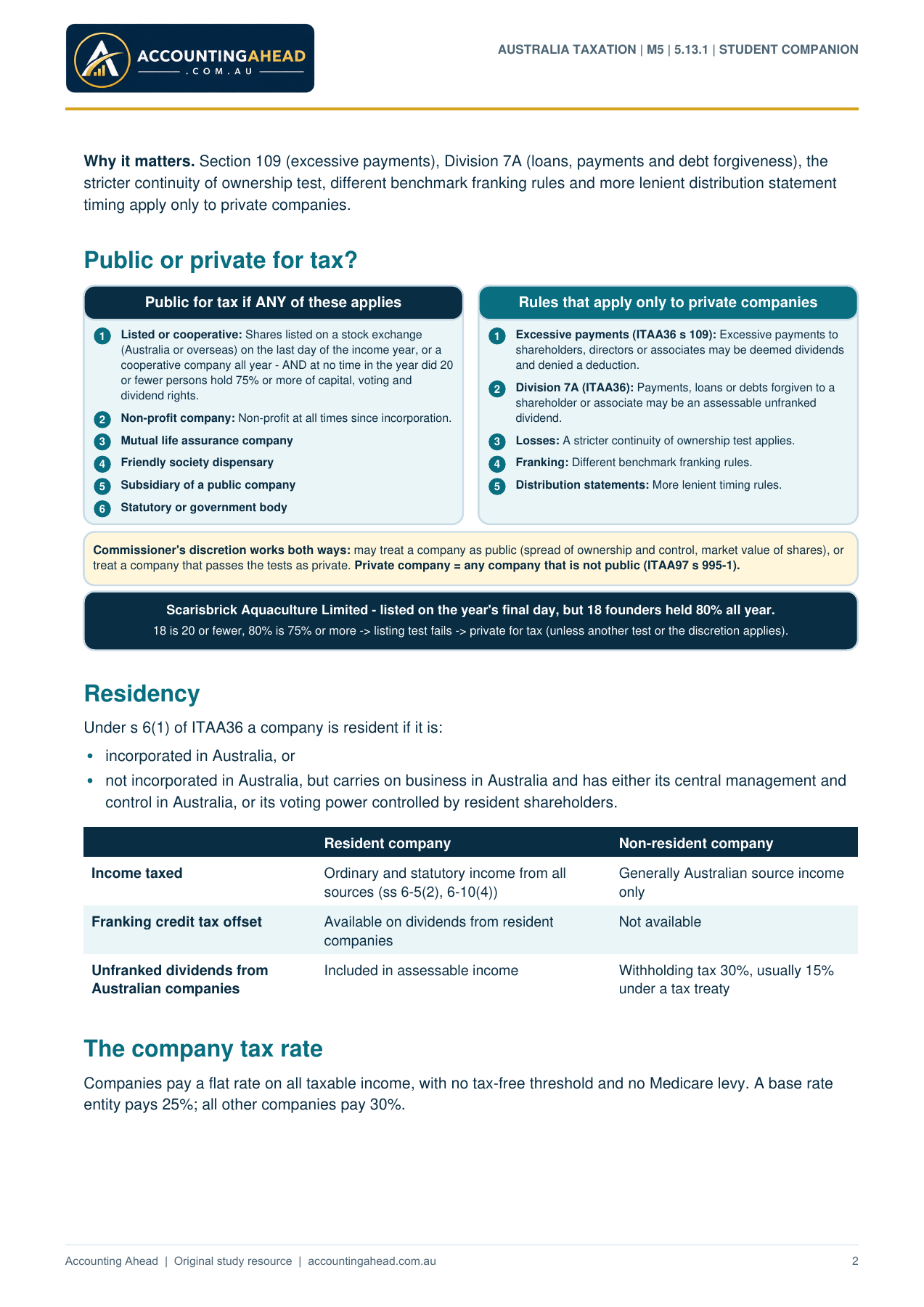
Why it matters. Section 109 (excessive payments), Division 7A (loans, payments and debt forgiveness), the
stricter continuity of ownership test, different benchmark franking rules and more lenient distribution statement
timing apply only to private companies.
Public or private for tax?
Public for tax if ANY of these applies
1 Listed or cooperative: Shares listed on a stock exchange
(Australia or overseas) on the last day of the income year, or a
cooperative company all year - AND at no time in the year did 20
or fewer persons hold 75% or more of capital, voting and
dividend rights.
2 Non-profit company: Non-profit at all times since incorporation.
3 Mutual life assurance company
4 Friendly society dispensary
5 Subsidiary of a public company
6 Statutory or government body
Rules that apply only to private companies
1 Excessive payments (ITAA36 s 109): Excessive payments to
shareholders, directors or associates may be deemed dividends
and denied a deduction.
2 Division 7A (ITAA36): Payments, loans or debts forgiven to a
shareholder or associate may be an assessable unfranked
dividend.
3 Losses: A stricter continuity of ownership test applies.
4 Franking: Different benchmark franking rules.
5 Distribution statements: More lenient timing rules.
Commissioner's discretion works both ways: may treat a company as public (spread of ownership and control, market value of shares), or
treat a company that passes the tests as private. Private company = any company that is not public (ITAA97 s 995-1).
Scarisbrick Aquaculture Limited - listed on the year's final day, but 18 founders held 80% all year.
18 is 20 or fewer, 80% is 75% or more -> listing test fails -> private for tax (unless another test or the discretion applies).
Residency
Under s 6(1) of ITAA36 a company is resident if it is:
incorporated in Australia, or
not incorporated in Australia, but carries on business in Australia and has either its central management and
control in Australia, or its voting power controlled by resident shareholders.
Resident company Non-resident company
Income taxed Ordinary and statutory income from all
sources (ss 6-5(2), 6-10(4))
Generally Australian source income
only
Franking credit tax offset Available on dividends from resident
companies
Not available
Unfranked dividends from
Australian companies
Included in assessable income Withholding tax 30%, usually 15%
under a tax treaty
The company tax rate
Companies pay a flat rate on all taxable income, with no tax-free threshold and no Medicare levy. A base rate
entity pays 25%; all other companies pay 30%.
AUSTRALIA TAXATION | M5 | 5.13.1 | STUDENT COMPANION
2
Accounting Ahead | Original study resource | accountingahead.com.au
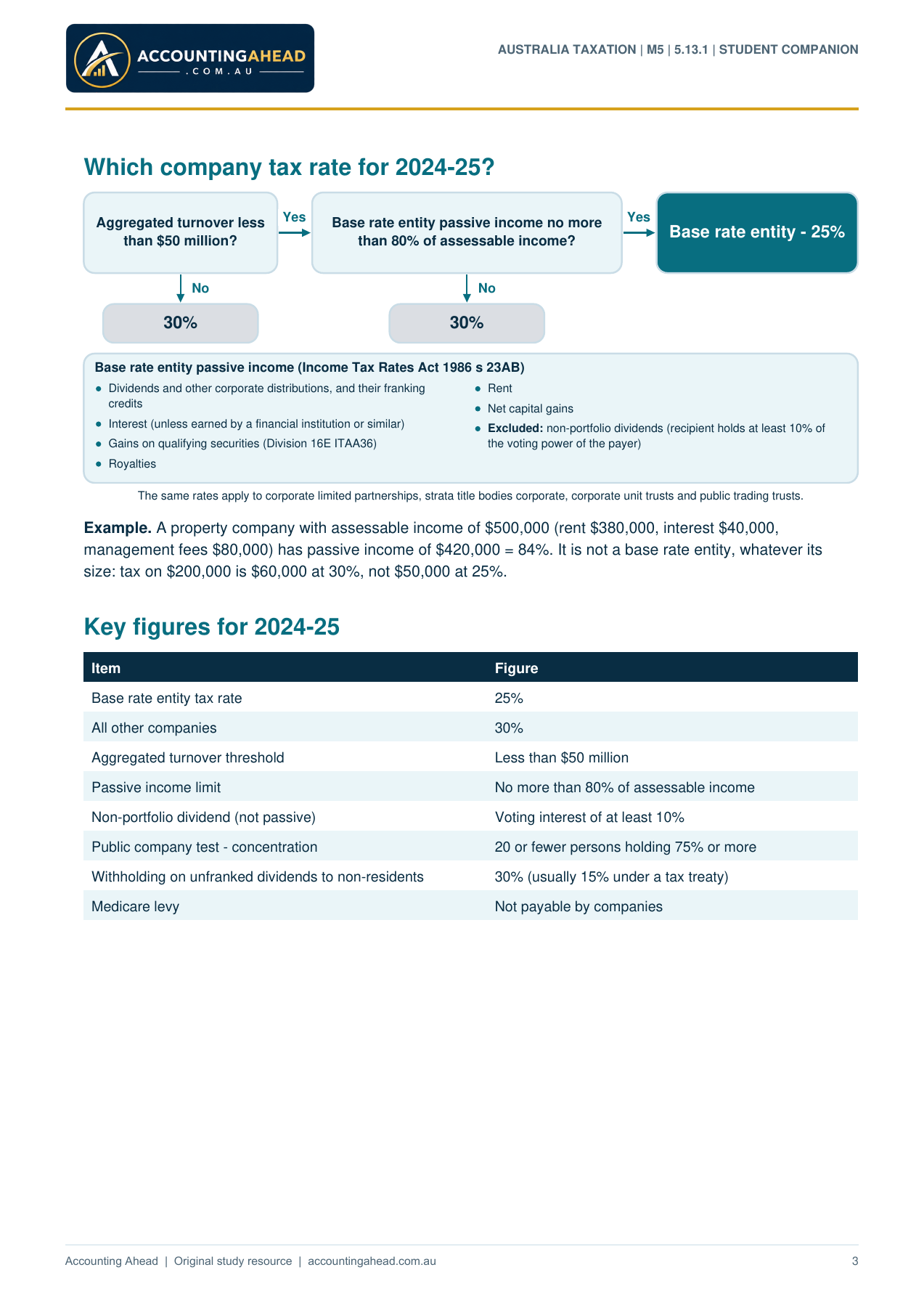
Which company tax rate for 2024-25?
Aggregated turnover less
than $50 million?
Base rate entity passive income no more
than 80% of assessable income? Base rate entity - 25%
Yes Yes
No
30%
No
30%
Base rate entity passive income (Income Tax Rates Act 1986 s 23AB)
Dividends and other corporate distributions, and their franking
credits
Interest (unless earned by a financial institution or similar)
Gains on qualifying securities (Division 16E ITAA36)
Royalties
Rent
Net capital gains
Excluded: non-portfolio dividends (recipient holds at least 10% of
the voting power of the payer)
The same rates apply to corporate limited partnerships, strata title bodies corporate, corporate unit trusts and public trading trusts.
Example. A property company with assessable income of $500,000 (rent $380,000, interest $40,000,
management fees $80,000) has passive income of $420,000 = 84%. It is not a base rate entity, whatever its
size: tax on $200,000 is $60,000 at 30%, not $50,000 at 25%.
Key figures for 2024-25
Item Figure
Base rate entity tax rate 25%
All other companies 30%
Aggregated turnover threshold Less than $50 million
Passive income limit No more than 80% of assessable income
Non-portfolio dividend (not passive) Voting interest of at least 10%
Public company test - concentration 20 or fewer persons holding 75% or more
Withholding on unfranked dividends to non-residents 30% (usually 15% under a tax treaty)
Medicare levy Not payable by companies
AUSTRALIA TAXATION | M5 | 5.13.1 | STUDENT COMPANION
3
Accounting Ahead | Original study resource | accountingahead.com.au
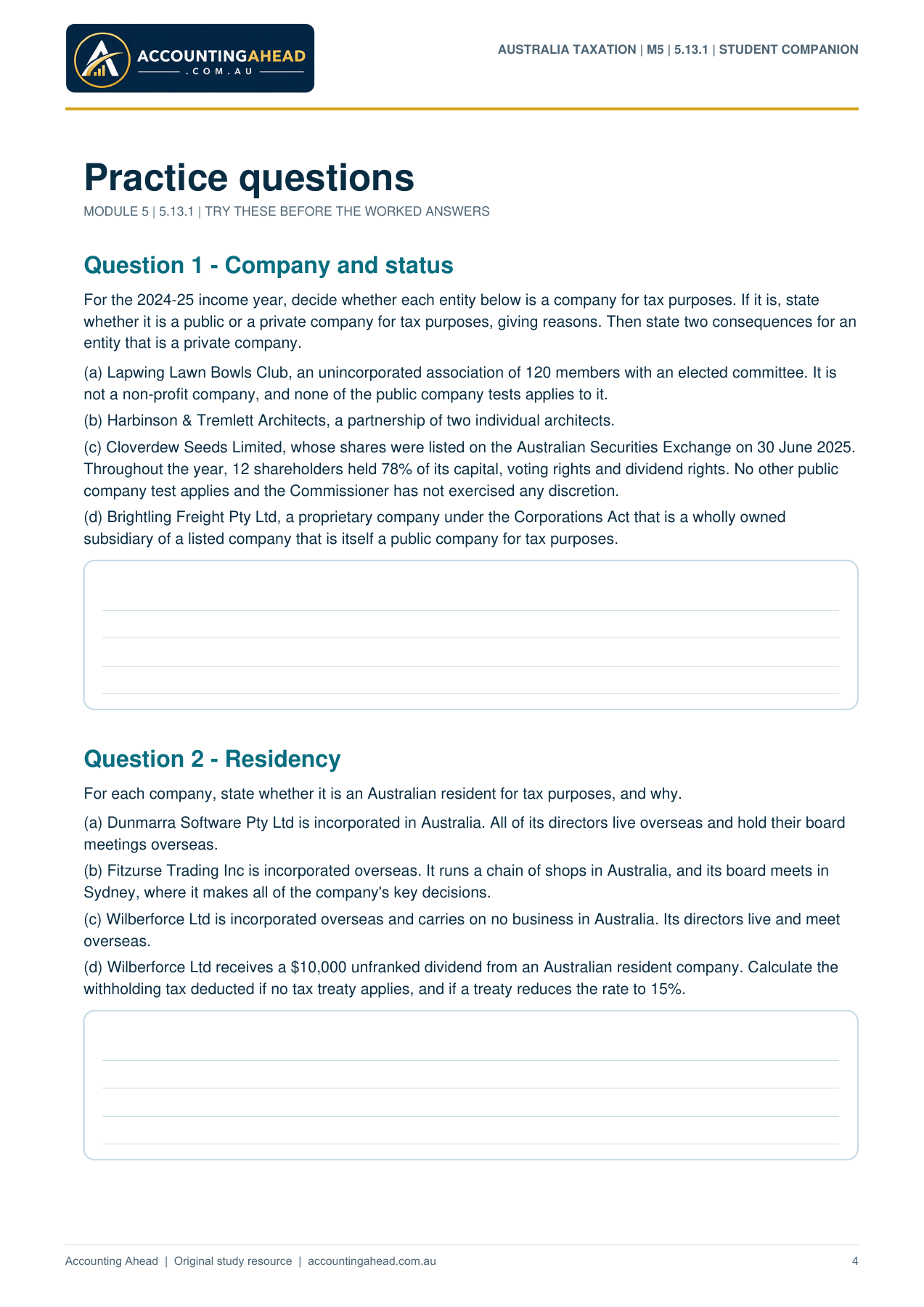
Practice questions
MODULE 5 | 5.13.1 | TRY THESE BEFORE THE WORKED ANSWERS
Question 1 - Company and status
For the 2024-25 income year, decide whether each entity below is a company for tax purposes. If it is, state
whether it is a public or a private company for tax purposes, giving reasons. Then state two consequences for an
entity that is a private company.
(a) Lapwing Lawn Bowls Club, an unincorporated association of 120 members with an elected committee. It is
not a non-profit company, and none of the public company tests applies to it.
(b) Harbinson & Tremlett Architects, a partnership of two individual architects.
(c) Cloverdew Seeds Limited, whose shares were listed on the Australian Securities Exchange on 30 June 2025.
Throughout the year, 12 shareholders held 78% of its capital, voting rights and dividend rights. No other public
company test applies and the Commissioner has not exercised any discretion.
(d) Brightling Freight Pty Ltd, a proprietary company under the Corporations Act that is a wholly owned
subsidiary of a listed company that is itself a public company for tax purposes.
Question 2 - Residency
For each company, state whether it is an Australian resident for tax purposes, and why.
(a) Dunmarra Software Pty Ltd is incorporated in Australia. All of its directors live overseas and hold their board
meetings overseas.
(b) Fitzurse Trading Inc is incorporated overseas. It runs a chain of shops in Australia, and its board meets in
Sydney, where it makes all of the company's key decisions.
(c) Wilberforce Ltd is incorporated overseas and carries on no business in Australia. Its directors live and meet
overseas.
(d) Wilberforce Ltd receives a $10,000 unfranked dividend from an Australian resident company. Calculate the
withholding tax deducted if no tax treaty applies, and if a treaty reduces the rate to 15%.
AUSTRALIA TAXATION | M5 | 5.13.1 | STUDENT COMPANION
4
Accounting Ahead | Original study resource | accountingahead.com.au
Question 3 - Which rate?
Two Australian resident companies have these results for the 2024-25 income year. For each company, decide
whether it is a base rate entity and calculate its tax on taxable income (ignore tax offsets).
Ashwick Holdings Pty Ltd - aggregated turnover $570,000; taxable income $200,000. Its assessable income
was:
Item Amount
Rent $300,000
Interest from a bank term deposit $90,000
Portfolio dividends (franked) $70,000
Franking credits on those dividends $30,000
Net capital gain $40,000
Consulting fees $110,000
Total assessable income $640,000
Stobart Engineering Pty Ltd - aggregated turnover $18 million; taxable income $1,200,000. Its assessable
income of $18,250,000 was made up of engineering services income of $17,600,000, rent from sub-letting part
of its factory of $100,000, bank interest of $50,000, and a fully franked dividend of $350,000 (with a franking
credit of $150,000) from a company in which Stobart holds 40% of the voting power.
(c) Would Stobart's answer change if its aggregated turnover had been exactly $50 million? Calculate its tax in
that case.
AUSTRALIA TAXATION | M5 | 5.13.1 | STUDENT COMPANION
5
Accounting Ahead | Original study resource | accountingahead.com.au
Worked answers
MODULE 5 | 5.13.1 | WORKED ANSWERS - ATTEMPT THE QUESTIONS FIRST
Answer 1 - Company and status
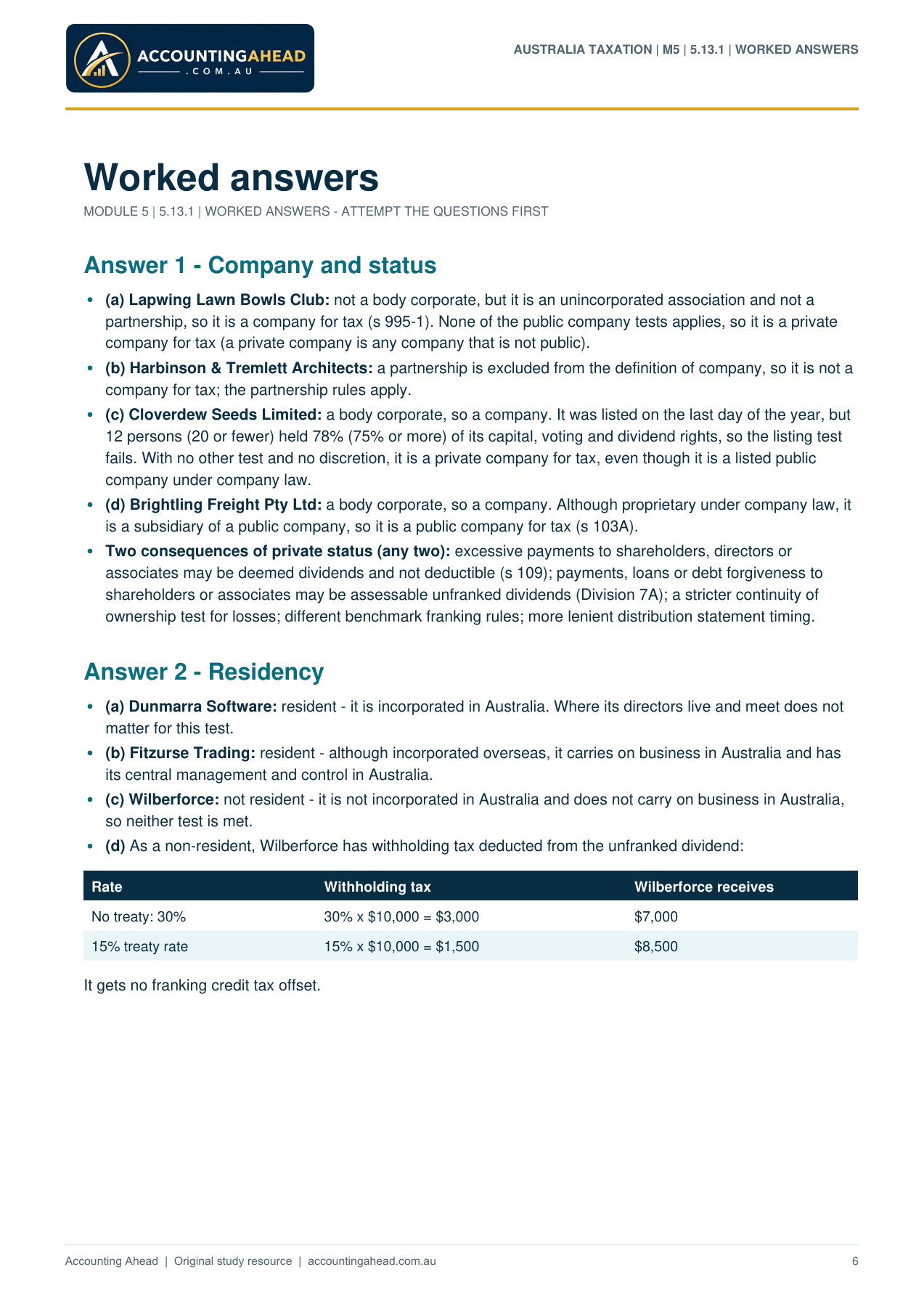
(a) Lapwing Lawn Bowls Club: not a body corporate, but it is an unincorporated association and not a
partnership, so it is a company for tax (s 995-1). None of the public company tests applies, so it is a private
company for tax (a private company is any company that is not public).
(b) Harbinson & Tremlett Architects: a partnership is excluded from the definition of company, so it is not a
company for tax; the partnership rules apply.
(c) Cloverdew Seeds Limited: a body corporate, so a company. It was listed on the last day of the year, but
12 persons (20 or fewer) held 78% (75% or more) of its capital, voting and dividend rights, so the listing test
fails. With no other test and no discretion, it is a private company for tax, even though it is a listed public
company under company law.
(d) Brightling Freight Pty Ltd: a body corporate, so a company. Although proprietary under company law, it
is a subsidiary of a public company, so it is a public company for tax (s 103A).
Two consequences of private status (any two): excessive payments to shareholders, directors or
associates may be deemed dividends and not deductible (s 109); payments, loans or debt forgiveness to
shareholders or associates may be assessable unfranked dividends (Division 7A); a stricter continuity of
ownership test for losses; different benchmark franking rules; more lenient distribution statement timing.
Answer 2 - Residency
(a) Dunmarra Software: resident - it is incorporated in Australia. Where its directors live and meet does not
matter for this test.
(b) Fitzurse Trading: resident - although incorporated overseas, it carries on business in Australia and has
its central management and control in Australia.
(c) Wilberforce: not resident - it is not incorporated in Australia and does not carry on business in Australia,
so neither test is met.
(d) As a non-resident, Wilberforce has withholding tax deducted from the unfranked dividend:
Rate Withholding tax Wilberforce receives
No treaty: 30% 30% x $10,000 = $3,000 $7,000
15% treaty rate 15% x $10,000 = $1,500 $8,500
It gets no franking credit tax offset.
AUSTRALIA TAXATION | M5 | 5.13.1 | WORKED ANSWERS
6
Accounting Ahead | Original study resource | accountingahead.com.au
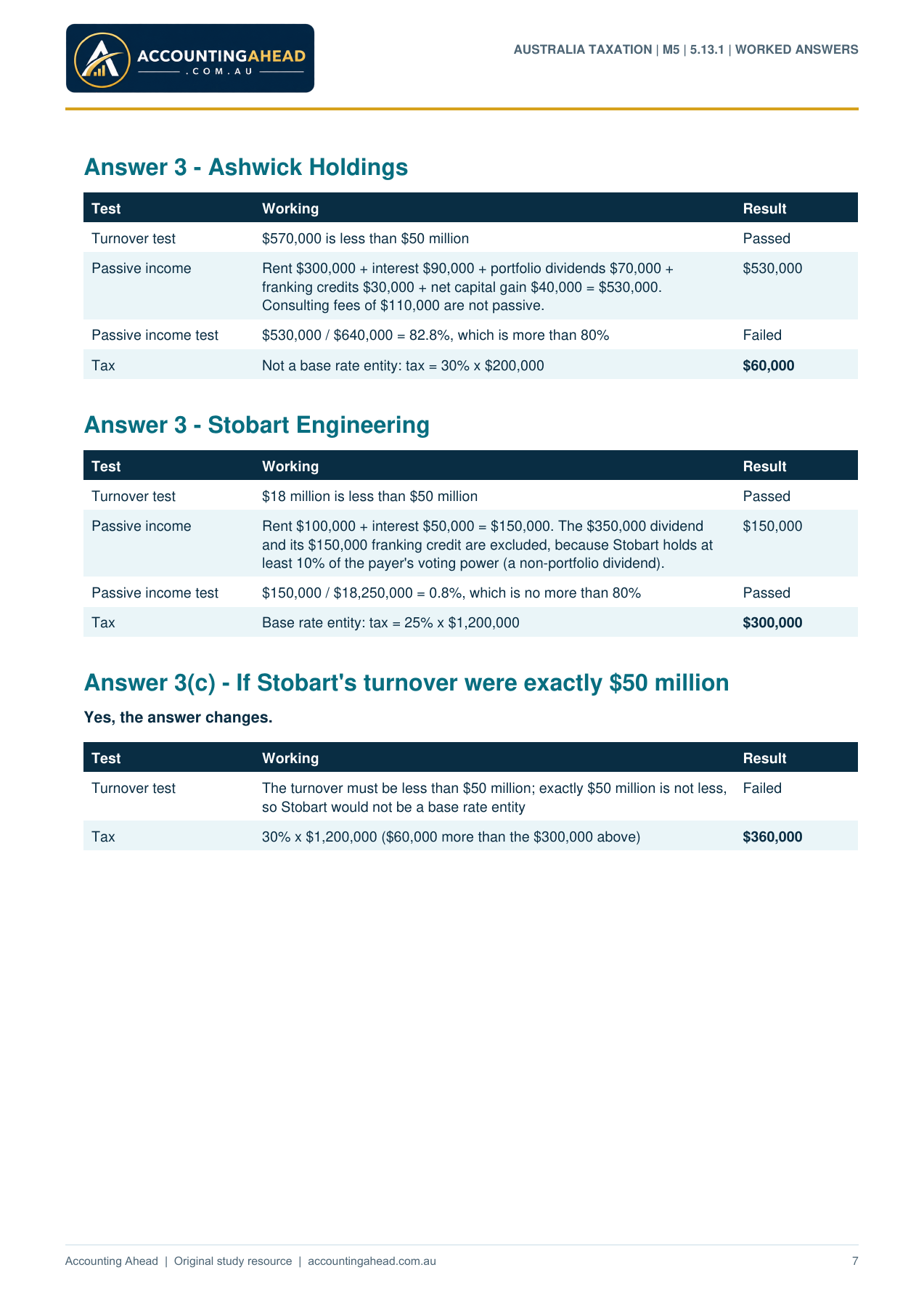
Answer 3 - Ashwick Holdings
Test Working Result
Turnover test $570,000 is less than $50 million Passed
Passive income Rent $300,000 + interest $90,000 + portfolio dividends $70,000 +
franking credits $30,000 + net capital gain $40,000 = $530,000.
Consulting fees of $110,000 are not passive.
$530,000
Passive income test $530,000 / $640,000 = 82.8%, which is more than 80% Failed
Tax Not a base rate entity: tax = 30% x $200,000 $60,000
Answer 3 - Stobart Engineering
Test Working Result
Turnover test $18 million is less than $50 million Passed
Passive income Rent $100,000 + interest $50,000 = $150,000. The $350,000 dividend
and its $150,000 franking credit are excluded, because Stobart holds at
least 10% of the payer's voting power (a non-portfolio dividend).
$150,000
Passive income test $150,000 / $18,250,000 = 0.8%, which is no more than 80% Passed
Tax Base rate entity: tax = 25% x $1,200,000 $300,000
Answer 3(c) - If Stobart's turnover were exactly $50 million
Yes, the answer changes.
Test Working Result
Turnover test The turnover must be less than $50 million; exactly $50 million is not less,
so Stobart would not be a base rate entity
Failed
Tax 30% x $1,200,000 ($60,000 more than the $300,000 above) $360,000
AUSTRALIA TAXATION | M5 | 5.13.1 | WORKED ANSWERS
7