
Imputation - Franking Credits and Limits — study companion
Part 5.14.1 of Australia Taxation. Preview the study companion or download the printable PDF.

Read the handout text
Accounting Ahead | Original study resource | accountingahead.com.au
Imputation - franking credits and limits
MODULE 5 | 5.14.1 | STUDENT COMPANION
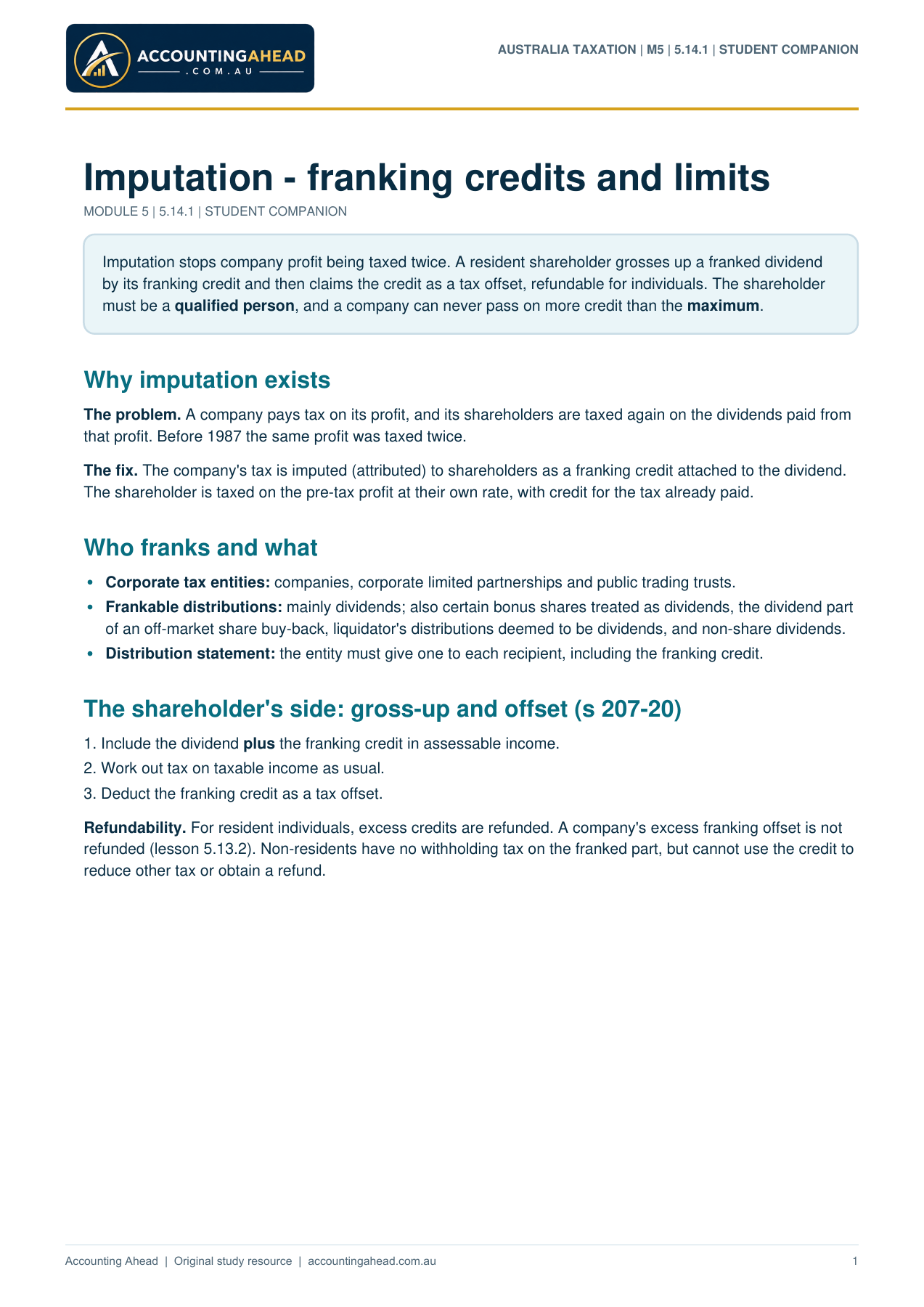
Imputation stops company profit being taxed twice. A resident shareholder grosses up a franked dividend
by its franking credit and then claims the credit as a tax offset, refundable for individuals. The shareholder
must be a qualified person, and a company can never pass on more credit than the maximum.
Why imputation exists
The problem. A company pays tax on its profit, and its shareholders are taxed again on the dividends paid from
that profit. Before 1987 the same profit was taxed twice.
The fix. The company's tax is imputed (attributed) to shareholders as a franking credit attached to the dividend.
The shareholder is taxed on the pre-tax profit at their own rate, with credit for the tax already paid.
Who franks and what
Corporate tax entities: companies, corporate limited partnerships and public trading trusts.
Frankable distributions: mainly dividends; also certain bonus shares treated as dividends, the dividend part
of an off-market share buy-back, liquidator's distributions deemed to be dividends, and non-share dividends.
Distribution statement: the entity must give one to each recipient, including the franking credit.
The shareholder's side: gross-up and offset (s 207-20)
1. Include the dividend plus the franking credit in assessable income.
2. Work out tax on taxable income as usual.
3. Deduct the franking credit as a tax offset.
Refundability. For resident individuals, excess credits are refunded. A company's excess franking offset is not
refunded (lesson 5.13.2). Non-residents have no withholding tax on the franked part, but cannot use the credit to
reduce other tax or obtain a refund.
AUSTRALIA TAXATION | M5 | 5.14.1 | STUDENT COMPANION
1
Accounting Ahead | Original study resource | accountingahead.com.au
How a franked dividend is taxed
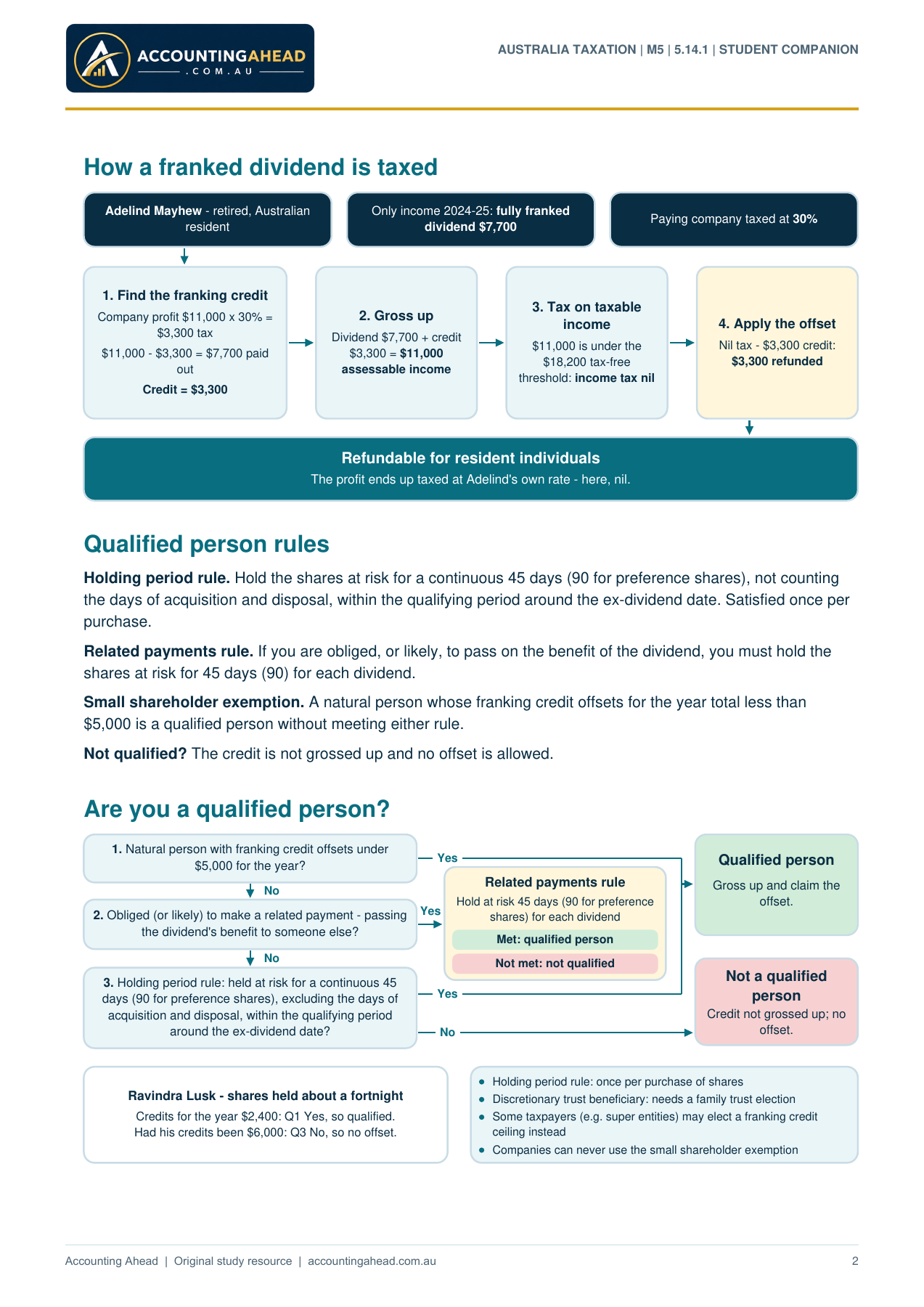
Adelind Mayhew - retired, Australian
resident
Only income 2024-25: fully franked
dividend $7,700 Paying company taxed at 30%
1. Find the franking credit
Company profit $11,000 x 30% =
$3,300 tax
$11,000 - $3,300 = $7,700 paid
out
Credit = $3,300
2. Gross up
Dividend $7,700 + credit
$3,300 = $11,000
assessable income
3. Tax on taxable
income
$11,000 is under the
$18,200 tax-free
threshold: income tax nil
4. Apply the offset
Nil tax - $3,300 credit:
$3,300 refunded
Refundable for resident individuals
The profit ends up taxed at Adelind's own rate - here, nil.
Qualified person rules
Holding period rule. Hold the shares at risk for a continuous 45 days (90 for preference shares), not counting
the days of acquisition and disposal, within the qualifying period around the ex-dividend date. Satisfied once per
purchase.
Related payments rule. If you are obliged, or likely, to pass on the benefit of the dividend, you must hold the
shares at risk for 45 days (90) for each dividend.
Small shareholder exemption. A natural person whose franking credit offsets for the year total less than
$5,000 is a qualified person without meeting either rule.
Not qualified? The credit is not grossed up and no offset is allowed.
Are you a qualified person?
1. Natural person with franking credit offsets under
$5,000 for the year?
2. Obliged (or likely) to make a related payment - passing
the dividend's benefit to someone else?
3. Holding period rule: held at risk for a continuous 45
days (90 for preference shares), excluding the days of
acquisition and disposal, within the qualifying period
around the ex-dividend date?
No
No
Related payments rule
Hold at risk 45 days (90 for preference
shares) for each dividend
Met: qualified person
Not met: not qualified
Yes
Qualified person
Gross up and claim the
offset.
Not a qualified
person
Credit not grossed up; no
offset.
Yes
Yes
No
Ravindra Lusk - shares held about a fortnight
Credits for the year $2,400: Q1 Yes, so qualified.
Had his credits been $6,000: Q3 No, so no offset.
Holding period rule: once per purchase of shares
Discretionary trust beneficiary: needs a family trust election
Some taxpayers (e.g. super entities) may elect a franking credit
ceiling instead
Companies can never use the small shareholder exemption
AUSTRALIA TAXATION | M5 | 5.14.1 | STUDENT COMPANION
2
Accounting Ahead | Original study resource | accountingahead.com.au
The company's side: maximum franking credit
Credit allocated = the lesser of the credit stated on the distribution statement and the maximum franking credit.
Maximum franking credit (s 202-60(2)) = frankable distribution x 1 / applicable gross-up rate, where gross-up
rate = (100% - corporate tax rate) / corporate tax rate.
Gross-up rates and maximum credits
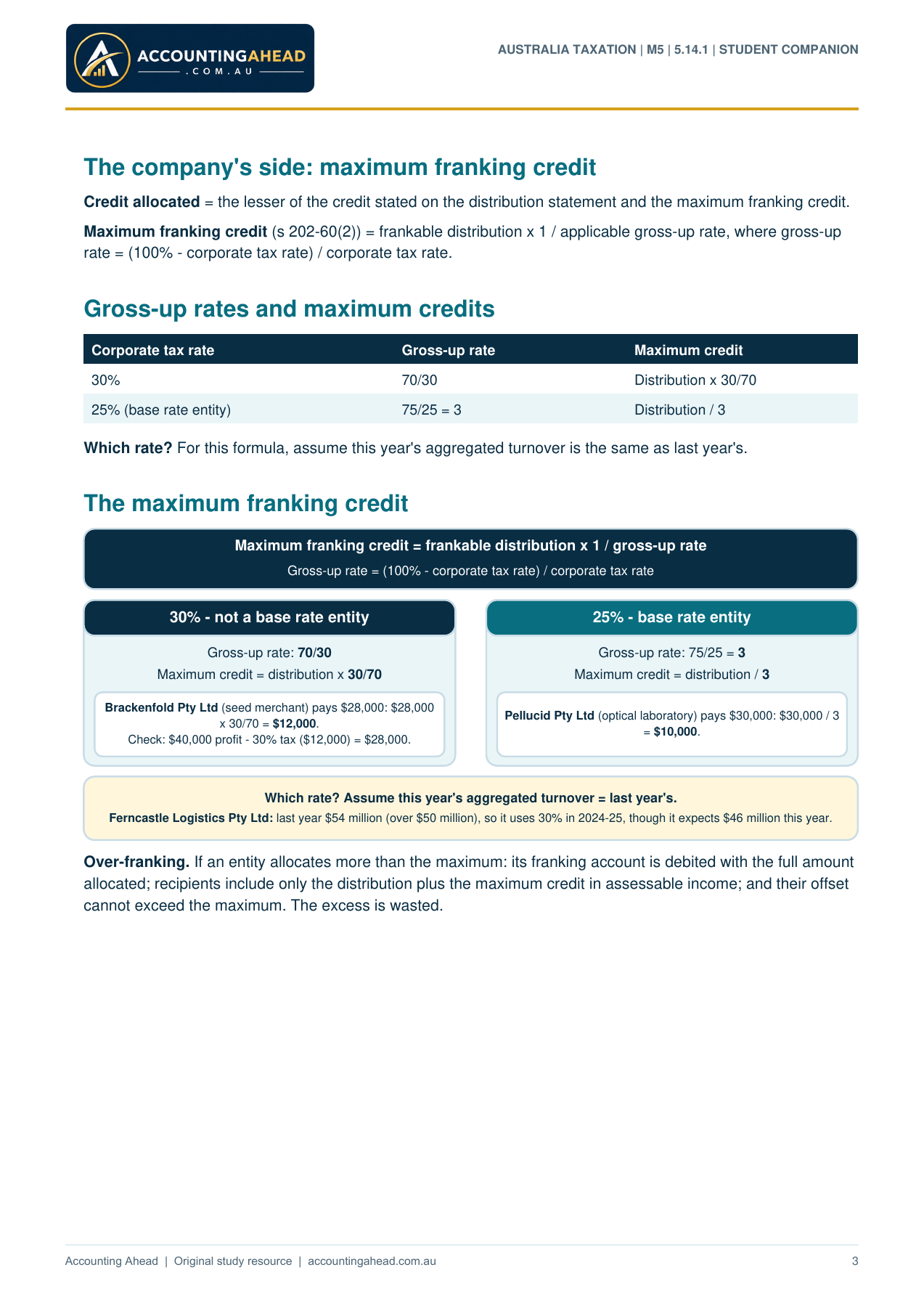
Corporate tax rate Gross-up rate Maximum credit
30% 70/30 Distribution x 30/70
25% (base rate entity) 75/25 = 3 Distribution / 3
Which rate? For this formula, assume this year's aggregated turnover is the same as last year's.
The maximum franking credit
Maximum franking credit = frankable distribution x 1 / gross-up rate
Gross-up rate = (100% - corporate tax rate) / corporate tax rate
30% - not a base rate entity
Gross-up rate: 70/30
Maximum credit = distribution x 30/70
Brackenfold Pty Ltd (seed merchant) pays $28,000: $28,000
x 30/70 = $12,000.
Check: $40,000 profit - 30% tax ($12,000) = $28,000.
25% - base rate entity
Gross-up rate: 75/25 = 3
Maximum credit = distribution / 3
Pellucid Pty Ltd (optical laboratory) pays $30,000: $30,000 / 3
= $10,000.
Which rate? Assume this year's aggregated turnover = last year's.
Ferncastle Logistics Pty Ltd: last year $54 million (over $50 million), so it uses 30% in 2024-25, though it expects $46 million this year.
Over-franking. If an entity allocates more than the maximum: its franking account is debited with the full amount
allocated; recipients include only the distribution plus the maximum credit in assessable income; and their offset
cannot exceed the maximum. The excess is wasted.
AUSTRALIA TAXATION | M5 | 5.14.1 | STUDENT COMPANION
3
Accounting Ahead | Original study resource | accountingahead.com.au
Key figures for 2024-25
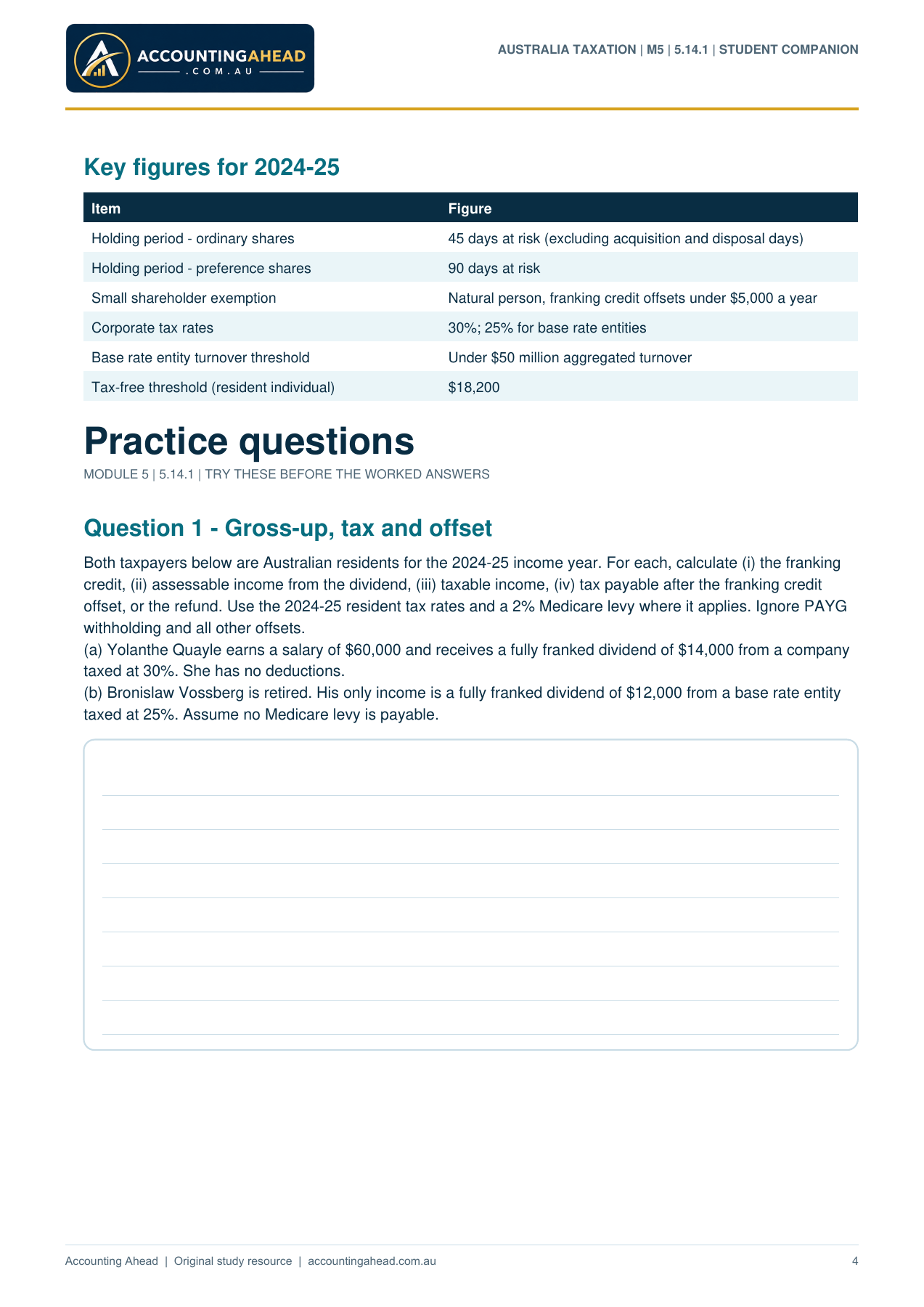
Item Figure
Holding period - ordinary shares 45 days at risk (excluding acquisition and disposal days)
Holding period - preference shares 90 days at risk
Small shareholder exemption Natural person, franking credit offsets under $5,000 a year
Corporate tax rates 30%; 25% for base rate entities
Base rate entity turnover threshold Under $50 million aggregated turnover
Tax-free threshold (resident individual) $18,200
Practice questions
MODULE 5 | 5.14.1 | TRY THESE BEFORE THE WORKED ANSWERS
Question 1 - Gross-up, tax and offset
Both taxpayers below are Australian residents for the 2024-25 income year. For each, calculate (i) the franking
credit, (ii) assessable income from the dividend, (iii) taxable income, (iv) tax payable after the franking credit
offset, or the refund. Use the 2024-25 resident tax rates and a 2% Medicare levy where it applies. Ignore PAYG
withholding and all other offsets.
(a) Yolanthe Quayle earns a salary of $60,000 and receives a fully franked dividend of $14,000 from a company
taxed at 30%. She has no deductions.
(b) Bronislaw Vossberg is retired. His only income is a fully franked dividend of $12,000 from a base rate entity
taxed at 25%. Assume no Medicare levy is payable.
AUSTRALIA TAXATION | M5 | 5.14.1 | STUDENT COMPANION
4
Accounting Ahead | Original study resource | accountingahead.com.au
Question 2 - Qualified person?
For each situation in 2024-25, state whether the taxpayer is a qualified person for the dividend, and explain why.
Assume the shares are held at risk throughout (no hedging) and that no related payment is made.
(a) Hortense Harcourt, an individual, buys ordinary shares in a listed company 10 days before they go
ex-dividend and sells them 20 days after. Her franking credit offsets for the whole year total $3,200.
(b) Tregenna Orchards Pty Ltd makes the same trade. Its franking credits for the year total $800.
(c) Marguerite Pellow holds preference shares for 60 days, not counting the days she bought and sold them. Her
franking credit offsets for the year total $7,400.
(d) Lysander Trewin holds ordinary shares for a continuous 50 days, not counting the days he bought and sold
them, spanning the ex-dividend date. His franking credit offsets for the year total $9,000.
AUSTRALIA TAXATION | M5 | 5.14.1 | STUDENT COMPANION
5
Accounting Ahead | Original study resource | accountingahead.com.au
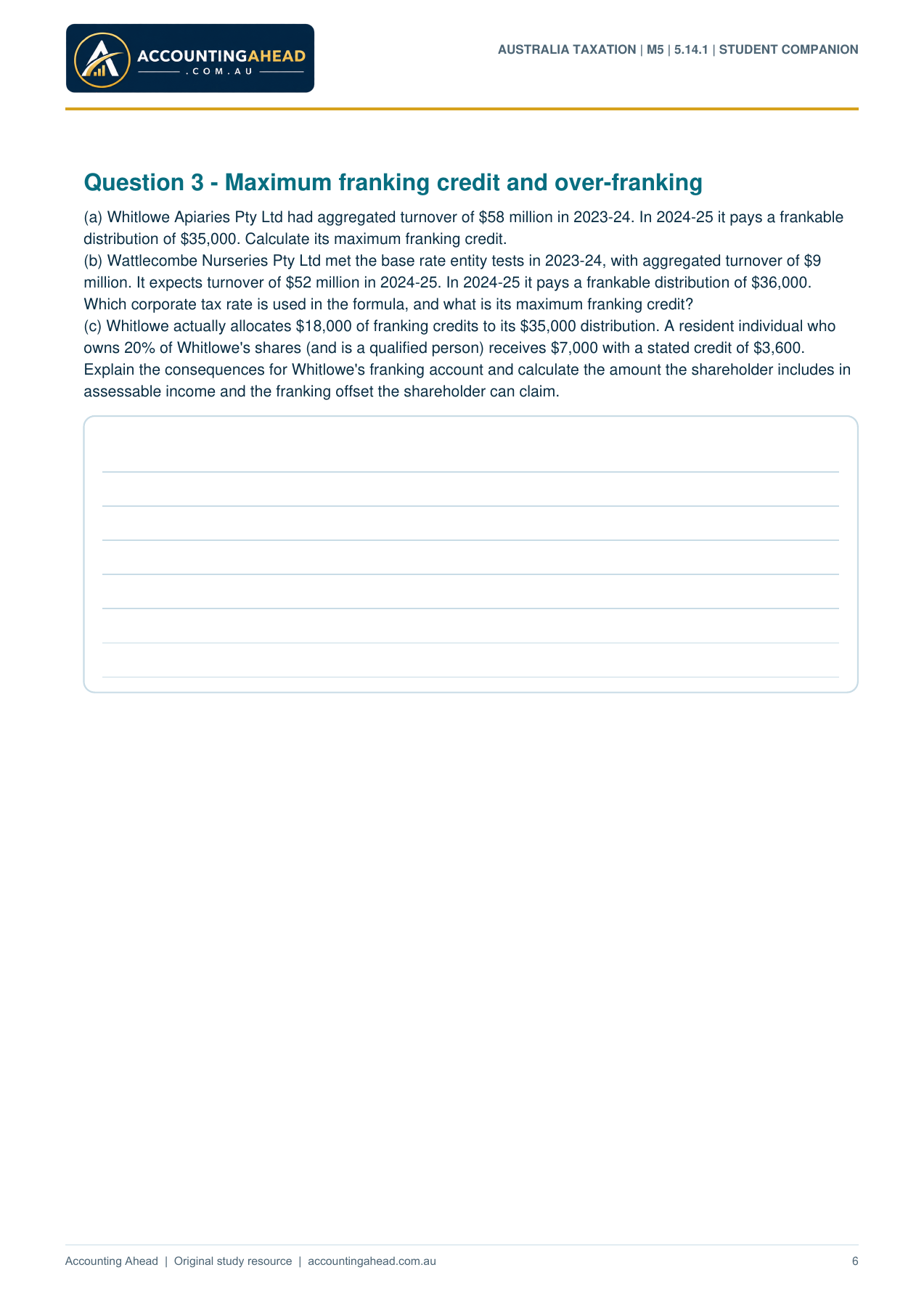
Question 3 - Maximum franking credit and over-franking
(a) Whitlowe Apiaries Pty Ltd had aggregated turnover of $58 million in 2023-24. In 2024-25 it pays a frankable
distribution of $35,000. Calculate its maximum franking credit.
(b) Wattlecombe Nurseries Pty Ltd met the base rate entity tests in 2023-24, with aggregated turnover of $9
million. It expects turnover of $52 million in 2024-25. In 2024-25 it pays a frankable distribution of $36,000.
Which corporate tax rate is used in the formula, and what is its maximum franking credit?
(c) Whitlowe actually allocates $18,000 of franking credits to its $35,000 distribution. A resident individual who
owns 20% of Whitlowe's shares (and is a qualified person) receives $7,000 with a stated credit of $3,600.
Explain the consequences for Whitlowe's franking account and calculate the amount the shareholder includes in
assessable income and the franking offset the shareholder can claim.
AUSTRALIA TAXATION | M5 | 5.14.1 | STUDENT COMPANION
6
Accounting Ahead | Original study resource | accountingahead.com.au
Worked answers
MODULE 5 | 5.14.1 | WORKED ANSWERS - ATTEMPT THE QUESTIONS FIRST
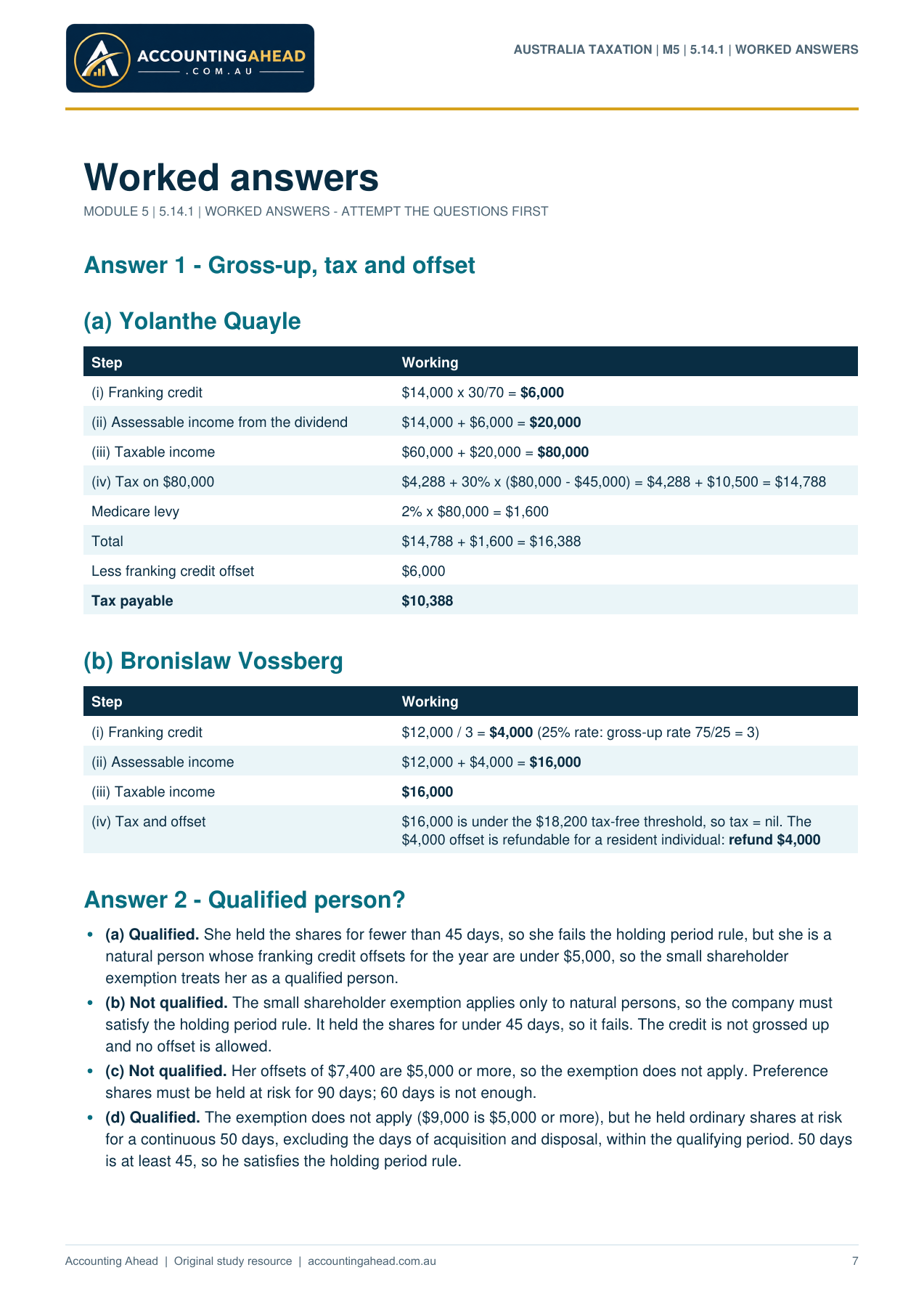
Answer 1 - Gross-up, tax and offset
(a) Yolanthe Quayle
Step Working
(i) Franking credit $14,000 x 30/70 = $6,000
(ii) Assessable income from the dividend $14,000 + $6,000 = $20,000
(iii) Taxable income $60,000 + $20,000 = $80,000
(iv) Tax on $80,000 $4,288 + 30% x ($80,000 - $45,000) = $4,288 + $10,500 = $14,788
Medicare levy 2% x $80,000 = $1,600
Total $14,788 + $1,600 = $16,388
Less franking credit offset $6,000
Tax payable $10,388
(b) Bronislaw Vossberg
Step Working
(i) Franking credit $12,000 / 3 = $4,000 (25% rate: gross-up rate 75/25 = 3)
(ii) Assessable income $12,000 + $4,000 = $16,000
(iii) Taxable income $16,000
(iv) Tax and offset $16,000 is under the $18,200 tax-free threshold, so tax = nil. The
$4,000 offset is refundable for a resident individual: refund $4,000
Answer 2 - Qualified person?
(a) Qualified. She held the shares for fewer than 45 days, so she fails the holding period rule, but she is a
natural person whose franking credit offsets for the year are under $5,000, so the small shareholder
exemption treats her as a qualified person.
(b) Not qualified. The small shareholder exemption applies only to natural persons, so the company must
satisfy the holding period rule. It held the shares for under 45 days, so it fails. The credit is not grossed up
and no offset is allowed.
(c) Not qualified. Her offsets of $7,400 are $5,000 or more, so the exemption does not apply. Preference
shares must be held at risk for 90 days; 60 days is not enough.
(d) Qualified. The exemption does not apply ($9,000 is $5,000 or more), but he held ordinary shares at risk
for a continuous 50 days, excluding the days of acquisition and disposal, within the qualifying period. 50 days
is at least 45, so he satisfies the holding period rule.
AUSTRALIA TAXATION | M5 | 5.14.1 | WORKED ANSWERS
7
Accounting Ahead | Original study resource | accountingahead.com.au
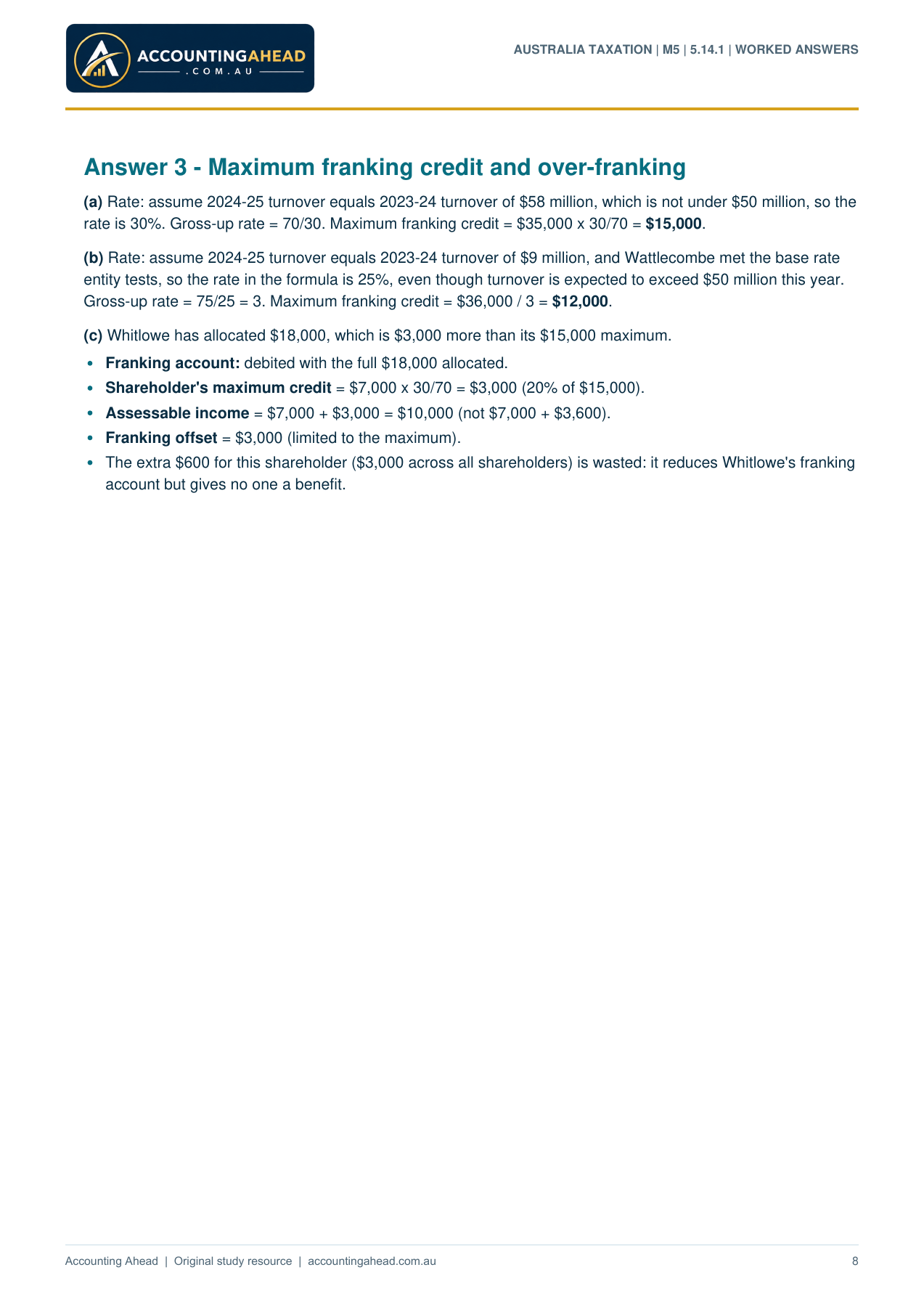
Answer 3 - Maximum franking credit and over-franking
(a) Rate: assume 2024-25 turnover equals 2023-24 turnover of $58 million, which is not under $50 million, so the
rate is 30%. Gross-up rate = 70/30. Maximum franking credit = $35,000 x 30/70 = $15,000.
(b) Rate: assume 2024-25 turnover equals 2023-24 turnover of $9 million, and Wattlecombe met the base rate
entity tests, so the rate in the formula is 25%, even though turnover is expected to exceed $50 million this year.
Gross-up rate = 75/25 = 3. Maximum franking credit = $36,000 / 3 = $12,000.
(c) Whitlowe has allocated $18,000, which is $3,000 more than its $15,000 maximum.
Franking account: debited with the full $18,000 allocated.
Shareholder's maximum credit = $7,000 x 30/70 = $3,000 (20% of $15,000).
Assessable income = $7,000 + $3,000 = $10,000 (not $7,000 + $3,600).
Franking offset = $3,000 (limited to the maximum).
The extra $600 for this shareholder ($3,000 across all shareholders) is wasted: it reduces Whitlowe's franking
account but gives no one a benefit.
AUSTRALIA TAXATION | M5 | 5.14.1 | WORKED ANSWERS
8