
Net Partnership Income or Loss — study companion
Part 5.4 of Australia Taxation. Preview the study companion or download the printable PDF.
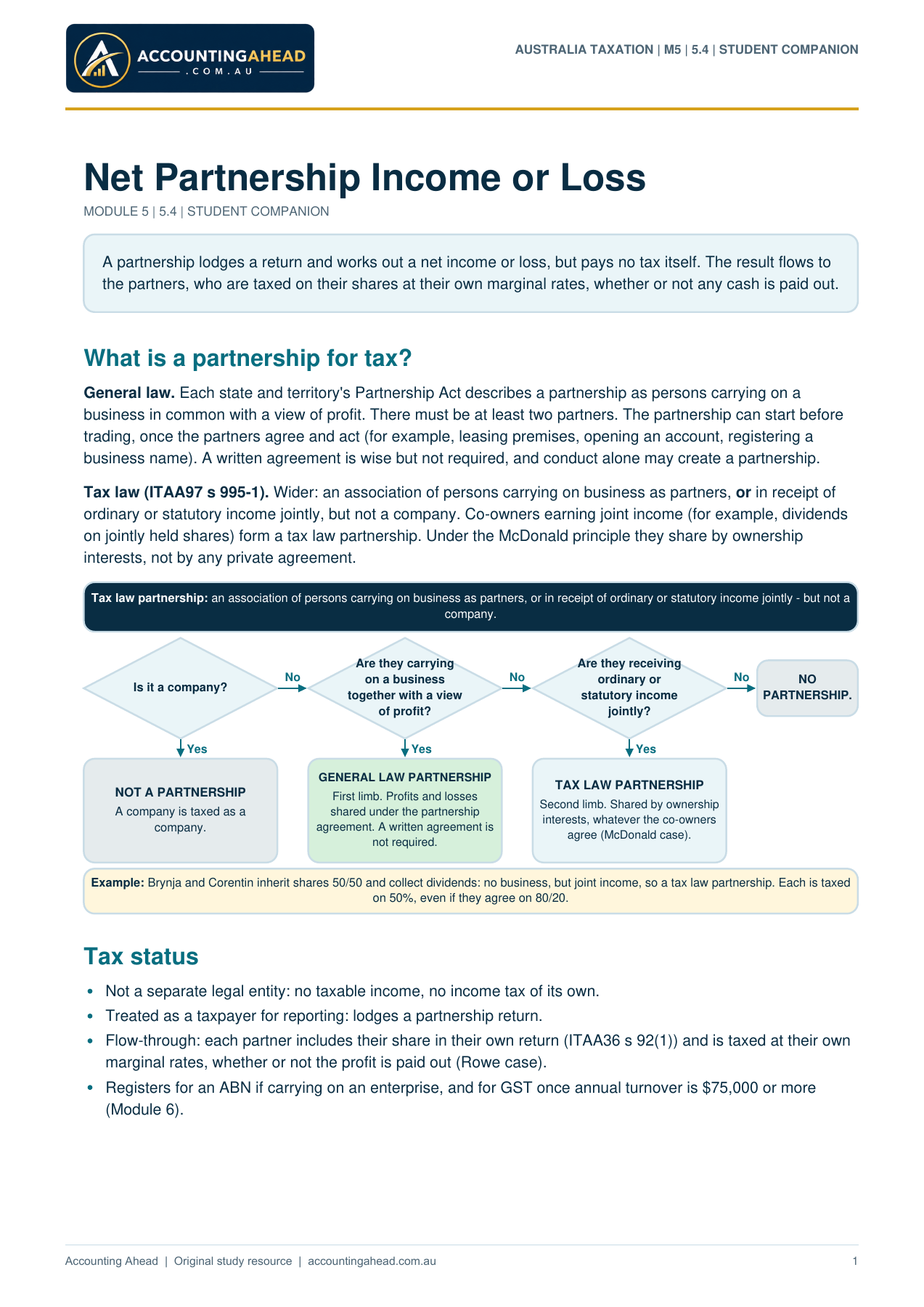
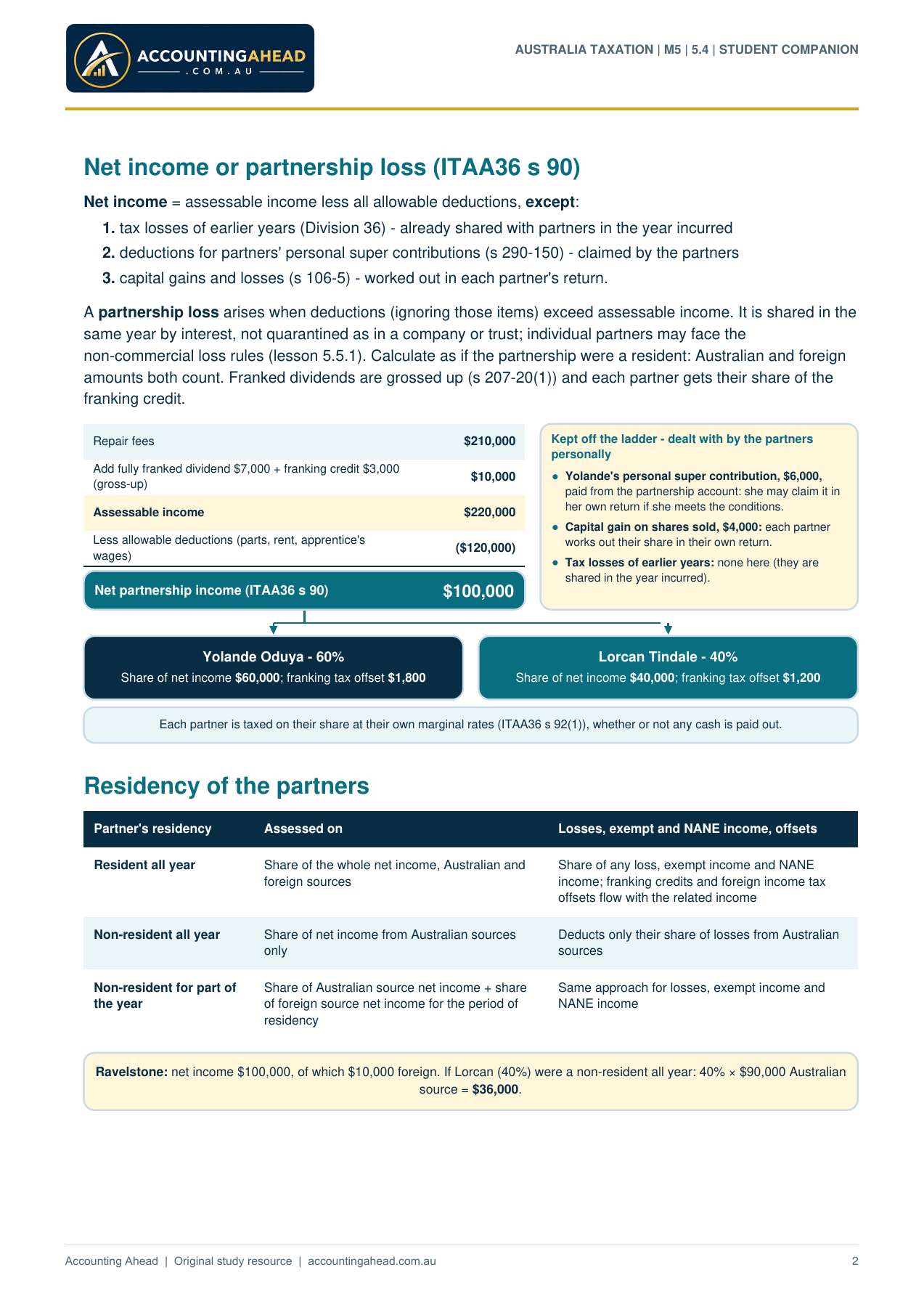


Read the handout text
Accounting Ahead | Original study resource | accountingahead.com.au
Net Partnership Income or Loss
MODULE 5 | 5.4 | STUDENT COMPANION
A partnership lodges a return and works out a net income or loss, but pays no tax itself. The result flows to
the partners, who are taxed on their shares at their own marginal rates, whether or not any cash is paid out.
What is a partnership for tax?
General law. Each state and territory's Partnership Act describes a partnership as persons carrying on a
business in common with a view of profit. There must be at least two partners. The partnership can start before
trading, once the partners agree and act (for example, leasing premises, opening an account, registering a
business name). A written agreement is wise but not required, and conduct alone may create a partnership.
Tax law (ITAA97 s 995-1). Wider: an association of persons carrying on business as partners, or in receipt of
ordinary or statutory income jointly, but not a company. Co-owners earning joint income (for example, dividends
on jointly held shares) form a tax law partnership. Under the McDonald principle they share by ownership
interests, not by any private agreement.
Tax law partnership: an association of persons carrying on business as partners, or in receipt of ordinary or statutory income jointly - but not a
company.
Is it a company?
No
Yes
Are they carrying
on a business
together with a view
of profit?
No
Yes
Are they receiving
ordinary or
statutory income
jointly?
No
Yes
NO
PARTNERSHIP.
NOT A PARTNERSHIP
A company is taxed as a
company.
GENERAL LAW PARTNERSHIP
First limb. Profits and losses
shared under the partnership
agreement. A written agreement is
not required.
TAX LAW PARTNERSHIP
Second limb. Shared by ownership
interests, whatever the co-owners
agree (McDonald case).
Example: Brynja and Corentin inherit shares 50/50 and collect dividends: no business, but joint income, so a tax law partnership. Each is taxed
on 50%, even if they agree on 80/20.
Tax status
Not a separate legal entity: no taxable income, no income tax of its own.
Treated as a taxpayer for reporting: lodges a partnership return.
Flow-through: each partner includes their share in their own return (ITAA36 s 92(1)) and is taxed at their own
marginal rates, whether or not the profit is paid out (Rowe case).
Registers for an ABN if carrying on an enterprise, and for GST once annual turnover is $75,000 or more
(Module 6).
AUSTRALIA TAXATION | M5 | 5.4 | STUDENT COMPANION
1
Accounting Ahead | Original study resource | accountingahead.com.au
Net income or partnership loss (ITAA36 s 90)
Net income = assessable income less all allowable deductions, except:
1. tax losses of earlier years (Division 36) - already shared with partners in the year incurred
2. deductions for partners' personal super contributions (s 290-150) - claimed by the partners
3. capital gains and losses (s 106-5) - worked out in each partner's return.
A partnership loss arises when deductions (ignoring those items) exceed assessable income. It is shared in the
same year by interest, not quarantined as in a company or trust; individual partners may face the
non-commercial loss rules (lesson 5.5.1). Calculate as if the partnership were a resident: Australian and foreign
amounts both count. Franked dividends are grossed up (s 207-20(1)) and each partner gets their share of the
franking credit.
Repair fees $210,000
Add fully franked dividend $7,000 + franking credit $3,000
(gross-up) $10,000
Assessable income $220,000
Less allowable deductions (parts, rent, apprentice's
wages) ($120,000)
Net partnership income (ITAA36 s 90) $100,000
Kept off the ladder - dealt with by the partners
personally
Yolande's personal super contribution, $6,000,
paid from the partnership account: she may claim it in
her own return if she meets the conditions.
Capital gain on shares sold, $4,000: each partner
works out their share in their own return.
Tax losses of earlier years: none here (they are
shared in the year incurred).
Yolande Oduya - 60%
Share of net income $60,000; franking tax offset $1,800
Lorcan Tindale - 40%
Share of net income $40,000; franking tax offset $1,200
Each partner is taxed on their share at their own marginal rates (ITAA36 s 92(1)), whether or not any cash is paid out.
Residency of the partners
Partner's residency Assessed on Losses, exempt and NANE income, offsets
Resident all year Share of the whole net income, Australian and
foreign sources
Share of any loss, exempt income and NANE
income; franking credits and foreign income tax
offsets flow with the related income
Non-resident all year Share of net income from Australian sources
only
Deducts only their share of losses from Australian
sources
Non-resident for part of
the year
Share of Australian source net income + share
of foreign source net income for the period of
residency
Same approach for losses, exempt income and
NANE income
Ravelstone: net income $100,000, of which $10,000 foreign. If Lorcan (40%) were a non-resident all year: 40% × $90,000 Australian
source = $36,000.
AUSTRALIA TAXATION | M5 | 5.4 | STUDENT COMPANION
2
Accounting Ahead | Original study resource | accountingahead.com.au
Elections and administration
Elections affecting the calculation (for example, trading stock valuation, depreciation method) are made by
the partnership and bind every partner.
The partnership pays no PAYG instalments; partners pay them on their own activity statements, based on
their partnership share and other income.
The partnership works out its income or loss each reporting period and tells the partners.
Key figures for 2024-25
Item Figure
Minimum number of partners 2
GST registration turnover threshold $75,000
Corporate tax rate behind the franking credits in the examples 30%
Practice questions
MODULE 5 | 5.4 | TRY THESE BEFORE THE WORKED ANSWERS
Question 1 - Partnership or not?
For each arrangement, decide whether it is a general law partnership, a tax law partnership (second limb only) or
no partnership, and give a one-line reason. For any tax law partnership, state how its income is shared.
(a) In May 2025, Farrah Pembrey and Yannick Cheverton agree to open Glenrock Bakehouse together. They
sign a shop lease, open a joint business bank account and register the business name. They have no written
agreement. Trading starts in August 2025.
(b) Siblings Bastian and Zuleika Mulvaney hold a term deposit in their joint names, in equal shares, and receive
the interest. They agree privately that Zuleika will take 90% of the interest.
(c) Bilbarra Pty Ltd, a company with two shareholders, runs a cafe.
(d) Two neighbours jointly bought a ride-on mower that they use only on their own lawns. It earns no income.
AUSTRALIA TAXATION | M5 | 5.4 | STUDENT COMPANION
3
Accounting Ahead | Original study resource | accountingahead.com.au
Question 2 - Net income and sharing
Copperfern Acoustics is a partnership of Augustin Kinnaird (50%), Noor Ashbury (30%) and Arvid Dunkerley
(20%). Its figures for the 2024-25 income year are:
Item Amount
Fees from acoustic consulting $260,000
Interest on the business bank account $2,000
Fully franked dividend received (franking credit $6,000) $14,000
Capital gain on shares sold (held for two years, before any discount) $10,000
Allowable operating deductions $172,000
Personal super contribution paid from the partnership account for Augustin $8,000
Partnership tax loss of 2023-24, shown in the draft accounts as a deduction $12,000
Required: (a) Calculate the net income of the partnership. (b) Calculate each partner's share of net income and
of the franking credit. (c) Explain how the capital gain, the super contribution and the 2023-24 loss are dealt with.
AUSTRALIA TAXATION | M5 | 5.4 | STUDENT COMPANION
4
Accounting Ahead | Original study resource | accountingahead.com.au
Question 3 - Residency and instalments
Fernvale Translation Studio is a partnership. Leontyne Ferridge (50%) is a resident all year. Wolfram Gundersen
(30%) is a non-resident all year. Ilsa Thackwray (20%) was a non-resident until she became a resident on 1
January 2025. Net income for 2024-25 is $150,000: $120,000 from Australian sources and $30,000 from a
branch office in Singapore. Of the foreign source net income, $12,000 was derived between 1 January and 30
June 2025.
Required: (a) Calculate the amount of partnership net income each partner is assessed on. (b) Who pays PAYG
instalments on this income, and what must the partnership do to make that possible?
AUSTRALIA TAXATION | M5 | 5.4 | STUDENT COMPANION
5
Accounting Ahead | Original study resource | accountingahead.com.au
Worked answers
MODULE 5 | 5.4 | WORKED ANSWERS - ATTEMPT THE QUESTIONS FIRST
Answer 1 - Partnership or not?
(a) General law partnership (and so a partnership for tax under the first limb). Farrah and Yannick agreed to
carry on a business together with a view of profit and acted on it, so the partnership began in May 2025, before
trading started. No written agreement is needed; profits are shared as the partners agree.
(b) Tax law partnership (second limb) only. Bastian and Zuleika are not carrying on a business, but they receive
interest jointly. As co-owners they share by ownership interests, so each is assessed on 50% of the interest;
their private 90/10 agreement does not change this (McDonald principle).
(c) No partnership. The s 995-1 definition excludes a company; Bilbarra Pty Ltd is taxed as a company.
(d) No partnership. There is no business and no income received jointly.
Answer 2 - Copperfern Acoustics
(a) Assessable income = $260,000 + $2,000 + $14,000 + $6,000 franking credit (gross-up) = $282,000. Less
allowable operating deductions $172,000. Net income = $282,000 - $172,000 = $110,000. The capital gain, the
super contribution and the prior-year loss are excluded (ITAA36 s 90).
Step Working Amount
Fees Acoustic consulting $260,000
Interest Business bank account $2,000
Dividend plus gross-up $14,000 + $6,000 franking credit $20,000
Assessable income $260,000 + $2,000 + $14,000 + $6,000 $282,000
Less allowable operating deductions ($172,000)
Net income $282,000 - $172,000 $110,000
Shares of net income and franking credit
(b) Each partner's share of net income and of the franking credit follows their profit share.
Partner Share Net income Franking credit
Augustin Kinnaird 50% 50% × $110,000 = $55,000 50% × $6,000 = $3,000
Noor Ashbury 30% 30% × $110,000 = $33,000 30% × $6,000 = $1,800
Arvid Dunkerley 20% 20% × $110,000 = $22,000 20% × $6,000 = $1,200
Total (check) 100% $55,000 + $33,000 + $22,000 =
$110,000
$3,000 + $1,800 + $1,200 = $6,000
Each partner includes the share in assessable income and claims the franking credit as a tax offset.
AUSTRALIA TAXATION | M5 | 5.4 | WORKED ANSWERS
6
Accounting Ahead | Original study resource | accountingahead.com.au
(c) Capital gain: not part of net income (s 106-5). Each partner works out their share in their own return; if their
interests in the shares follow the profit shares, that is $5,000, $3,000 and $2,000 before their own capital losses
and any discount. Super contribution: not deductible to the partnership; Augustin may claim the $8,000 in his
own return under s 290-150 if he meets the conditions. 2023-24 loss: not deductible in 2024-25. A partnership
loss is shared in the year incurred, so the $12,000 went to the partners in 2023-24 ($6,000, $3,600 and $2,400)
for use in their own returns. Removing it from the draft accounts is why net income is $110,000, not $98,000.
Answer 3 - Fernvale Translation Studio
(a) Each partner is assessed according to their residency.
Partner Residency Working Assessed on
Leontyne Ferridge
(50%)
Resident all year 50% of the whole net income = 50% ×
$150,000
$75,000
Wolfram Gundersen
(30%)
Non-resident all year Australian sources only = 30% × $120,000 $36,000
Ilsa Thackwray (20%) Non-resident for part
of the year
Australian source share + foreign source
share for her period of residency = (20% ×
$120,000) + (20% × $12,000) = $24,000 +
$2,400
$26,400
(b) The partnership pays no PAYG instalments because it pays no tax. Each partner pays their own instalments
on their own activity statements, based on their partnership share and other income. The partnership must
calculate its income or loss at the end of each reporting period and report it to the partners.
AUSTRALIA TAXATION | M5 | 5.4 | WORKED ANSWERS
7