
Partner Salaries, Interest and Drawings — study companion
Part 5.5.2 of Australia Taxation. Preview the study companion or download the printable PDF.




Read the handout text
Accounting Ahead | Original study resource | accountingahead.com.au
Partner salaries, interest and drawings
MODULE 5 | 5.5.2 | STUDENT COMPANION
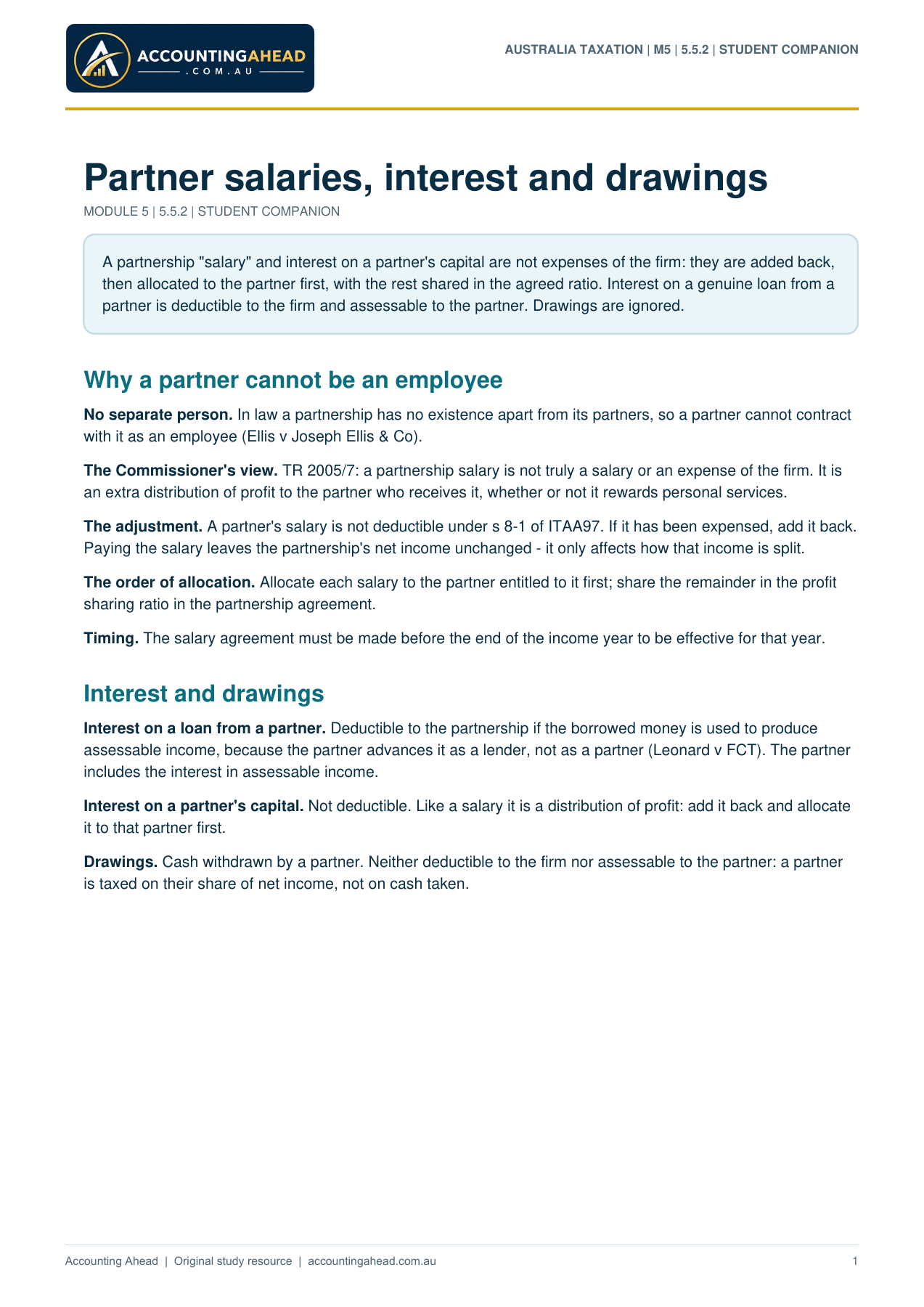
A partnership "salary" and interest on a partner's capital are not expenses of the firm: they are added back,
then allocated to the partner first, with the rest shared in the agreed ratio. Interest on a genuine loan from a
partner is deductible to the firm and assessable to the partner. Drawings are ignored.
Why a partner cannot be an employee
No separate person. In law a partnership has no existence apart from its partners, so a partner cannot contract
with it as an employee (Ellis v Joseph Ellis & Co).
The Commissioner's view. TR 2005/7: a partnership salary is not truly a salary or an expense of the firm. It is
an extra distribution of profit to the partner who receives it, whether or not it rewards personal services.
The adjustment. A partner's salary is not deductible under s 8-1 of ITAA97. If it has been expensed, add it back.
Paying the salary leaves the partnership's net income unchanged - it only affects how that income is split.
The order of allocation. Allocate each salary to the partner entitled to it first; share the remainder in the profit
sharing ratio in the partnership agreement.
Timing. The salary agreement must be made before the end of the income year to be effective for that year.
Interest and drawings
Interest on a loan from a partner. Deductible to the partnership if the borrowed money is used to produce
assessable income, because the partner advances it as a lender, not as a partner (Leonard v FCT). The partner
includes the interest in assessable income.
Interest on a partner's capital. Not deductible. Like a salary it is a distribution of profit: add it back and allocate
it to that partner first.
Drawings. Cash withdrawn by a partner. Neither deductible to the firm nor assessable to the partner: a partner
is taxed on their share of net income, not on cash taken.
AUSTRALIA TAXATION | M5 | 5.5.2 | STUDENT COMPANION
1
Accounting Ahead | Original study resource | accountingahead.com.au
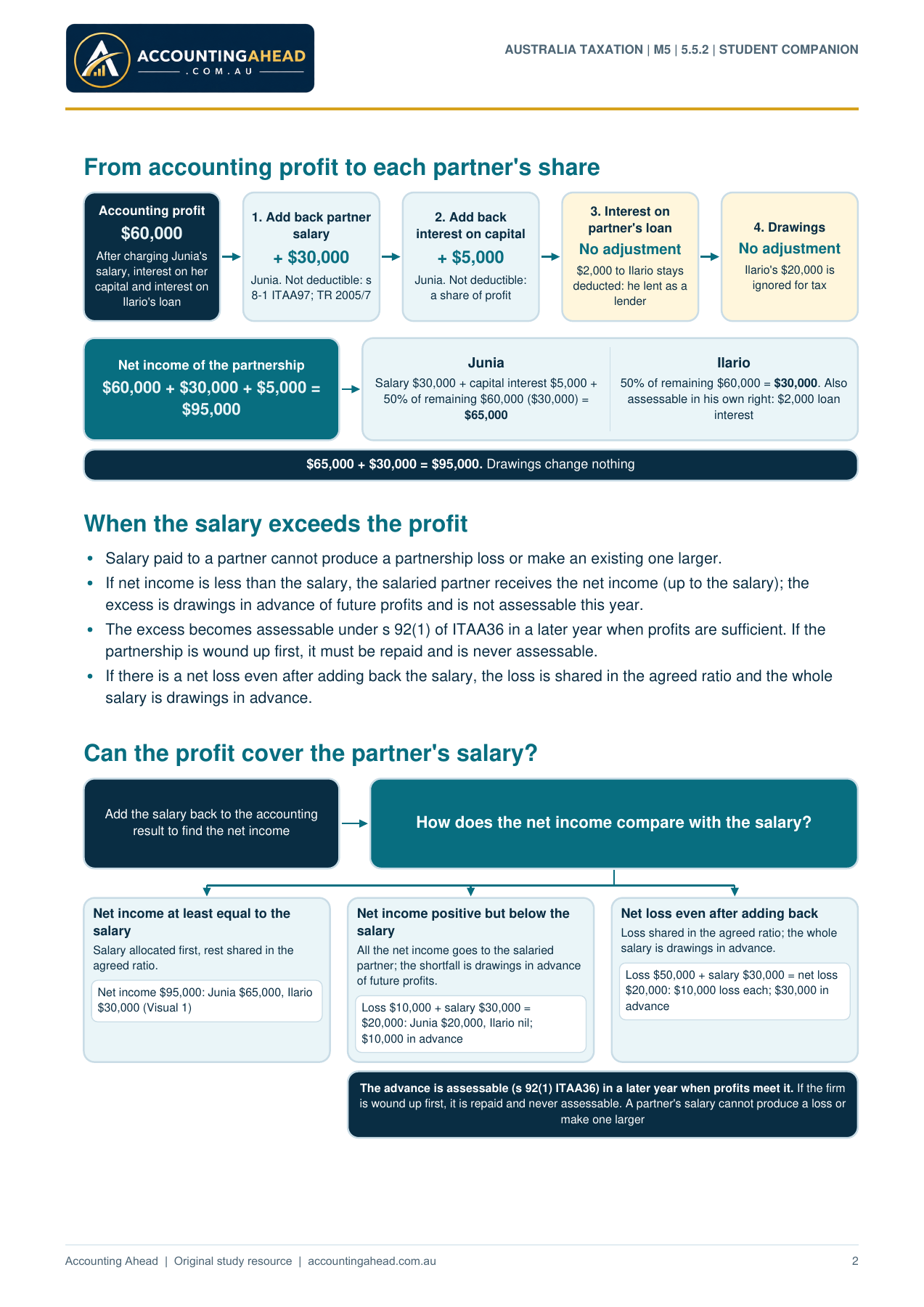
From accounting profit to each partner's share
Accounting profit
$60,000
After charging Junia's
salary, interest on her
capital and interest on
Ilario's loan
1. Add back partner
salary
+ $30,000
Junia. Not deductible: s
8-1 ITAA97; TR 2005/7
2. Add back
interest on capital
+ $5,000
Junia. Not deductible:
a share of profit
3. Interest on
partner's loan
No adjustment
$2,000 to Ilario stays
deducted: he lent as a
lender
4. Drawings
No adjustment
Ilario's $20,000 is
ignored for tax
Net income of the partnership
$60,000 + $30,000 + $5,000 =
$95,000
Junia
Salary $30,000 + capital interest $5,000 +
50% of remaining $60,000 ($30,000) =
$65,000
Ilario
50% of remaining $60,000 = $30,000. Also
assessable in his own right: $2,000 loan
interest
$65,000 + $30,000 = $95,000. Drawings change nothing
When the salary exceeds the profit
Salary paid to a partner cannot produce a partnership loss or make an existing one larger.
If net income is less than the salary, the salaried partner receives the net income (up to the salary); the
excess is drawings in advance of future profits and is not assessable this year.
The excess becomes assessable under s 92(1) of ITAA36 in a later year when profits are sufficient. If the
partnership is wound up first, it must be repaid and is never assessable.
If there is a net loss even after adding back the salary, the loss is shared in the agreed ratio and the whole
salary is drawings in advance.
Can the profit cover the partner's salary?
Add the salary back to the accounting
result to find the net income How does the net income compare with the salary?
Net income at least equal to the
salary
Salary allocated first, rest shared in the
agreed ratio.
Net income $95,000: Junia $65,000, Ilario
$30,000 (Visual 1)
Net income positive but below the
salary
All the net income goes to the salaried
partner; the shortfall is drawings in advance
of future profits.
Loss $10,000 + salary $30,000 =
$20,000: Junia $20,000, Ilario nil;
$10,000 in advance
Net loss even after adding back
Loss shared in the agreed ratio; the whole
salary is drawings in advance.
Loss $50,000 + salary $30,000 = net loss
$20,000: $10,000 loss each; $30,000 in
advance
The advance is assessable (s 92(1) ITAA36) in a later year when profits meet it. If the firm
is wound up first, it is repaid and never assessable. A partner's salary cannot produce a loss or
make one larger
AUSTRALIA TAXATION | M5 | 5.5.2 | STUDENT COMPANION
2
Accounting Ahead | Original study resource | accountingahead.com.au
Borrowing to repay partners' capital
In FCT v Roberts; FCT v Smith the Full Federal Court allowed a deduction under s 8-1 for interest on money a
general law partnership borrowed to repay part of the partners' capital, because the borrowing replaces working
capital used to earn assessable income. The deduction is limited to the partnership's capital: capital contributed
by the partners plus retained profits. Borrowings that replace an asset revaluation reserve are ignored.
Deductible share of interest = (capital contributed + retained profits) / amount borrowed x interest paid.
Partners cannot deduct interest on borrowings used to pay their personal income tax.
Who deducts, who is assessed?
Transaction Partnership Partner
Salary paid to a partner Not deductible: add back; an allocation of profit Taxed as part of their share of net income (s 92
ITAA36)
Interest on a partner's capital
(or current account credit
balance)
Not deductible: add back; an allocation of profit Taxed as part of their share of net income (s 92
ITAA36)
Interest on a loan from a
partner, used to earn income
Deductible: the partner lends as a lender (Leonard v
FCT)
Assessable as interest income
Interest on a bank loan used to
repay partners' funds
Deductible for a general law partnership, but only up to
capital contributed plus retained profits, not revaluation
reserves (FCT v Roberts; FCT v Smith)
Not applicable
Drawings Ignored Ignored
A partner cannot deduct interest on money borrowed to pay their own income tax: it is a private expense
Key figures and references
Item Treatment
Partner salary Not deductible (s 8-1 ITAA97; TR 2005/7); allocated first
Interest on partner's capital Not deductible; allocated first
Interest on partner's loan Deductible to firm; assessable to partner
Drawings Ignored
Salary in excess of profit Drawings in advance; assessable later under s 92(1) ITAA36
Salary agreement Must be made before the end of the income year
AUSTRALIA TAXATION | M5 | 5.5.2 | STUDENT COMPANION
3
Accounting Ahead | Original study resource | accountingahead.com.au
Practice questions
MODULE 5 | 5.5.2 | TRY THESE BEFORE THE WORKED ANSWERS
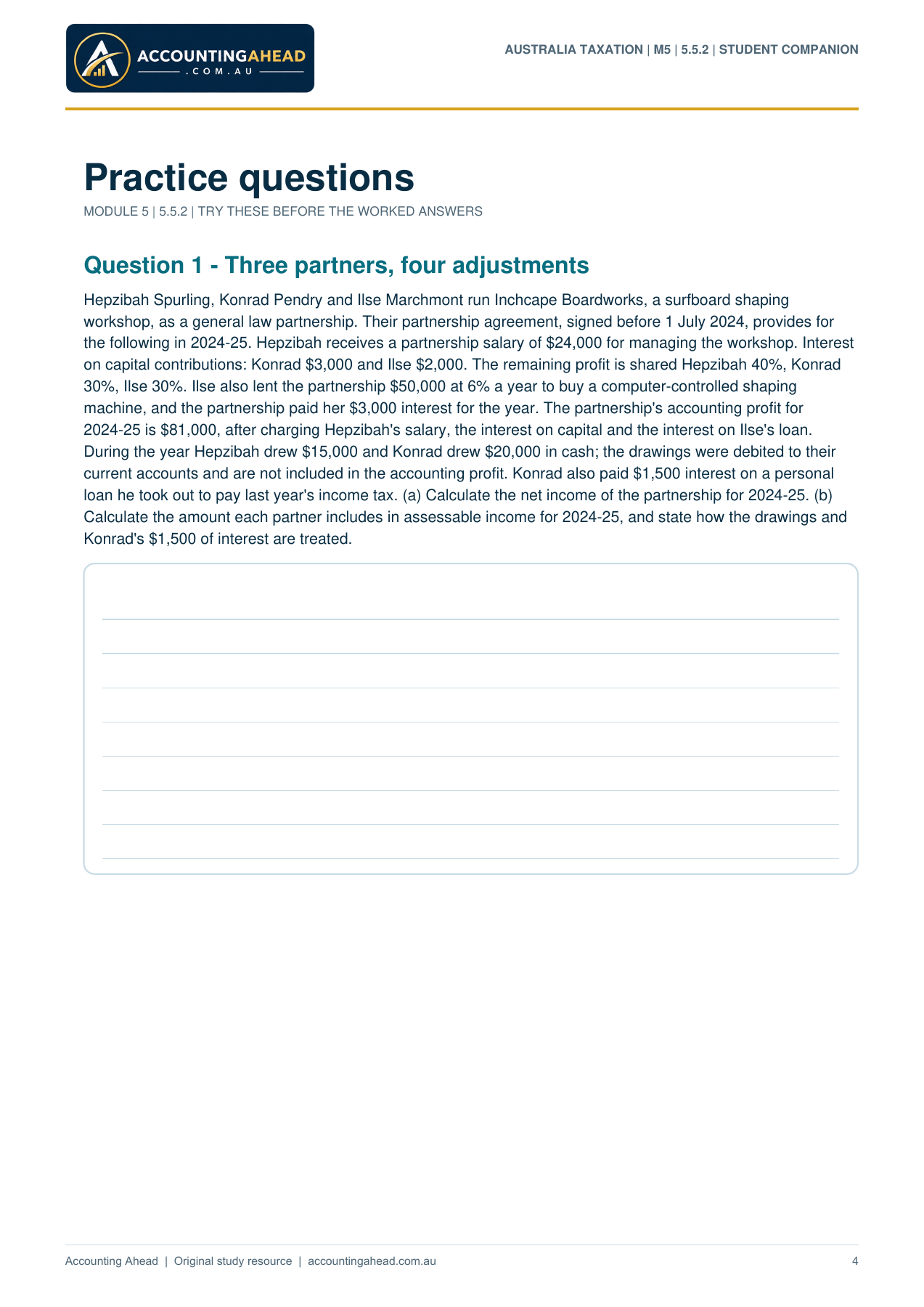
Question 1 - Three partners, four adjustments
Hepzibah Spurling, Konrad Pendry and Ilse Marchmont run Inchcape Boardworks, a surfboard shaping
workshop, as a general law partnership. Their partnership agreement, signed before 1 July 2024, provides for
the following in 2024-25. Hepzibah receives a partnership salary of $24,000 for managing the workshop. Interest
on capital contributions: Konrad $3,000 and Ilse $2,000. The remaining profit is shared Hepzibah 40%, Konrad
30%, Ilse 30%. Ilse also lent the partnership $50,000 at 6% a year to buy a computer-controlled shaping
machine, and the partnership paid her $3,000 interest for the year. The partnership's accounting profit for
2024-25 is $81,000, after charging Hepzibah's salary, the interest on capital and the interest on Ilse's loan.
During the year Hepzibah drew $15,000 and Konrad drew $20,000 in cash; the drawings were debited to their
current accounts and are not included in the accounting profit. Konrad also paid $1,500 interest on a personal
loan he took out to pay last year's income tax. (a) Calculate the net income of the partnership for 2024-25. (b)
Calculate the amount each partner includes in assessable income for 2024-25, and state how the drawings and
Konrad's $1,500 of interest are treated.
AUSTRALIA TAXATION | M5 | 5.5.2 | STUDENT COMPANION
4
Accounting Ahead | Original study resource | accountingahead.com.au
Question 2 - Two lean years
Persephone Dwyer and Ysabeau Keane run a wedding floristry business in partnership, sharing profits and
losses equally. Before 1 July 2024 they agreed in writing that Persephone would draw a salary of $36,000 a year
for running the business, with the balance of profits and losses shared equally. (a) For 2024-25 the accounts
show a net loss of $6,000 after paying Persephone's salary. Calculate the net income or loss of the partnership
and each partner's share, and explain the treatment of any salary not covered by profit. (b) Suppose instead that
the accounts showed a net loss of $46,000 after paying the salary. Calculate the net income or loss of the
partnership and each partner's share, and explain the treatment of the salary. (c) Using the facts in (b), what
happens to Persephone's excess salary if the partnership is wound up in 2025-26 before any further profits are
made?
AUSTRALIA TAXATION | M5 | 5.5.2 | STUDENT COMPANION
5
Accounting Ahead | Original study resource | accountingahead.com.au
Question 3 - Borrowing to repay partners' funds
Fergal Rourke and Gwilym Wollaston run a marine electronics business in partnership. On 1 July 2024 the
partnership borrowed $400,000 from a bank, and the partners immediately withdrew the whole amount for
private purposes. The bookkeeper debited the withdrawal against the partnership accounts as follows.
Account $
Partners' capital contributed 150,000
Retained profits 90,000
Asset revaluation reserve (unrealised, from revaluing the firm's warehouse) 160,000
Total 400,000
The partnership paid the bank $25,000 interest in 2024-25. In the same year Gwilym lent the partnership
$20,000 of his own money for working capital, and the partnership paid him $1,000 interest. (a) Calculate the
interest deductible to the partnership on the bank loan. (b) Explain the tax treatment of the $1,000 paid to
Gwilym, for the partnership and for Gwilym.
AUSTRALIA TAXATION | M5 | 5.5.2 | STUDENT COMPANION
6
Accounting Ahead | Original study resource | accountingahead.com.au
Worked answers
MODULE 5 | 5.5.2 | WORKED ANSWERS - ATTEMPT THE QUESTIONS FIRST
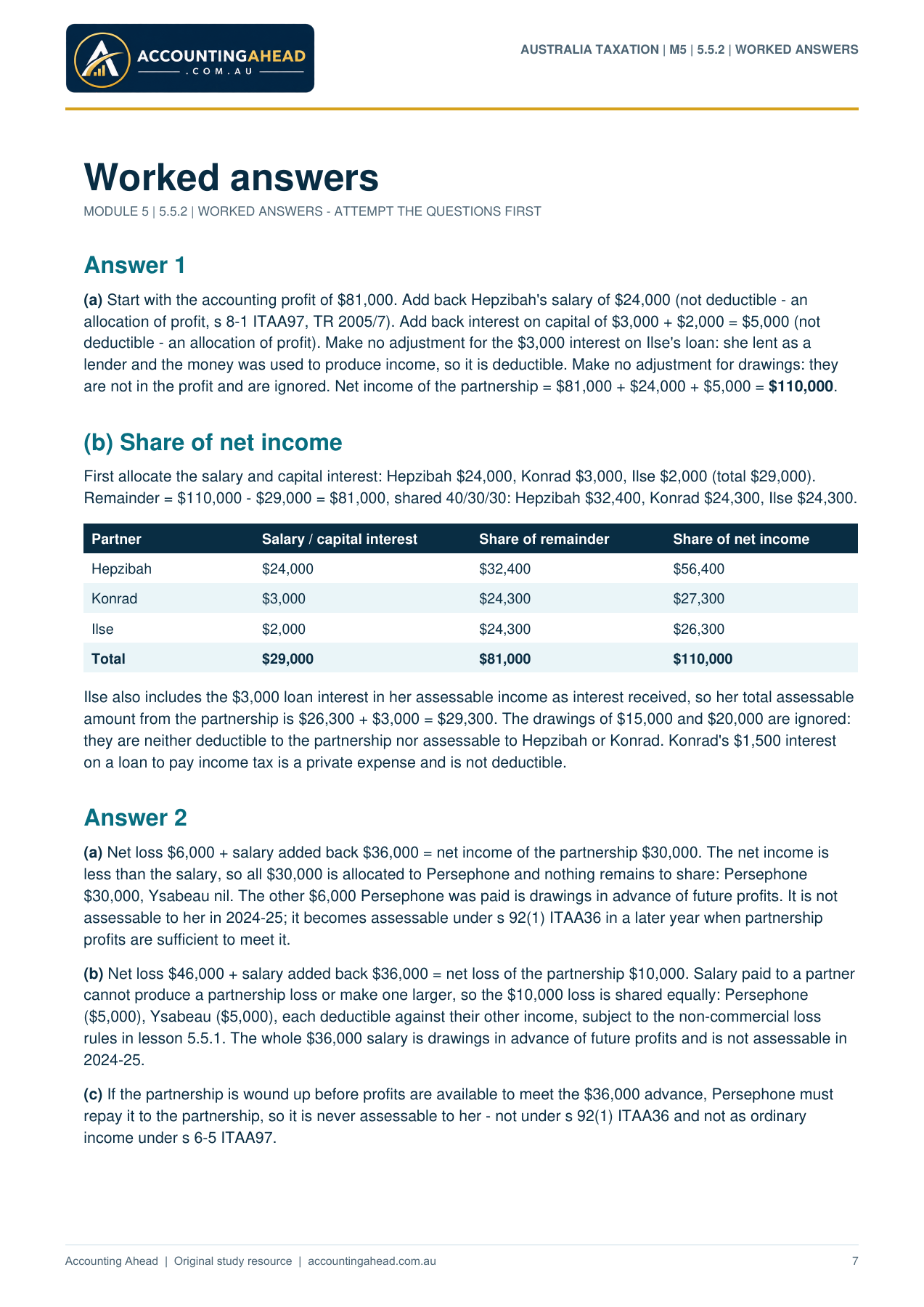
Answer 1
(a) Start with the accounting profit of $81,000. Add back Hepzibah's salary of $24,000 (not deductible - an
allocation of profit, s 8-1 ITAA97, TR 2005/7). Add back interest on capital of $3,000 + $2,000 = $5,000 (not
deductible - an allocation of profit). Make no adjustment for the $3,000 interest on Ilse's loan: she lent as a
lender and the money was used to produce income, so it is deductible. Make no adjustment for drawings: they
are not in the profit and are ignored. Net income of the partnership = $81,000 + $24,000 + $5,000 = $110,000.
(b) Share of net income
First allocate the salary and capital interest: Hepzibah $24,000, Konrad $3,000, Ilse $2,000 (total $29,000).
Remainder = $110,000 - $29,000 = $81,000, shared 40/30/30: Hepzibah $32,400, Konrad $24,300, Ilse $24,300.
Partner Salary / capital interest Share of remainder Share of net income
Hepzibah $24,000 $32,400 $56,400
Konrad $3,000 $24,300 $27,300
Ilse $2,000 $24,300 $26,300
Total $29,000 $81,000 $110,000
Ilse also includes the $3,000 loan interest in her assessable income as interest received, so her total assessable
amount from the partnership is $26,300 + $3,000 = $29,300. The drawings of $15,000 and $20,000 are ignored:
they are neither deductible to the partnership nor assessable to Hepzibah or Konrad. Konrad's $1,500 interest
on a loan to pay income tax is a private expense and is not deductible.
Answer 2
(a) Net loss $6,000 + salary added back $36,000 = net income of the partnership $30,000. The net income is
less than the salary, so all $30,000 is allocated to Persephone and nothing remains to share: Persephone
$30,000, Ysabeau nil. The other $6,000 Persephone was paid is drawings in advance of future profits. It is not
assessable to her in 2024-25; it becomes assessable under s 92(1) ITAA36 in a later year when partnership
profits are sufficient to meet it.
(b) Net loss $46,000 + salary added back $36,000 = net loss of the partnership $10,000. Salary paid to a partner
cannot produce a partnership loss or make one larger, so the $10,000 loss is shared equally: Persephone
($5,000), Ysabeau ($5,000), each deductible against their other income, subject to the non-commercial loss
rules in lesson 5.5.1. The whole $36,000 salary is drawings in advance of future profits and is not assessable in
2024-25.
(c) If the partnership is wound up before profits are available to meet the $36,000 advance, Persephone must
repay it to the partnership, so it is never assessable to her - not under s 92(1) ITAA36 and not as ordinary
income under s 6-5 ITAA97.
AUSTRALIA TAXATION | M5 | 5.5.2 | WORKED ANSWERS
7
Accounting Ahead | Original study resource | accountingahead.com.au
Answer 3
(a) Interest on borrowings used to repay partners' funds is deductible under s 8-1 ITAA97 only to the extent the
borrowing replaces the partnership's capital - capital contributed plus retained profits (FCT v Roberts; FCT v
Smith). The revaluation reserve is excluded. Qualifying amount = $150,000 + $90,000 = $240,000. Deductible
interest = $240,000 / $400,000 x $25,000 = 0.6 x $25,000 = $15,000. The remaining $10,000 (relating to the
$160,000 revaluation reserve) is not deductible.
(b) Gwilym lent the money as a lender, not as a partner, and the partnership used it to produce assessable
income, so the $1,000 is deductible to the partnership (Leonard v FCT). Gwilym includes the $1,000 in his
assessable income as interest. No add-back is needed.
AUSTRALIA TAXATION | M5 | 5.5.2 | WORKED ANSWERS
8