
Changes in a Partner's Interest — study companion
Part 5.6 of Australia Taxation. Preview the study companion or download the printable PDF.

Read the handout text
Accounting Ahead | Original study resource | accountingahead.com.au
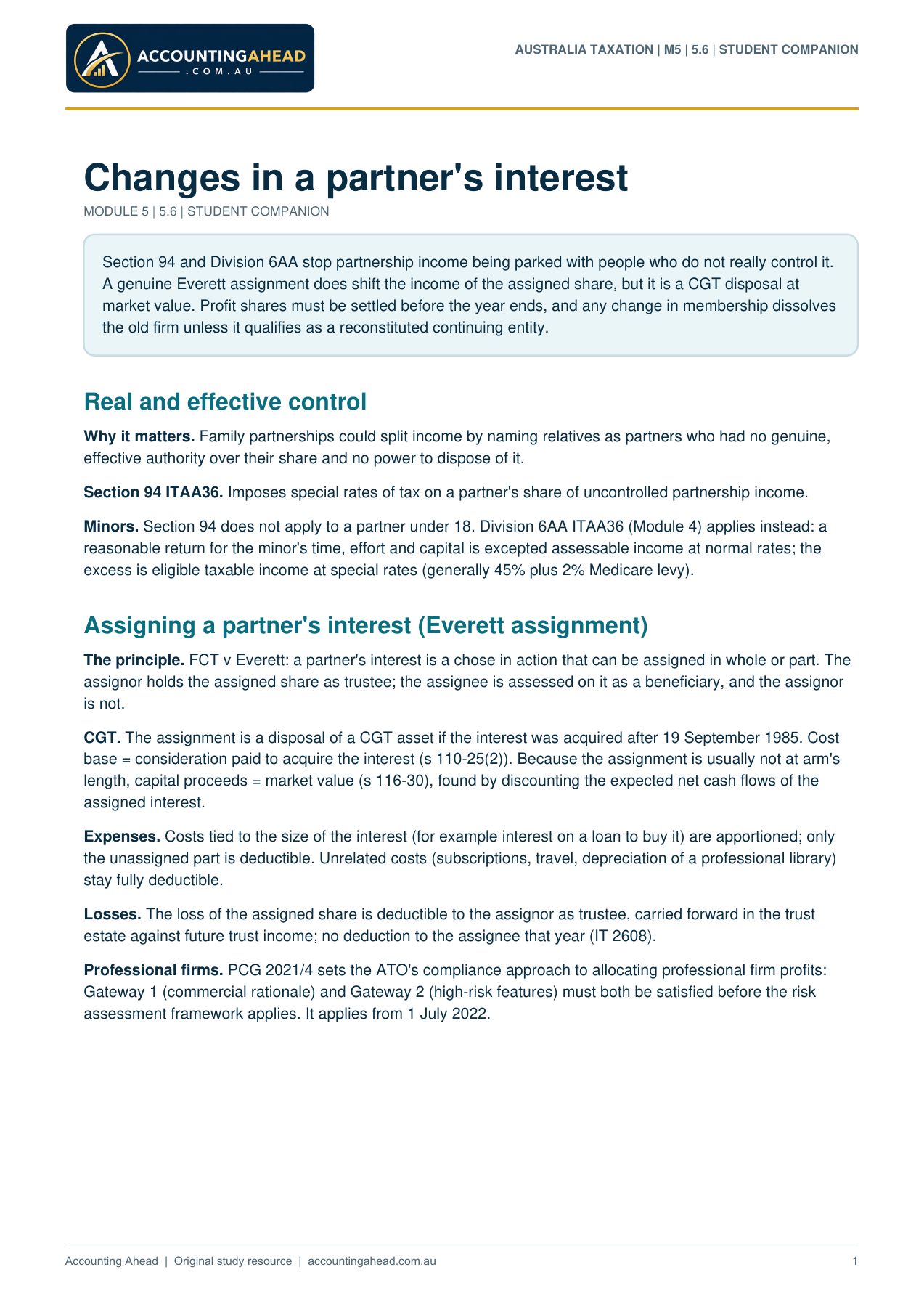
Changes in a partner's interest
MODULE 5 | 5.6 | STUDENT COMPANION
Section 94 and Division 6AA stop partnership income being parked with people who do not really control it.
A genuine Everett assignment does shift the income of the assigned share, but it is a CGT disposal at
market value. Profit shares must be settled before the year ends, and any change in membership dissolves
the old firm unless it qualifies as a reconstituted continuing entity.
Real and effective control
Why it matters. Family partnerships could split income by naming relatives as partners who had no genuine,
effective authority over their share and no power to dispose of it.
Section 94 ITAA36. Imposes special rates of tax on a partner's share of uncontrolled partnership income.
Minors. Section 94 does not apply to a partner under 18. Division 6AA ITAA36 (Module 4) applies instead: a
reasonable return for the minor's time, effort and capital is excepted assessable income at normal rates; the
excess is eligible taxable income at special rates (generally 45% plus 2% Medicare levy).
Assigning a partner's interest (Everett assignment)
The principle. FCT v Everett: a partner's interest is a chose in action that can be assigned in whole or part. The
assignor holds the assigned share as trustee; the assignee is assessed on it as a beneficiary, and the assignor
is not.
CGT. The assignment is a disposal of a CGT asset if the interest was acquired after 19 September 1985. Cost
base = consideration paid to acquire the interest (s 110-25(2)). Because the assignment is usually not at arm's
length, capital proceeds = market value (s 116-30), found by discounting the expected net cash flows of the
assigned interest.
Expenses. Costs tied to the size of the interest (for example interest on a loan to buy it) are apportioned; only
the unassigned part is deductible. Unrelated costs (subscriptions, travel, depreciation of a professional library)
stay fully deductible.
Losses. The loss of the assigned share is deductible to the assignor as trustee, carried forward in the trust
estate against future trust income; no deduction to the assignee that year (IT 2608).
Professional firms. PCG 2021/4 sets the ATO's compliance approach to allocating professional firm profits:
Gateway 1 (commercial rationale) and Gateway 2 (high-risk features) must both be satisfied before the risk
assessment framework applies. It applies from 1 July 2022.
AUSTRALIA TAXATION | M5 | 5.6 | STUDENT COMPANION
1
Accounting Ahead | Original study resource | accountingahead.com.au
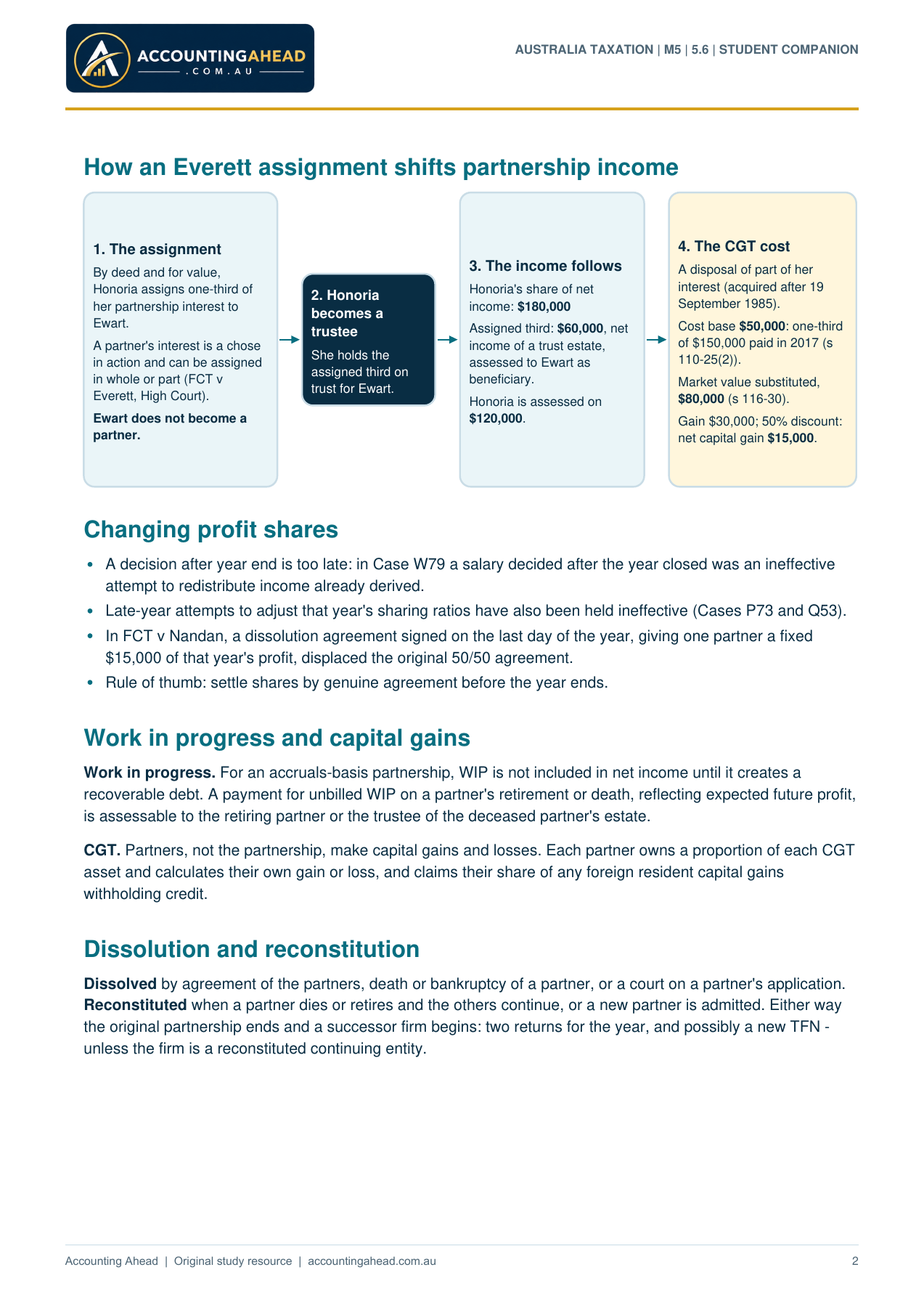
How an Everett assignment shifts partnership income
1. The assignment
By deed and for value,
Honoria assigns one-third of
her partnership interest to
Ewart.
A partner's interest is a chose
in action and can be assigned
in whole or part (FCT v
Everett, High Court).
Ewart does not become a
partner.
2. Honoria
becomes a
trustee
She holds the
assigned third on
trust for Ewart.
3. The income follows
Honoria's share of net
income: $180,000
Assigned third: $60,000, net
income of a trust estate,
assessed to Ewart as
beneficiary.
Honoria is assessed on
$120,000.
4. The CGT cost
A disposal of part of her
interest (acquired after 19
September 1985).
Cost base $50,000: one-third
of $150,000 paid in 2017 (s
110-25(2)).
Market value substituted,
$80,000 (s 116-30).
Gain $30,000; 50% discount:
net capital gain $15,000.
Changing profit shares
A decision after year end is too late: in Case W79 a salary decided after the year closed was an ineffective
attempt to redistribute income already derived.
Late-year attempts to adjust that year's sharing ratios have also been held ineffective (Cases P73 and Q53).
In FCT v Nandan, a dissolution agreement signed on the last day of the year, giving one partner a fixed
$15,000 of that year's profit, displaced the original 50/50 agreement.
Rule of thumb: settle shares by genuine agreement before the year ends.
Work in progress and capital gains
Work in progress. For an accruals-basis partnership, WIP is not included in net income until it creates a
recoverable debt. A payment for unbilled WIP on a partner's retirement or death, reflecting expected future profit,
is assessable to the retiring partner or the trustee of the deceased partner's estate.
CGT. Partners, not the partnership, make capital gains and losses. Each partner owns a proportion of each CGT
asset and calculates their own gain or loss, and claims their share of any foreign resident capital gains
withholding credit.
Dissolution and reconstitution
Dissolved by agreement of the partners, death or bankruptcy of a partner, or a court on a partner's application.
Reconstituted when a partner dies or retires and the others continue, or a new partner is admitted. Either way
the original partnership ends and a successor firm begins: two returns for the year, and possibly a new TFN -
unless the firm is a reconstituted continuing entity.
AUSTRALIA TAXATION | M5 | 5.6 | STUDENT COMPANION
2
Accounting Ahead | Original study resource | accountingahead.com.au
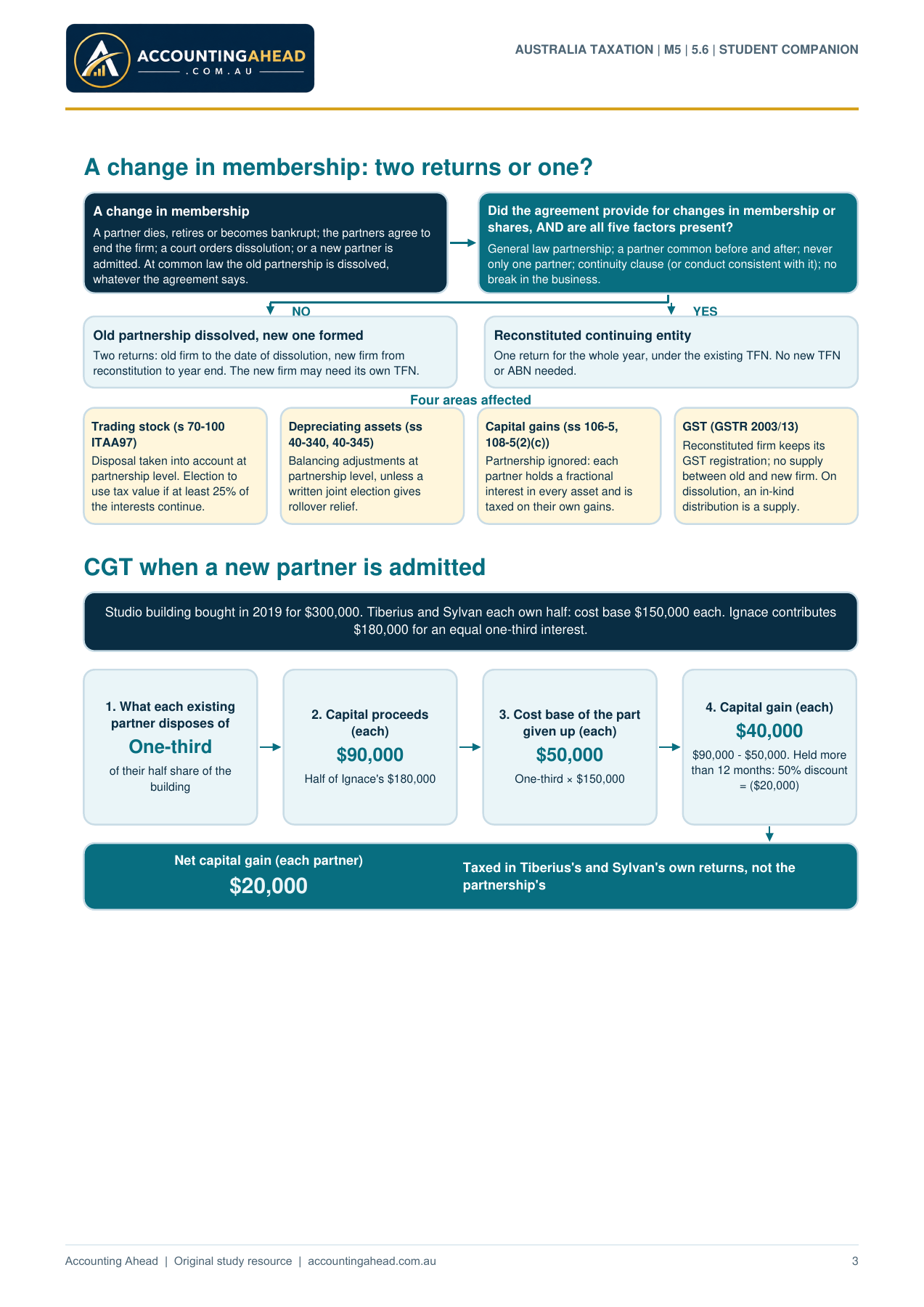
A change in membership: two returns or one?
A change in membership
A partner dies, retires or becomes bankrupt; the partners agree to
end the firm; a court orders dissolution; or a new partner is
admitted. At common law the old partnership is dissolved,
whatever the agreement says.
Did the agreement provide for changes in membership or
shares, AND are all five factors present?
General law partnership; a partner common before and after; never
only one partner; continuity clause (or conduct consistent with it); no
break in the business.
NO YES
Old partnership dissolved, new one formed
Two returns: old firm to the date of dissolution, new firm from
reconstitution to year end. The new firm may need its own TFN.
Reconstituted continuing entity
One return for the whole year, under the existing TFN. No new TFN
or ABN needed.
Four areas affected
Trading stock (s 70-100
ITAA97)
Disposal taken into account at
partnership level. Election to
use tax value if at least 25% of
the interests continue.
Depreciating assets (ss
40-340, 40-345)
Balancing adjustments at
partnership level, unless a
written joint election gives
rollover relief.
Capital gains (ss 106-5,
108-5(2)(c))
Partnership ignored: each
partner holds a fractional
interest in every asset and is
taxed on their own gains.
GST (GSTR 2003/13)
Reconstituted firm keeps its
GST registration; no supply
between old and new firm. On
dissolution, an in-kind
distribution is a supply.
CGT when a new partner is admitted
Studio building bought in 2019 for $300,000. Tiberius and Sylvan each own half: cost base $150,000 each. Ignace contributes
$180,000 for an equal one-third interest.
1. What each existing
partner disposes of
One-third
of their half share of the
building
2. Capital proceeds
(each)
$90,000
Half of Ignace's $180,000
3. Cost base of the part
given up (each)
$50,000
One-third × $150,000
4. Capital gain (each)
$40,000
$90,000 - $50,000. Held more
than 12 months: 50% discount
= ($20,000)
Net capital gain (each partner)
$20,000
Taxed in Tiberius's and Sylvan's own returns, not the
partnership's
AUSTRALIA TAXATION | M5 | 5.6 | STUDENT COMPANION
3
Accounting Ahead | Original study resource | accountingahead.com.au
Key references
Item Rule
Uncontrolled partnership income s 94 ITAA36 - special rates
Minor partners Div 6AA ITAA36 - excess generally 45% + 2% Medicare
CGT on an Everett assignment Interests acquired after 19 September 1985; s 110-25(2) cost base; s
116-30 market value
PCG 2021/4 Applies from 1 July 2022
Trading stock election on reconstitution At least 25% of interests continue
CGT discount on a partner's gain 50% if held more than 12 months (individual)
Practice questions
MODULE 5 | 5.6 | TRY THESE BEFORE THE WORKED ANSWERS
Question 1 - An assignment in an engineering firm
Amaryllis Stellmach is a partner in Ravensdale Acoustics, a firm of acoustic engineers. She bought her
partnership interest in 2014 for $240,000, financed by a bank loan. On 1 July 2024 she assigns one-quarter of
her interest to her spouse by deed, for $1. The spouse does not become a partner. Based on its expected net
cash flows, the assigned quarter is worth $100,000. For 2024-25: Amaryllis's share of the net income of the
partnership is $200,000; she pays $8,000 interest on the loan used to buy her interest; she pays $1,200 in
professional subscriptions and claims $800 depreciation on her professional library. (a) Who is assessed on the
partnership income attached to Amaryllis's interest for 2024-25, in what capacity, and how much? (b) How much
of her expenses can Amaryllis deduct? (c) Calculate Amaryllis's net capital gain from the assignment. (d) If in
2025-26 her share of the partnership is a loss of $40,000, how is the loss on the assigned quarter treated?
AUSTRALIA TAXATION | M5 | 5.6 | STUDENT COMPANION
4
Accounting Ahead | Original study resource | accountingahead.com.au
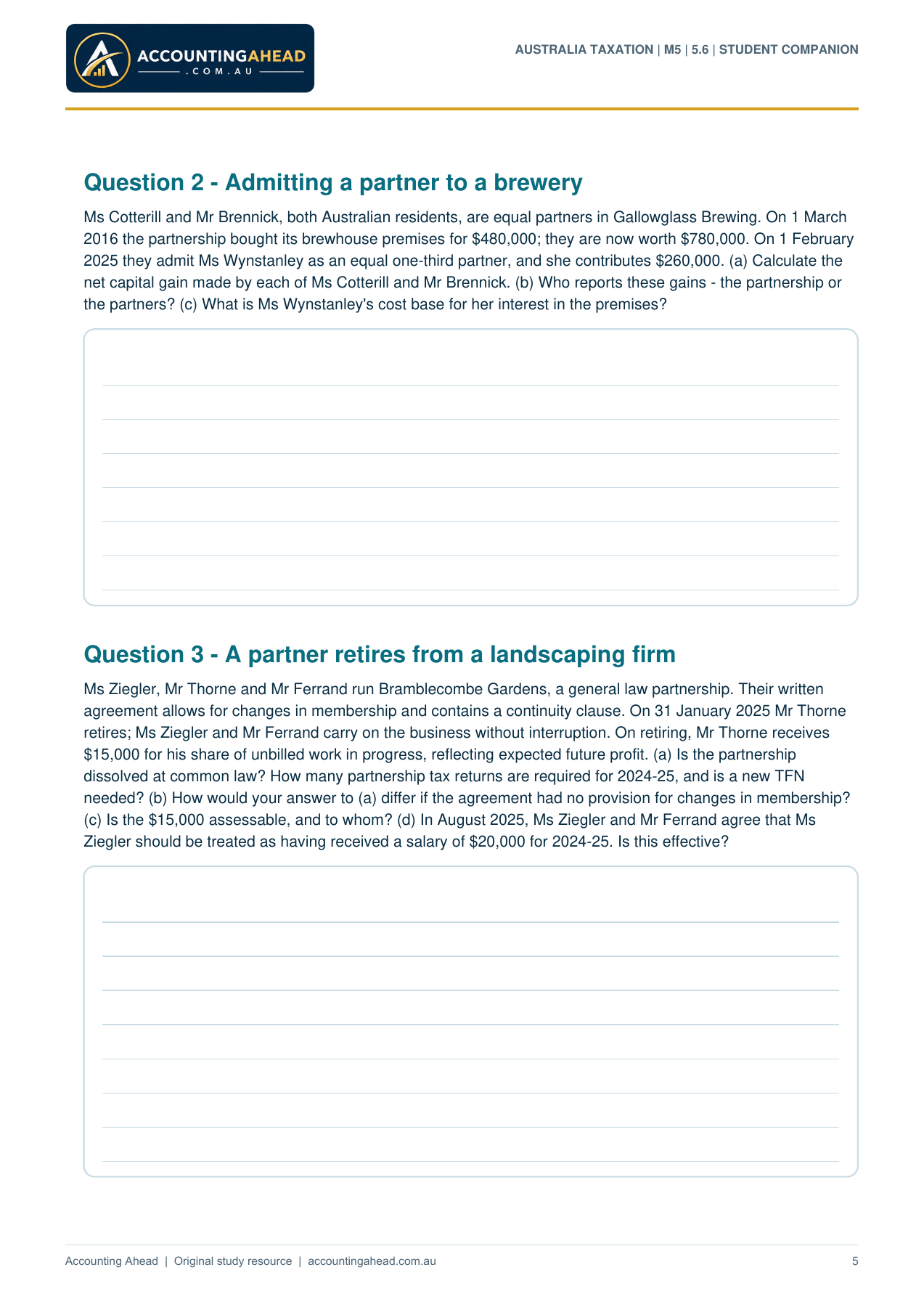
Question 2 - Admitting a partner to a brewery
Ms Cotterill and Mr Brennick, both Australian residents, are equal partners in Gallowglass Brewing. On 1 March
2016 the partnership bought its brewhouse premises for $480,000; they are now worth $780,000. On 1 February
2025 they admit Ms Wynstanley as an equal one-third partner, and she contributes $260,000. (a) Calculate the
net capital gain made by each of Ms Cotterill and Mr Brennick. (b) Who reports these gains - the partnership or
the partners? (c) What is Ms Wynstanley's cost base for her interest in the premises?
Question 3 - A partner retires from a landscaping firm
Ms Ziegler, Mr Thorne and Mr Ferrand run Bramblecombe Gardens, a general law partnership. Their written
agreement allows for changes in membership and contains a continuity clause. On 31 January 2025 Mr Thorne
retires; Ms Ziegler and Mr Ferrand carry on the business without interruption. On retiring, Mr Thorne receives
$15,000 for his share of unbilled work in progress, reflecting expected future profit. (a) Is the partnership
dissolved at common law? How many partnership tax returns are required for 2024-25, and is a new TFN
needed? (b) How would your answer to (a) differ if the agreement had no provision for changes in membership?
(c) Is the $15,000 assessable, and to whom? (d) In August 2025, Ms Ziegler and Mr Ferrand agree that Ms
Ziegler should be treated as having received a salary of $20,000 for 2024-25. Is this effective?
AUSTRALIA TAXATION | M5 | 5.6 | STUDENT COMPANION
5
Accounting Ahead | Original study resource | accountingahead.com.au
Worked answers
MODULE 5 | 5.6 | WORKED ANSWERS - ATTEMPT THE QUESTIONS FIRST
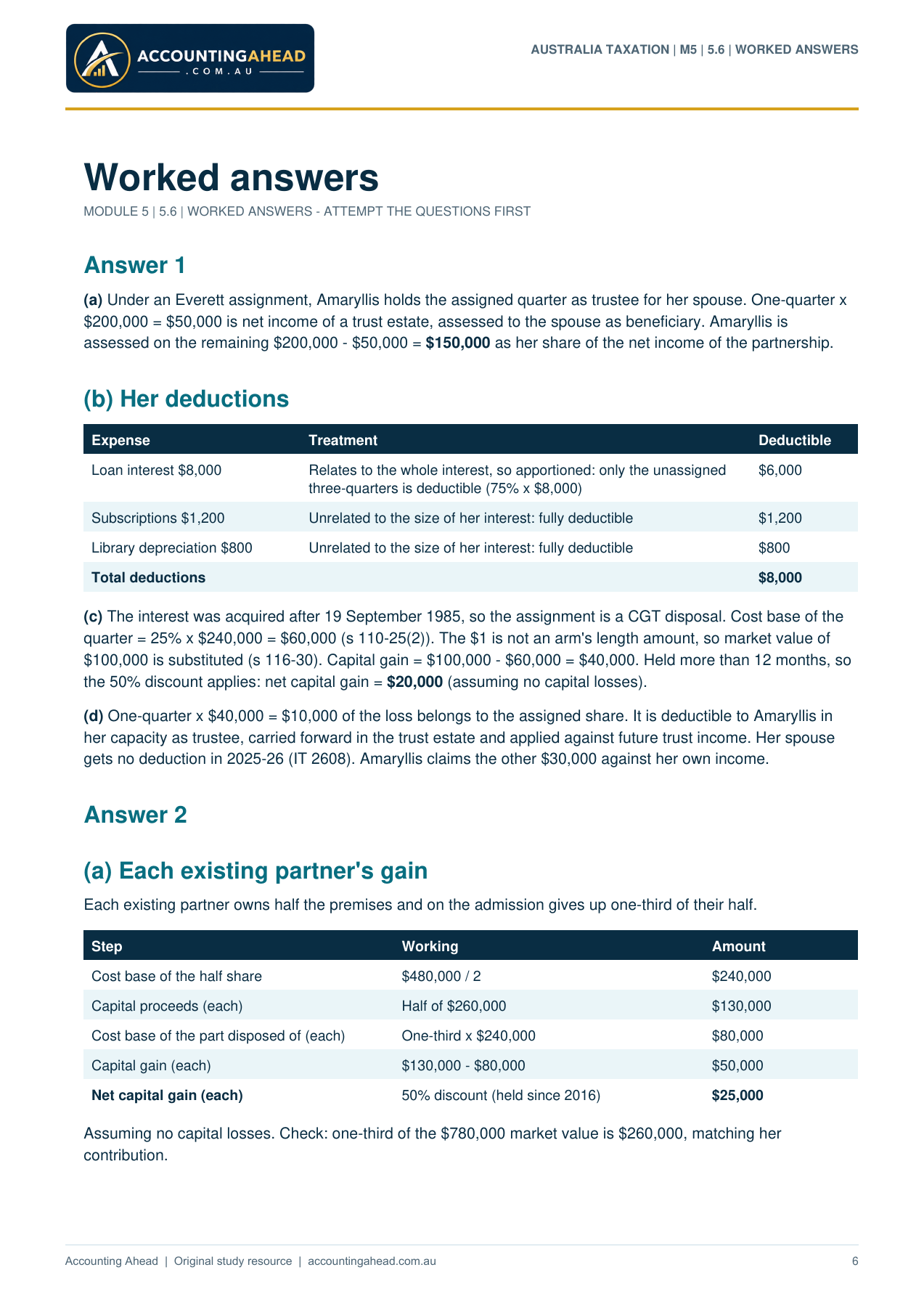
Answer 1
(a) Under an Everett assignment, Amaryllis holds the assigned quarter as trustee for her spouse. One-quarter x
$200,000 = $50,000 is net income of a trust estate, assessed to the spouse as beneficiary. Amaryllis is
assessed on the remaining $200,000 - $50,000 = $150,000 as her share of the net income of the partnership.
(b) Her deductions
Expense Treatment Deductible
Loan interest $8,000 Relates to the whole interest, so apportioned: only the unassigned
three-quarters is deductible (75% x $8,000)
$6,000
Subscriptions $1,200 Unrelated to the size of her interest: fully deductible $1,200
Library depreciation $800 Unrelated to the size of her interest: fully deductible $800
Total deductions $8,000
(c) The interest was acquired after 19 September 1985, so the assignment is a CGT disposal. Cost base of the
quarter = 25% x $240,000 = $60,000 (s 110-25(2)). The $1 is not an arm's length amount, so market value of
$100,000 is substituted (s 116-30). Capital gain = $100,000 - $60,000 = $40,000. Held more than 12 months, so
the 50% discount applies: net capital gain = $20,000 (assuming no capital losses).
(d) One-quarter x $40,000 = $10,000 of the loss belongs to the assigned share. It is deductible to Amaryllis in
her capacity as trustee, carried forward in the trust estate and applied against future trust income. Her spouse
gets no deduction in 2025-26 (IT 2608). Amaryllis claims the other $30,000 against her own income.
Answer 2
(a) Each existing partner's gain
Each existing partner owns half the premises and on the admission gives up one-third of their half.
Step Working Amount
Cost base of the half share $480,000 / 2 $240,000
Capital proceeds (each) Half of $260,000 $130,000
Cost base of the part disposed of (each) One-third x $240,000 $80,000
Capital gain (each) $130,000 - $80,000 $50,000
Net capital gain (each) 50% discount (held since 2016) $25,000
Assuming no capital losses. Check: one-third of the $780,000 market value is $260,000, matching her
contribution.
AUSTRALIA TAXATION | M5 | 5.6 | WORKED ANSWERS
6
Accounting Ahead | Original study resource | accountingahead.com.au
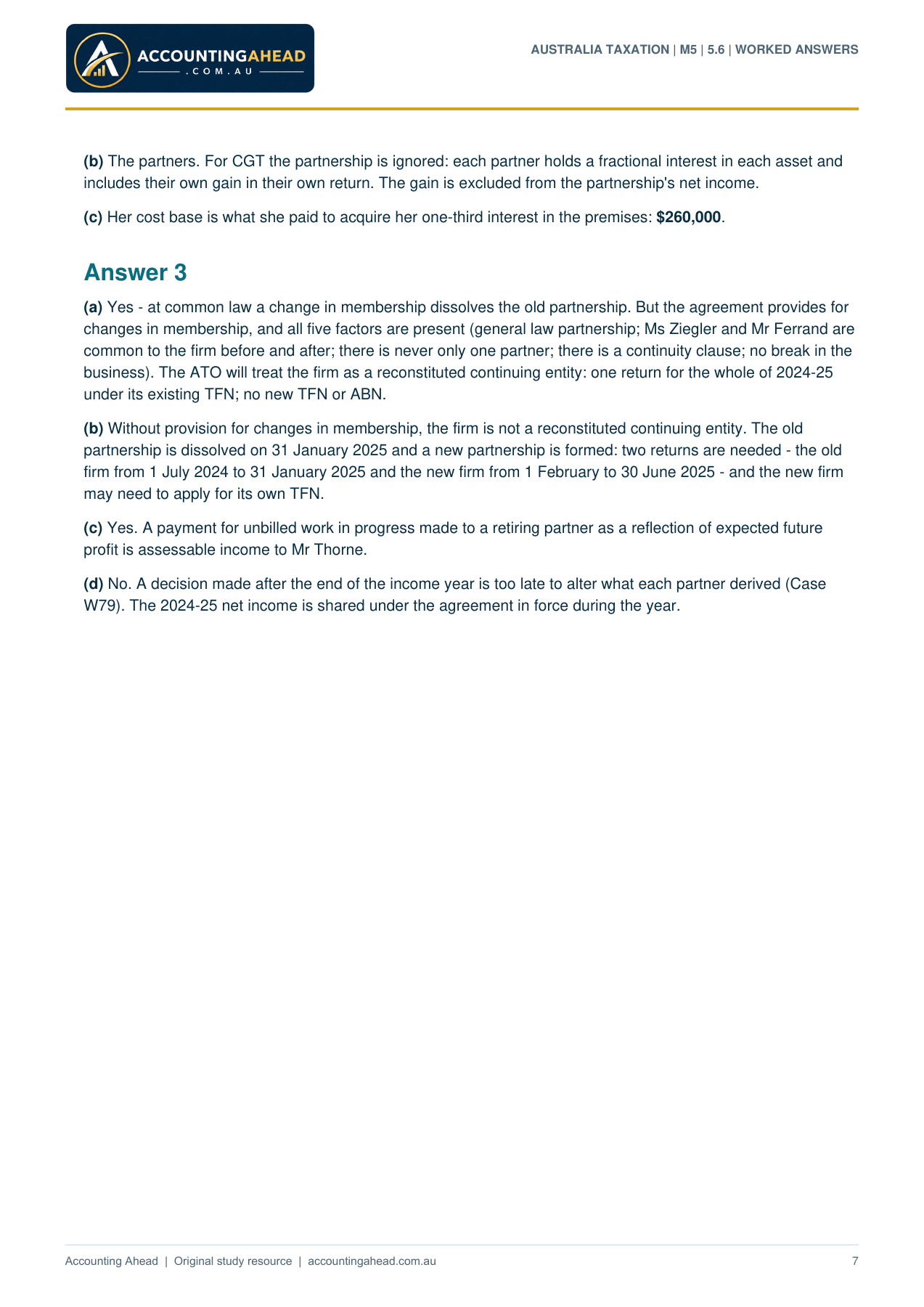
(b) The partners. For CGT the partnership is ignored: each partner holds a fractional interest in each asset and
includes their own gain in their own return. The gain is excluded from the partnership's net income.
(c) Her cost base is what she paid to acquire her one-third interest in the premises: $260,000.
Answer 3
(a) Yes - at common law a change in membership dissolves the old partnership. But the agreement provides for
changes in membership, and all five factors are present (general law partnership; Ms Ziegler and Mr Ferrand are
common to the firm before and after; there is never only one partner; there is a continuity clause; no break in the
business). The ATO will treat the firm as a reconstituted continuing entity: one return for the whole of 2024-25
under its existing TFN; no new TFN or ABN.
(b) Without provision for changes in membership, the firm is not a reconstituted continuing entity. The old
partnership is dissolved on 31 January 2025 and a new partnership is formed: two returns are needed - the old
firm from 1 July 2024 to 31 January 2025 and the new firm from 1 February to 30 June 2025 - and the new firm
may need to apply for its own TFN.
(c) Yes. A payment for unbilled work in progress made to a retiring partner as a reflection of expected future
profit is assessable income to Mr Thorne.
(d) No. A decision made after the end of the income year is too late to alter what each partner derived (Case
W79). The 2024-25 net income is shared under the agreement in force during the year.
AUSTRALIA TAXATION | M5 | 5.6 | WORKED ANSWERS
7