
Net Income of a Trust — study companion
Part 5.9 of Australia Taxation. Preview the study companion or download the printable PDF.



Read the handout text
Accounting Ahead | Original study resource | accountingahead.com.au
Net Income of a Trust
MODULE 5 | 5.9 | STUDENT COMPANION
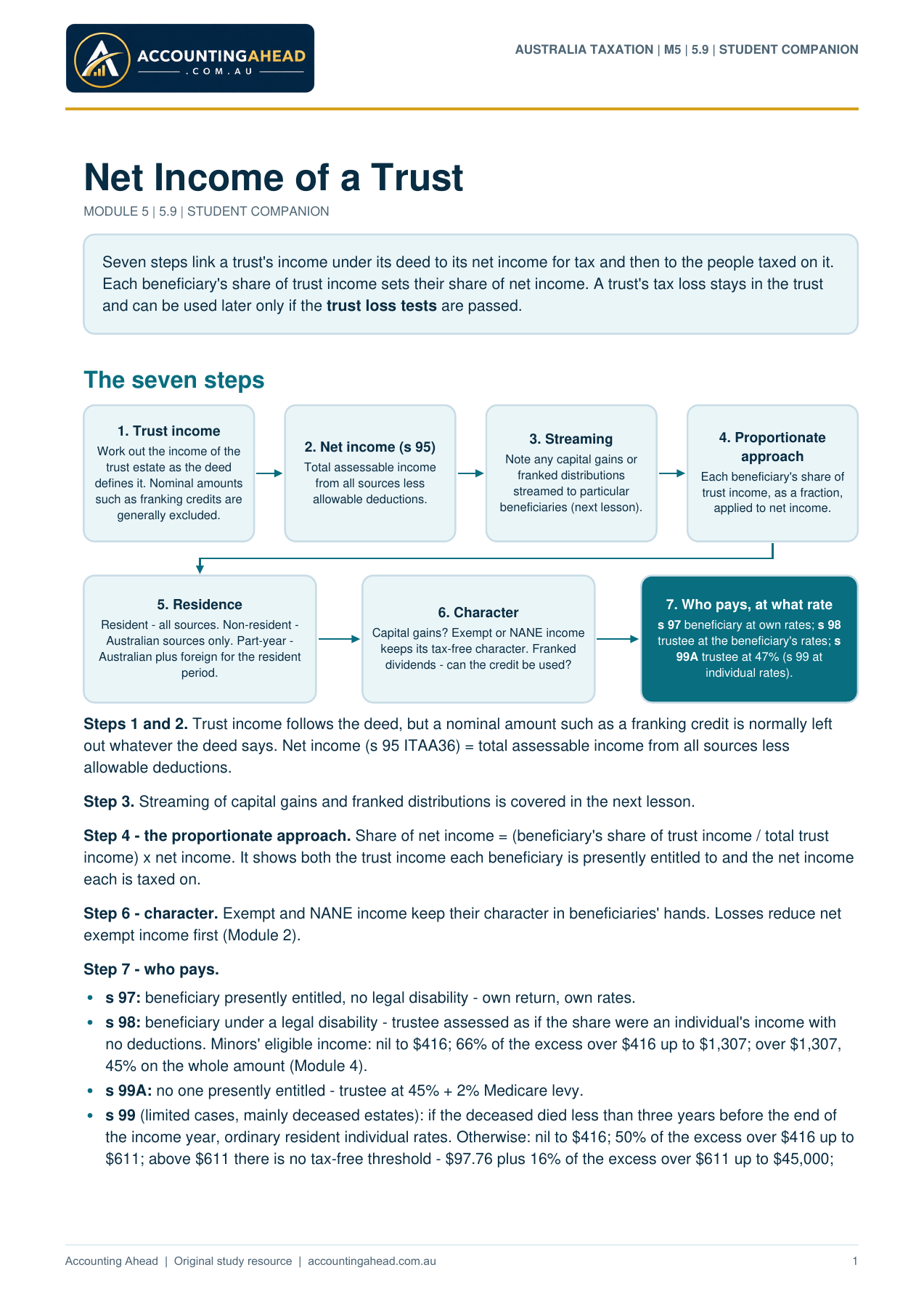
Seven steps link a trust's income under its deed to its net income for tax and then to the people taxed on it.
Each beneficiary's share of trust income sets their share of net income. A trust's tax loss stays in the trust
and can be used later only if the trust loss tests are passed.
The seven steps
1. Trust income
Work out the income of the
trust estate as the deed
defines it. Nominal amounts
such as franking credits are
generally excluded.
2. Net income (s 95)
Total assessable income
from all sources less
allowable deductions.
3. Streaming
Note any capital gains or
franked distributions
streamed to particular
beneficiaries (next lesson).
4. Proportionate
approach
Each beneficiary's share of
trust income, as a fraction,
applied to net income.
5. Residence
Resident - all sources. Non-resident -
Australian sources only. Part-year -
Australian plus foreign for the resident
period.
6. Character
Capital gains? Exempt or NANE income
keeps its tax-free character. Franked
dividends - can the credit be used?
7. Who pays, at what rate
s 97 beneficiary at own rates; s 98
trustee at the beneficiary's rates; s
99A trustee at 47% (s 99 at
individual rates).
Steps 1 and 2. Trust income follows the deed, but a nominal amount such as a franking credit is normally left
out whatever the deed says. Net income (s 95 ITAA36) = total assessable income from all sources less
allowable deductions.
Step 3. Streaming of capital gains and franked distributions is covered in the next lesson.
Step 4 - the proportionate approach. Share of net income = (beneficiary's share of trust income / total trust
income) x net income. It shows both the trust income each beneficiary is presently entitled to and the net income
each is taxed on.
Step 6 - character. Exempt and NANE income keep their character in beneficiaries' hands. Losses reduce net
exempt income first (Module 2).
Step 7 - who pays.
s 97: beneficiary presently entitled, no legal disability - own return, own rates.
s 98: beneficiary under a legal disability - trustee assessed as if the share were an individual's income with
no deductions. Minors' eligible income: nil to $416; 66% of the excess over $416 up to $1,307; over $1,307,
45% on the whole amount (Module 4).
s 99A: no one presently entitled - trustee at 45% + 2% Medicare levy.
s 99 (limited cases, mainly deceased estates): if the deceased died less than three years before the end of
the income year, ordinary resident individual rates. Otherwise: nil to $416; 50% of the excess over $416 up to
$611; above $611 there is no tax-free threshold - $97.76 plus 16% of the excess over $611 up to $45,000;
AUSTRALIA TAXATION | M5 | 5.9 | STUDENT COMPANION
1
Accounting Ahead | Original study resource | accountingahead.com.au
$7,200 plus 30% over $45,000; $34,200 plus 37% over $135,000; $54,550 plus 45% over $190,000. Add
Medicare levy where applicable.
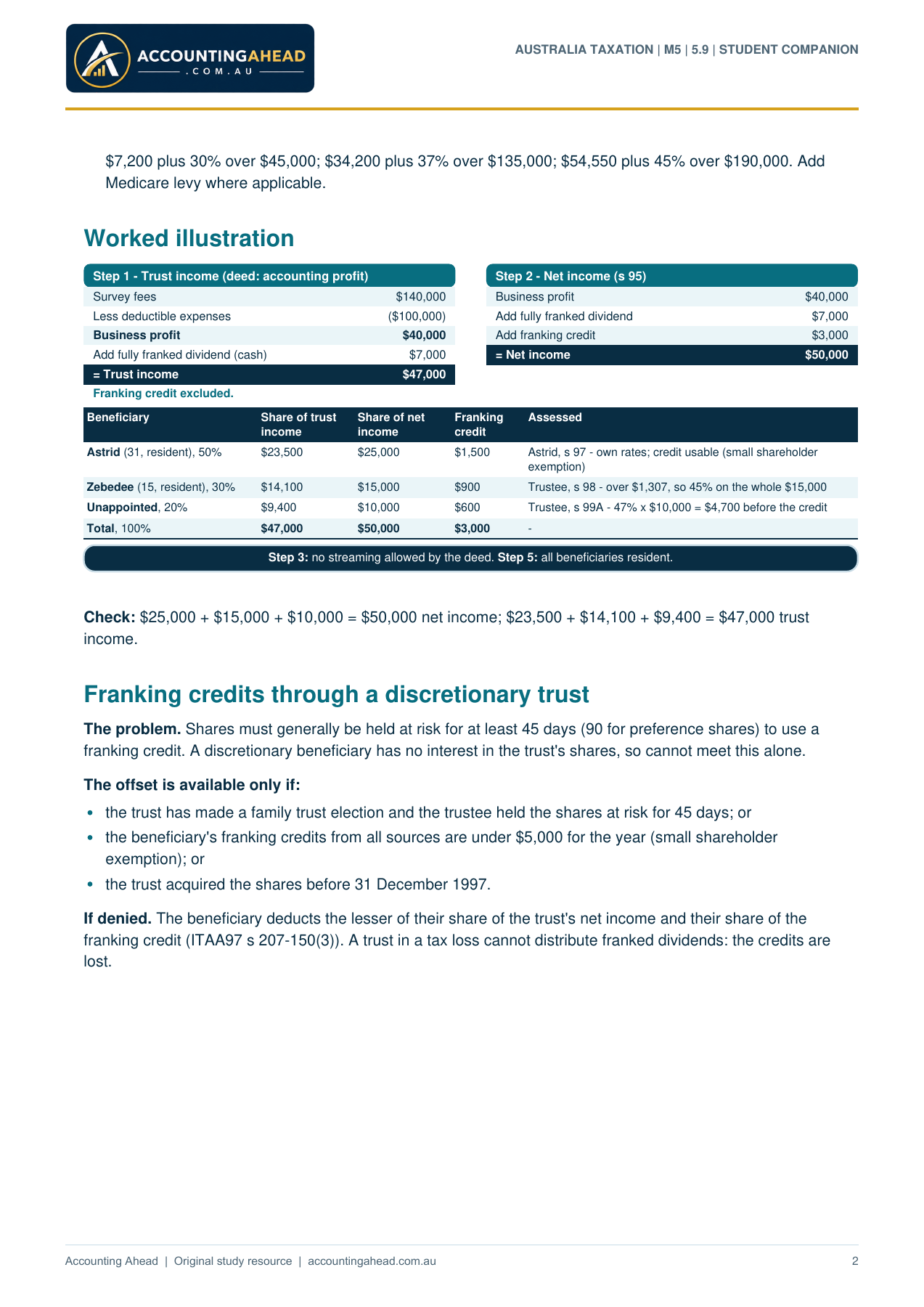
Worked illustration
Step 1 - Trust income (deed: accounting profit)
Survey fees $140,000
Less deductible expenses ($100,000)
Business profit $40,000
Add fully franked dividend (cash) $7,000
= Trust income $47,000
Franking credit excluded.
Step 2 - Net income (s 95)
Business profit $40,000
Add fully franked dividend $7,000
Add franking credit $3,000
= Net income $50,000
Beneficiary Share of trust
income
Share of net
income
Franking
credit
Assessed
Astrid (31, resident), 50% $23,500 $25,000 $1,500 Astrid, s 97 - own rates; credit usable (small shareholder
exemption)
Zebedee (15, resident), 30% $14,100 $15,000 $900 Trustee, s 98 - over $1,307, so 45% on the whole $15,000
Unappointed, 20% $9,400 $10,000 $600 Trustee, s 99A - 47% x $10,000 = $4,700 before the credit
Total, 100% $47,000 $50,000 $3,000 -
Step 3: no streaming allowed by the deed. Step 5: all beneficiaries resident.
Check: $25,000 + $15,000 + $10,000 = $50,000 net income; $23,500 + $14,100 + $9,400 = $47,000 trust
income.
Franking credits through a discretionary trust
The problem. Shares must generally be held at risk for at least 45 days (90 for preference shares) to use a
franking credit. A discretionary beneficiary has no interest in the trust's shares, so cannot meet this alone.
The offset is available only if:
the trust has made a family trust election and the trustee held the shares at risk for 45 days; or
the beneficiary's franking credits from all sources are under $5,000 for the year (small shareholder
exemption); or
the trust acquired the shares before 31 December 1997.
If denied. The beneficiary deducts the lesser of their share of the trust's net income and their share of the
franking credit (ITAA97 s 207-150(3)). A trust in a tax loss cannot distribute franked dividends: the credits are
lost.
AUSTRALIA TAXATION | M5 | 5.9 | STUDENT COMPANION
2
Accounting Ahead | Original study resource | accountingahead.com.au
Trust losses
A trust's tax loss cannot be distributed to beneficiaries. It is carried forward and deducted from the trust's net income in a
later year - if the tests are passed.
Fixed trust Discretionary trust Family trust election made
50% stake test Applies
Only where there are fixed
entitlements, in the
circumstances in s 267-40
Generally does not apply
Income injection test Applies Applies Can apply in certain
circumstances
Control test Does not apply Applies Generally does not apply
Pattern of distributions
test Does not apply Applies Generally does not apply
Listed widely held trusts also face a business continuity test. Capital losses are outside these rules.
Quarantined. A tax loss stays in the trust and is carried forward against its own later net income. The tests stop
a trust's losses being used to shelter income from people who buy in or inject income.
Key figures for 2024-25
Item Figure
s 99A rate 45% + 2% Medicare levy = 47%
Minors' eligible income Nil to $416; 66% of excess to $1,307; 45% on whole above $1,307
s 99 deceased estate, death 3 or more years
before year end
Nil to $416; 50% of excess to $611; then 16% from the first dollar
($97.76 + 16% over $611) and ordinary rates above $45,000
Holding period 45 days (90 days preference shares)
Small shareholder exemption Franking credits under $5,000 from all sources
Pre-rule shares Acquired before 31 December 1997
AUSTRALIA TAXATION | M5 | 5.9 | STUDENT COMPANION
3
Accounting Ahead | Original study resource | accountingahead.com.au
Practice questions
MODULE 5 | 5.9 | TRY THESE BEFORE THE WORKED ANSWERS
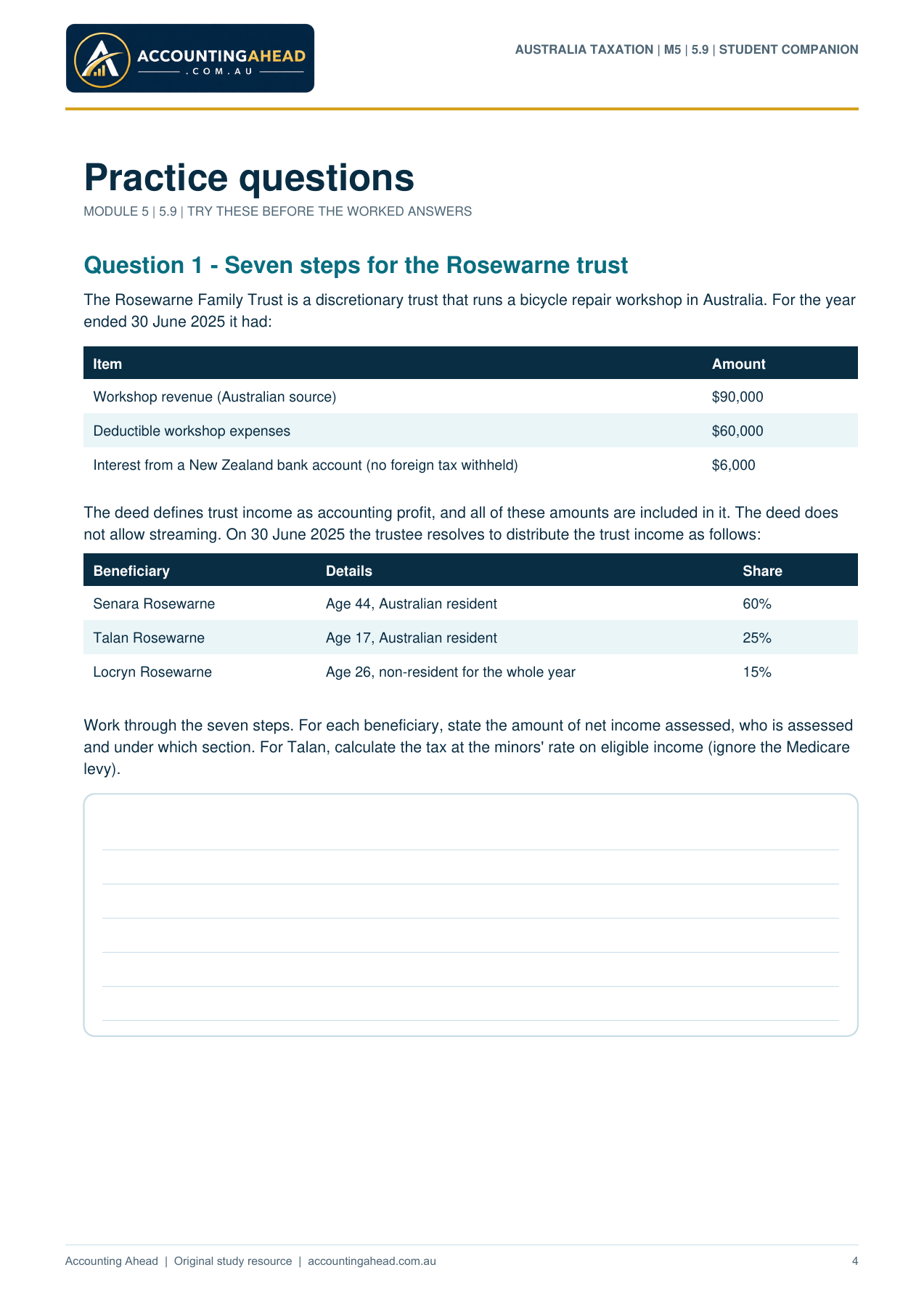
Question 1 - Seven steps for the Rosewarne trust
The Rosewarne Family Trust is a discretionary trust that runs a bicycle repair workshop in Australia. For the year
ended 30 June 2025 it had:
Item Amount
Workshop revenue (Australian source) $90,000
Deductible workshop expenses $60,000
Interest from a New Zealand bank account (no foreign tax withheld) $6,000
The deed defines trust income as accounting profit, and all of these amounts are included in it. The deed does
not allow streaming. On 30 June 2025 the trustee resolves to distribute the trust income as follows:
Beneficiary Details Share
Senara Rosewarne Age 44, Australian resident 60%
Talan Rosewarne Age 17, Australian resident 25%
Locryn Rosewarne Age 26, non-resident for the whole year 15%
Work through the seven steps. For each beneficiary, state the amount of net income assessed, who is assessed
and under which section. For Talan, calculate the tax at the minors' rate on eligible income (ignore the Medicare
levy).
AUSTRALIA TAXATION | M5 | 5.9 | STUDENT COMPANION
4
Accounting Ahead | Original study resource | accountingahead.com.au
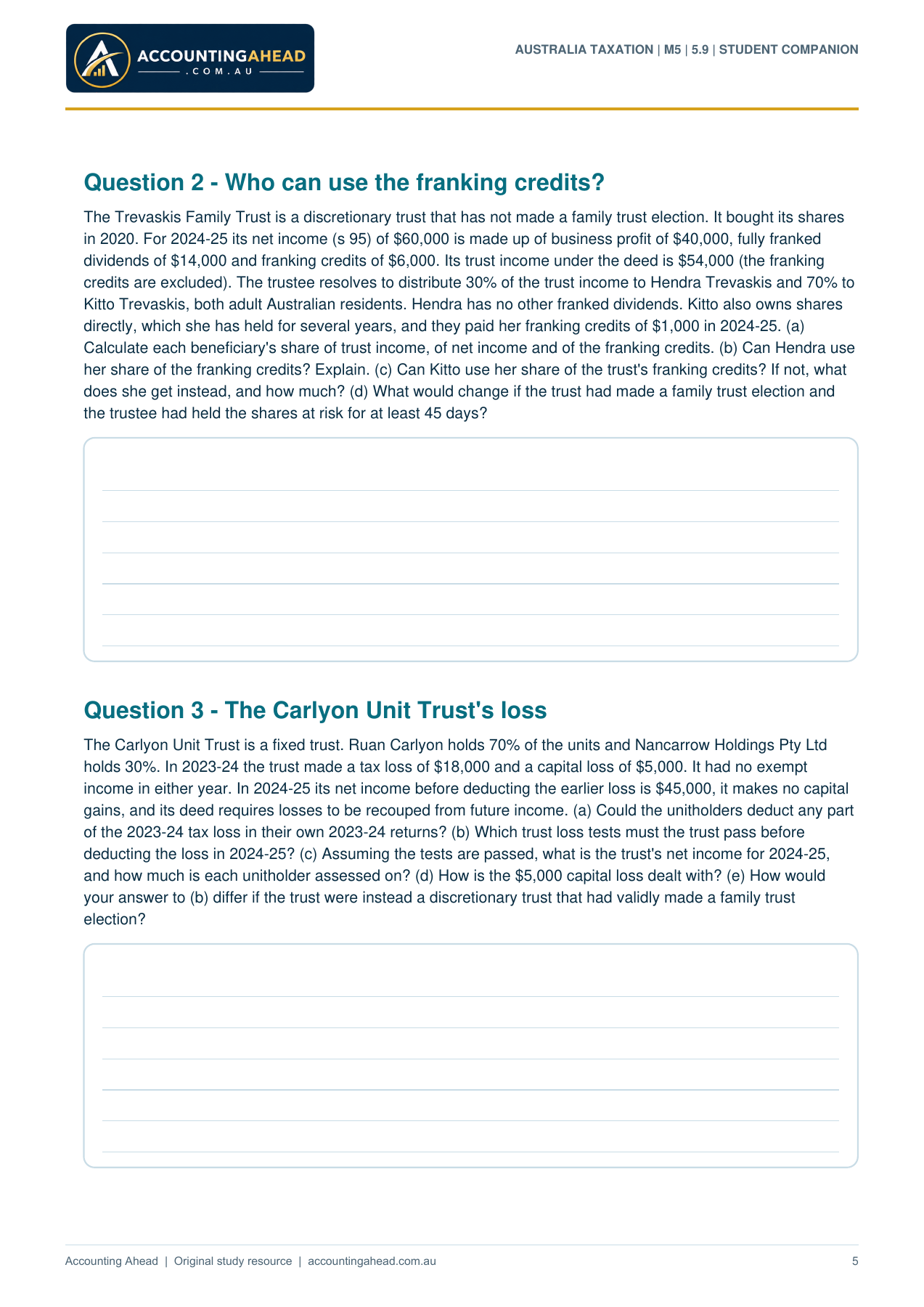
Question 2 - Who can use the franking credits?
The Trevaskis Family Trust is a discretionary trust that has not made a family trust election. It bought its shares
in 2020. For 2024-25 its net income (s 95) of $60,000 is made up of business profit of $40,000, fully franked
dividends of $14,000 and franking credits of $6,000. Its trust income under the deed is $54,000 (the franking
credits are excluded). The trustee resolves to distribute 30% of the trust income to Hendra Trevaskis and 70% to
Kitto Trevaskis, both adult Australian residents. Hendra has no other franked dividends. Kitto also owns shares
directly, which she has held for several years, and they paid her franking credits of $1,000 in 2024-25. (a)
Calculate each beneficiary's share of trust income, of net income and of the franking credits. (b) Can Hendra use
her share of the franking credits? Explain. (c) Can Kitto use her share of the trust's franking credits? If not, what
does she get instead, and how much? (d) What would change if the trust had made a family trust election and
the trustee had held the shares at risk for at least 45 days?
Question 3 - The Carlyon Unit Trust's loss
The Carlyon Unit Trust is a fixed trust. Ruan Carlyon holds 70% of the units and Nancarrow Holdings Pty Ltd
holds 30%. In 2023-24 the trust made a tax loss of $18,000 and a capital loss of $5,000. It had no exempt
income in either year. In 2024-25 its net income before deducting the earlier loss is $45,000, it makes no capital
gains, and its deed requires losses to be recouped from future income. (a) Could the unitholders deduct any part
of the 2023-24 tax loss in their own 2023-24 returns? (b) Which trust loss tests must the trust pass before
deducting the loss in 2024-25? (c) Assuming the tests are passed, what is the trust's net income for 2024-25,
and how much is each unitholder assessed on? (d) How is the $5,000 capital loss dealt with? (e) How would
your answer to (b) differ if the trust were instead a discretionary trust that had validly made a family trust
election?
AUSTRALIA TAXATION | M5 | 5.9 | STUDENT COMPANION
5
Accounting Ahead | Original study resource | accountingahead.com.au
Worked answers
MODULE 5 | 5.9 | WORKED ANSWERS - ATTEMPT THE QUESTIONS FIRST
Answer 1 - Seven steps for the Rosewarne trust
Step 1 - Trust income (deed: accounting profit): $90,000 - $60,000 + $6,000 = $36,000.
Step 2 - Net income (s 95): assessable income from all sources $90,000 + $6,000 = $96,000, less
deductions $60,000 = $36,000.
Step 3 - No streaming: the deed does not allow it.
Step 4 - Proportionate approach (net income equals trust income here):
Beneficiary Share Net income Australian-source part
($30,000)
Foreign part
($6,000)
Senara 60% $21,600 $18,000 $3,600
Talan 25% $9,000 $7,500 $1,500
Locryn 15% $5,400 $4,500 $900
Total 100% $36,000 $30,000 $6,000
Step 5 - Residence: Senara and Talan are residents, so they are taxed on their shares from all sources.
Locryn is a non-resident for the whole year, so only the Australian-sourced part, $4,500, is assessable; the
$900 of New Zealand interest is not.
Step 6 - Character: there is no capital gain, exempt income, NANE income or franked dividend.
Step 7 - Senara: presently entitled, no legal disability. She includes $21,600 in her own return under s 97.
Step 7 - Talan: presently entitled but a minor (under 18 at 30 June 2025), so the trustee is assessed on
$9,000 under s 98. This is eligible income above $1,307, so 45% applies to the whole amount: 45% x $9,000
= $4,050.
Step 7 - Locryn: assessed on $4,500 at non-resident rates. The trustee is also assessed on this share under
s 98 and must keep back enough of the distribution to pay the tax.
Answer 2 - Who can use the franking credits? (a)
Beneficiary Share Trust income Net income Franking credits
Hendra 30% 30% x $54,000 = $16,200 30% x $60,000 = $18,000 30% x $6,000 = $1,800
Kitto 70% 70% x $54,000 = $37,800 70% x $60,000 = $42,000 70% x $6,000 = $4,200
(b) Yes. A discretionary beneficiary has no interest in the trust's shares and cannot satisfy the 45-day holding
rule, the trust has made no family trust election, and the shares were bought after 31 December 1997. But
Hendra's total franking credits from all sources are $1,800, under $5,000, so the small shareholder exemption
applies. She includes $18,000 (which already contains the $1,800 gross-up) and claims a $1,800 franking
credit offset.
(c) No. Her franking credits from all sources are $4,200 + $1,000 = $5,200, which is not under $5,000, so the
small shareholder exemption fails. No other route applies. Instead she gets a deduction equal to the lesser of
her share of the net income ($42,000) and her share of the franking credit ($4,200): a deduction of $4,200.
AUSTRALIA TAXATION | M5 | 5.9 | WORKED ANSWERS
6
Accounting Ahead | Original study resource | accountingahead.com.au
She can still use the $1,000 credit on the shares she holds directly, because she held them for well over 45
days.
(d) With a family trust election and the trustee holding the shares at risk for at least 45 days, both
beneficiaries could use their share of the trust's franking credits: Hendra $1,800 and Kitto $4,200.
Answer 3 - The Carlyon Unit Trust's loss
(a) No. A trust's tax loss is quarantined in the trust and cannot be distributed to beneficiaries.
(b) It is a fixed trust, so it must pass the 50% stake test and the income injection test (Schedule 2F, ITAA36).
(c) Net income: $45,000 - $18,000 = $27,000. Ruan: 70% x $27,000 = $18,900. Nancarrow Holdings Pty Ltd:
30% x $27,000 = $8,100. Both are presently entitled and not under a legal disability, so both are assessed
under s 97. Check: $18,900 + $8,100 = $27,000.
(d) The trust loss provisions do not apply to capital losses. The $5,000 stays in the trust and is carried
forward under the CGT rules, to be applied against future capital gains of the trust. It cannot reduce the
2024-25 net income, because the trust made no capital gains that year.
(e) A trust that has validly made a family trust election is generally outside the trust loss tests. Only the
income injection test can still apply, in certain circumstances.
AUSTRALIA TAXATION | M5 | 5.9 | WORKED ANSWERS
7