
Special Supply Cases — study companion
Part 6.2.2 of Australia Taxation. Preview the study companion or download the printable PDF.


Read the handout text
Accounting Ahead | Original study resource | accountingahead.com.au
Special supply cases
MODULE 6 | 6.2.2 | STUDENT COMPANION
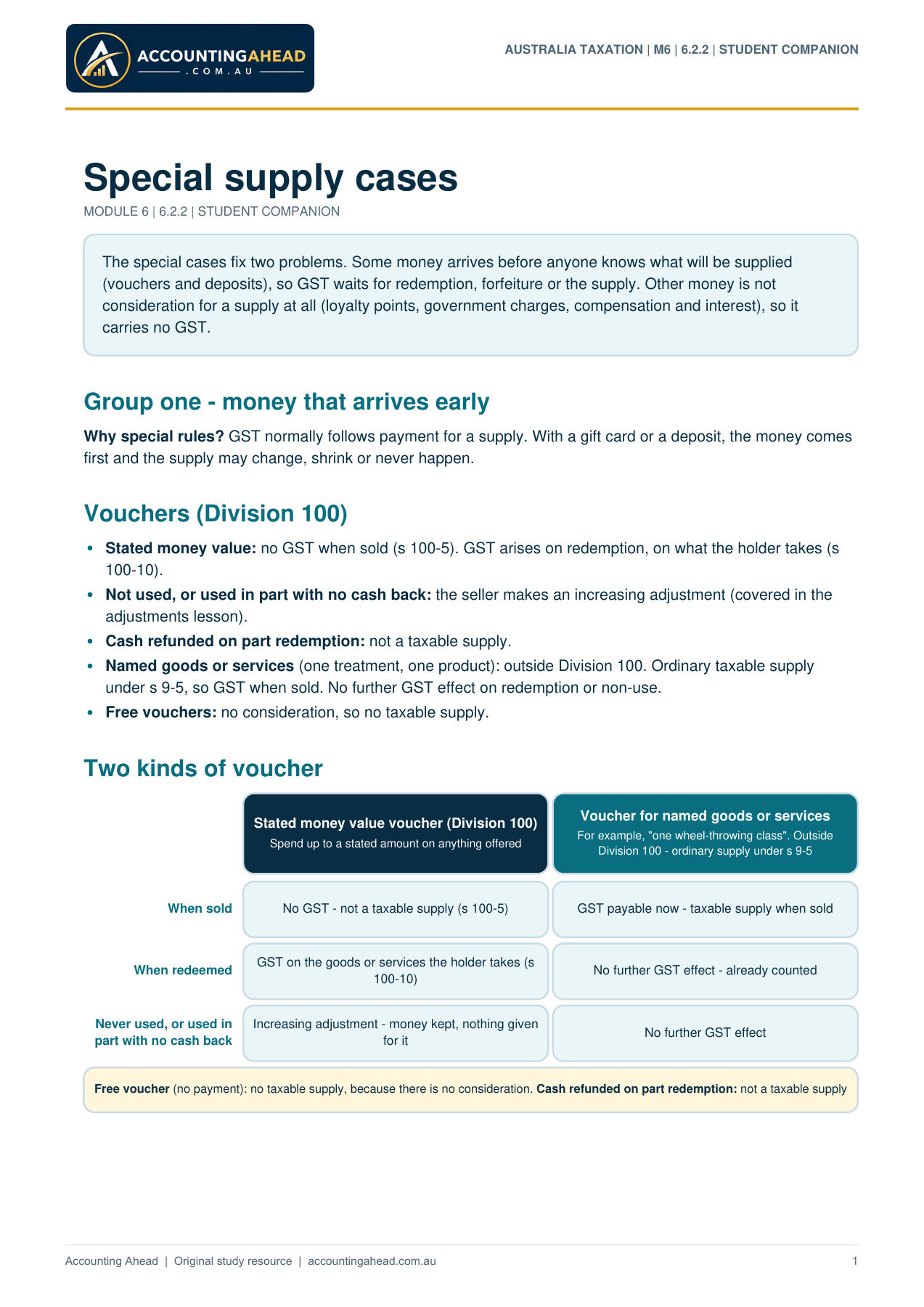
The special cases fix two problems. Some money arrives before anyone knows what will be supplied
(vouchers and deposits), so GST waits for redemption, forfeiture or the supply. Other money is not
consideration for a supply at all (loyalty points, government charges, compensation and interest), so it
carries no GST.
Group one - money that arrives early
Why special rules? GST normally follows payment for a supply. With a gift card or a deposit, the money comes
first and the supply may change, shrink or never happen.
Vouchers (Division 100)
Stated money value: no GST when sold (s 100-5). GST arises on redemption, on what the holder takes (s
100-10).
Not used, or used in part with no cash back: the seller makes an increasing adjustment (covered in the
adjustments lesson).
Cash refunded on part redemption: not a taxable supply.
Named goods or services (one treatment, one product): outside Division 100. Ordinary taxable supply
under s 9-5, so GST when sold. No further GST effect on redemption or non-use.
Free vouchers: no consideration, so no taxable supply.
Two kinds of voucher
Stated money value voucher (Division 100)
Spend up to a stated amount on anything offered
Voucher for named goods or services
For example, "one wheel-throwing class". Outside
Division 100 - ordinary supply under s 9-5
When sold No GST - not a taxable supply (s 100-5) GST payable now - taxable supply when sold
When redeemed GST on the goods or services the holder takes (s
100-10) No further GST effect - already counted
Never used, or used in
part with no cash back
Increasing adjustment - money kept, nothing given
for it No further GST effect
Free voucher (no payment): no taxable supply, because there is no consideration. Cash refunded on part redemption: not a taxable supply
AUSTRALIA TAXATION | M6 | 6.2.2 | STUDENT COMPANION
1
Accounting Ahead | Original study resource | accountingahead.com.au
Security deposits (Division 99)
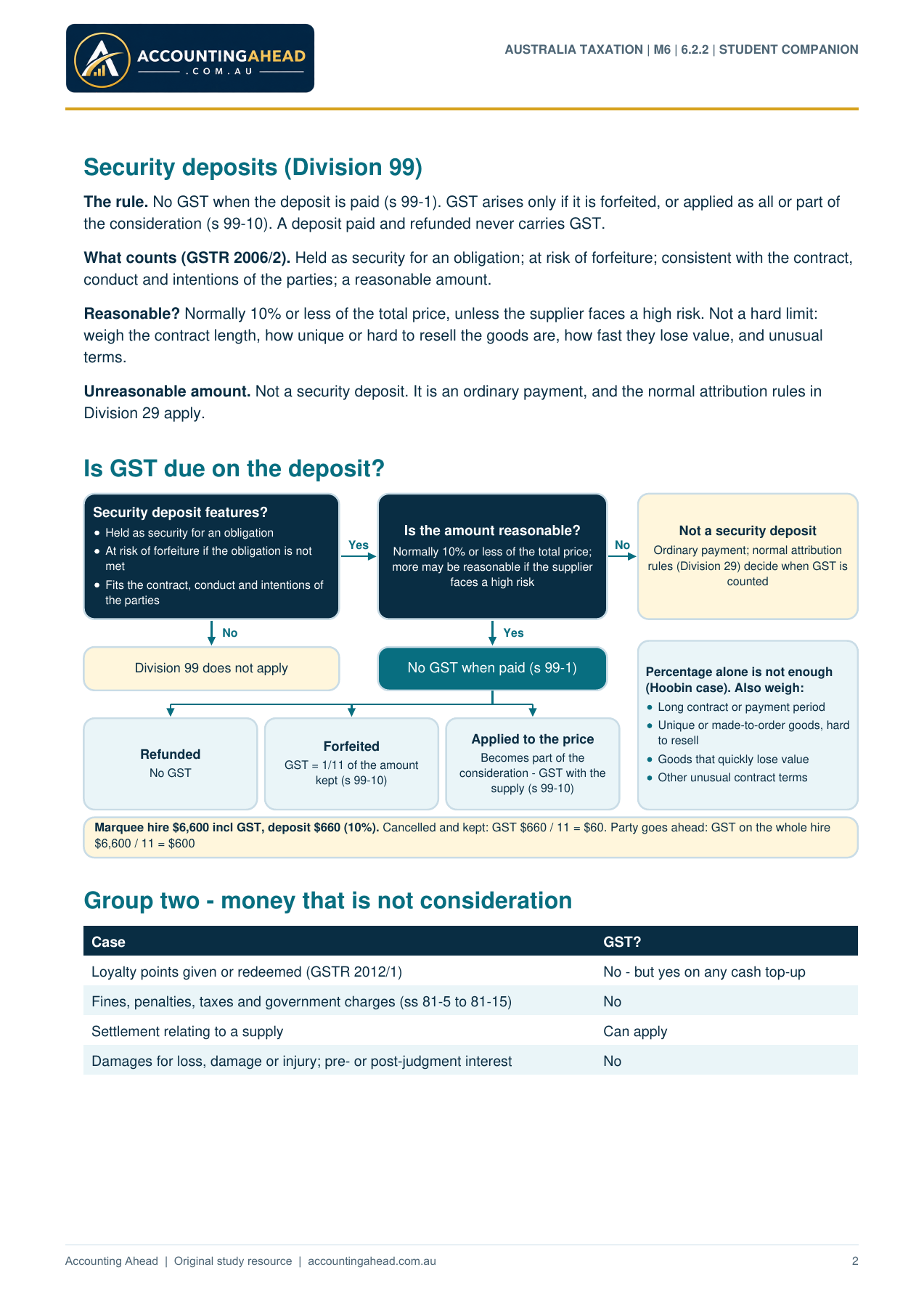
The rule. No GST when the deposit is paid (s 99-1). GST arises only if it is forfeited, or applied as all or part of
the consideration (s 99-10). A deposit paid and refunded never carries GST.
What counts (GSTR 2006/2). Held as security for an obligation; at risk of forfeiture; consistent with the contract,
conduct and intentions of the parties; a reasonable amount.
Reasonable? Normally 10% or less of the total price, unless the supplier faces a high risk. Not a hard limit:
weigh the contract length, how unique or hard to resell the goods are, how fast they lose value, and unusual
terms.
Unreasonable amount. Not a security deposit. It is an ordinary payment, and the normal attribution rules in
Division 29 apply.
Is GST due on the deposit?
Security deposit features?
Held as security for an obligation
At risk of forfeiture if the obligation is not
met
Fits the contract, conduct and intentions of
the parties
Is the amount reasonable?
Normally 10% or less of the total price;
more may be reasonable if the supplier
faces a high risk
Yes No
Not a security deposit
Ordinary payment; normal attribution
rules (Division 29) decide when GST is
counted
No
Division 99 does not apply
Yes
No GST when paid (s 99-1)
Refunded
No GST
Forfeited
GST = 1/11 of the amount
kept (s 99-10)
Applied to the price
Becomes part of the
consideration - GST with the
supply (s 99-10)
Percentage alone is not enough
(Hoobin case). Also weigh:
Long contract or payment period
Unique or made-to-order goods, hard
to resell
Goods that quickly lose value
Other unusual contract terms
Marquee hire $6,600 incl GST, deposit $660 (10%). Cancelled and kept: GST $660 / 11 = $60. Party goes ahead: GST on the whole hire
$6,600 / 11 = $600
Group two - money that is not consideration
Case GST?
Loyalty points given or redeemed (GSTR 2012/1) No - but yes on any cash top-up
Fines, penalties, taxes and government charges (ss 81-5 to 81-15) No
Settlement relating to a supply Can apply
Damages for loss, damage or injury; pre- or post-judgment interest No
AUSTRALIA TAXATION | M6 | 6.2.2 | STUDENT COMPANION
2
Accounting Ahead | Original study resource | accountingahead.com.au
Money that is not consideration
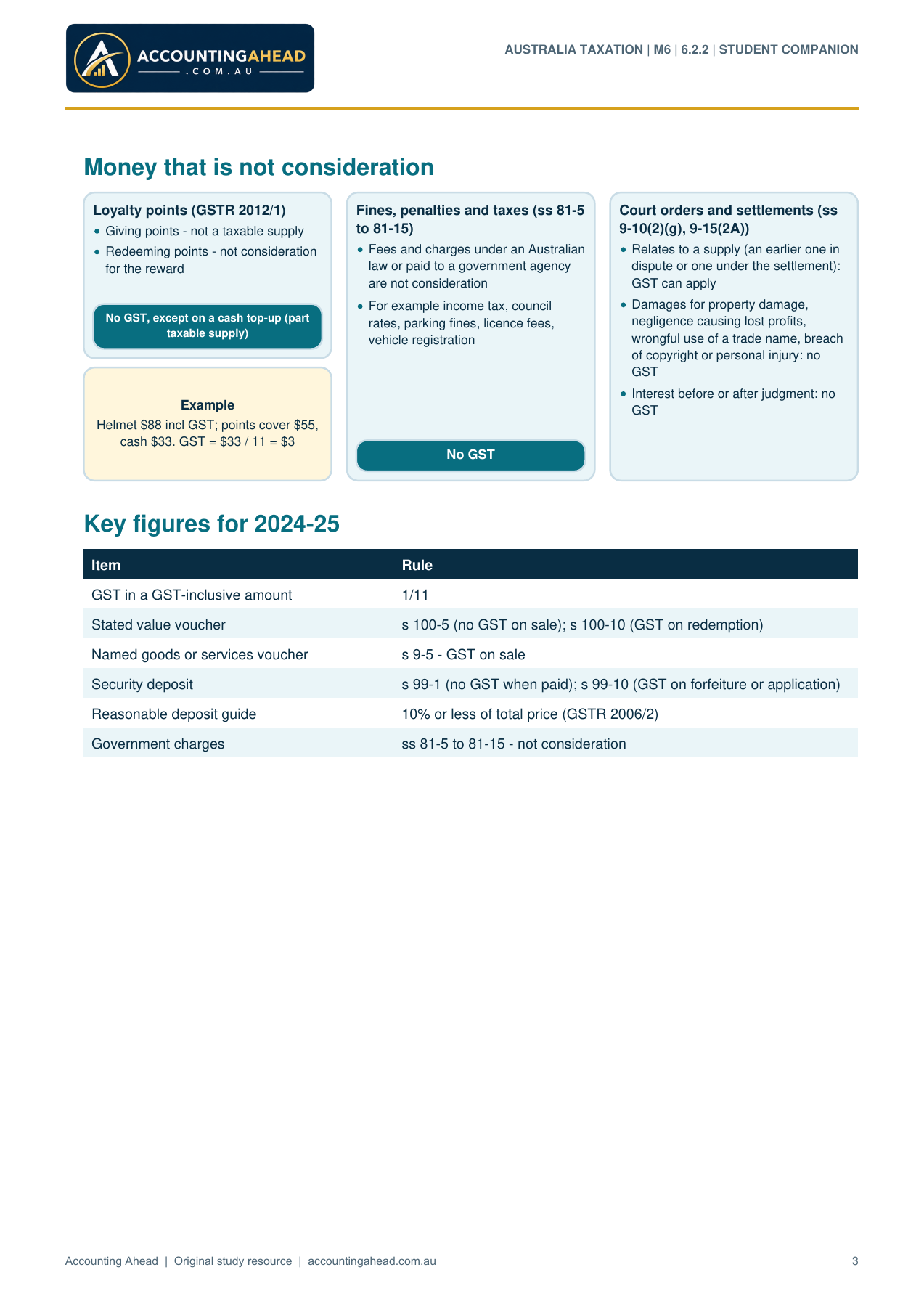
Loyalty points (GSTR 2012/1)
Giving points - not a taxable supply
Redeeming points - not consideration
for the reward
No GST, except on a cash top-up (part
taxable supply)
Example
Helmet $88 incl GST; points cover $55,
cash $33. GST = $33 / 11 = $3
Fines, penalties and taxes (ss 81-5
to 81-15)
Fees and charges under an Australian
law or paid to a government agency
are not consideration
For example income tax, council
rates, parking fines, licence fees,
vehicle registration
No GST
Court orders and settlements (ss
9-10(2)(g), 9-15(2A))
Relates to a supply (an earlier one in
dispute or one under the settlement):
GST can apply
Damages for property damage,
negligence causing lost profits,
wrongful use of a trade name, breach
of copyright or personal injury: no
GST
Interest before or after judgment: no
GST
Key figures for 2024-25
Item Rule
GST in a GST-inclusive amount 1/11
Stated value voucher s 100-5 (no GST on sale); s 100-10 (GST on redemption)
Named goods or services voucher s 9-5 - GST on sale
Security deposit s 99-1 (no GST when paid); s 99-10 (GST on forfeiture or application)
Reasonable deposit guide 10% or less of total price (GSTR 2006/2)
Government charges ss 81-5 to 81-15 - not consideration
AUSTRALIA TAXATION | M6 | 6.2.2 | STUDENT COMPANION
3
Accounting Ahead | Original study resource | accountingahead.com.au
Practice questions
MODULE 6 | 6.2.2 | TRY THESE BEFORE THE WORKED ANSWERS
Question 1 - Gift vouchers at a day spa
Bramblecote Day Spa is registered for GST. All prices include GST. Explain when GST arises on each voucher
below, and calculate the GST or any adjustment.
(a) On 1 November a customer buys a $330 gift voucher that can be spent on any spa service. On 20 January
the holder spends the full $330 on a massage and a facial.
(b) On 5 November a customer buys a voucher for "one deluxe pedicure" for $165. It is never used.
(c) On 10 November a customer buys a $110 gift voucher that can be spent on any service. It expires unused.
(d) On 15 November a customer buys a $220 gift voucher that can be spent on any service. The holder spends
$132 on a manicure. The remaining $88 expires, and the spa gives no cash refund.
AUSTRALIA TAXATION | M6 | 6.2.2 | STUDENT COMPANION
4
Accounting Ahead | Original study resource | accountingahead.com.au
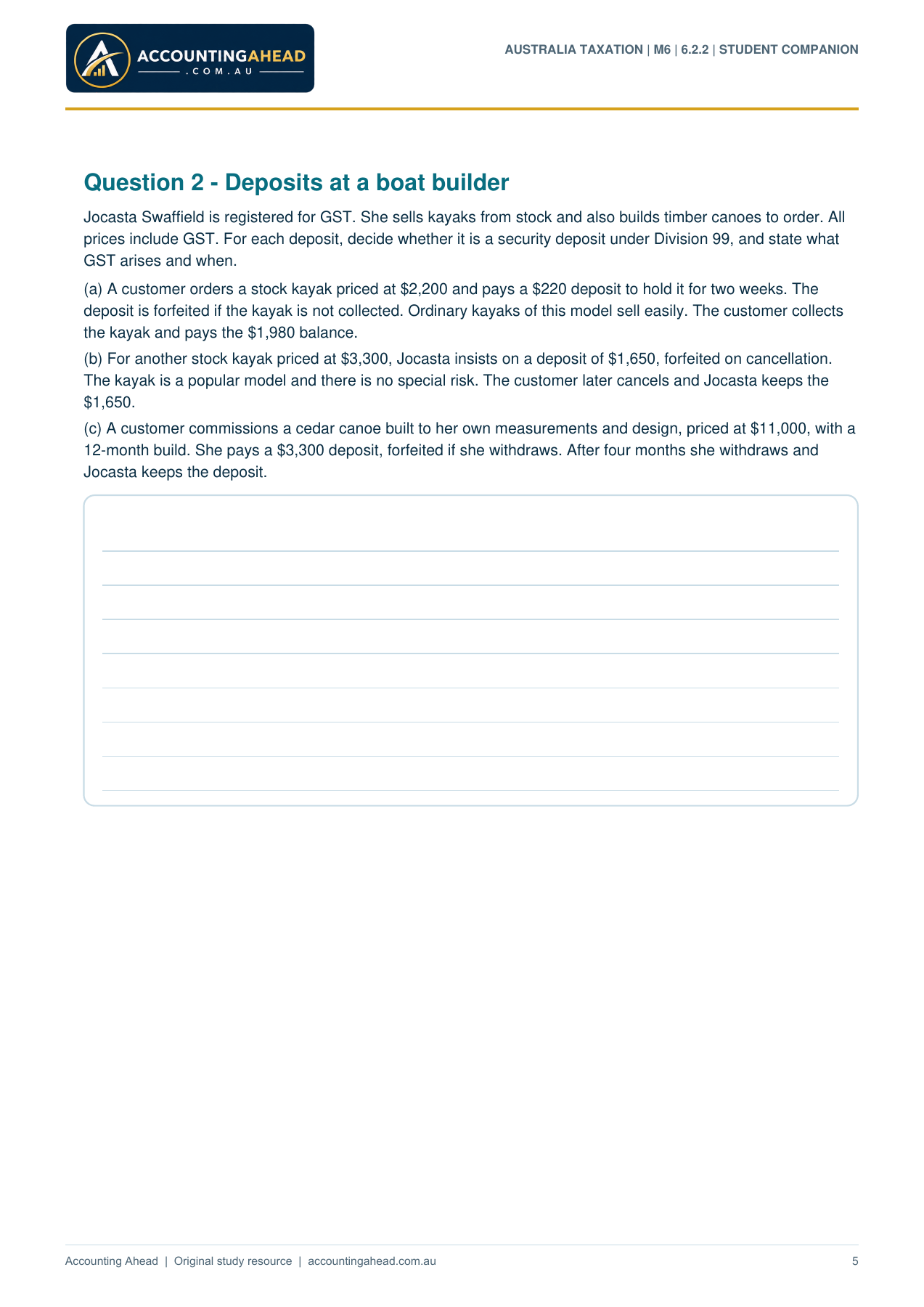
Question 2 - Deposits at a boat builder
Jocasta Swaffield is registered for GST. She sells kayaks from stock and also builds timber canoes to order. All
prices include GST. For each deposit, decide whether it is a security deposit under Division 99, and state what
GST arises and when.
(a) A customer orders a stock kayak priced at $2,200 and pays a $220 deposit to hold it for two weeks. The
deposit is forfeited if the kayak is not collected. Ordinary kayaks of this model sell easily. The customer collects
the kayak and pays the $1,980 balance.
(b) For another stock kayak priced at $3,300, Jocasta insists on a deposit of $1,650, forfeited on cancellation.
The kayak is a popular model and there is no special risk. The customer later cancels and Jocasta keeps the
$1,650.
(c) A customer commissions a cedar canoe built to her own measurements and design, priced at $11,000, with a
12-month build. She pays a $3,300 deposit, forfeited if she withdraws. After four months she withdraws and
Jocasta keeps the deposit.
AUSTRALIA TAXATION | M6 | 6.2.2 | STUDENT COMPANION
5
Accounting Ahead | Original study resource | accountingahead.com.au
Question 3 - A hardware store's payments and receipts
Inverleigh Hardware is registered for GST and runs a points program for members. All amounts that are prices
include GST. For each item, state whether GST arises (or whether the store can claim an input tax credit) and
calculate the GST where it applies.
(a) A member redeems points for a cordless drill priced at $242. The points cover $176 and the member pays
$66 in cash.
(b) The store pays its local council $1,650 in annual rates, and pays a $330 parking fine incurred by its delivery
van.
(c) A customer disputes the price of a garden shed kit the store supplied and installed. The parties settle out of
court: the customer pays $3,300 as the full price of the kit.
(d) Under an out-of-court settlement, a neighbouring business pays the store $5,500 as compensation for
damage its truck caused to the store's awning, plus $110 interest.
AUSTRALIA TAXATION | M6 | 6.2.2 | STUDENT COMPANION
6
Accounting Ahead | Original study resource | accountingahead.com.au
Worked answers
MODULE 6 | 6.2.2 | WORKED ANSWERS - ATTEMPT THE QUESTIONS FIRST
Answer 1 - Gift vouchers at Bramblecote Day Spa
(a) A stated money value voucher falls within Division 100. No GST when it is sold on 1 November (s 100-5).
GST arises when it is redeemed on 20 January (s 100-10): $330 / 11 = $30.
(b) A voucher for a named service is outside Division 100. It is an ordinary taxable supply under s 9-5, so
GST arises when it is sold on 5 November: $165 / 11 = $15. Because it is never used, there is no further GST
effect.
(c) Stated money value voucher: no GST on sale. It is never redeemed, so the spa has kept the money and
given nothing. It makes an increasing adjustment when the voucher expires: $110 / 11 = $10.
(d) Stated money value voucher: no GST on sale. GST on the manicure when the voucher is redeemed:
$132 / 11 = $12. The unused $88 expires without a cash refund, so the spa makes an increasing adjustment
of $88 / 11 = $8. In total the spa accounts for $12 + $8 = $20, which equals $220 / 11.
Answer 2 - Deposits at the boat builder
(a) Yes, a security deposit. It is held as security, at risk of forfeiture, and 10% of the price ($220 / $2,200),
which is normally reasonable. No GST when it is paid (s 99-1). On collection it is applied as part of the
consideration (s 99-10), so GST is on the full price: $2,200 / 11 = $200 ($20 relating to the deposit and $180
to the $1,980 balance).
(b) No. The deposit is 50% of the price ($1,650 / $3,300) for a popular stock item with no special risk, so it is
not a reasonable amount. It is not a security deposit under Division 99. It is treated as an ordinary payment
and its GST is counted under the normal attribution rules in Division 29, not delayed until cancellation: $1,650
/ 11 = $150.
(c) Yes, very likely a security deposit. At 30% ($3,300 / $11,000) it is above the usual 10% guide, but the
percentage alone does not decide the question. The canoe is made to the customer's own design and
measurements, so it would be hard to sell to anyone else, and the build runs for 12 months, which increases
Jocasta's risk. No GST when the deposit is paid. When it is forfeited, GST arises (s 99-10): $3,300 / 11 =
$300.
Answer 3 - Inverleigh Hardware
(a) Redeeming points is not consideration (GSTR 2012/1), so the $176 covered by points carries no GST.
The $66 cash top-up is consideration, so this is a part taxable supply. GST = $66 / 11 = $6.
(b) Council rates and a parking fine are charges under an Australian law or paid to a government agency.
They are not consideration (ss 81-5 to 81-15), so they include no GST and the store cannot claim any input
tax credit.
(c) The settlement relates to a supply: it fixes the price of the shed kit the store supplied. The $3,300 is
consideration for that taxable supply. GST = $3,300 / 11 = $300.
(d) Compensation for damage to property is not consideration for a supply, so the $5,500 carries no GST.
Interest paid under the settlement also carries no GST. Total GST: nil.
AUSTRALIA TAXATION | M6 | 6.2.2 | WORKED ANSWERS
7