
Car Fringe Benefits — study companion
Part 6.8.1 of Australia Taxation. Preview the study companion or download the printable PDF.

Read the handout text
Accounting Ahead | Original study resource | accountingahead.com.au
Car fringe benefits
MODULE 6 | 6.8.1 | STUDENT COMPANION
A car fringe benefit arises on each day a car held by the employer is used privately, or is available for
private use, by an employee or their associate. It is valued by the statutory formula method or the
operating cost method, whichever is lower, less any after-tax employee contribution. Eligible electric cars
are exempt.
When a car fringe benefit arises
What is a car? A motor car, station wagon, panel van, utility truck or other road vehicle built to carry less than 1
tonne and fewer than 9 passengers (FBTAA s 136(1)). Motorcycles are excluded. The rules are in Division 2 of
Part III (ss 7-13).
Held by the employer. The car must be owned or leased by the employer.
Private use or availability. Private use is any use not in earning the employee's income, including
home-to-work travel. A benefit arises on any day the car is used privately or is available for that use. A car
garaged at the employee's home is treated as available.
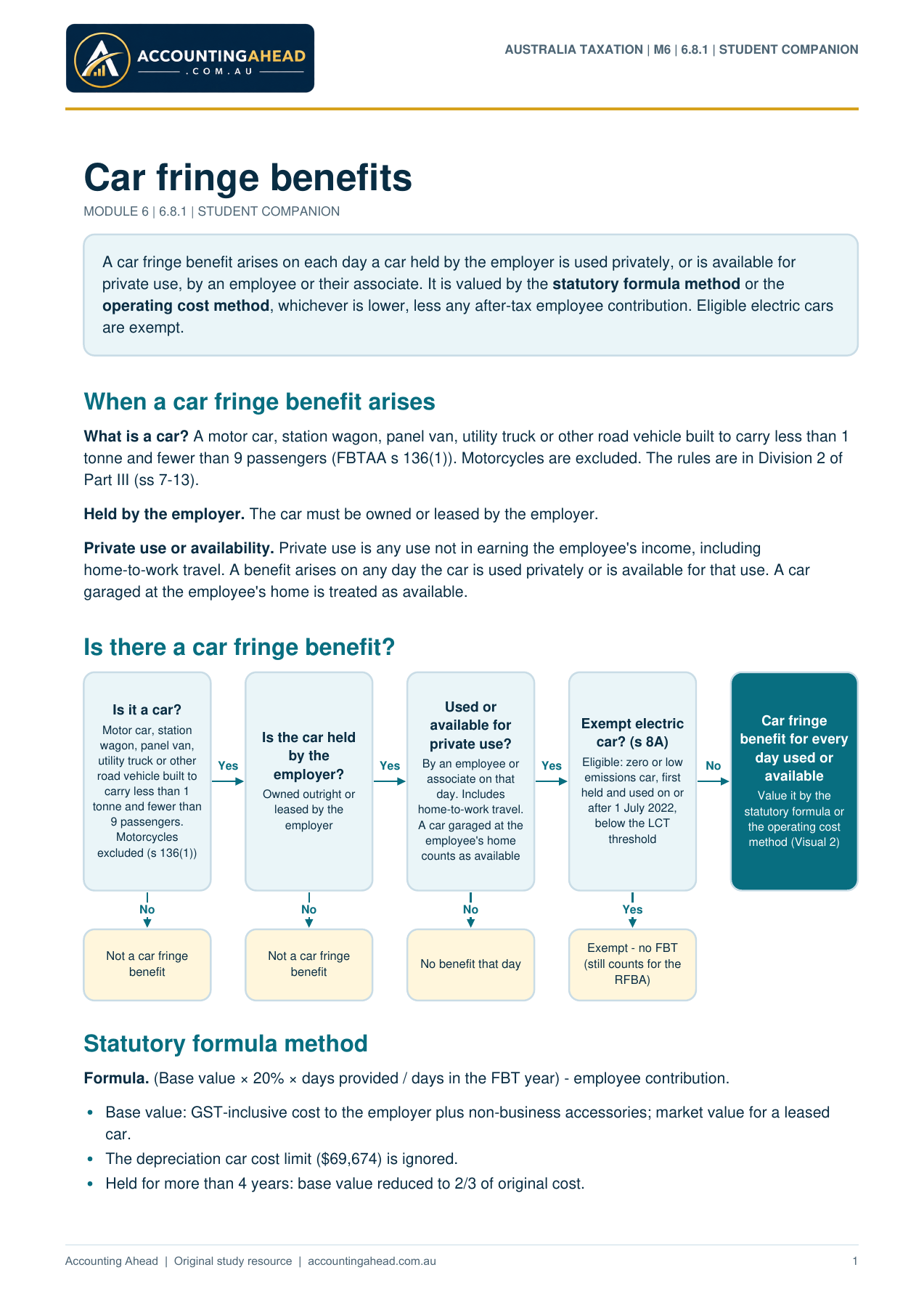
Is there a car fringe benefit?
Is it a car?
Motor car, station
wagon, panel van,
utility truck or other
road vehicle built to
carry less than 1
tonne and fewer than
9 passengers.
Motorcycles
excluded (s 136(1))
No
Not a car fringe
benefit
Yes
Is the car held
by the
employer?
Owned outright or
leased by the
employer
No
Not a car fringe
benefit
Yes
Used or
available for
private use?
By an employee or
associate on that
day. Includes
home-to-work travel.
A car garaged at the
employee's home
counts as available
No
No benefit that day
Yes
Exempt electric
car? (s 8A)
Eligible: zero or low
emissions car, first
held and used on or
after 1 July 2022,
below the LCT
threshold
Yes
Exempt - no FBT
(still counts for the
RFBA)
No
Car fringe
benefit for every
day used or
available
Value it by the
statutory formula or
the operating cost
method (Visual 2)
Statutory formula method
Formula. (Base value × 20% × days provided / days in the FBT year) - employee contribution.
Base value: GST-inclusive cost to the employer plus non-business accessories; market value for a leased
car.
The depreciation car cost limit ($69,674) is ignored.
Held for more than 4 years: base value reduced to 2/3 of original cost.
AUSTRALIA TAXATION | M6 | 6.8.1 | STUDENT COMPANION
1
Accounting Ahead | Original study resource | accountingahead.com.au
Kilometres travelled make no difference.
Operating cost method
Formula. (Total operating costs × private use %) - employee contribution.
Costs: fuel and oil, registration, insurance, repairs and maintenance.
Owned car: add depreciation at 25% diminishing value and imputed interest at 8.77% on the GST-inclusive
opening written-down value (car cost limit ignored). Leased car: add lease payments instead.
Private use % = 100% - business use %. Business use % = business km / total km, supported by a logbook
(typically kept for 12 weeks).
No records: business use is nil.
Choice. The employer may use whichever method gives the lower taxable value.
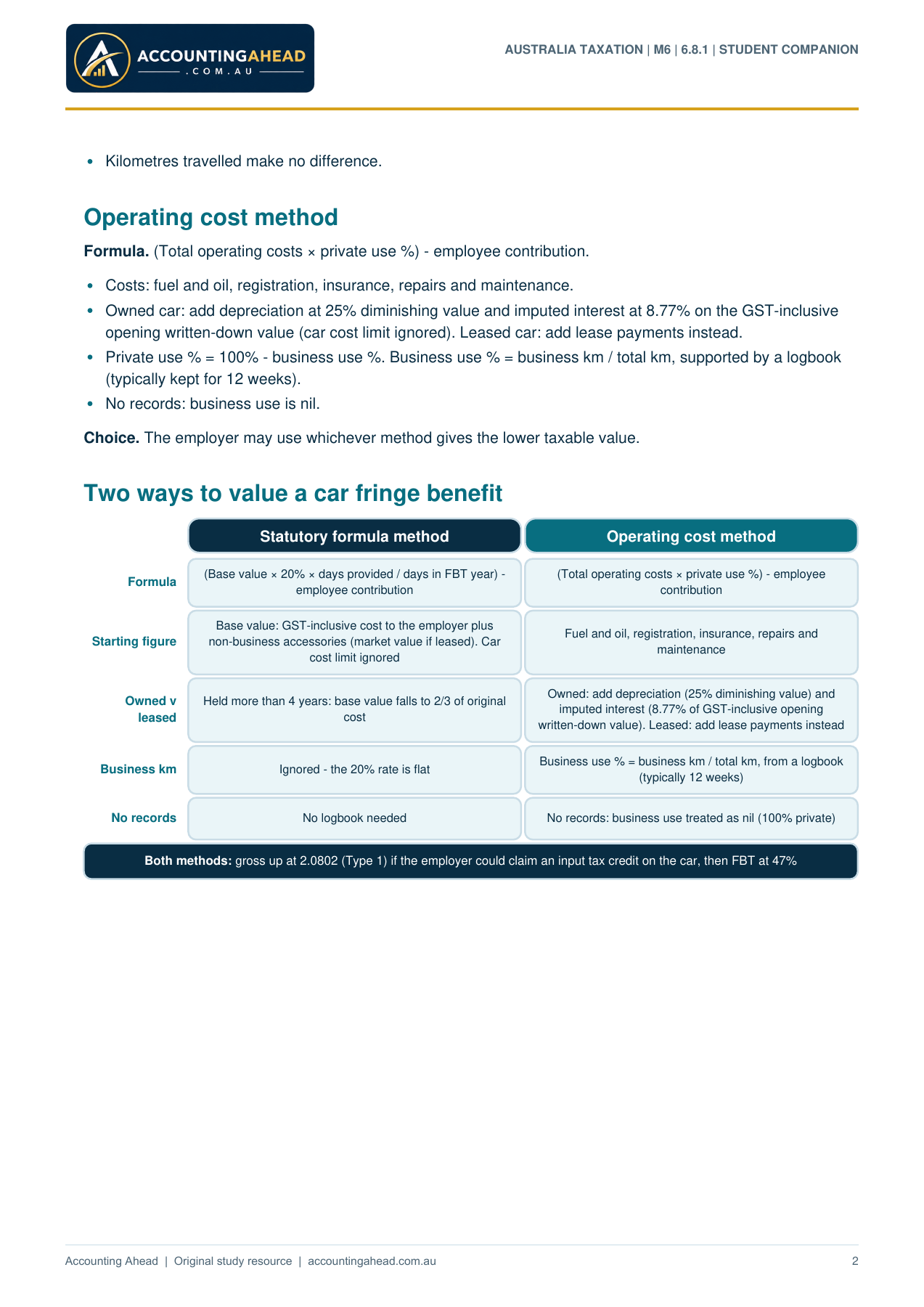
Two ways to value a car fringe benefit
Statutory formula method Operating cost method
Formula (Base value × 20% × days provided / days in FBT year) -
employee contribution
(Total operating costs × private use %) - employee
contribution
Starting figure
Base value: GST-inclusive cost to the employer plus
non-business accessories (market value if leased). Car
cost limit ignored
Fuel and oil, registration, insurance, repairs and
maintenance
Owned v
leased
Held more than 4 years: base value falls to 2/3 of original
cost
Owned: add depreciation (25% diminishing value) and
imputed interest (8.77% of GST-inclusive opening
written-down value). Leased: add lease payments instead
Business km Ignored - the 20% rate is flat Business use % = business km / total km, from a logbook
(typically 12 weeks)
No records No logbook needed No records: business use treated as nil (100% private)
Both methods: gross up at 2.0802 (Type 1) if the employer could claim an input tax credit on the car, then FBT at 47%
AUSTRALIA TAXATION | M6 | 6.8.1 | STUDENT COMPANION
2
Accounting Ahead | Original study resource | accountingahead.com.au
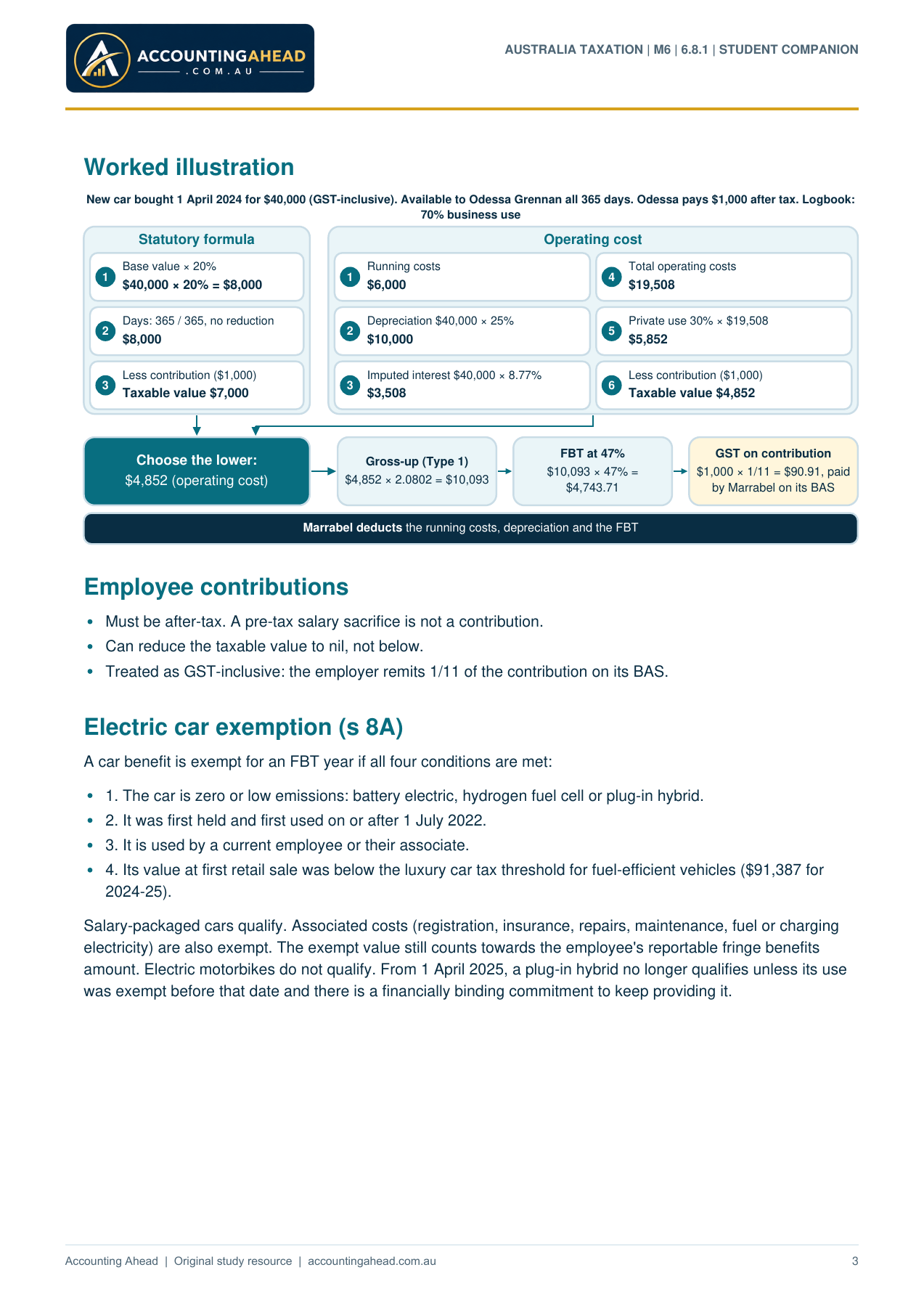
Worked illustration
New car bought 1 April 2024 for $40,000 (GST-inclusive). Available to Odessa Grennan all 365 days. Odessa pays $1,000 after tax. Logbook:
70% business use
Statutory formula
1
Base value × 20%
$40,000 × 20% = $8,000
2
Days: 365 / 365, no reduction
$8,000
3
Less contribution ($1,000)
Taxable value $7,000
Operating cost
1
Running costs
$6,000
2
Depreciation $40,000 × 25%
$10,000
3
Imputed interest $40,000 × 8.77%
$3,508
4
Total operating costs
$19,508
5
Private use 30% × $19,508
$5,852
6
Less contribution ($1,000)
Taxable value $4,852
Choose the lower:
$4,852 (operating cost)
Gross-up (Type 1)
$4,852 × 2.0802 = $10,093
FBT at 47%
$10,093 × 47% =
$4,743.71
GST on contribution
$1,000 × 1/11 = $90.91, paid
by Marrabel on its BAS
Marrabel deducts the running costs, depreciation and the FBT
Employee contributions
Must be after-tax. A pre-tax salary sacrifice is not a contribution.
Can reduce the taxable value to nil, not below.
Treated as GST-inclusive: the employer remits 1/11 of the contribution on its BAS.
Electric car exemption (s 8A)
A car benefit is exempt for an FBT year if all four conditions are met:
1. The car is zero or low emissions: battery electric, hydrogen fuel cell or plug-in hybrid.
2. It was first held and first used on or after 1 July 2022.
3. It is used by a current employee or their associate.
4. Its value at first retail sale was below the luxury car tax threshold for fuel-efficient vehicles ($91,387 for
2024-25).
Salary-packaged cars qualify. Associated costs (registration, insurance, repairs, maintenance, fuel or charging
electricity) are also exempt. The exempt value still counts towards the employee's reportable fringe benefits
amount. Electric motorbikes do not qualify. From 1 April 2025, a plug-in hybrid no longer qualifies unless its use
was exempt before that date and there is a financially binding commitment to keep providing it.
AUSTRALIA TAXATION | M6 | 6.8.1 | STUDENT COMPANION
3
Accounting Ahead | Original study resource | accountingahead.com.au
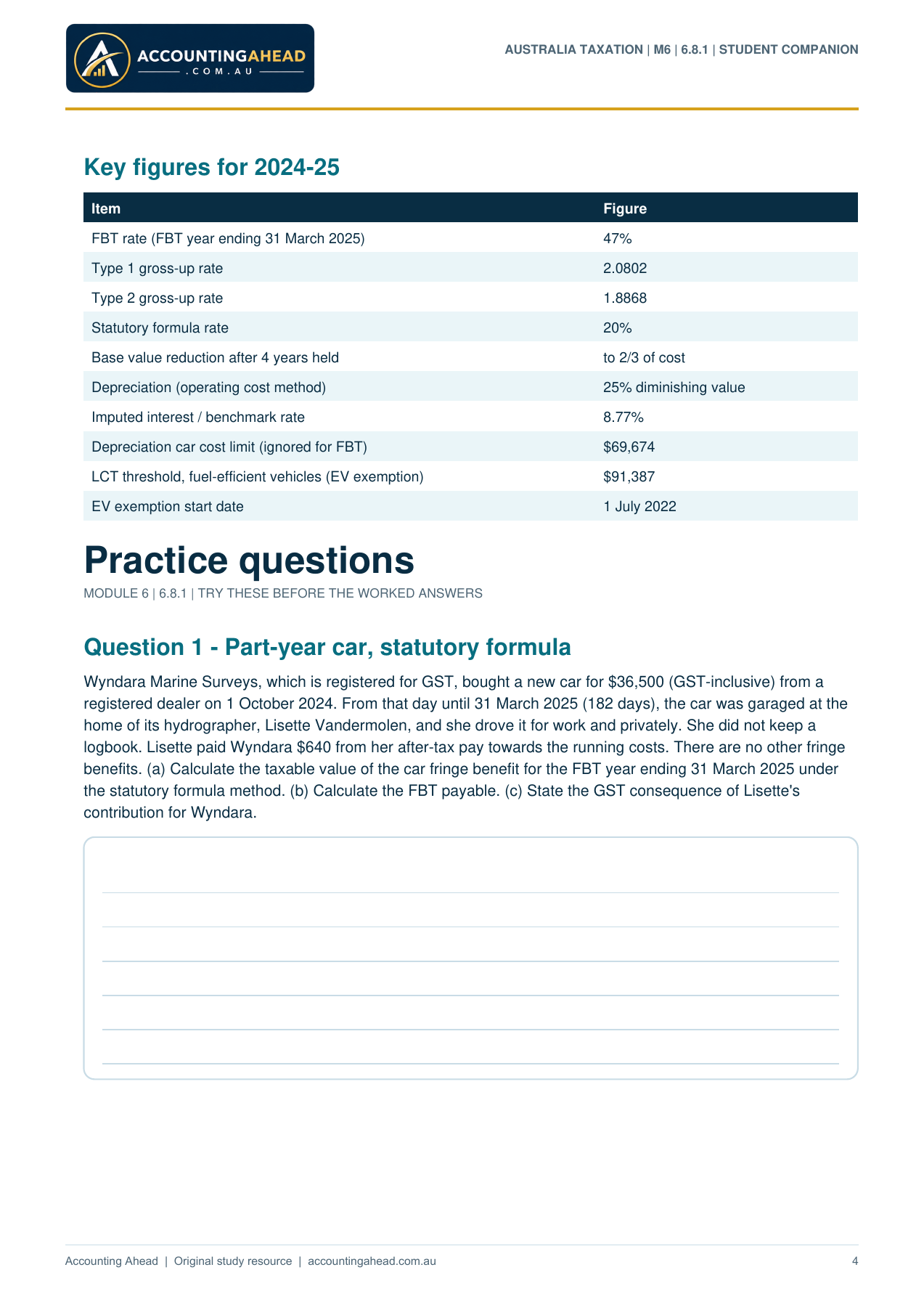
Key figures for 2024-25
Item Figure
FBT rate (FBT year ending 31 March 2025) 47%
Type 1 gross-up rate 2.0802
Type 2 gross-up rate 1.8868
Statutory formula rate 20%
Base value reduction after 4 years held to 2/3 of cost
Depreciation (operating cost method) 25% diminishing value
Imputed interest / benchmark rate 8.77%
Depreciation car cost limit (ignored for FBT) $69,674
LCT threshold, fuel-efficient vehicles (EV exemption) $91,387
EV exemption start date 1 July 2022
Practice questions
MODULE 6 | 6.8.1 | TRY THESE BEFORE THE WORKED ANSWERS
Question 1 - Part-year car, statutory formula
Wyndara Marine Surveys, which is registered for GST, bought a new car for $36,500 (GST-inclusive) from a
registered dealer on 1 October 2024. From that day until 31 March 2025 (182 days), the car was garaged at the
home of its hydrographer, Lisette Vandermolen, and she drove it for work and privately. She did not keep a
logbook. Lisette paid Wyndara $640 from her after-tax pay towards the running costs. There are no other fringe
benefits. (a) Calculate the taxable value of the car fringe benefit for the FBT year ending 31 March 2025 under
the statutory formula method. (b) Calculate the FBT payable. (c) State the GST consequence of Lisette's
contribution for Wyndara.
AUSTRALIA TAXATION | M6 | 6.8.1 | STUDENT COMPANION
4
Accounting Ahead | Original study resource | accountingahead.com.au
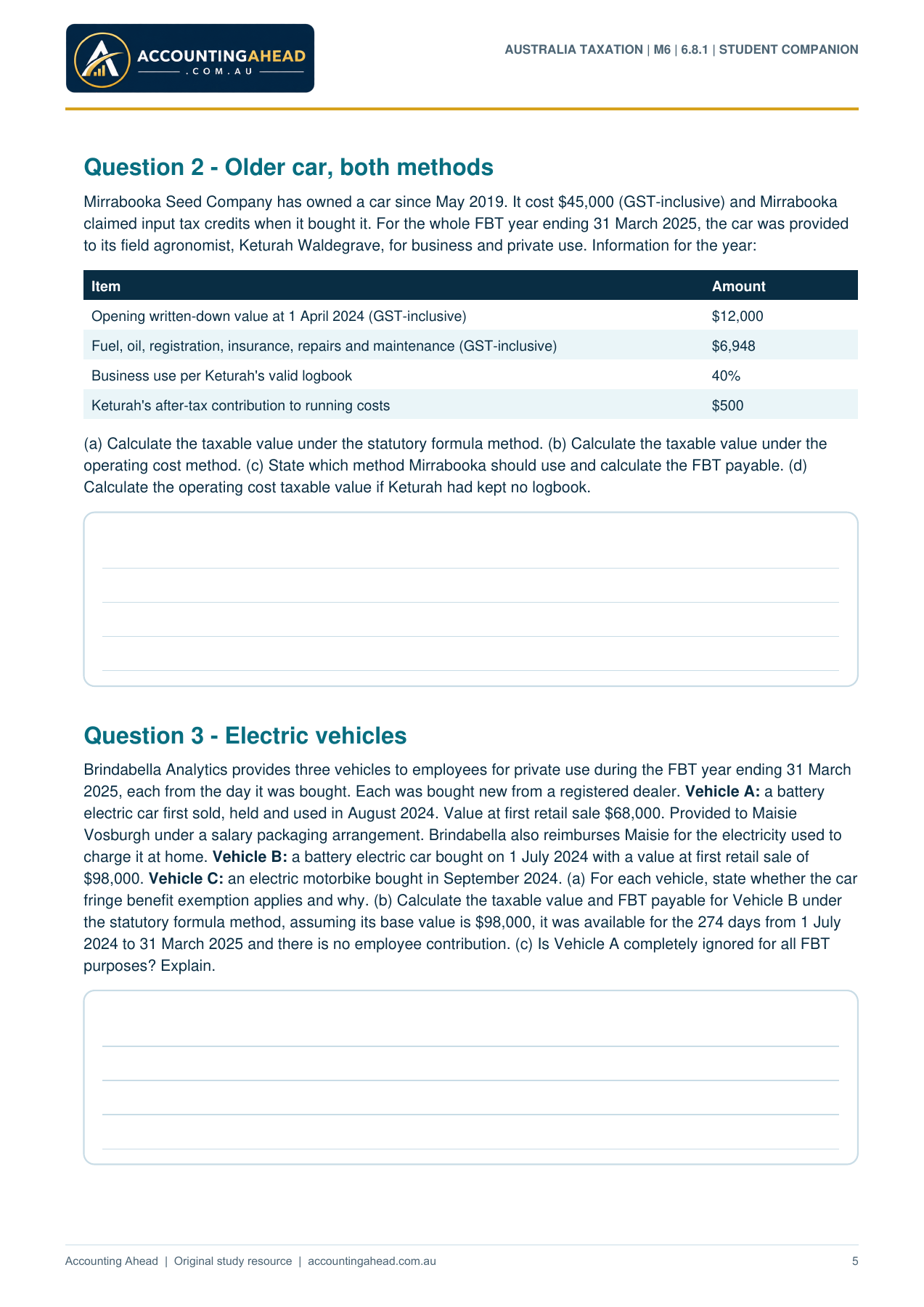
Question 2 - Older car, both methods
Mirrabooka Seed Company has owned a car since May 2019. It cost $45,000 (GST-inclusive) and Mirrabooka
claimed input tax credits when it bought it. For the whole FBT year ending 31 March 2025, the car was provided
to its field agronomist, Keturah Waldegrave, for business and private use. Information for the year:
Item Amount
Opening written-down value at 1 April 2024 (GST-inclusive) $12,000
Fuel, oil, registration, insurance, repairs and maintenance (GST-inclusive) $6,948
Business use per Keturah's valid logbook 40%
Keturah's after-tax contribution to running costs $500
(a) Calculate the taxable value under the statutory formula method. (b) Calculate the taxable value under the
operating cost method. (c) State which method Mirrabooka should use and calculate the FBT payable. (d)
Calculate the operating cost taxable value if Keturah had kept no logbook.
Question 3 - Electric vehicles
Brindabella Analytics provides three vehicles to employees for private use during the FBT year ending 31 March
2025, each from the day it was bought. Each was bought new from a registered dealer. Vehicle A: a battery
electric car first sold, held and used in August 2024. Value at first retail sale $68,000. Provided to Maisie
Vosburgh under a salary packaging arrangement. Brindabella also reimburses Maisie for the electricity used to
charge it at home. Vehicle B: a battery electric car bought on 1 July 2024 with a value at first retail sale of
$98,000. Vehicle C: an electric motorbike bought in September 2024. (a) For each vehicle, state whether the car
fringe benefit exemption applies and why. (b) Calculate the taxable value and FBT payable for Vehicle B under
the statutory formula method, assuming its base value is $98,000, it was available for the 274 days from 1 July
2024 to 31 March 2025 and there is no employee contribution. (c) Is Vehicle A completely ignored for all FBT
purposes? Explain.
AUSTRALIA TAXATION | M6 | 6.8.1 | STUDENT COMPANION
5
Accounting Ahead | Original study resource | accountingahead.com.au
Worked answers
MODULE 6 | 6.8.1 | WORKED ANSWERS - ATTEMPT THE QUESTIONS FIRST
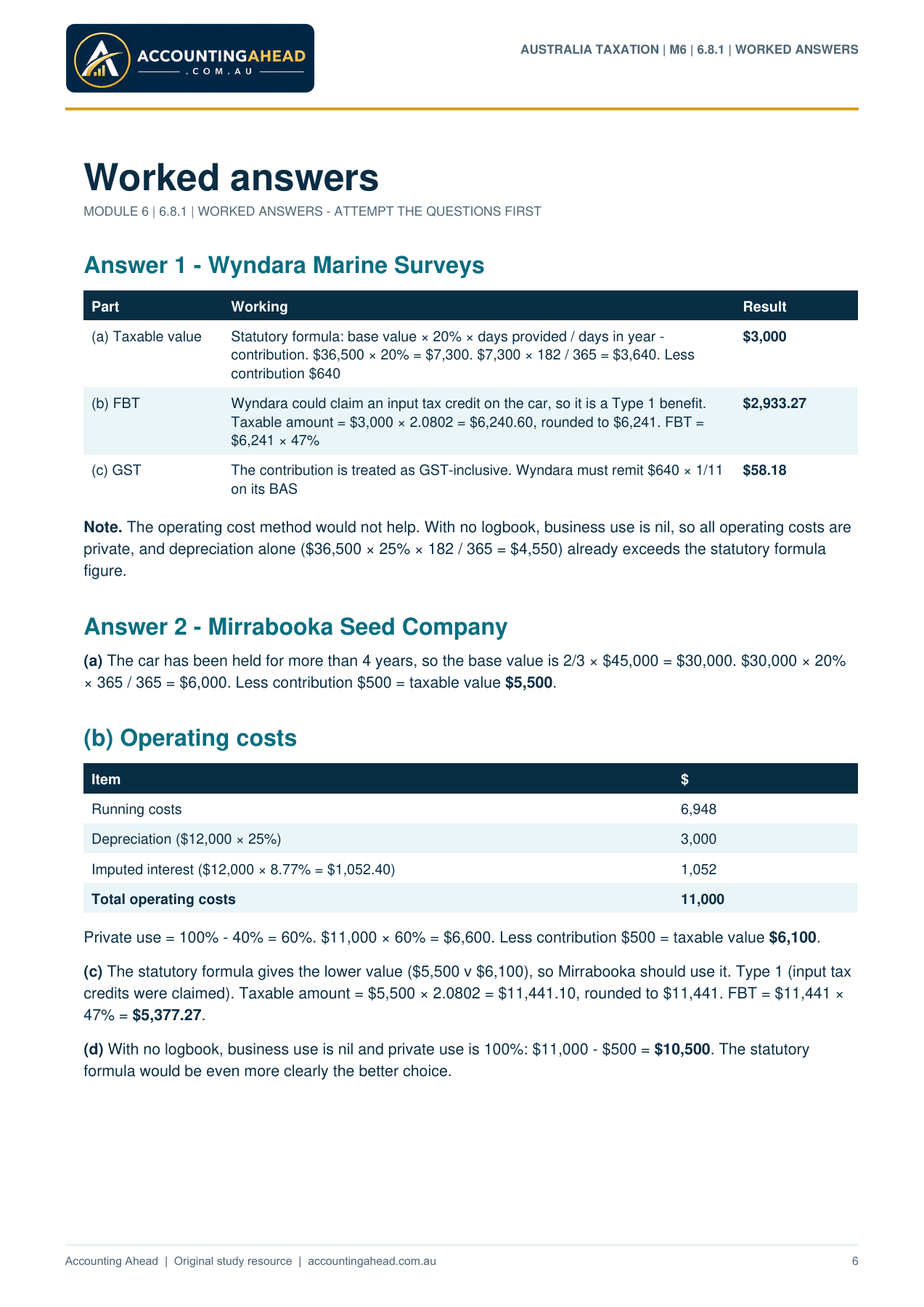
Answer 1 - Wyndara Marine Surveys
Part Working Result
(a) Taxable value Statutory formula: base value × 20% × days provided / days in year -
contribution. $36,500 × 20% = $7,300. $7,300 × 182 / 365 = $3,640. Less
contribution $640
$3,000
(b) FBT Wyndara could claim an input tax credit on the car, so it is a Type 1 benefit.
Taxable amount = $3,000 × 2.0802 = $6,240.60, rounded to $6,241. FBT =
$6,241 × 47%
$2,933.27
(c) GST The contribution is treated as GST-inclusive. Wyndara must remit $640 × 1/11
on its BAS
$58.18
Note. The operating cost method would not help. With no logbook, business use is nil, so all operating costs are
private, and depreciation alone ($36,500 × 25% × 182 / 365 = $4,550) already exceeds the statutory formula
figure.
Answer 2 - Mirrabooka Seed Company
(a) The car has been held for more than 4 years, so the base value is 2/3 × $45,000 = $30,000. $30,000 × 20%
× 365 / 365 = $6,000. Less contribution $500 = taxable value $5,500.
(b) Operating costs
Item $
Running costs 6,948
Depreciation ($12,000 × 25%) 3,000
Imputed interest ($12,000 × 8.77% = $1,052.40) 1,052
Total operating costs 11,000
Private use = 100% - 40% = 60%. $11,000 × 60% = $6,600. Less contribution $500 = taxable value $6,100.
(c) The statutory formula gives the lower value ($5,500 v $6,100), so Mirrabooka should use it. Type 1 (input tax
credits were claimed). Taxable amount = $5,500 × 2.0802 = $11,441.10, rounded to $11,441. FBT = $11,441 ×
47% = $5,377.27.
(d) With no logbook, business use is nil and private use is 100%: $11,000 - $500 = $10,500. The statutory
formula would be even more clearly the better choice.
AUSTRALIA TAXATION | M6 | 6.8.1 | WORKED ANSWERS
6
Accounting Ahead | Original study resource | accountingahead.com.au
Answer 3 - Brindabella Analytics, (a) the three vehicles
Vehicle Exempt? Why
A Exempt It is a battery electric (zero emissions) car, first held and used on or after 1 July 2022,
used by a current employee, and its value at first retail sale ($68,000) is below the
$91,387 threshold. Salary packaging does not prevent the exemption, and the
charging electricity is an associated car expense that is also exempt
B Not exempt Its value at first retail sale ($98,000) is above the $91,387 threshold
C Not exempt Not exempt under s 8A. A motorcycle is not a car, so the electric car exemption
cannot apply (and it is not a car fringe benefit at all)
(b) Vehicle B: $98,000 × 20% × 274 / 365 = $14,713.42, rounded to $14,713 taxable value. Type 1 (Brindabella
can claim input tax credits on the car). Taxable amount = $14,713 × 2.0802 = $30,605.98, rounded to $30,606.
FBT = $30,606 × 47% = $14,384.82.
(c) No. Although the benefit is exempt from FBT, its value is still included when working out Maisie's reportable
fringe benefits amount.
AUSTRALIA TAXATION | M6 | 6.8.1 | WORKED ANSWERS
7