
Module 3 quick reference: planning, budgeting and forecasting
A printable quick reference for Module 3.
Read the handout text
Accounting Ahead | Original study resource | accountingahead.com.au
Module 3 quick reference: planning,
budgeting and forecasting
SMA EXAM REFERENCE PACK | MODULE 3 | PRINT AND KEEP WITH YOUR NOTES
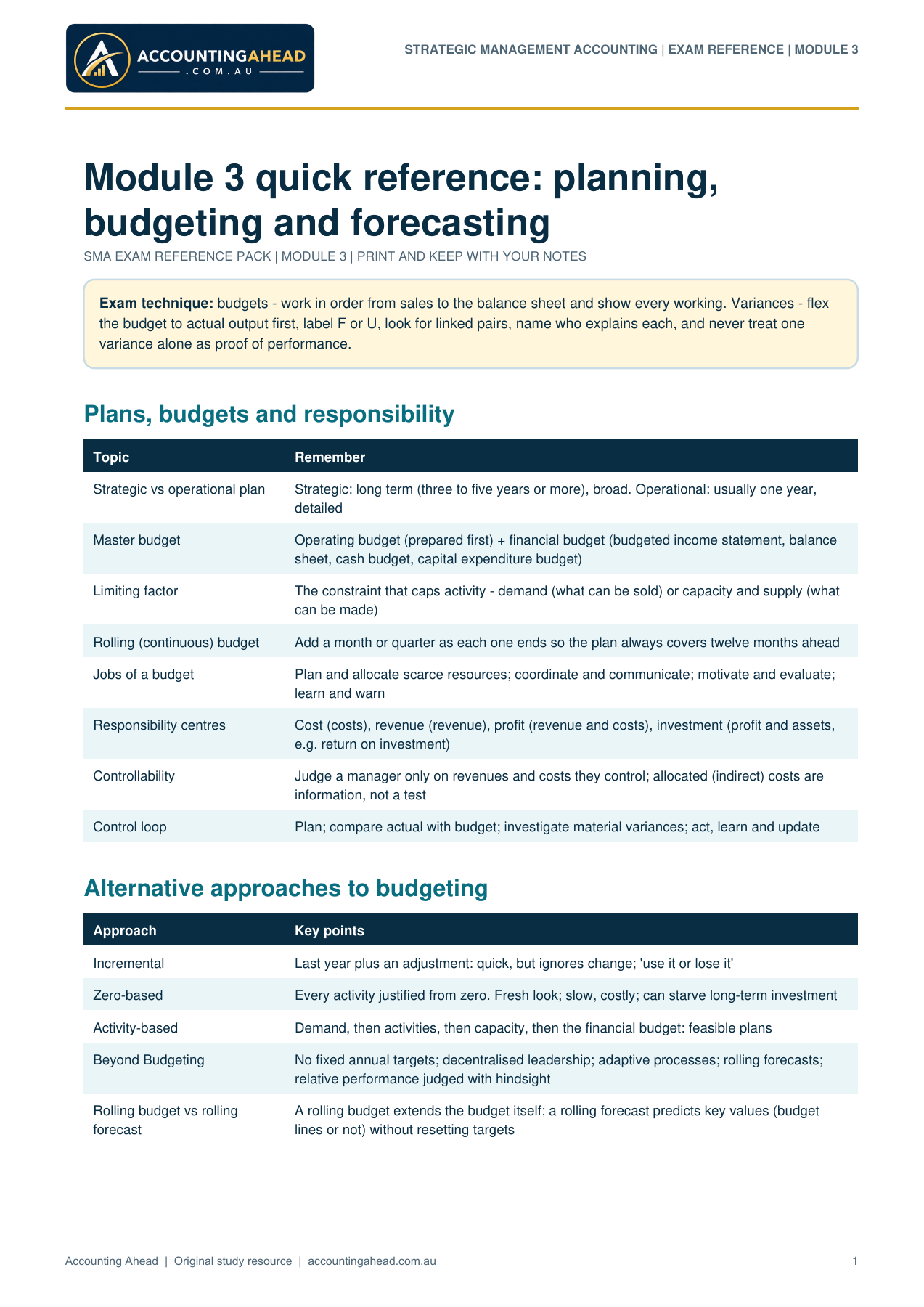
Exam technique: budgets - work in order from sales to the balance sheet and show every working. Variances - flex
the budget to actual output first, label F or U, look for linked pairs, name who explains each, and never treat one
variance alone as proof of performance.
Plans, budgets and responsibility
Topic Remember
Strategic vs operational plan Strategic: long term (three to five years or more), broad. Operational: usually one year,
detailed
Master budget Operating budget (prepared first) + financial budget (budgeted income statement, balance
sheet, cash budget, capital expenditure budget)
Limiting factor The constraint that caps activity - demand (what can be sold) or capacity and supply (what
can be made)
Rolling (continuous) budget Add a month or quarter as each one ends so the plan always covers twelve months ahead
Jobs of a budget Plan and allocate scarce resources; coordinate and communicate; motivate and evaluate;
learn and warn
Responsibility centres Cost (costs), revenue (revenue), profit (revenue and costs), investment (profit and assets,
e.g. return on investment)
Controllability Judge a manager only on revenues and costs they control; allocated (indirect) costs are
information, not a test
Control loop Plan; compare actual with budget; investigate material variances; act, learn and update
Alternative approaches to budgeting
Approach Key points
Incremental Last year plus an adjustment: quick, but ignores change; 'use it or lose it'
Zero-based Every activity justified from zero. Fresh look; slow, costly; can starve long-term investment
Activity-based Demand, then activities, then capacity, then the financial budget: feasible plans
Beyond Budgeting No fixed annual targets; decentralised leadership; adaptive processes; rolling forecasts;
relative performance judged with hindsight
Rolling budget vs rolling
forecast
A rolling budget extends the budget itself; a rolling forecast predicts key values (budget
lines or not) without resetting targets
STRATEGIC MANAGEMENT ACCOUNTING | EXAM REFERENCE | MODULE 3
1
Accounting Ahead | Original study resource | accountingahead.com.au
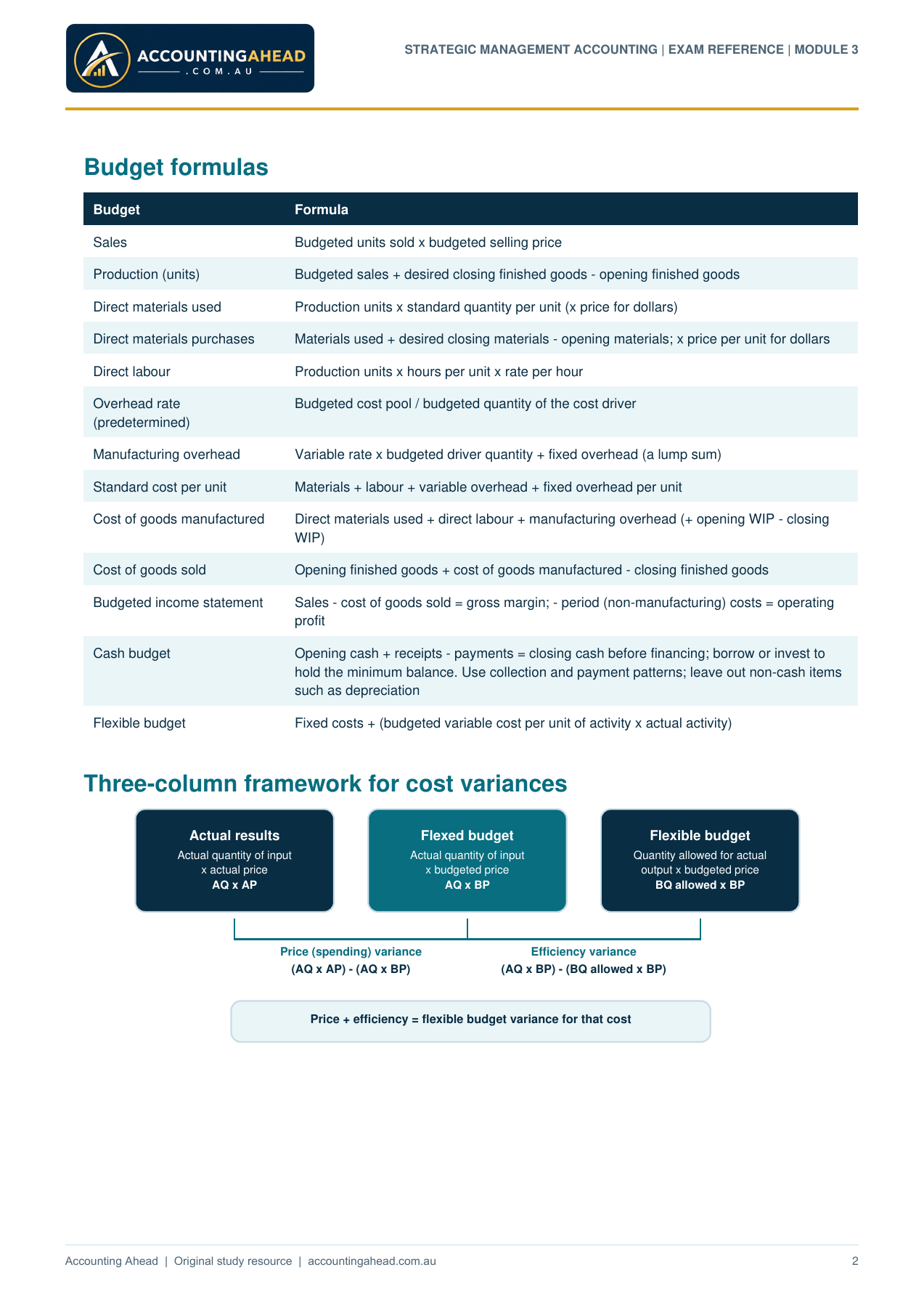
Budget formulas
Budget Formula
Sales Budgeted units sold x budgeted selling price
Production (units) Budgeted sales + desired closing finished goods - opening finished goods
Direct materials used Production units x standard quantity per unit (x price for dollars)
Direct materials purchases Materials used + desired closing materials - opening materials; x price per unit for dollars
Direct labour Production units x hours per unit x rate per hour
Overhead rate
(predetermined)
Budgeted cost pool / budgeted quantity of the cost driver
Manufacturing overhead Variable rate x budgeted driver quantity + fixed overhead (a lump sum)
Standard cost per unit Materials + labour + variable overhead + fixed overhead per unit
Cost of goods manufactured Direct materials used + direct labour + manufacturing overhead (+ opening WIP - closing
WIP)
Cost of goods sold Opening finished goods + cost of goods manufactured - closing finished goods
Budgeted income statement Sales - cost of goods sold = gross margin; - period (non-manufacturing) costs = operating
profit
Cash budget Opening cash + receipts - payments = closing cash before financing; borrow or invest to
hold the minimum balance. Use collection and payment patterns; leave out non-cash items
such as depreciation
Flexible budget Fixed costs + (budgeted variable cost per unit of activity x actual activity)
Three-column framework for cost variances
Actual results
Actual quantity of input
x actual price
AQ x AP
Flexed budget
Actual quantity of input
x budgeted price
AQ x BP
Flexible budget
Quantity allowed for actual
output x budgeted price
BQ allowed x BP
Price (spending) variance
(AQ x AP) - (AQ x BP)
Efficiency variance
(AQ x BP) - (BQ allowed x BP)
Price + efficiency = flexible budget variance for that cost
STRATEGIC MANAGEMENT ACCOUNTING | EXAM REFERENCE | MODULE 3
2
Accounting Ahead | Original study resource | accountingahead.com.au
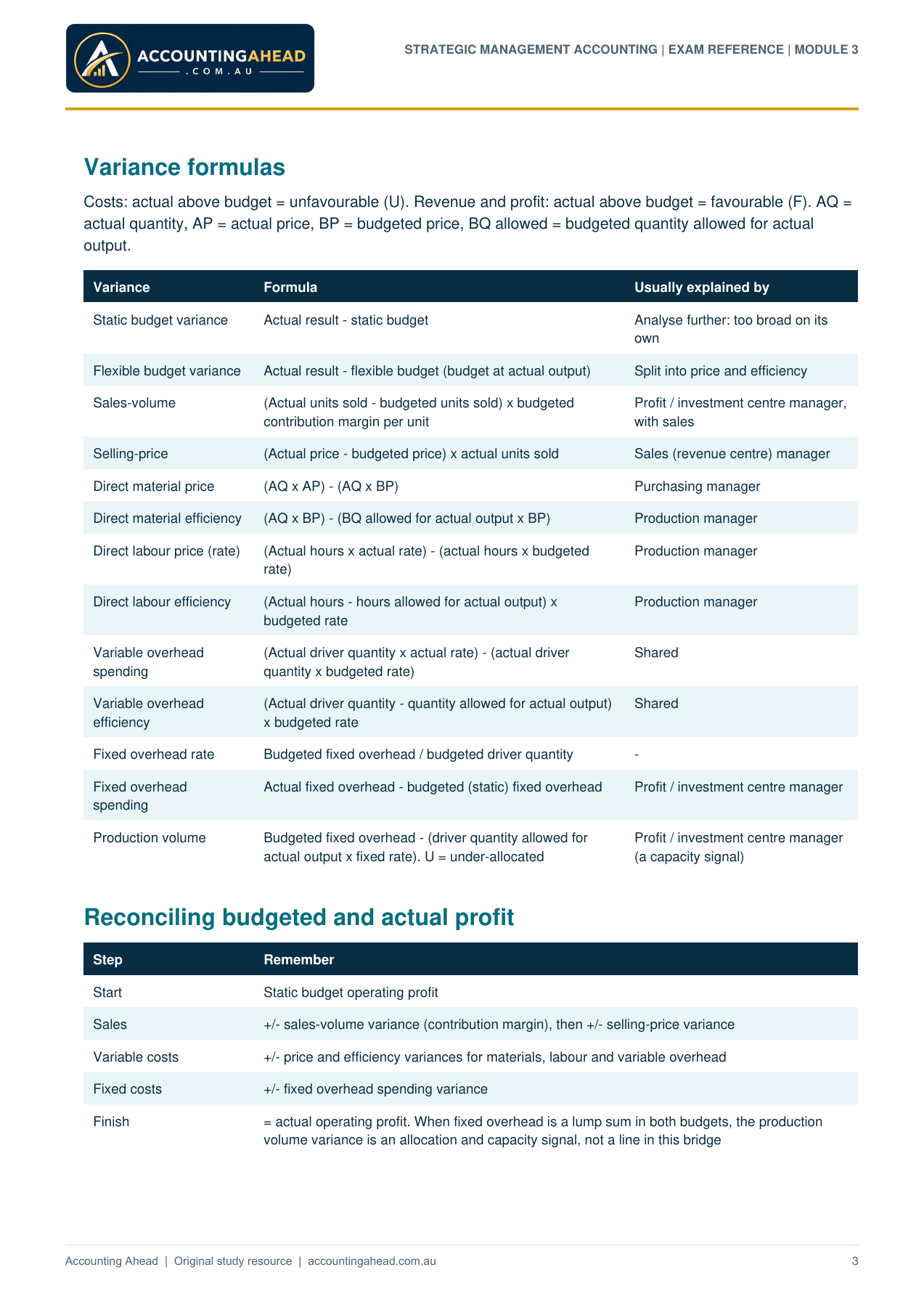
Variance formulas
Costs: actual above budget = unfavourable (U). Revenue and profit: actual above budget = favourable (F). AQ =
actual quantity, AP = actual price, BP = budgeted price, BQ allowed = budgeted quantity allowed for actual
output.
Variance Formula Usually explained by
Static budget variance Actual result - static budget Analyse further: too broad on its
own
Flexible budget variance Actual result - flexible budget (budget at actual output) Split into price and efficiency
Sales-volume (Actual units sold - budgeted units sold) x budgeted
contribution margin per unit
Profit / investment centre manager,
with sales
Selling-price (Actual price - budgeted price) x actual units sold Sales (revenue centre) manager
Direct material price (AQ x AP) - (AQ x BP) Purchasing manager
Direct material efficiency (AQ x BP) - (BQ allowed for actual output x BP) Production manager
Direct labour price (rate) (Actual hours x actual rate) - (actual hours x budgeted
rate)
Production manager
Direct labour efficiency (Actual hours - hours allowed for actual output) x
budgeted rate
Production manager
Variable overhead
spending
(Actual driver quantity x actual rate) - (actual driver
quantity x budgeted rate)
Shared
Variable overhead
efficiency
(Actual driver quantity - quantity allowed for actual output)
x budgeted rate
Shared
Fixed overhead rate Budgeted fixed overhead / budgeted driver quantity -
Fixed overhead
spending
Actual fixed overhead - budgeted (static) fixed overhead Profit / investment centre manager
Production volume Budgeted fixed overhead - (driver quantity allowed for
actual output x fixed rate). U = under-allocated
Profit / investment centre manager
(a capacity signal)
Reconciling budgeted and actual profit
Step Remember
Start Static budget operating profit
Sales +/- sales-volume variance (contribution margin), then +/- selling-price variance
Variable costs +/- price and efficiency variances for materials, labour and variable overhead
Fixed costs +/- fixed overhead spending variance
Finish = actual operating profit. When fixed overhead is a lump sum in both budgets, the production
volume variance is an allocation and capacity signal, not a line in this bridge
STRATEGIC MANAGEMENT ACCOUNTING | EXAM REFERENCE | MODULE 3
3
Accounting Ahead | Original study resource | accountingahead.com.au
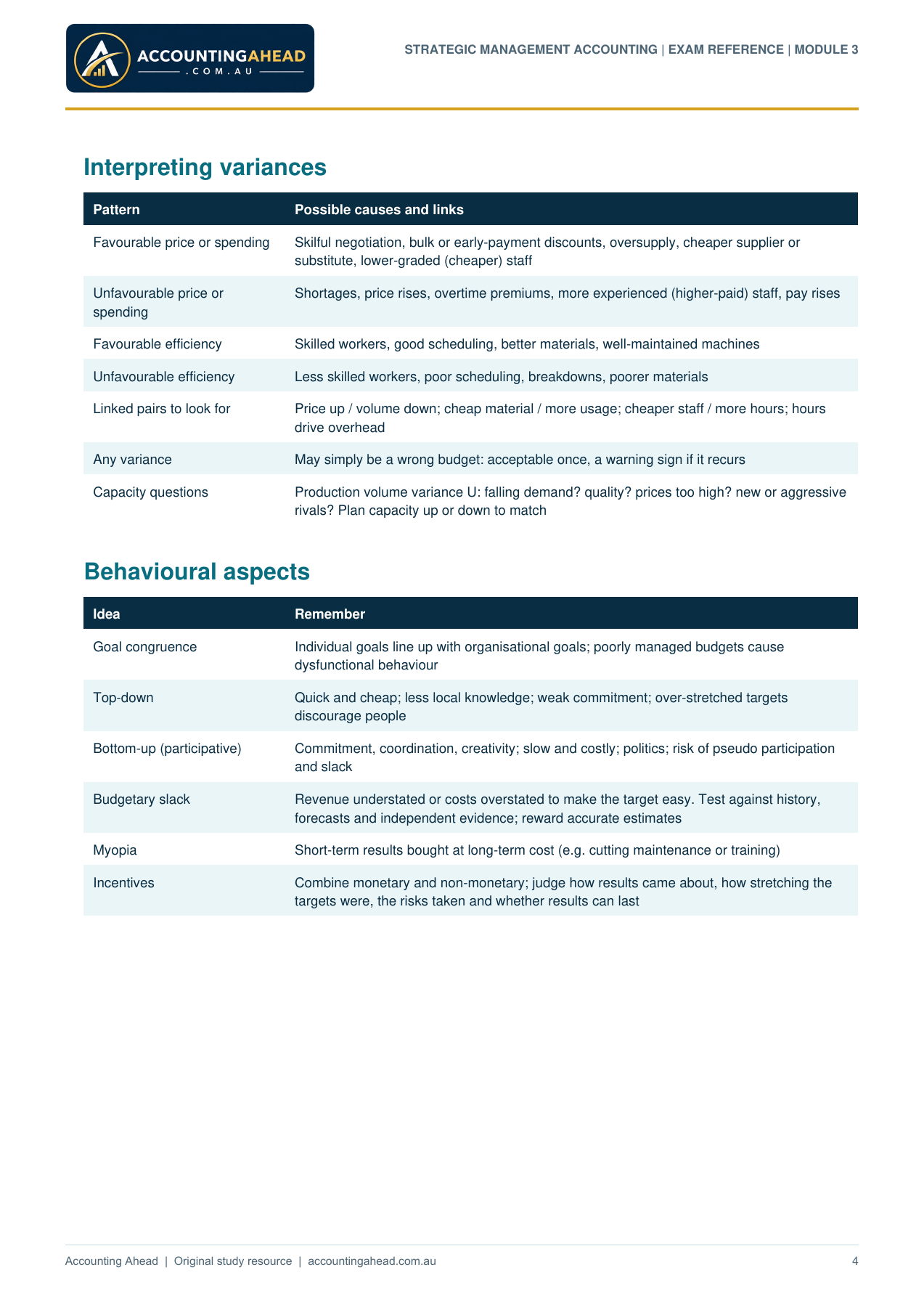
Interpreting variances
Pattern Possible causes and links
Favourable price or spending Skilful negotiation, bulk or early-payment discounts, oversupply, cheaper supplier or
substitute, lower-graded (cheaper) staff
Unfavourable price or
spending
Shortages, price rises, overtime premiums, more experienced (higher-paid) staff, pay rises
Favourable efficiency Skilled workers, good scheduling, better materials, well-maintained machines
Unfavourable efficiency Less skilled workers, poor scheduling, breakdowns, poorer materials
Linked pairs to look for Price up / volume down; cheap material / more usage; cheaper staff / more hours; hours
drive overhead
Any variance May simply be a wrong budget: acceptable once, a warning sign if it recurs
Capacity questions Production volume variance U: falling demand? quality? prices too high? new or aggressive
rivals? Plan capacity up or down to match
Behavioural aspects
Idea Remember
Goal congruence Individual goals line up with organisational goals; poorly managed budgets cause
dysfunctional behaviour
Top-down Quick and cheap; less local knowledge; weak commitment; over-stretched targets
discourage people
Bottom-up (participative) Commitment, coordination, creativity; slow and costly; politics; risk of pseudo participation
and slack
Budgetary slack Revenue understated or costs overstated to make the target easy. Test against history,
forecasts and independent evidence; reward accurate estimates
Myopia Short-term results bought at long-term cost (e.g. cutting maintenance or training)
Incentives Combine monetary and non-monetary; judge how results came about, how stretching the
targets were, the risks taken and whether results can last
STRATEGIC MANAGEMENT ACCOUNTING | EXAM REFERENCE | MODULE 3
4