
Module 6 quick reference: tools for creating and managing value
A printable quick reference for Module 6.
Read the handout text
Accounting Ahead | Original study resource | accountingahead.com.au
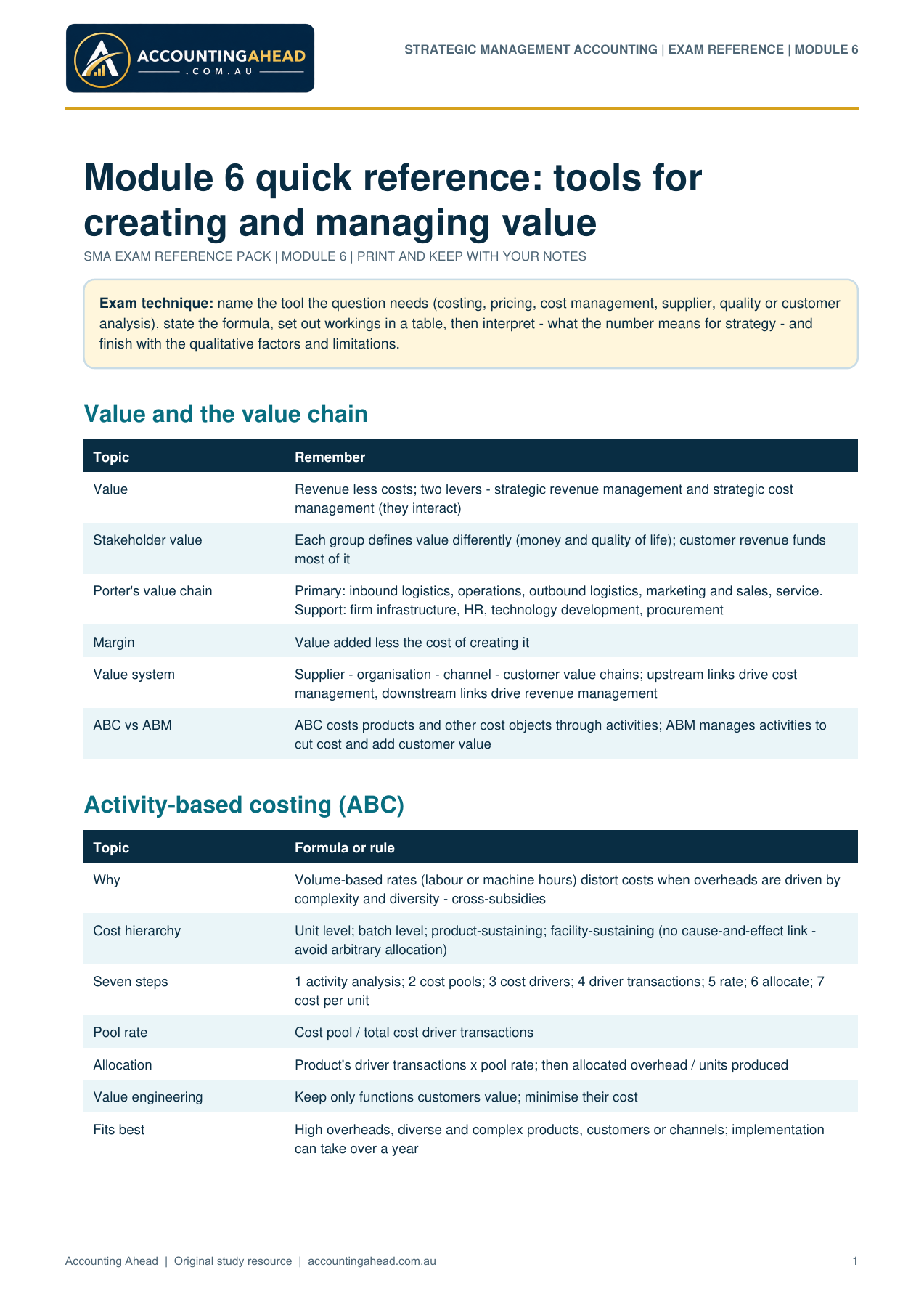
Module 6 quick reference: tools for
creating and managing value
SMA EXAM REFERENCE PACK | MODULE 6 | PRINT AND KEEP WITH YOUR NOTES
Exam technique: name the tool the question needs (costing, pricing, cost management, supplier, quality or customer
analysis), state the formula, set out workings in a table, then interpret - what the number means for strategy - and
finish with the qualitative factors and limitations.
Value and the value chain
Topic Remember
Value Revenue less costs; two levers - strategic revenue management and strategic cost
management (they interact)
Stakeholder value Each group defines value differently (money and quality of life); customer revenue funds
most of it
Porter's value chain Primary: inbound logistics, operations, outbound logistics, marketing and sales, service.
Support: firm infrastructure, HR, technology development, procurement
Margin Value added less the cost of creating it
Value system Supplier - organisation - channel - customer value chains; upstream links drive cost
management, downstream links drive revenue management
ABC vs ABM ABC costs products and other cost objects through activities; ABM manages activities to
cut cost and add customer value
Activity-based costing (ABC)
Topic Formula or rule
Why Volume-based rates (labour or machine hours) distort costs when overheads are driven by
complexity and diversity - cross-subsidies
Cost hierarchy Unit level; batch level; product-sustaining; facility-sustaining (no cause-and-effect link -
avoid arbitrary allocation)
Seven steps 1 activity analysis; 2 cost pools; 3 cost drivers; 4 driver transactions; 5 rate; 6 allocate; 7
cost per unit
Pool rate Cost pool / total cost driver transactions
Allocation Product's driver transactions x pool rate; then allocated overhead / units produced
Value engineering Keep only functions customers value; minimise their cost
Fits best High overheads, diverse and complex products, customers or channels; implementation
can take over a year
STRATEGIC MANAGEMENT ACCOUNTING | EXAM REFERENCE | MODULE 6
1
Accounting Ahead | Original study resource | accountingahead.com.au
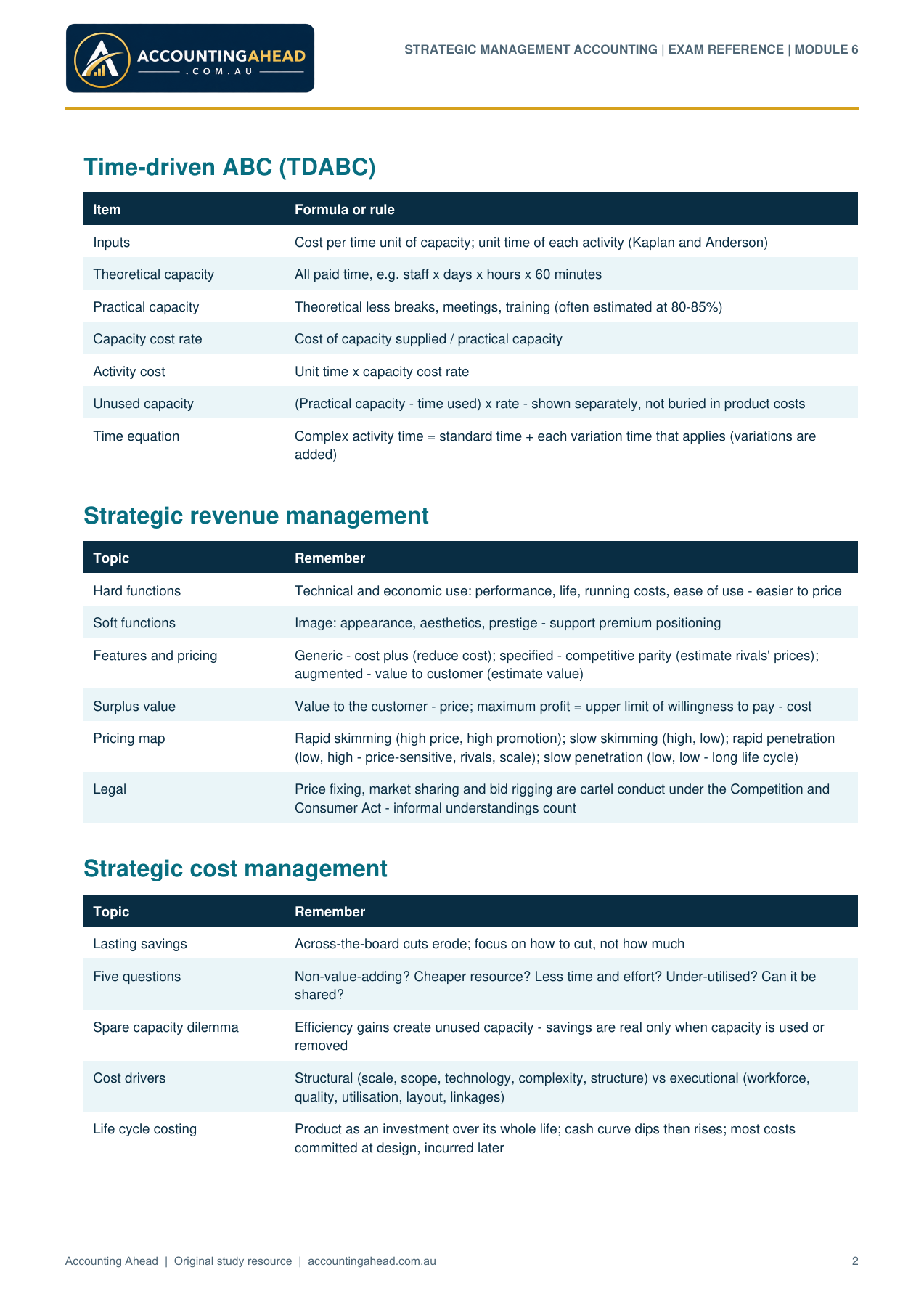
Time-driven ABC (TDABC)
Item Formula or rule
Inputs Cost per time unit of capacity; unit time of each activity (Kaplan and Anderson)
Theoretical capacity All paid time, e.g. staff x days x hours x 60 minutes
Practical capacity Theoretical less breaks, meetings, training (often estimated at 80-85%)
Capacity cost rate Cost of capacity supplied / practical capacity
Activity cost Unit time x capacity cost rate
Unused capacity (Practical capacity - time used) x rate - shown separately, not buried in product costs
Time equation Complex activity time = standard time + each variation time that applies (variations are
added)
Strategic revenue management
Topic Remember
Hard functions Technical and economic use: performance, life, running costs, ease of use - easier to price
Soft functions Image: appearance, aesthetics, prestige - support premium positioning
Features and pricing Generic - cost plus (reduce cost); specified - competitive parity (estimate rivals' prices);
augmented - value to customer (estimate value)
Surplus value Value to the customer - price; maximum profit = upper limit of willingness to pay - cost
Pricing map Rapid skimming (high price, high promotion); slow skimming (high, low); rapid penetration
(low, high - price-sensitive, rivals, scale); slow penetration (low, low - long life cycle)
Legal Price fixing, market sharing and bid rigging are cartel conduct under the Competition and
Consumer Act - informal understandings count
Strategic cost management
Topic Remember
Lasting savings Across-the-board cuts erode; focus on how to cut, not how much
Five questions Non-value-adding? Cheaper resource? Less time and effort? Under-utilised? Can it be
shared?
Spare capacity dilemma Efficiency gains create unused capacity - savings are real only when capacity is used or
removed
Cost drivers Structural (scale, scope, technology, complexity, structure) vs executional (workforce,
quality, utilisation, layout, linkages)
Life cycle costing Product as an investment over its whole life; cash curve dips then rises; most costs
committed at design, incurred later
STRATEGIC MANAGEMENT ACCOUNTING | EXAM REFERENCE | MODULE 6
2
Accounting Ahead | Original study resource | accountingahead.com.au
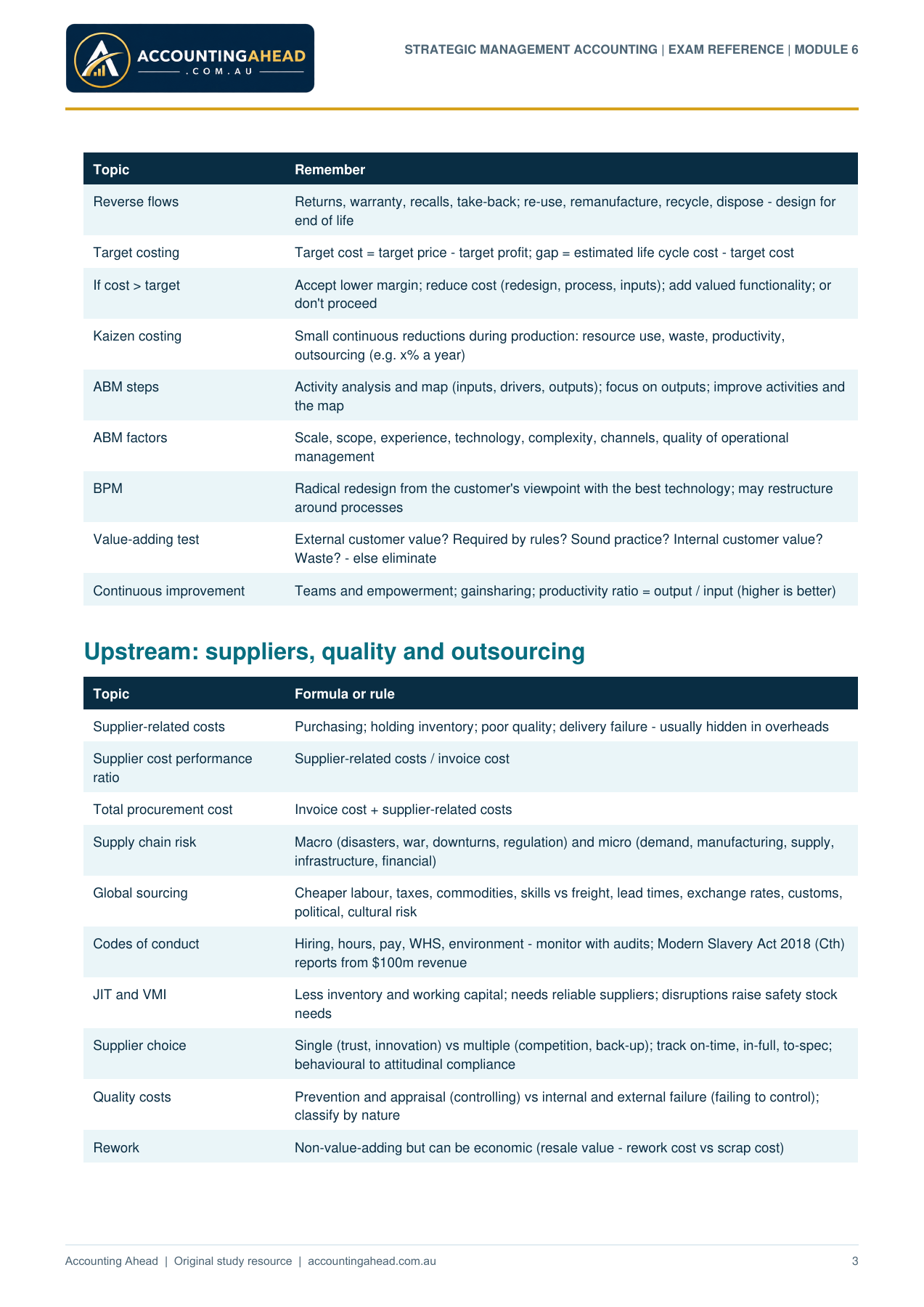
Topic Remember
Reverse flows Returns, warranty, recalls, take-back; re-use, remanufacture, recycle, dispose - design for
end of life
Target costing Target cost = target price - target profit; gap = estimated life cycle cost - target cost
If cost > target Accept lower margin; reduce cost (redesign, process, inputs); add valued functionality; or
don't proceed
Kaizen costing Small continuous reductions during production: resource use, waste, productivity,
outsourcing (e.g. x% a year)
ABM steps Activity analysis and map (inputs, drivers, outputs); focus on outputs; improve activities and
the map
ABM factors Scale, scope, experience, technology, complexity, channels, quality of operational
management
BPM Radical redesign from the customer's viewpoint with the best technology; may restructure
around processes
Value-adding test External customer value? Required by rules? Sound practice? Internal customer value?
Waste? - else eliminate
Continuous improvement Teams and empowerment; gainsharing; productivity ratio = output / input (higher is better)
Upstream: suppliers, quality and outsourcing
Topic Formula or rule
Supplier-related costs Purchasing; holding inventory; poor quality; delivery failure - usually hidden in overheads
Supplier cost performance
ratio
Supplier-related costs / invoice cost
Total procurement cost Invoice cost + supplier-related costs
Supply chain risk Macro (disasters, war, downturns, regulation) and micro (demand, manufacturing, supply,
infrastructure, financial)
Global sourcing Cheaper labour, taxes, commodities, skills vs freight, lead times, exchange rates, customs,
political, cultural risk
Codes of conduct Hiring, hours, pay, WHS, environment - monitor with audits; Modern Slavery Act 2018 (Cth)
reports from $100m revenue
JIT and VMI Less inventory and working capital; needs reliable suppliers; disruptions raise safety stock
needs
Supplier choice Single (trust, innovation) vs multiple (competition, back-up); track on-time, in-full, to-spec;
behavioural to attitudinal compliance
Quality costs Prevention and appraisal (controlling) vs internal and external failure (failing to control);
classify by nature
Rework Non-value-adding but can be economic (resale value - rework cost vs scrap cost)
STRATEGIC MANAGEMENT ACCOUNTING | EXAM REFERENCE | MODULE 6
3
Accounting Ahead | Original study resource | accountingahead.com.au
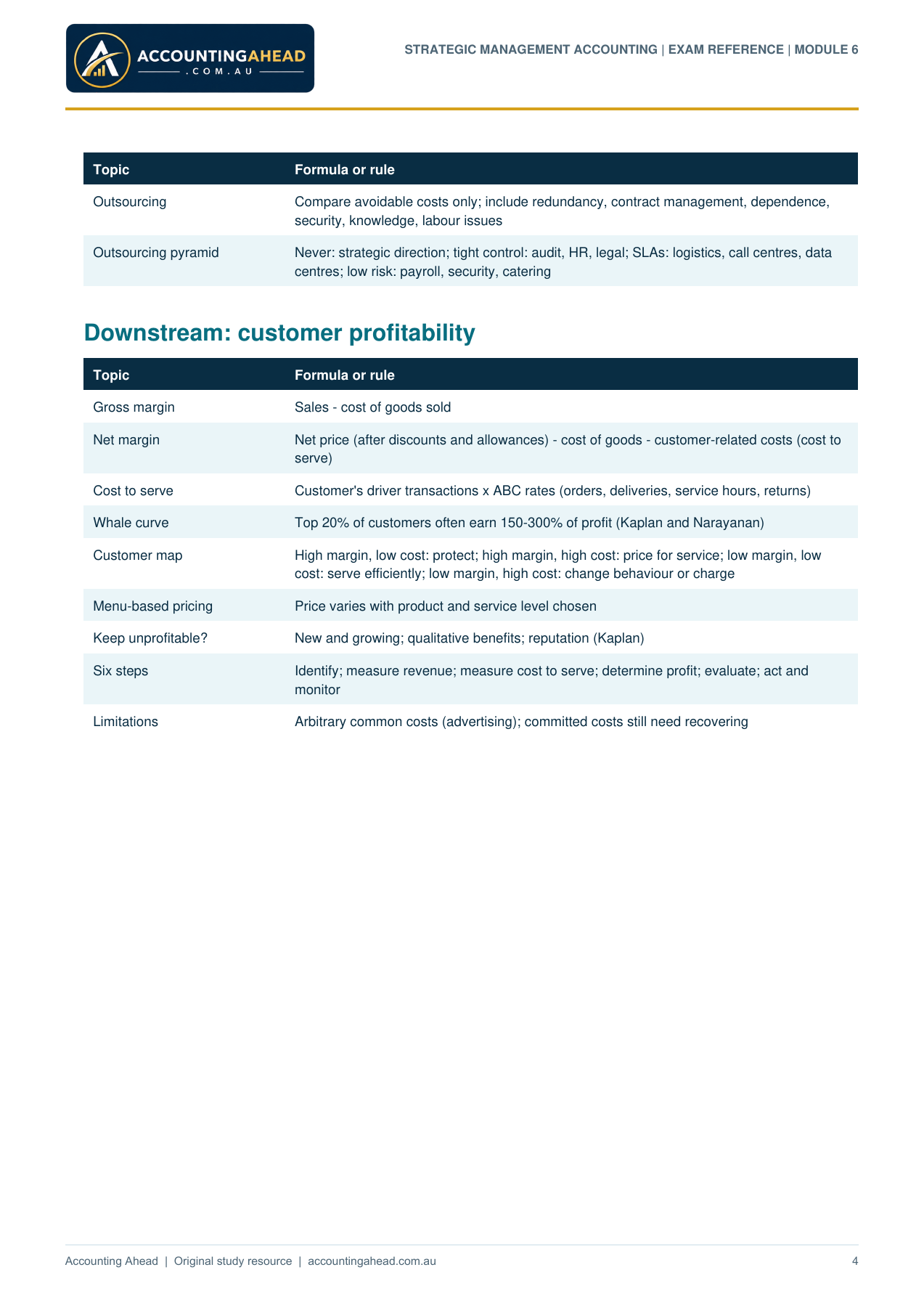
Topic Formula or rule
Outsourcing Compare avoidable costs only; include redundancy, contract management, dependence,
security, knowledge, labour issues
Outsourcing pyramid Never: strategic direction; tight control: audit, HR, legal; SLAs: logistics, call centres, data
centres; low risk: payroll, security, catering
Downstream: customer profitability
Topic Formula or rule
Gross margin Sales - cost of goods sold
Net margin Net price (after discounts and allowances) - cost of goods - customer-related costs (cost to
serve)
Cost to serve Customer's driver transactions x ABC rates (orders, deliveries, service hours, returns)
Whale curve Top 20% of customers often earn 150-300% of profit (Kaplan and Narayanan)
Customer map High margin, low cost: protect; high margin, high cost: price for service; low margin, low
cost: serve efficiently; low margin, high cost: change behaviour or charge
Menu-based pricing Price varies with product and service level chosen
Keep unprofitable? New and growing; qualitative benefits; reputation (Kaplan)
Six steps Identify; measure revenue; measure cost to serve; determine profit; evaluate; act and
monitor
Limitations Arbitrary common costs (advertising); committed costs still need recovering
STRATEGIC MANAGEMENT ACCOUNTING | EXAM REFERENCE | MODULE 6
4