
Internal structures and responsibility centres
Printable study notes to use alongside Part D.3.
Read the handout text
Accounting Ahead | Original study resource | accountingahead.com.au
Internal structures and responsibility
centres
MODULE 1 | PART D.3 | STUDENT COMPANION
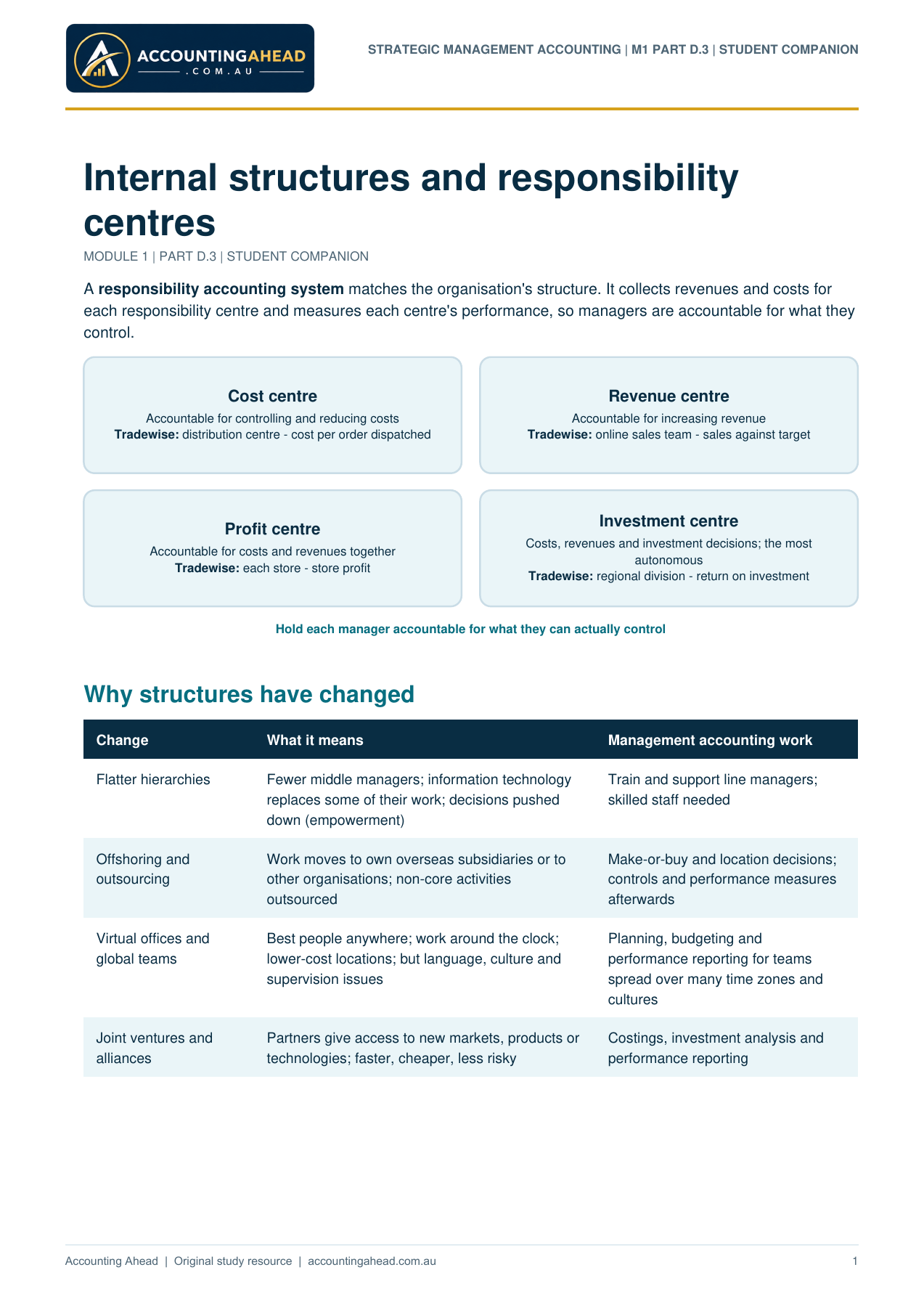
A responsibility accounting system matches the organisation's structure. It collects revenues and costs for
each responsibility centre and measures each centre's performance, so managers are accountable for what they
control.
Cost centre
Accountable for controlling and reducing costs
Tradewise: distribution centre - cost per order dispatched
Revenue centre
Accountable for increasing revenue
Tradewise: online sales team - sales against target
Profit centre
Accountable for costs and revenues together
Tradewise: each store - store profit
Investment centre
Costs, revenues and investment decisions; the most
autonomous
Tradewise: regional division - return on investment
Hold each manager accountable for what they can actually control
Why structures have changed
Change What it means Management accounting work
Flatter hierarchies Fewer middle managers; information technology
replaces some of their work; decisions pushed
down (empowerment)
Train and support line managers;
skilled staff needed
Offshoring and
outsourcing
Work moves to own overseas subsidiaries or to
other organisations; non-core activities
outsourced
Make-or-buy and location decisions;
controls and performance measures
afterwards
Virtual offices and
global teams
Best people anywhere; work around the clock;
lower-cost locations; but language, culture and
supervision issues
Planning, budgeting and
performance reporting for teams
spread over many time zones and
cultures
Joint ventures and
alliances
Partners give access to new markets, products or
technologies; faster, cheaper, less risky
Costings, investment analysis and
performance reporting
STRATEGIC MANAGEMENT ACCOUNTING | M1 PART D.3 | STUDENT COMPANION
1
Accounting Ahead | Original study resource | accountingahead.com.au
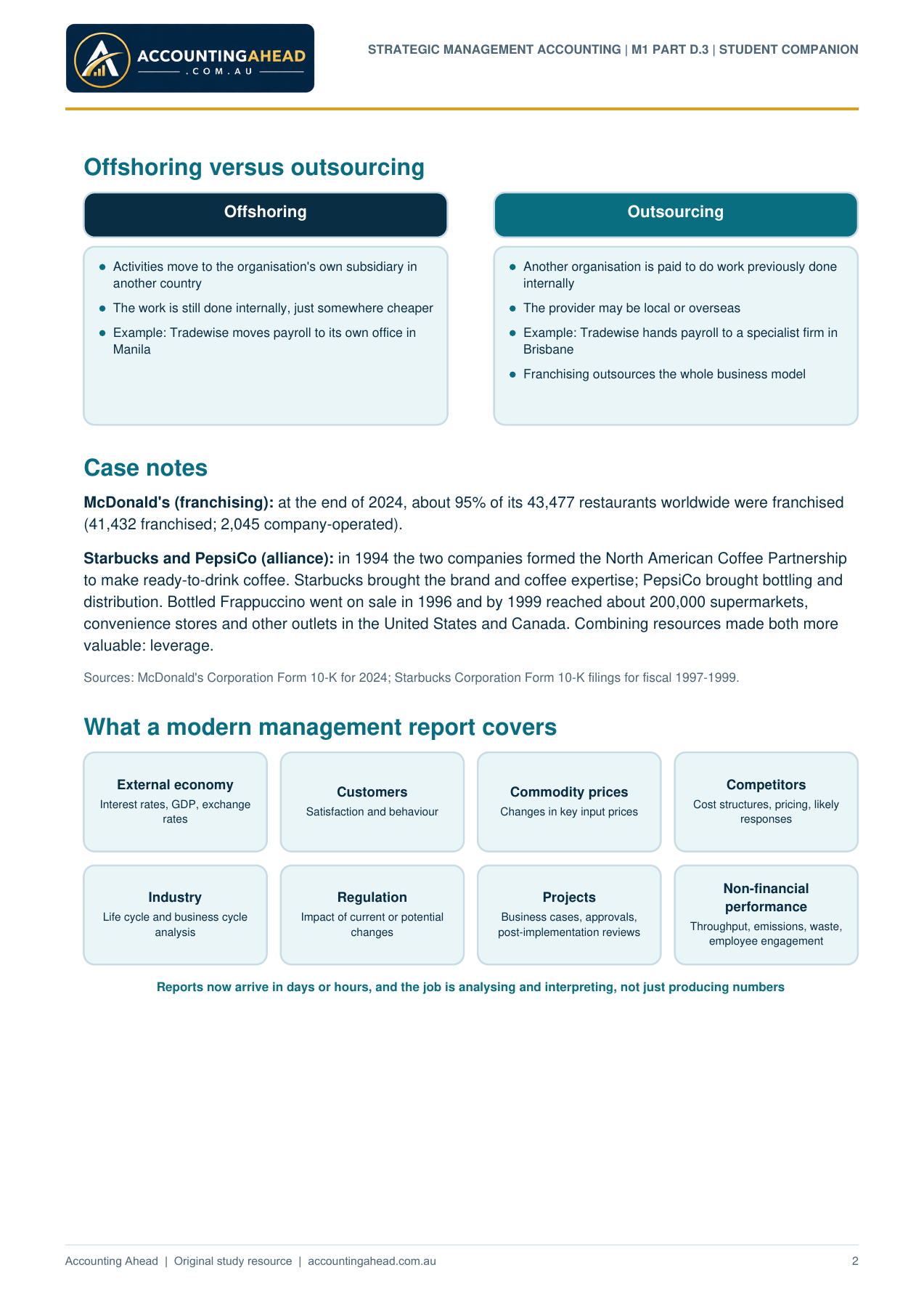
Offshoring versus outsourcing
Offshoring
Activities move to the organisation's own subsidiary in
another country
The work is still done internally, just somewhere cheaper
Example: Tradewise moves payroll to its own office in
Manila
Outsourcing
Another organisation is paid to do work previously done
internally
The provider may be local or overseas
Example: Tradewise hands payroll to a specialist firm in
Brisbane
Franchising outsources the whole business model
Case notes
McDonald's (franchising): at the end of 2024, about 95% of its 43,477 restaurants worldwide were franchised
(41,432 franchised; 2,045 company-operated).
Starbucks and PepsiCo (alliance): in 1994 the two companies formed the North American Coffee Partnership
to make ready-to-drink coffee. Starbucks brought the brand and coffee expertise; PepsiCo brought bottling and
distribution. Bottled Frappuccino went on sale in 1996 and by 1999 reached about 200,000 supermarkets,
convenience stores and other outlets in the United States and Canada. Combining resources made both more
valuable: leverage.
Sources: McDonald's Corporation Form 10-K for 2024; Starbucks Corporation Form 10-K filings for fiscal 1997-1999.
What a modern management report covers
External economy
Interest rates, GDP, exchange
rates
Customers
Satisfaction and behaviour
Commodity prices
Changes in key input prices
Competitors
Cost structures, pricing, likely
responses
Industry
Life cycle and business cycle
analysis
Regulation
Impact of current or potential
changes
Projects
Business cases, approvals,
post-implementation reviews
Non-financial
performance
Throughput, emissions, waste,
employee engagement
Reports now arrive in days or hours, and the job is analysing and interpreting, not just producing numbers
STRATEGIC MANAGEMENT ACCOUNTING | M1 PART D.3 | STUDENT COMPANION
2
Accounting Ahead | Original study resource | accountingahead.com.au
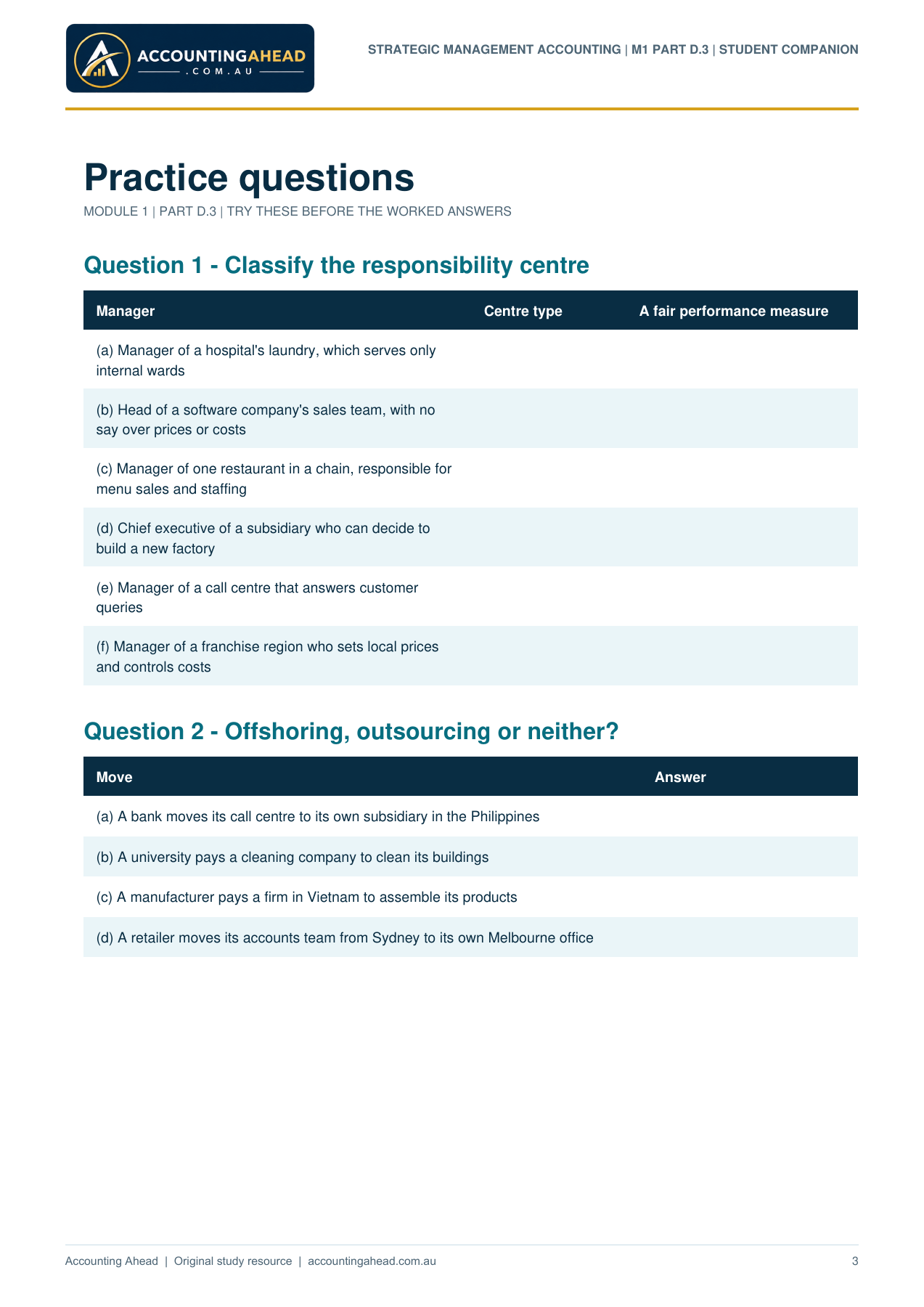
Practice questions
MODULE 1 | PART D.3 | TRY THESE BEFORE THE WORKED ANSWERS
Question 1 - Classify the responsibility centre
Manager Centre type A fair performance measure
(a) Manager of a hospital's laundry, which serves only
internal wards
(b) Head of a software company's sales team, with no
say over prices or costs
(c) Manager of one restaurant in a chain, responsible for
menu sales and staffing
(d) Chief executive of a subsidiary who can decide to
build a new factory
(e) Manager of a call centre that answers customer
queries
(f) Manager of a franchise region who sets local prices
and controls costs
Question 2 - Offshoring, outsourcing or neither?
Move Answer
(a) A bank moves its call centre to its own subsidiary in the Philippines
(b) A university pays a cleaning company to clean its buildings
(c) A manufacturer pays a firm in Vietnam to assemble its products
(d) A retailer moves its accounts team from Sydney to its own Melbourne office
STRATEGIC MANAGEMENT ACCOUNTING | M1 PART D.3 | STUDENT COMPANION
3
Accounting Ahead | Original study resource | accountingahead.com.au
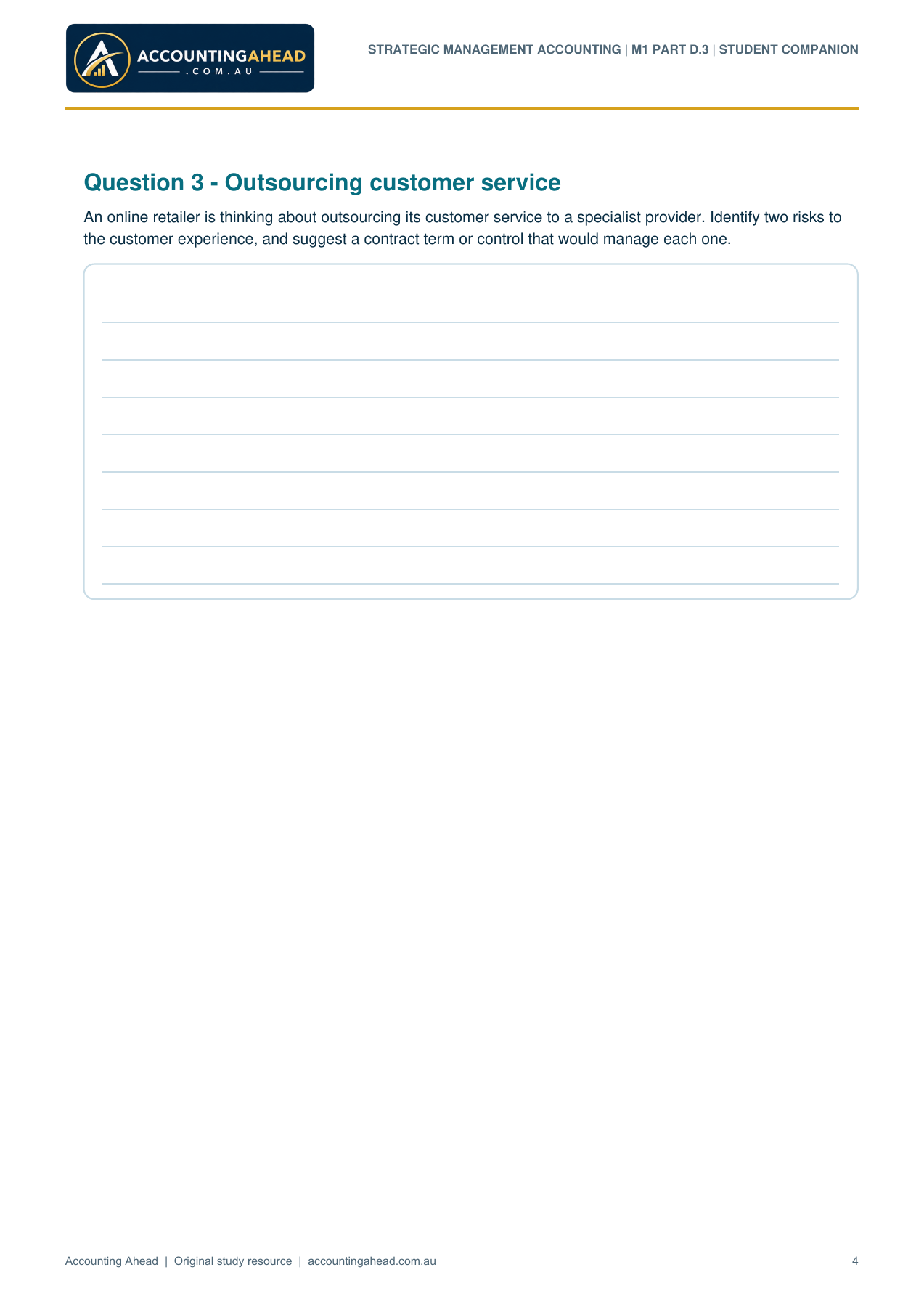
Question 3 - Outsourcing customer service
An online retailer is thinking about outsourcing its customer service to a specialist provider. Identify two risks to
the customer experience, and suggest a contract term or control that would manage each one.
STRATEGIC MANAGEMENT ACCOUNTING | M1 PART D.3 | STUDENT COMPANION
4
Accounting Ahead | Original study resource | accountingahead.com.au
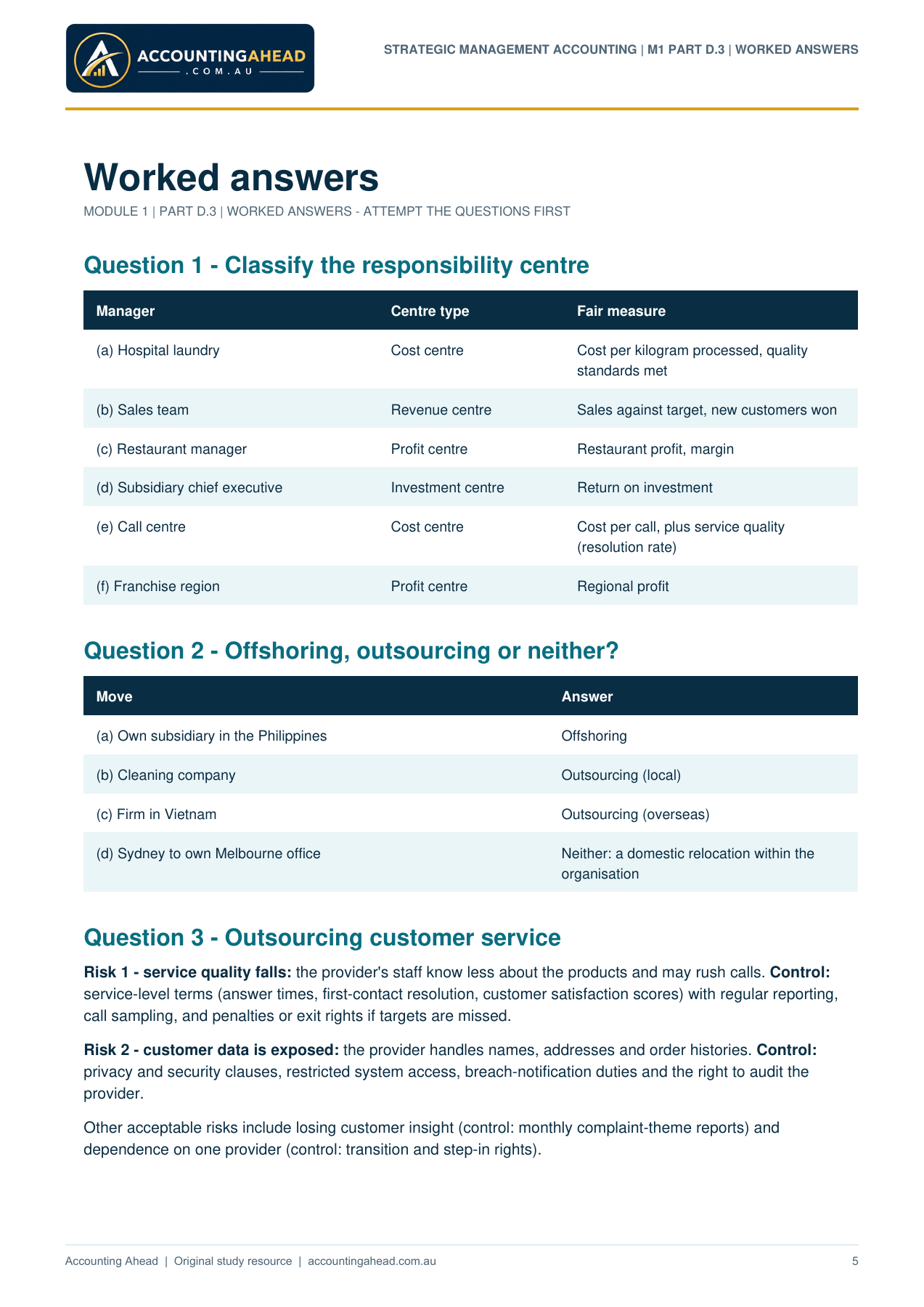
Worked answers
MODULE 1 | PART D.3 | WORKED ANSWERS - ATTEMPT THE QUESTIONS FIRST
Question 1 - Classify the responsibility centre
Manager Centre type Fair measure
(a) Hospital laundry Cost centre Cost per kilogram processed, quality
standards met
(b) Sales team Revenue centre Sales against target, new customers won
(c) Restaurant manager Profit centre Restaurant profit, margin
(d) Subsidiary chief executive Investment centre Return on investment
(e) Call centre Cost centre Cost per call, plus service quality
(resolution rate)
(f) Franchise region Profit centre Regional profit
Question 2 - Offshoring, outsourcing or neither?
Move Answer
(a) Own subsidiary in the Philippines Offshoring
(b) Cleaning company Outsourcing (local)
(c) Firm in Vietnam Outsourcing (overseas)
(d) Sydney to own Melbourne office Neither: a domestic relocation within the
organisation
Question 3 - Outsourcing customer service
Risk 1 - service quality falls: the provider's staff know less about the products and may rush calls. Control:
service-level terms (answer times, first-contact resolution, customer satisfaction scores) with regular reporting,
call sampling, and penalties or exit rights if targets are missed.
Risk 2 - customer data is exposed: the provider handles names, addresses and order histories. Control:
privacy and security clauses, restricted system access, breach-notification duties and the right to audit the
provider.
Other acceptable risks include losing customer insight (control: monthly complaint-theme reports) and
dependence on one provider (control: transition and step-in rights).
STRATEGIC MANAGEMENT ACCOUNTING | M1 PART D.3 | WORKED ANSWERS
5