
Value analysis, SWOT and internal analysis
Printable study notes to use alongside Part E.1.
Read the handout text
Accounting Ahead | Original study resource | accountingahead.com.au
Value analysis, SWOT and internal analysis
MODULE 1 | PART E.1 | STUDENT COMPANION
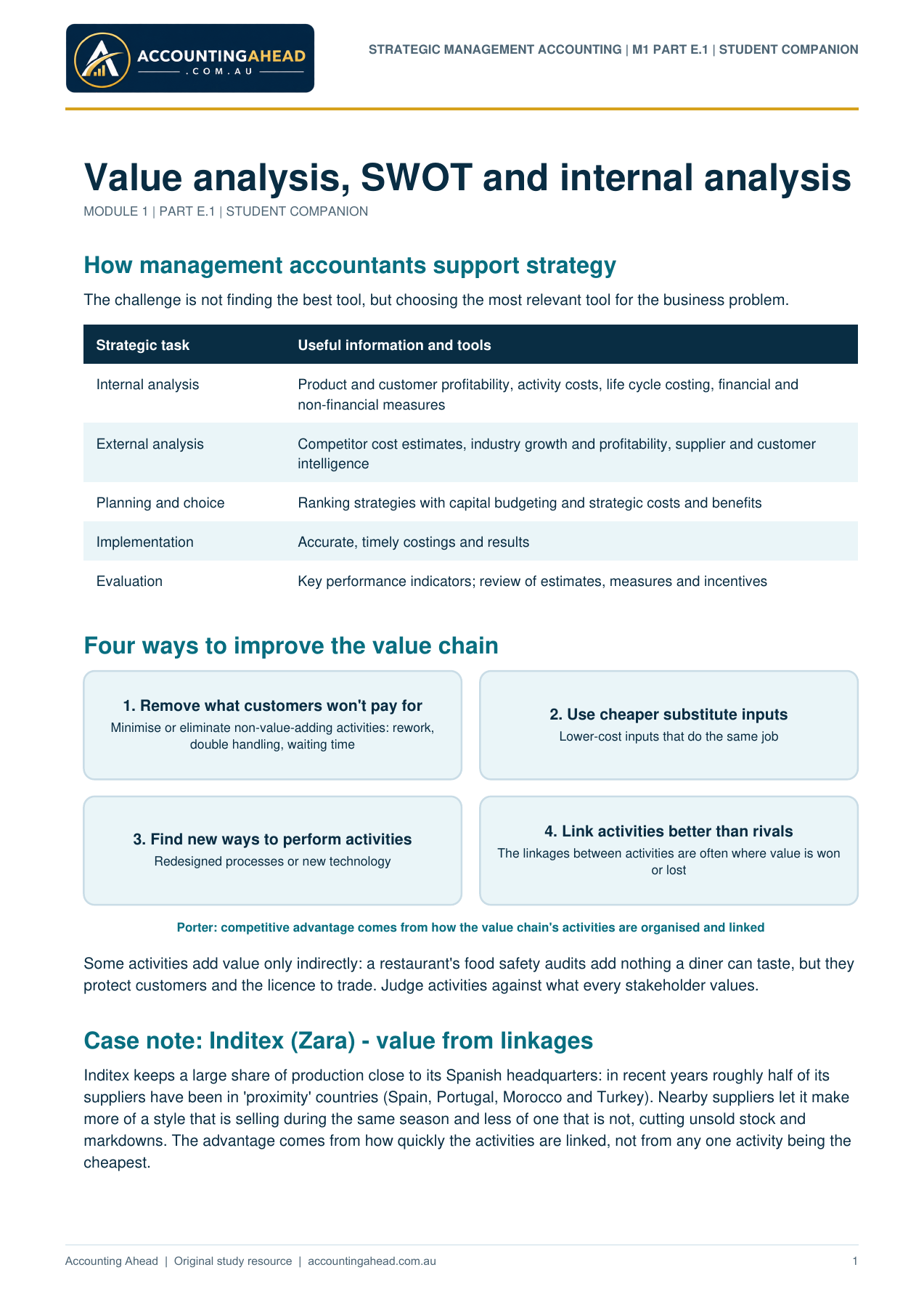
How management accountants support strategy
The challenge is not finding the best tool, but choosing the most relevant tool for the business problem.
Strategic task Useful information and tools
Internal analysis Product and customer profitability, activity costs, life cycle costing, financial and
non-financial measures
External analysis Competitor cost estimates, industry growth and profitability, supplier and customer
intelligence
Planning and choice Ranking strategies with capital budgeting and strategic costs and benefits
Implementation Accurate, timely costings and results
Evaluation Key performance indicators; review of estimates, measures and incentives
Four ways to improve the value chain
1. Remove what customers won't pay for
Minimise or eliminate non-value-adding activities: rework,
double handling, waiting time
2. Use cheaper substitute inputs
Lower-cost inputs that do the same job
3. Find new ways to perform activities
Redesigned processes or new technology
4. Link activities better than rivals
The linkages between activities are often where value is won
or lost
Porter: competitive advantage comes from how the value chain's activities are organised and linked
Some activities add value only indirectly: a restaurant's food safety audits add nothing a diner can taste, but they
protect customers and the licence to trade. Judge activities against what every stakeholder values.
Case note: Inditex (Zara) - value from linkages
Inditex keeps a large share of production close to its Spanish headquarters: in recent years roughly half of its
suppliers have been in 'proximity' countries (Spain, Portugal, Morocco and Turkey). Nearby suppliers let it make
more of a style that is selling during the same season and less of one that is not, cutting unsold stock and
markdowns. The advantage comes from how quickly the activities are linked, not from any one activity being the
cheapest.
STRATEGIC MANAGEMENT ACCOUNTING | M1 PART E.1 | STUDENT COMPANION
1
Accounting Ahead | Original study resource | accountingahead.com.au
Sources: Inditex supplier disclosures as reported by Modaes (2019-2024) and Georgetown McDonough School of Business.
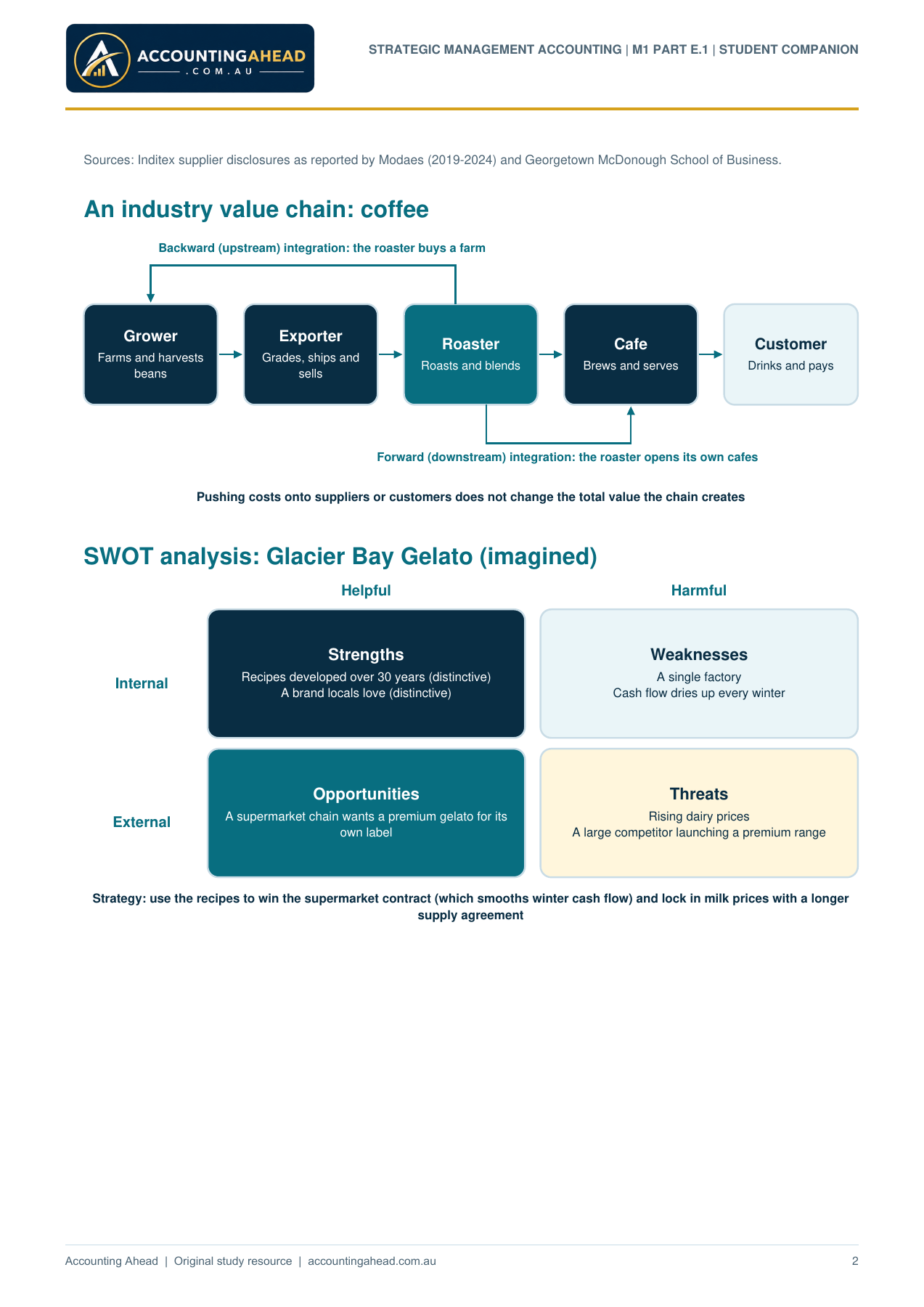
An industry value chain: coffee
Grower
Farms and harvests
beans
Exporter
Grades, ships and
sells
Roaster
Roasts and blends
Cafe
Brews and serves
Customer
Drinks and pays
Backward (upstream) integration: the roaster buys a farm
Forward (downstream) integration: the roaster opens its own cafes
Pushing costs onto suppliers or customers does not change the total value the chain creates
SWOT analysis: Glacier Bay Gelato (imagined)
Helpful Harmful
Internal
External
Strengths
Recipes developed over 30 years (distinctive)
A brand locals love (distinctive)
Weaknesses
A single factory
Cash flow dries up every winter
Opportunities
A supermarket chain wants a premium gelato for its
own label
Threats
Rising dairy prices
A large competitor launching a premium range
Strategy: use the recipes to win the supermarket contract (which smooths winter cash flow) and lock in milk prices with a longer
supply agreement
STRATEGIC MANAGEMENT ACCOUNTING | M1 PART E.1 | STUDENT COMPANION
2
Accounting Ahead | Original study resource | accountingahead.com.au
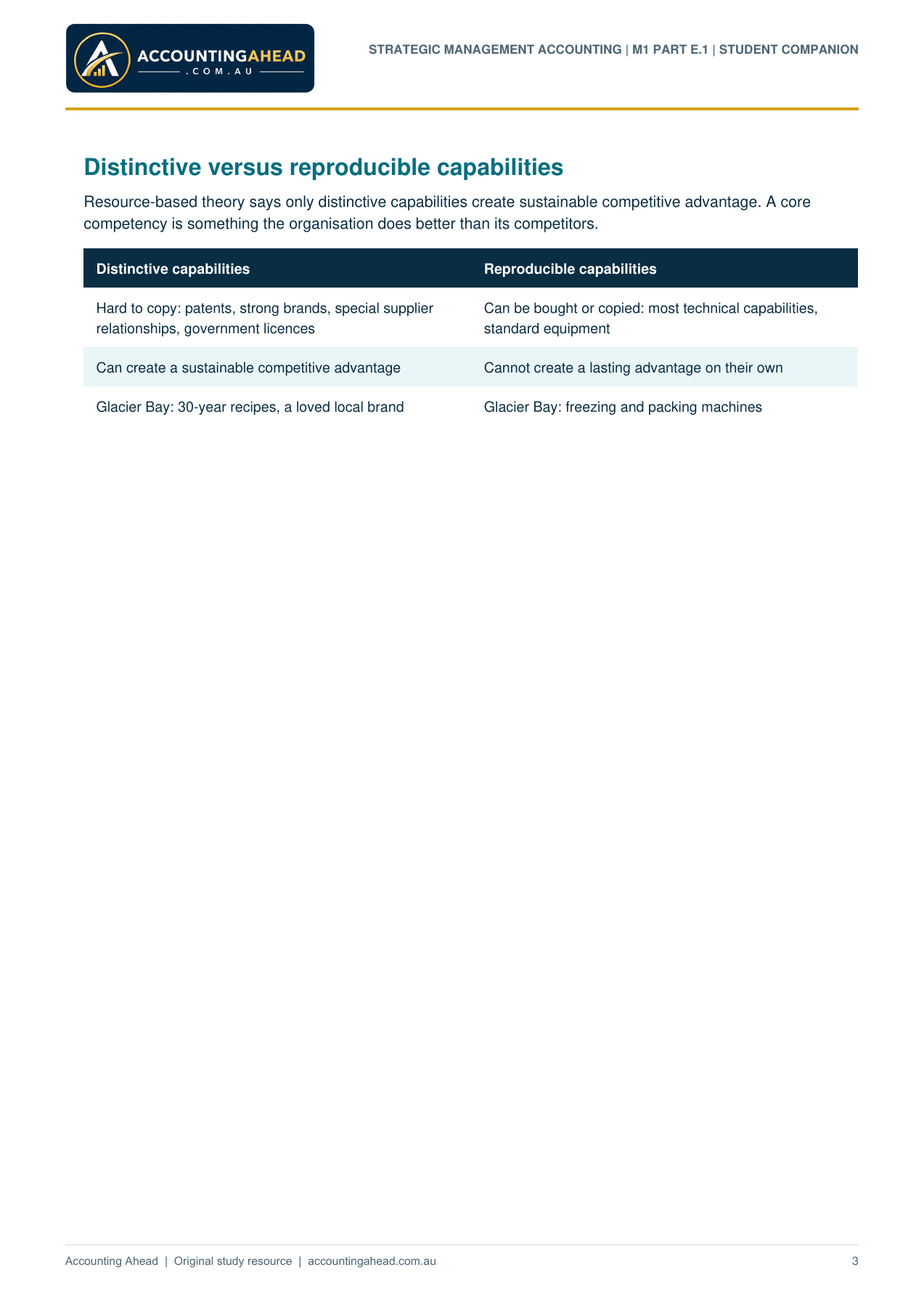
Distinctive versus reproducible capabilities
Resource-based theory says only distinctive capabilities create sustainable competitive advantage. A core
competency is something the organisation does better than its competitors.
Distinctive capabilities Reproducible capabilities
Hard to copy: patents, strong brands, special supplier
relationships, government licences
Can be bought or copied: most technical capabilities,
standard equipment
Can create a sustainable competitive advantage Cannot create a lasting advantage on their own
Glacier Bay: 30-year recipes, a loved local brand Glacier Bay: freezing and packing machines
STRATEGIC MANAGEMENT ACCOUNTING | M1 PART E.1 | STUDENT COMPANION
3
Accounting Ahead | Original study resource | accountingahead.com.au
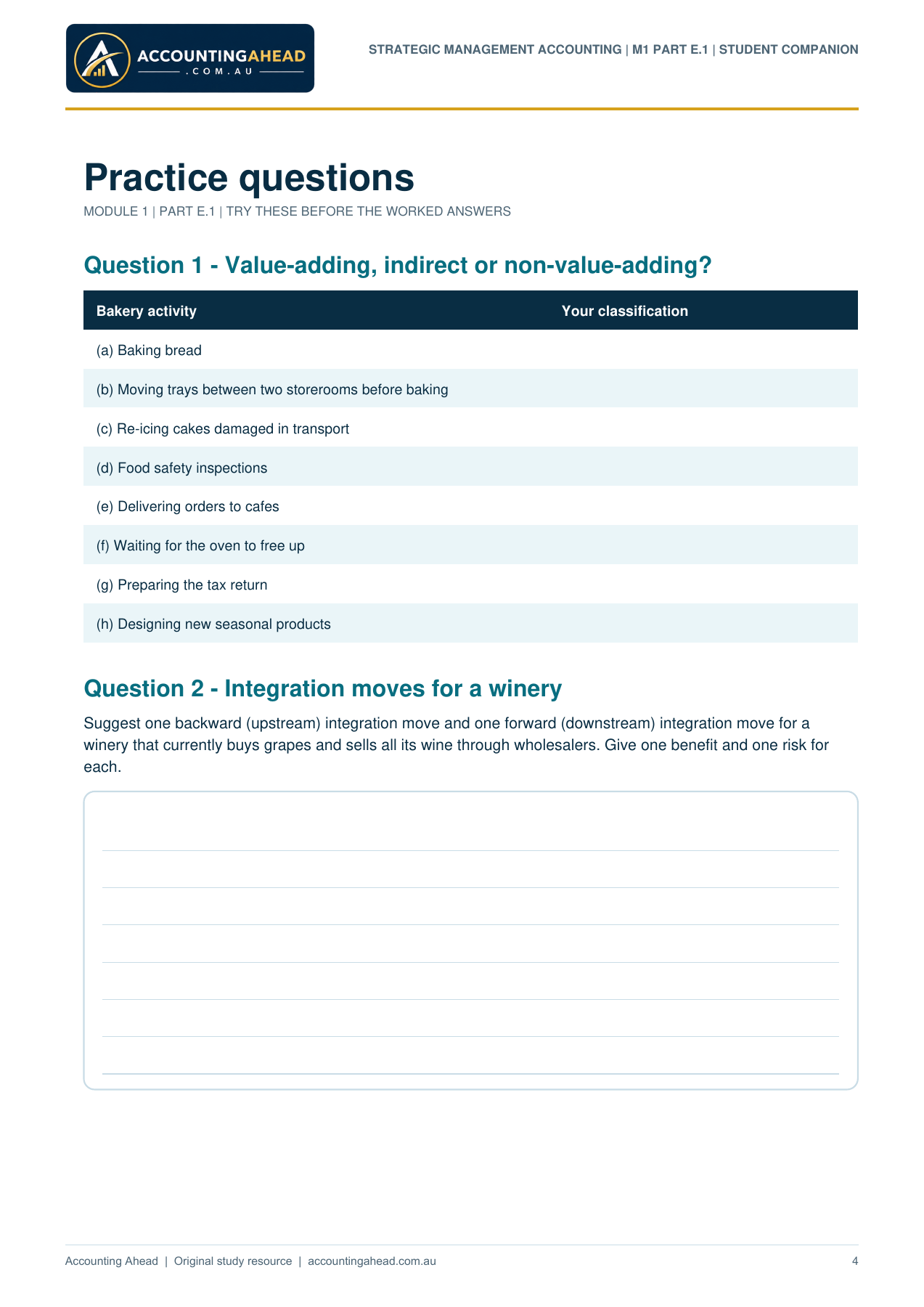
Practice questions
MODULE 1 | PART E.1 | TRY THESE BEFORE THE WORKED ANSWERS
Question 1 - Value-adding, indirect or non-value-adding?
Bakery activity Your classification
(a) Baking bread
(b) Moving trays between two storerooms before baking
(c) Re-icing cakes damaged in transport
(d) Food safety inspections
(e) Delivering orders to cafes
(f) Waiting for the oven to free up
(g) Preparing the tax return
(h) Designing new seasonal products
Question 2 - Integration moves for a winery
Suggest one backward (upstream) integration move and one forward (downstream) integration move for a
winery that currently buys grapes and sells all its wine through wholesalers. Give one benefit and one risk for
each.
STRATEGIC MANAGEMENT ACCOUNTING | M1 PART E.1 | STUDENT COMPANION
4
Accounting Ahead | Original study resource | accountingahead.com.au
Question 3 - A SWOT for a local gym
A local gym has experienced trainers who run popular small-group classes, an ageing building, a new housing
estate being built nearby, and a low-cost 24-hour chain planning to open down the road. Prepare a short SWOT
and identify which strengths are distinctive.
STRATEGIC MANAGEMENT ACCOUNTING | M1 PART E.1 | STUDENT COMPANION
5
Accounting Ahead | Original study resource | accountingahead.com.au
Worked answers
MODULE 1 | PART E.1 | WORKED ANSWERS - ATTEMPT THE QUESTIONS FIRST
Question 1 - Value-adding, indirect or non-value-adding?
Activity Classification
(a) Baking bread Value-adding
(b) Moving trays between storerooms Non-value-adding (double handling)
(c) Re-icing damaged cakes Non-value-adding (rework)
(d) Food safety inspections Indirect value (protects customers and the licence)
(e) Delivering orders Value-adding (distribution)
(f) Waiting for the oven Non-value-adding (waiting)
(g) Preparing the tax return Indirect value (serves government, a key stakeholder)
(h) Designing seasonal products Value-adding (support activity: development)
Question 2 - Integration moves for a winery
Backward: buy or lease vineyards. Benefit: control over grape quality and supply. Risk: large capital outlay and
exposure to weather and crop risk.
Forward: open a cellar door, an online store or its own distribution. Benefit: higher margins and direct customer
relationships. Risk: new skills and costs, and possible conflict with existing wholesalers.
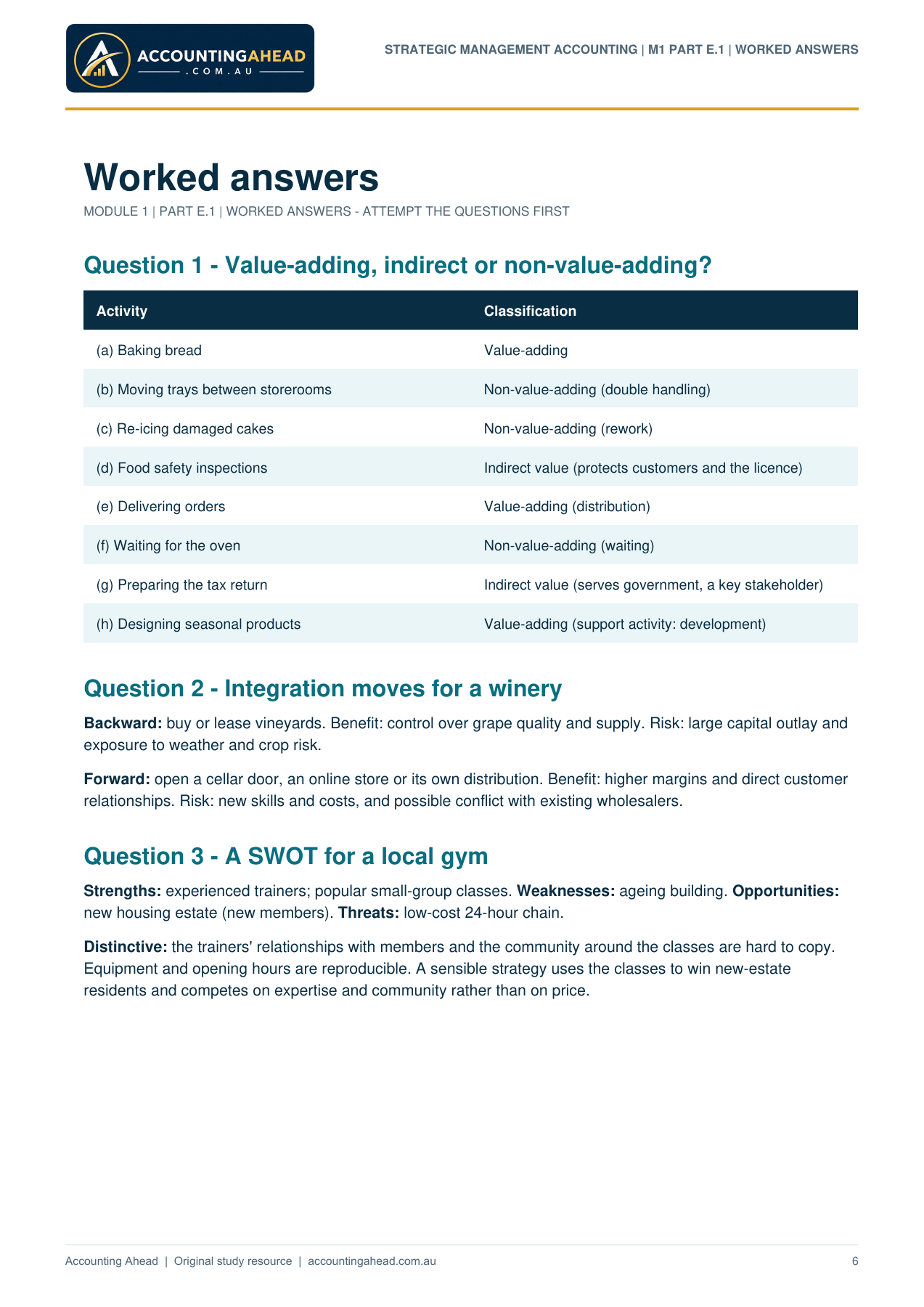
Question 3 - A SWOT for a local gym
Strengths: experienced trainers; popular small-group classes. Weaknesses: ageing building. Opportunities:
new housing estate (new members). Threats: low-cost 24-hour chain.
Distinctive: the trainers' relationships with members and the community around the classes are hard to copy.
Equipment and opening hours are reproducible. A sensible strategy uses the classes to win new-estate
residents and competes on expertise and community rather than on price.
STRATEGIC MANAGEMENT ACCOUNTING | M1 PART E.1 | WORKED ANSWERS
6