
PEST, regulation, CSR and the business cycle
Printable study notes to use alongside Part E.4.
Read the handout text
Accounting Ahead | Original study resource | accountingahead.com.au
PEST, regulation, CSR and the business
cycle
MODULE 1 | PART E.4 | STUDENT COMPANION
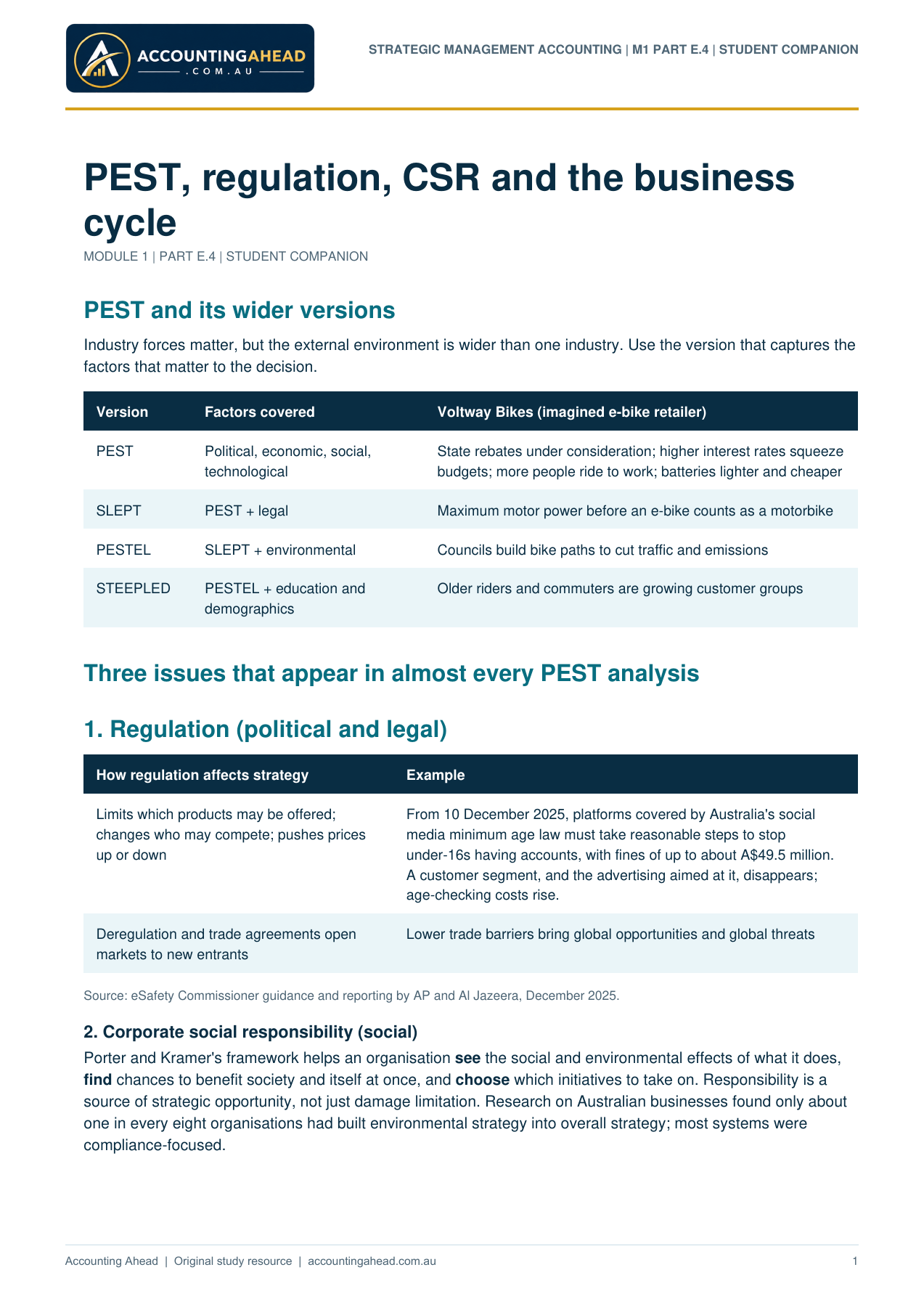
PEST and its wider versions
Industry forces matter, but the external environment is wider than one industry. Use the version that captures the
factors that matter to the decision.
Version Factors covered Voltway Bikes (imagined e-bike retailer)
PEST Political, economic, social,
technological
State rebates under consideration; higher interest rates squeeze
budgets; more people ride to work; batteries lighter and cheaper
SLEPT PEST + legal Maximum motor power before an e-bike counts as a motorbike
PESTEL SLEPT + environmental Councils build bike paths to cut traffic and emissions
STEEPLED PESTEL + education and
demographics
Older riders and commuters are growing customer groups
Three issues that appear in almost every PEST analysis
1. Regulation (political and legal)
How regulation affects strategy Example
Limits which products may be offered;
changes who may compete; pushes prices
up or down
From 10 December 2025, platforms covered by Australia's social
media minimum age law must take reasonable steps to stop
under-16s having accounts, with fines of up to about A$49.5 million.
A customer segment, and the advertising aimed at it, disappears;
age-checking costs rise.
Deregulation and trade agreements open
markets to new entrants
Lower trade barriers bring global opportunities and global threats
Source: eSafety Commissioner guidance and reporting by AP and Al Jazeera, December 2025.
2. Corporate social responsibility (social)
Porter and Kramer's framework helps an organisation see the social and environmental effects of what it does,
find chances to benefit society and itself at once, and choose which initiatives to take on. Responsibility is a
source of strategic opportunity, not just damage limitation. Research on Australian businesses found only about
one in every eight organisations had built environmental strategy into overall strategy; most systems were
compliance-focused.
STRATEGIC MANAGEMENT ACCOUNTING | M1 PART E.4 | STUDENT COMPANION
1
Accounting Ahead | Original study resource | accountingahead.com.au
Voltway (imagined): collecting and recycling old e-bike batteries reduces a real hazard, brings customers
back to the store, and builds a reputation an online discounter cannot easily copy.
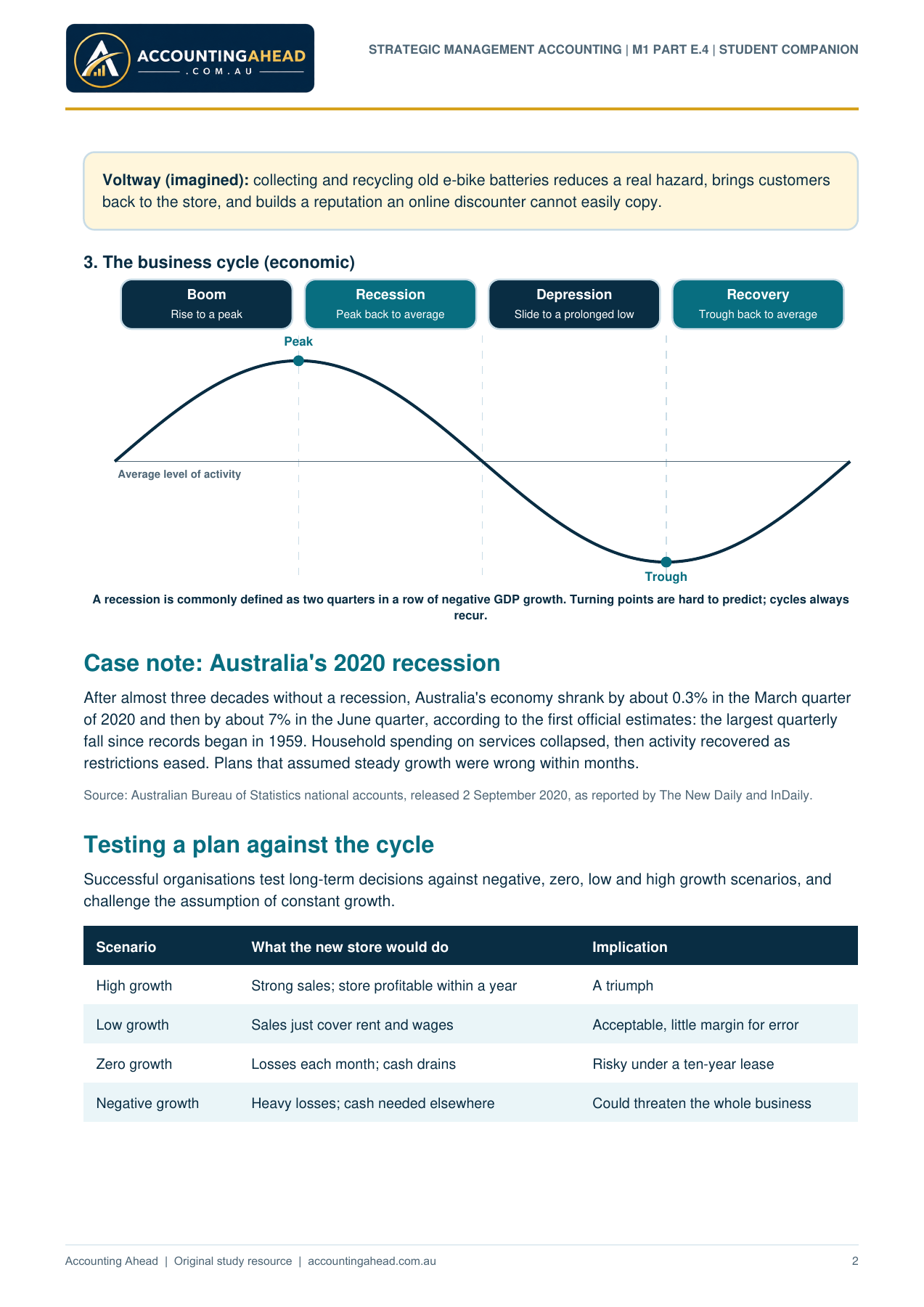
3. The business cycle (economic)
Average level of activity
Boom
Rise to a peak
Recession
Peak back to average
Depression
Slide to a prolonged low
Recovery
Trough back to average
Peak
Trough
A recession is commonly defined as two quarters in a row of negative GDP growth. Turning points are hard to predict; cycles always
recur.
Case note: Australia's 2020 recession
After almost three decades without a recession, Australia's economy shrank by about 0.3% in the March quarter
of 2020 and then by about 7% in the June quarter, according to the first official estimates: the largest quarterly
fall since records began in 1959. Household spending on services collapsed, then activity recovered as
restrictions eased. Plans that assumed steady growth were wrong within months.
Source: Australian Bureau of Statistics national accounts, released 2 September 2020, as reported by The New Daily and InDaily.
Testing a plan against the cycle
Successful organisations test long-term decisions against negative, zero, low and high growth scenarios, and
challenge the assumption of constant growth.
Scenario What the new store would do Implication
High growth Strong sales; store profitable within a year A triumph
Low growth Sales just cover rent and wages Acceptable, little margin for error
Zero growth Losses each month; cash drains Risky under a ten-year lease
Negative growth Heavy losses; cash needed elsewhere Could threaten the whole business
STRATEGIC MANAGEMENT ACCOUNTING | M1 PART E.4 | STUDENT COMPANION
2
Accounting Ahead | Original study resource | accountingahead.com.au
Practice questions
MODULE 1 | PART E.4 | TRY THESE BEFORE THE WORKED ANSWERS
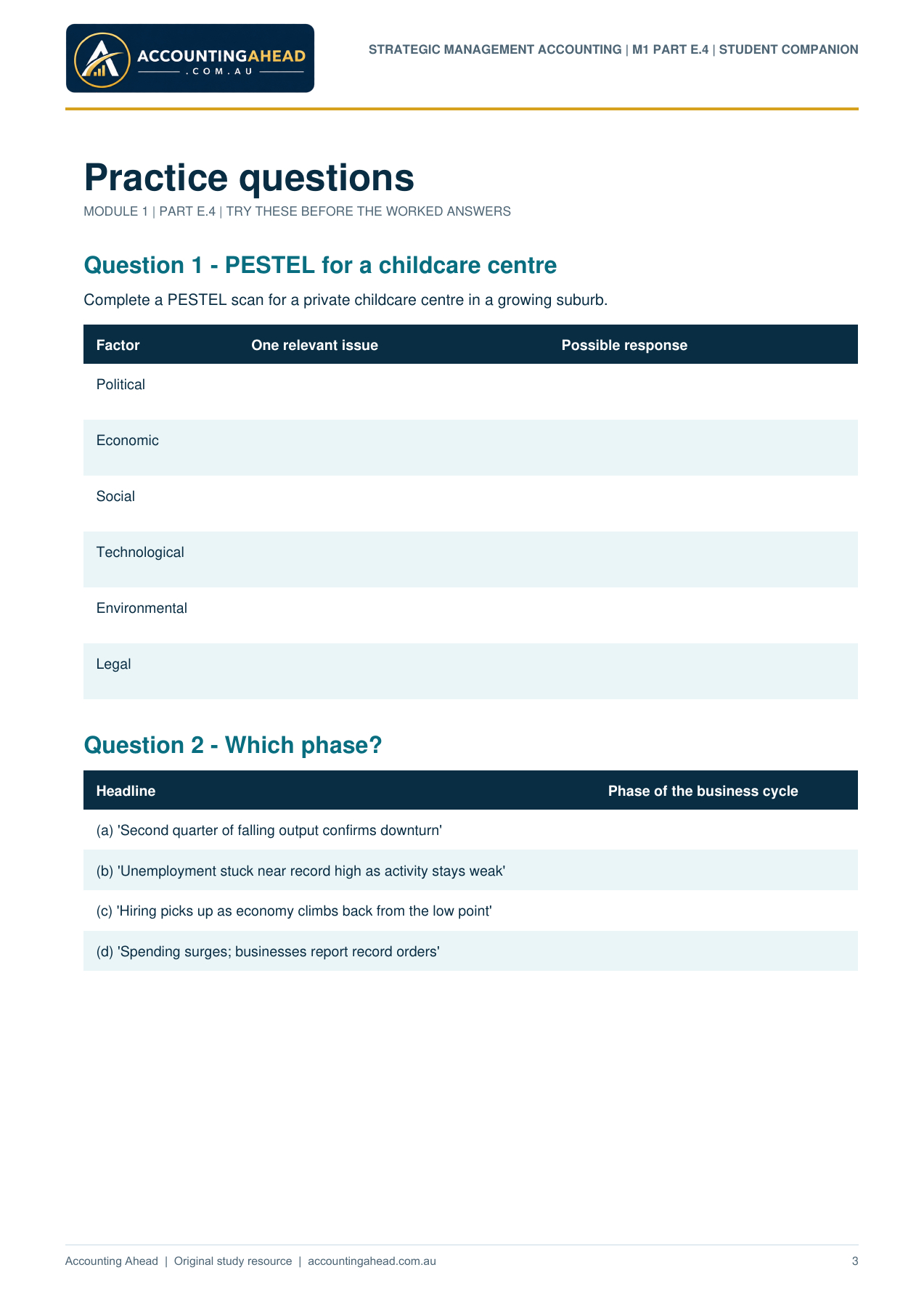
Question 1 - PESTEL for a childcare centre
Complete a PESTEL scan for a private childcare centre in a growing suburb.
Factor One relevant issue Possible response
Political
Economic
Social
Technological
Environmental
Legal
Question 2 - Which phase?
Headline Phase of the business cycle
(a) 'Second quarter of falling output confirms downturn'
(b) 'Unemployment stuck near record high as activity stays weak'
(c) 'Hiring picks up as economy climbs back from the low point'
(d) 'Spending surges; businesses report record orders'
STRATEGIC MANAGEMENT ACCOUNTING | M1 PART E.4 | STUDENT COMPANION
3
Accounting Ahead | Original study resource | accountingahead.com.au
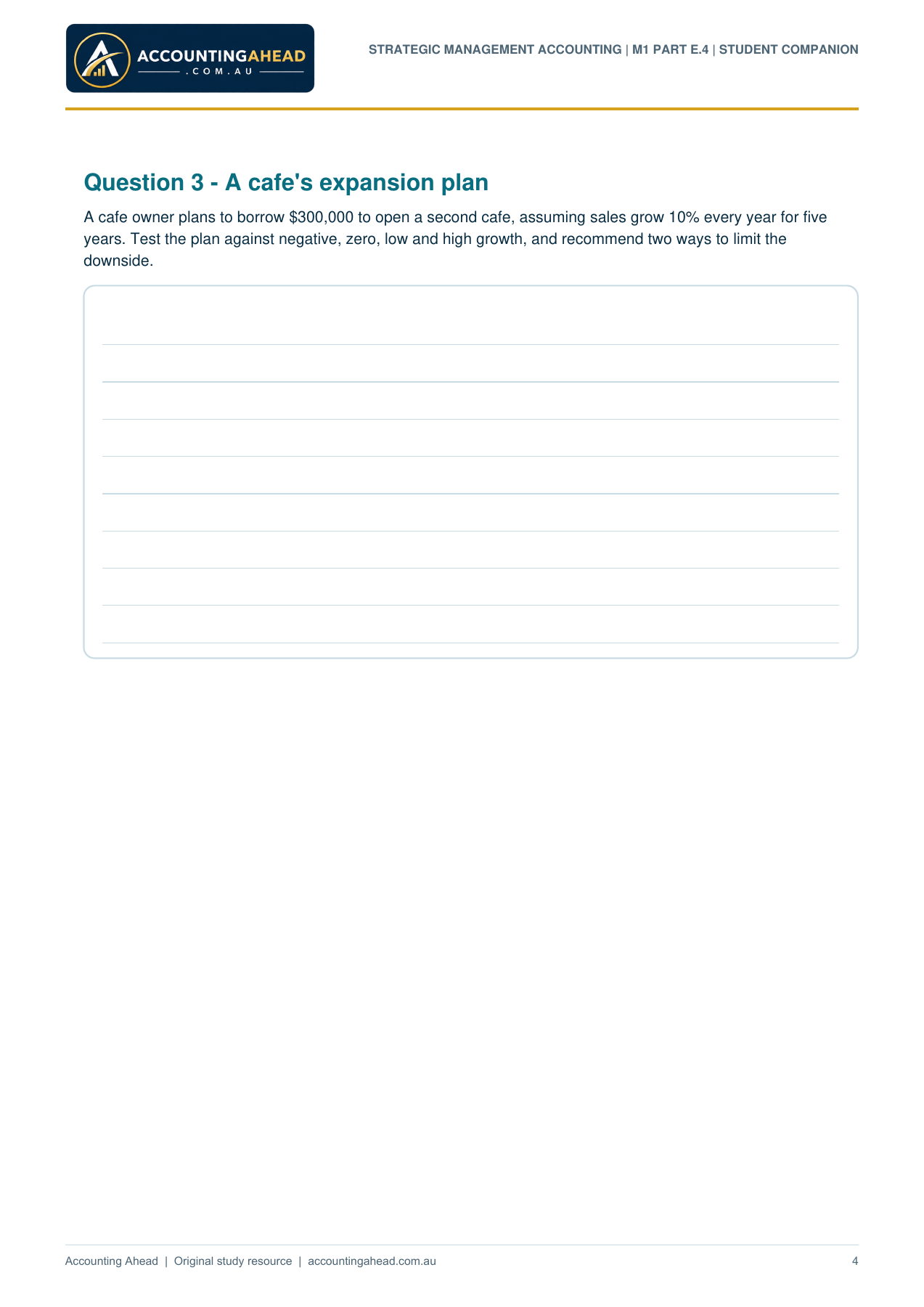
Question 3 - A cafe's expansion plan
A cafe owner plans to borrow $300,000 to open a second cafe, assuming sales grow 10% every year for five
years. Test the plan against negative, zero, low and high growth, and recommend two ways to limit the
downside.
STRATEGIC MANAGEMENT ACCOUNTING | M1 PART E.4 | STUDENT COMPANION
4
Accounting Ahead | Original study resource | accountingahead.com.au
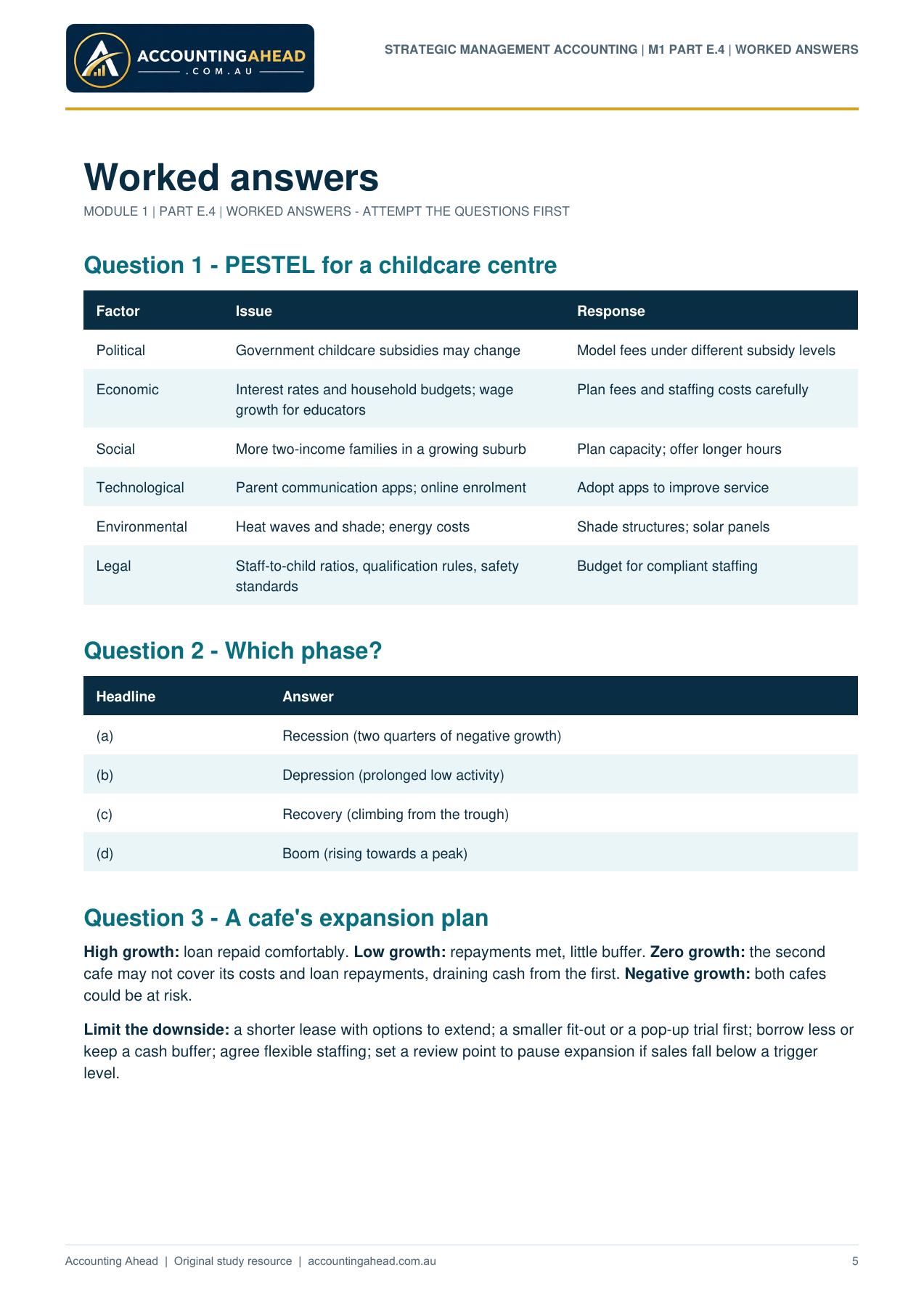
Worked answers
MODULE 1 | PART E.4 | WORKED ANSWERS - ATTEMPT THE QUESTIONS FIRST
Question 1 - PESTEL for a childcare centre
Factor Issue Response
Political Government childcare subsidies may change Model fees under different subsidy levels
Economic Interest rates and household budgets; wage
growth for educators
Plan fees and staffing costs carefully
Social More two-income families in a growing suburb Plan capacity; offer longer hours
Technological Parent communication apps; online enrolment Adopt apps to improve service
Environmental Heat waves and shade; energy costs Shade structures; solar panels
Legal Staff-to-child ratios, qualification rules, safety
standards
Budget for compliant staffing
Question 2 - Which phase?
Headline Answer
(a) Recession (two quarters of negative growth)
(b) Depression (prolonged low activity)
(c) Recovery (climbing from the trough)
(d) Boom (rising towards a peak)
Question 3 - A cafe's expansion plan
High growth: loan repaid comfortably. Low growth: repayments met, little buffer. Zero growth: the second
cafe may not cover its costs and loan repayments, draining cash from the first. Negative growth: both cafes
could be at risk.
Limit the downside: a shorter lease with options to extend; a smaller fit-out or a pop-up trial first; borrow less or
keep a cash buffer; agree flexible staffing; set a review point to pause expansion if sales fall below a trigger
level.
STRATEGIC MANAGEMENT ACCOUNTING | M1 PART E.4 | WORKED ANSWERS
5