
Managing stakeholders: power, interest and risk
Printable study notes to use alongside Part A.2.
Read the handout text
Accounting Ahead | Original study resource | accountingahead.com.au
Managing stakeholders: power, interest
and risk
MODULE 2 | PART A.2 | STUDENT COMPANION
Objectives of stakeholder management: anticipate information needs; judge the value the management
accountant can add; assess each stakeholder's importance; assess each stakeholder's power.
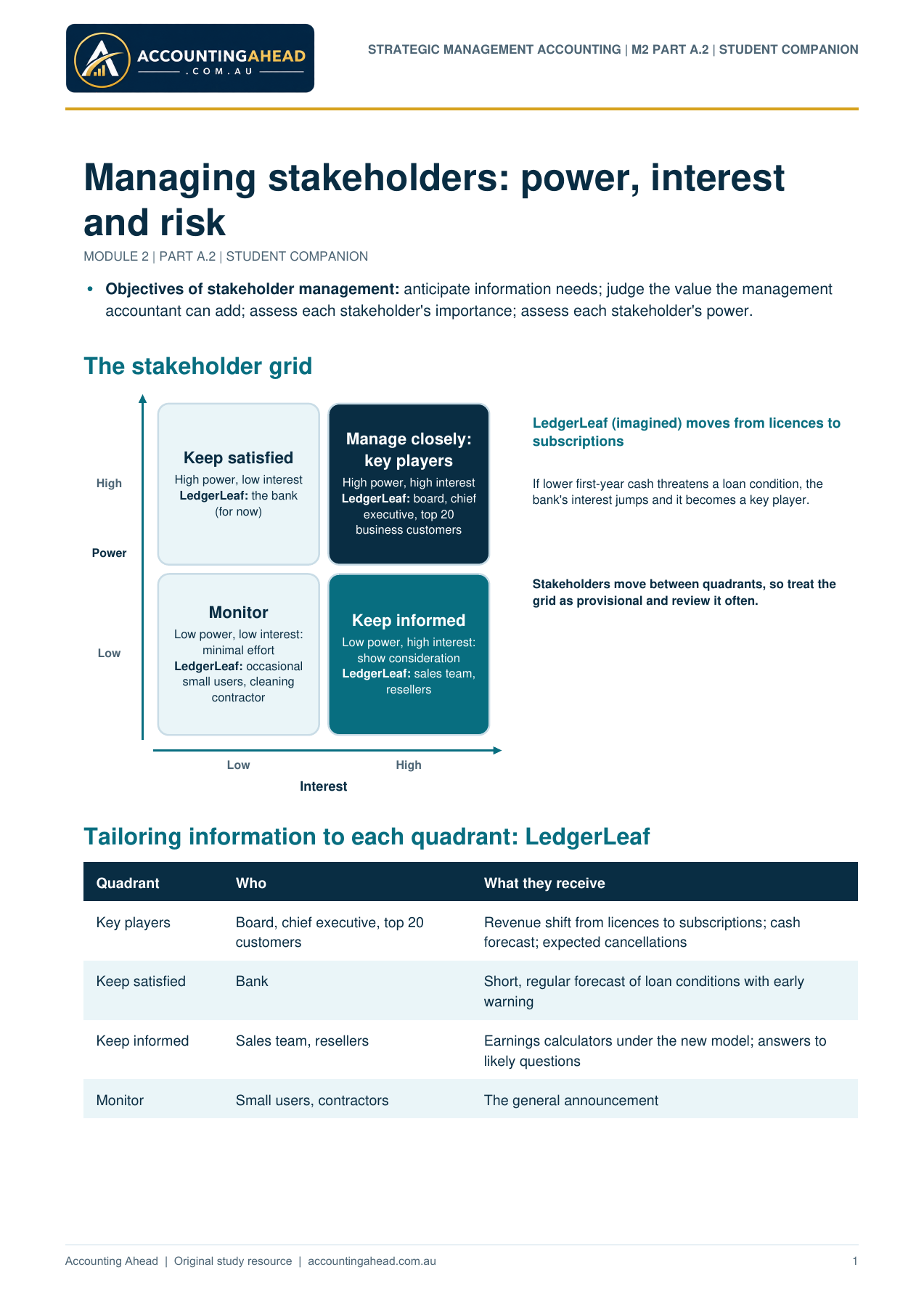
The stakeholder grid
Keep satisfied
High power, low interest
LedgerLeaf: the bank
(for now)
Manage closely:
key players
High power, high interest
LedgerLeaf: board, chief
executive, top 20
business customers
Monitor
Low power, low interest:
minimal effort
LedgerLeaf: occasional
small users, cleaning
contractor
Keep informed
Low power, high interest:
show consideration
LedgerLeaf: sales team,
resellers
Low High
Interest
High
Low
Power
LedgerLeaf (imagined) moves from licences to
subscriptions
If lower first-year cash threatens a loan condition, the
bank's interest jumps and it becomes a key player.
Stakeholders move between quadrants, so treat the
grid as provisional and review it often.
Tailoring information to each quadrant: LedgerLeaf
Quadrant Who What they receive
Key players Board, chief executive, top 20
customers
Revenue shift from licences to subscriptions; cash
forecast; expected cancellations
Keep satisfied Bank Short, regular forecast of loan conditions with early
warning
Keep informed Sales team, resellers Earnings calculators under the new model; answers to
likely questions
Monitor Small users, contractors The general announcement
STRATEGIC MANAGEMENT ACCOUNTING | M2 PART A.2 | STUDENT COMPANION
1
Accounting Ahead | Original study resource | accountingahead.com.au
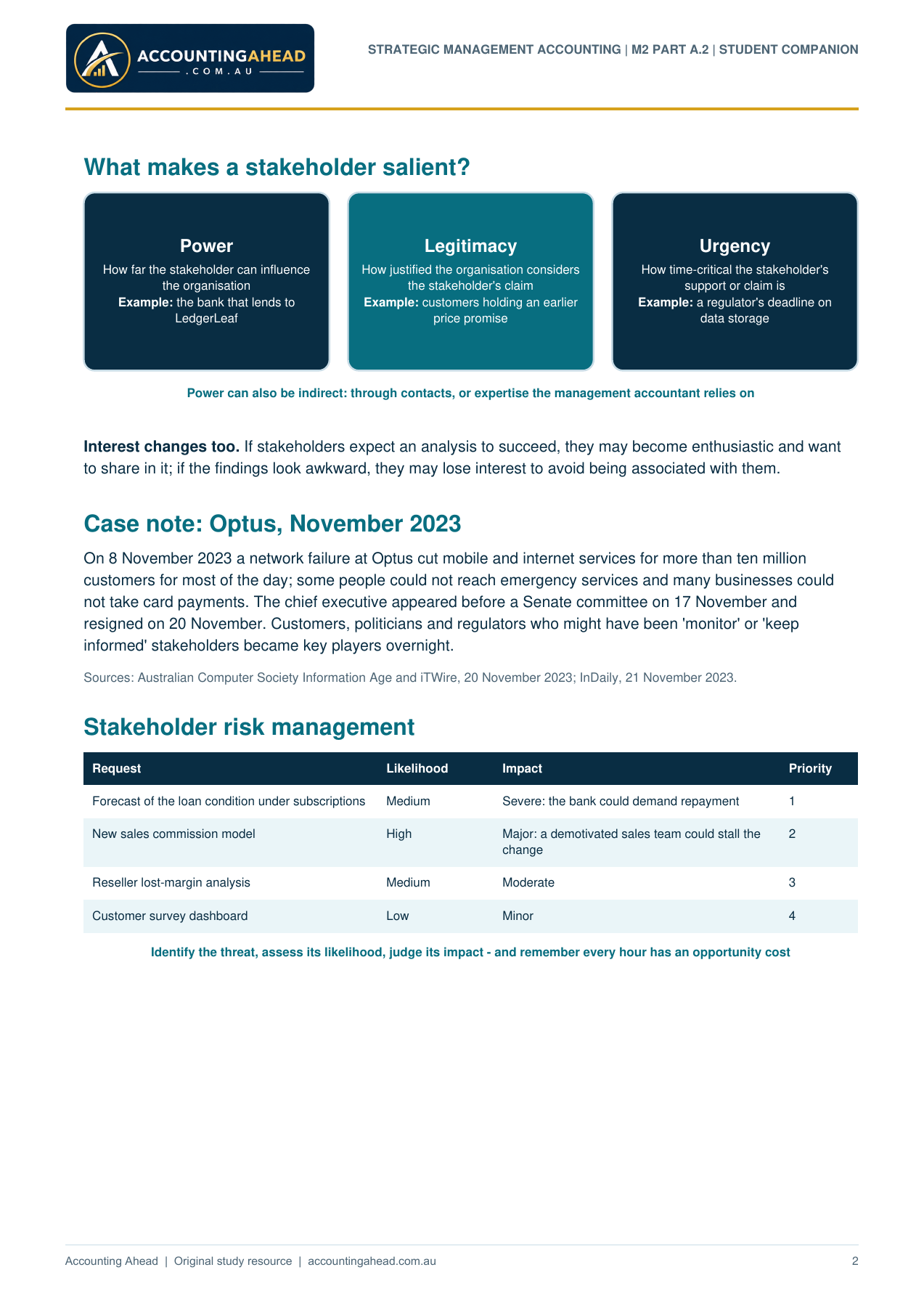
What makes a stakeholder salient?
Power
How far the stakeholder can influence
the organisation
Example: the bank that lends to
LedgerLeaf
Legitimacy
How justified the organisation considers
the stakeholder's claim
Example: customers holding an earlier
price promise
Urgency
How time-critical the stakeholder's
support or claim is
Example: a regulator's deadline on
data storage
Power can also be indirect: through contacts, or expertise the management accountant relies on
Interest changes too. If stakeholders expect an analysis to succeed, they may become enthusiastic and want
to share in it; if the findings look awkward, they may lose interest to avoid being associated with them.
Case note: Optus, November 2023
On 8 November 2023 a network failure at Optus cut mobile and internet services for more than ten million
customers for most of the day; some people could not reach emergency services and many businesses could
not take card payments. The chief executive appeared before a Senate committee on 17 November and
resigned on 20 November. Customers, politicians and regulators who might have been 'monitor' or 'keep
informed' stakeholders became key players overnight.
Sources: Australian Computer Society Information Age and iTWire, 20 November 2023; InDaily, 21 November 2023.
Stakeholder risk management
Request Likelihood Impact Priority
Forecast of the loan condition under subscriptions Medium Severe: the bank could demand repayment 1
New sales commission model High Major: a demotivated sales team could stall the
change
2
Reseller lost-margin analysis Medium Moderate 3
Customer survey dashboard Low Minor 4
Identify the threat, assess its likelihood, judge its impact - and remember every hour has an opportunity cost
STRATEGIC MANAGEMENT ACCOUNTING | M2 PART A.2 | STUDENT COMPANION
2
Accounting Ahead | Original study resource | accountingahead.com.au
Practice questions
MODULE 2 | PART A.2 | TRY THESE BEFORE THE WORKED ANSWERS
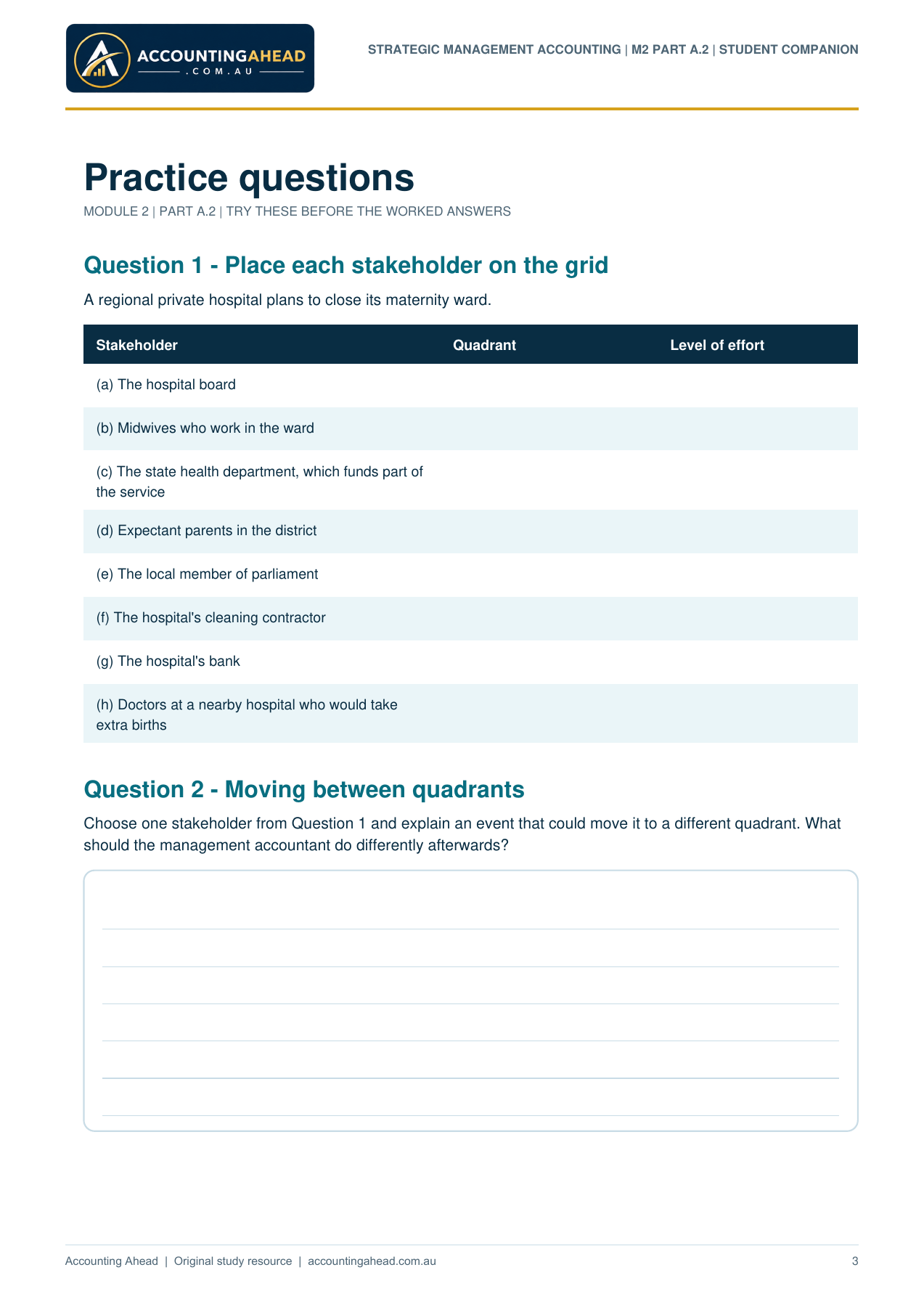
Question 1 - Place each stakeholder on the grid
A regional private hospital plans to close its maternity ward.
Stakeholder Quadrant Level of effort
(a) The hospital board
(b) Midwives who work in the ward
(c) The state health department, which funds part of
the service
(d) Expectant parents in the district
(e) The local member of parliament
(f) The hospital's cleaning contractor
(g) The hospital's bank
(h) Doctors at a nearby hospital who would take
extra births
Question 2 - Moving between quadrants
Choose one stakeholder from Question 1 and explain an event that could move it to a different quadrant. What
should the management accountant do differently afterwards?
STRATEGIC MANAGEMENT ACCOUNTING | M2 PART A.2 | STUDENT COMPANION
3
Accounting Ahead | Original study resource | accountingahead.com.au
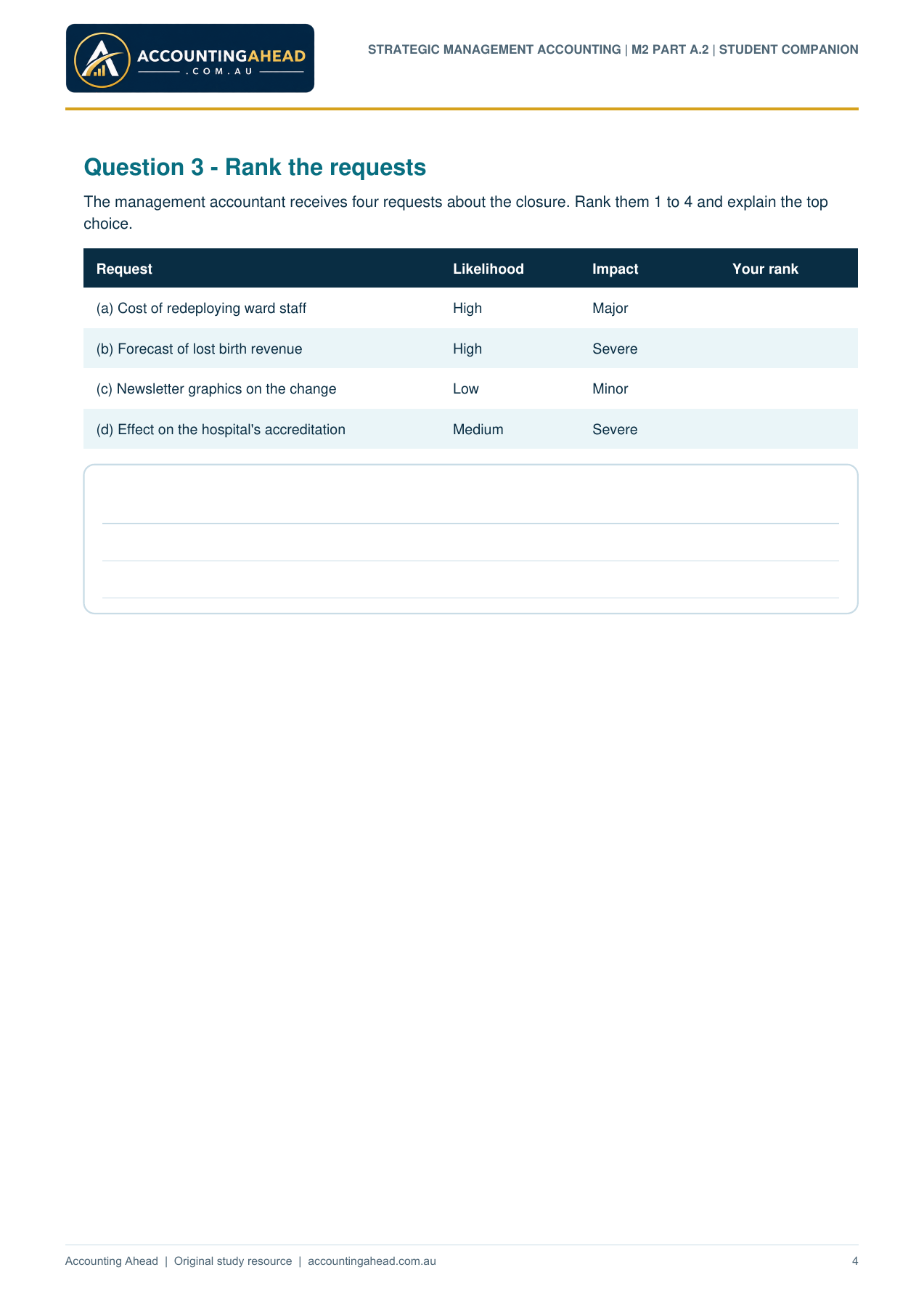
Question 3 - Rank the requests
The management accountant receives four requests about the closure. Rank them 1 to 4 and explain the top
choice.
Request Likelihood Impact Your rank
(a) Cost of redeploying ward staff High Major
(b) Forecast of lost birth revenue High Severe
(c) Newsletter graphics on the change Low Minor
(d) Effect on the hospital's accreditation Medium Severe
STRATEGIC MANAGEMENT ACCOUNTING | M2 PART A.2 | STUDENT COMPANION
4
Accounting Ahead | Original study resource | accountingahead.com.au
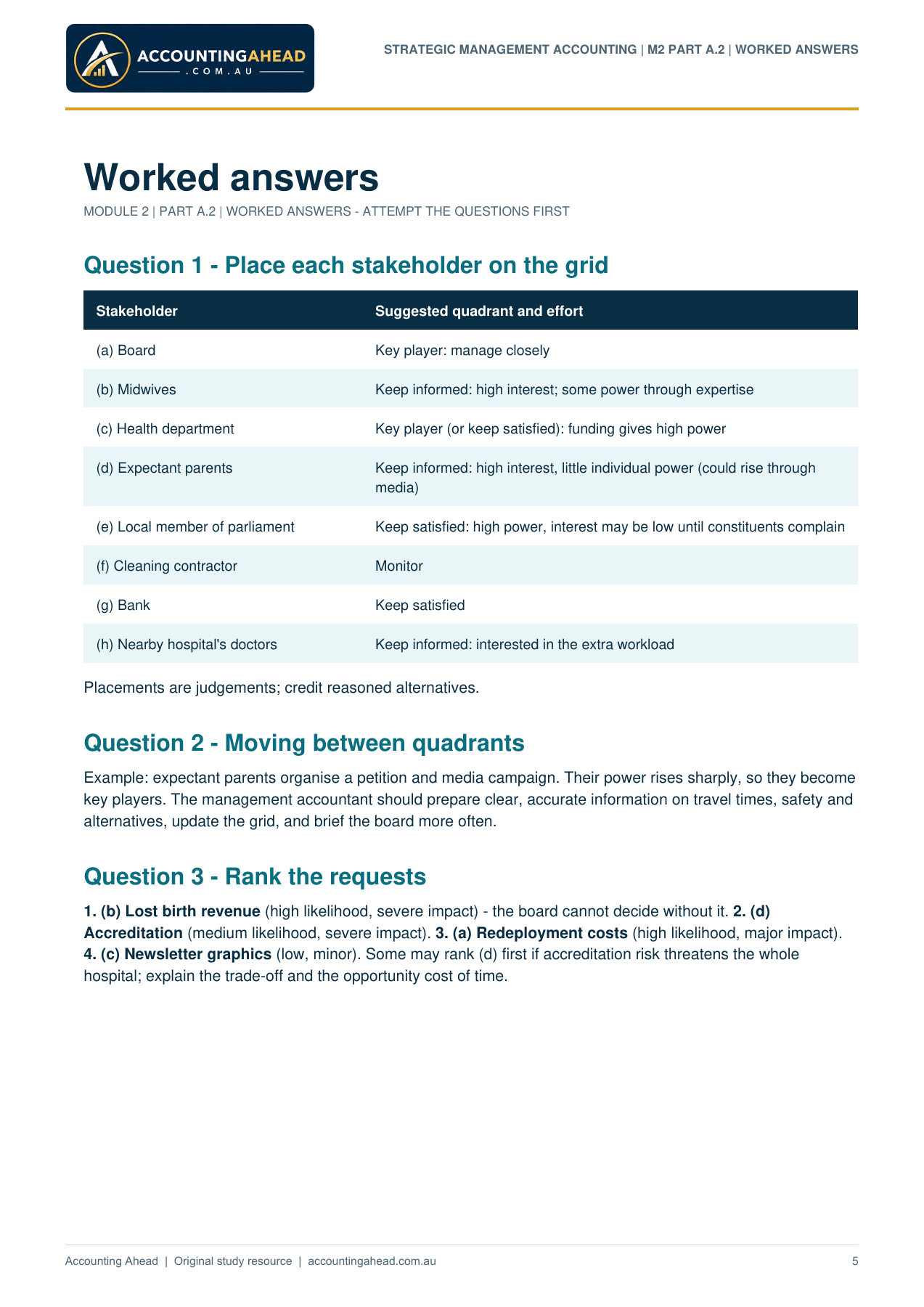
Worked answers
MODULE 2 | PART A.2 | WORKED ANSWERS - ATTEMPT THE QUESTIONS FIRST
Question 1 - Place each stakeholder on the grid
Stakeholder Suggested quadrant and effort
(a) Board Key player: manage closely
(b) Midwives Keep informed: high interest; some power through expertise
(c) Health department Key player (or keep satisfied): funding gives high power
(d) Expectant parents Keep informed: high interest, little individual power (could rise through
media)
(e) Local member of parliament Keep satisfied: high power, interest may be low until constituents complain
(f) Cleaning contractor Monitor
(g) Bank Keep satisfied
(h) Nearby hospital's doctors Keep informed: interested in the extra workload
Placements are judgements; credit reasoned alternatives.
Question 2 - Moving between quadrants
Example: expectant parents organise a petition and media campaign. Their power rises sharply, so they become
key players. The management accountant should prepare clear, accurate information on travel times, safety and
alternatives, update the grid, and brief the board more often.
Question 3 - Rank the requests
1. (b) Lost birth revenue (high likelihood, severe impact) - the board cannot decide without it. 2. (d)
Accreditation (medium likelihood, severe impact). 3. (a) Redeployment costs (high likelihood, major impact).
4. (c) Newsletter graphics (low, minor). Some may rank (d) first if accreditation risk threatens the whole
hospital; explain the trade-off and the opportunity cost of time.
STRATEGIC MANAGEMENT ACCOUNTING | M2 PART A.2 | WORKED ANSWERS
5