
Linking information to strategy as a trusted partner
Printable study notes to use alongside Part C.2.
Read the handout text
Accounting Ahead | Original study resource | accountingahead.com.au
Linking information to strategy as a trusted
partner
MODULE 2 | PART C.2 | STUDENT COMPANION
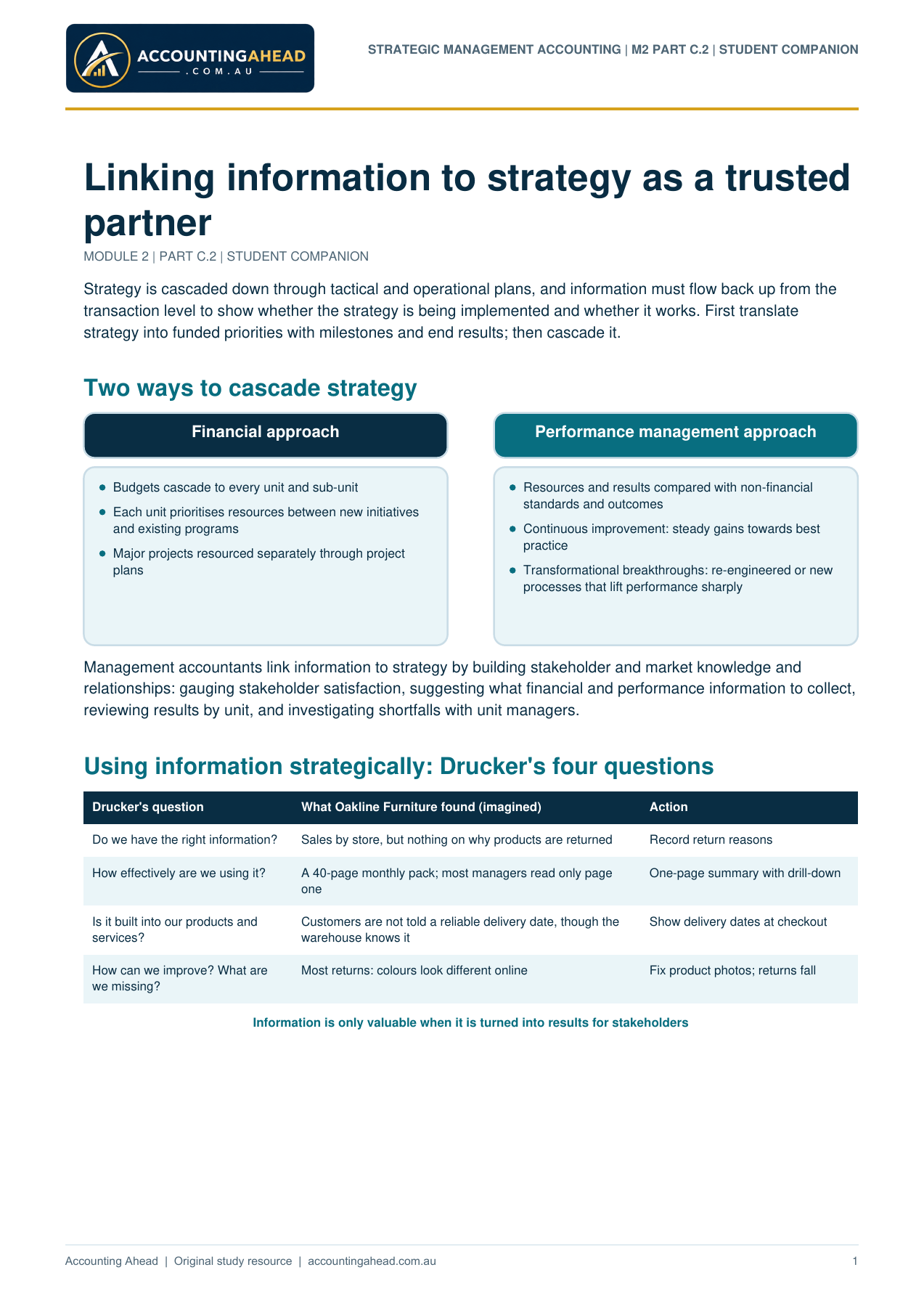
Strategy is cascaded down through tactical and operational plans, and information must flow back up from the
transaction level to show whether the strategy is being implemented and whether it works. First translate
strategy into funded priorities with milestones and end results; then cascade it.
Two ways to cascade strategy
Financial approach
Budgets cascade to every unit and sub-unit
Each unit prioritises resources between new initiatives
and existing programs
Major projects resourced separately through project
plans
Performance management approach
Resources and results compared with non-financial
standards and outcomes
Continuous improvement: steady gains towards best
practice
Transformational breakthroughs: re-engineered or new
processes that lift performance sharply
Management accountants link information to strategy by building stakeholder and market knowledge and
relationships: gauging stakeholder satisfaction, suggesting what financial and performance information to collect,
reviewing results by unit, and investigating shortfalls with unit managers.
Using information strategically: Drucker's four questions
Drucker's question What Oakline Furniture found (imagined) Action
Do we have the right information? Sales by store, but nothing on why products are returned Record return reasons
How effectively are we using it? A 40-page monthly pack; most managers read only page
one
One-page summary with drill-down
Is it built into our products and
services?
Customers are not told a reliable delivery date, though the
warehouse knows it
Show delivery dates at checkout
How can we improve? What are
we missing?
Most returns: colours look different online Fix product photos; returns fall
Information is only valuable when it is turned into results for stakeholders
STRATEGIC MANAGEMENT ACCOUNTING | M2 PART C.2 | STUDENT COMPANION
1
Accounting Ahead | Original study resource | accountingahead.com.au
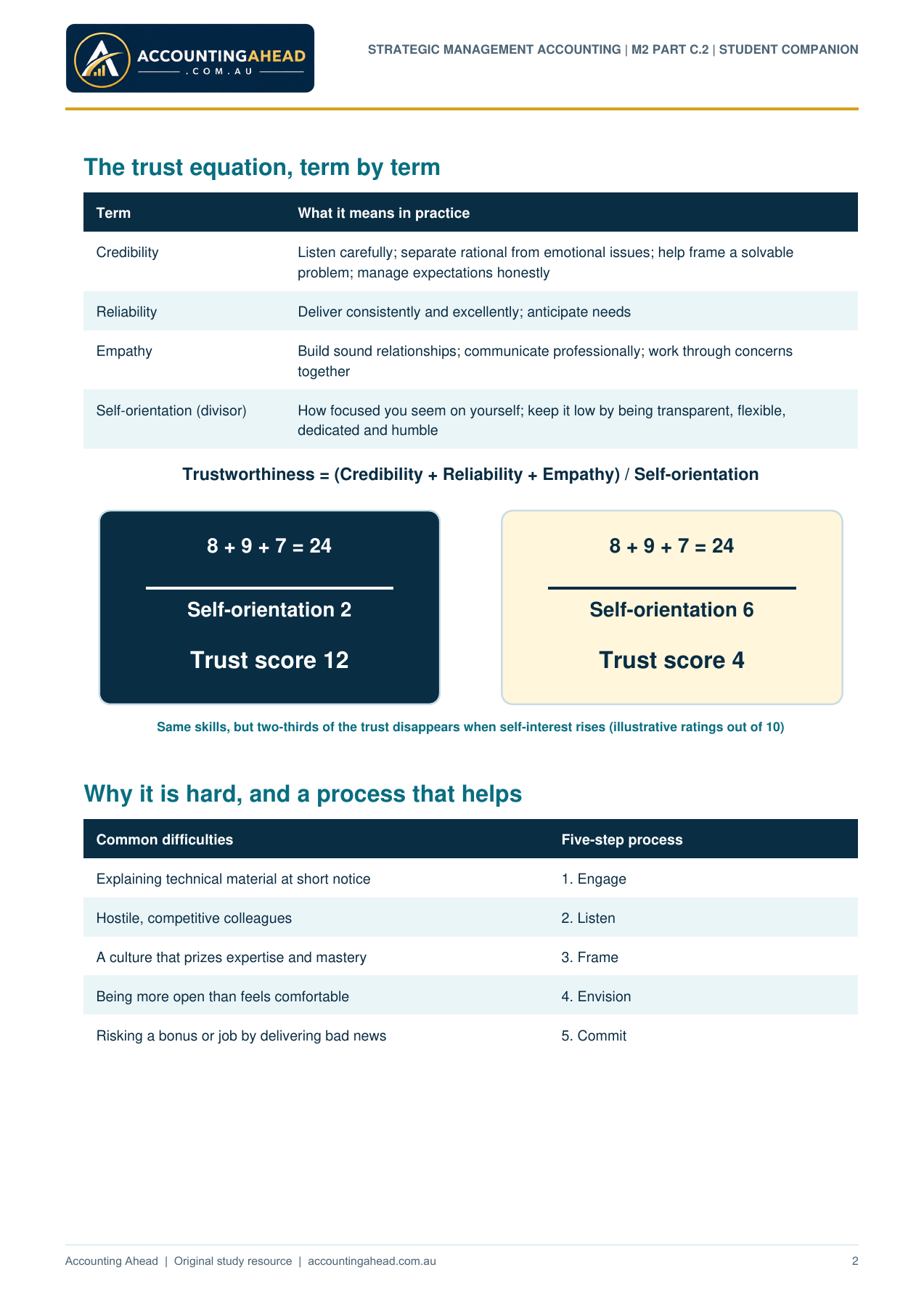
The trust equation, term by term
Term What it means in practice
Credibility Listen carefully; separate rational from emotional issues; help frame a solvable
problem; manage expectations honestly
Reliability Deliver consistently and excellently; anticipate needs
Empathy Build sound relationships; communicate professionally; work through concerns
together
Self-orientation (divisor) How focused you seem on yourself; keep it low by being transparent, flexible,
dedicated and humble
Trustworthiness = (Credibility + Reliability + Empathy) / Self-orientation
8 + 9 + 7 = 24
Self-orientation 2
Trust score 12
8 + 9 + 7 = 24
Self-orientation 6
Trust score 4
Same skills, but two-thirds of the trust disappears when self-interest rises (illustrative ratings out of 10)
Why it is hard, and a process that helps
Common difficulties Five-step process
Explaining technical material at short notice 1. Engage
Hostile, competitive colleagues 2. Listen
A culture that prizes expertise and mastery 3. Frame
Being more open than feels comfortable 4. Envision
Risking a bonus or job by delivering bad news 5. Commit
STRATEGIC MANAGEMENT ACCOUNTING | M2 PART C.2 | STUDENT COMPANION
2
Accounting Ahead | Original study resource | accountingahead.com.au
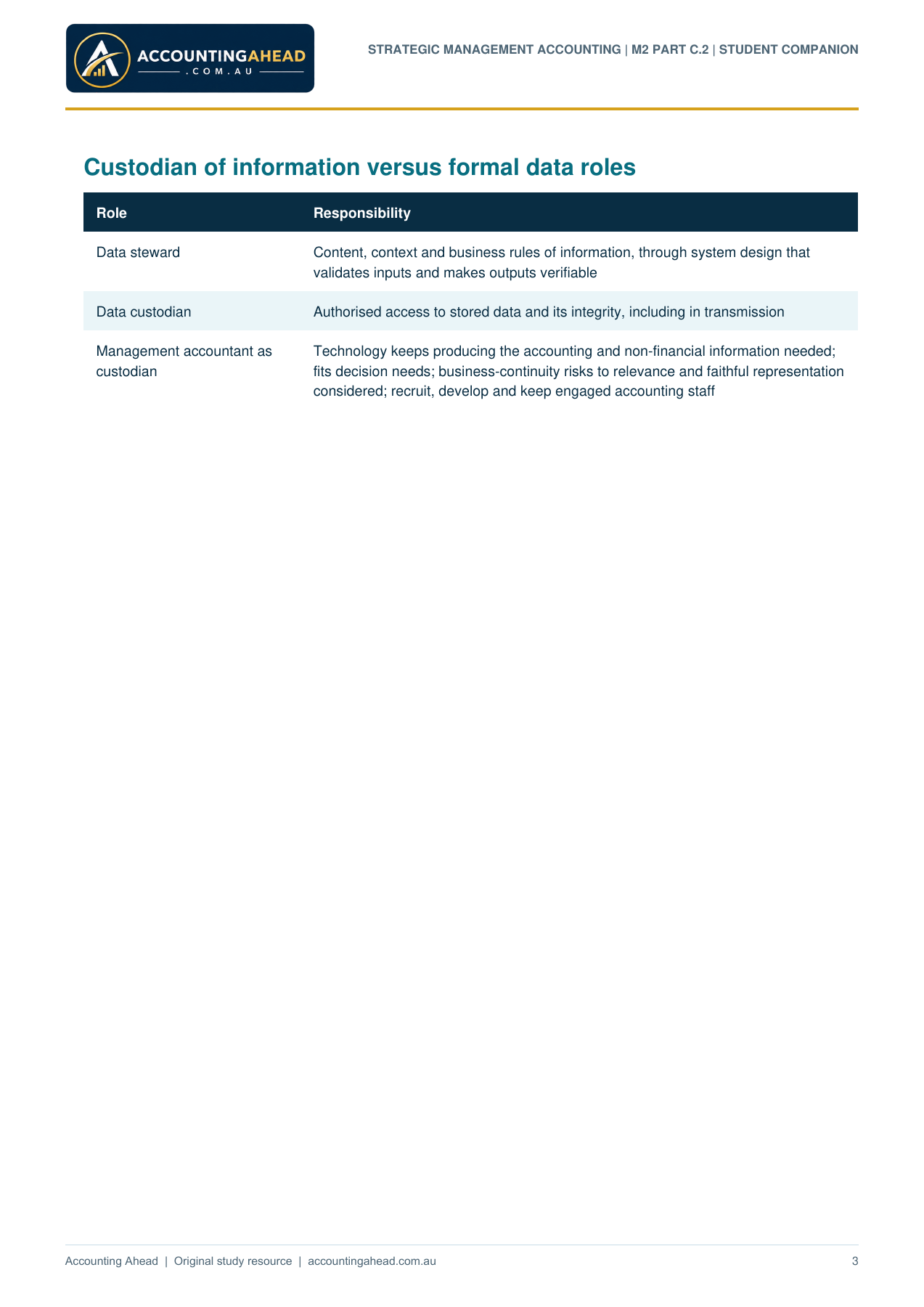
Custodian of information versus formal data roles
Role Responsibility
Data steward Content, context and business rules of information, through system design that
validates inputs and makes outputs verifiable
Data custodian Authorised access to stored data and its integrity, including in transmission
Management accountant as
custodian
Technology keeps producing the accounting and non-financial information needed;
fits decision needs; business-continuity risks to relevance and faithful representation
considered; recruit, develop and keep engaged accounting staff
STRATEGIC MANAGEMENT ACCOUNTING | M2 PART C.2 | STUDENT COMPANION
3
Accounting Ahead | Original study resource | accountingahead.com.au
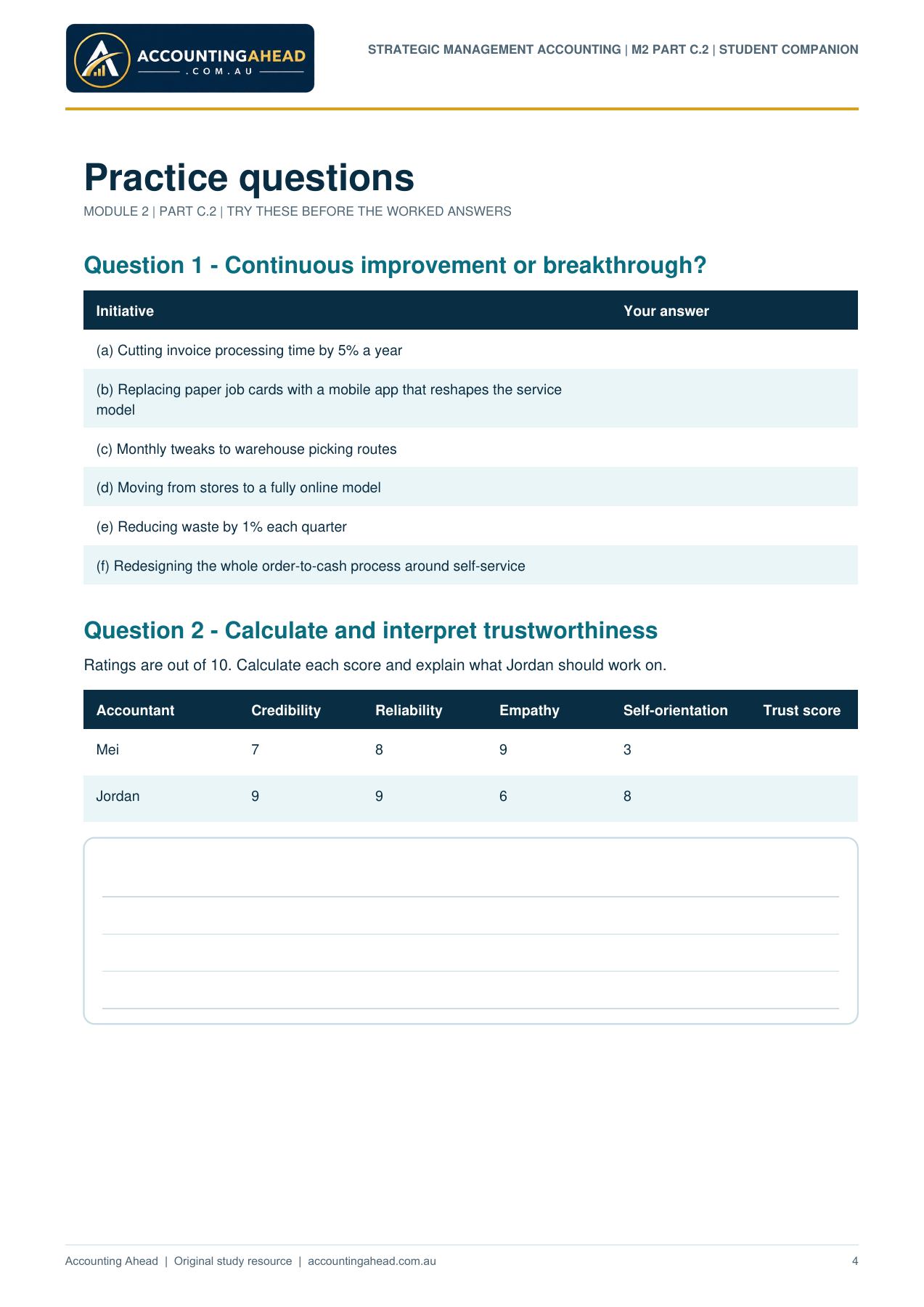
Practice questions
MODULE 2 | PART C.2 | TRY THESE BEFORE THE WORKED ANSWERS
Question 1 - Continuous improvement or breakthrough?
Initiative Your answer
(a) Cutting invoice processing time by 5% a year
(b) Replacing paper job cards with a mobile app that reshapes the service
model
(c) Monthly tweaks to warehouse picking routes
(d) Moving from stores to a fully online model
(e) Reducing waste by 1% each quarter
(f) Redesigning the whole order-to-cash process around self-service
Question 2 - Calculate and interpret trustworthiness
Ratings are out of 10. Calculate each score and explain what Jordan should work on.
Accountant Credibility Reliability Empathy Self-orientation Trust score
Mei 7 8 9 3
Jordan 9 9 6 8
STRATEGIC MANAGEMENT ACCOUNTING | M2 PART C.2 | STUDENT COMPANION
4
Accounting Ahead | Original study resource | accountingahead.com.au
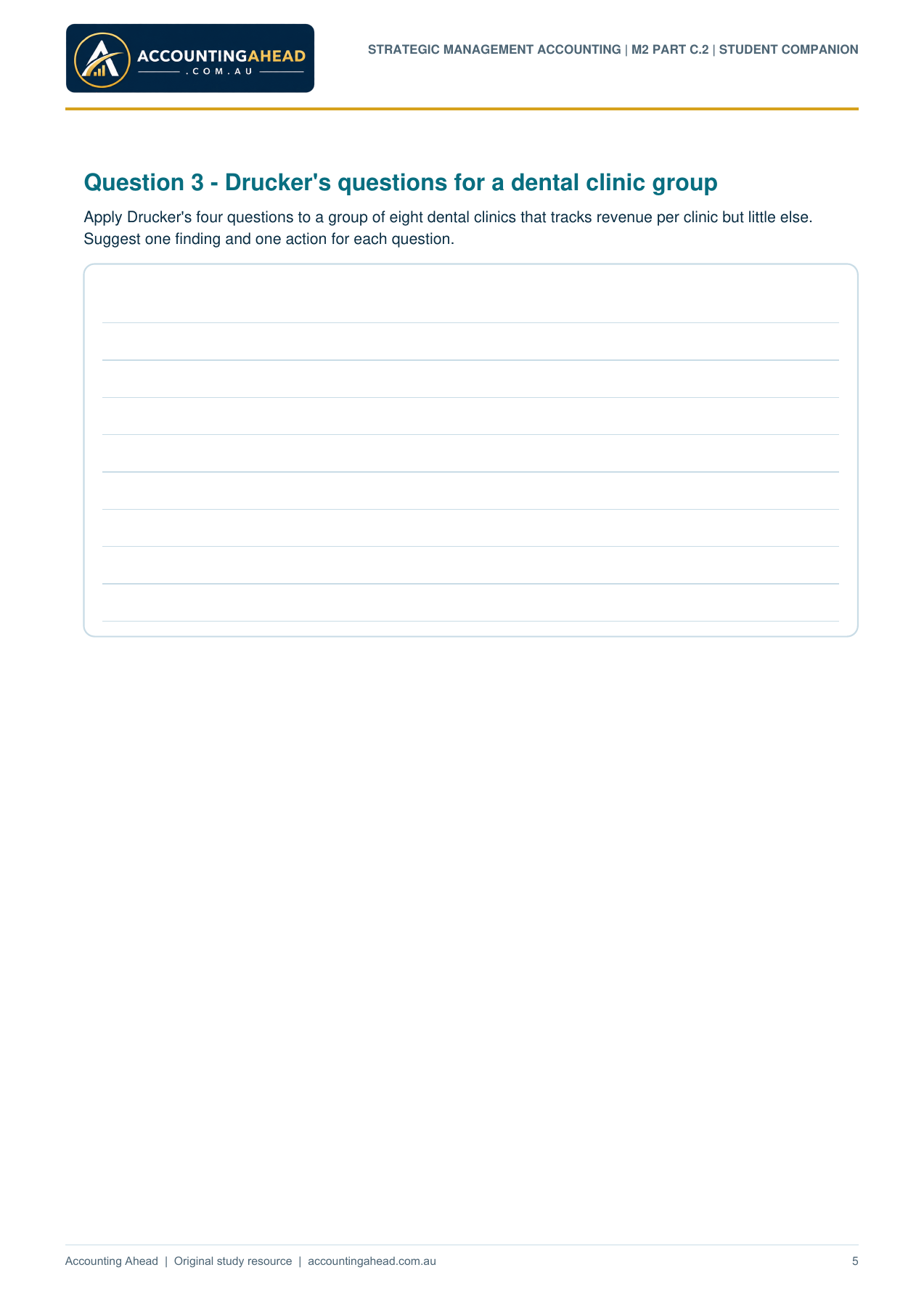
Question 3 - Drucker's questions for a dental clinic group
Apply Drucker's four questions to a group of eight dental clinics that tracks revenue per clinic but little else.
Suggest one finding and one action for each question.
STRATEGIC MANAGEMENT ACCOUNTING | M2 PART C.2 | STUDENT COMPANION
5
Accounting Ahead | Original study resource | accountingahead.com.au
Worked answers
MODULE 2 | PART C.2 | WORKED ANSWERS - ATTEMPT THE QUESTIONS FIRST
Question 1 - Continuous improvement or breakthrough?
Initiative Answer
(a) Continuous improvement
(b) Breakthrough
(c) Continuous improvement
(d) Breakthrough
(e) Continuous improvement
(f) Breakthrough
Question 2 - Calculate and interpret trustworthiness
Mei: (7 + 8 + 9) / 3 = 24 / 3 = 8. Jordan: (9 + 9 + 6) / 8 = 24 / 8 = 3.
Both have the same numerator, but Jordan's high self-orientation cuts trust sharply. Jordan should focus on
others' goals, be transparent about motives, credit colleagues and listen more; lifting empathy would also help.
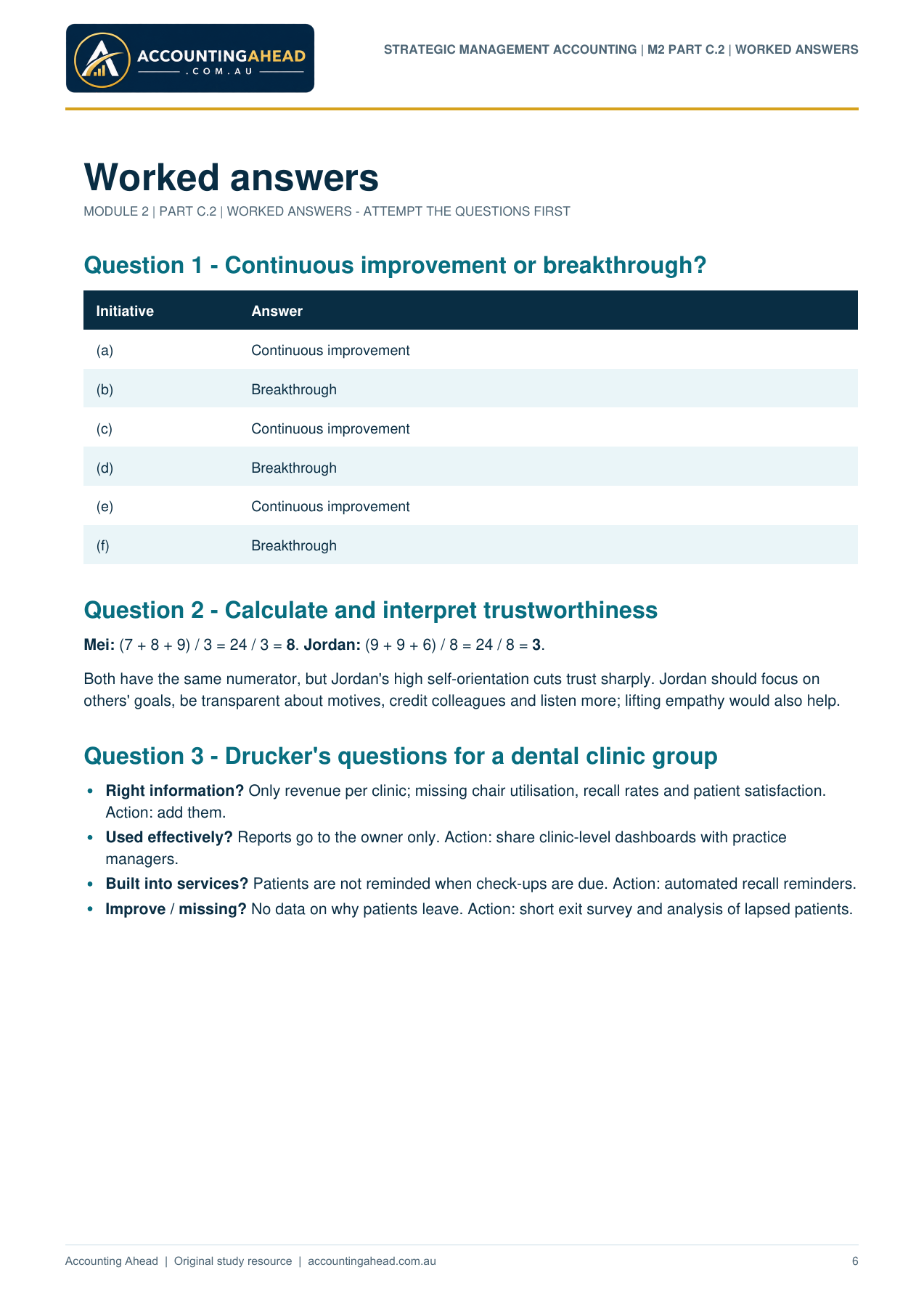
Question 3 - Drucker's questions for a dental clinic group
Right information? Only revenue per clinic; missing chair utilisation, recall rates and patient satisfaction.
Action: add them.
Used effectively? Reports go to the owner only. Action: share clinic-level dashboards with practice
managers.
Built into services? Patients are not reminded when check-ups are due. Action: automated recall reminders.
Improve / missing? No data on why patients leave. Action: short exit survey and analysis of lapsed patients.
STRATEGIC MANAGEMENT ACCOUNTING | M2 PART C.2 | WORKED ANSWERS
6