
The sales, production and materials budgets
Printable study notes to use alongside Part B.1.
Read the handout text
Accounting Ahead | Original study resource | accountingahead.com.au
The sales, production and materials
budgets
MODULE 3 | PART B.1 | STUDENT COMPANION
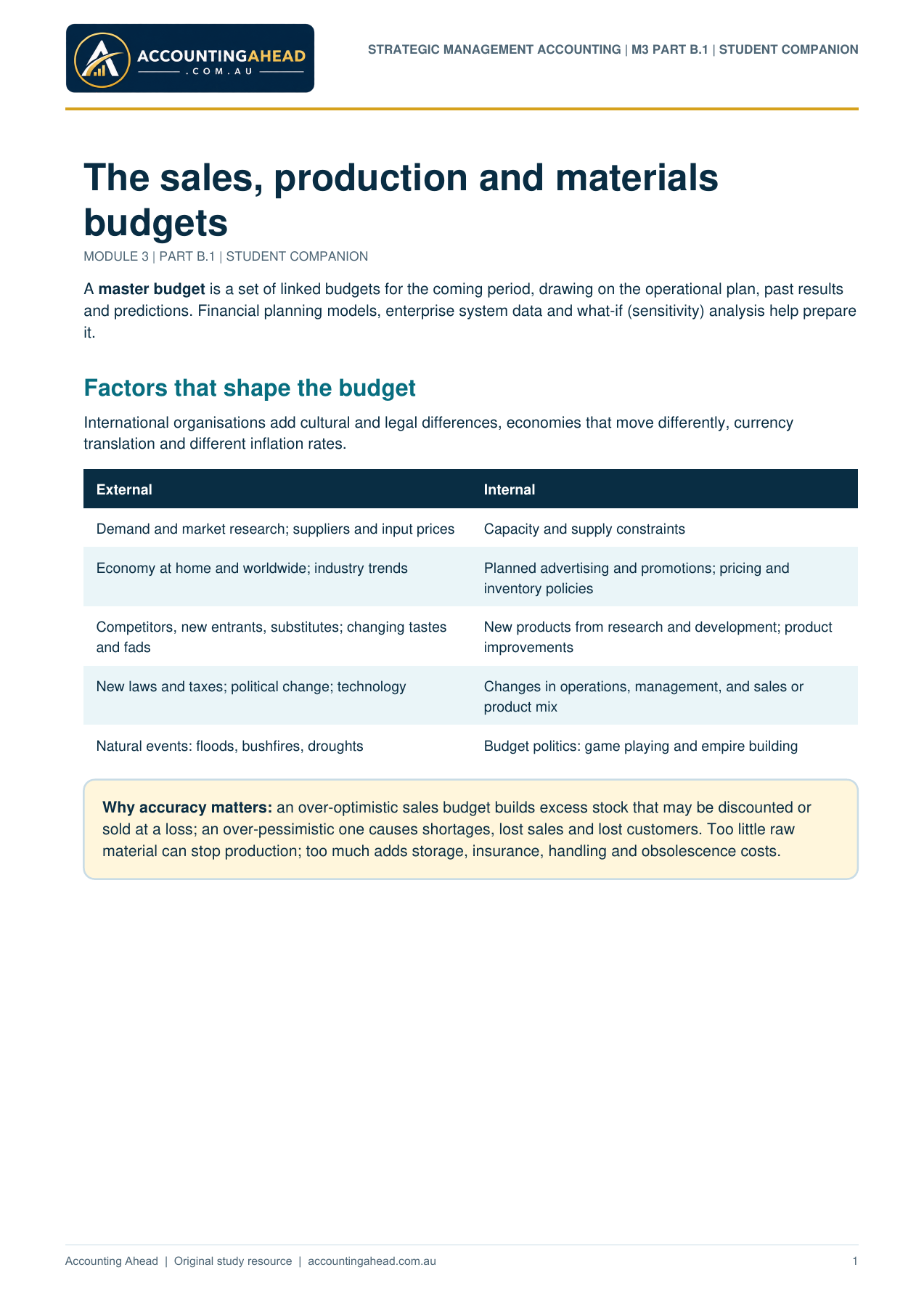
A master budget is a set of linked budgets for the coming period, drawing on the operational plan, past results
and predictions. Financial planning models, enterprise system data and what-if (sensitivity) analysis help prepare
it.
Factors that shape the budget
International organisations add cultural and legal differences, economies that move differently, currency
translation and different inflation rates.
External Internal
Demand and market research; suppliers and input prices Capacity and supply constraints
Economy at home and worldwide; industry trends Planned advertising and promotions; pricing and
inventory policies
Competitors, new entrants, substitutes; changing tastes
and fads
New products from research and development; product
improvements
New laws and taxes; political change; technology Changes in operations, management, and sales or
product mix
Natural events: floods, bushfires, droughts Budget politics: game playing and empire building
Why accuracy matters: an over-optimistic sales budget builds excess stock that may be discounted or
sold at a loss; an over-pessimistic one causes shortages, lost sales and lost customers. Too little raw
material can stop production; too much adds storage, insurance, handling and obsolescence costs.
STRATEGIC MANAGEMENT ACCOUNTING | M3 PART B.1 | STUDENT COMPANION
1
Accounting Ahead | Original study resource | accountingahead.com.au
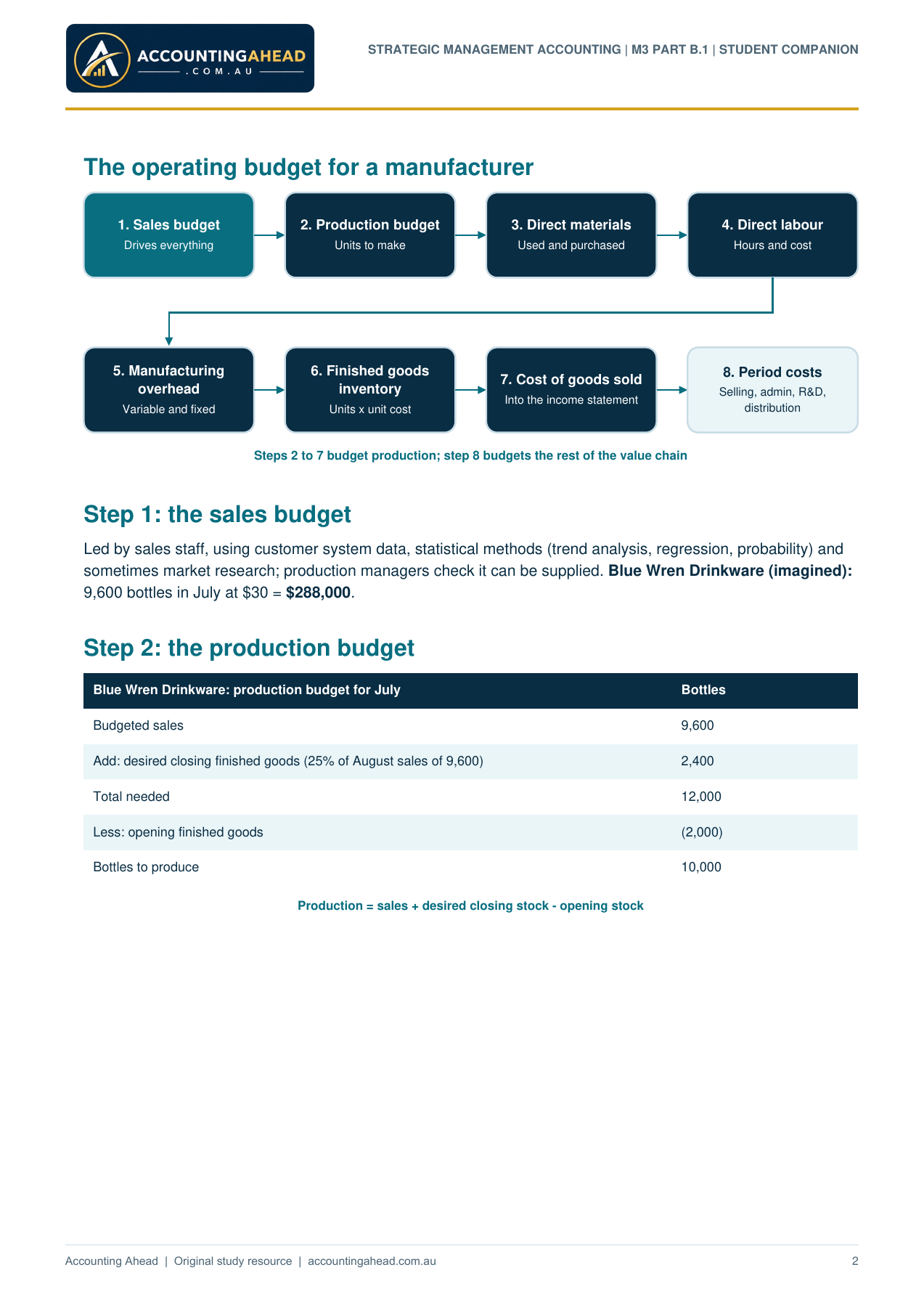
The operating budget for a manufacturer
1. Sales budget
Drives everything
2. Production budget
Units to make
3. Direct materials
Used and purchased
4. Direct labour
Hours and cost
5. Manufacturing
overhead
Variable and fixed
6. Finished goods
inventory
Units x unit cost
7. Cost of goods sold
Into the income statement
8. Period costs
Selling, admin, R&D,
distribution
Steps 2 to 7 budget production; step 8 budgets the rest of the value chain
Step 1: the sales budget
Led by sales staff, using customer system data, statistical methods (trend analysis, regression, probability) and
sometimes market research; production managers check it can be supplied. Blue Wren Drinkware (imagined):
9,600 bottles in July at $30 = $288,000.
Step 2: the production budget
Blue Wren Drinkware: production budget for July Bottles
Budgeted sales 9,600
Add: desired closing finished goods (25% of August sales of 9,600) 2,400
Total needed 12,000
Less: opening finished goods (2,000)
Bottles to produce 10,000
Production = sales + desired closing stock - opening stock
STRATEGIC MANAGEMENT ACCOUNTING | M3 PART B.1 | STUDENT COMPANION
2
Accounting Ahead | Original study resource | accountingahead.com.au
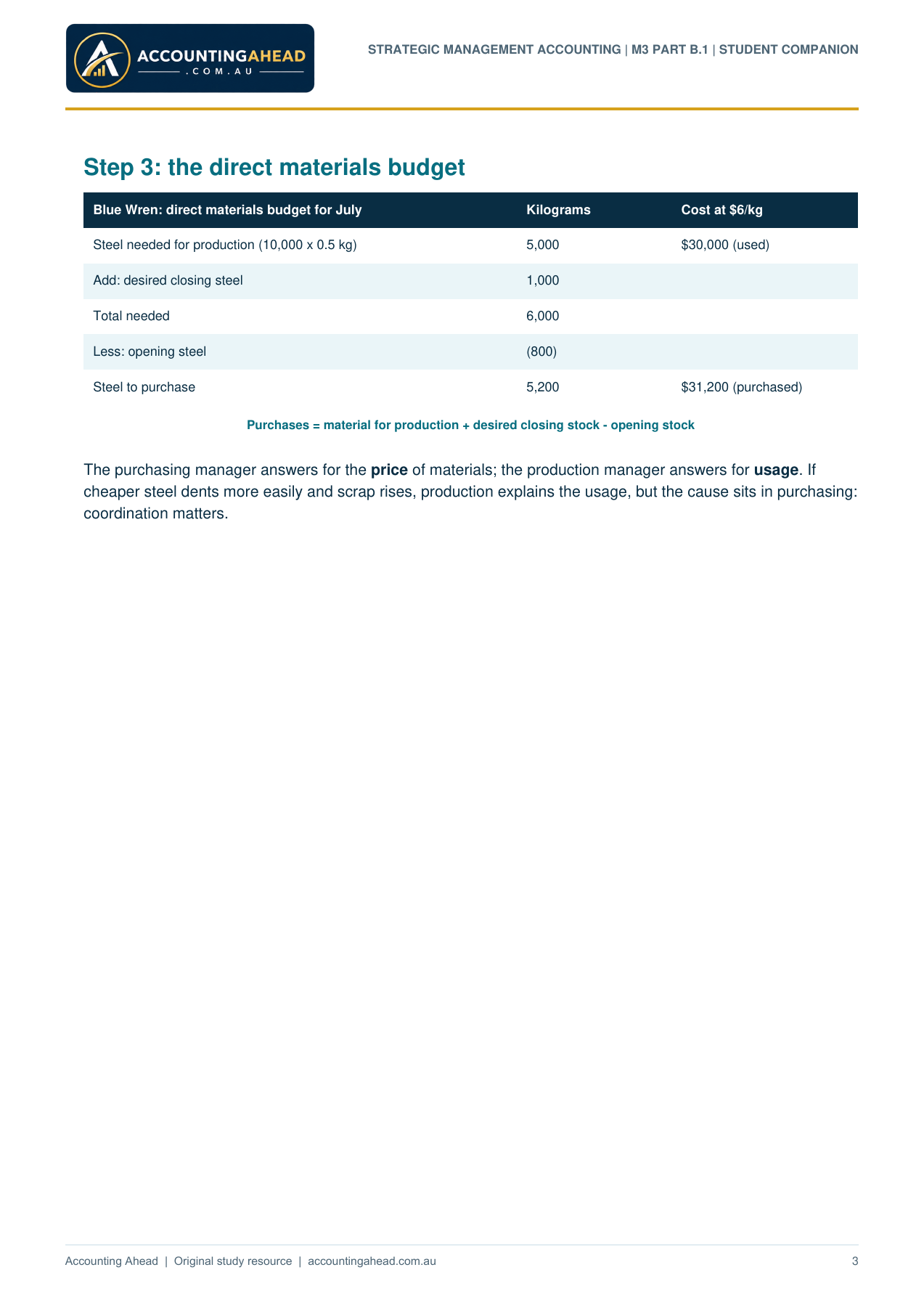
Step 3: the direct materials budget
Blue Wren: direct materials budget for July Kilograms Cost at $6/kg
Steel needed for production (10,000 x 0.5 kg) 5,000 $30,000 (used)
Add: desired closing steel 1,000
Total needed 6,000
Less: opening steel (800)
Steel to purchase 5,200 $31,200 (purchased)
Purchases = material for production + desired closing stock - opening stock
The purchasing manager answers for the price of materials; the production manager answers for usage. If
cheaper steel dents more easily and scrap rises, production explains the usage, but the cause sits in purchasing:
coordination matters.
STRATEGIC MANAGEMENT ACCOUNTING | M3 PART B.1 | STUDENT COMPANION
3
Accounting Ahead | Original study resource | accountingahead.com.au
Practice questions
MODULE 3 | PART B.1 | TRY THESE BEFORE THE WORKED ANSWERS
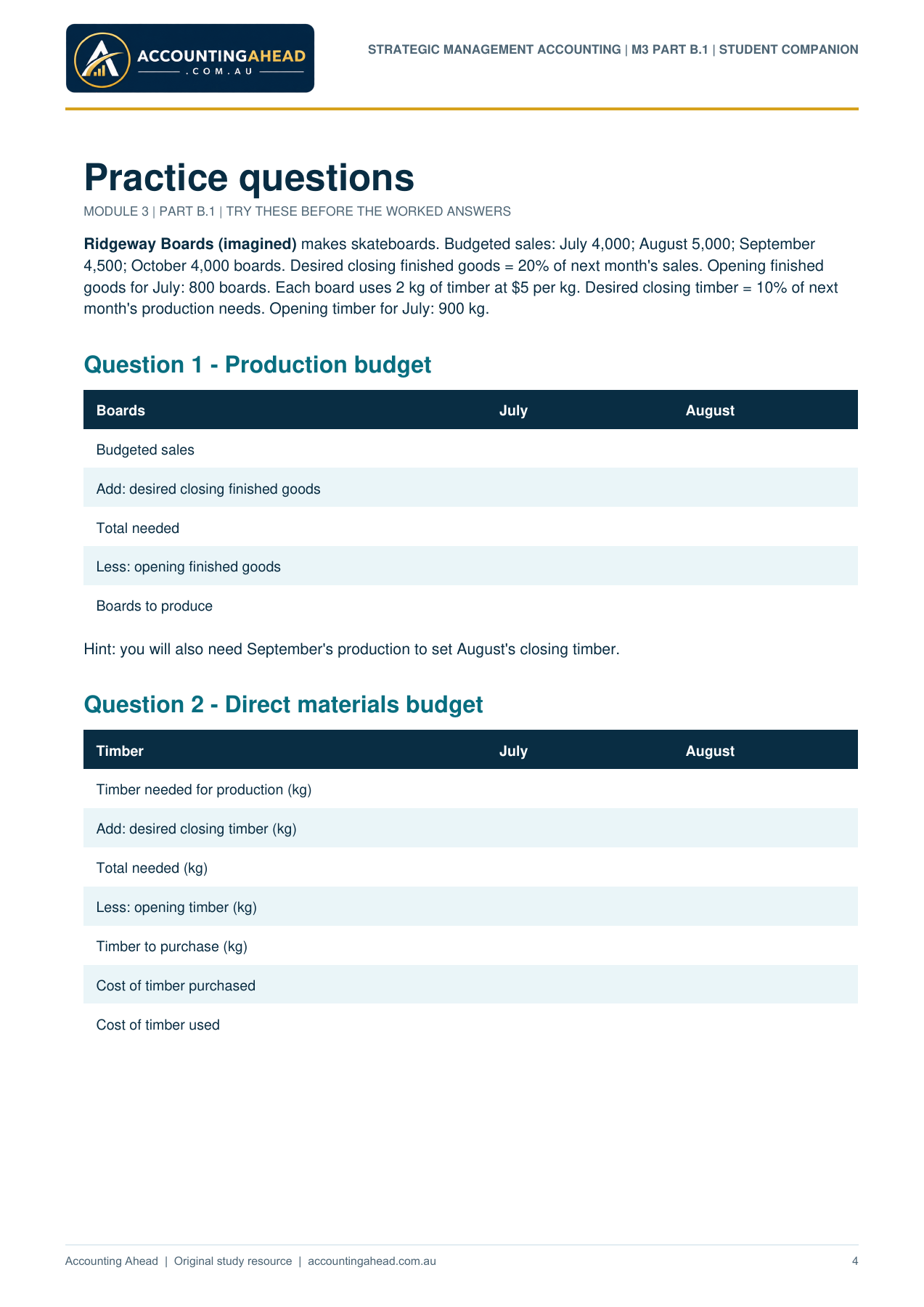
Ridgeway Boards (imagined) makes skateboards. Budgeted sales: July 4,000; August 5,000; September
4,500; October 4,000 boards. Desired closing finished goods = 20% of next month's sales. Opening finished
goods for July: 800 boards. Each board uses 2 kg of timber at $5 per kg. Desired closing timber = 10% of next
month's production needs. Opening timber for July: 900 kg.
Question 1 - Production budget
Boards July August
Budgeted sales
Add: desired closing finished goods
Total needed
Less: opening finished goods
Boards to produce
Hint: you will also need September's production to set August's closing timber.
Question 2 - Direct materials budget
Timber July August
Timber needed for production (kg)
Add: desired closing timber (kg)
Total needed (kg)
Less: opening timber (kg)
Timber to purchase (kg)
Cost of timber purchased
Cost of timber used
STRATEGIC MANAGEMENT ACCOUNTING | M3 PART B.1 | STUDENT COMPANION
4
Accounting Ahead | Original study resource | accountingahead.com.au
Question 3 - Factors for Ridgeway's sales budget
Name four external and four internal factors that should shape Ridgeway's sales budget.
STRATEGIC MANAGEMENT ACCOUNTING | M3 PART B.1 | STUDENT COMPANION
5
Accounting Ahead | Original study resource | accountingahead.com.au
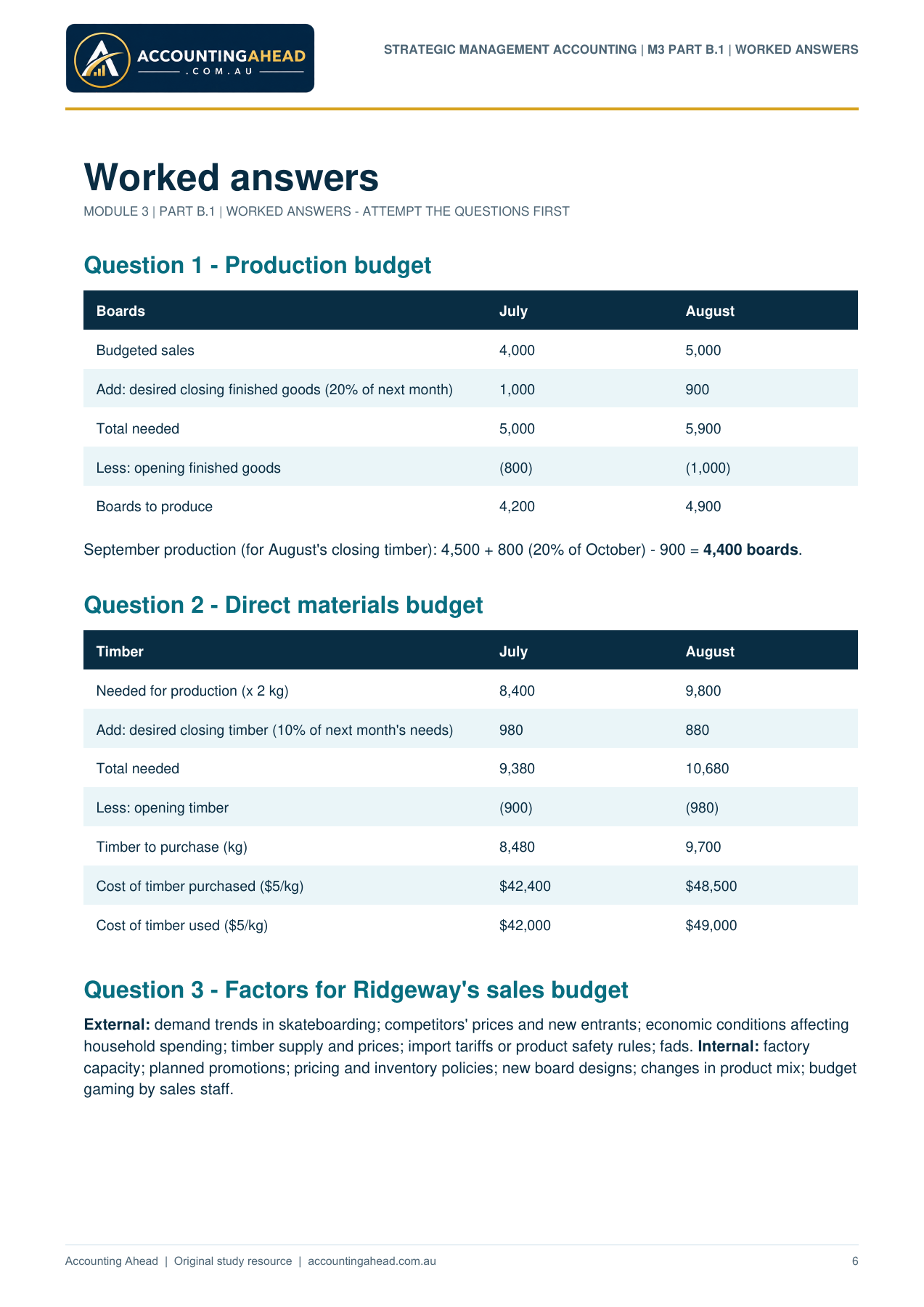
Worked answers
MODULE 3 | PART B.1 | WORKED ANSWERS - ATTEMPT THE QUESTIONS FIRST
Question 1 - Production budget
Boards July August
Budgeted sales 4,000 5,000
Add: desired closing finished goods (20% of next month) 1,000 900
Total needed 5,000 5,900
Less: opening finished goods (800) (1,000)
Boards to produce 4,200 4,900
September production (for August's closing timber): 4,500 + 800 (20% of October) - 900 = 4,400 boards.
Question 2 - Direct materials budget
Timber July August
Needed for production (x 2 kg) 8,400 9,800
Add: desired closing timber (10% of next month's needs) 980 880
Total needed 9,380 10,680
Less: opening timber (900) (980)
Timber to purchase (kg) 8,480 9,700
Cost of timber purchased ($5/kg) $42,400 $48,500
Cost of timber used ($5/kg) $42,000 $49,000
Question 3 - Factors for Ridgeway's sales budget
External: demand trends in skateboarding; competitors' prices and new entrants; economic conditions affecting
household spending; timber supply and prices; import tariffs or product safety rules; fads. Internal: factory
capacity; planned promotions; pricing and inventory policies; new board designs; changes in product mix; budget
gaming by sales staff.
STRATEGIC MANAGEMENT ACCOUNTING | M3 PART B.1 | WORKED ANSWERS
6