
Interpreting variances and taking action
Printable study notes to use alongside Part C.3.
Read the handout text
Accounting Ahead | Original study resource | accountingahead.com.au
Interpreting variances and taking action
MODULE 3 | PART C.3 | STUDENT COMPANION
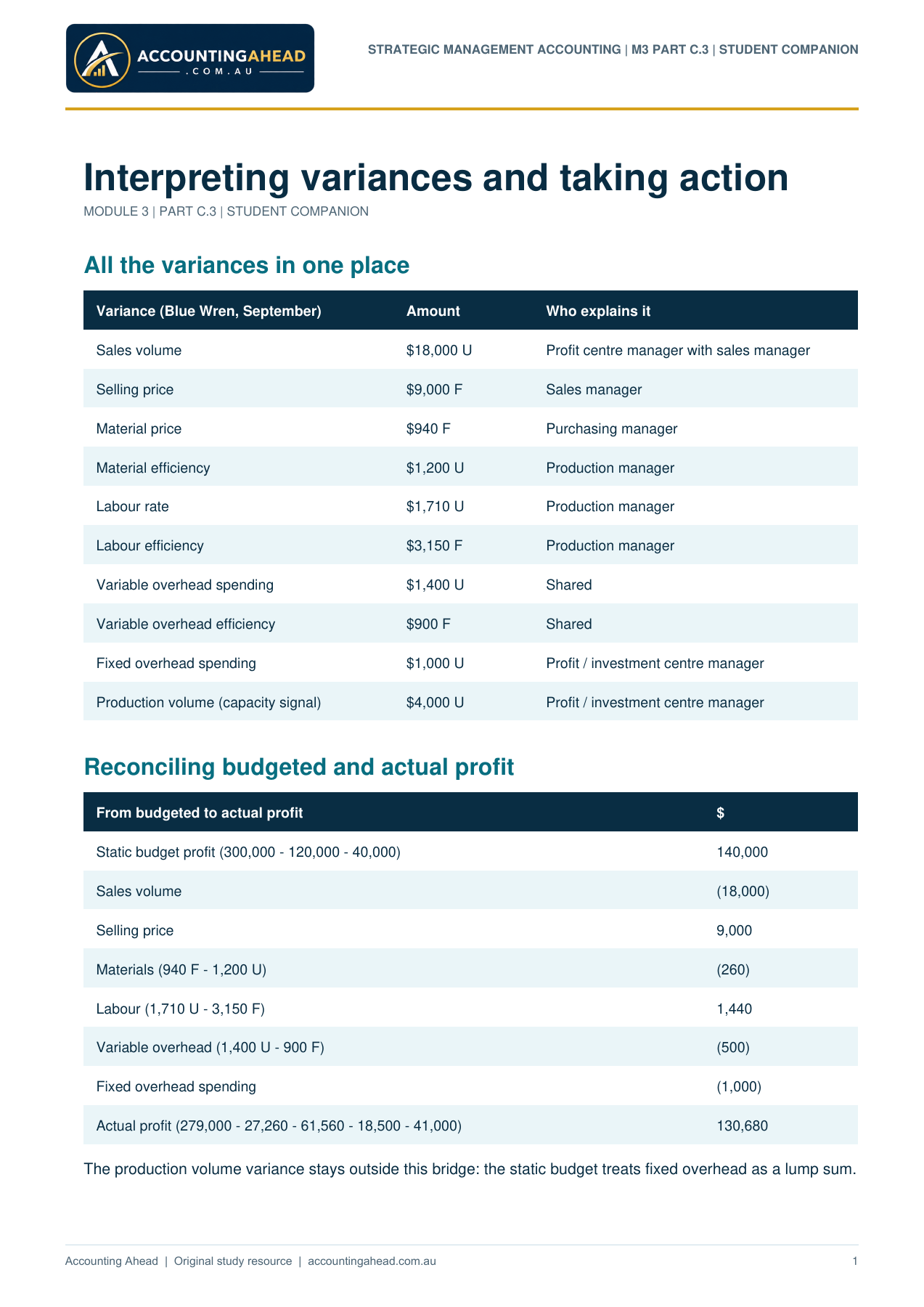
All the variances in one place
Variance (Blue Wren, September) Amount Who explains it
Sales volume $18,000 U Profit centre manager with sales manager
Selling price $9,000 F Sales manager
Material price $940 F Purchasing manager
Material efficiency $1,200 U Production manager
Labour rate $1,710 U Production manager
Labour efficiency $3,150 F Production manager
Variable overhead spending $1,400 U Shared
Variable overhead efficiency $900 F Shared
Fixed overhead spending $1,000 U Profit / investment centre manager
Production volume (capacity signal) $4,000 U Profit / investment centre manager
Reconciling budgeted and actual profit
From budgeted to actual profit $
Static budget profit (300,000 - 120,000 - 40,000) 140,000
Sales volume (18,000)
Selling price 9,000
Materials (940 F - 1,200 U) (260)
Labour (1,710 U - 3,150 F) 1,440
Variable overhead (1,400 U - 900 F) (500)
Fixed overhead spending (1,000)
Actual profit (279,000 - 27,260 - 61,560 - 18,500 - 41,000) 130,680
The production volume variance stays outside this bridge: the static budget treats fixed overhead as a lump sum.
STRATEGIC MANAGEMENT ACCOUNTING | M3 PART C.3 | STUDENT COMPANION
1
Accounting Ahead | Original study resource | accountingahead.com.au
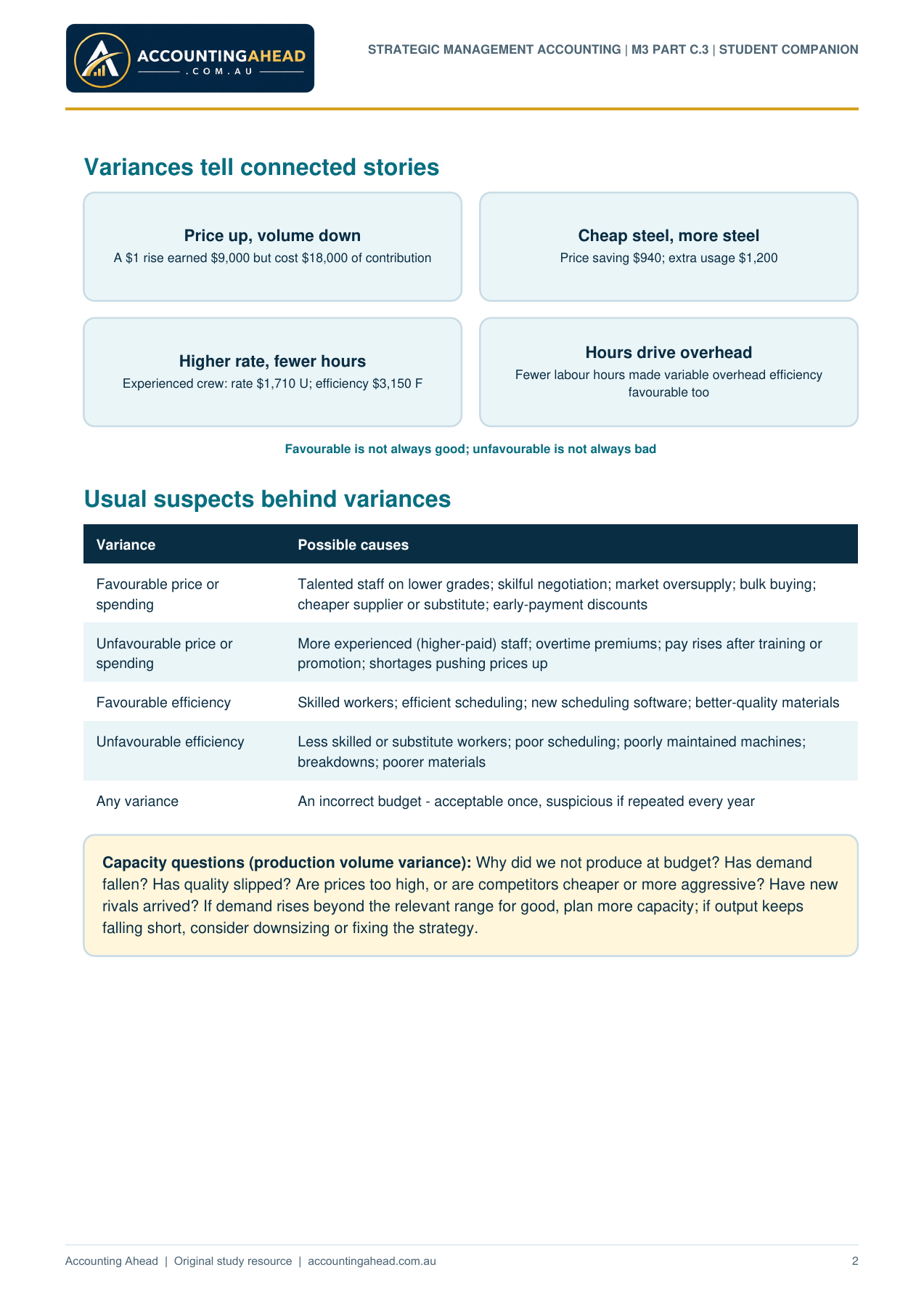
Variances tell connected stories
Price up, volume down
A $1 rise earned $9,000 but cost $18,000 of contribution
Cheap steel, more steel
Price saving $940; extra usage $1,200
Higher rate, fewer hours
Experienced crew: rate $1,710 U; efficiency $3,150 F
Hours drive overhead
Fewer labour hours made variable overhead efficiency
favourable too
Favourable is not always good; unfavourable is not always bad
Usual suspects behind variances
Variance Possible causes
Favourable price or
spending
Talented staff on lower grades; skilful negotiation; market oversupply; bulk buying;
cheaper supplier or substitute; early-payment discounts
Unfavourable price or
spending
More experienced (higher-paid) staff; overtime premiums; pay rises after training or
promotion; shortages pushing prices up
Favourable efficiency Skilled workers; efficient scheduling; new scheduling software; better-quality materials
Unfavourable efficiency Less skilled or substitute workers; poor scheduling; poorly maintained machines;
breakdowns; poorer materials
Any variance An incorrect budget - acceptable once, suspicious if repeated every year
Capacity questions (production volume variance): Why did we not produce at budget? Has demand
fallen? Has quality slipped? Are prices too high, or are competitors cheaper or more aggressive? Have new
rivals arrived? If demand rises beyond the relevant range for good, plan more capacity; if output keeps
falling short, consider downsizing or fixing the strategy.
STRATEGIC MANAGEMENT ACCOUNTING | M3 PART C.3 | STUDENT COMPANION
2
Accounting Ahead | Original study resource | accountingahead.com.au
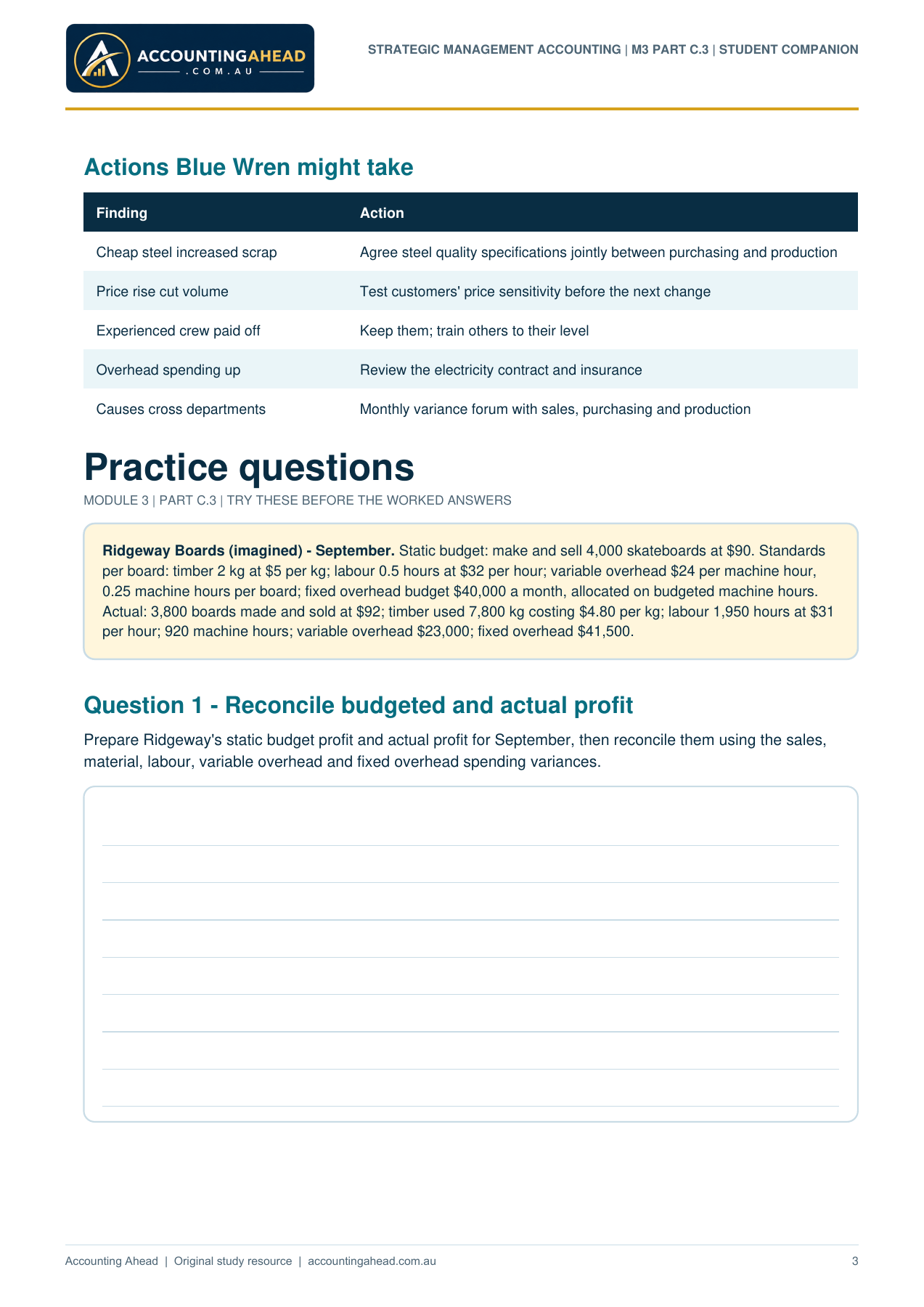
Actions Blue Wren might take
Finding Action
Cheap steel increased scrap Agree steel quality specifications jointly between purchasing and production
Price rise cut volume Test customers' price sensitivity before the next change
Experienced crew paid off Keep them; train others to their level
Overhead spending up Review the electricity contract and insurance
Causes cross departments Monthly variance forum with sales, purchasing and production
Practice questions
MODULE 3 | PART C.3 | TRY THESE BEFORE THE WORKED ANSWERS
Ridgeway Boards (imagined) - September. Static budget: make and sell 4,000 skateboards at $90. Standards
per board: timber 2 kg at $5 per kg; labour 0.5 hours at $32 per hour; variable overhead $24 per machine hour,
0.25 machine hours per board; fixed overhead budget $40,000 a month, allocated on budgeted machine hours.
Actual: 3,800 boards made and sold at $92; timber used 7,800 kg costing $4.80 per kg; labour 1,950 hours at $31
per hour; 920 machine hours; variable overhead $23,000; fixed overhead $41,500.
Question 1 - Reconcile budgeted and actual profit
Prepare Ridgeway's static budget profit and actual profit for September, then reconcile them using the sales,
material, labour, variable overhead and fixed overhead spending variances.
STRATEGIC MANAGEMENT ACCOUNTING | M3 PART C.3 | STUDENT COMPANION
3
Accounting Ahead | Original study resource | accountingahead.com.au
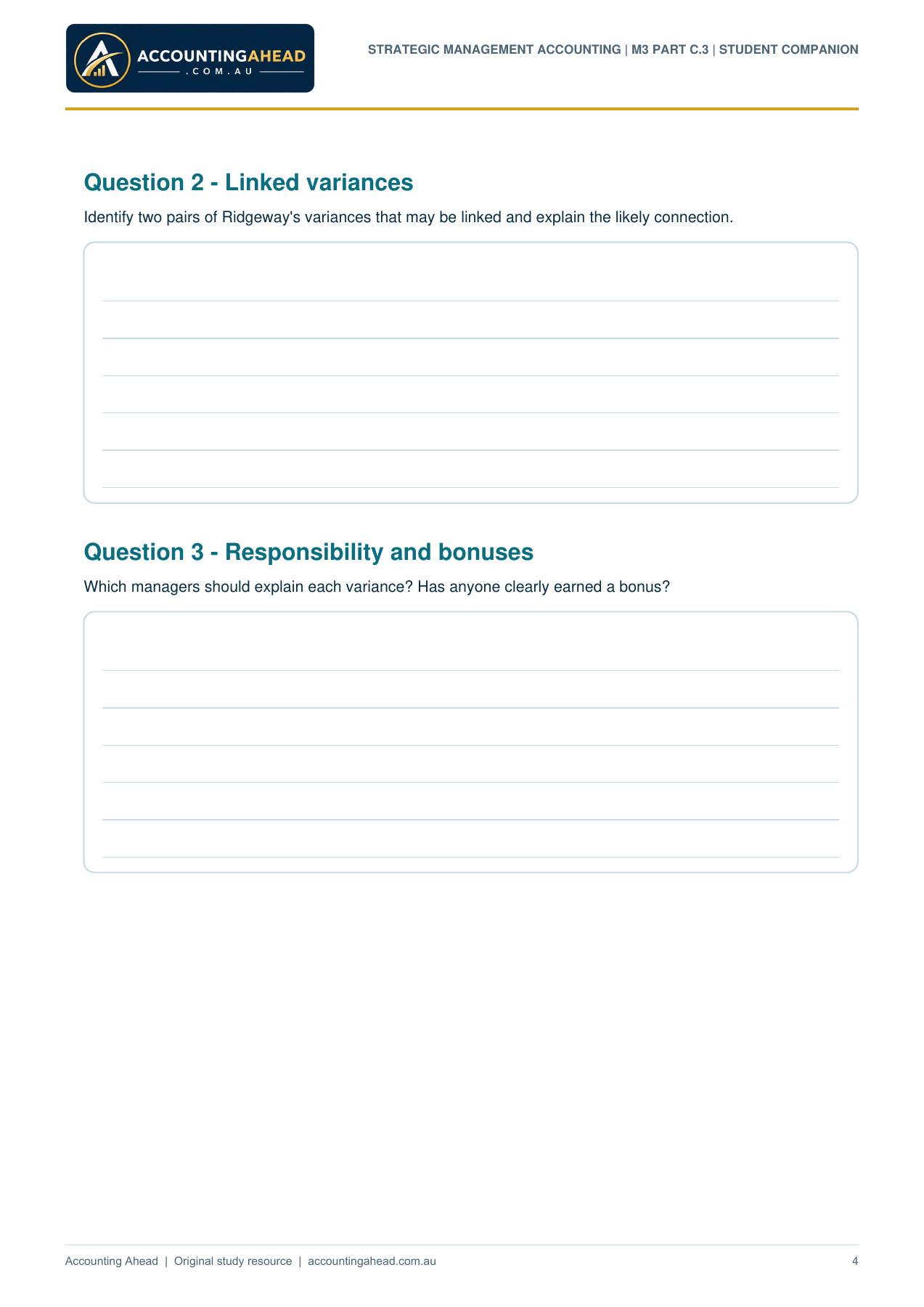
Question 2 - Linked variances
Identify two pairs of Ridgeway's variances that may be linked and explain the likely connection.
Question 3 - Responsibility and bonuses
Which managers should explain each variance? Has anyone clearly earned a bonus?
STRATEGIC MANAGEMENT ACCOUNTING | M3 PART C.3 | STUDENT COMPANION
4
Accounting Ahead | Original study resource | accountingahead.com.au
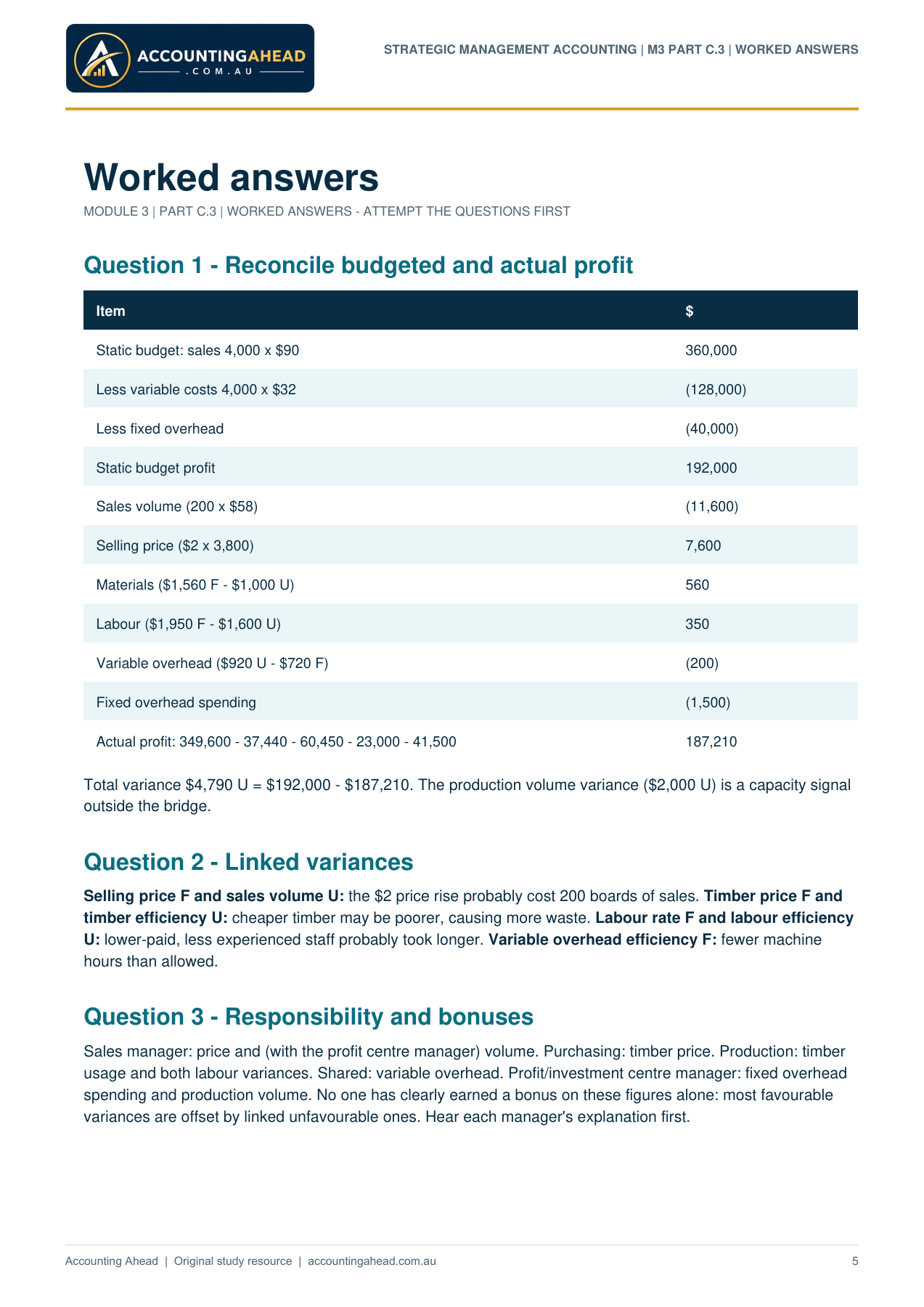
Worked answers
MODULE 3 | PART C.3 | WORKED ANSWERS - ATTEMPT THE QUESTIONS FIRST
Question 1 - Reconcile budgeted and actual profit
Item $
Static budget: sales 4,000 x $90 360,000
Less variable costs 4,000 x $32 (128,000)
Less fixed overhead (40,000)
Static budget profit 192,000
Sales volume (200 x $58) (11,600)
Selling price ($2 x 3,800) 7,600
Materials ($1,560 F - $1,000 U) 560
Labour ($1,950 F - $1,600 U) 350
Variable overhead ($920 U - $720 F) (200)
Fixed overhead spending (1,500)
Actual profit: 349,600 - 37,440 - 60,450 - 23,000 - 41,500 187,210
Total variance $4,790 U = $192,000 - $187,210. The production volume variance ($2,000 U) is a capacity signal
outside the bridge.
Question 2 - Linked variances
Selling price F and sales volume U: the $2 price rise probably cost 200 boards of sales. Timber price F and
timber efficiency U: cheaper timber may be poorer, causing more waste. Labour rate F and labour efficiency
U: lower-paid, less experienced staff probably took longer. Variable overhead efficiency F: fewer machine
hours than allowed.
Question 3 - Responsibility and bonuses
Sales manager: price and (with the profit centre manager) volume. Purchasing: timber price. Production: timber
usage and both labour variances. Shared: variable overhead. Profit/investment centre manager: fixed overhead
spending and production volume. No one has clearly earned a bonus on these figures alone: most favourable
variances are offset by linked unfavourable ones. Hear each manager's explanation first.
STRATEGIC MANAGEMENT ACCOUNTING | M3 PART C.3 | WORKED ANSWERS
5