
Master budget formulas guide
Printable study notes to use alongside Part B.1.
Read the handout text
Accounting Ahead | Original study resource | accountingahead.com.au
Master budget formulas guide
SMA EXAM REFERENCE PACK | MODULE 3 | PRINT AND KEEP WITH YOUR NOTES
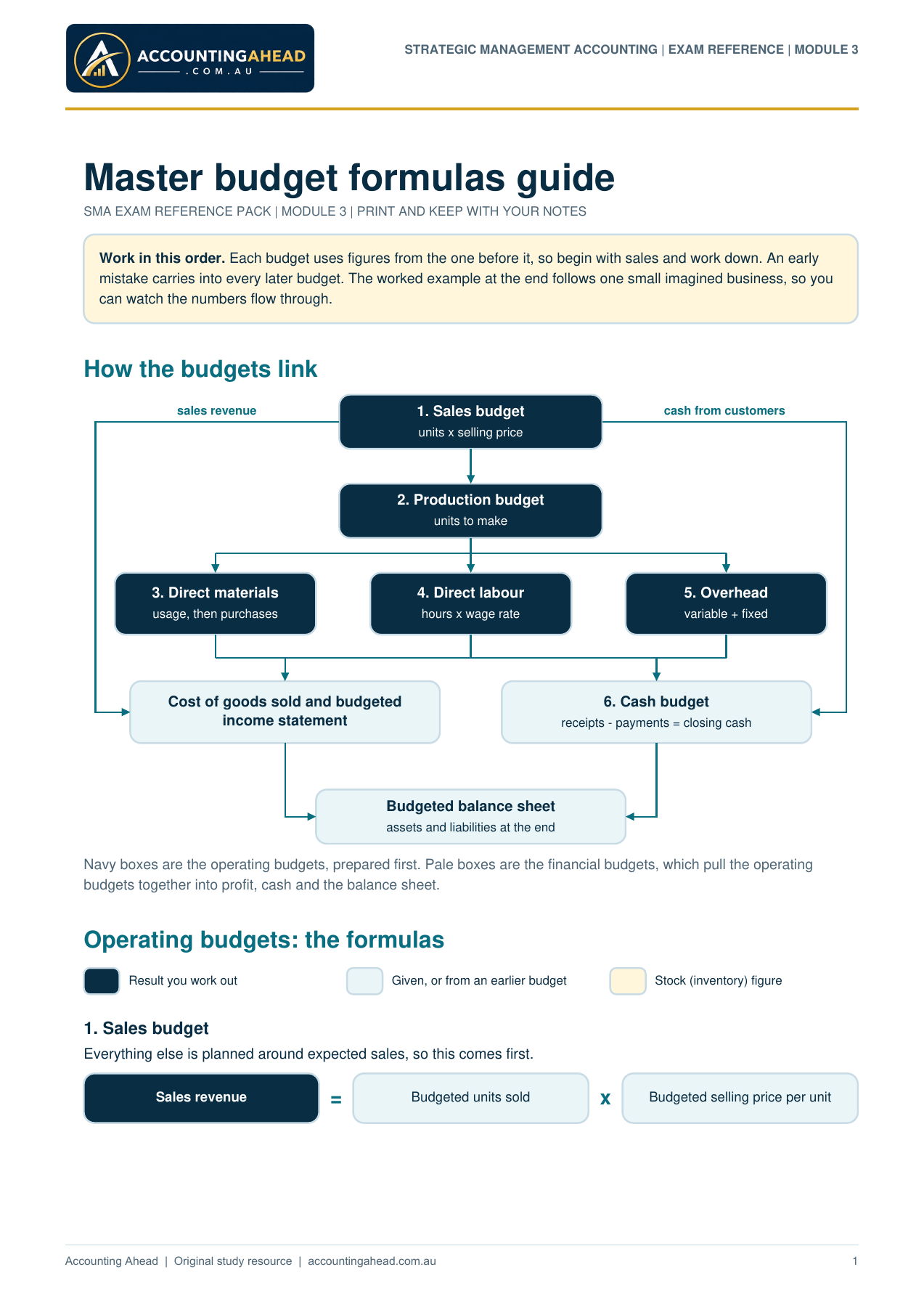
Work in this order. Each budget uses figures from the one before it, so begin with sales and work down. An early
mistake carries into every later budget. The worked example at the end follows one small imagined business, so you
can watch the numbers flow through.
How the budgets link
1. Sales budget
units x selling price
2. Production budget
units to make
3. Direct materials
usage, then purchases
4. Direct labour
hours x wage rate
5. Overhead
variable + fixed
Cost of goods sold and budgeted
income statement
6. Cash budget
receipts - payments = closing cash
Budgeted balance sheet
assets and liabilities at the end
sales revenue cash from customers
Navy boxes are the operating budgets, prepared first. Pale boxes are the financial budgets, which pull the operating
budgets together into profit, cash and the balance sheet.
Operating budgets: the formulas
Result you work out Given, or from an earlier budget Stock (inventory) figure
1. Sales budget
Everything else is planned around expected sales, so this comes first.
Sales revenue = Budgeted units sold x Budgeted selling price per unit
STRATEGIC MANAGEMENT ACCOUNTING | EXAM REFERENCE | MODULE 3
1
Accounting Ahead | Original study resource | accountingahead.com.au
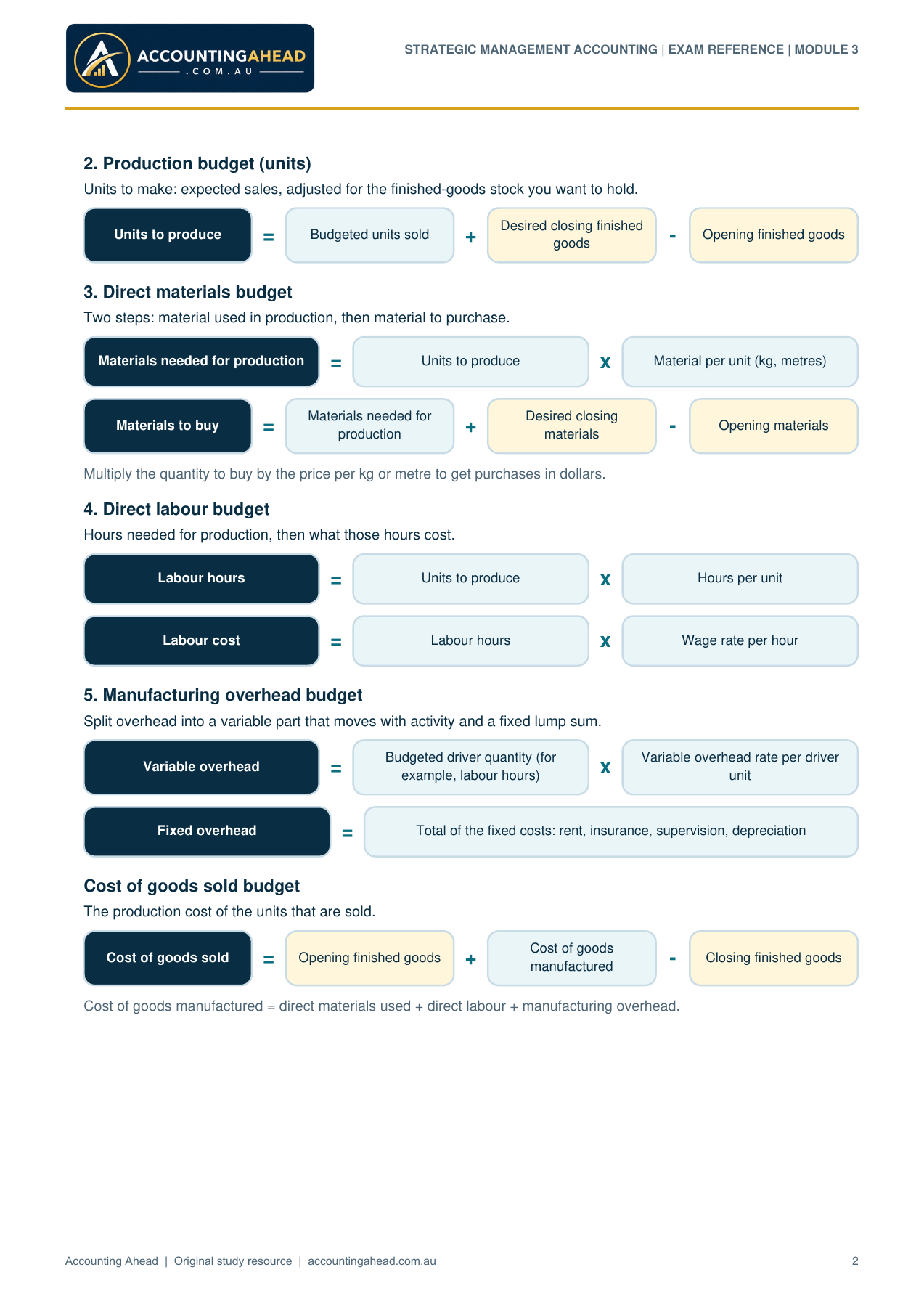
2. Production budget (units)
Units to make: expected sales, adjusted for the finished-goods stock you want to hold.
Units to produce = Budgeted units sold + Desired closing finished
goods - Opening finished goods
3. Direct materials budget
Two steps: material used in production, then material to purchase.
Materials needed for production = Units to produce x Material per unit (kg, metres)
Materials to buy = Materials needed for
production + Desired closing
materials - Opening materials
Multiply the quantity to buy by the price per kg or metre to get purchases in dollars.
4. Direct labour budget
Hours needed for production, then what those hours cost.
Labour hours = Units to produce x Hours per unit
Labour cost = Labour hours x Wage rate per hour
5. Manufacturing overhead budget
Split overhead into a variable part that moves with activity and a fixed lump sum.
Variable overhead = Budgeted driver quantity (for
example, labour hours) x Variable overhead rate per driver
unit
Fixed overhead = Total of the fixed costs: rent, insurance, supervision, depreciation
Cost of goods sold budget
The production cost of the units that are sold.
Cost of goods sold = Opening finished goods + Cost of goods
manufactured - Closing finished goods
Cost of goods manufactured = direct materials used + direct labour + manufacturing overhead.
STRATEGIC MANAGEMENT ACCOUNTING | EXAM REFERENCE | MODULE 3
2
Accounting Ahead | Original study resource | accountingahead.com.au
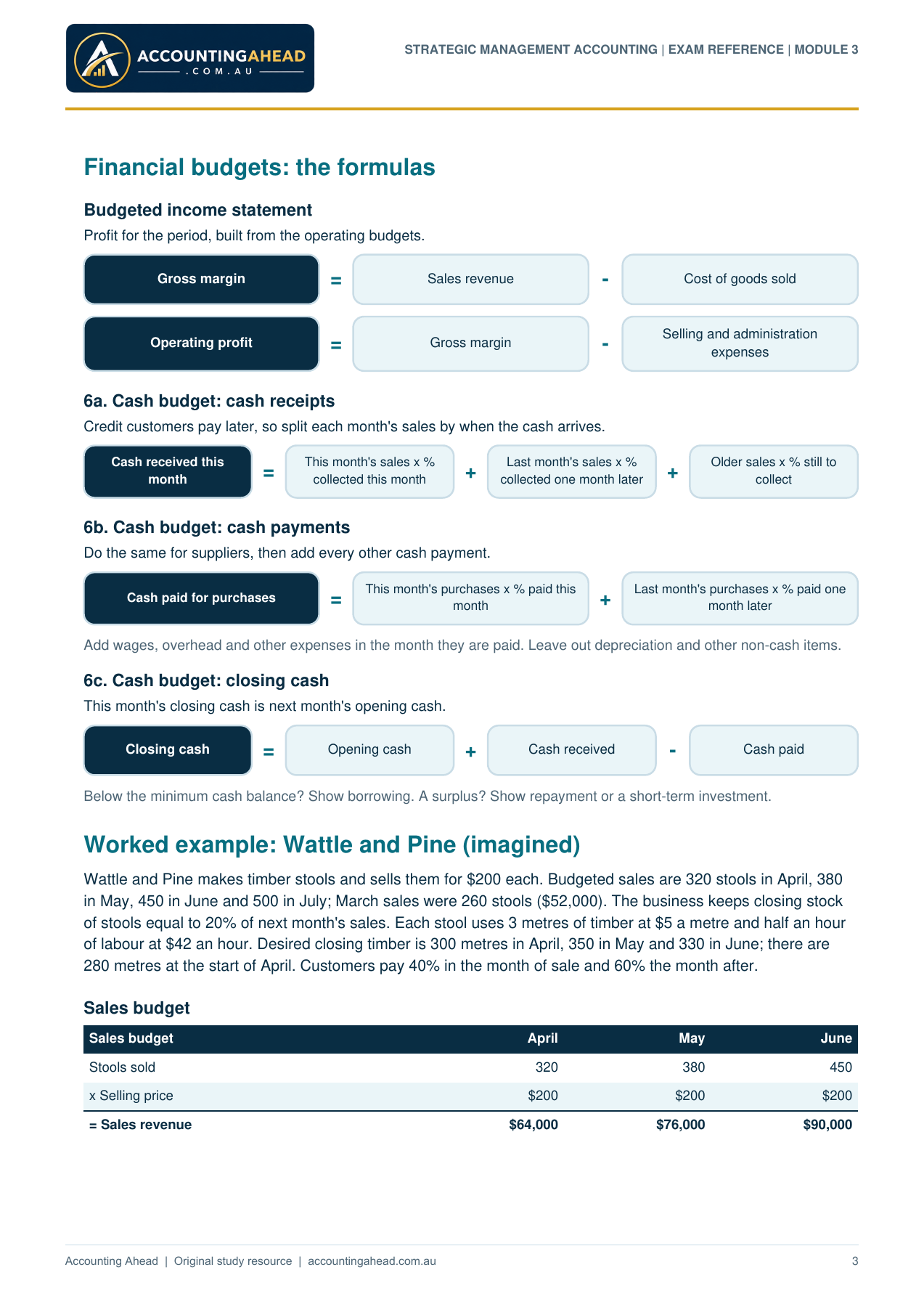
Financial budgets: the formulas
Budgeted income statement
Profit for the period, built from the operating budgets.
Gross margin = Sales revenue - Cost of goods sold
Operating profit = Gross margin - Selling and administration
expenses
6a. Cash budget: cash receipts
Credit customers pay later, so split each month's sales by when the cash arrives.
Cash received this
month = This month's sales x %
collected this month + Last month's sales x %
collected one month later + Older sales x % still to
collect
6b. Cash budget: cash payments
Do the same for suppliers, then add every other cash payment.
Cash paid for purchases = This month's purchases x % paid this
month + Last month's purchases x % paid one
month later
Add wages, overhead and other expenses in the month they are paid. Leave out depreciation and other non-cash items.
6c. Cash budget: closing cash
This month's closing cash is next month's opening cash.
Closing cash = Opening cash + Cash received - Cash paid
Below the minimum cash balance? Show borrowing. A surplus? Show repayment or a short-term investment.
Worked example: Wattle and Pine (imagined)
Wattle and Pine makes timber stools and sells them for $200 each. Budgeted sales are 320 stools in April, 380
in May, 450 in June and 500 in July; March sales were 260 stools ($52,000). The business keeps closing stock
of stools equal to 20% of next month's sales. Each stool uses 3 metres of timber at $5 a metre and half an hour
of labour at $42 an hour. Desired closing timber is 300 metres in April, 350 in May and 330 in June; there are
280 metres at the start of April. Customers pay 40% in the month of sale and 60% the month after.
Sales budget
Sales budget April May June
Stools sold 320 380 450
x Selling price $200 $200 $200
= Sales revenue $64,000 $76,000 $90,000
STRATEGIC MANAGEMENT ACCOUNTING | EXAM REFERENCE | MODULE 3
3
Accounting Ahead | Original study resource | accountingahead.com.au
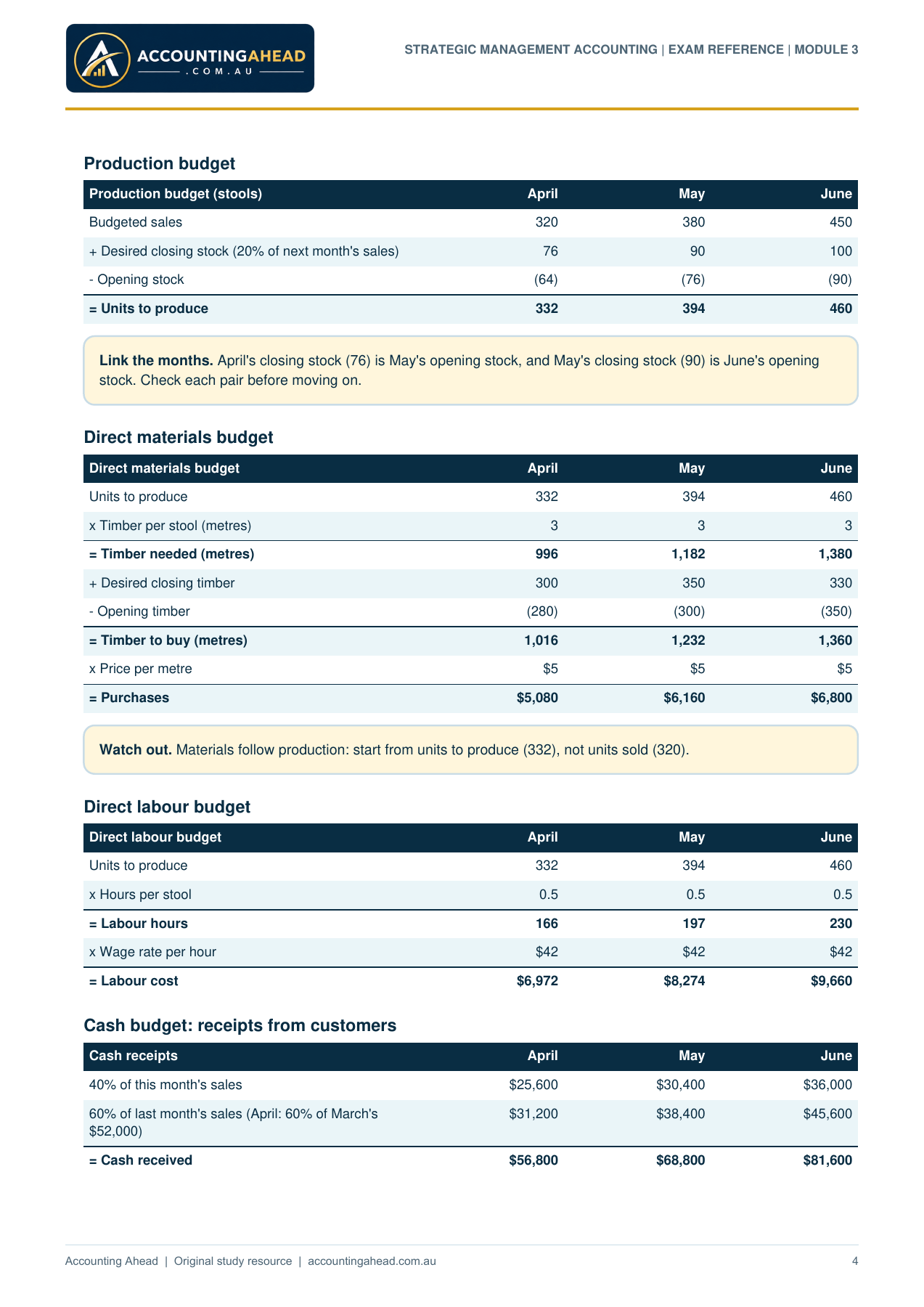
Production budget
Production budget (stools) April May June
Budgeted sales 320 380 450
+ Desired closing stock (20% of next month's sales) 76 90 100
- Opening stock (64) (76) (90)
= Units to produce 332 394 460
Link the months. April's closing stock (76) is May's opening stock, and May's closing stock (90) is June's opening
stock. Check each pair before moving on.
Direct materials budget
Direct materials budget April May June
Units to produce 332 394 460
x Timber per stool (metres) 3 3 3
= Timber needed (metres) 996 1,182 1,380
+ Desired closing timber 300 350 330
- Opening timber (280) (300) (350)
= Timber to buy (metres) 1,016 1,232 1,360
x Price per metre $5 $5 $5
= Purchases $5,080 $6,160 $6,800
Watch out. Materials follow production: start from units to produce (332), not units sold (320).
Direct labour budget
Direct labour budget April May June
Units to produce 332 394 460
x Hours per stool 0.5 0.5 0.5
= Labour hours 166 197 230
x Wage rate per hour $42 $42 $42
= Labour cost $6,972 $8,274 $9,660
Cash budget: receipts from customers
Cash receipts April May June
40% of this month's sales $25,600 $30,400 $36,000
60% of last month's sales (April: 60% of March's
$52,000)
$31,200 $38,400 $45,600
= Cash received $56,800 $68,800 $81,600
STRATEGIC MANAGEMENT ACCOUNTING | EXAM REFERENCE | MODULE 3
4