
Variance analysis guide
Printable study notes to use alongside Part C.1.
Read the handout text
Accounting Ahead | Original study resource | accountingahead.com.au
Variance analysis guide
SMA EXAM REFERENCE PACK | MODULE 3 | PRINT AND KEEP WITH YOUR NOTES
How to use this guide. A variance is the gap between what actually happened and what the budget planned. Learn
the letters, use one test for F or U, then let the map send you to the right card. Each card ends with a worked line
from the same small example, so you can see the numbers go in.
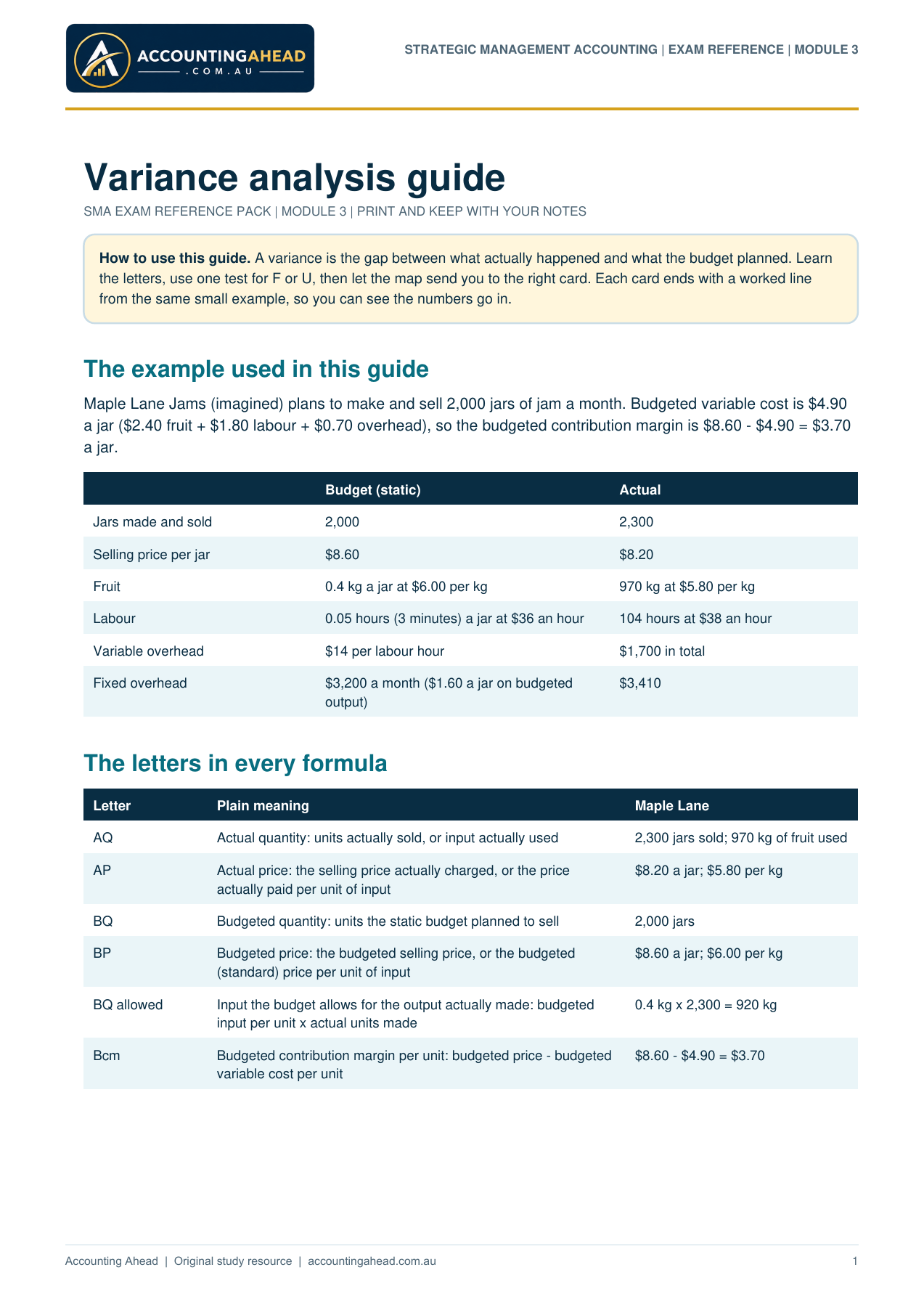
The example used in this guide
Maple Lane Jams (imagined) plans to make and sell 2,000 jars of jam a month. Budgeted variable cost is $4.90
a jar ($2.40 fruit + $1.80 labour + $0.70 overhead), so the budgeted contribution margin is $8.60 - $4.90 = $3.70
a jar.
Budget (static) Actual
Jars made and sold 2,000 2,300
Selling price per jar $8.60 $8.20
Fruit 0.4 kg a jar at $6.00 per kg 970 kg at $5.80 per kg
Labour 0.05 hours (3 minutes) a jar at $36 an hour 104 hours at $38 an hour
Variable overhead $14 per labour hour $1,700 in total
Fixed overhead $3,200 a month ($1.60 a jar on budgeted
output)
$3,410
The letters in every formula
Letter Plain meaning Maple Lane
AQ Actual quantity: units actually sold, or input actually used 2,300 jars sold; 970 kg of fruit used
AP Actual price: the selling price actually charged, or the price
actually paid per unit of input
$8.20 a jar; $5.80 per kg
BQ Budgeted quantity: units the static budget planned to sell 2,000 jars
BP Budgeted price: the budgeted selling price, or the budgeted
(standard) price per unit of input
$8.60 a jar; $6.00 per kg
BQ allowed Input the budget allows for the output actually made: budgeted
input per unit x actual units made
0.4 kg x 2,300 = 920 kg
Bcm Budgeted contribution margin per unit: budgeted price - budgeted
variable cost per unit
$8.60 - $4.90 = $3.70
STRATEGIC MANAGEMENT ACCOUNTING | EXAM REFERENCE | MODULE 3
1
Accounting Ahead | Original study resource | accountingahead.com.au
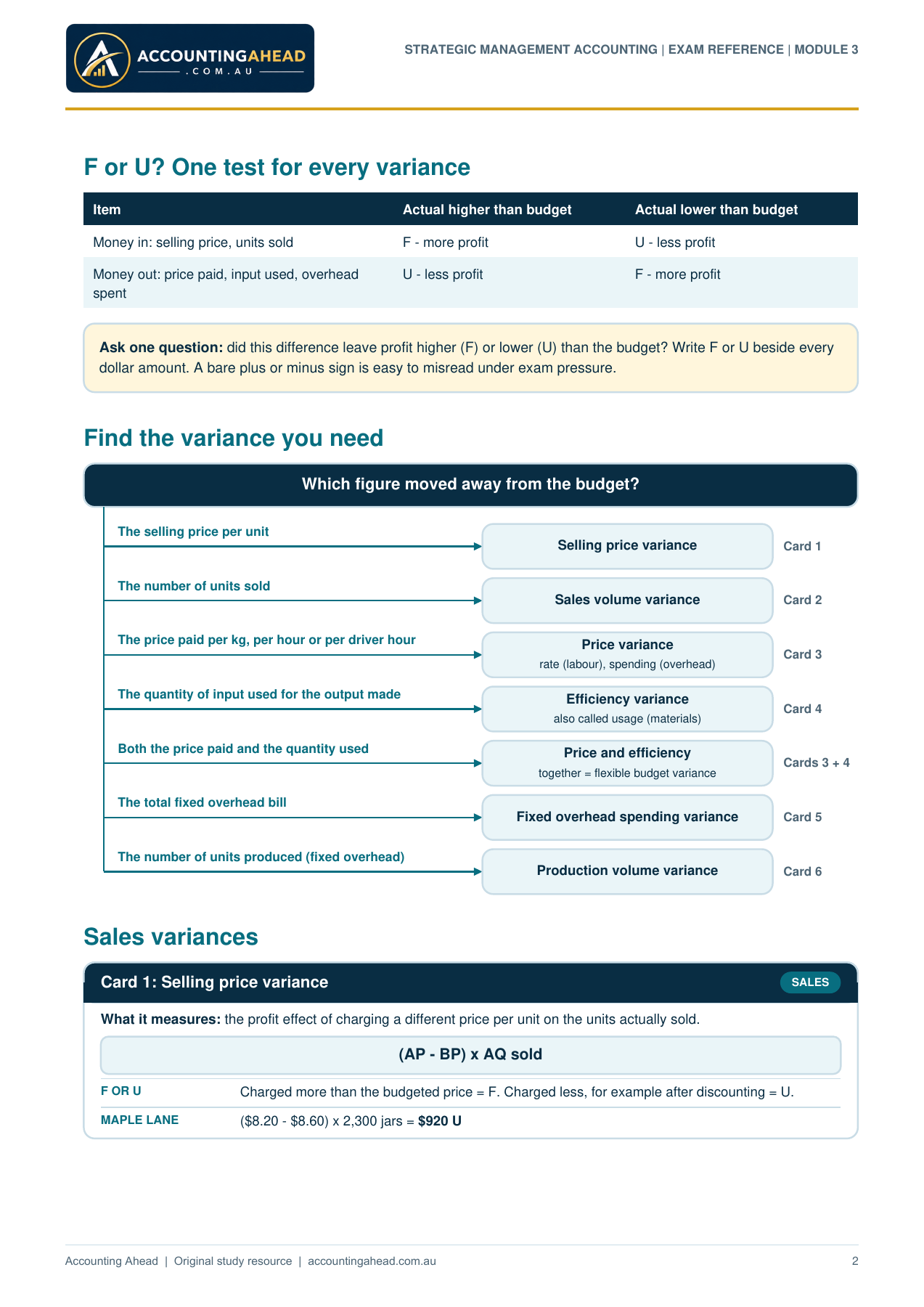
F or U? One test for every variance
Item Actual higher than budget Actual lower than budget
Money in: selling price, units sold F - more profit U - less profit
Money out: price paid, input used, overhead
spent
U - less profit F - more profit
Ask one question: did this difference leave profit higher (F) or lower (U) than the budget? Write F or U beside every
dollar amount. A bare plus or minus sign is easy to misread under exam pressure.
Find the variance you need
Which figure moved away from the budget?
The selling price per unit
Selling price variance Card 1
The number of units sold
Sales volume variance Card 2
The price paid per kg, per hour or per driver hour Price variance
rate (labour), spending (overhead)
Card 3
The quantity of input used for the output made Efficiency variance
also called usage (materials)
Card 4
Both the price paid and the quantity used Price and efficiency
together = flexible budget variance
Cards 3 + 4
The total fixed overhead bill
Fixed overhead spending variance Card 5
The number of units produced (fixed overhead)
Production volume variance Card 6
Sales variances
Card 1: Selling price variance SALES
What it measures: the profit effect of charging a different price per unit on the units actually sold.
(AP - BP) x AQ sold
F OR U Charged more than the budgeted price = F. Charged less, for example after discounting = U.
MAPLE LANE ($8.20 - $8.60) x 2,300 jars = $920 U
STRATEGIC MANAGEMENT ACCOUNTING | EXAM REFERENCE | MODULE 3
2
Accounting Ahead | Original study resource | accountingahead.com.au
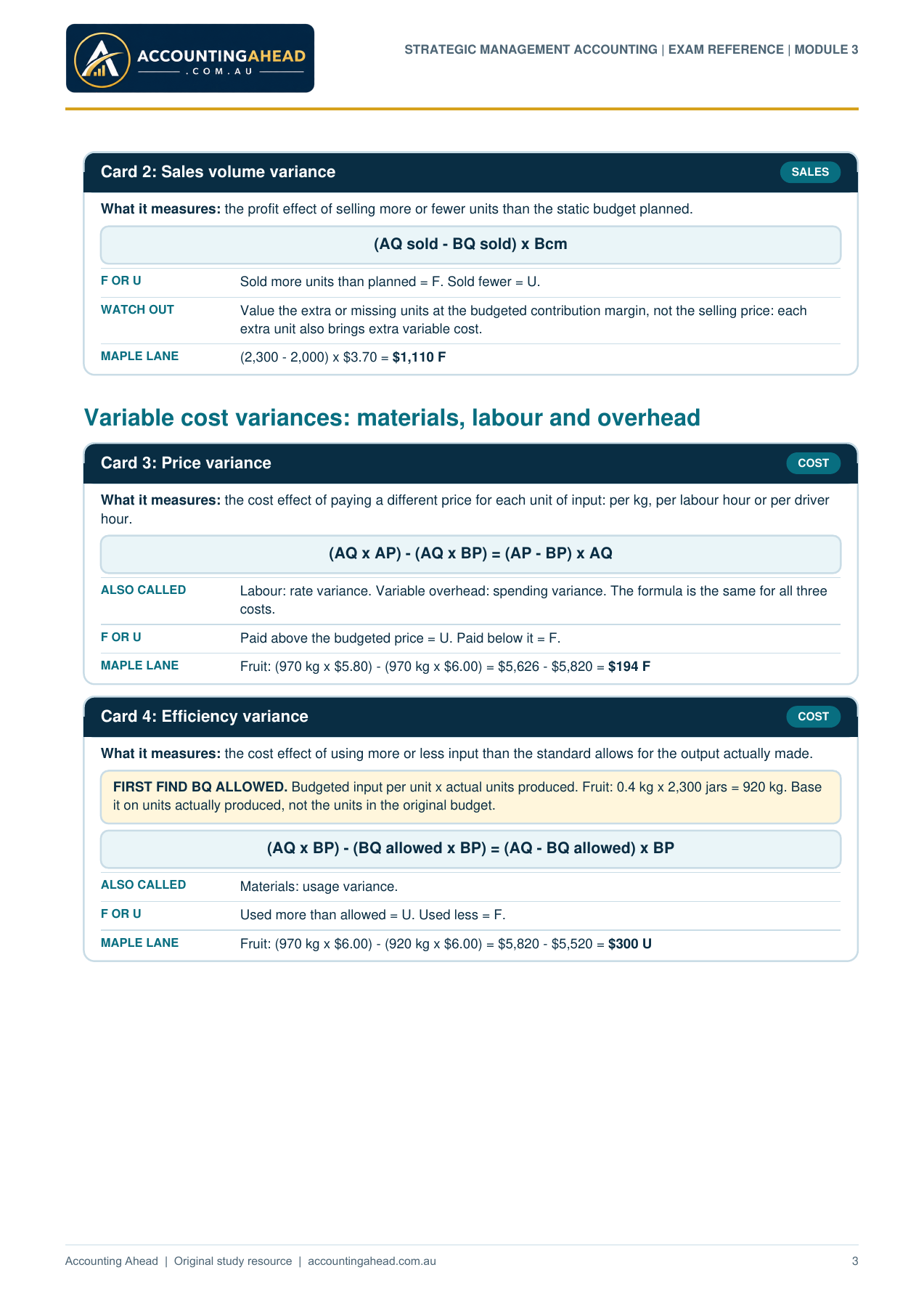
Card 2: Sales volume variance SALES
What it measures: the profit effect of selling more or fewer units than the static budget planned.
(AQ sold - BQ sold) x Bcm
F OR U Sold more units than planned = F. Sold fewer = U.
WATCH OUT Value the extra or missing units at the budgeted contribution margin, not the selling price: each
extra unit also brings extra variable cost.
MAPLE LANE (2,300 - 2,000) x $3.70 = $1,110 F
Variable cost variances: materials, labour and overhead
Card 3: Price variance COST
What it measures: the cost effect of paying a different price for each unit of input: per kg, per labour hour or per driver
hour.
(AQ x AP) - (AQ x BP) = (AP - BP) x AQ
ALSO CALLED Labour: rate variance. Variable overhead: spending variance. The formula is the same for all three
costs.
F OR U Paid above the budgeted price = U. Paid below it = F.
MAPLE LANE Fruit: (970 kg x $5.80) - (970 kg x $6.00) = $5,626 - $5,820 = $194 F
Card 4: Efficiency variance COST
What it measures: the cost effect of using more or less input than the standard allows for the output actually made.
FIRST FIND BQ ALLOWED. Budgeted input per unit x actual units produced. Fruit: 0.4 kg x 2,300 jars = 920 kg. Base
it on units actually produced, not the units in the original budget.
(AQ x BP) - (BQ allowed x BP) = (AQ - BQ allowed) x BP
ALSO CALLED Materials: usage variance.
F OR U Used more than allowed = U. Used less = F.
MAPLE LANE Fruit: (970 kg x $6.00) - (920 kg x $6.00) = $5,820 - $5,520 = $300 U
STRATEGIC MANAGEMENT ACCOUNTING | EXAM REFERENCE | MODULE 3
3
Accounting Ahead | Original study resource | accountingahead.com.au
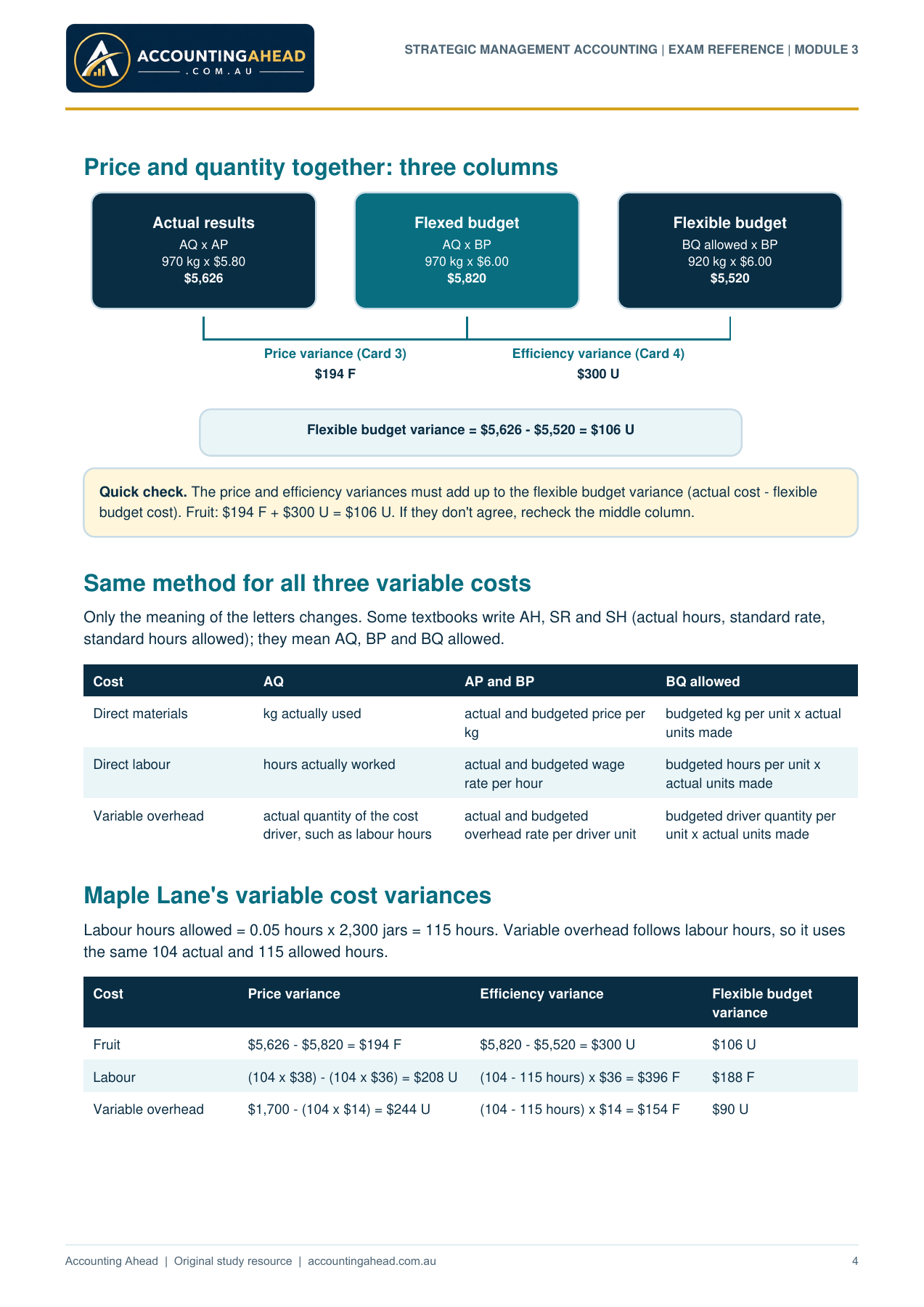
Price and quantity together: three columns
Actual results
AQ x AP
970 kg x $5.80
$5,626
Flexed budget
AQ x BP
970 kg x $6.00
$5,820
Flexible budget
BQ allowed x BP
920 kg x $6.00
$5,520
Price variance (Card 3)
$194 F
Efficiency variance (Card 4)
$300 U
Flexible budget variance = $5,626 - $5,520 = $106 U
Quick check. The price and efficiency variances must add up to the flexible budget variance (actual cost - flexible
budget cost). Fruit: $194 F + $300 U = $106 U. If they don't agree, recheck the middle column.
Same method for all three variable costs
Only the meaning of the letters changes. Some textbooks write AH, SR and SH (actual hours, standard rate,
standard hours allowed); they mean AQ, BP and BQ allowed.
Cost AQ AP and BP BQ allowed
Direct materials kg actually used actual and budgeted price per
kg
budgeted kg per unit x actual
units made
Direct labour hours actually worked actual and budgeted wage
rate per hour
budgeted hours per unit x
actual units made
Variable overhead actual quantity of the cost
driver, such as labour hours
actual and budgeted
overhead rate per driver unit
budgeted driver quantity per
unit x actual units made
Maple Lane's variable cost variances
Labour hours allowed = 0.05 hours x 2,300 jars = 115 hours. Variable overhead follows labour hours, so it uses
the same 104 actual and 115 allowed hours.
Cost Price variance Efficiency variance Flexible budget
variance
Fruit $5,626 - $5,820 = $194 F $5,820 - $5,520 = $300 U $106 U
Labour (104 x $38) - (104 x $36) = $208 U (104 - 115 hours) x $36 = $396 F $188 F
Variable overhead $1,700 - (104 x $14) = $244 U (104 - 115 hours) x $14 = $154 F $90 U
STRATEGIC MANAGEMENT ACCOUNTING | EXAM REFERENCE | MODULE 3
4
Accounting Ahead | Original study resource | accountingahead.com.au
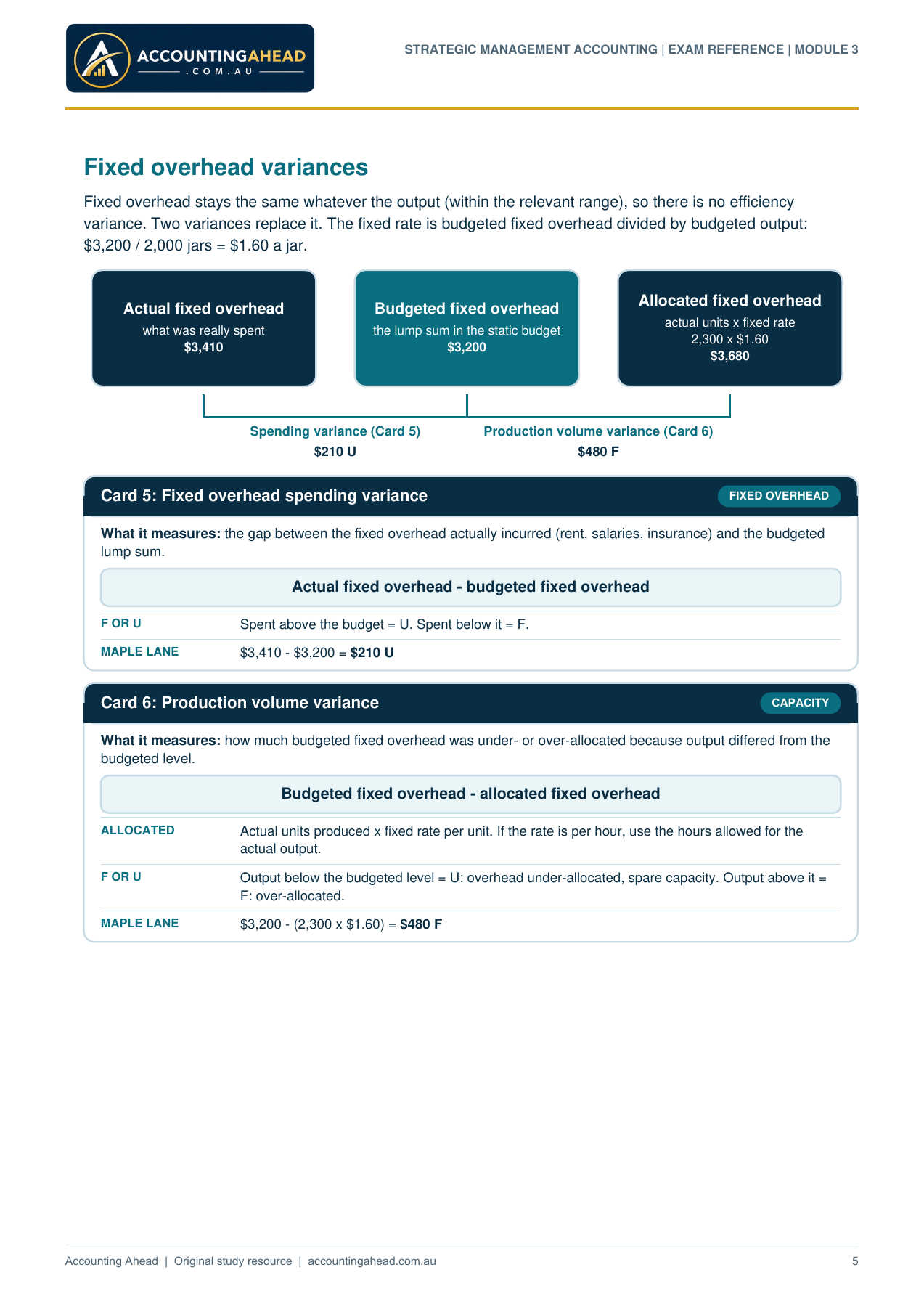
Fixed overhead variances
Fixed overhead stays the same whatever the output (within the relevant range), so there is no efficiency
variance. Two variances replace it. The fixed rate is budgeted fixed overhead divided by budgeted output:
$3,200 / 2,000 jars = $1.60 a jar.
Actual fixed overhead
what was really spent
$3,410
Budgeted fixed overhead
the lump sum in the static budget
$3,200
Allocated fixed overhead
actual units x fixed rate
2,300 x $1.60
$3,680
Spending variance (Card 5)
$210 U
Production volume variance (Card 6)
$480 F
Card 5: Fixed overhead spending variance FIXED OVERHEAD
What it measures: the gap between the fixed overhead actually incurred (rent, salaries, insurance) and the budgeted
lump sum.
Actual fixed overhead - budgeted fixed overhead
F OR U Spent above the budget = U. Spent below it = F.
MAPLE LANE $3,410 - $3,200 = $210 U
Card 6: Production volume variance CAPACITY
What it measures: how much budgeted fixed overhead was under- or over-allocated because output differed from the
budgeted level.
Budgeted fixed overhead - allocated fixed overhead
ALLOCATED Actual units produced x fixed rate per unit. If the rate is per hour, use the hours allowed for the
actual output.
F OR U Output below the budgeted level = U: overhead under-allocated, spare capacity. Output above it =
F: over-allocated.
MAPLE LANE $3,200 - (2,300 x $1.60) = $480 F
STRATEGIC MANAGEMENT ACCOUNTING | EXAM REFERENCE | MODULE 3
5
Accounting Ahead | Original study resource | accountingahead.com.au
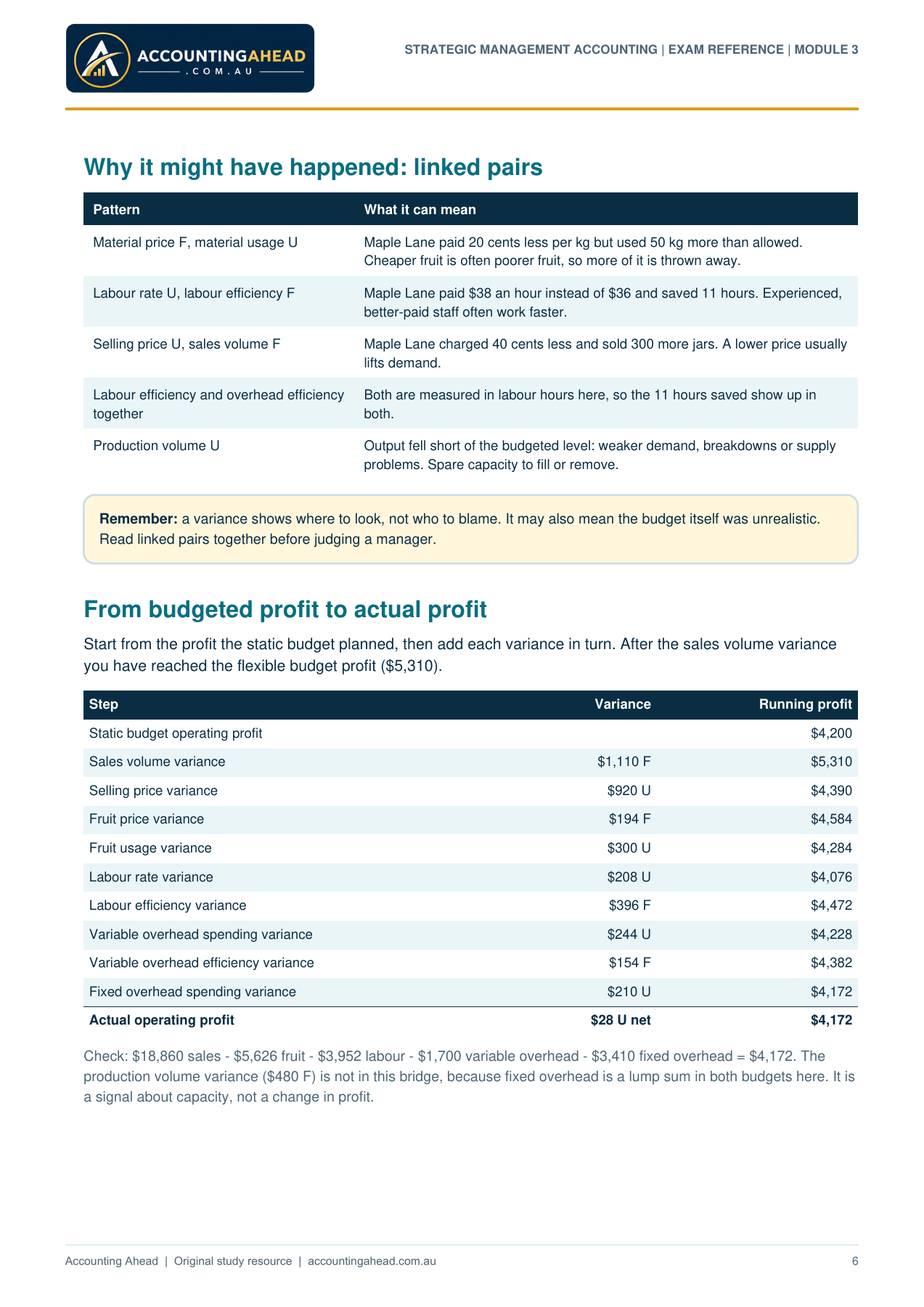
Why it might have happened: linked pairs
Pattern What it can mean
Material price F, material usage U Maple Lane paid 20 cents less per kg but used 50 kg more than allowed.
Cheaper fruit is often poorer fruit, so more of it is thrown away.
Labour rate U, labour efficiency F Maple Lane paid $38 an hour instead of $36 and saved 11 hours. Experienced,
better-paid staff often work faster.
Selling price U, sales volume F Maple Lane charged 40 cents less and sold 300 more jars. A lower price usually
lifts demand.
Labour efficiency and overhead efficiency
together
Both are measured in labour hours here, so the 11 hours saved show up in
both.
Production volume U Output fell short of the budgeted level: weaker demand, breakdowns or supply
problems. Spare capacity to fill or remove.
Remember: a variance shows where to look, not who to blame. It may also mean the budget itself was unrealistic.
Read linked pairs together before judging a manager.
From budgeted profit to actual profit
Start from the profit the static budget planned, then add each variance in turn. After the sales volume variance
you have reached the flexible budget profit ($5,310).
Step Variance Running profit
Static budget operating profit $4,200
Sales volume variance $1,110 F $5,310
Selling price variance $920 U $4,390
Fruit price variance $194 F $4,584
Fruit usage variance $300 U $4,284
Labour rate variance $208 U $4,076
Labour efficiency variance $396 F $4,472
Variable overhead spending variance $244 U $4,228
Variable overhead efficiency variance $154 F $4,382
Fixed overhead spending variance $210 U $4,172
Actual operating profit $28 U net $4,172
Check: $18,860 sales - $5,626 fruit - $3,952 labour - $1,700 variable overhead - $3,410 fixed overhead = $4,172. The
production volume variance ($480 F) is not in this bridge, because fixed overhead is a lump sum in both budgets here. It is
a signal about capacity, not a change in profit.
STRATEGIC MANAGEMENT ACCOUNTING | EXAM REFERENCE | MODULE 3
6