
Projects and the four stages
Printable study notes to use alongside Part A.1.
Read the handout text
Accounting Ahead | Original study resource | accountingahead.com.au
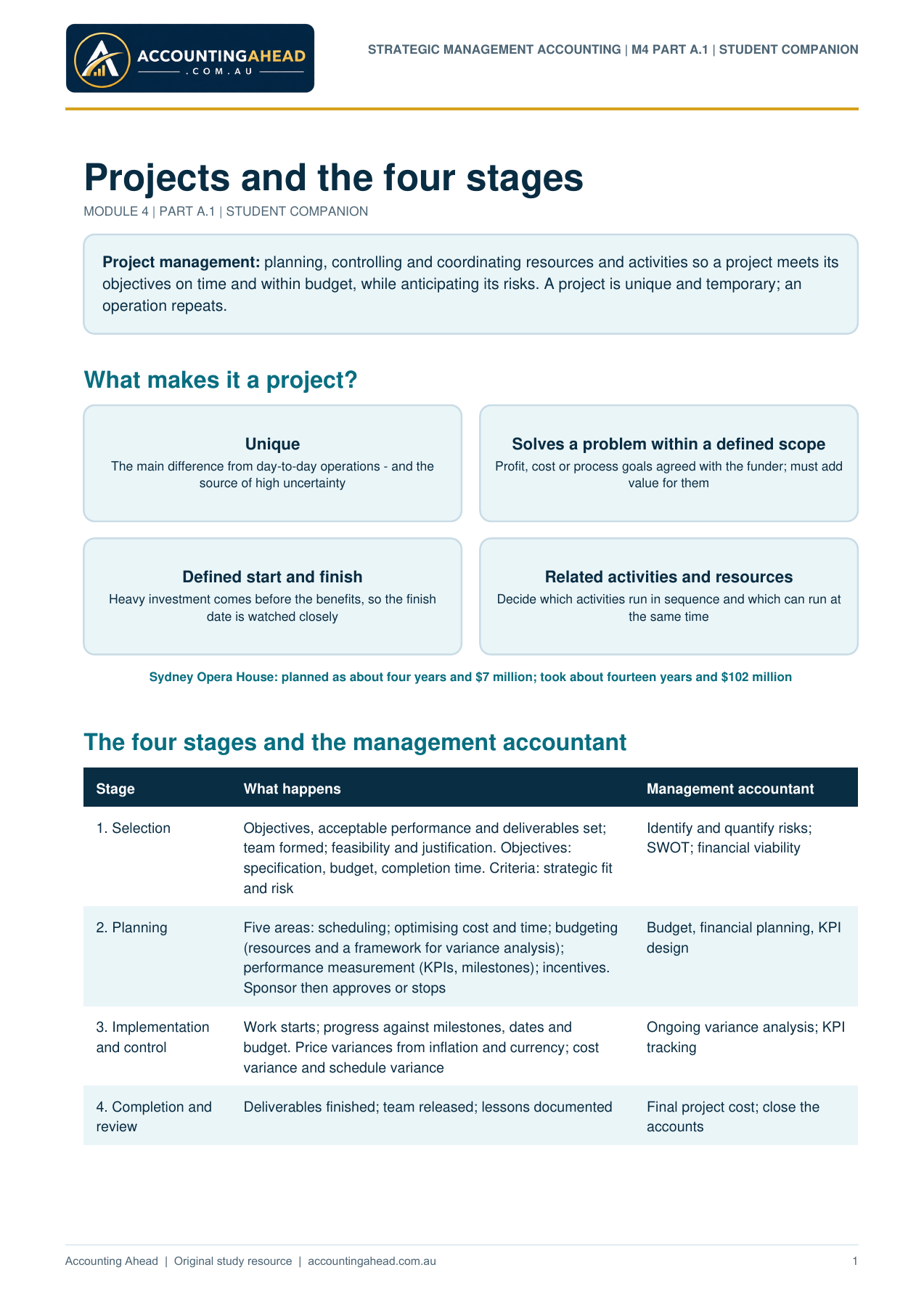
Projects and the four stages
MODULE 4 | PART A.1 | STUDENT COMPANION
Project management: planning, controlling and coordinating resources and activities so a project meets its
objectives on time and within budget, while anticipating its risks. A project is unique and temporary; an
operation repeats.
What makes it a project?
Unique
The main difference from day-to-day operations - and the
source of high uncertainty
Solves a problem within a defined scope
Profit, cost or process goals agreed with the funder; must add
value for them
Defined start and finish
Heavy investment comes before the benefits, so the finish
date is watched closely
Related activities and resources
Decide which activities run in sequence and which can run at
the same time
Sydney Opera House: planned as about four years and $7 million; took about fourteen years and $102 million
The four stages and the management accountant
Stage What happens Management accountant
1. Selection Objectives, acceptable performance and deliverables set;
team formed; feasibility and justification. Objectives:
specification, budget, completion time. Criteria: strategic fit
and risk
Identify and quantify risks;
SWOT; financial viability
2. Planning Five areas: scheduling; optimising cost and time; budgeting
(resources and a framework for variance analysis);
performance measurement (KPIs, milestones); incentives.
Sponsor then approves or stops
Budget, financial planning, KPI
design
3. Implementation
and control
Work starts; progress against milestones, dates and
budget. Price variances from inflation and currency; cost
variance and schedule variance
Ongoing variance analysis; KPI
tracking
4. Completion and
review
Deliverables finished; team released; lessons documented Final project cost; close the
accounts
STRATEGIC MANAGEMENT ACCOUNTING | M4 PART A.1 | STUDENT COMPANION
1
Accounting Ahead | Original study resource | accountingahead.com.au
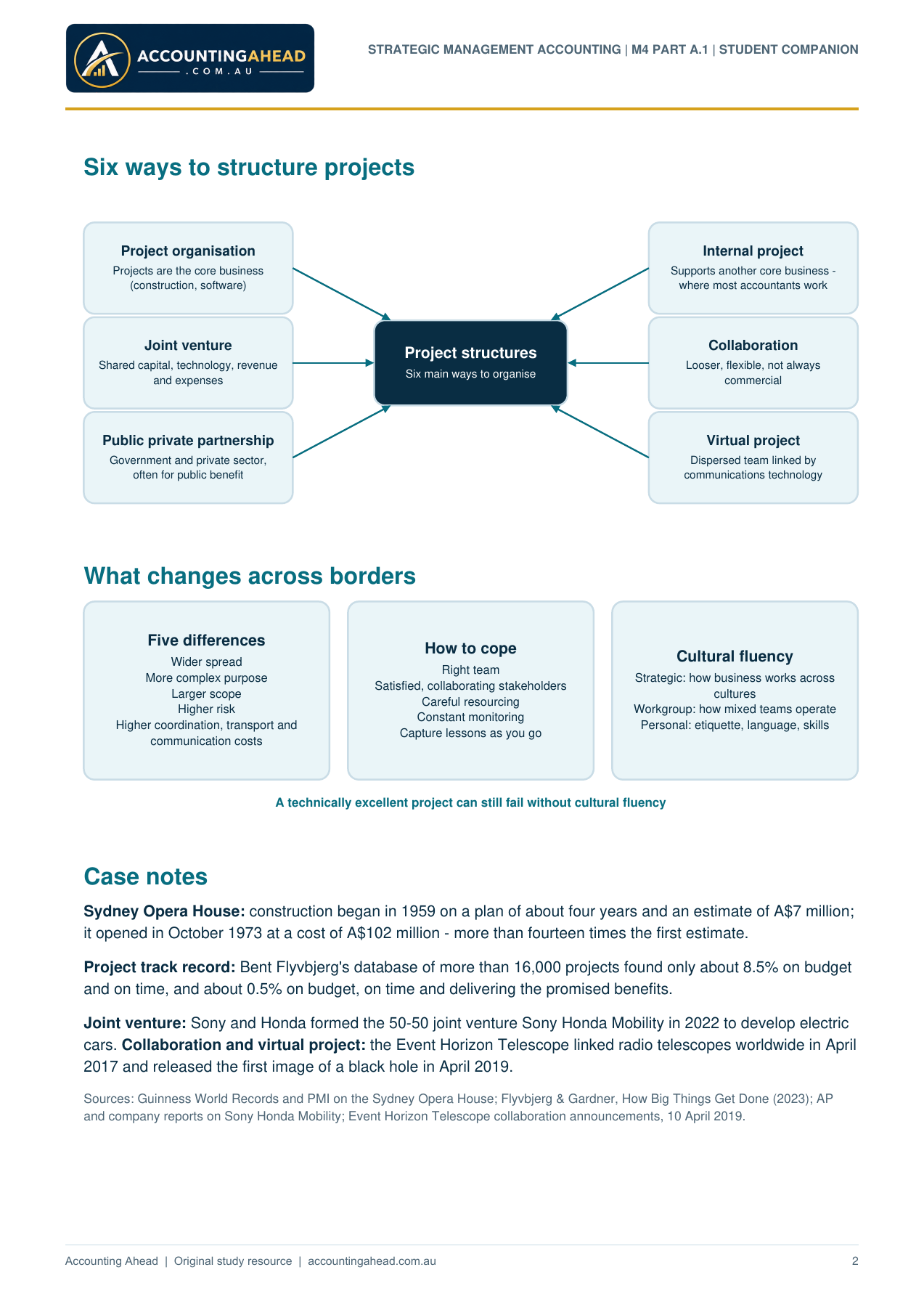
Six ways to structure projects
Project structures
Six main ways to organise
Project organisation
Projects are the core business
(construction, software)
Internal project
Supports another core business -
where most accountants work
Joint venture
Shared capital, technology, revenue
and expenses
Collaboration
Looser, flexible, not always
commercial
Public private partnership
Government and private sector,
often for public benefit
Virtual project
Dispersed team linked by
communications technology
What changes across borders
Five differences
Wider spread
More complex purpose
Larger scope
Higher risk
Higher coordination, transport and
communication costs
How to cope
Right team
Satisfied, collaborating stakeholders
Careful resourcing
Constant monitoring
Capture lessons as you go
Cultural fluency
Strategic: how business works across
cultures
Workgroup: how mixed teams operate
Personal: etiquette, language, skills
A technically excellent project can still fail without cultural fluency
Case notes
Sydney Opera House: construction began in 1959 on a plan of about four years and an estimate of A$7 million;
it opened in October 1973 at a cost of A$102 million - more than fourteen times the first estimate.
Project track record: Bent Flyvbjerg's database of more than 16,000 projects found only about 8.5% on budget
and on time, and about 0.5% on budget, on time and delivering the promised benefits.
Joint venture: Sony and Honda formed the 50-50 joint venture Sony Honda Mobility in 2022 to develop electric
cars. Collaboration and virtual project: the Event Horizon Telescope linked radio telescopes worldwide in April
2017 and released the first image of a black hole in April 2019.
Sources: Guinness World Records and PMI on the Sydney Opera House; Flyvbjerg & Gardner, How Big Things Get Done (2023); AP
and company reports on Sony Honda Mobility; Event Horizon Telescope collaboration announcements, 10 April 2019.
STRATEGIC MANAGEMENT ACCOUNTING | M4 PART A.1 | STUDENT COMPANION
2
Accounting Ahead | Original study resource | accountingahead.com.au
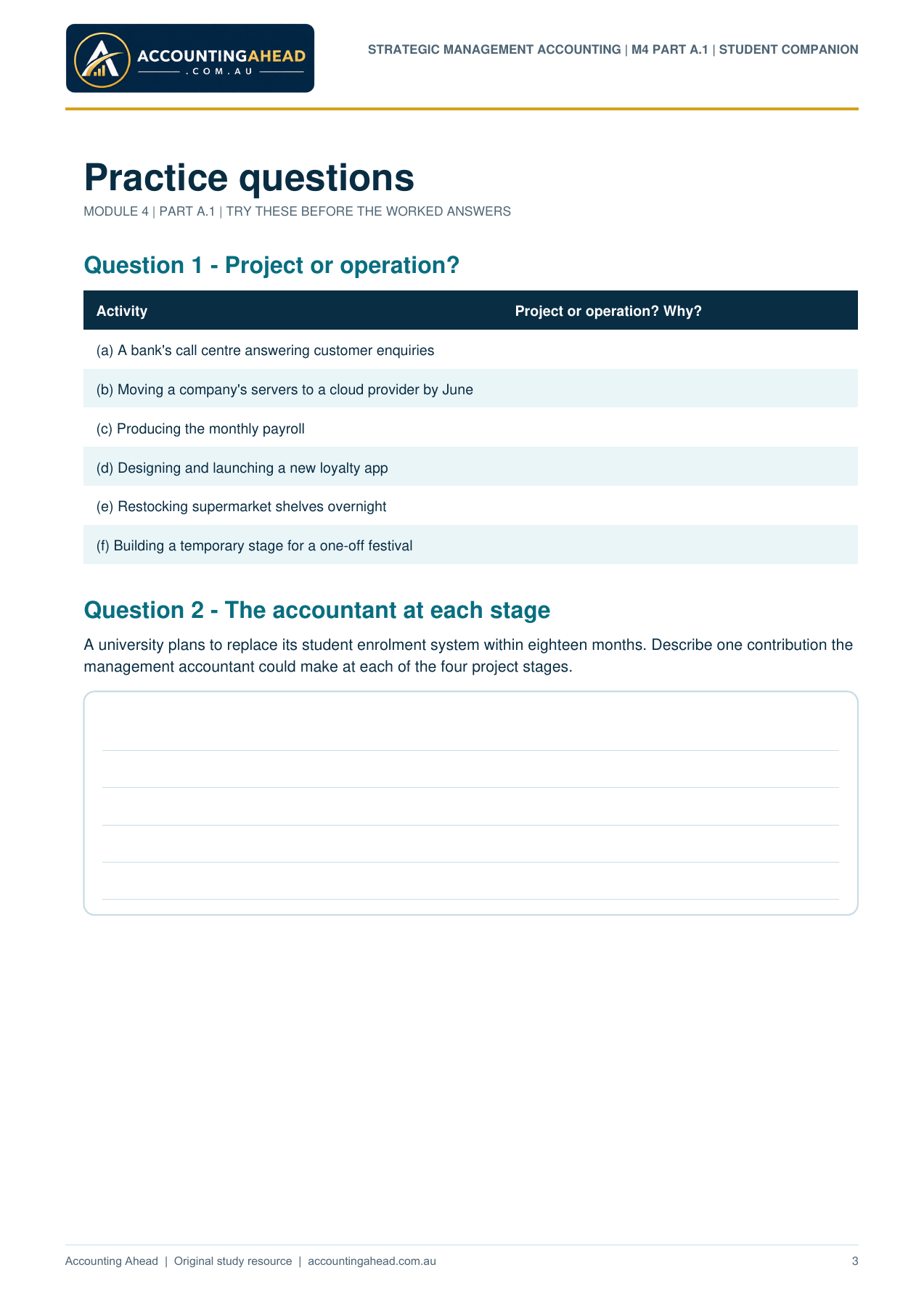
Practice questions
MODULE 4 | PART A.1 | TRY THESE BEFORE THE WORKED ANSWERS
Question 1 - Project or operation?
Activity Project or operation? Why?
(a) A bank's call centre answering customer enquiries
(b) Moving a company's servers to a cloud provider by June
(c) Producing the monthly payroll
(d) Designing and launching a new loyalty app
(e) Restocking supermarket shelves overnight
(f) Building a temporary stage for a one-off festival
Question 2 - The accountant at each stage
A university plans to replace its student enrolment system within eighteen months. Describe one contribution the
management accountant could make at each of the four project stages.
STRATEGIC MANAGEMENT ACCOUNTING | M4 PART A.1 | STUDENT COMPANION
3
Accounting Ahead | Original study resource | accountingahead.com.au
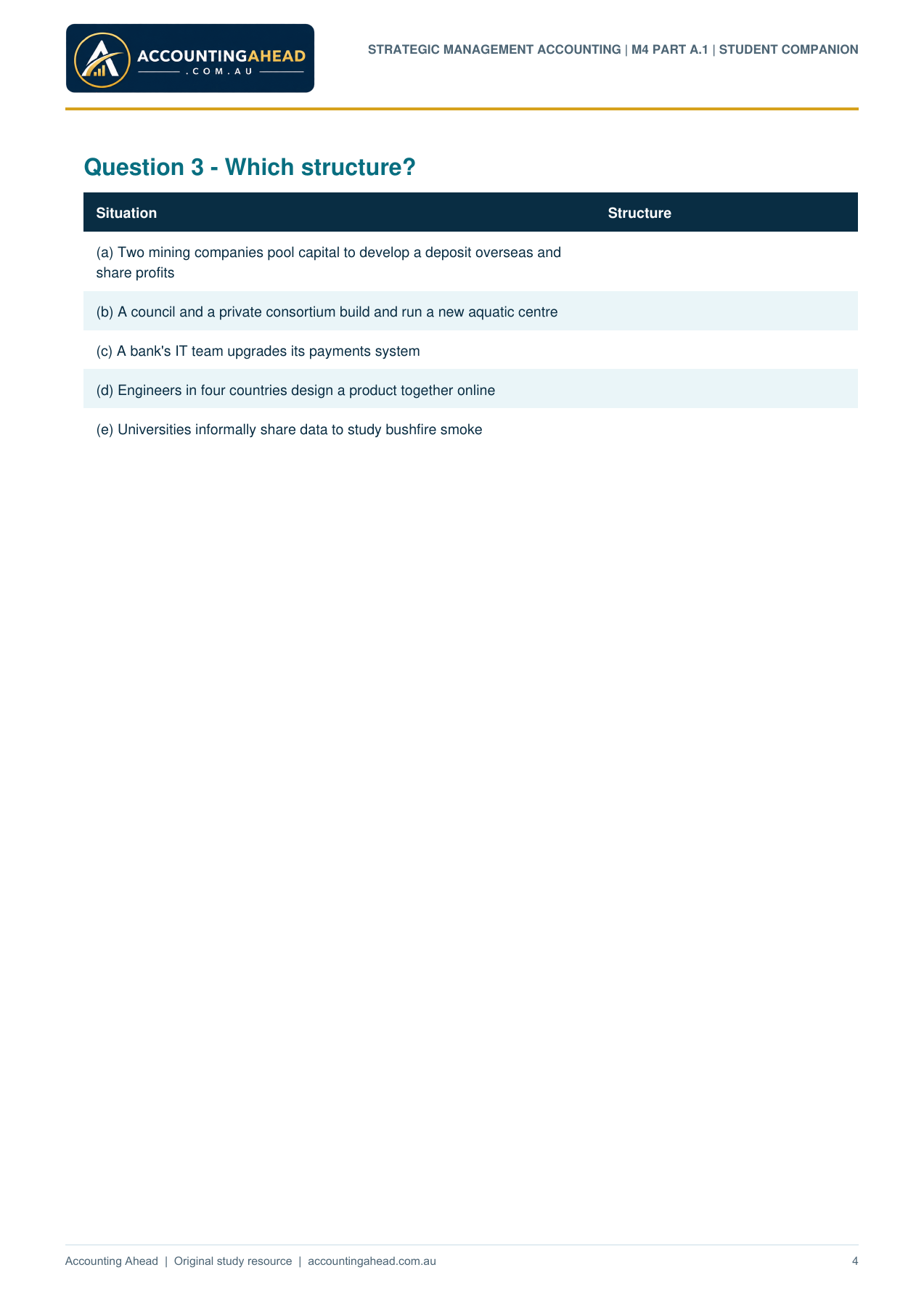
Question 3 - Which structure?
Situation Structure
(a) Two mining companies pool capital to develop a deposit overseas and
share profits
(b) A council and a private consortium build and run a new aquatic centre
(c) A bank's IT team upgrades its payments system
(d) Engineers in four countries design a product together online
(e) Universities informally share data to study bushfire smoke
STRATEGIC MANAGEMENT ACCOUNTING | M4 PART A.1 | STUDENT COMPANION
4
Accounting Ahead | Original study resource | accountingahead.com.au
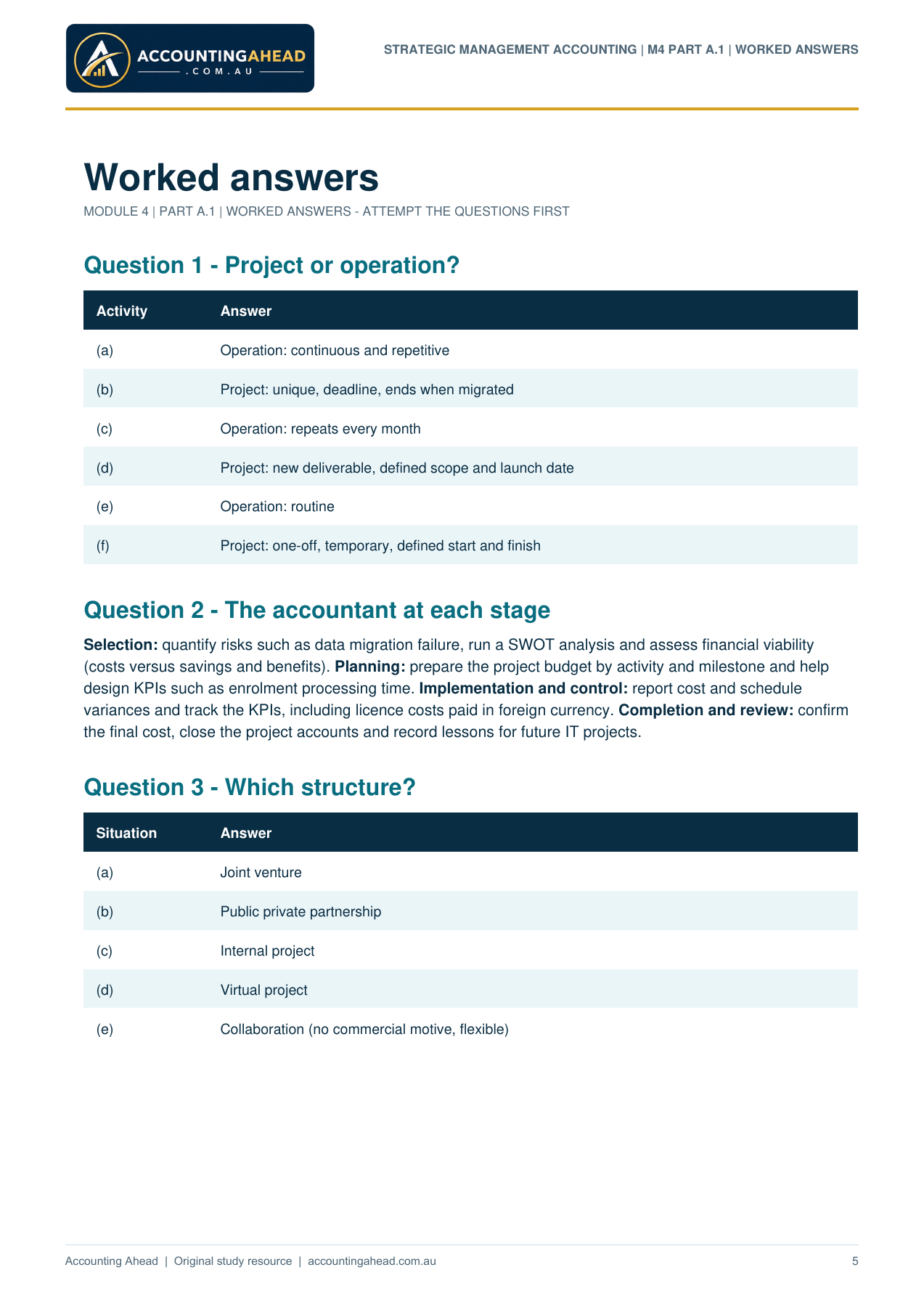
Worked answers
MODULE 4 | PART A.1 | WORKED ANSWERS - ATTEMPT THE QUESTIONS FIRST
Question 1 - Project or operation?
Activity Answer
(a) Operation: continuous and repetitive
(b) Project: unique, deadline, ends when migrated
(c) Operation: repeats every month
(d) Project: new deliverable, defined scope and launch date
(e) Operation: routine
(f) Project: one-off, temporary, defined start and finish
Question 2 - The accountant at each stage
Selection: quantify risks such as data migration failure, run a SWOT analysis and assess financial viability
(costs versus savings and benefits). Planning: prepare the project budget by activity and milestone and help
design KPIs such as enrolment processing time. Implementation and control: report cost and schedule
variances and track the KPIs, including licence costs paid in foreign currency. Completion and review: confirm
the final cost, close the project accounts and record lessons for future IT projects.
Question 3 - Which structure?
Situation Answer
(a) Joint venture
(b) Public private partnership
(c) Internal project
(d) Virtual project
(e) Collaboration (no commercial motive, flexible)
STRATEGIC MANAGEMENT ACCOUNTING | M4 PART A.1 | WORKED ANSWERS
5