
Project roles and teams
Printable study notes to use alongside Part B.1.
Read the handout text
Accounting Ahead | Original study resource | accountingahead.com.au
Project roles and teams
MODULE 4 | PART B.1 | STUDENT COMPANION
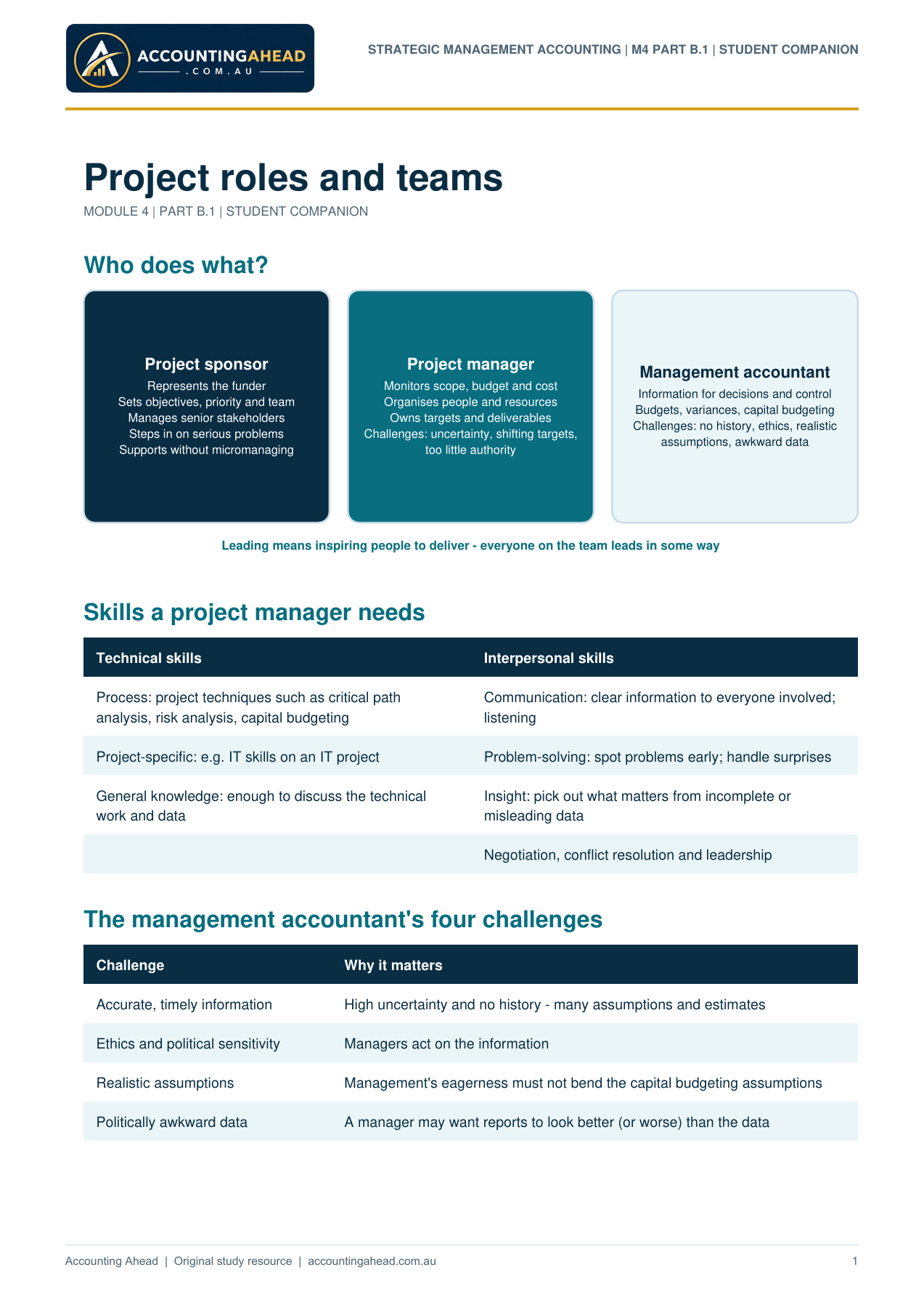
Who does what?
Project sponsor
Represents the funder
Sets objectives, priority and team
Manages senior stakeholders
Steps in on serious problems
Supports without micromanaging
Project manager
Monitors scope, budget and cost
Organises people and resources
Owns targets and deliverables
Challenges: uncertainty, shifting targets,
too little authority
Management accountant
Information for decisions and control
Budgets, variances, capital budgeting
Challenges: no history, ethics, realistic
assumptions, awkward data
Leading means inspiring people to deliver - everyone on the team leads in some way
Skills a project manager needs
Technical skills Interpersonal skills
Process: project techniques such as critical path
analysis, risk analysis, capital budgeting
Communication: clear information to everyone involved;
listening
Project-specific: e.g. IT skills on an IT project Problem-solving: spot problems early; handle surprises
General knowledge: enough to discuss the technical
work and data
Insight: pick out what matters from incomplete or
misleading data
Negotiation, conflict resolution and leadership
The management accountant's four challenges
Challenge Why it matters
Accurate, timely information High uncertainty and no history - many assumptions and estimates
Ethics and political sensitivity Managers act on the information
Realistic assumptions Management's eagerness must not bend the capital budgeting assumptions
Politically awkward data A manager may want reports to look better (or worse) than the data
STRATEGIC MANAGEMENT ACCOUNTING | M4 PART B.1 | STUDENT COMPANION
1
Accounting Ahead | Original study resource | accountingahead.com.au
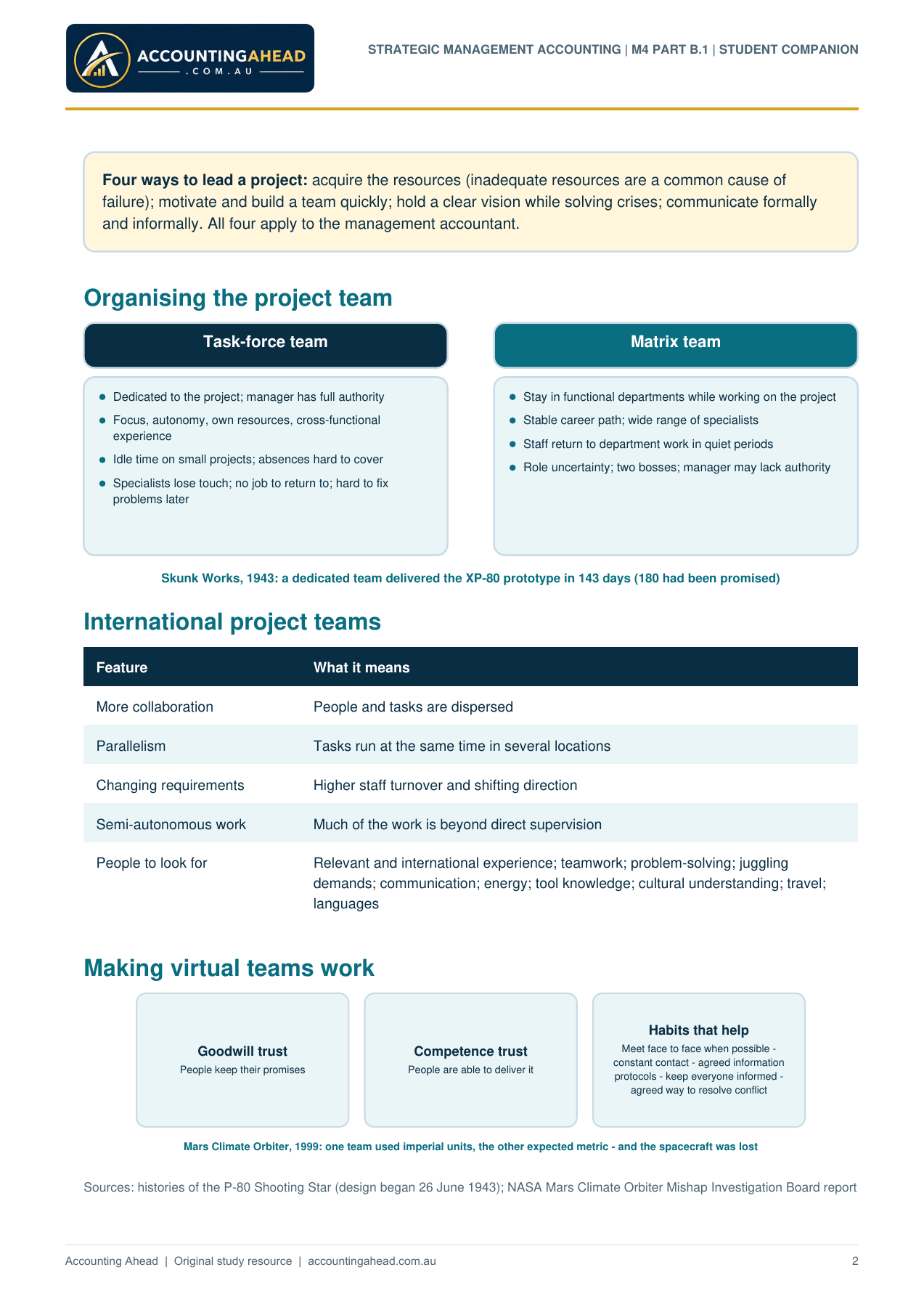
Four ways to lead a project: acquire the resources (inadequate resources are a common cause of
failure); motivate and build a team quickly; hold a clear vision while solving crises; communicate formally
and informally. All four apply to the management accountant.
Organising the project team
Task-force team
Dedicated to the project; manager has full authority
Focus, autonomy, own resources, cross-functional
experience
Idle time on small projects; absences hard to cover
Specialists lose touch; no job to return to; hard to fix
problems later
Matrix team
Stay in functional departments while working on the project
Stable career path; wide range of specialists
Staff return to department work in quiet periods
Role uncertainty; two bosses; manager may lack authority
Skunk Works, 1943: a dedicated team delivered the XP-80 prototype in 143 days (180 had been promised)
International project teams
Feature What it means
More collaboration People and tasks are dispersed
Parallelism Tasks run at the same time in several locations
Changing requirements Higher staff turnover and shifting direction
Semi-autonomous work Much of the work is beyond direct supervision
People to look for Relevant and international experience; teamwork; problem-solving; juggling
demands; communication; energy; tool knowledge; cultural understanding; travel;
languages
Making virtual teams work
Goodwill trust
People keep their promises
Competence trust
People are able to deliver it
Habits that help
Meet face to face when possible -
constant contact - agreed information
protocols - keep everyone informed -
agreed way to resolve conflict
Mars Climate Orbiter, 1999: one team used imperial units, the other expected metric - and the spacecraft was lost
Sources: histories of the P-80 Shooting Star (design began 26 June 1943); NASA Mars Climate Orbiter Mishap Investigation Board report
STRATEGIC MANAGEMENT ACCOUNTING | M4 PART B.1 | STUDENT COMPANION
2
Accounting Ahead | Original study resource | accountingahead.com.au
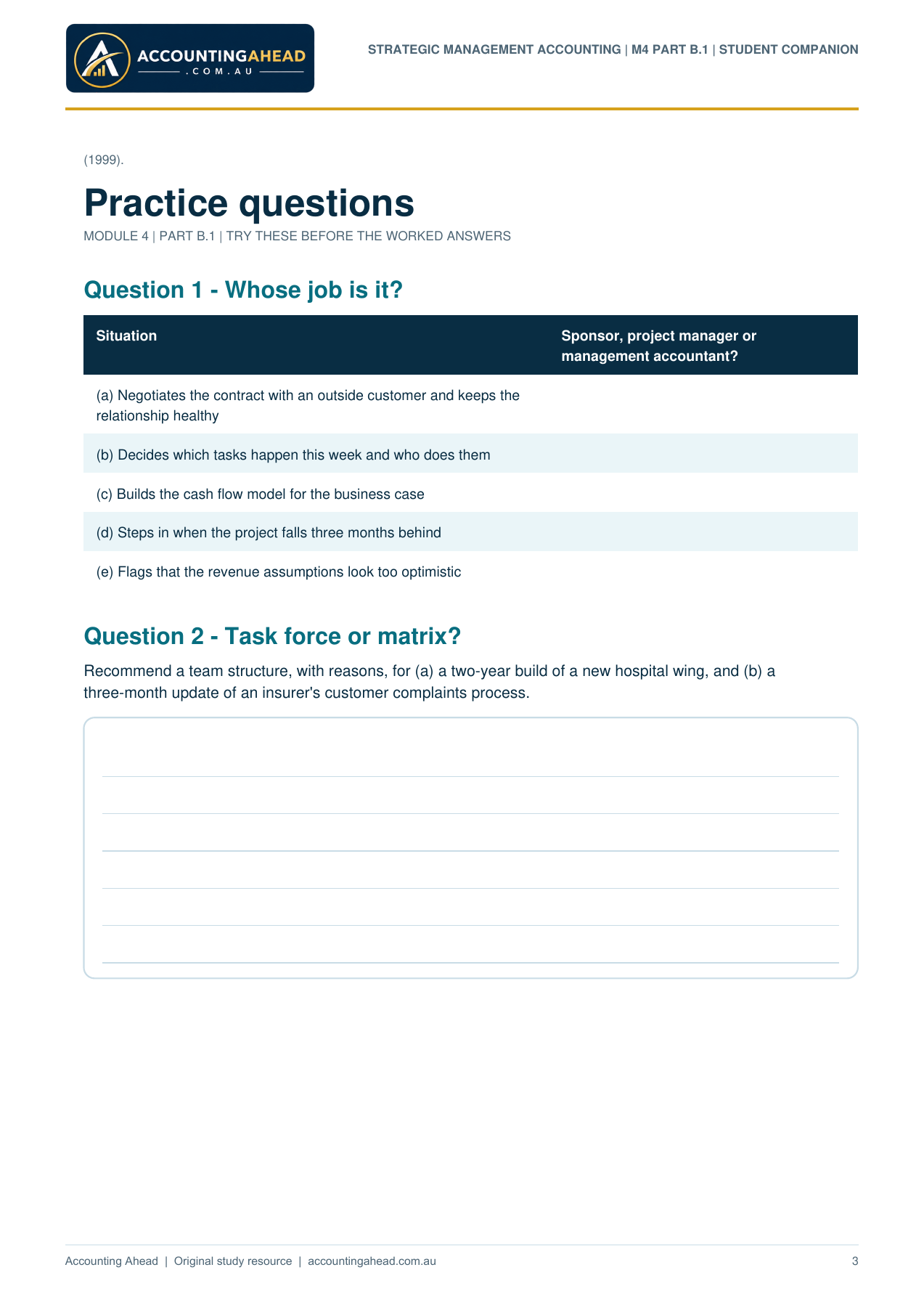
(1999).
Practice questions
MODULE 4 | PART B.1 | TRY THESE BEFORE THE WORKED ANSWERS
Question 1 - Whose job is it?
Situation Sponsor, project manager or
management accountant?
(a) Negotiates the contract with an outside customer and keeps the
relationship healthy
(b) Decides which tasks happen this week and who does them
(c) Builds the cash flow model for the business case
(d) Steps in when the project falls three months behind
(e) Flags that the revenue assumptions look too optimistic
Question 2 - Task force or matrix?
Recommend a team structure, with reasons, for (a) a two-year build of a new hospital wing, and (b) a
three-month update of an insurer's customer complaints process.
STRATEGIC MANAGEMENT ACCOUNTING | M4 PART B.1 | STUDENT COMPANION
3
Accounting Ahead | Original study resource | accountingahead.com.au
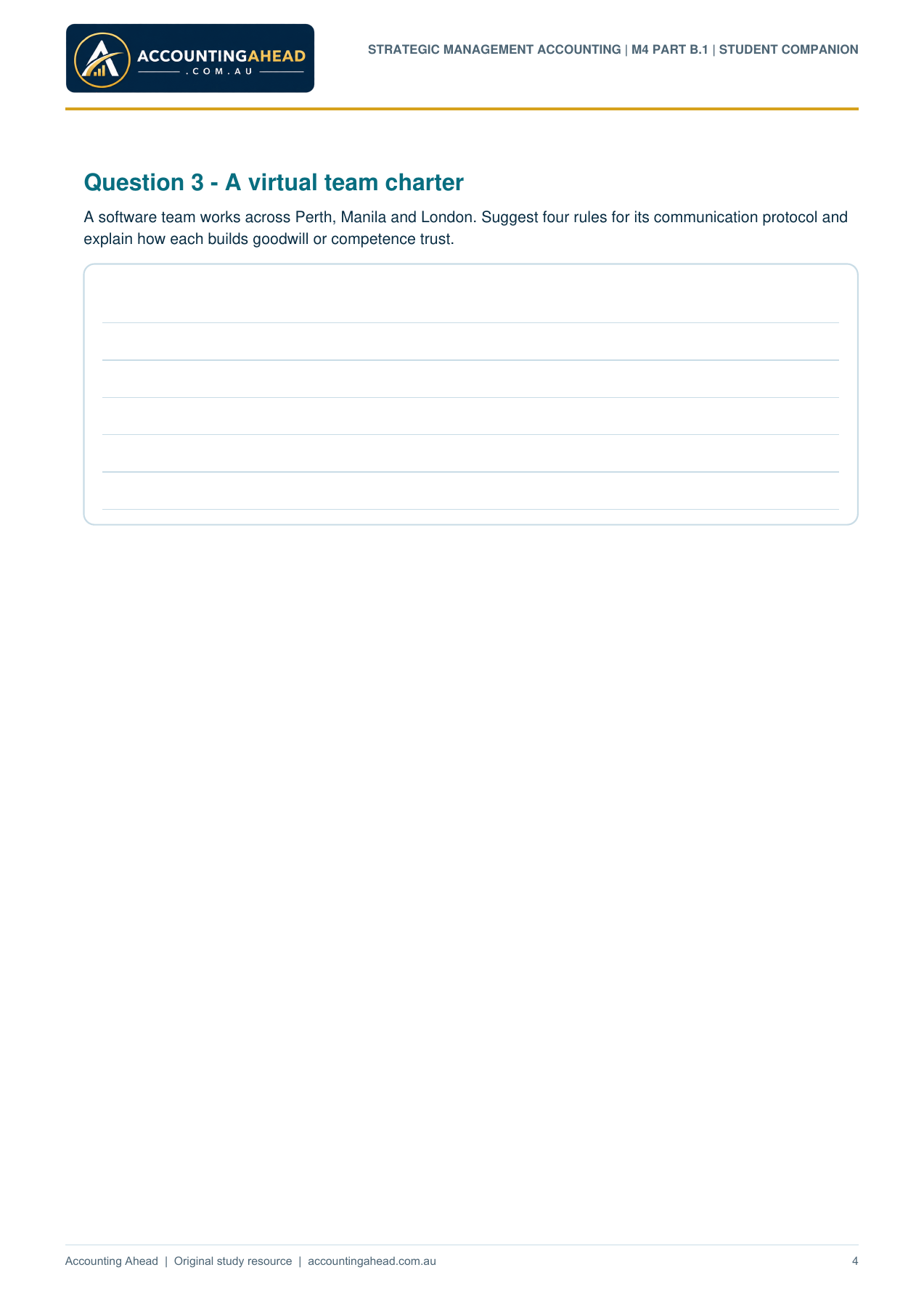
Question 3 - A virtual team charter
A software team works across Perth, Manila and London. Suggest four rules for its communication protocol and
explain how each builds goodwill or competence trust.
STRATEGIC MANAGEMENT ACCOUNTING | M4 PART B.1 | STUDENT COMPANION
4
Accounting Ahead | Original study resource | accountingahead.com.au
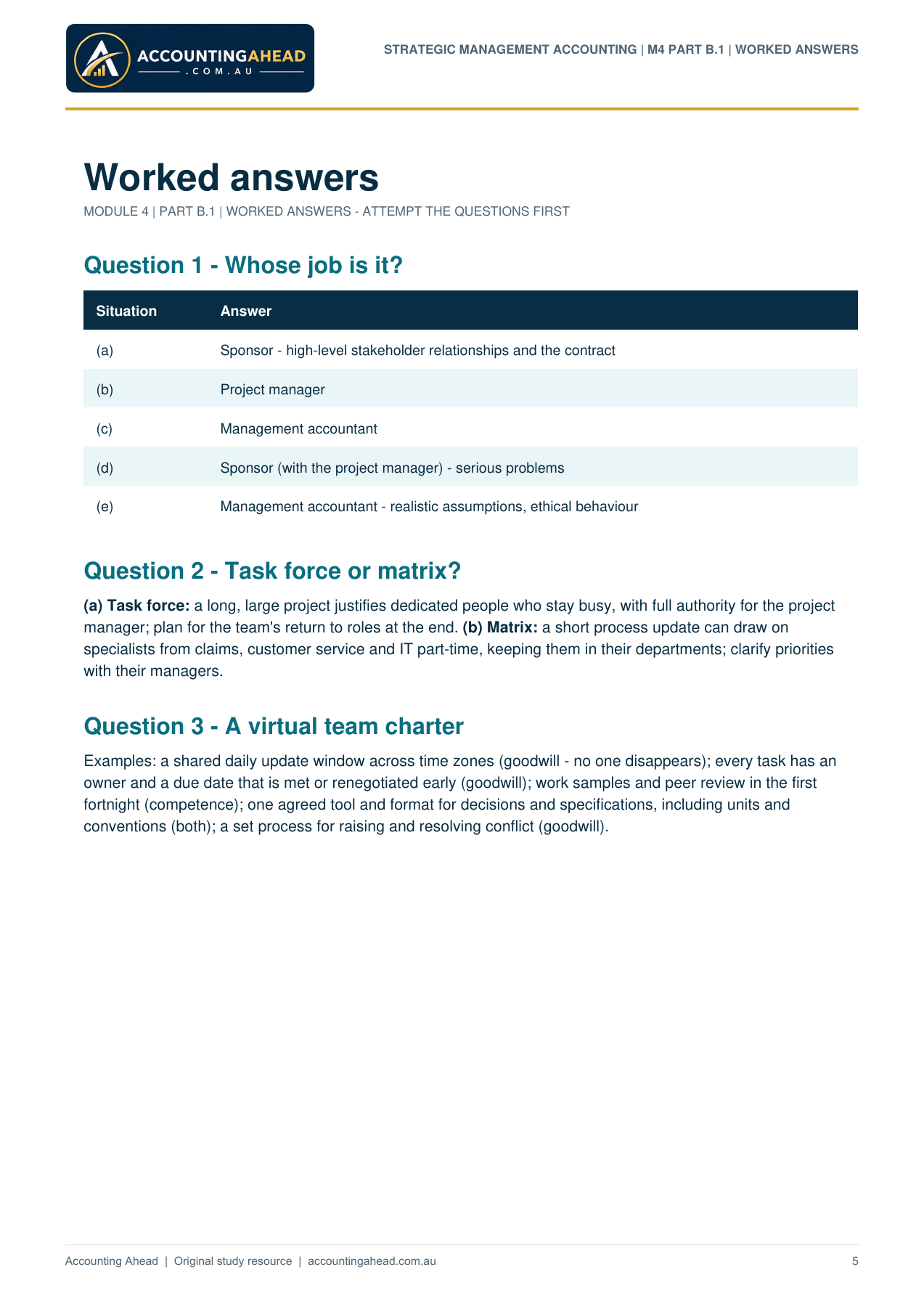
Worked answers
MODULE 4 | PART B.1 | WORKED ANSWERS - ATTEMPT THE QUESTIONS FIRST
Question 1 - Whose job is it?
Situation Answer
(a) Sponsor - high-level stakeholder relationships and the contract
(b) Project manager
(c) Management accountant
(d) Sponsor (with the project manager) - serious problems
(e) Management accountant - realistic assumptions, ethical behaviour
Question 2 - Task force or matrix?
(a) Task force: a long, large project justifies dedicated people who stay busy, with full authority for the project
manager; plan for the team's return to roles at the end. (b) Matrix: a short process update can draw on
specialists from claims, customer service and IT part-time, keeping them in their departments; clarify priorities
with their managers.
Question 3 - A virtual team charter
Examples: a shared daily update window across time zones (goodwill - no one disappears); every task has an
owner and a due date that is met or renegotiated early (goodwill); work samples and peer review in the first
fortnight (competence); one agreed tool and format for decisions and specifications, including units and
conventions (both); a set process for raising and resolving conflict (goodwill).
STRATEGIC MANAGEMENT ACCOUNTING | M4 PART B.1 | WORKED ANSWERS
5