
Business case and strategic fit
Printable study notes to use alongside Part C.1.
Read the handout text
Accounting Ahead | Original study resource | accountingahead.com.au
Business case and strategic fit
MODULE 4 | PART C.1 | STUDENT COMPANION
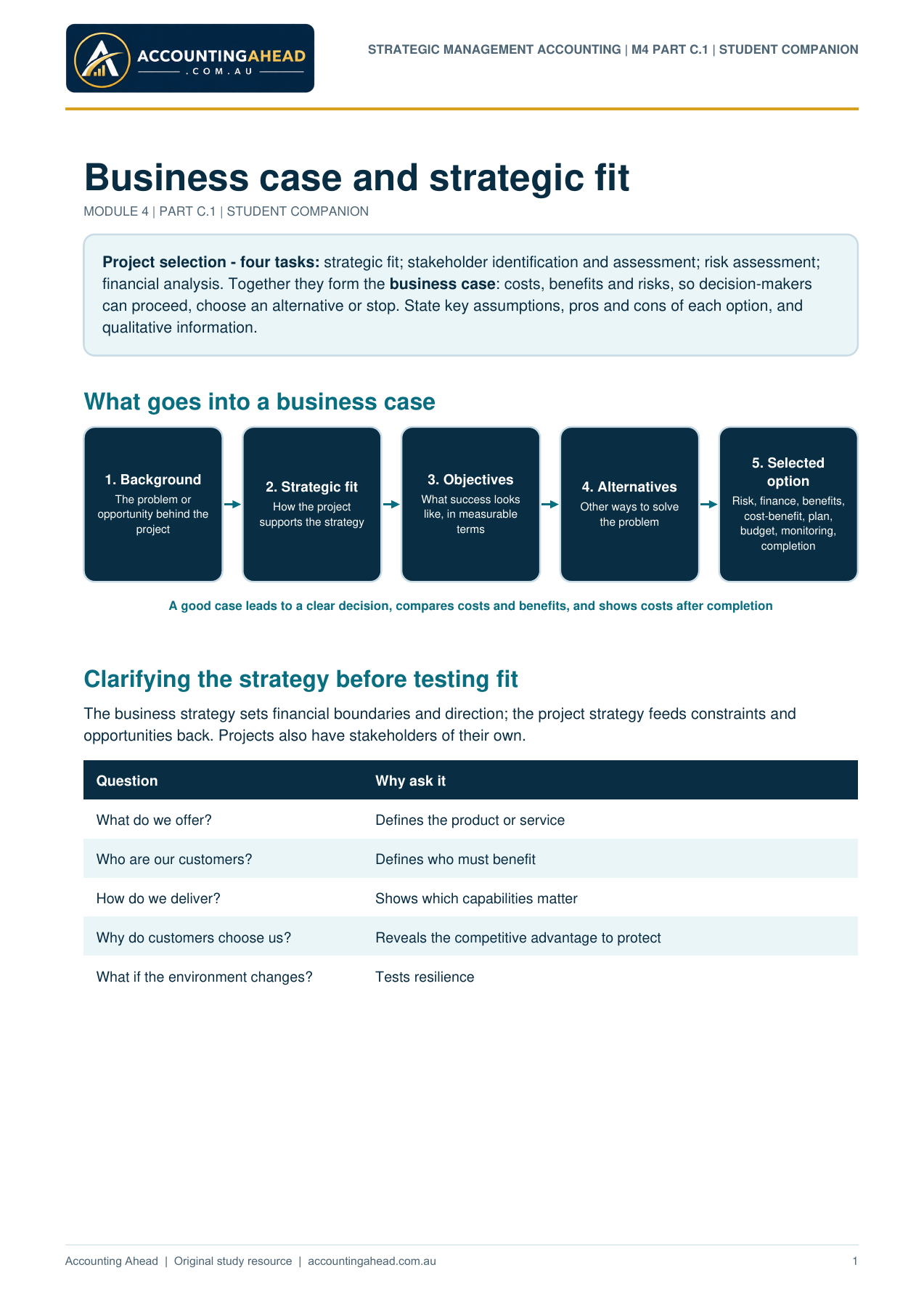
Project selection - four tasks: strategic fit; stakeholder identification and assessment; risk assessment;
financial analysis. Together they form the business case: costs, benefits and risks, so decision-makers
can proceed, choose an alternative or stop. State key assumptions, pros and cons of each option, and
qualitative information.
What goes into a business case
1. Background
The problem or
opportunity behind the
project
2. Strategic fit
How the project
supports the strategy
3. Objectives
What success looks
like, in measurable
terms
4. Alternatives
Other ways to solve
the problem
5. Selected
option
Risk, finance, benefits,
cost-benefit, plan,
budget, monitoring,
completion
A good case leads to a clear decision, compares costs and benefits, and shows costs after completion
Clarifying the strategy before testing fit
The business strategy sets financial boundaries and direction; the project strategy feeds constraints and
opportunities back. Projects also have stakeholders of their own.
Question Why ask it
What do we offer? Defines the product or service
Who are our customers? Defines who must benefit
How do we deliver? Shows which capabilities matter
Why do customers choose us? Reveals the competitive advantage to protect
What if the environment changes? Tests resilience
STRATEGIC MANAGEMENT ACCOUNTING | M4 PART C.1 | STUDENT COMPANION
1
Accounting Ahead | Original study resource | accountingahead.com.au
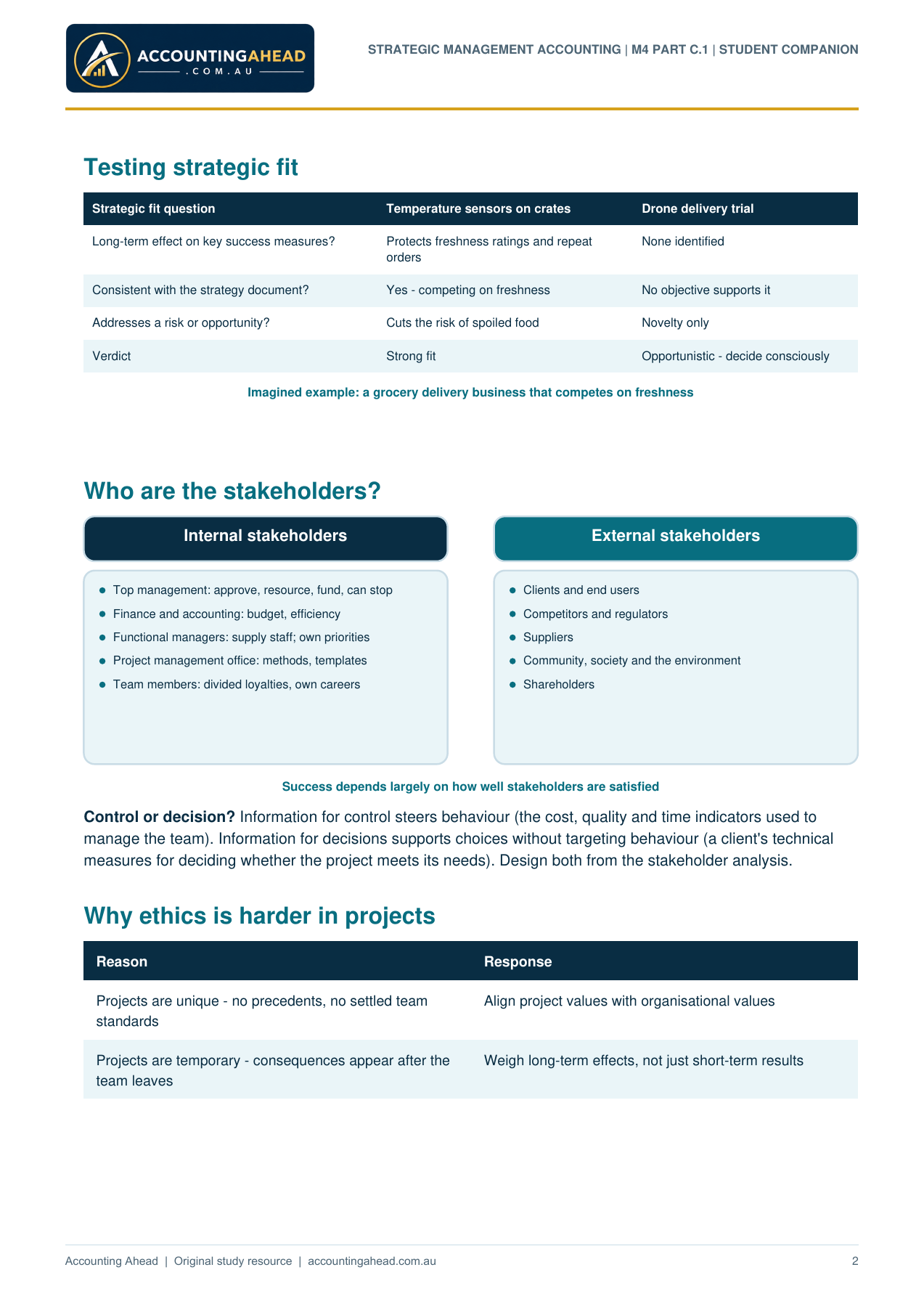
Testing strategic fit
Strategic fit question Temperature sensors on crates Drone delivery trial
Long-term effect on key success measures? Protects freshness ratings and repeat
orders
None identified
Consistent with the strategy document? Yes - competing on freshness No objective supports it
Addresses a risk or opportunity? Cuts the risk of spoiled food Novelty only
Verdict Strong fit Opportunistic - decide consciously
Imagined example: a grocery delivery business that competes on freshness
Who are the stakeholders?
Internal stakeholders
Top management: approve, resource, fund, can stop
Finance and accounting: budget, efficiency
Functional managers: supply staff; own priorities
Project management office: methods, templates
Team members: divided loyalties, own careers
External stakeholders
Clients and end users
Competitors and regulators
Suppliers
Community, society and the environment
Shareholders
Success depends largely on how well stakeholders are satisfied
Control or decision? Information for control steers behaviour (the cost, quality and time indicators used to
manage the team). Information for decisions supports choices without targeting behaviour (a client's technical
measures for deciding whether the project meets its needs). Design both from the stakeholder analysis.
Why ethics is harder in projects
Reason Response
Projects are unique - no precedents, no settled team
standards
Align project values with organisational values
Projects are temporary - consequences appear after the
team leaves
Weigh long-term effects, not just short-term results
STRATEGIC MANAGEMENT ACCOUNTING | M4 PART C.1 | STUDENT COMPANION
2
Accounting Ahead | Original study resource | accountingahead.com.au
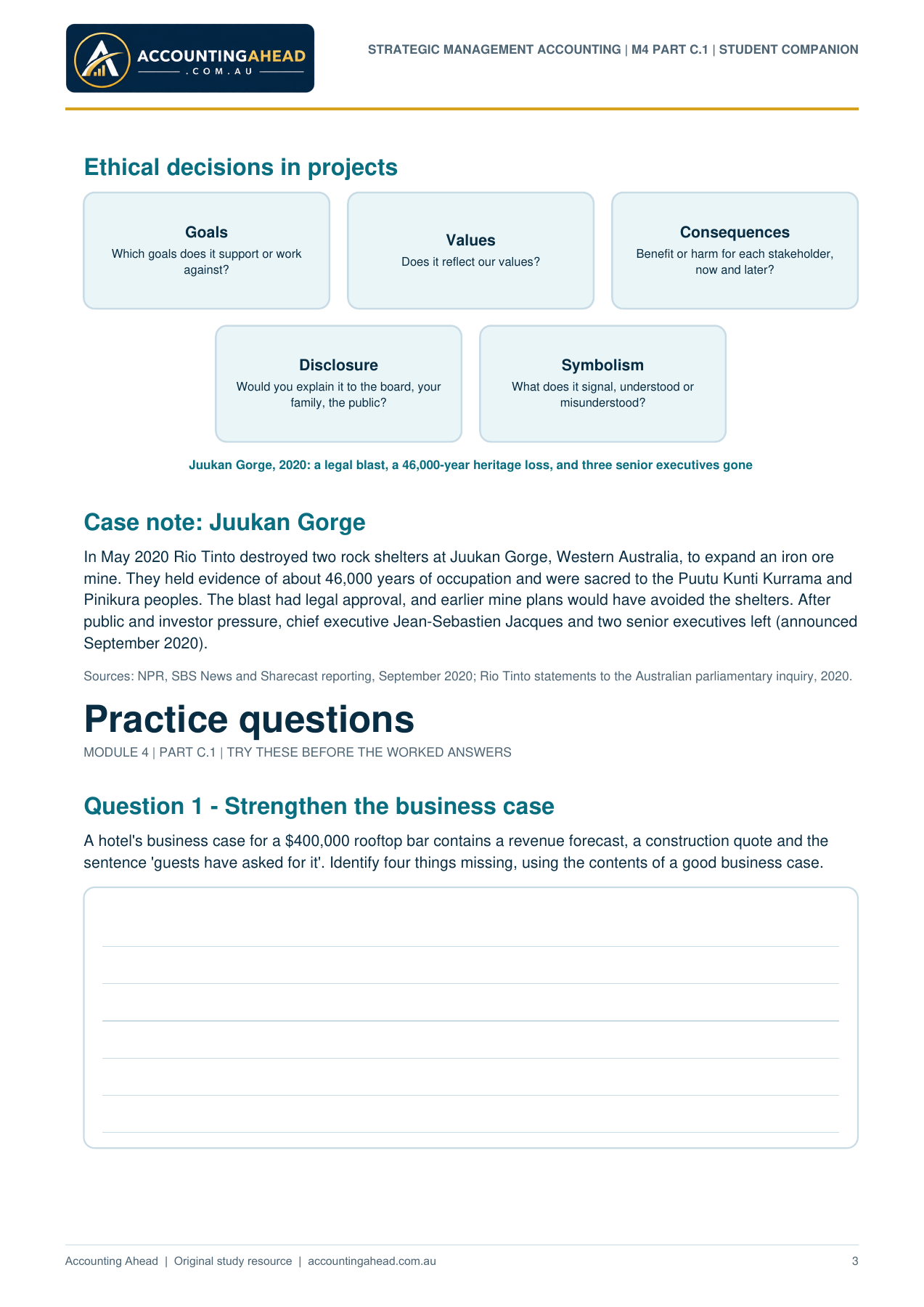
Ethical decisions in projects
Goals
Which goals does it support or work
against?
Values
Does it reflect our values?
Consequences
Benefit or harm for each stakeholder,
now and later?
Disclosure
Would you explain it to the board, your
family, the public?
Symbolism
What does it signal, understood or
misunderstood?
Juukan Gorge, 2020: a legal blast, a 46,000-year heritage loss, and three senior executives gone
Case note: Juukan Gorge
In May 2020 Rio Tinto destroyed two rock shelters at Juukan Gorge, Western Australia, to expand an iron ore
mine. They held evidence of about 46,000 years of occupation and were sacred to the Puutu Kunti Kurrama and
Pinikura peoples. The blast had legal approval, and earlier mine plans would have avoided the shelters. After
public and investor pressure, chief executive Jean-Sebastien Jacques and two senior executives left (announced
September 2020).
Sources: NPR, SBS News and Sharecast reporting, September 2020; Rio Tinto statements to the Australian parliamentary inquiry, 2020.
Practice questions
MODULE 4 | PART C.1 | TRY THESE BEFORE THE WORKED ANSWERS
Question 1 - Strengthen the business case
A hotel's business case for a $400,000 rooftop bar contains a revenue forecast, a construction quote and the
sentence 'guests have asked for it'. Identify four things missing, using the contents of a good business case.
STRATEGIC MANAGEMENT ACCOUNTING | M4 PART C.1 | STUDENT COMPANION
3
Accounting Ahead | Original study resource | accountingahead.com.au
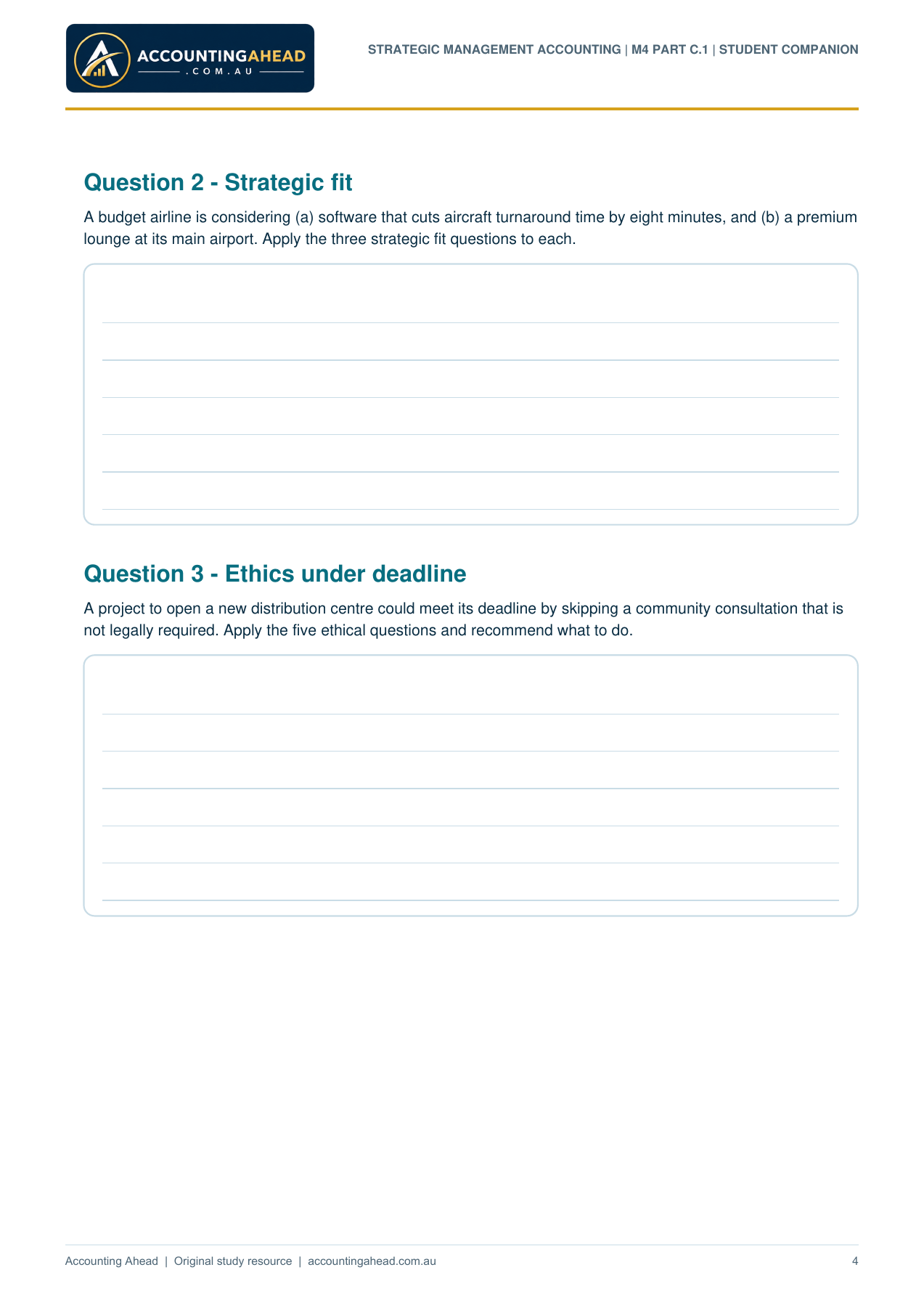
Question 2 - Strategic fit
A budget airline is considering (a) software that cuts aircraft turnaround time by eight minutes, and (b) a premium
lounge at its main airport. Apply the three strategic fit questions to each.
Question 3 - Ethics under deadline
A project to open a new distribution centre could meet its deadline by skipping a community consultation that is
not legally required. Apply the five ethical questions and recommend what to do.
STRATEGIC MANAGEMENT ACCOUNTING | M4 PART C.1 | STUDENT COMPANION
4
Accounting Ahead | Original study resource | accountingahead.com.au
Worked answers
MODULE 4 | PART C.1 | WORKED ANSWERS - ATTEMPT THE QUESTIONS FIRST
Question 1 - Strengthen the business case
Missing: (1) a clear problem or opportunity statement backed by evidence, not anecdote; (2) strategic fit with the
hotel's positioning; (3) measurable objectives (e.g. revenue per guest, occupancy uplift); (4) alternatives
considered (e.g. upgrading the existing lounge bar); (5) risk assessment (approvals, weather, noise complaints),
costs after completion (staffing, maintenance), key assumptions, and how performance will be monitored.
Question 2 - Strategic fit
(a) Turnaround software: improves aircraft utilisation and unit cost - a key low-cost measure; consistent with a
cost leadership strategy; reduces the risk of delays. Strong fit. (b) Premium lounge: little effect on cost
measures; inconsistent with a no-frills strategy; may confuse the brand. Poor fit - only proceed as a conscious,
opportunistic choice with a strong case.
Question 3 - Ethics under deadline
Goals: speed versus community acceptance. Values: most organisations claim to respect neighbours.
Consequences: traffic, noise and trust effects for residents; future planning approvals at risk. Disclosure:
uncomfortable to explain publicly. Symbolism: signals that legal minimums are all that matter. Recommendation:
hold a shortened but genuine consultation and adjust the schedule, or phase the opening.
STRATEGIC MANAGEMENT ACCOUNTING | M4 PART C.1 | WORKED ANSWERS
5