
Gantt charts, budgets and contracts
Printable study notes to use alongside Part D.1.
Read the handout text
Accounting Ahead | Original study resource | accountingahead.com.au
Gantt charts, budgets and contracts
MODULE 4 | PART D.1 | STUDENT COMPANION
Project planning steps
1. Describe
Activities and tasks in
detail, with resources and
responsibilities
2. Develop
The project budget and
schedule from the work
plans
3. Decide
How to monitor: when,
how often, what reports,
to whom
4. Complete
Prepare for the project's
completion
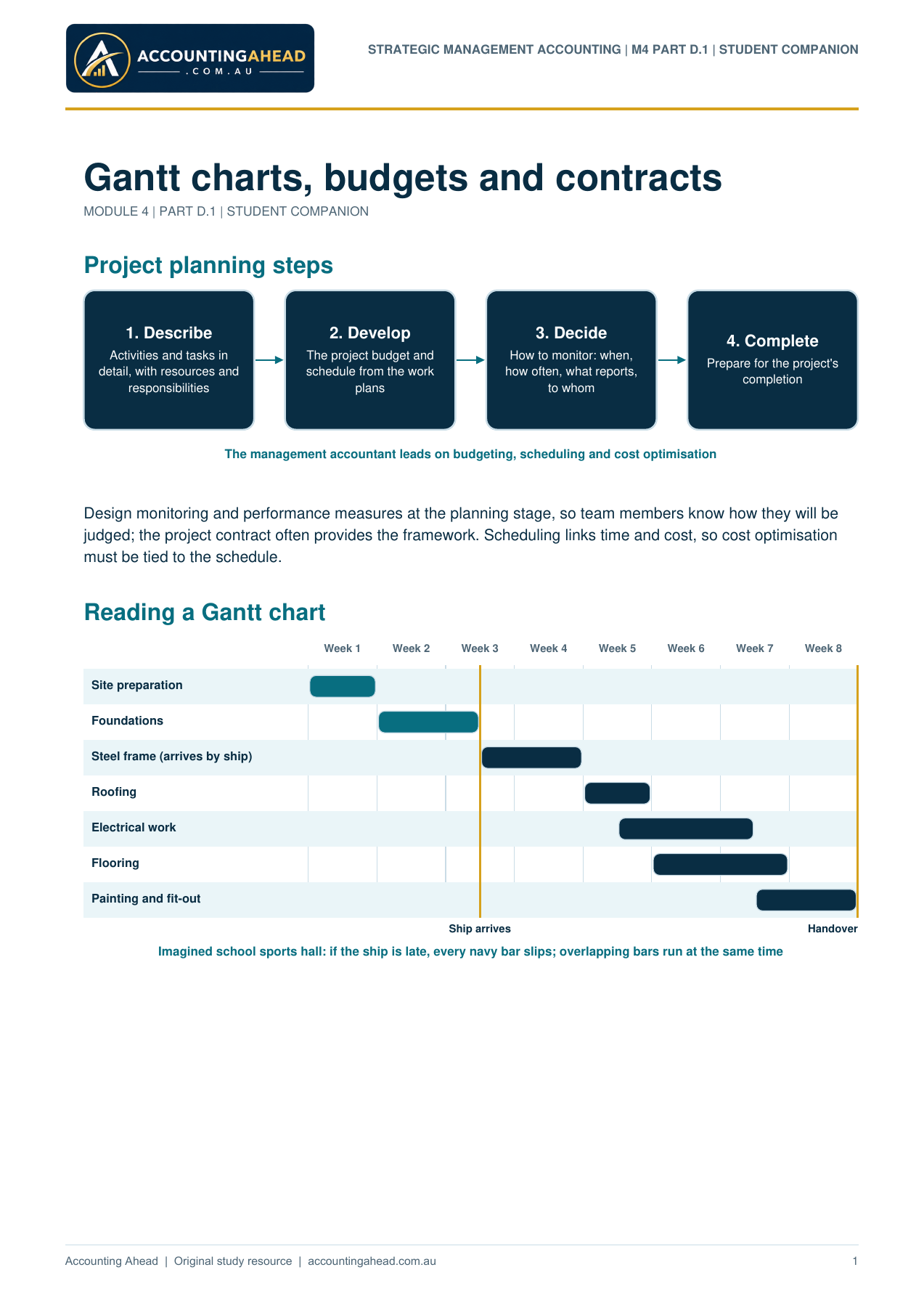
The management accountant leads on budgeting, scheduling and cost optimisation
Design monitoring and performance measures at the planning stage, so team members know how they will be
judged; the project contract often provides the framework. Scheduling links time and cost, so cost optimisation
must be tied to the schedule.
Reading a Gantt chart
Week 1 Week 2 Week 3 Week 4 Week 5 Week 6 Week 7 Week 8
Site preparation
Foundations
Steel frame (arrives by ship)
Roofing
Electrical work
Flooring
Painting and fit-out
Ship arrives Handover
Imagined school sports hall: if the ship is late, every navy bar slips; overlapping bars run at the same time
STRATEGIC MANAGEMENT ACCOUNTING | M4 PART D.1 | STUDENT COMPANION
1
Accounting Ahead | Original study resource | accountingahead.com.au
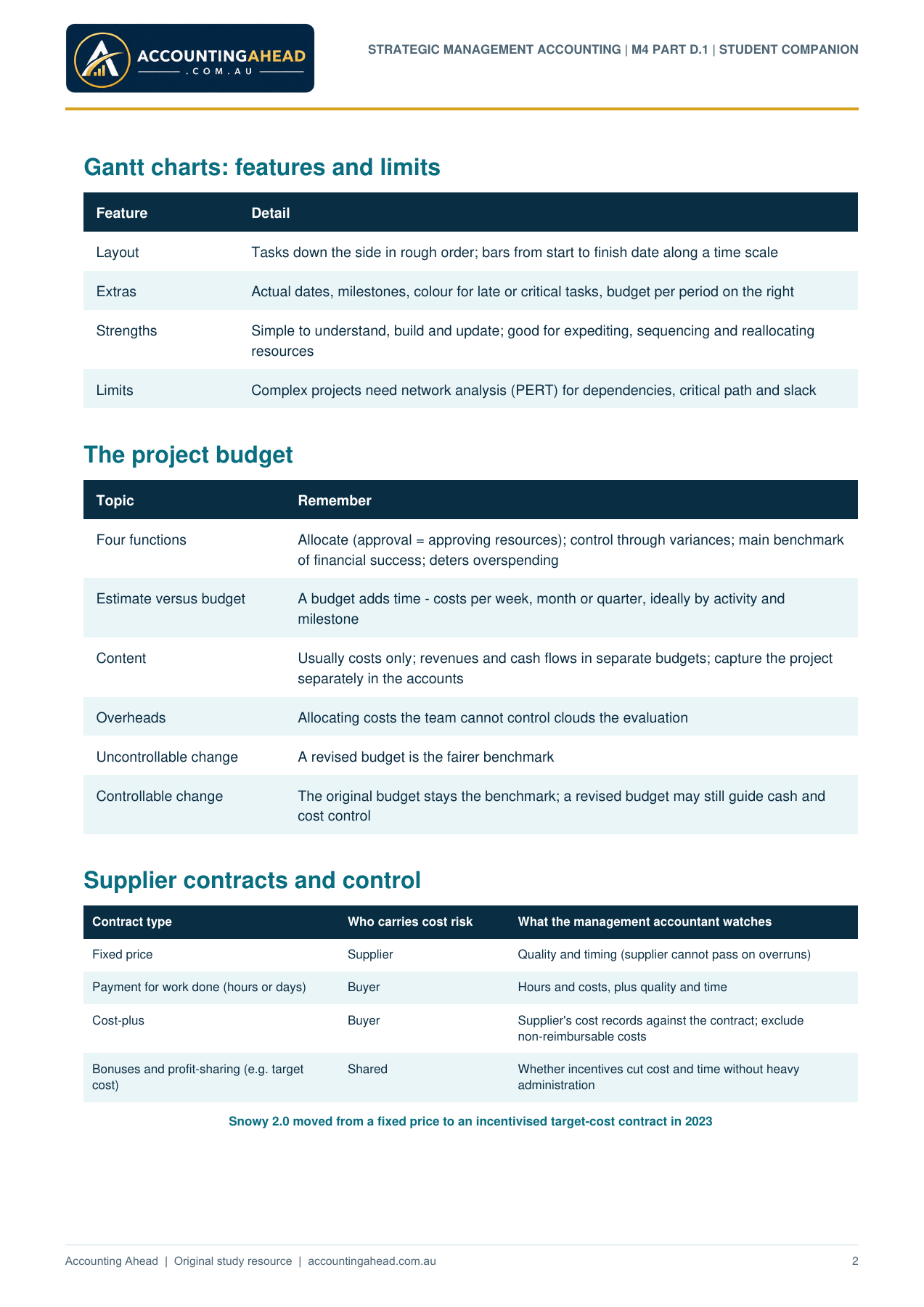
Gantt charts: features and limits
Feature Detail
Layout Tasks down the side in rough order; bars from start to finish date along a time scale
Extras Actual dates, milestones, colour for late or critical tasks, budget per period on the right
Strengths Simple to understand, build and update; good for expediting, sequencing and reallocating
resources
Limits Complex projects need network analysis (PERT) for dependencies, critical path and slack
The project budget
Topic Remember
Four functions Allocate (approval = approving resources); control through variances; main benchmark
of financial success; deters overspending
Estimate versus budget A budget adds time - costs per week, month or quarter, ideally by activity and
milestone
Content Usually costs only; revenues and cash flows in separate budgets; capture the project
separately in the accounts
Overheads Allocating costs the team cannot control clouds the evaluation
Uncontrollable change A revised budget is the fairer benchmark
Controllable change The original budget stays the benchmark; a revised budget may still guide cash and
cost control
Supplier contracts and control
Contract type Who carries cost risk What the management accountant watches
Fixed price Supplier Quality and timing (supplier cannot pass on overruns)
Payment for work done (hours or days) Buyer Hours and costs, plus quality and time
Cost-plus Buyer Supplier's cost records against the contract; exclude
non-reimbursable costs
Bonuses and profit-sharing (e.g. target
cost)
Shared Whether incentives cut cost and time without heavy
administration
Snowy 2.0 moved from a fixed price to an incentivised target-cost contract in 2023
STRATEGIC MANAGEMENT ACCOUNTING | M4 PART D.1 | STUDENT COMPANION
2
Accounting Ahead | Original study resource | accountingahead.com.au
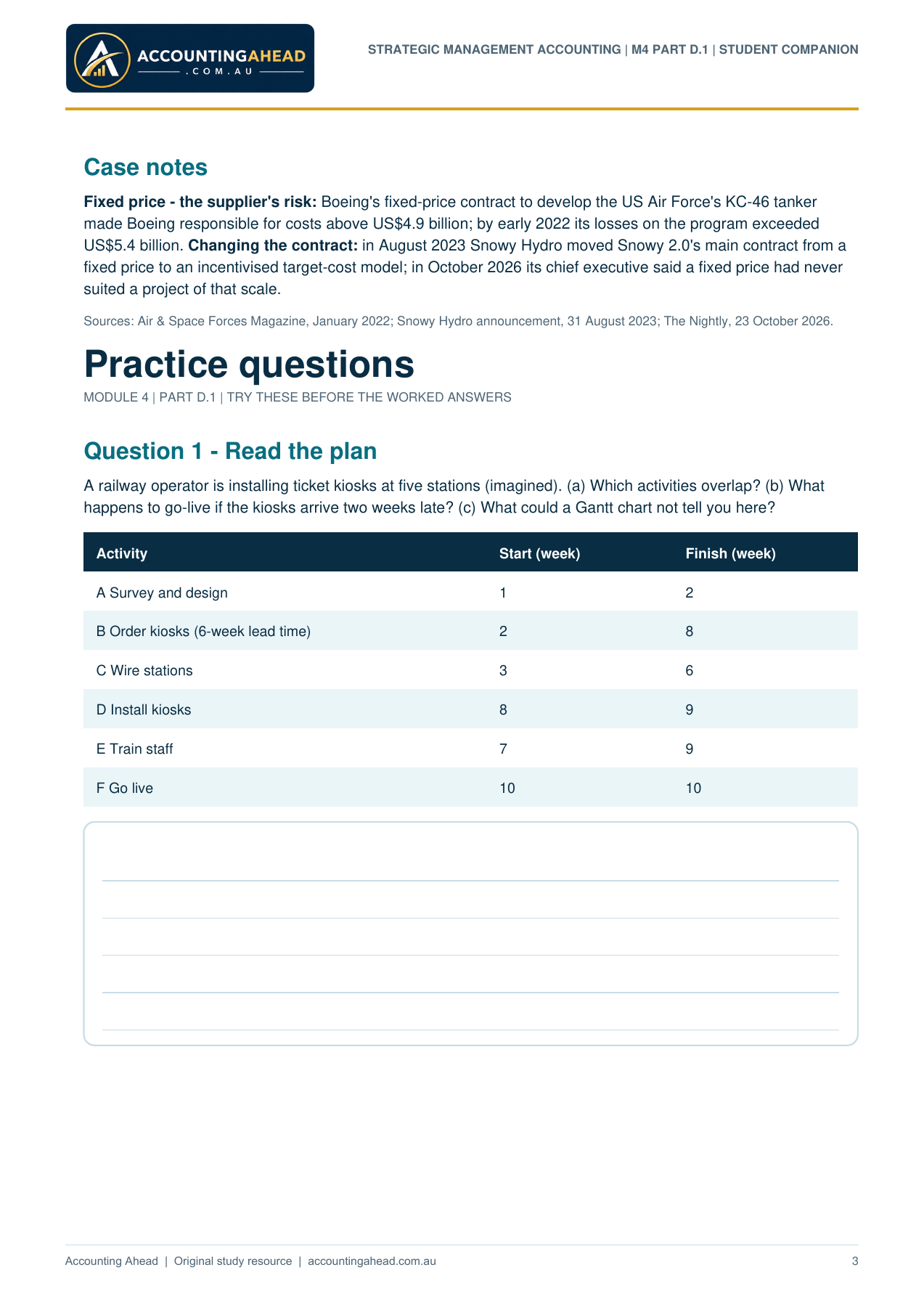
Case notes
Fixed price - the supplier's risk: Boeing's fixed-price contract to develop the US Air Force's KC-46 tanker
made Boeing responsible for costs above US$4.9 billion; by early 2022 its losses on the program exceeded
US$5.4 billion. Changing the contract: in August 2023 Snowy Hydro moved Snowy 2.0's main contract from a
fixed price to an incentivised target-cost model; in October 2026 its chief executive said a fixed price had never
suited a project of that scale.
Sources: Air & Space Forces Magazine, January 2022; Snowy Hydro announcement, 31 August 2023; The Nightly, 23 October 2026.
Practice questions
MODULE 4 | PART D.1 | TRY THESE BEFORE THE WORKED ANSWERS
Question 1 - Read the plan
A railway operator is installing ticket kiosks at five stations (imagined). (a) Which activities overlap? (b) What
happens to go-live if the kiosks arrive two weeks late? (c) What could a Gantt chart not tell you here?
Activity Start (week) Finish (week)
A Survey and design 1 2
B Order kiosks (6-week lead time) 2 8
C Wire stations 3 6
D Install kiosks 8 9
E Train staff 7 9
F Go live 10 10
STRATEGIC MANAGEMENT ACCOUNTING | M4 PART D.1 | STUDENT COMPANION
3
Accounting Ahead | Original study resource | accountingahead.com.au
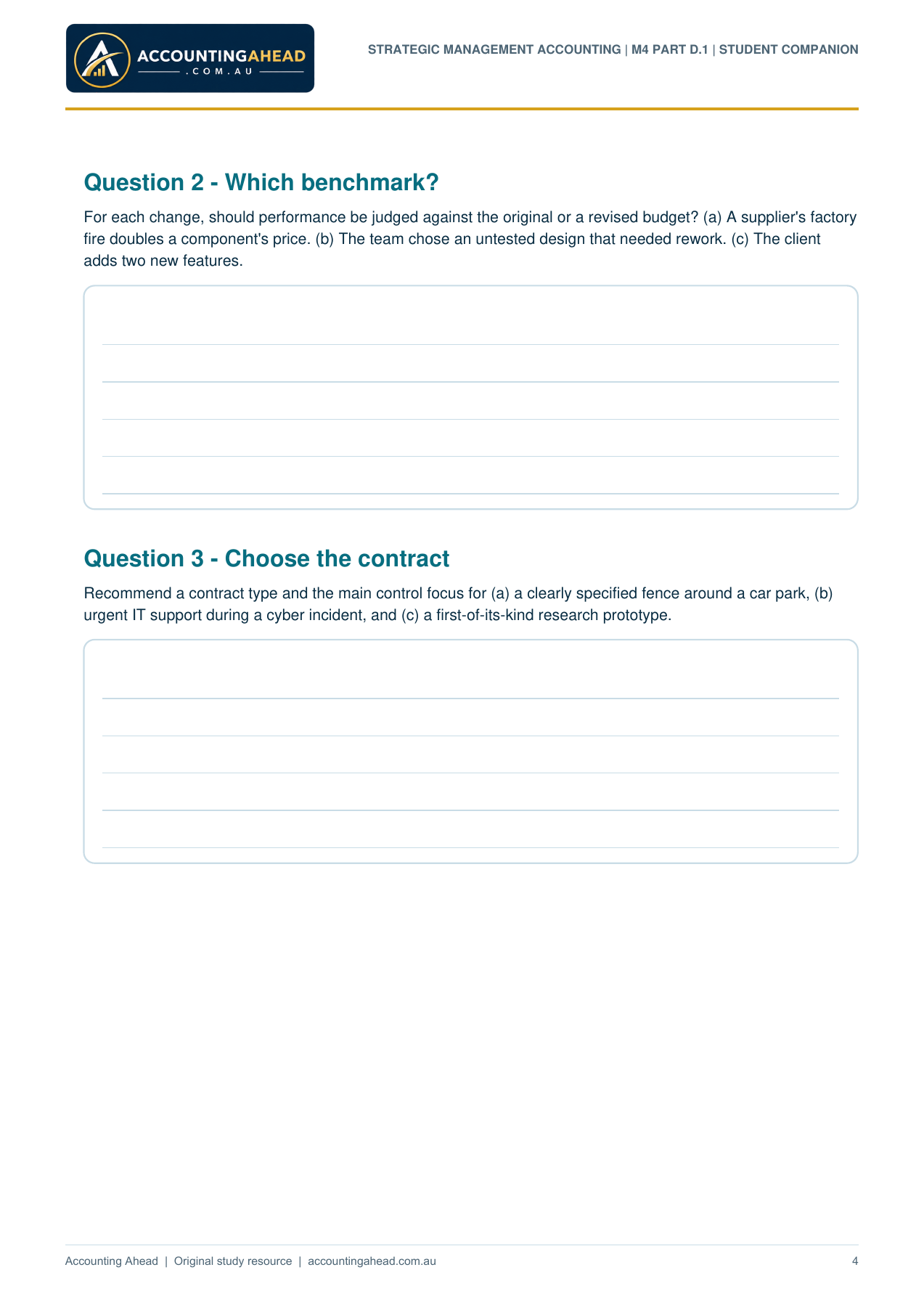
Question 2 - Which benchmark?
For each change, should performance be judged against the original or a revised budget? (a) A supplier's factory
fire doubles a component's price. (b) The team chose an untested design that needed rework. (c) The client
adds two new features.
Question 3 - Choose the contract
Recommend a contract type and the main control focus for (a) a clearly specified fence around a car park, (b)
urgent IT support during a cyber incident, and (c) a first-of-its-kind research prototype.
STRATEGIC MANAGEMENT ACCOUNTING | M4 PART D.1 | STUDENT COMPANION
4
Accounting Ahead | Original study resource | accountingahead.com.au
Worked answers
MODULE 4 | PART D.1 | WORKED ANSWERS - ATTEMPT THE QUESTIONS FIRST
Question 1 - Read the plan
(a) B overlaps with A's end and with C and E; D overlaps with E. (b) Kiosks arrive in week 10, so installation (D)
moves to weeks 10-11 and go-live to about week 12 - two weeks late, because B, D and F are in sequence. (c)
Which activities are critical, how much slack C and E have, and the cost of speeding up delivery - these need
network analysis.
Question 2 - Which benchmark?
(a) Revised budget - uncontrollable. (b) Original budget - the design choice was controllable (a revised budget
may still guide cash planning). (c) Revised budget for the new scope - scope changes are negotiated and priced
separately.
Question 3 - Choose the contract
(a) Fixed price - well specified; watch quality and timing. (b) Payment for work done - scope unknowable in
advance; monitor hours, rates and outcomes daily. (c) Cost-plus or a target-cost contract with shared savings -
high uncertainty; audit cost records, exclude non-reimbursable costs, and use incentives for time and cost.
STRATEGIC MANAGEMENT ACCOUNTING | M4 PART D.1 | WORKED ANSWERS
5