
Governance, risk, ethics and theory
Printable study notes to use alongside Part A.3.

Read the handout text
Accounting Ahead | Original study resource | accountingahead.com.au
Governance, risk, ethics and theory
MODULE 5 | PART A.3 | STUDENT COMPANION
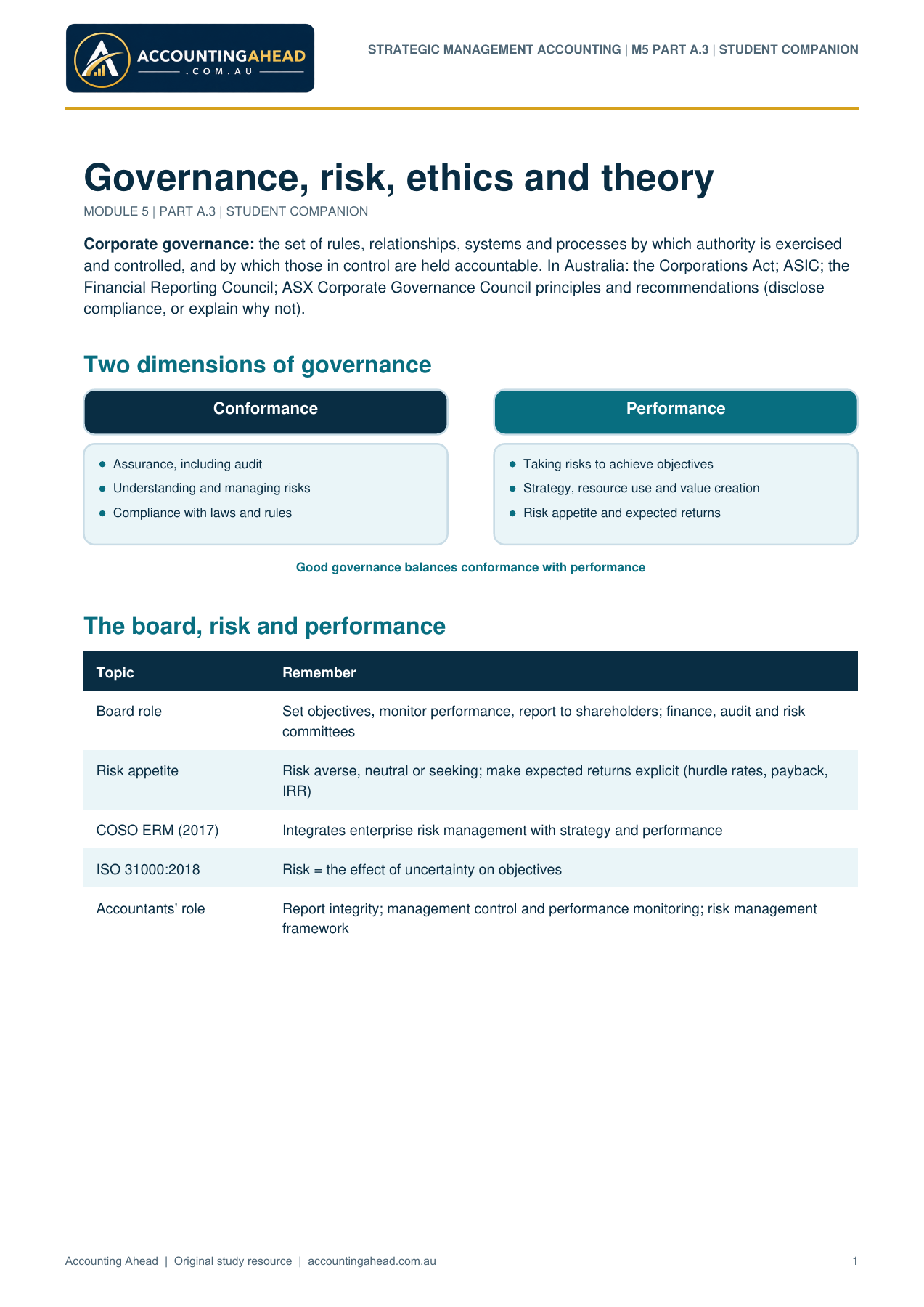
Corporate governance: the set of rules, relationships, systems and processes by which authority is exercised
and controlled, and by which those in control are held accountable. In Australia: the Corporations Act; ASIC; the
Financial Reporting Council; ASX Corporate Governance Council principles and recommendations (disclose
compliance, or explain why not).
Two dimensions of governance
Conformance
Assurance, including audit
Understanding and managing risks
Compliance with laws and rules
Performance
Taking risks to achieve objectives
Strategy, resource use and value creation
Risk appetite and expected returns
Good governance balances conformance with performance
The board, risk and performance
Topic Remember
Board role Set objectives, monitor performance, report to shareholders; finance, audit and risk
committees
Risk appetite Risk averse, neutral or seeking; make expected returns explicit (hurdle rates, payback,
IRR)
COSO ERM (2017) Integrates enterprise risk management with strategy and performance
ISO 31000:2018 Risk = the effect of uncertainty on objectives
Accountants' role Report integrity; management control and performance monitoring; risk management
framework
STRATEGIC MANAGEMENT ACCOUNTING | M5 PART A.3 | STUDENT COMPANION
1
Accounting Ahead | Original study resource | accountingahead.com.au
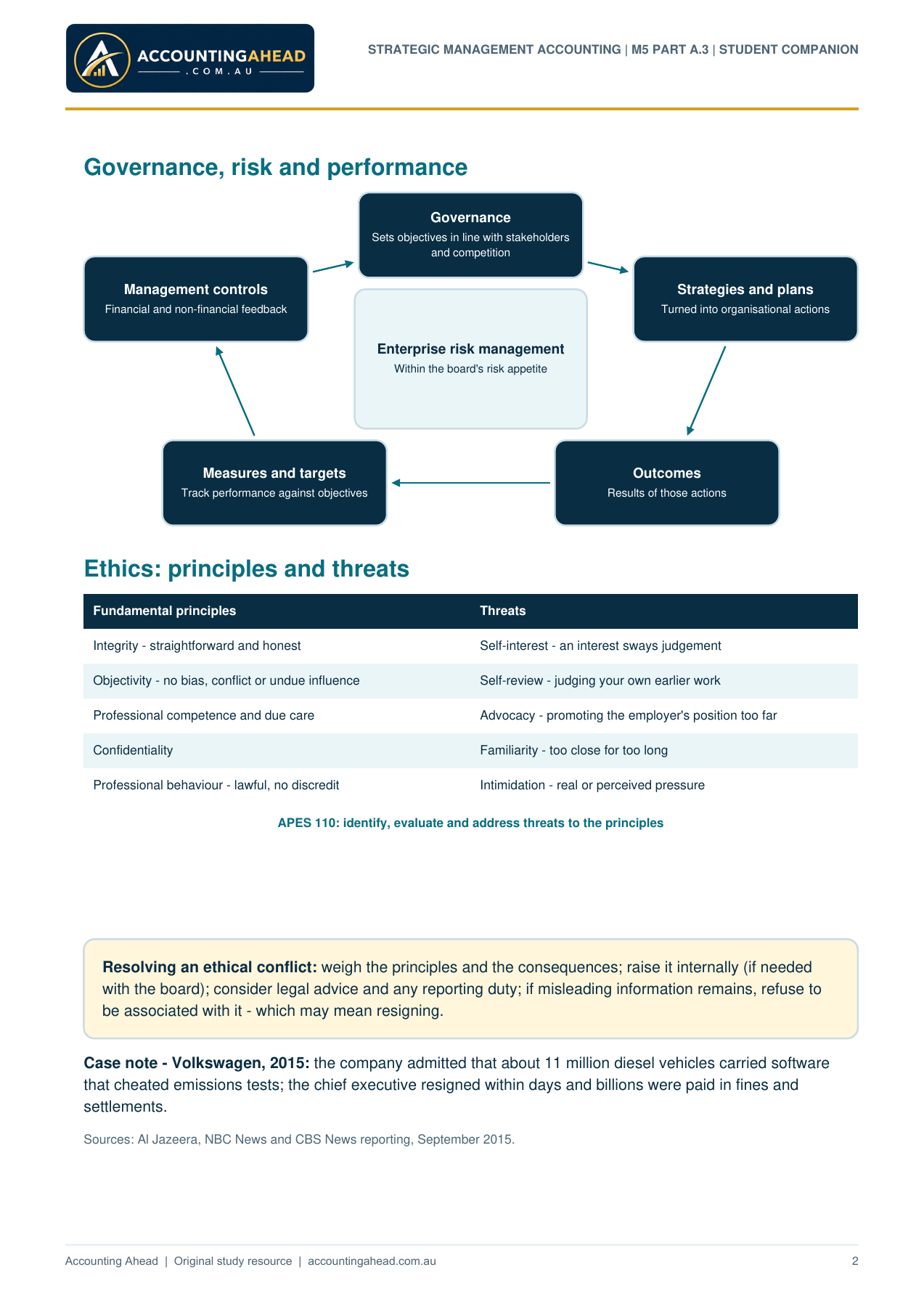
Governance, risk and performance
Governance
Sets objectives in line with stakeholders
and competition
Strategies and plans
Turned into organisational actions
Outcomes
Results of those actions
Measures and targets
Track performance against objectives
Management controls
Financial and non-financial feedback
Enterprise risk management
Within the board's risk appetite
Ethics: principles and threats
Fundamental principles Threats
Integrity - straightforward and honest Self-interest - an interest sways judgement
Objectivity - no bias, conflict or undue influence Self-review - judging your own earlier work
Professional competence and due care Advocacy - promoting the employer's position too far
Confidentiality Familiarity - too close for too long
Professional behaviour - lawful, no discredit Intimidation - real or perceived pressure
APES 110: identify, evaluate and address threats to the principles
Resolving an ethical conflict: weigh the principles and the consequences; raise it internally (if needed
with the board); consider legal advice and any reporting duty; if misleading information remains, refuse to
be associated with it - which may mean resigning.
Case note - Volkswagen, 2015: the company admitted that about 11 million diesel vehicles carried software
that cheated emissions tests; the chief executive resigned within days and billions were paid in fines and
settlements.
Sources: Al Jazeera, NBC News and CBS News reporting, September 2015.
STRATEGIC MANAGEMENT ACCOUNTING | M5 PART A.3 | STUDENT COMPANION
2
Accounting Ahead | Original study resource | accountingahead.com.au
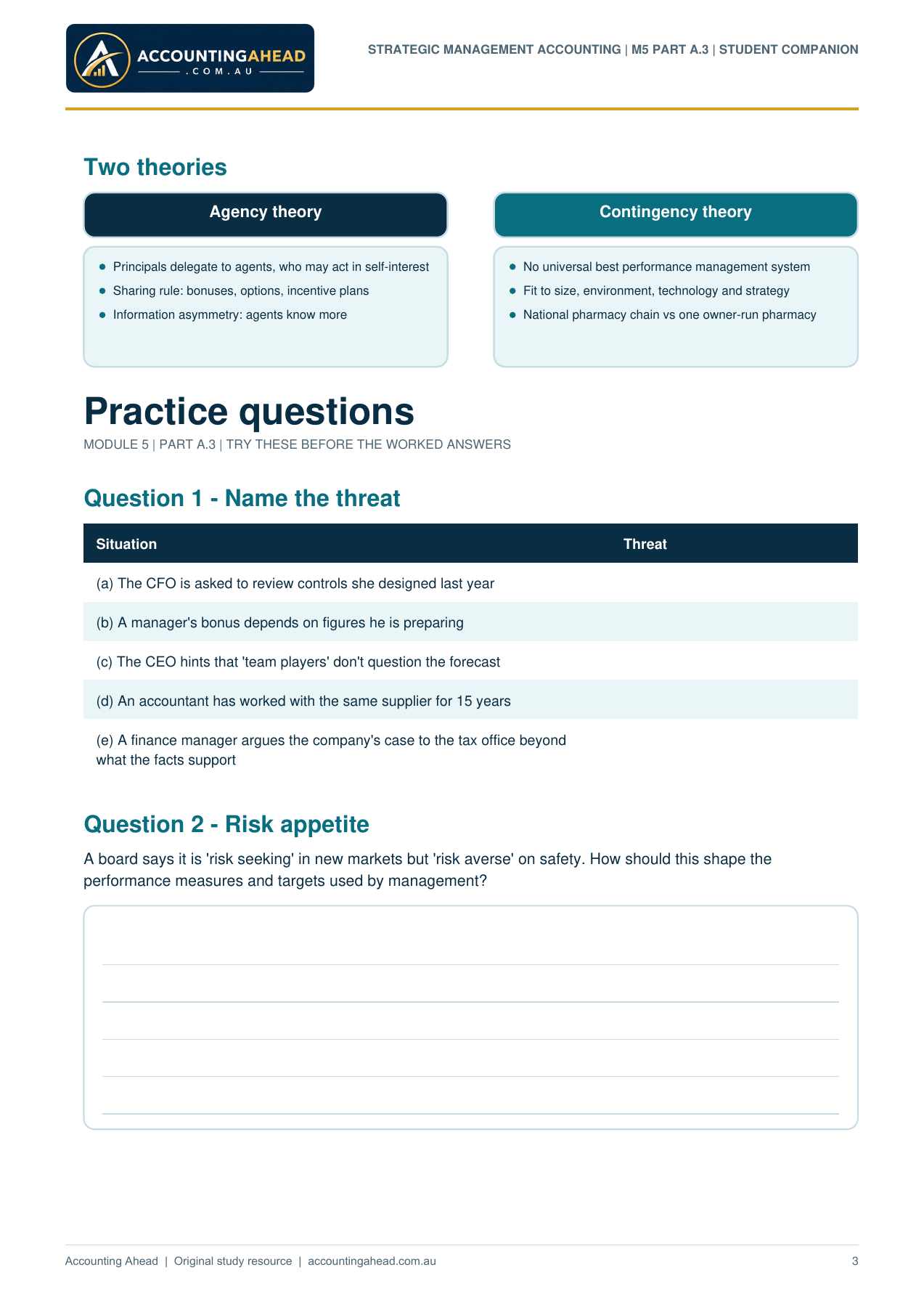
Two theories
Agency theory
Principals delegate to agents, who may act in self-interest
Sharing rule: bonuses, options, incentive plans
Information asymmetry: agents know more
Contingency theory
No universal best performance management system
Fit to size, environment, technology and strategy
National pharmacy chain vs one owner-run pharmacy
Practice questions
MODULE 5 | PART A.3 | TRY THESE BEFORE THE WORKED ANSWERS
Question 1 - Name the threat
Situation Threat
(a) The CFO is asked to review controls she designed last year
(b) A manager's bonus depends on figures he is preparing
(c) The CEO hints that 'team players' don't question the forecast
(d) An accountant has worked with the same supplier for 15 years
(e) A finance manager argues the company's case to the tax office beyond
what the facts support
Question 2 - Risk appetite
A board says it is 'risk seeking' in new markets but 'risk averse' on safety. How should this shape the
performance measures and targets used by management?
STRATEGIC MANAGEMENT ACCOUNTING | M5 PART A.3 | STUDENT COMPANION
3
Accounting Ahead | Original study resource | accountingahead.com.au
Question 3 - Agency
A franchisor pays franchisees a bonus on sales revenue. Explain the agency problem this may create and
suggest a better sharing rule.
STRATEGIC MANAGEMENT ACCOUNTING | M5 PART A.3 | STUDENT COMPANION
4
Accounting Ahead | Original study resource | accountingahead.com.au
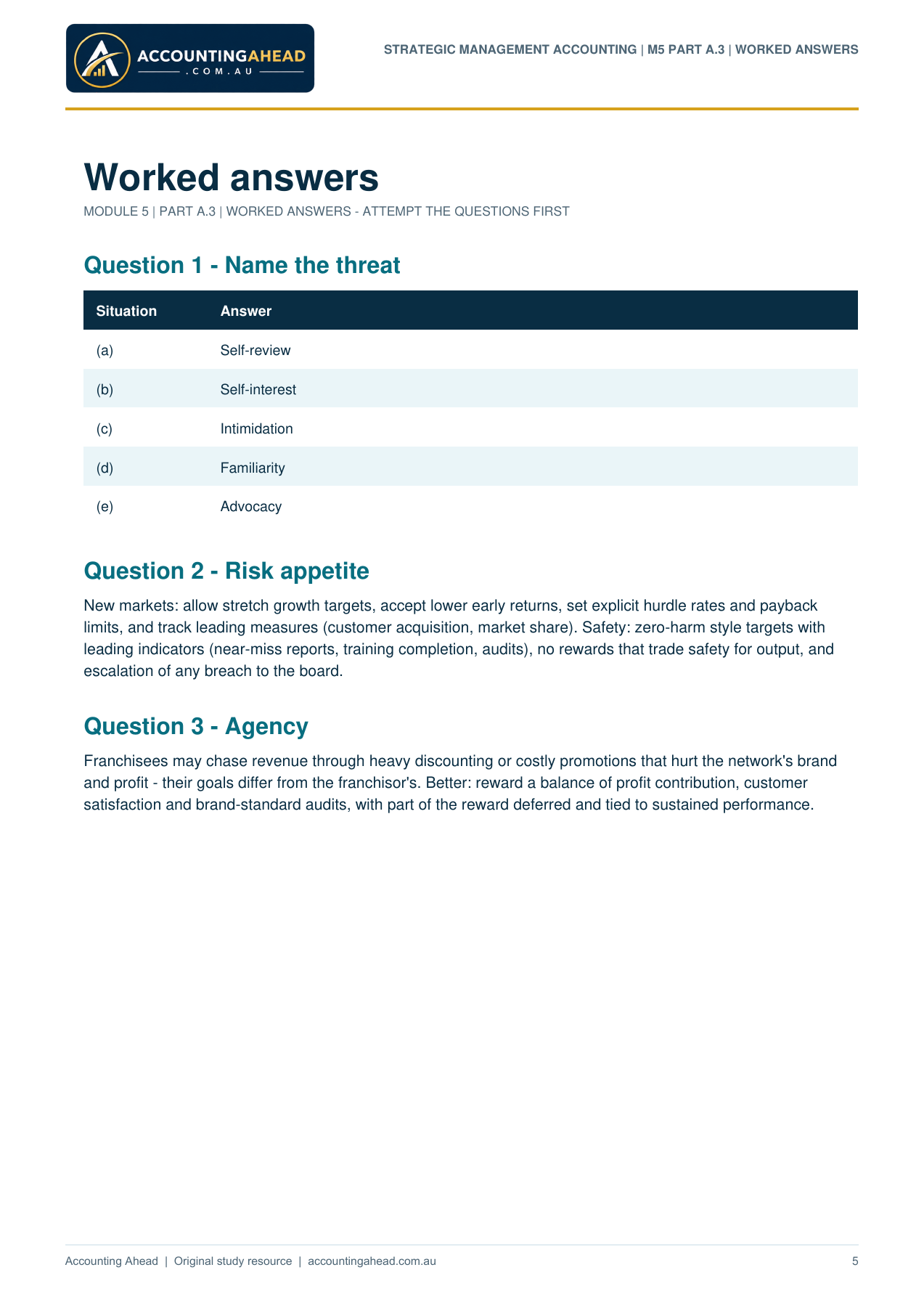
Worked answers
MODULE 5 | PART A.3 | WORKED ANSWERS - ATTEMPT THE QUESTIONS FIRST
Question 1 - Name the threat
Situation Answer
(a) Self-review
(b) Self-interest
(c) Intimidation
(d) Familiarity
(e) Advocacy
Question 2 - Risk appetite
New markets: allow stretch growth targets, accept lower early returns, set explicit hurdle rates and payback
limits, and track leading measures (customer acquisition, market share). Safety: zero-harm style targets with
leading indicators (near-miss reports, training completion, audits), no rewards that trade safety for output, and
escalation of any breach to the board.
Question 3 - Agency
Franchisees may chase revenue through heavy discounting or costly promotions that hurt the network's brand
and profit - their goals differ from the franchisor's. Better: reward a balance of profit contribution, customer
satisfaction and brand-standard audits, with part of the reward deferred and tied to sustained performance.
STRATEGIC MANAGEMENT ACCOUNTING | M5 PART A.3 | WORKED ANSWERS
5