
Strategy and management control
Printable study notes to use alongside Part B.1.
Read the handout text
Accounting Ahead | Original study resource | accountingahead.com.au
Strategy and management control
MODULE 5 | PART B.1 | STUDENT COMPANION
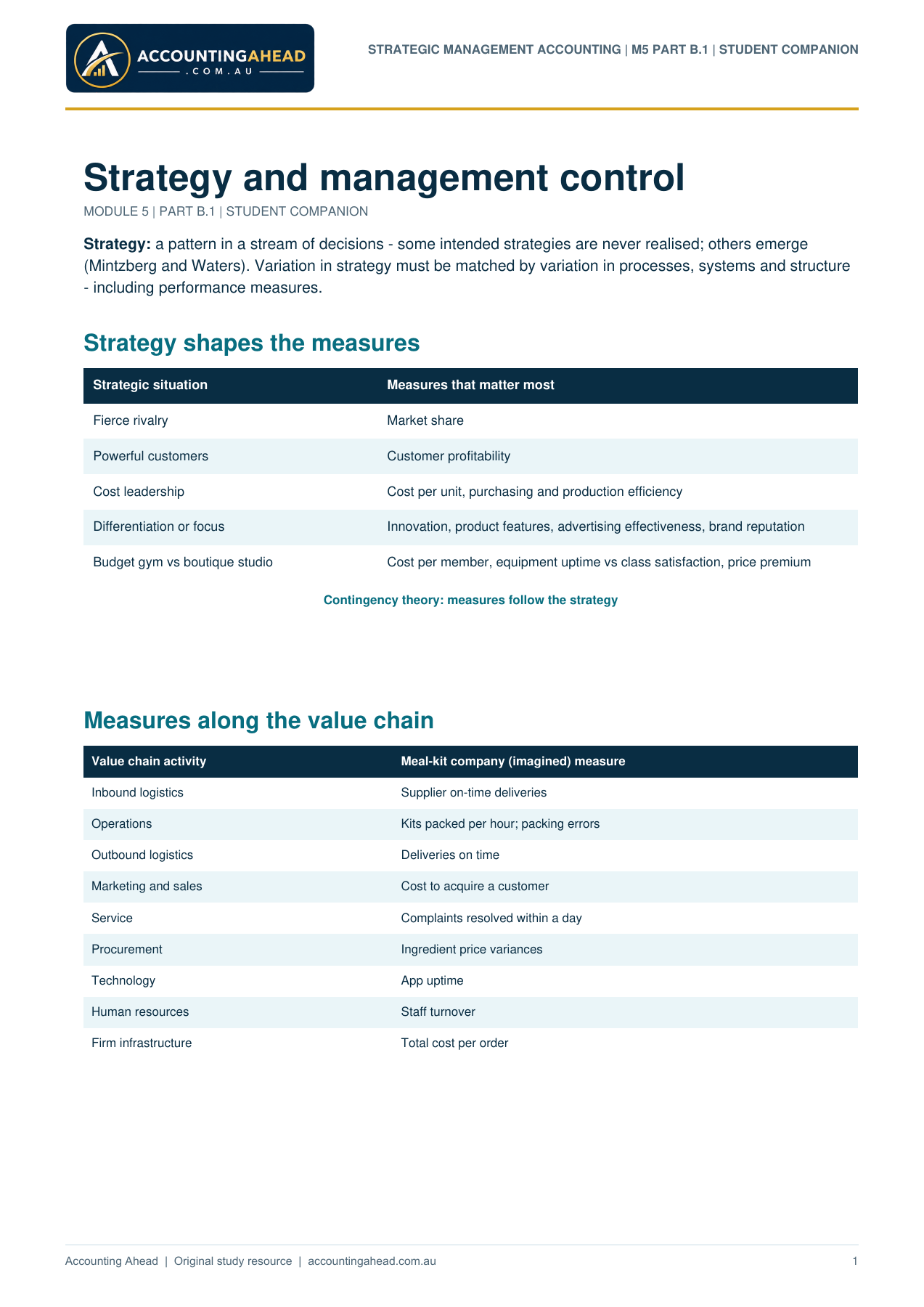
Strategy: a pattern in a stream of decisions - some intended strategies are never realised; others emerge
(Mintzberg and Waters). Variation in strategy must be matched by variation in processes, systems and structure
- including performance measures.
Strategy shapes the measures
Strategic situation Measures that matter most
Fierce rivalry Market share
Powerful customers Customer profitability
Cost leadership Cost per unit, purchasing and production efficiency
Differentiation or focus Innovation, product features, advertising effectiveness, brand reputation
Budget gym vs boutique studio Cost per member, equipment uptime vs class satisfaction, price premium
Contingency theory: measures follow the strategy
Measures along the value chain
Value chain activity Meal-kit company (imagined) measure
Inbound logistics Supplier on-time deliveries
Operations Kits packed per hour; packing errors
Outbound logistics Deliveries on time
Marketing and sales Cost to acquire a customer
Service Complaints resolved within a day
Procurement Ingredient price variances
Technology App uptime
Human resources Staff turnover
Firm infrastructure Total cost per order
STRATEGIC MANAGEMENT ACCOUNTING | M5 PART B.1 | STUDENT COMPANION
1
Accounting Ahead | Original study resource | accountingahead.com.au
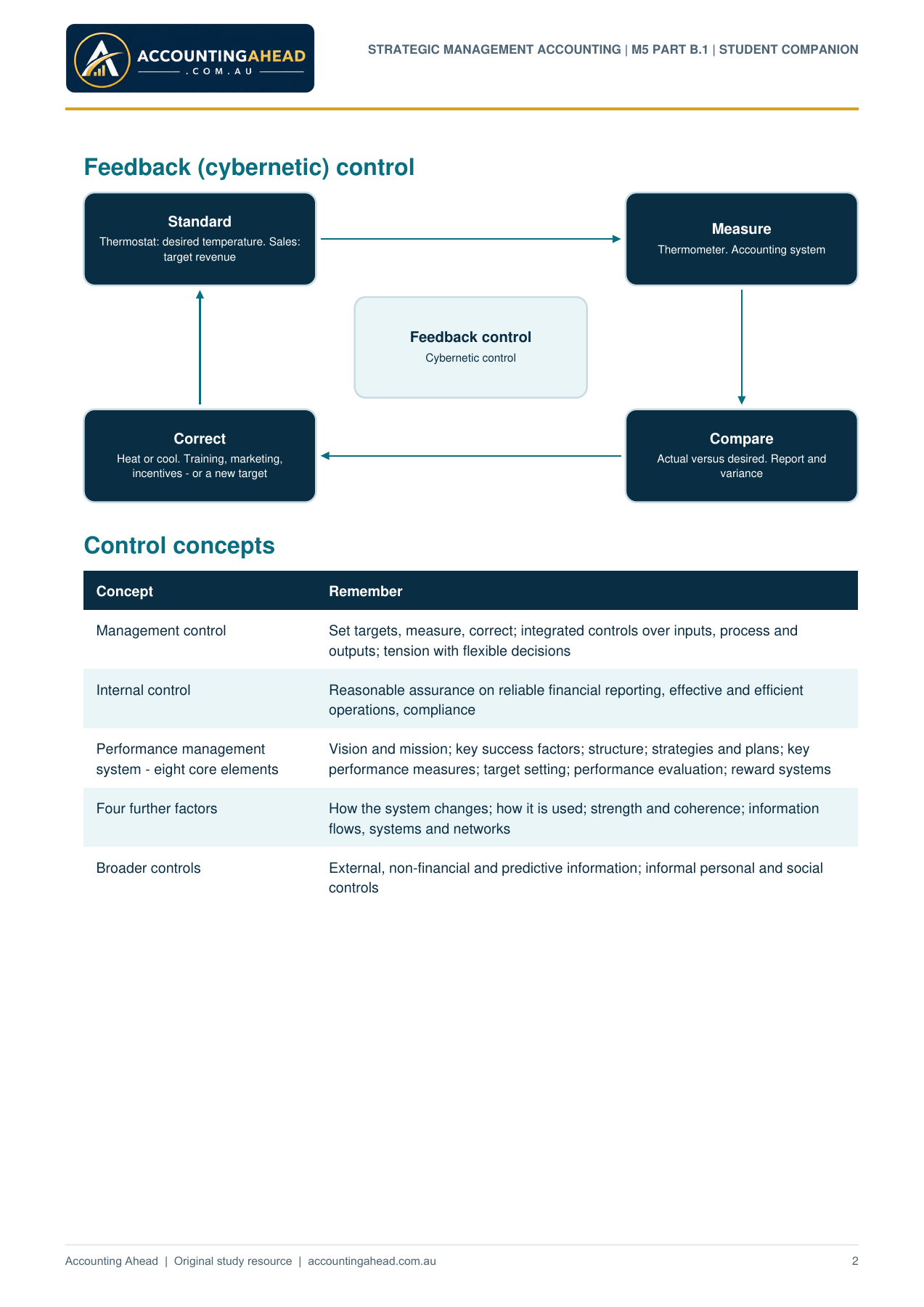
Feedback (cybernetic) control
Standard
Thermostat: desired temperature. Sales:
target revenue
Measure
Thermometer. Accounting system
Compare
Actual versus desired. Report and
variance
Correct
Heat or cool. Training, marketing,
incentives - or a new target
Feedback control
Cybernetic control
Control concepts
Concept Remember
Management control Set targets, measure, correct; integrated controls over inputs, process and
outputs; tension with flexible decisions
Internal control Reasonable assurance on reliable financial reporting, effective and efficient
operations, compliance
Performance management
system - eight core elements
Vision and mission; key success factors; structure; strategies and plans; key
performance measures; target setting; performance evaluation; reward systems
Four further factors How the system changes; how it is used; strength and coherence; information
flows, systems and networks
Broader controls External, non-financial and predictive information; informal personal and social
controls
STRATEGIC MANAGEMENT ACCOUNTING | M5 PART B.1 | STUDENT COMPANION
2
Accounting Ahead | Original study resource | accountingahead.com.au
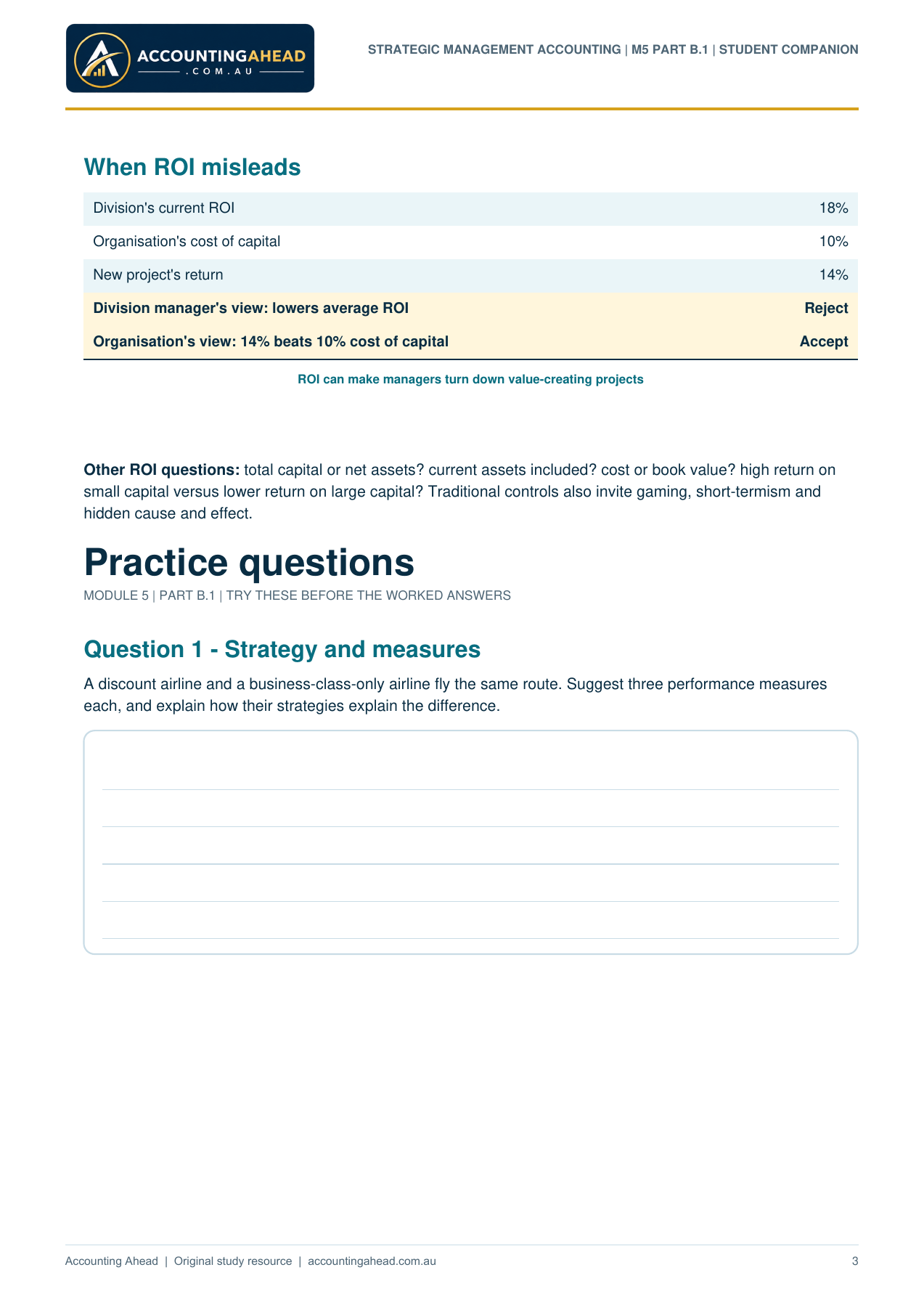
When ROI misleads
Division's current ROI 18%
Organisation's cost of capital 10%
New project's return 14%
Division manager's view: lowers average ROI Reject
Organisation's view: 14% beats 10% cost of capital Accept
ROI can make managers turn down value-creating projects
Other ROI questions: total capital or net assets? current assets included? cost or book value? high return on
small capital versus lower return on large capital? Traditional controls also invite gaming, short-termism and
hidden cause and effect.
Practice questions
MODULE 5 | PART B.1 | TRY THESE BEFORE THE WORKED ANSWERS
Question 1 - Strategy and measures
A discount airline and a business-class-only airline fly the same route. Suggest three performance measures
each, and explain how their strategies explain the difference.
STRATEGIC MANAGEMENT ACCOUNTING | M5 PART B.1 | STUDENT COMPANION
3
Accounting Ahead | Original study resource | accountingahead.com.au
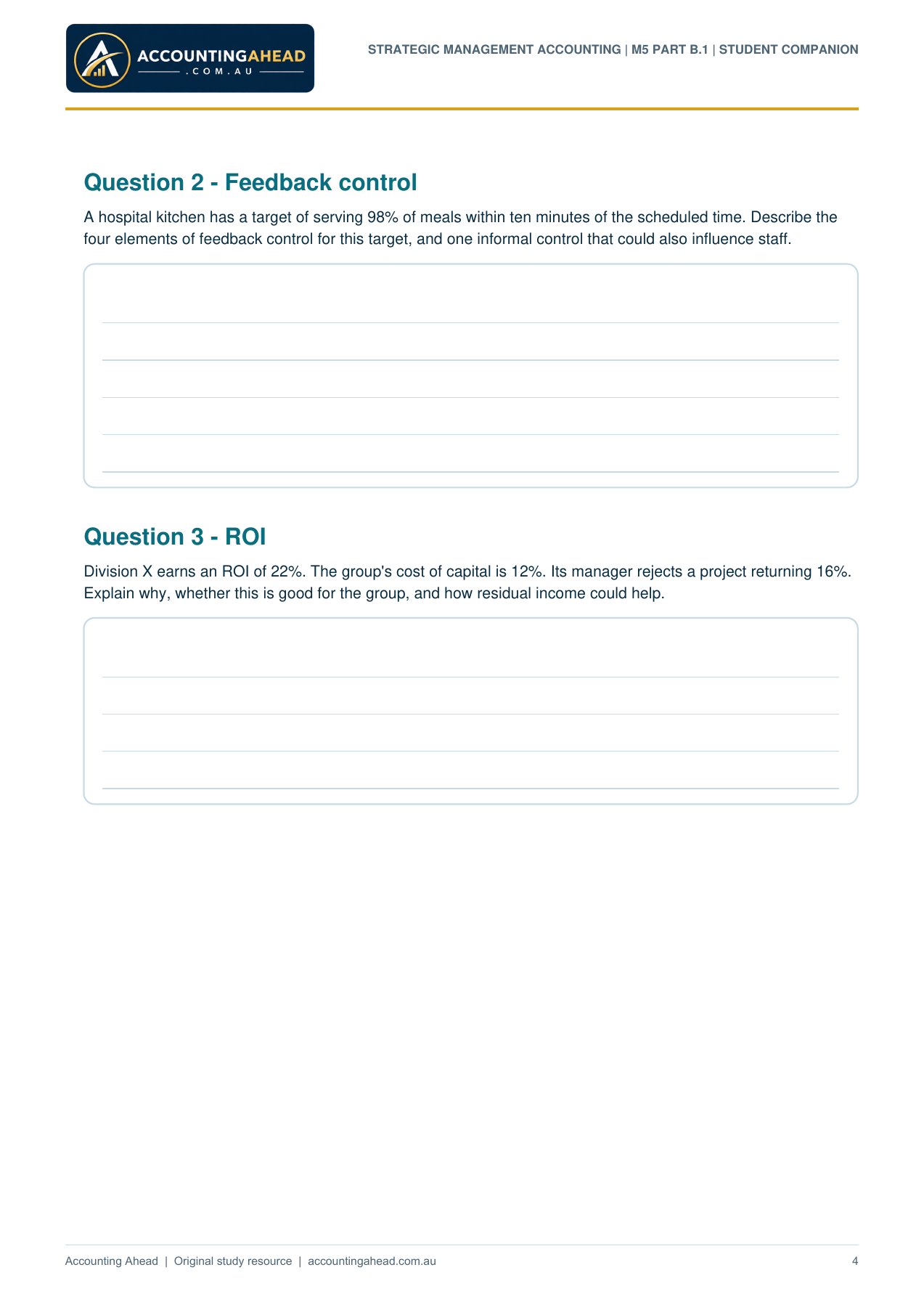
Question 2 - Feedback control
A hospital kitchen has a target of serving 98% of meals within ten minutes of the scheduled time. Describe the
four elements of feedback control for this target, and one informal control that could also influence staff.
Question 3 - ROI
Division X earns an ROI of 22%. The group's cost of capital is 12%. Its manager rejects a project returning 16%.
Explain why, whether this is good for the group, and how residual income could help.
STRATEGIC MANAGEMENT ACCOUNTING | M5 PART B.1 | STUDENT COMPANION
4
Accounting Ahead | Original study resource | accountingahead.com.au
Worked answers
MODULE 5 | PART B.1 | WORKED ANSWERS - ATTEMPT THE QUESTIONS FIRST
Question 1 - Strategy and measures
Discount airline (cost leadership): cost per available seat kilometre, aircraft turnaround time, load factor.
Business-class airline (differentiation): customer satisfaction and Net Promoter Score, on-time performance for
time-sensitive travellers, yield (revenue per passenger). Each tracks what its strategy needs - cost efficiency
versus premium value.
Question 2 - Feedback control
Standard: 98% of meals within ten minutes. Measure: timestamps when trays leave the kitchen. Compare: daily
report of the percentage on time, by ward and meal. Correct: adjust rosters, prep routines or trolley routes - or
revisit the target. Informal control: a team culture of pride in patient care, or the head chef's daily briefing.
Question 3 - ROI
Accepting the 16% project would pull the division's average below 22%, so the manager rejects it. That hurts the
group, because 16% exceeds the 12% cost of capital - value is lost. Residual income (profit - 12% x investment)
would rise if the project is accepted, aligning the manager with the group.
STRATEGIC MANAGEMENT ACCOUNTING | M5 PART B.1 | WORKED ANSWERS
5