
Scorecard 2: benefits and criticisms
Printable study notes to use alongside Part B.3.2.

Read the handout text
Accounting Ahead | Original study resource | accountingahead.com.au
Scorecard 2: benefits and criticisms
MODULE 5 | PART B.3.2 | STUDENT COMPANION
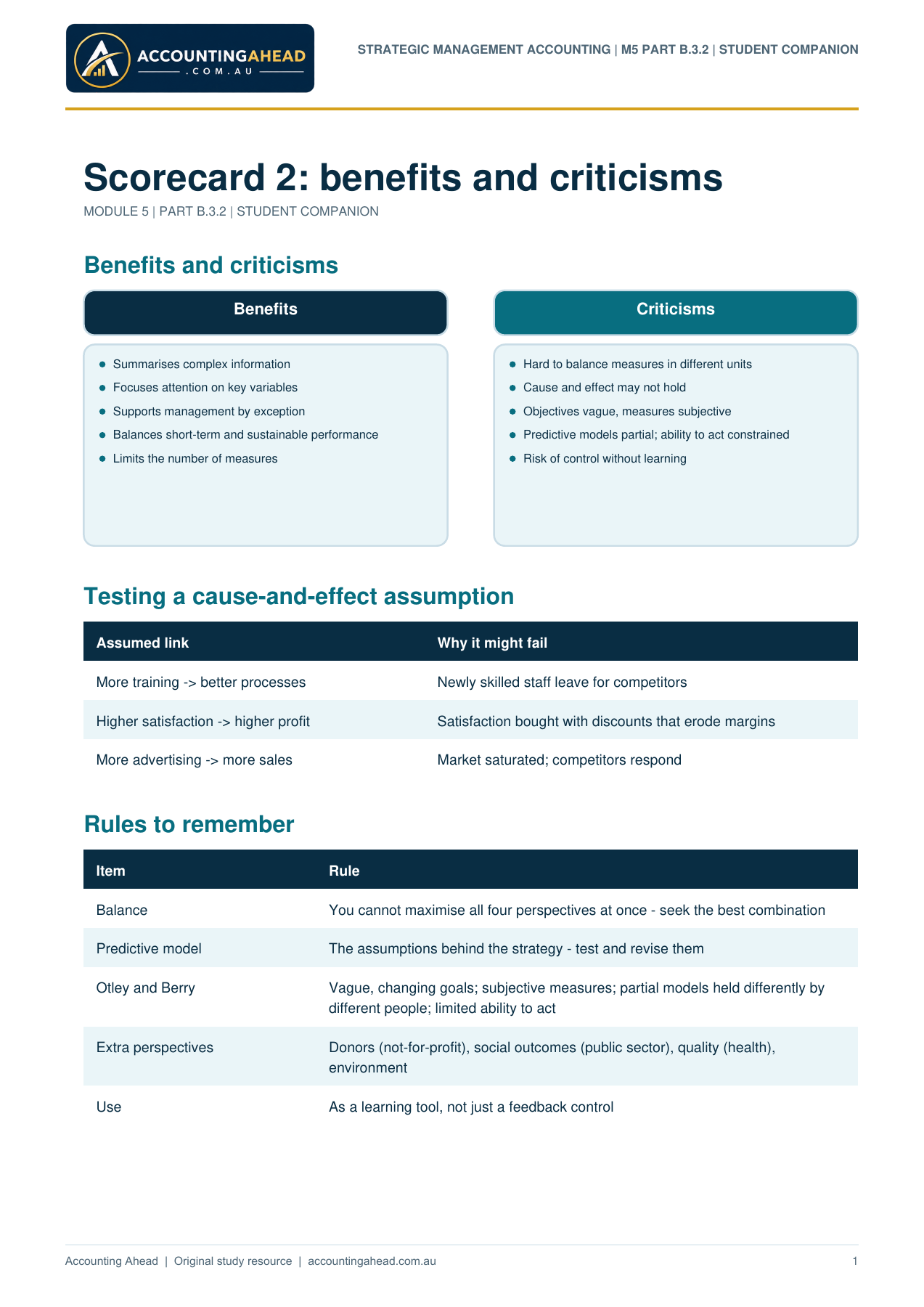
Benefits and criticisms
Benefits
Summarises complex information
Focuses attention on key variables
Supports management by exception
Balances short-term and sustainable performance
Limits the number of measures
Criticisms
Hard to balance measures in different units
Cause and effect may not hold
Objectives vague, measures subjective
Predictive models partial; ability to act constrained
Risk of control without learning
Testing a cause-and-effect assumption
Assumed link Why it might fail
More training -> better processes Newly skilled staff leave for competitors
Higher satisfaction -> higher profit Satisfaction bought with discounts that erode margins
More advertising -> more sales Market saturated; competitors respond
Rules to remember
Item Rule
Balance You cannot maximise all four perspectives at once - seek the best combination
Predictive model The assumptions behind the strategy - test and revise them
Otley and Berry Vague, changing goals; subjective measures; partial models held differently by
different people; limited ability to act
Extra perspectives Donors (not-for-profit), social outcomes (public sector), quality (health),
environment
Use As a learning tool, not just a feedback control
STRATEGIC MANAGEMENT ACCOUNTING | M5 PART B.3.2 | STUDENT COMPANION
1
Accounting Ahead | Original study resource | accountingahead.com.au
Question 1
A charity uses a four-perspective scorecard copied from a retailer. Identify two weaknesses of this approach and
suggest how the scorecard should be adapted.
STRATEGIC MANAGEMENT ACCOUNTING | M5 PART B.3.2 | STUDENT COMPANION
2
Accounting Ahead | Original study resource | accountingahead.com.au
Worked answers
MODULE 5 | PART B.3.2 | WORKED ANSWERS - ATTEMPT THE QUESTIONS FIRST
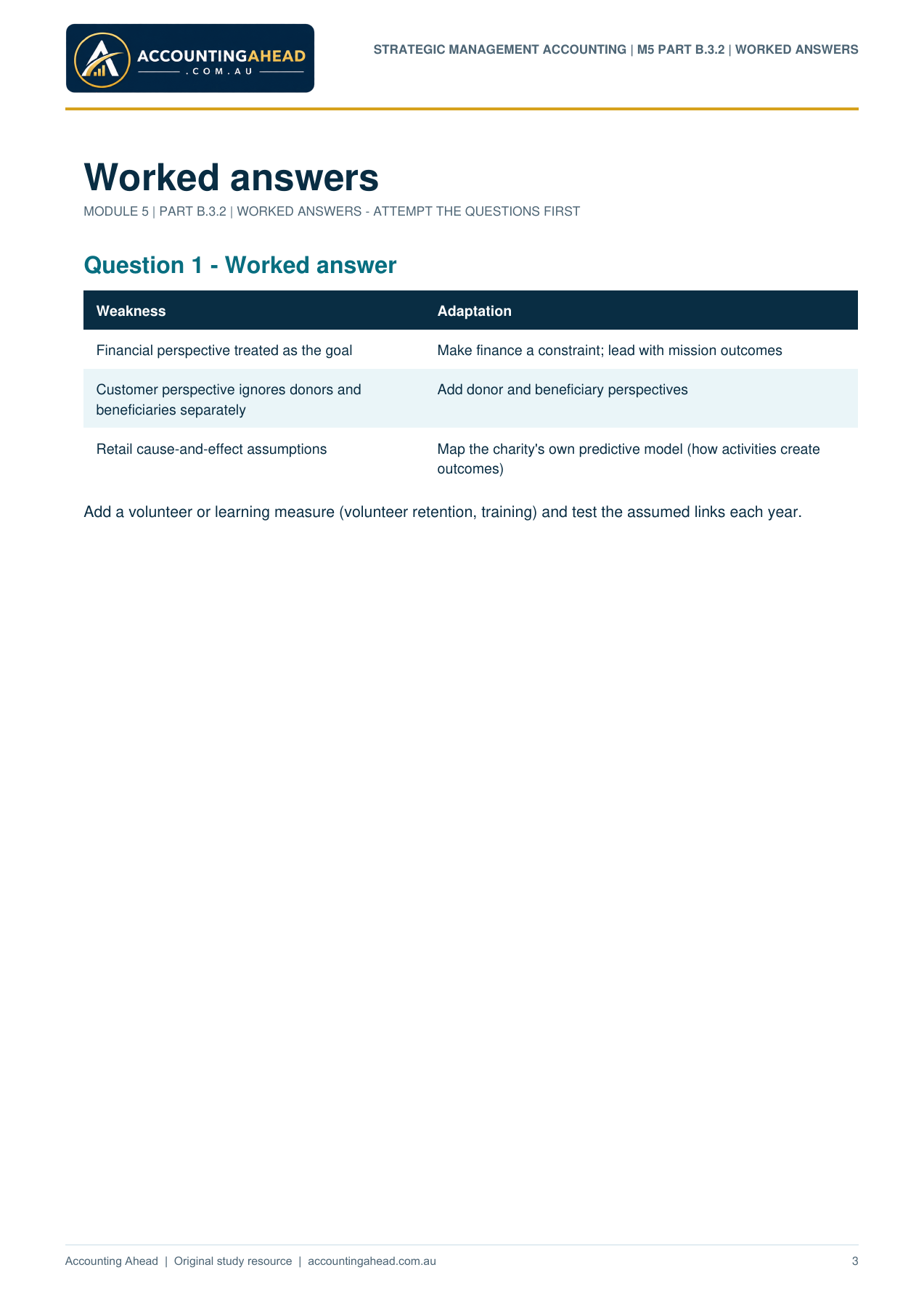
Question 1 - Worked answer
Weakness Adaptation
Financial perspective treated as the goal Make finance a constraint; lead with mission outcomes
Customer perspective ignores donors and
beneficiaries separately
Add donor and beneficiary perspectives
Retail cause-and-effect assumptions Map the charity's own predictive model (how activities create
outcomes)
Add a volunteer or learning measure (volunteer retention, training) and test the assumed links each year.
STRATEGIC MANAGEMENT ACCOUNTING | M5 PART B.3.2 | WORKED ANSWERS
3